
Ate Slang Meaning: What Does “Ate” Mean in Text and on TikTok?
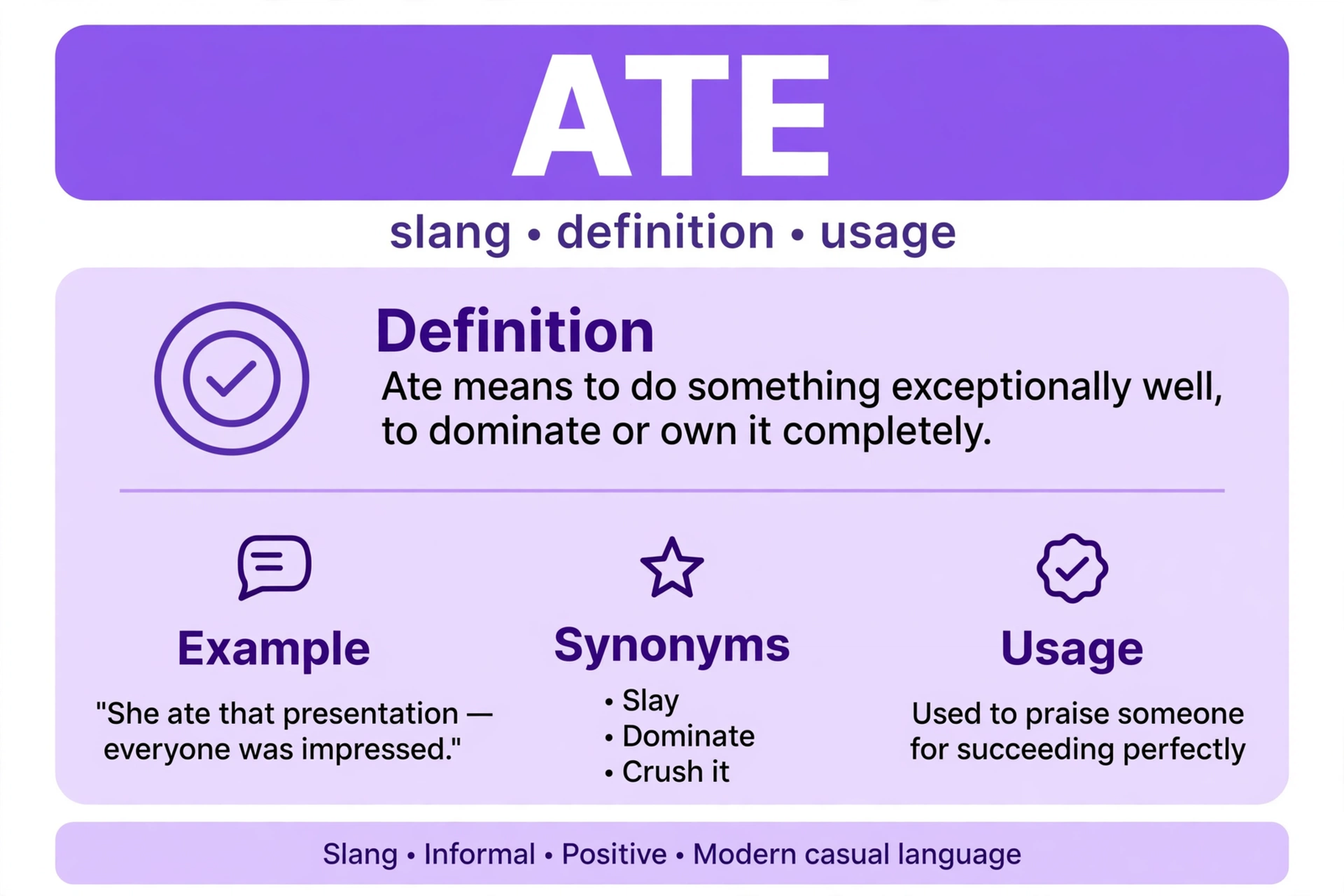
Quick definition: In slang, “ate” means someone did something exceptionally well — they performed flawlessly, looked amazing, or completely owned the moment. When people say “she ate that” or “he ate and left no crumbs,” they mean the person nailed it so completely that there was nothing left to criticize. If you have been wondering about the ate slang meaning, the short answer is simple: it is one of the highest compliments in modern internet culture.
Ate Slang Meaning & Definition
“Ate” is slang for doing something perfectly. It is the past tense of “eat” repurposed as praise: instead of finishing a meal, the person “finished” a performance, an outfit, a dance, a speech, or a comeback so completely that nothing was left behind. That is where the famous extension comes from — “ate and left no crumbs” means the performance was flawless, with zero room for improvement and zero leftovers for the critics.
The word works as a verb, and it almost always shows up with a subject and an object:
- She ate. — She was amazing. (Simple, confident, complete.)
- She ate that. — She nailed that specific thing.
- She ate that up. — She devoured the moment; she enjoyed owning it.
- She ate and left no crumbs. — The strongest version. Flawless, no notes.
- She’s eating. — She is currently doing an amazing job (present tense).
- She ate down. — An intensified form, common in ballroom and stan communities.
Notice what “ate” does not mean. It has nothing to do with food, hunger, or an actual meal. It is pure praise — closer to “slayed” or “killed it” than to anything you would say at a dinner table. The eating metaphor is the whole point: just as someone can finish a plate and leave nothing behind, a performer can finish a moment so thoroughly that nothing is left for anyone else to say.
The term also carries a specific energy. “Ate” is not quiet, polite praise like “well done.” It is loud, enthusiastic, and a little dramatic. It is the comment you leave under a friend’s photo when her outfit is unreal, the word you text after someone delivers a speech that silences the room, and the caption on a dance video that racks up a million views. It says: you did not just do well — you dominated.
Introduction
Scroll through TikTok or Instagram comments for five minutes and you will almost certainly see it: “SHE ATE 😭🔥” under a makeup transformation, “ate and left no crumbs” under a red-carpet look, or simply “you ate that” in a friend’s DMs after a job interview went perfectly. The word has become one of the most common compliments on the internet — and if you did not grow up in the communities that created it, it can look genuinely confusing. Why is everyone talking about eating when nobody is holding food?
The answer is that “ate” is one of those slang words with a real history behind it. It did not appear out of nowhere in a TikTok trend. It traveled from Black and Latino LGBTQ+ ballroom culture in New York City, through drag and stan communities on Twitter and Instagram, and finally into the mainstream feeds of Gen Z and Gen Alpha. Like delulu and so many other terms that now feel like generic “internet slang,” it started in a specific community with a specific meaning — and that meaning has stayed remarkably consistent even as the word went global.
In this guide, we will break down the ate slang meaning in full: the exact definition, where it came from, why it exploded on TikTok, how to use it correctly in texts and comments, and the mistakes that make people sound like they are trying too hard. Whether you saw it in a comment section, heard it from a friend, or want to use it yourself without sounding awkward, you will leave knowing exactly what “ate” means — and exactly when to say it.
Origin
The story of “ate” begins in African American Vernacular English (AAVE) and, more specifically, in the Black and Latino ballroom scene of New York City. Ballroom culture — a competitive performance world built around drag, voguing, runway walks, and fashion categories — began taking its modern shape in Harlem in the 1970s and 1980s, with roots in drag balls going back much further. In that world, praise had to be as dramatic as the performances themselves, and the community developed a rich vocabulary for judging a flawless walk: slay, serve, werk, realness — and “ate.”
The metaphor made perfect sense in ballroom. A performer who “ate” had devoured the category: they consumed the runway, the music, and the judges’ attention so completely that there was nothing left for the next competitor. “Ate and left no crumbs” pushed the image even further — the performance was so total, so clean, that not even crumbs remained. The phrase was praise, but it was also a verdict: the competition was over.
The earliest documented online use of “ate that” appeared on Urban Dictionary in July 2008, where it was defined as doing a great job or pulling something off successfully, with usage noted among teens in New York City communities. That entry is important because it proves the term was circulating in Black urban communities years before it reached the wider internet. Through the 2010s, “ate” and “ate and left no crumbs” spread through Black Twitter, drag fan communities, and stan culture, showing up in reaction tweets, red-carpet commentary, and fancams. RuPaul’s Drag Race helped carry ballroom language into living rooms, and by the late 2010s the word was firmly established in online queer and stan spaces.
What is worth remembering — and what many explainers skip — is that “ate” is not a TikTok invention. TikTok discovered it; ballroom created it. The word is part of a long pattern in which language born in Black and queer communities travels onto social media, gets adopted by everyone, and then gets rebranded as generic “Gen Z slang” with its origins quietly erased. Using the word is fine. Knowing where it came from is better — and it is the respectful thing to do.
Popularity
So why is everyone saying “ate” now? The word’s explosion into the mainstream happened in the early 2020s, and TikTok was the main engine. Short-form video is the perfect home for “ate”: a creator posts a glow-up, a dance, an outfit transition, or a performance clip, and the comments section becomes a chorus of “SHE ATE” within minutes. The word is short, punchy, and instantly readable — exactly the kind of language that thrives in comments and captions.
Several things fueled the rise:
- Celebrity and red-carpet culture: Every awards season, fashion week, and album rollout brings a wave of “she ate that look” comments. Outfit posts are probably the single most common place to see the word today.
- Stan culture: Fan communities use “ate” to celebrate their favorite artists’ performances, music videos, and live shows. A comeback stage that goes viral is almost guaranteed to be described as “ate.”
- Reaction and transformation content: Makeup transformations, glow-ups, “get ready with me” videos, and dance challenges all invite exactly the kind of instant, emphatic praise “ate” delivers.
- Its versatility: Unlike some slang that only works in one setting, “ate” fits almost anywhere — a photo, a speech, a meal someone cooked, a clever reply in an argument, even a good parking job. If someone did it well, they ate.
- Mainstream media pickup: As Sprout Social’s social media slang guide notes, “ate” now sits alongside the biggest viral terms in the social media vocabulary — a sign of just how far it has traveled from its ballroom roots.
By 2024 and 2025, “ate” had crossed fully into everyday speech. Parents hear it from their kids, coworkers drop it in group chats, and brands — sometimes awkwardly — use it in ads. That mainstreaming has a downside: like “slay” before it, “ate” risks becoming so overused that it loses its punch. But as of 2026, it remains one of the most recognizable compliments on the internet, and it shows no sign of disappearing. Its staying power comes from its specificity: “ate” does not just mean “good” — it means flawless, dominant, and unforgettable.
How It Is Used
“Ate” is flexible, but it follows a few clear patterns. Understanding the grammar of the word is the difference between sounding natural and sounding like you learned slang from a dictionary.
1. As a standalone compliment. “You ate.” Two words, full sentence, total praise. This is the most common form in comments and texts. It works on its own because the context — the photo, the video, the performance — supplies the object.
2. With “that” for a specific thing. “She ate that performance.” “He ate that outfit.” Adding “that” points the praise at one particular thing, which makes it feel more deliberate and more personal.
3. With “and left no crumbs” for maximum emphasis. This is the highest level of the compliment. Save it for genuinely show-stopping moments — a flawless performance, an unbelievable outfit, a comeback nobody saw coming. Using it for something ordinary is like giving a standing ovation to a microwave beep.
4. In the present tense: “eating.” “She’s eating right now.” This describes someone who is currently on a streak of excellence — a tour, a season, a run of great outfits. It suggests ongoing dominance rather than a single moment.
5. As a reaction, not a description. “Ate” is usually something you say about someone else, right after they do something impressive. Saying “I ate” about yourself is possible — and people do it playfully — but it lands very differently. Self-praise with “ate” works as a joke or a confident flex; said seriously, it can come across as bragging.
| Form | Meaning | When to use it |
|---|---|---|
| “You ate.” | You did amazing. | Any impressive moment — photo, performance, outfit |
| “She ate that.” | She nailed that specific thing. | When you want to point at one exact moment |
| “Ate and left no crumbs.” | Flawless — nothing to criticize. | Truly show-stopping moments only |
| “Ate that up.” | Devoured it; owned it completely. | Energetic performances, big comebacks |
| “She’s eating.” | She is on a streak of excellence. | Ongoing success, not a single moment |
| “Ate down.” | Did it flawlessly, intensified. | Ballroom, drag, and stan contexts |
Tone matters as much as grammar. “Ate” is enthusiastic, warm, and supportive — it is a compliment, not a neutral observation. It almost always arrives with energy: exclamation marks, fire emojis, crying-laughing faces, or all-caps. A flat, deadpan “you ate” would confuse people, because the word itself carries excitement. If you are going to say it, say it like you mean it.
Examples
The best way to understand “ate” is to see it in real conversations. Here are examples across different tones and settings — notice how the word stays the same while the situation around it changes completely.
Friendly Examples
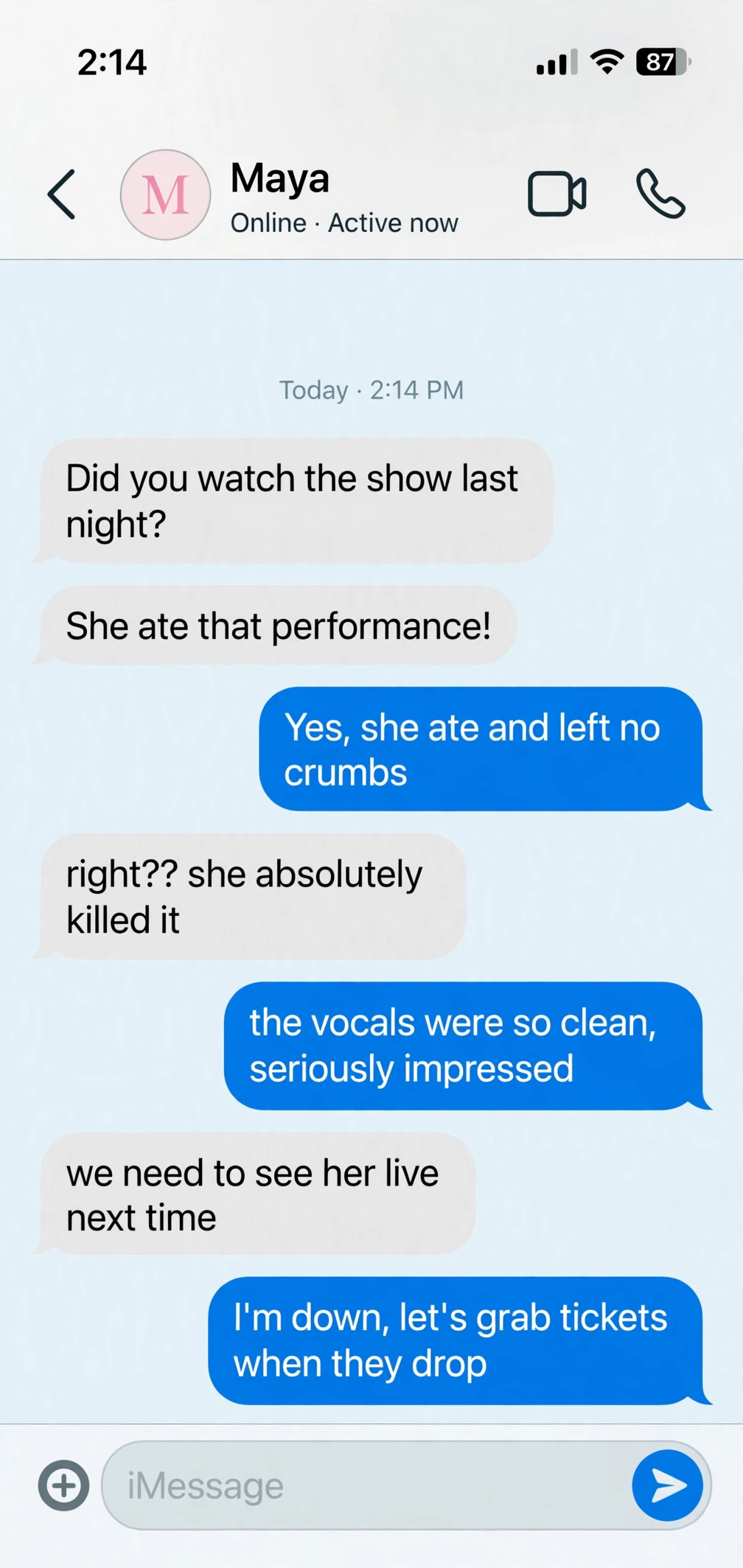
- “Okay?? Your birthday outfit ATE. I need the link immediately. 😭🔥”
- “Girl, you ate that presentation. The whole class was staring.”
- “He posted his new song and honestly? He ate. No notes.”
- “Your makeup today?? You ate and left no crumbs, I’m obsessed.”
- “She ate that dance challenge on the first try. Meanwhile I tripped over my own feet.”
Professional Examples
“Ate” is casual slang, so it rarely belongs in a formal workplace email or a meeting with your boss. But in creative industries — fashion, entertainment, social media, marketing — it shows up more than you might expect, usually in relaxed, peer-to-peer conversations:
- “The design team really ate with this campaign. The visuals are unreal.”
- “She ate that client pitch — they signed before she even finished.”
- “Honestly, the new collection ate. The launch numbers prove it.”
- “He ate that keynote. The whole room was on its feet by the end.”
The rule of thumb: “ate” is fine with coworkers you are friendly with and in industries where casual language is normal. Keep it out of formal reports, client-facing emails, and anything going to senior leadership — unless you are very sure of the room.
Funny Examples
- “My grandma ate that Thanksgiving dinner and left no crumbs. Literally. The plate was clean.”
- “Bro ate that exam and didn’t even study. Some people have all the luck.”
- “The dog ate my homework AND my sandwich. He really ate — in every sense of the word.”
- “She said ‘I ate’ about her own cooking and honestly? She wasn’t wrong. That pasta was elite.”
- “Me: I’m going to eat healthy this week. Also me at 2 a.m.: ate an entire pizza and left no crumbs. Different kind of ate, but still ate.”
| Situation | Example | Tone |
|---|---|---|
| Friend’s outfit photo | “You ATE this look. 🔥” | Supportive, hyped |
| Dance performance | “She ate that choreography and left no crumbs.” | Admiring, emphatic |
| Work presentation | “You ate that pitch — they loved it.” | Casual professional |
| Sports highlight | “He ate that game. 40 points, no mercy.” | Excited, playful |
| Cooking | “Okay, you ate with this dinner. Chef status.” | Warm, funny |
| Comeback or clapback | “She ate him up with that reply. He never stood a chance.” | Playful, dramatic |
Comparison with Similar Terms
“Ate” has a lot of close cousins in the praise department, and mixing them up is easy. They all mean “you did great,” but each one carries a slightly different flavor — and using the right one makes you sound fluent instead of forced.
Ate vs. slayed: These are the closest pair, and both come from ballroom culture. “Slayed” leans toward looking incredible and commanding attention; “ate” leans toward flawless execution of a specific thing. You slay a look; you ate a performance. In practice, people use them almost interchangeably — but “ate” tends to follow an action, while “slay” often describes a state of being fabulous.
Ate vs. served: Also ballroom-born, and also closely related. “Served” is about presentation — serving a look, serving attitude, serving face. “Ate” is about the result — the thing was done perfectly. If someone served, they looked the part; if they ate, they delivered on it completely.
Ate vs. killed it / nailed it: These are the mainstream, non-slang equivalents. “Killed it” and “nailed it” mean the same thing in plain English, and they are safer in professional settings. “Ate” is the cooler, more internet-native version — same praise, more cultural flavor.
Ate vs. devoured: “Devoured” is basically “ate” turned up a notch, and it has become popular as a synonym in the same comment sections. “She devoured that look” hits the same note as “she ate,” just with a slightly more dramatic, fashion-forward edge.
Ate vs. glazing: These are not synonyms at all — they are opposites in spirit. “Ate” is sincere, earned praise for something genuinely impressive. Glazing means over-the-top, excessive flattery, often insincere. Telling someone they ate is a compliment; glazing someone is what people accuse you of when the praise feels fake or desperate. The difference is honesty — and whether the performance actually deserved the hype.
| Term | Meaning | Best for | Vibe |
|---|---|---|---|
| Ate | Did something flawlessly | Performances, outfits, comebacks | Enthusiastic praise |
| Slayed | Looked or performed amazingly | Looks, confidence, stage presence | Fabulous, bold |
| Served | Presented something powerfully | Fashion, attitude, face | Stylish, dramatic |
| Killed it | Did something very well | Work, exams, speeches | Mainstream, safe |
| Nailed it | Got it exactly right | Tasks, tests, presentations | Mainstream, safe |
| Devoured | Completely owned the moment | Fashion, performances | Dramatic, intense |
| Glazing | Excessive, often fake praise | Calling out over-the-top flattery | Negative, mocking |

Alternate Meanings
Like most slang, “ate” does not have just one meaning — context decides everything. Here are the other ways the word shows up.
1. The literal meaning. First and most obviously, “ate” is the past tense of “eat.” “I ate breakfast.” “She ate the whole pizza.” This is the dictionary definition, and it is the one your English teacher cares about. The slang meaning grew out of this literal one, but in a text, context makes it clear which one is meant. “She ate that performance” is slang; “she ate that sandwich” is lunch.
2. “Ate that up” — enjoyed it thoroughly. In some contexts, “ate that up” means someone loved or eagerly consumed something — attention, praise, a story, a drama. “The crowd ate that up” can mean the audience loved every second of a performance. It sits halfway between the literal and slang meanings, and it usually reads as positive either way.
3. “Ate” as in defeated or overwhelmed. In competitive settings — gaming, sports, rap battles — “ate” can carry the sense of dominating an opponent. “He ate him up in that debate” means he destroyed the other person’s argument. The praise is still there, but the focus shifts from the performance itself to the person who got beaten by it.
4. “Eat” in other slang phrases. The eating metaphor appears in a whole family of expressions: “eat your heart out,” “eat it up,” “what’s eating you?” None of these are the same as “ate” slang, but they share the same root idea — eating as a metaphor for consuming, enjoying, or dominating something. Knowing the family helps you spot the slang meaning faster in the wild.
The good news is that confusion is rare. In practice, if someone writes “ate” in a comment under a photo or a video, it is the slang meaning about 99 percent of the time. Nobody comments “you ate” under a selfie because they think you had lunch.
Professional or Polite Alternatives
“Ate” is perfect for friends, comments, and casual chats — but it is not a universal word. In professional or formal settings, you need alternatives that carry the same praise without the slang. Here are the best swaps, matched to the situation:
- “You did an outstanding job.” — The all-purpose professional version. Works in emails, reviews, and meetings.
- “That was flawless.” — Captures the “left no crumbs” energy in plain English. Great for praising a presentation or performance.
- “You absolutely nailed it.” — Warm and natural, safe for most workplaces.
- “That was exceptional work.” — Formal enough for a performance review, still genuinely complimentary.
- “You delivered a brilliant performance.” — Best when the praise is about a speech, a pitch, or a stage moment.
- “That outfit is stunning.” — The polite translation of “she ate that look” for a professional compliment.
- “Impressive work — you really owned that.” — Keeps the confident energy of “ate” without the slang.
The underlying rule is simple: match your language to your audience. “Ate” says you are in on the culture; a polished alternative says you respect the setting. Both are compliments — the difference is just the room you are in.
Common Mistakes
“Ate” is a simple word, but people still use it wrong — usually by forcing it into places where it does not belong. Here are the mistakes to avoid.
1. Using it for anything less than excellent. This is the biggest one. “Ate” means flawless, not “pretty good.” Saying someone “ate” a mediocre presentation is like calling a sandwich a five-star meal. Save the word for moments that actually deserve it, or it stops meaning anything.
2. Overusing “and left no crumbs.” The full phrase is the nuclear option. If you attach it to every outfit photo and every decent TikTok, it becomes background noise. Reserve it for the truly jaw-dropping moments — that is what keeps it powerful.
3. Saying it about yourself too seriously. “I ate” as a joke or a confident caption is fine. “I ate” as a serious claim about your own work, delivered to other people, usually reads as arrogant. Let other people say you ate — it hits harder coming from them.
4. Using it in formal or professional settings. Dropping “ate” in a job interview, a client email, or a meeting with senior leadership is a fast way to sound unprofessional — unless you work in an industry where that language is the norm. Know your room.
5. Confusing it with the literal meaning. This sounds silly, but it happens in translation and in language learning: “ate” in a comment does not mean the person had a meal. If you are explaining the slang to someone, make the metaphor explicit — it is about devouring a moment, not a plate of food.
6. Forcing it to sound current. Nothing ages slang faster than someone using it self-consciously. If “ate” does not come naturally to you, do not wedge it into every sentence. One natural use beats five forced ones. And if you are a brand, think twice — audiences can tell instantly when a company is performing slang instead of speaking it.

Quick Tips
- Use it as a reaction. “Ate” works best right after something impressive happens — a post, a performance, a reveal. It is a response word.
- Pair it with specifics. “You ate that outfit” lands harder than a bare “you ate,” because it shows you actually noticed what was great.
- Match the energy. If the moment is big, go big — caps, emojis, the full “left no crumbs.” If it is small, keep it simple.
- Keep it positive. “Ate” is a compliment. It is not sarcasm, not an insult, and not a joke at someone’s expense. Use it to lift people up.
- Know the culture. The word comes from Black and Latino ballroom culture. Using it with that knowledge — and credit — matters more than using it perfectly.
- Do not explain the joke. If someone asks what “ate” means, a quick “it means they nailed it” is enough. Over-explaining slang kills it.
- Watch the context. In comments and group chats, “ate” is welcome. In a formal email or a job interview, pick a professional alternative instead.
- Let it stay special. The power of “ate” comes from the fact that it means flawless. Use it sparingly and it keeps its shine.

FAQ
1. What does “ate” mean in slang?
In slang, “ate” means someone did something exceptionally well — they performed flawlessly, looked amazing, or completely owned the moment. “She ate that performance” means she nailed it perfectly.
2. What does “ate and left no crumbs” mean?
It is the strongest version of “ate.” It means someone performed so flawlessly that there was nothing left to criticize — like finishing a meal so completely that not even crumbs remain. It comes from Black and Latino ballroom culture.
3. Where did “ate” slang come from?
“Ate” comes from African American Vernacular English (AAVE) and Black and Latino ballroom culture in New York City, where it was used to praise a flawless performance in drag, vogue, or runway categories. The earliest online record of “ate that” dates to an Urban Dictionary entry from July 2008, and the term went mainstream through TikTok and stan culture in the early 2020s.
4. What does “she ate” mean on TikTok?
On TikTok, “she ate” is a comment-section compliment meaning a woman did something perfectly — usually an outfit, a dance, a makeup look, or a performance. It is one of the most common forms of praise on the platform.
5. Is “ate” a compliment?
Yes — it is a very high compliment. Saying someone “ate” means they did something flawlessly, with style and total confidence. It is stronger than “good job” and roughly equal to “slayed” or “killed it.”
6. What is the difference between “ate” and “slayed”?
Both come from ballroom culture and both mean someone did amazingly. “Slayed” leans toward looking incredible and commanding attention, while “ate” leans toward flawless execution of a specific thing — a performance, an outfit, a comeback. In everyday use, people often treat them as interchangeable.
7. Can I say “ate” in a professional setting?
It depends on the workplace. In creative industries and casual teams, “she ate that pitch” is fine among peers. In formal settings — client emails, interviews, official reports — use a professional alternative like “she did an outstanding job” or “that was flawless.”
8. What does “ate that up” mean?
“Ate that up” means someone devoured the moment — they owned it completely and enjoyed doing it. It can also mean an audience loved something thoroughly, as in “the crowd ate that up.” It is a slightly more energetic, enthusiastic version of “ate.”
Conclusion
The ate slang meaning is simple, but the word carries a lot more than its three letters suggest. It means flawless execution — a performance, an outfit, a comeback, or a moment so well done that there is nothing left to criticize. “She ate that” is a compliment with real weight behind it, and “ate and left no crumbs” is the highest form of that praise: no notes, no leftovers, no competition.
It is also a word with a history worth knowing. “Ate” traveled from the ballroom floors of New York City — from Black and Latino LGBTQ+ performers who turned praise into an art form — through drag, stan culture, and TikTok, into the everyday vocabulary of millions of people. Like the aura points trend and the sigma wave, it is part of a much bigger story about how internet slang actually moves through culture — and who creates it first.
So the next time you see a jaw-dropping outfit, a flawless performance, or a friend absolutely owning their moment, you know what to say: they ate. Just save “and left no crumbs” for the moments that truly deserve it — that is what keeps the compliment powerful.

3 thoughts on “Ate Slang Meaning: What Does “Ate” Mean in Text and on TikTok?”