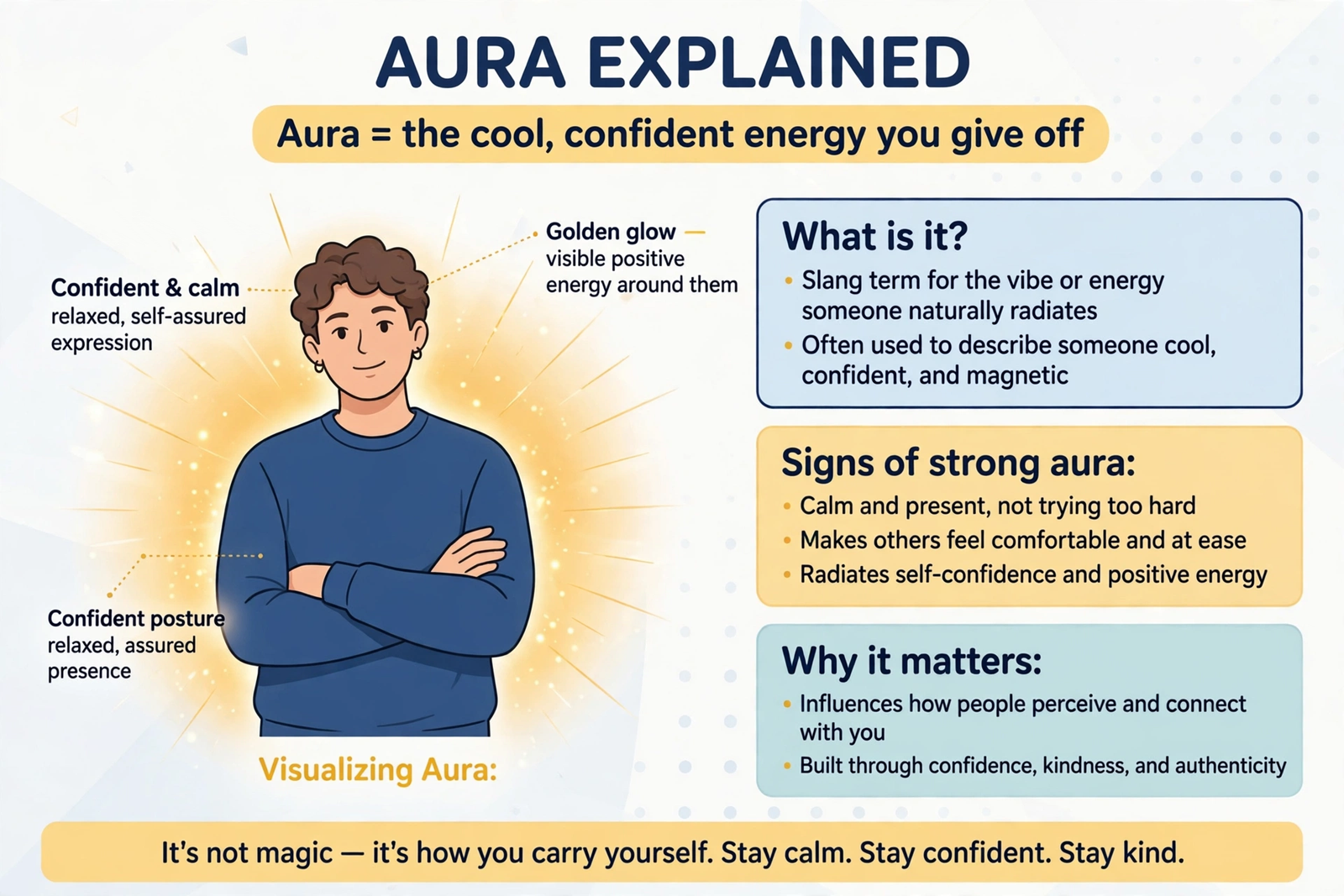
Quick definition: In slang, aura means the cool, confident energy or vibe a person gives off — the invisible impression you make just by walking into a room. When someone says you have “aura,” they mean you look effortlessly cool, calm, and magnetic. On TikTok, it is also scored like a game: doing something cool earns “+aura points,” while doing something embarrassing costs you “-aura points.”
What Does Aura Mean Slang Meaning & Definition
What does aura mean slang in simple terms? It is the modern internet word for personal presence. The old, literal meaning of aura is an invisible energy field said to surround a person, but slang took that idea and made it practical: your aura is how cool, confident, or impressive you seem to other people. It is not about what you say — it is about the feeling you create.
A person with strong aura does not try hard. They walk in, say little, and somehow everyone notices. A person with no aura tries too hard and everyone notices that, too — for the wrong reasons. That is why the slang caught on so fast: it gives a single word to something everyone has felt but could never quite name.
On TikTok and in group chats, the word usually appears in a few fixed patterns. “He has aura” means he is effortlessly cool. “That fit has aura” means the outfit radiates confidence. “Aura farming” means deliberately trying to look cool for the camera — posing, walking in slow motion, or staring into the distance like a movie character. And the points system turned it into a joke economy: cool moments add points, cringe moments subtract them, and everyone keeps an imaginary score.
| Slang Phrase | What It Means | Example |
|---|---|---|
| Has aura | Effortlessly cool and confident | “Did you see him walk in? He has aura.” |
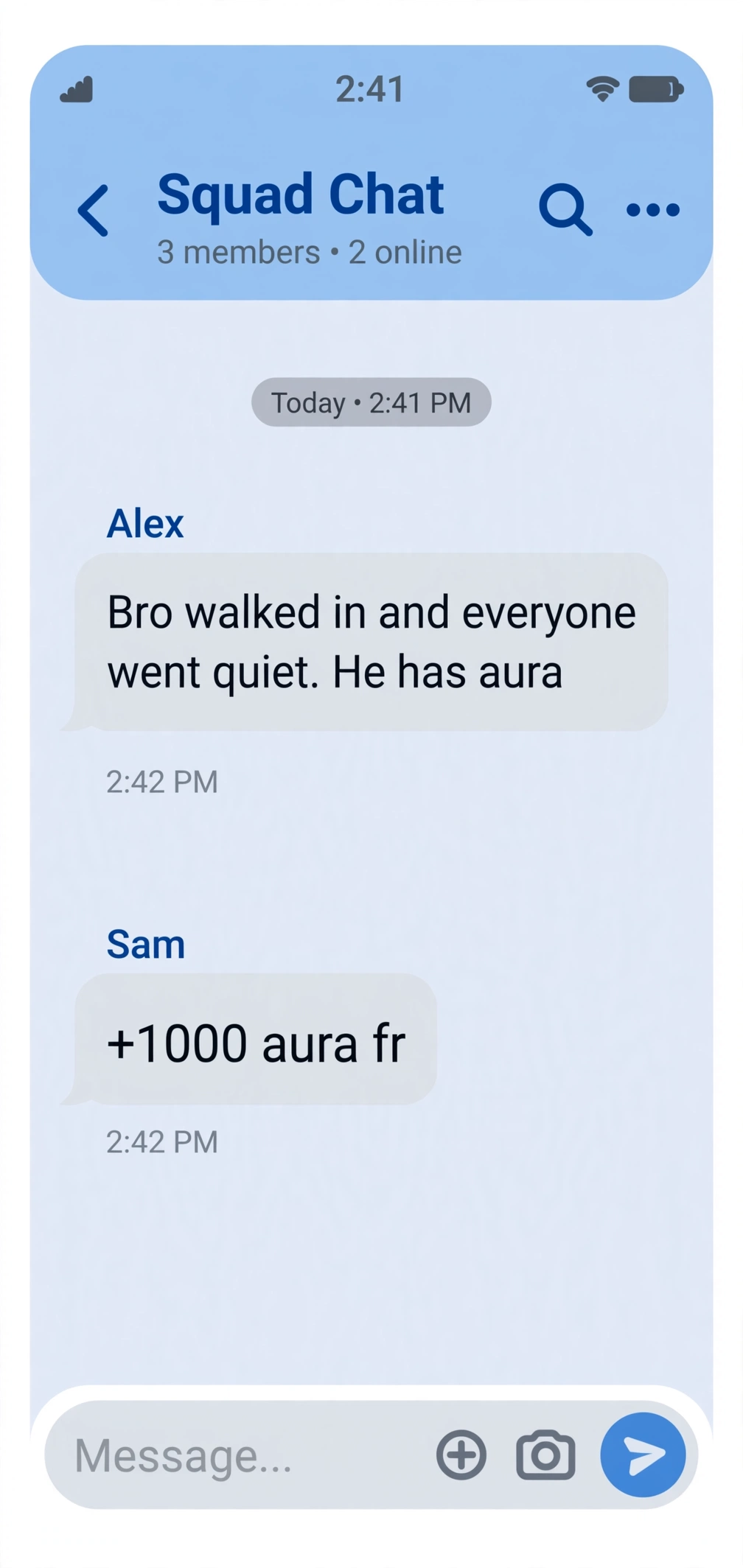
| +1000 aura | A huge coolness boost | “He caught the ball one-handed. +1000 aura.” |
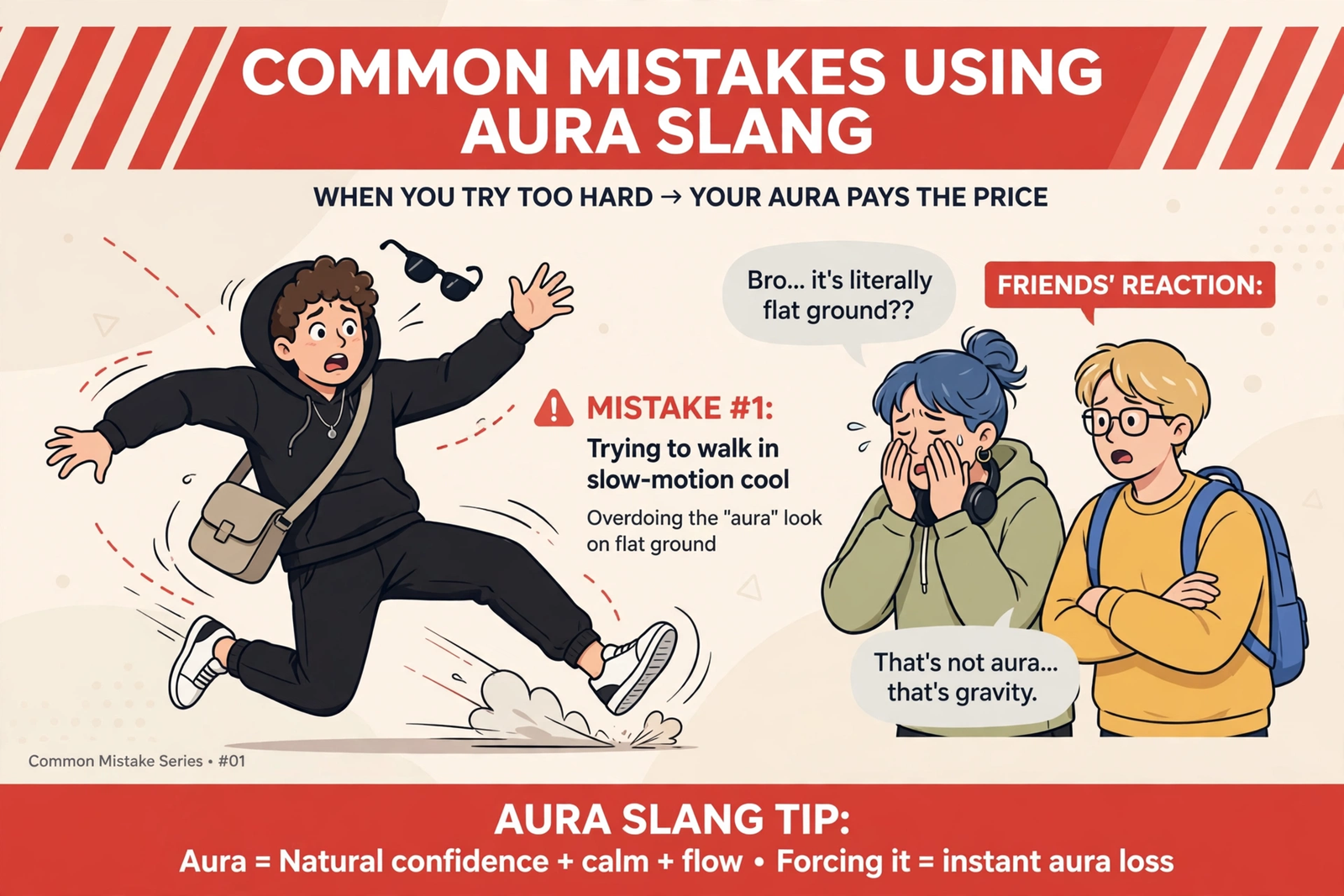
| -1000 aura | A big embarrassing loss | “He tripped on flat ground. -1000 aura.” |
| Aura farming | Deliberately acting cool for attention | “He is just aura farming with that slow walk.” |
| No aura | Zero cool factor, trying too hard | “Bro thought that was cool. No aura.” |
| Aura points | The imaginary score of your coolness | “Wearing sunglasses indoors? -500 aura points.” |
Pronunciation is exactly like the original word: “OR-uh” (two syllables). You will see it written in lowercase as “aura” in texts and comments, and the points are almost always written with a plus or minus sign, like “+500 aura” or “-200 aura.”
Introduction
You have seen the comments a thousand times: a video of someone walking through a hallway in slow motion, sunglasses on, not a care in the world — and the top comment just says “+1000 aura.” Or the opposite: a guy tries a backflip, lands flat on his face, and the comments flood in with “-5000 aura, bro is finished.” If you have ever scrolled past these and wondered what everyone is scoring, you are in the right place.
What does aura mean slang has become one of the most searched slang questions of 2025 and 2026, and for good reason. The word went from a niche gaming and anime term to a full-blown TikTok phenomenon, complete with its own points system, memes, and endless debates about who has aura and who does not. It is short, it is visual, and it captures something every generation has talked about — coolness — in a way that feels fresh.
In this guide, we break down the complete aura meaning slang carries today: the definition, where it came from, how the aura points system works, real examples from texts and TikTok, how it compares to similar words like “rizz” and “vibe,” and the mistakes that instantly cost you aura. By the end, you will know exactly when to use it, when to avoid it, and how to spot genuine aura versus someone just farming it. And if you enjoy decoding internet slang, you will love our breakdown of sigma meaning slang, another word that went from a niche internet idea to everyday language.
Origin
The word aura itself is ancient. It comes from the Greek word for “breeze” or “breath,” and for centuries it described a glow or atmosphere around a person or place — think of the halo in old paintings, or the feeling you get when you meet someone charismatic. Spiritual and New Age communities used it to describe energy fields around the body. That is the serious, dictionary version of the word — Merriam-Webster defines aura as a distinctive atmosphere or quality that seems to surround a person or thing — and it is still the first meaning you will find if you look it up.
The slang version has a different family tree. It grew out of anime, gaming, and sports culture in the early 2020s, where characters with overwhelming presence — the calm fighter who never raises his voice, the basketball player who stares down the crowd — were described as having an “aura.” The word fit perfectly: it was about the feeling a person gives off, not anything they said or did. From there it spread to TikTok edits, where dramatic slow-motion clips of athletes, movie characters, and even ordinary people walking confidently were set to moody music and captioned with “aura.”
The points system is what turned aura from a compliment into a meme. Around 2024, creators started joking that coolness could be measured: every impressive thing you did added aura points, and every embarrassing thing subtracted them. The joke format exploded because it is endlessly flexible — you can score anything, from a perfect parallel park (+200 aura) to waving back at someone who was not waving at you (-1000 aura). The format even connects to the older aura points meaning trend, where creators built entire videos around keeping score of a friend’s day.
Popularity
Aura slang hit the mainstream in 2024 and stayed there through 2025 and into 2026. TikTok is the engine: videos tagged with “aura” or “aura points” have racked up billions of views, and the comment sections turned the points system into a shared language. It is one of those rare slang terms that jumped generations — teenagers use it in school hallways, athletes use it in post-game interviews, and even brands have started using it in ads.
Part of the appeal is that aura is positive but not cringe to say. Unlike some slang that sounds forced when adults use it, “he has aura” sounds almost normal — because the word already existed in English. It also fills a gap: before aura, there was no single word for “that person’s whole vibe is cool.” You had to say “he has a presence” or “he just has it.” Now you just say “aura,” and everyone understands.
The term also thrives because it is a game. The points system invites everyone to play along. Friends score each other in real life, comment sections score strangers, and the numbers are always exaggerated for comedy — nobody actually gains or loses 10,000 points, but saying it makes the joke land. That playful, low-stakes scoring is exactly why the word keeps trending instead of fading like most TikTok slang.
How It Is Used
Aura slang is flexible, and it shows up in three main ways: as a compliment, as a joke score, and as a criticism. As a compliment, it is simple: “She has aura” or “That entrance had aura.” As a joke score, it follows the plus/minus pattern: “+500 aura for the fit” or “-300 aura for tripping over nothing.” As a criticism, it is usually the phrase “no aura” or “aura farming” — calling out someone who is trying too hard to look cool.
Here are the most common patterns you will see:
- “He/she has aura” — the basic compliment. Effortlessly cool.
- “+/- [number] aura” — the joke score. Bigger numbers mean bigger moments.
- “Aura farming” — accusing someone of performing coolness for the camera.
- “Lost all his aura” — a public embarrassment wiped out someone’s cool image.
- “Aura diff” — borrowed from gaming (“diff” means difference); one person’s presence completely outshines another’s.
- “That fit has aura” — the outfit itself radiates confidence.
It also works as a noun, an adjective, and almost a verb. You can say “pure aura,” “aura moment,” or “he is aura farming.” The word bends to fit whatever you need, which is another reason it spread so far. In texts, it is almost always lowercase and casual. In TikTok comments, it is often just the number: “+1000” with no other words, because everyone already knows what is being scored.
Examples
Real examples make the meaning click. Here are the kinds of messages, comments, and captions where aura slang shows up every day — sorted by tone so you can see how flexible the word really is.
Friendly Examples
- “Bro walked into the party and everyone went quiet. He has aura fr.”
- “Your new profile pic? +2000 aura, not gonna lie.”
- “She didn’t even try and still stole the whole show. That’s aura.”
- “That sunset pic you posted has aura. Keep that energy.”
- “You handled that argument so calmly. +500 aura for real.”
Professional Examples
- “The CEO walked in, said three sentences, and the whole room listened. That is aura.”
- “Her presentation was calm, clear, and confident — pure aura, no slides needed.”
- “In a job interview, aura means composure: steady voice, eye contact, no fidgeting.”
- “A good manager has aura. People follow them because of presence, not just title.”
Funny Examples
- “He tried to lean on the wall and missed it. -1000 aura instantly.”
- “Bro said ‘I have aura’ out loud. -5000 aura for saying it.”
- “Waved at someone who wasn’t waving at me. My aura is in the negatives now.”
- “He’s been aura farming all day — slow walking, sunglasses indoors, staring at nothing.”
- “My aura points after tripping in front of my crush: -999,999. I am cooked.”
Notice the pattern in the funny examples: the biggest aura losses always come from trying to look cool and failing. That is the golden rule of aura slang — real aura is effortless, and the moment you announce you have it, you have already lost it.
Comparison with Similar Terms
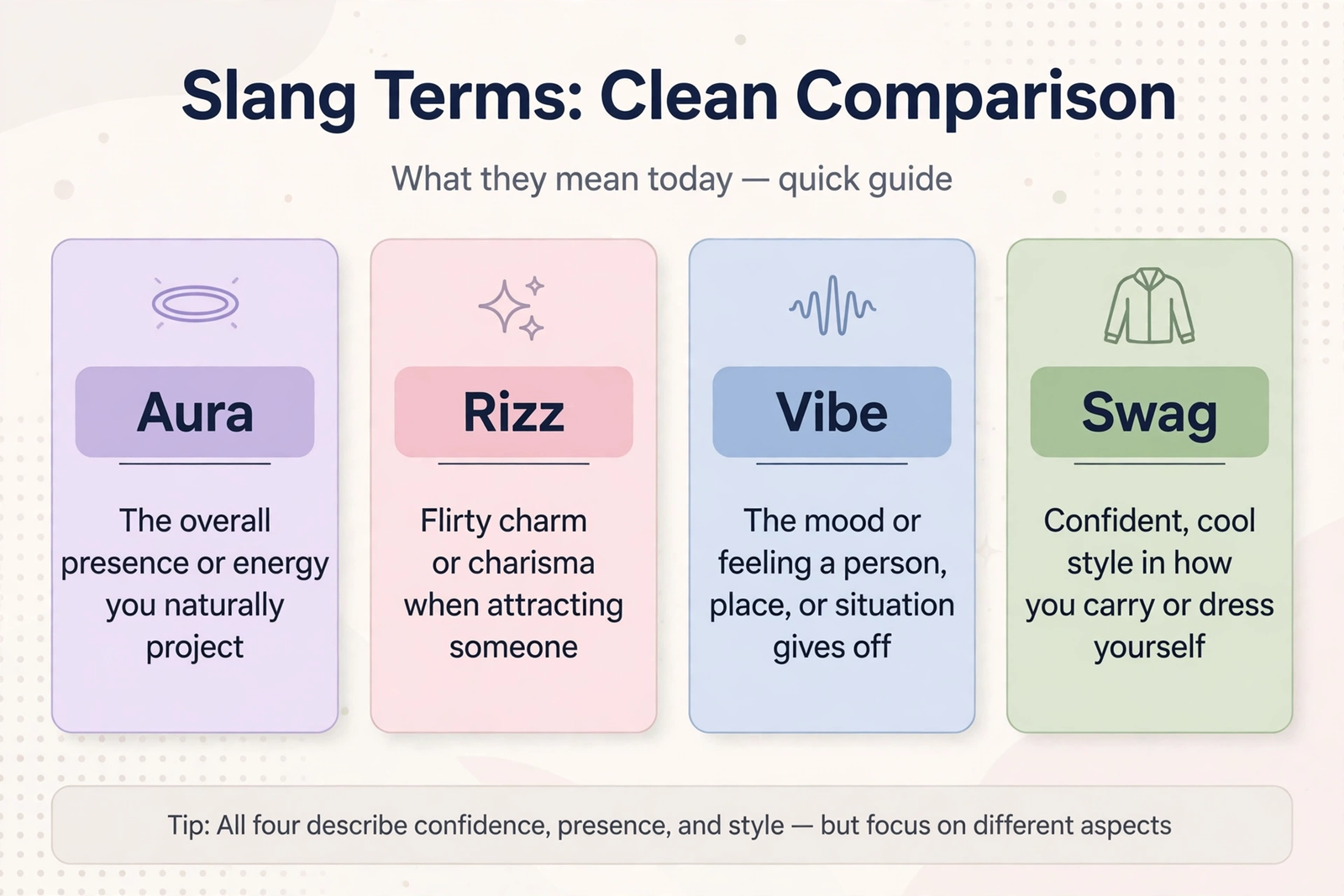
Aura is often confused with other slang words that describe coolness or energy, but each one means something different. The table below clears up the confusion.
| Term | What It Means | How It Differs from Aura |
|---|---|---|
| Aura | The cool, confident energy you give off | The baseline — your overall presence |
| Rizz | Charisma, especially flirting skill | Rizz is about talking to people; aura is about presence without talking |
| Vibe | A general feeling or mood | Vibe can be good or bad and applies to places too; aura is personal coolness |
| Swag | Stylish confidence, often about clothes | Swag is more about style and flash; aura is quieter and deeper |
| Sigma | A lone-wolf, independent personality type | Sigma is a character type; aura is the energy anyone can have |
| Main character energy | Acting like the star of a movie | Similar idea, but louder and more dramatic; aura is calmer |
| Charisma | The ability to attract and influence people | The formal word for a similar idea; aura is the slang version |
The closest cousin is “main character energy,” and the two get mixed up constantly. The difference is volume: main character energy is big, dramatic, and performative — the person who walks in like the camera is following them. Aura is quieter — the person who walks in and does not need the camera at all. Both are compliments, but aura is the one people use when the coolness feels natural instead of staged.
And if you are wondering how aura connects to the Ohio slang meaning trend and other TikTok-born words, the pattern is the same: a niche internet joke becomes a shared shorthand, then becomes everyday language. Aura just happened to be the one with the most staying power, because the feeling it names is universal.
Alternate Meanings
Aura has several meanings outside slang, and knowing them helps you avoid confusion. In its original sense, an aura is a subtle energy field or glow that some people believe surrounds living things — that is the spiritual and New Age meaning, and it is where the slang borrowed the word. In medicine, an “aura” is a warning sensation some people feel before a migraine or a seizure, like flashing lights or strange smells. In art and photography, an aura is the glow or halo effect around a bright object.
In gaming, aura can also describe the glowing effect around a powerful character or item — which is probably where the slang picked up its visual association with glowing, larger-than-life presence. And in everyday English, people have always said things like “she has an aura of calm” or “the house had a strange aura,” meaning an atmosphere or feeling. The slang meaning is just the newest branch of the same tree: instead of a mysterious glow, it is a cool glow.
Context tells you which meaning is in play. If someone in a doctor’s office says “I get an aura before my migraines,” they are not talking about TikTok. If a comment under a video says “+1000 aura,” they are definitely not talking about migraines.
Professional or Polite Alternatives
Aura is casual slang, and it does not belong in every setting. In professional or formal writing, use these alternatives instead:
- “He has a strong presence” — the closest formal equivalent.
- “She carries herself with confidence” — for describing poise and self-assurance.
- “He commands the room” — for someone whose presence fills a space.
- “She has real charisma” — the classic formal word for magnetic personality.
- “He makes a strong first impression” — for introductions and interviews.
- “She has quiet confidence” — for the calm, understated version of aura.
In a work email or a formal introduction, “aura” will sound out of place. Save it for friends, social media, and casual conversation, where it lands exactly as intended. For a full guide on how slang words translate into professional language, see our sigma slang breakdown, which covers the same formal-versus-casual line.
Common Mistakes
Aura slang is simple, but people still get it wrong — and ironically, getting it wrong costs you aura. Here are the mistakes to avoid:
- Saying you have aura yourself. The fastest way to lose it. Aura is something other people notice about you; announcing it proves you do not have it.
- Confusing aura with rizz. Rizz is about what you say to someone, especially when flirting. Aura is about the impression you make without saying anything. They are related, not identical.
- Using it for everything. Not every good thing is aura. A good haircut is a good haircut; it becomes aura only when the whole presence — the walk, the calm, the confidence — comes together.
- Aura farming too obviously. Slow-motion walks, staring into the distance, and sunglasses indoors are funny as a joke. Doing them seriously and expecting compliments is the opposite of aura.
- Scoring everything with points. The points system is a joke format. Using it in serious conversation makes you sound like you live in the comments section.
- Using it in formal settings. Telling your boss “you have aura” in a meeting will get you a strange look. Use “presence” or “charisma” instead.
Quick Tips
- Use it as a compliment, not a claim. Say “she has aura,” never “I have aura.” Let others decide.
- Keep the points exaggerated. The joke works because the numbers are ridiculous — +1000, -5000, never +7.
- Pair it with a specific moment. “That entrance had aura” is stronger than a vague “he has aura.”
- Watch for aura farming. If someone is clearly performing coolness for the camera, calling it out with “aura farming” is the perfect reply.
- Use it in comments, not captions. The word hits hardest as a reaction — a comment under someone else’s video, a reply in a group chat.
- Do not force it. Like the quality it describes, the slang works best when it comes naturally. If you have to think about whether something has aura, it probably does not need the label.
- Remember the golden rule: real aura is effortless. The moment you try to prove you have it, you have lost it.

FAQ
1. What does aura mean in slang?
In slang, aura means the cool, confident energy or presence a person gives off. When someone says you have aura, they mean you look effortlessly cool and magnetic — you make an impression just by being there. On TikTok, it is also scored with “aura points”: cool moments add points, embarrassing moments subtract them.
2. What are aura points?
Aura points are an imaginary score of your coolness, used as a joke on TikTok and in group chats. Doing something impressive earns points (like +1000 aura for a perfect catch), while doing something embarrassing loses points (like -1000 aura for tripping in public). The numbers are always exaggerated for comedy.
3. What does “+1000 aura” mean?
“+1000 aura” means something just earned a huge amount of coolness points. It is a comment you leave when someone does something impressive, confident, or stylish — a great entrance, a perfect outfit, or a calm response under pressure.
4. What does “-1000 aura” mean?
“-1000 aura” means someone just lost a huge amount of coolness points, usually by embarrassing themselves in public. Tripping over nothing, waving at the wrong person, or trying to look cool and failing are all classic -1000 aura moments.
5. What is aura farming?
Aura farming means deliberately trying to look cool for attention — posing for the camera, walking in slow motion, wearing sunglasses indoors, or staring into the distance like a movie character. It is usually said as a joke or a gentle roast when someone is clearly performing their coolness.
6. Is aura the same as rizz?
No. Rizz is charisma in conversation, especially flirting — it is about what you say. Aura is about presence — the impression you make without saying anything. A person can have aura without saying a word, but rizz only shows up when they start talking.
7. Can anyone have aura?
Yes. Aura is not about looks, money, or fame — it is about confidence, calm, and how you carry yourself. Anyone who walks in relaxed, speaks steadily, and does not try too hard can have aura. That is exactly why the word caught on: it describes something anyone can have, not something you buy.
8. Is “aura” appropriate to use at work or school?
With friends and classmates, yes — it is casual, positive slang. At work or in formal settings, use “presence,” “charisma,” or “confidence” instead. Saying someone “has aura” in a professional meeting will sound out of place, even if the compliment is genuine.
Conclusion
What does aura mean slang comes down to one simple idea: the cool, confident energy you give off without trying. It is the modern word for presence — the reason some people walk into a room and everyone notices, while others have to work for the same attention. On TikTok, it became a game with points, memes, and endless debates, but underneath the joke is a real human truth: people respond to calm confidence more than to anything else.
The key takeaways are simple: aura is effortless, so the moment you announce you have it, you have lost it; the points system is a joke, so keep the numbers ridiculous; and the word works best as a compliment you give others, not a title you claim for yourself. Use it in comments, group chats, and casual conversation — and swap it for “presence” or “charisma” when the setting turns formal. If you want to keep decoding the slang filling your feed, our guide to aura points meaning is the perfect next read — it goes deeper into the scoring system that made this word famous.
Quick recap: aura = the cool energy you give off · +aura points for impressive moments, -aura points for embarrassing ones · aura farming = performing coolness for attention · real aura is effortless and quiet · use “presence” or “charisma” in formal settings.
