
Quick definition: STFU stands for “shut the f*** up.” In slang, STFU meaning is a blunt, rude way to tell someone to stop talking. People use it in texts, chats, memes, and social media comments when they are annoyed, joking with close friends, or shutting down a conversation they do not want to continue. It is almost always informal, and it can sound aggressive, so the tone and the relationship matter a lot.
STFU Meaning & Definition
STFU is an abbreviation of the phrase “shut the f*** up.” It works as an imperative, a direct command telling the other person to be quiet. Unlike softer phrases such as “please be quiet” or “hold on a second,” STFU carries a sharp edge. Even when it is typed as a joke, the words underneath it are still harsh, which is why most people only use it with friends who understand the humor, or in moments of real frustration.
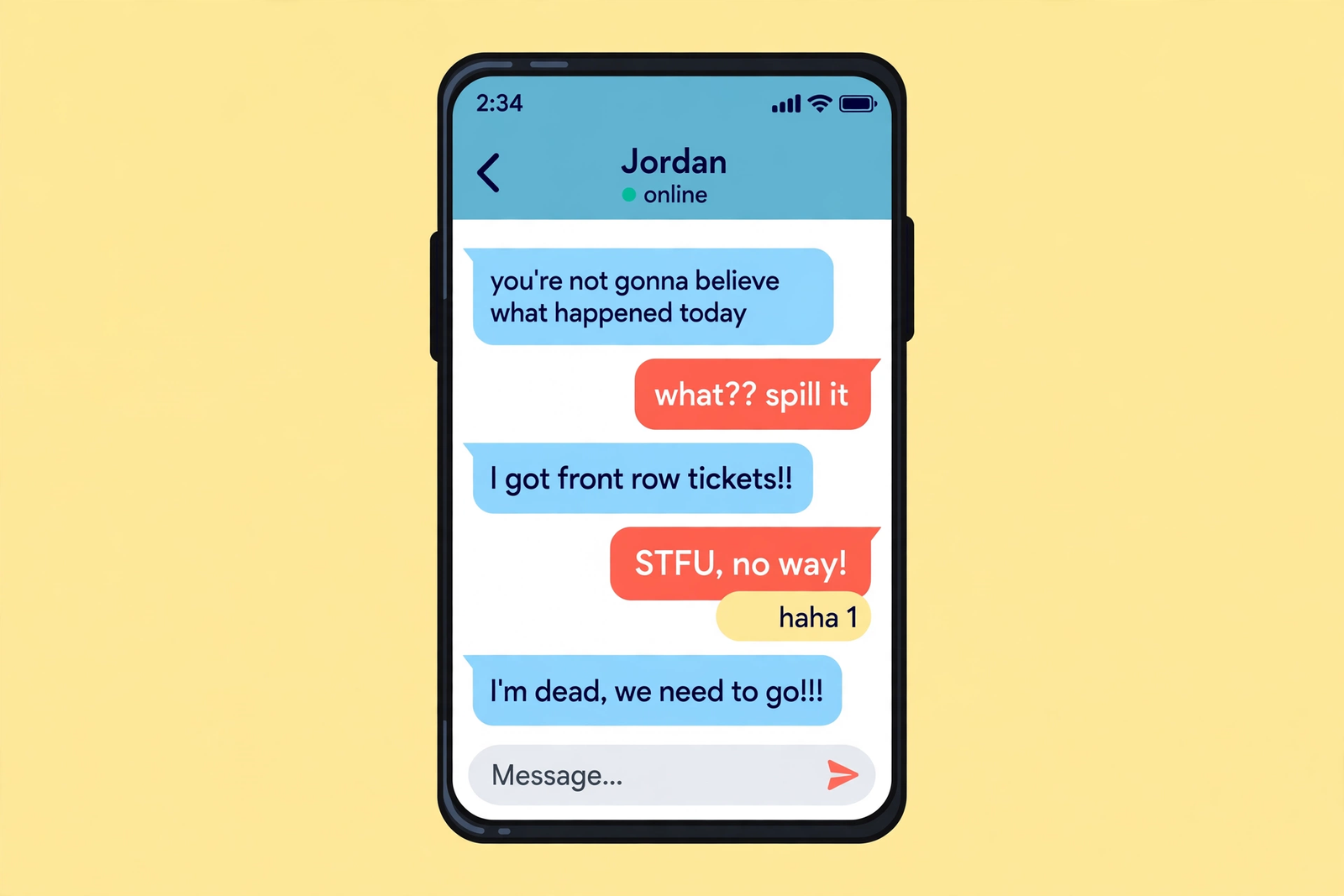
In everyday texting, the STFU meaning in slang stays the same, but the feeling behind it changes with context. A friend who types “stfu, that’s hilarious” is not actually angry. They are reacting the way someone might gasp or laugh out loud in person. On the other hand, “STFU. I don’t want to hear it” in the middle of an argument is a clear signal that the conversation is over, at least for now. The same four letters can mean “you’re joking, right?” or “leave me alone,” and only the surrounding conversation tells you which one it is.
STFU belongs to a family of short, punchy internet abbreviations that pack a whole sentence into a few letters. If you already know terms like fn meaning in text, you know how this style of slang works: a few letters stand in for a full phrase, and everyone who spends time online learns to read them instantly. STFU is one of the oldest and most recognizable members of that group, and it has survived every change in platforms, from early chat rooms to TikTok comments.
STFU is almost always used on its own or at the start of a sentence, and it often appears with punctuation for extra force, such as “STFU!” or “stfu…” where the ellipsis adds an eye-roll effect. Adding “lol” or an emoji after it usually softens it, while typing it in all caps usually makes it louder and angrier.
Introduction
Four letters, one very direct message. STFU is the kind of slang that almost everyone online recognizes, even if they would never type it themselves. It shows up in group chats when someone tells an unbelievable story, under viral videos when commenters react to a wild take, and in gaming lobbies when tempers run short. Because it is short, it is easy to type in the heat of the moment, and because it is rude, it lands hard.
Understanding STFU meaning in slang is not just about knowing the full form. It is about knowing when it is a joke, when it is an insult, and when it is a sign that someone has reached their limit. This guide breaks all of that down: the definition, the origin, real examples in different tones, comparisons with similar slang, polite alternatives, and the mistakes people make when they use it. By the end, you will know exactly what STFU means, when to use it, and when to leave it alone.
Origin
STFU comes from the spoken phrase “shut the f*** up,” which has been part of English slang for decades. Long before texting existed, people said it out loud in arguments, in movies, and in comedy routines. When the internet arrived, the phrase was shortened like so many others, because early chatrooms and text messages rewarded speed. Typing four letters was faster than typing a full sentence, and the abbreviation caught on quickly.
The abbreviation spread through the same early internet spaces where most texting slang was born: IRC chat rooms, AOL Instant Messenger, MSN Messenger, and early forums. In those spaces, users invented a whole shorthand system, and STFU sat alongside classics like LOL, BRB, and OMG. It was edgier than most of them, which may be part of why it stuck. People remembered it precisely because it was rude.
By the 2000s, STFU had moved from chat rooms into texting, and then into social media. It appeared in memes, reaction images, and comment sections, where it worked as a quick punchline. A picture of a celebrity with the caption “STFU” needed no explanation. Later, TikTok and Twitter/X gave it another boost, as creators used it in captions and replies to react to surprising or annoying content. According to Dictionary.com, STFU is listed as an abbreviation of “shut the f*** up,” used in digital communication to tell someone to be quiet, often rudely.
Popularity
STFU has stayed popular for an unusually long time in internet slang, where most terms fade within a year or two. Part of its staying power is that it fills a real need: sometimes people genuinely want a short way to say “stop talking.” Another part is its flexibility. It works as a joke, an insult, a reaction, and a meme caption, so it keeps finding new contexts.
On TikTok and Twitter/X, STFU appears most often in two ways. First, as a playful reaction, usually from a friend who cannot believe what they just heard. Comments like “stfu no way” or “STFU that’s actually true” are common under surprising videos. Second, as a genuine shutdown, usually aimed at a troll, a spoiler, or someone repeating an unpopular opinion. In gaming communities, it is also a familiar part of trash talk, although many games now filter or punish it.
Search interest in STFU meaning slang stays steady rather than spiking and disappearing. New social media users, younger teens getting their first phones, and non-native English speakers all look it up regularly, which is why it remains one of the most searched slang abbreviations year after year.
How It Is Used
STFU is used in three main ways, and telling them apart is the key to reading it correctly.
1. As a joke between friends. This is the most common use today. When a friend says something unbelievable or funny, replying “stfu” is like saying “no way” or “stop lying.” The humor depends entirely on the friendship: if the two people tease each other regularly, it lands as affection, but if they do not know each other well, it can land as an insult.
2. As an angry shutdown. In an argument, STFU means exactly what it says. The person typing it is frustrated and wants the other person to stop talking, texting, or commenting. There is no joke here, and replying with more messages usually makes things worse. The smart move is to give the person space.
3. As a reaction to surprising news. When someone shares shocking gossip or an unbelievable fact, “STFU!” can mean “I can’t believe this.” The tone is usually excitement rather than anger, and it is often followed by questions like “are you serious?” or “send proof.”
Examples
Here is how STFU looks in real conversations, across friendly, professional, and funny situations.
Friendly Examples
- Friend 1: “I just got tickets to the concert for $20.” Friend 2: “STFU, no way! How?” — playful disbelief, not anger.
- Friend 1: “I passed my driving test on the first try.” Friend 2: “stfu, I’m so proud of you!” — excitement and praise.
- Friend 1: “Guess who just texted me back?” Friend 2: “STFU. Tell me everything right now.” — eager curiosity.
- Group chat: “He really said that to the teacher?” — “stfu 😂 he did not.” — shared laughter.
Professional Examples
STFU has almost no place in professional communication. It is too rude for work emails, Slack messages with colleagues, or customer service chats. If it appears at work, it is usually a mistake, or a sign that a workplace relationship has broken down. The professional alternatives are phrases like “let’s pause here” or “let’s take this offline.” Knowing the difference between slang like STFU and polite workplace language is part of digital communication skills, just as knowing a friendly term like tysm meaning helps you read the tone of a thank-you text correctly.
Funny Examples
- “Me: I’m going to sleep early tonight. My brain at 2am: stfu, we’re thinking about that embarrassing thing from 2015.”
- “My alarm: time to wake up. Me: stfu, it’s Saturday.”
- “Nobody: … Absolutely nobody: … Me: stfu, I wasn’t even talking.”
- “My bank account after I check it: stfu, we don’t talk about that.”
Notice the pattern in the funny examples: STFU is aimed at an idea, a feeling, or an object, not at a person. That is what keeps it light. The moment it is aimed at a real person who did not agree to the joke, it stops being funny.
Comparison with Similar Terms
STFU is not the only way to tell someone to stop talking online. Here is how it compares with similar slang and phrases.
| Term | Meaning | Tone | When to Use It |
|---|---|---|---|
| STFU | Shut the f*** up | Rude, blunt, or joking | Close friends, memes, or real frustration |
| Shut up | Stop talking | Rude to playful | Similar to STFU, slightly softer |
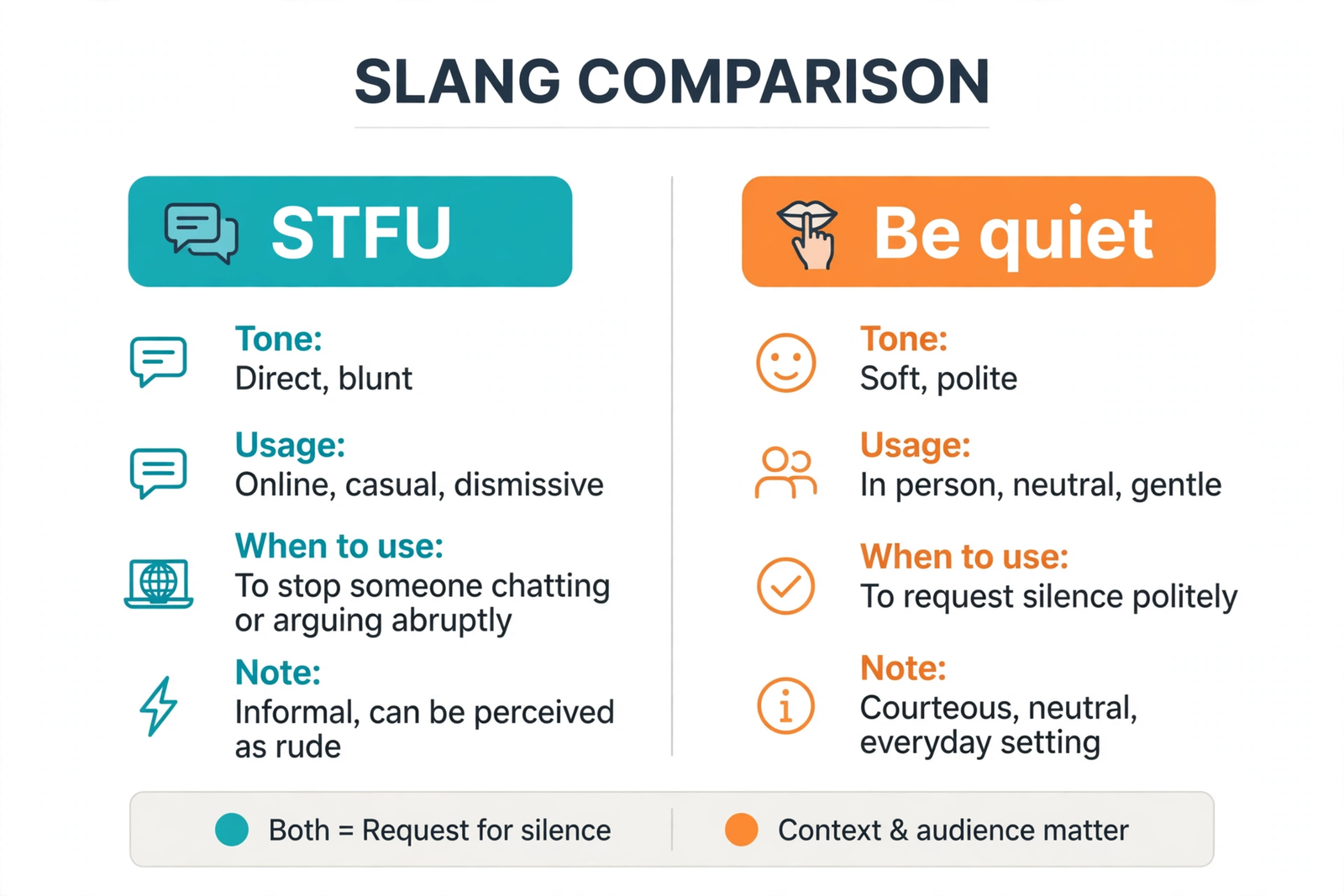
| Be quiet | Stop making noise | Neutral to firm | Parents, teachers, everyday requests |
| Hush | Be silent | Gentle, calming | Comforting someone or asking for quiet kindly |
| Zip it | Stop talking | Playful, teasing | Joking with friends or siblings |
| STFO | Shut the f*** off (less common) | Rude, dismissive | Rare; usually aimed at a device or app |
| GTFO | Get the f*** out | Rude, aggressive | Telling someone to leave, not just to be quiet |
| SMH | Shaking my head | Disappointed, not angry | Reacting to something silly without attacking |
The main difference between STFU and softer options like “be quiet” or “zip it” is the swear word hiding inside it. Even abbreviated, the full form is understood by everyone, so STFU always carries that weight. Compared with GTFO it is milder, because it asks for silence rather than for someone to leave, and compared with SMH it is much stronger, because it is a direct command rather than a reaction.
One useful rule: if you would not say the full phrase “shut the f*** up” out loud to that person, do not type STFU to them either. The abbreviation does not make the message polite. It only makes it shorter.
Alternate Meanings
STFU almost always means “shut the f*** up,” but like many abbreviations, it has a few rare alternate readings. These are uncommon, and context usually makes the intended meaning clear.
- Shut the f*** up — the standard meaning, used in texting, social media, gaming, and memes.
- Shut the front up — a cleaned-up joke version some people use when they want the punch of STFU without the swear word, similar to saying “what the heck” instead of a stronger phrase.
In practice, if you see STFU in a chat or comment, assume the standard meaning. The joke variants only appear when the writer is clearly playing with the letters, and even then the reader is expected to know the original first. There is no widely used professional or technical meaning of STFU, so there is little risk of confusing it with something else.
Professional or Polite Alternatives
Because STFU is rude, it is worth having softer options ready. Here are polite alternatives for different situations:
- “Let’s take a pause here.” — good for meetings and group chats that are getting heated.
- “I need a moment to think.” — honest and calm, and it asks for quiet without attacking anyone.
- “Can we come back to this later?” — useful when a topic is going in circles.
- “I hear you, but I disagree.” — acknowledges the other person while holding your ground.
- “Let’s agree to disagree.” — a classic way to end a debate without a fight.
- “Please give me some space.” — direct and respectful when you are upset.
- “No way!” or “You’re kidding!” — the friendly replacement for the joking version of STFU when a friend surprises you.
Choosing a polite alternative is not about being fake. It is about keeping the conversation open. STFU closes a conversation, often permanently, while a softer phrase leaves room to continue once tempers cool. In group chats, that difference matters even more, because everyone else in the chat sees the exchange. A calm reply protects your reputation; a rude one can follow you, since screenshots last forever. For casual check-ins, a term like hbu meaning in chat shows the friendly side of texting slang, and it is a good reminder that most abbreviations are meant to keep conversations warm, not shut them down.
Common Mistakes
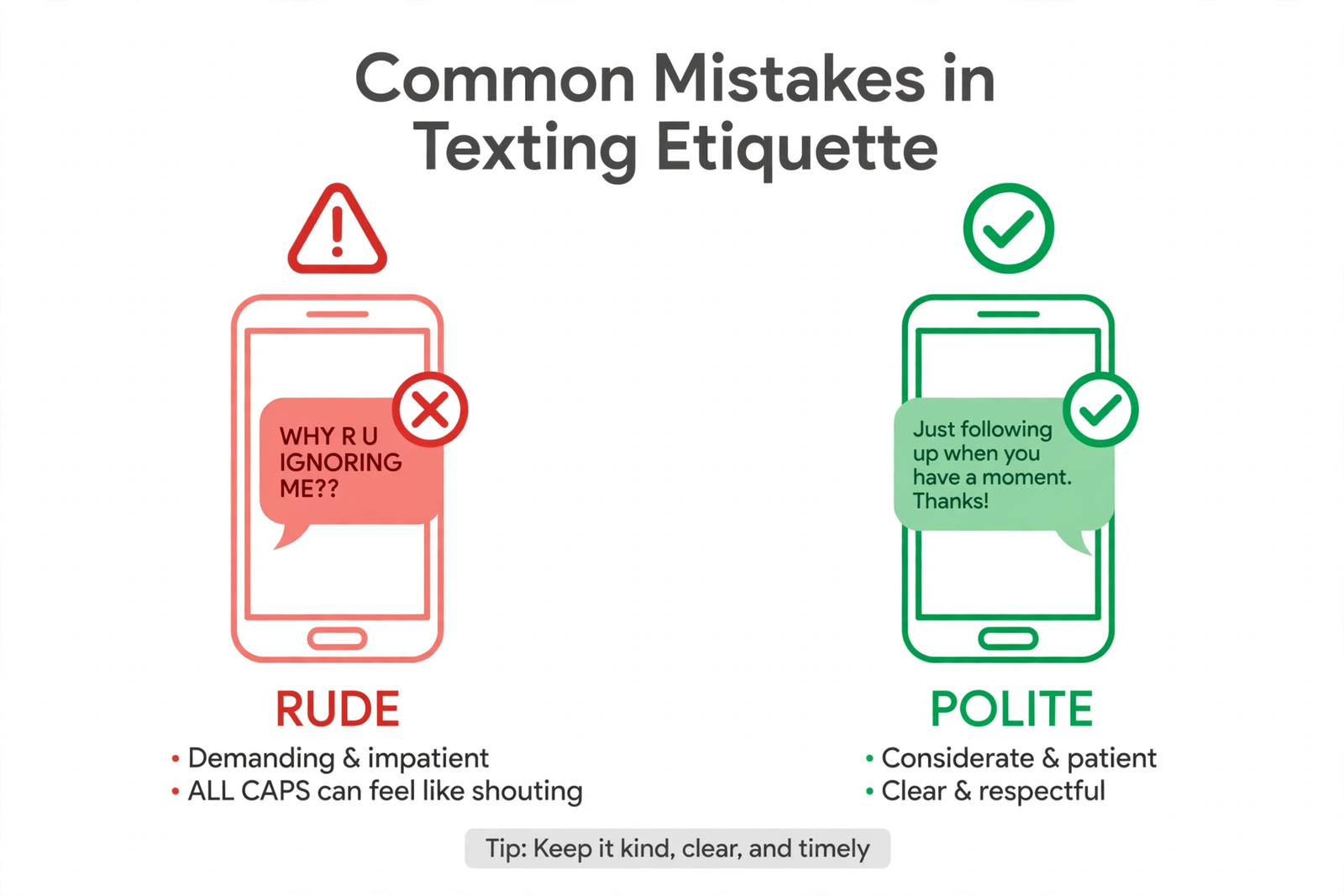
People make several mistakes with STFU, and most of them come from misjudging tone.
Using it with strangers. The biggest mistake is typing STFU to someone you do not know well. Online, it is easy to forget there is a real person behind a username. A stranger will almost always read it as an insult, and in gaming or comment sections it can lead to reports, mutes, or bans.
Using it at work or school. STFU in a work chat, a school group project, or an email is a fast way to damage a relationship. Even if everyone else is joking around, the abbreviation is still rude, and a teacher or manager who sees it will not treat it as a joke. Keep it out of anything professional.
Typing it when you mean the opposite. Because STFU can mean both “you’re joking” and “leave me alone,” it is easy to be misunderstood in text, where there is no voice or facial expression to guide the reader. Adding “lol,” an emoji, or a follow-up question usually fixes the ambiguity. If you are not sure the joke will land, use “no way!” instead.
Quick Tips
- Check the relationship first. Only use STFU jokingly with close friends who already tease you the same way.
- Add a softener when joking. A “lol,” “😂,” or “no way” after STFU signals clearly that you are laughing, not angry.
- Never use it at work, school, or with strangers. The risk is never worth the joke.
- Read the room in group chats. If the mood is serious, STFU will land badly, even if you meant it lightly.
- Do not use it to win an argument. It ends conversations instead of resolving them. Step away and reply later if you are upset.
- Know the full form. Remember that STFU stands for a swear phrase. The abbreviation does not hide the meaning from anyone.
- When in doubt, pick a softer phrase. “No way!” or “you’re kidding!” gives you the same playful reaction without the risk.

FAQ

What does STFU mean in slang?
STFU stands for “shut the f*** up.” In slang, it is a blunt way to tell someone to stop talking. It can be a joke between close friends, a reaction to surprising news, or a genuinely angry shutdown, depending on the context and tone.
Is STFU rude?
Yes, STFU is rude in most situations. It contains a swear word in its full form, and even as an abbreviation, everyone understands what it stands for. Between close friends it can be playful, but with strangers, colleagues, or teachers, it is offensive.
What does STFU mean in texting?
In texting, STFU usually means “shut the f*** up,” used either as a joke (“stfu, no way!”) or as an angry reply (“STFU, I don’t want to hear it”). The surrounding messages and the relationship tell you which meaning applies.
Can I say STFU to my friends?
Only if your friends use that kind of humor with you. In many friend groups, a playful “stfu” is normal teasing. If your friends have never used it with you, or if they seem uncomfortable, it is safer to use “no way!” or “you’re kidding!” instead.
What is a polite way to say STFU?
Polite alternatives include “let’s take a pause here,” “I need a moment to think,” “can we come back to this later?” and “please give me some space.” For the joking version, “no way!” or “you’re kidding!” works perfectly and carries no risk.
What does STFU mean on TikTok?
On TikTok, STFU appears in comments and captions as a reaction to surprising, funny, or annoying videos. Comments like “stfu no way” usually mean playful disbelief, while “stfu” aimed at a creator is often a genuine complaint or an attempt to shut down an unpopular opinion.
Is STFU an abbreviation or an acronym?
STFU is an initialism, a type of abbreviation formed from the first letters of “shut the f*** up.” People pronounce it letter by letter (S-T-F-U) rather than as a single word, which is why it is classed as an initialism rather than a true acronym.
Why do people type STFU instead of the full phrase?
People type STFU because it is faster and part of internet slang culture, where long phrases are shortened into a few letters. The abbreviation also feels slightly less harsh than spelling the phrase out, even though everyone knows what it means.
Conclusion
STFU meaning in slang is simple on the surface and tricky in practice. The letters stand for “shut the f*** up,” a blunt command to stop talking. But the real meaning depends on who is saying it, who they are saying it to, and what else is happening in the conversation. Between close friends, it can be a laugh. In an argument, it can be a door slamming shut. In a meme, it can be a punchline.
The safest way to handle STFU is to understand it fully and use it rarely. Know what it means, recognize it when you see it, and save it for the few people who will read it as a joke. Everywhere else, a softer phrase does the same job without the damage. Slang is supposed to make communication faster and more fun, and that works best when everyone in the conversation feels respected. If you want to keep exploring how short phrases shape online chats, our guide to cfs meaning in text is a good next read, since it shows how a few letters can carry a whole mood of their own.

2 thoughts on “STFU Meaning Slang: What Does STFU Mean in Texting and Online Chat?”