
Neti Slang Meaning & Definition
Quick definition: In slang, neti is a playful way of saying “not it” — a quick opt-out when someone is picking who has to do something nobody wants to do. If a friend asks who is carrying the heavy bags and you reply “neti!”, you are saying, in the lightest possible way, “not me, pick someone else.” The full focus keyword here is neti slang, and it covers the whole little world around this word: its meaning, where it came from, how people use it in texts, group chats, TikTok comments, and Discord servers, and what it does not mean.
Neti is short, soft, and a little bit cheeky. It does the job of a flat “no” without sounding rude, which is exactly why it caught on with younger users. It is the kind of word that looks like a typo the first time you see it and feels completely natural the second time you use it. This guide explains the exact neti slang meaning, traces the word from an ancient Sanskrit phrase to a modern group-chat reflex, shows real examples in friendly, professional, and funny tones, compares neti with similar terms like “not it,” “nah,” and “nope,” and clears up the confusion with two words that look almost identical: the neti pot and NEET.
Introduction
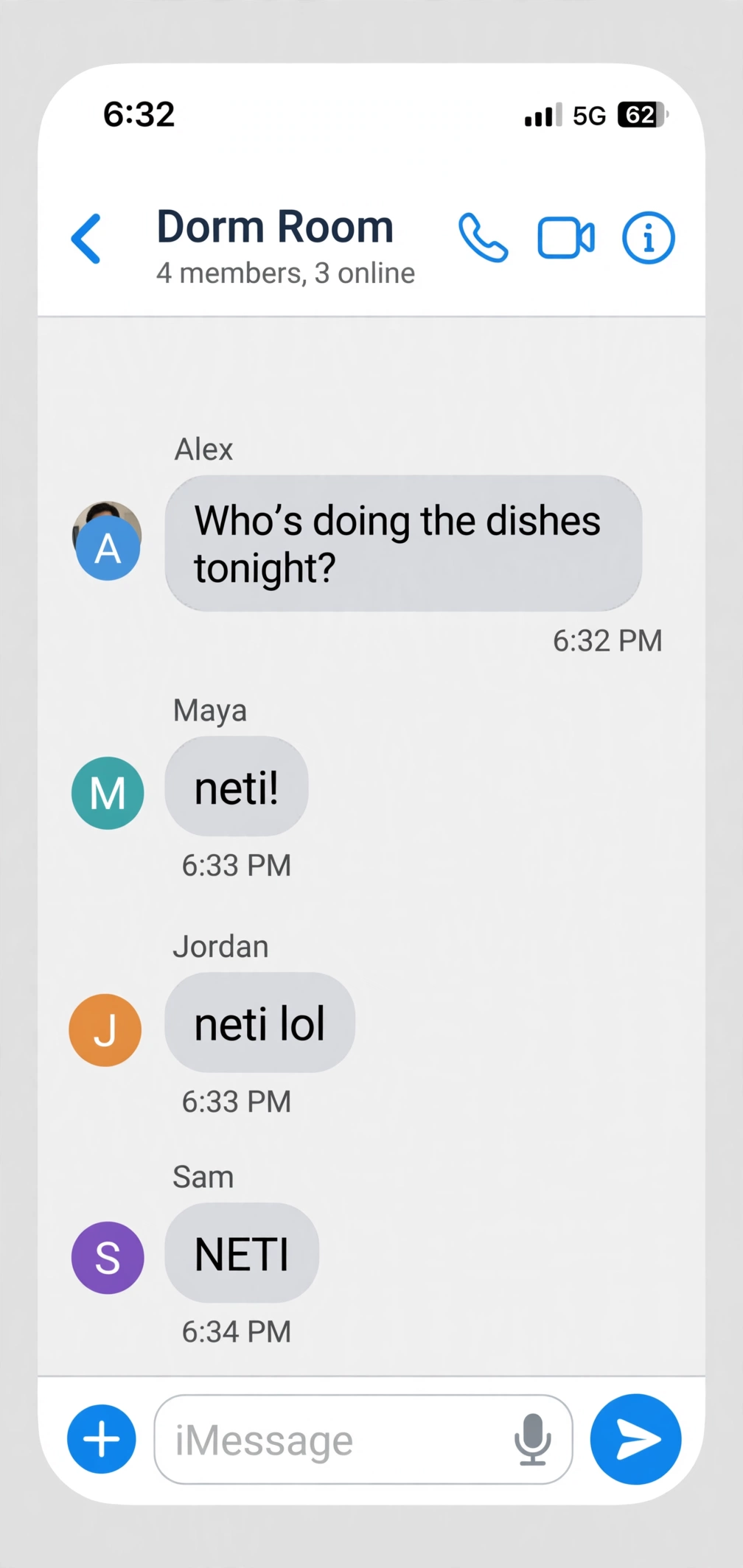
Picture a group chat on a Friday night. Someone types: “Who’s driving to the party?” Three dots appear. Then, one after another: “neti.” “neti lol.” “NETI.” Nobody has said no. Nobody has argued. Yet somehow the message is perfectly clear: not me, not me, not me. Within seconds the whole group is laughing, and the one person who did not type fast enough is suddenly the designated driver.
That is neti slang in action. It is a tiny word doing a very specific social job. English already has plenty of ways to refuse something — no, nope, nah, not me, count me out — but each of those carries a slightly different weight. “No” can sound blunt. “Not me” can sound defensive. “Neti” sounds like a game. It turns a refusal into a joke, which is why it works so well in the places where tone is hardest to read: text messages, comment sections, and fast-moving group chats.
This article does the job properly. You will learn what neti means in slang, where it really comes from, why it spread on TikTok, X, and Discord, exactly how to use it without sounding awkward, the mistakes that make people misunderstand you, and polite alternatives for situations where a joke refusal would be the wrong move.

Origin
The story of neti slang starts long before the internet, in a phrase that is roughly three thousand years old. In Sanskrit, neti neti means “not this, not that.” It comes from the Upanishads, the ancient Indian philosophical texts, where it was used as a method of self-inquiry: to understand what the true self is, you strip away everything it is not — not this body, not this thought, not this feeling — until only the essential remains. It is a serious, meditative idea, and it has nothing to do with group chats. But words travel, and this one travelled a very long way.
The second stop on the journey is the playground. Long before anyone typed “neti” on a phone, English-speaking children were playing a game with almost the same word. When a chore, a dare, or an embarrassing job needed a volunteer, kids would shout “not it!” — and the last one to say it was stuck with the task. The phrase “not it” is a claim of exemption, delivered at speed, and it works because everyone agrees on the rules: say it first, and you are free.
Internet slang did what internet slang always does: it compressed the phrase. “Not it” became “notit,” then “neti” — the two words squeezed into one short, typable chunk, with the middle consonant softened for speed. That is the same process that turned “going to” into “gonna” and “let me” into “lemme.” The spelling is not random. It follows the sound of the phrase said quickly, out loud, by someone trying to get their refusal in before anyone else.
The final push came from short-form video and fast-moving chat platforms. On TikTok, X, and Discord, where comments fly past in seconds, a four-letter refusal that reads as playful rather than hostile is genuinely useful. Creators started using “neti” in skits about group chores, roommate duties, and awkward invitations. Viewers copied it into their own chats, and by 2025 small slang blogs were publishing explainers about it.
Popularity
Neti is not one of the giant slang words. It does not have the reach of “rizz,” “slay,” or “no cap,” and it probably never will. Its popularity is quieter and more specific: it thrives in group chats, comment sections, and gaming lobbies rather than in headlines. That is actually a strength. The words that last in slang are often the ones that solve a small social problem well, and neti solves a real one — how to dodge a task without sounding rude.
It is worth being honest about scale. If you use “neti” with your parents or your boss, they will probably stare at you. This is youth internet slang, not mainstream English. But within its world — group chats, comments, and gaming — it is established, understood, and still growing. The slang term spread the way most modern slang spreads: not through a dictionary or a celebrity, but through thousands of small, funny moments in which it was exactly the right word.
How It Is Used
At its core, neti is used in one situation: someone is assigning an unwanted task, and you want out. The grammar is simple. You type “neti” on its own, or “neti!” with an exclamation mark, or “neti lol” to soften it further. Sometimes people double it — “neti neti” — for comic emphasis, a nod to the original Sanskrit phrase, whether they know it or not. The word usually comes fast, because in the “not it” game, speed is the whole point.
The tone matters more than the spelling. Neti is playful refusal, not serious refusal. It says “I am dodging this, and we both know I am dodging this, and that is the joke.” It works between friends, siblings, classmates, and gaming teammates — people who share enough trust that a joke refusal will not be taken as a real insult. It does not work as a genuine, firm no.
Examples
The best way to understand neti slang is to see it in the wild. Here are realistic examples, grouped by tone. Notice how in every case the meaning depends on context: the same four letters can be a game, a joke, or a gentle dodge, depending on who is talking and what is at stake.
Friendly Examples
Friendly use is where neti belongs. These are the group chats, sibling threads, and friend circles where everyone knows the rules and nobody takes a joke refusal seriously.
- The chore dodge: “Who’s washing the dishes tonight?” “Neti! I did them yesterday.” “Neti lol, I cooked.”
- The plan opt-out: “We should go to that boring family dinner on Sunday.” “Neti, I’m staying home and watching the game.”
- The group project: “Someone has to present first.” “Neti neti, I’ll go last.”
- The road trip: “Who’s driving the first shift?” “Neti! I drove last time and nearly fell asleep.”
- The dare: “Who wants to text him first?” “Neti!! Absolutely not, you do it.”
In each of these, neti does two things at once: it refuses, and it signals that the refusal is not serious. The extra words after it — the excuse, the laugh, the counter-offer — are what keep the conversation friendly.
Professional Examples
Here is the honest truth: neti is not a professional word. You should not use it in a work email, a meeting with your manager, or a message to a client. But it does show up in the informal spaces around work — the team group chat, the Slack channel where everyone jokes, the break-room conversation. In those spaces, it works the same way it works anywhere else: as a playful dodge among people who trust each other.
- The office lunch run: “Someone has to pick up lunch for the team.” “Neti, I went yesterday and it took an hour.”
- The meeting notes: “Who’s taking notes today?” “Neti lol, I did it last week.”
- The after-work plan: “Who’s organising the leaving party?” “Neti, but I’ll bring the cake.”
The rule is simple: if the request matters, answer it properly. If it is a small, shared, low-stakes job among colleagues who joke around, neti is fine — but follow it with something helpful, like “but I’ll bring the cake,” so the dodge does not read as laziness. A playful refusal plus a real contribution is good teamwork. A playful refusal on its own, repeated every day, is just dodging.
Funny Examples
Neti is at its funniest when the stakes are tiny and the drama is huge — the classic internet recipe of treating a small thing as if it were a matter of life and death.
- The last slice: “Who ate the last slice of pizza?” “Neti. It was definitely the dog.”
- The haunted house: “Who’s going into the creepy basement first?” “NETI NETI NETI.”
- The bill: “The Wi-Fi bill is due. Who’s paying?” “Neti, I paid for the snacks.”
- The awkward call: “Someone call the landlord about the leak.” “Neti, I’m scared of him.”
The humour comes from the contrast: a tiny word, delivered at full speed, against a job nobody wants. That is why “neti neti neti” is funnier than a single “neti.” Repetition is the joke.
Comparison with Similar Terms
Neti belongs to a family of short refusal words, and choosing between them is mostly about tone. The table below compares neti with its closest relatives, so you can pick the right one for the moment instead of guessing.
| Term | What it means | Tone | Best used when |
|---|---|---|---|
| Neti | “Not it” — I opt out of this task | Playful, cheeky | Dodging a shared chore or dare among friends |
| Not it | The original phrase neti comes from | Playful, childlike | The playground-style game of claiming exemption first |
| Nah | A casual “no” | Relaxed, neutral | Declining an offer or suggestion casually |
| Nope | A firm, casual “no” | Firm, slightly blunt | Shutting down an idea quickly |
| Hard pass | A strong, emphatic refusal | Bold, dramatic | Rejecting something you really do not want to do |
| Count me out | I am not participating | Clear, polite | Opting out of a plan or activity gracefully |
| Not me | It was not me / I am not the one | Defensive or literal | Denying responsibility or involvement |
| Pass | I will skip this one | Neutral, easy | Skipping a turn in a game or a round of drinks |
The key difference is that neti is the only one of these that turns the refusal into a game. “Nah” and “nope” answer a question. “Count me out” makes a statement. Neti issues a challenge: I said it first, so the job is yours. That game element is why it works so well in group chats and so badly in serious conversations.

Alternate Meanings
Neti is a word with several completely different lives, and mixing them up is the most common source of confusion. Here are the alternate meanings you need to know, so you never mistake one for another.
1. Neti neti (Sanskrit philosophy). The original meaning. In Hindu philosophy, particularly in the Upanishads, neti neti means “not this, not that,” and it is a method of discovering the true self by denying everything that it is not. You can read the background on Wikipedia’s Neti neti page if you want the full philosophical context. This is where the slang word’s DNA comes from, even if today’s users have never heard of the Upanishads.
2. The neti pot (nasal irrigation). A neti pot is a small teapot-shaped device used to rinse the nasal passages with salt water, a practice called jala neti in yoga. It is a health and wellness product, sold in pharmacies, and it has nothing to do with slang. If someone says “I bought a neti,” they almost certainly mean the pot, not the slang. Context is everything.
3. NEET (a different word entirely). NEET stands for “Not in Education, Employment, or Training” and describes young people who are not studying, working, or training. It is a policy term from a 1999 UK government report, and online it is sometimes used as a label or an insult. It is spelled N-E-E-T, pronounced “neet,” and it has nothing to do with neti slang. The two words look alike and sound alike, but confusing them will make you look uninformed.
4. Neti as a name. Neti is also used as a given name in some cultures, and as a surname. If you meet a person called Neti, that is their name, not a slang reference.
The practical rule: in a chat about chores, plans, or dares, neti is the slang. In a yoga studio or a pharmacy, it is the pot. In a philosophy class, it is neti neti. And in a discussion about youth unemployment, it is NEET — a different word that just happens to rhyme.
Professional or Polite Alternatives
Because neti is a joke, there are many situations where you need the same message in a grown-up form. Here are polite alternatives, matched to the situation, so you can opt out gracefully without sounding like you are playing a game.
- At work: “I won’t be able to take that one on this time, but I can help with something else.” Clear, honest, and it offers an alternative.
- With family: “I did it last time — could someone else take a turn?” Fair and factual, with no blame attached.
- With friends, semi-formally: “I’ll have to sit this one out, but have fun!” Warm, clear, and it does not spoil the mood.
- When you genuinely cannot: “I’m afraid I can’t — I’ve got too much on today.” A real reason beats a joke refusal every time.
- When you want to negotiate: “How about we split it? I’ll do the first half.” Turns a refusal into teamwork.
The pattern is simple: a good opt-out names a reason, or offers something else, or both. Neti does neither — that is what makes it funny, and that is what makes it wrong for serious moments. Keep neti for the group chat. Use the alternatives everywhere else.
Common Mistakes
Neti is a small word, but people still get it wrong. Here are the mistakes that cause the most confusion, so you can avoid them.
- Using it for a serious refusal. If your boss asks you to finish a report and you reply “neti,” you have not declined — you have made a joke at the wrong moment. Serious requests need serious answers.
- Confusing it with NEET. Neti (the slang opt-out) and NEET (not in education, employment, or training) are different words with different meanings. Mixing them up is the fastest way to confuse your reader.
- Confusing it with the neti pot. Talking about your sinuses and talking about dodging a chore are two different conversations. If the context is health, “neti” means the pot.
- Using it with people who do not know it. Your grandmother, your teacher, and your new colleague have probably never seen this word. With them, “not it” or “count me out” works better.
- Typing it too slowly. In the “not it” game, the last person to speak loses. If you type “neti” five minutes after everyone else, you have already lost.
- Overusing it. If every request in the group chat gets a “neti” from you, the joke wears thin and starts to look like a habit of dodging everything. Save it for the moments where it is actually funny.

Quick Tips
A few practical tips will help you use neti slang naturally, without overthinking it.
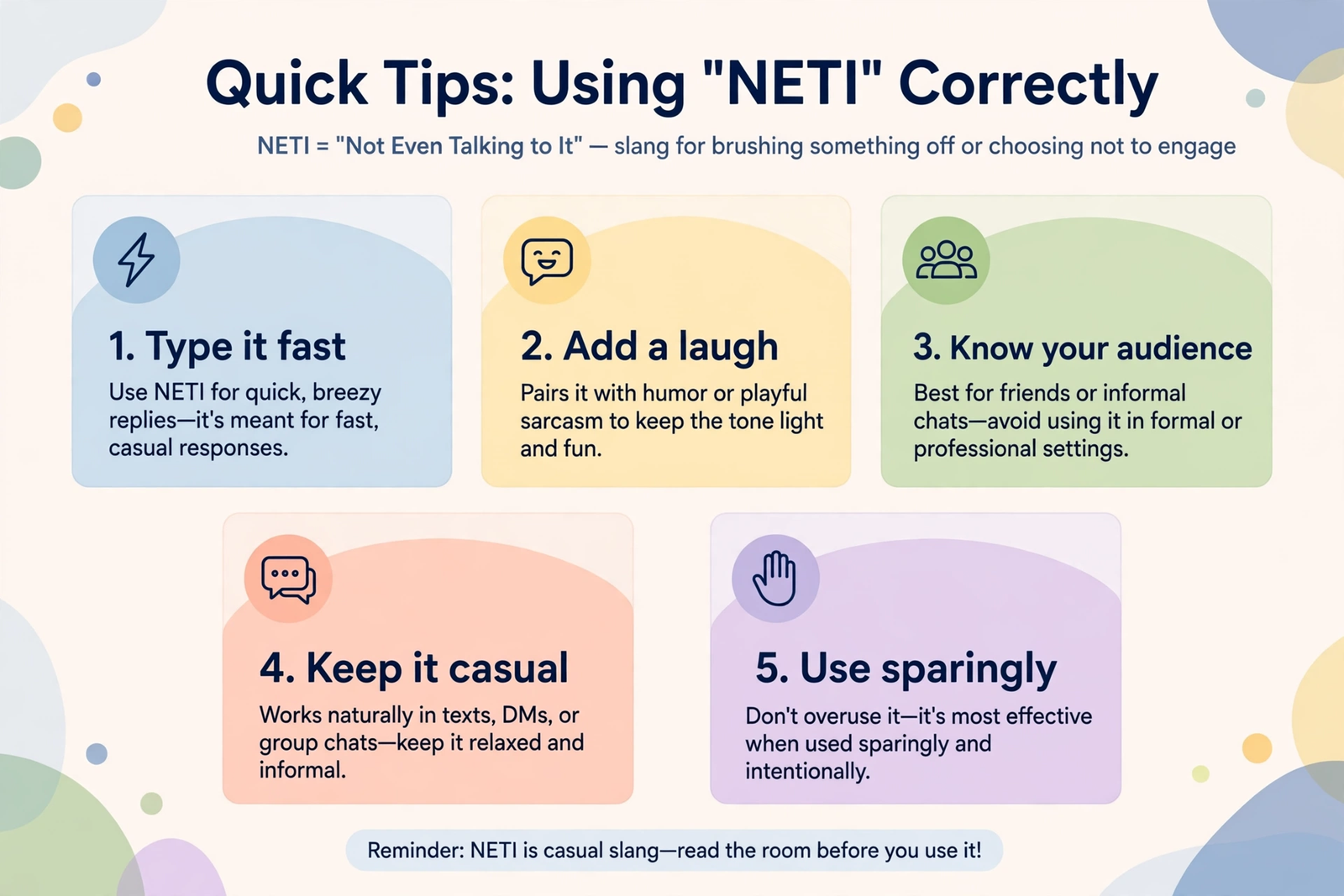
- Speed matters. In a group chat, neti works best when it is fast. The joke is the race. Type it, send it, and let the group laugh.
- Add a laugh or an excuse. “Neti lol” or “neti, I did it yesterday” lands better than a bare “neti” on its own, because it shows you are joking, not dismissing the group.
- Know your audience. Use it with friends, siblings, and gaming teammates. Avoid it with teachers, managers, clients, and anyone you are meeting for the first time.
- Do not use it twice in a row. Once is a joke. Twice is a pattern. If you dodge two tasks in a row, volunteer for the third one.
- Pair it with an offer. “Neti, but I’ll bring snacks” is the gold standard: a joke refusal plus a real contribution.
- Remember what it is not. Neti is not a no, not a pot, and not NEET. If the conversation is serious, medical, or about employment, you are in the wrong meaning.
FAQ

What does neti mean in slang?
In slang, neti means “not it” — a playful way of opting out of an unwanted task, chore, or dare. If someone asks who is doing something nobody wants to do, replying “neti” means “not me, pick someone else.” It is mostly used in group chats, TikTok comments, and Discord servers among younger users.
Where did neti slang come from?
Neti slang comes from two sources. The phrase itself is a compressed form of “not it,” the playground claim of exemption, shortened the way internet slang shortens everything. The word “neti” also echoes the Sanskrit phrase neti neti, meaning “not this, not that,” from the Upanishads. The slang use spread through TikTok, X, and Discord in the 2020s as a quick, funny refusal.
Is neti the same as NEET?
No. Neti is slang for “not it,” a playful opt-out. NEET stands for “Not in Education, Employment, or Training” and describes young people who are not studying, working, or in training. They are spelled differently, pronounced differently, and mean completely different things.
What is the difference between neti slang and a neti pot?
A neti pot is a small device used to rinse the nasal passages with salt water, a yoga practice called jala neti. Neti slang is a word used in chats to dodge a task. They share a name and nothing else. Context tells you which one someone means: a pharmacy or yoga studio means the pot, a group chat means the slang.
How do you use neti in a text?
Type “neti” on its own, or add a laugh or an excuse: “neti lol,” “neti, I did it yesterday.” Use it when someone is assigning an unwanted task in a friendly group chat. Do not use it for serious requests, at work, or with people who do not know the slang.
Is neti slang rude?
Usually not. Neti is designed to be a soft, funny refusal — much gentler than a flat “no.” It can become rude if you use it for every task, or if you use it to dodge something serious. Among friends, it reads as a joke. In formal settings, it reads as inappropriate, so save it for casual conversations.
What does “neti neti” mean?
“Neti neti” is the doubled, emphatic version of the slang — a funnier, more dramatic way of saying “definitely not me.” It also happens to be the original Sanskrit phrase meaning “not this, not that,” used in philosophy as a method of self-inquiry. In a group chat, it is the joke version. In a philosophy book, it is the serious version.
Can I use neti at work?
Not in formal work communication. Do not put “neti” in an email to your manager or a message to a client. In an informal team group chat where colleagues joke around, a playful “neti” about a low-stakes task like a lunch run is usually fine — especially if you follow it with something helpful, like volunteering for a different job.
Conclusion
Neti slang is a small word with a long history and a very specific job. It began as neti neti, a Sanskrit phrase meaning “not this, not that,” passed through the playground game of “not it,” and arrived in the group chat as a four-letter joke that lets you dodge a chore without sounding rude. Its value is precision: in the exact moment when someone asks who is doing the thing nobody wants to do, neti is the fastest, funniest answer available.
The things to remember are simple. Neti means “not it” — a playful opt-out, not a serious refusal. It belongs in friendly group chats, comment sections, and gaming lobbies, not in work emails or serious conversations. It is not NEET, it is not the neti pot, and it is not a firm no. Use it fast, use it with a laugh or an excuse, and do not use it for everything. And if you are the last one to type it, well — the job is yours. That is the game, and that is the whole point.
If you enjoyed this guide, you will probably like our other slang explainers too. Start with fn meaning in text for another short word that confuses everyone the first time they see it, then check out CFS meaning in text and TYSM meaning — two more chat abbreviations that do a lot of work in very few letters. And if group-chat language is your thing, our guide to HBU meaning in chat is the natural next read.
