
Quick definition: In slang, low key means something done quietly, secretly, or without making a big deal out of it. When someone says they “low key” like something, they mean they like it a lot but do not want to admit it loudly. The phrase low key slang covers this whole casual, under-the-radar way of talking that is everywhere in texts, TikTok captions, and group chats today.
low key slang Meaning & Definition
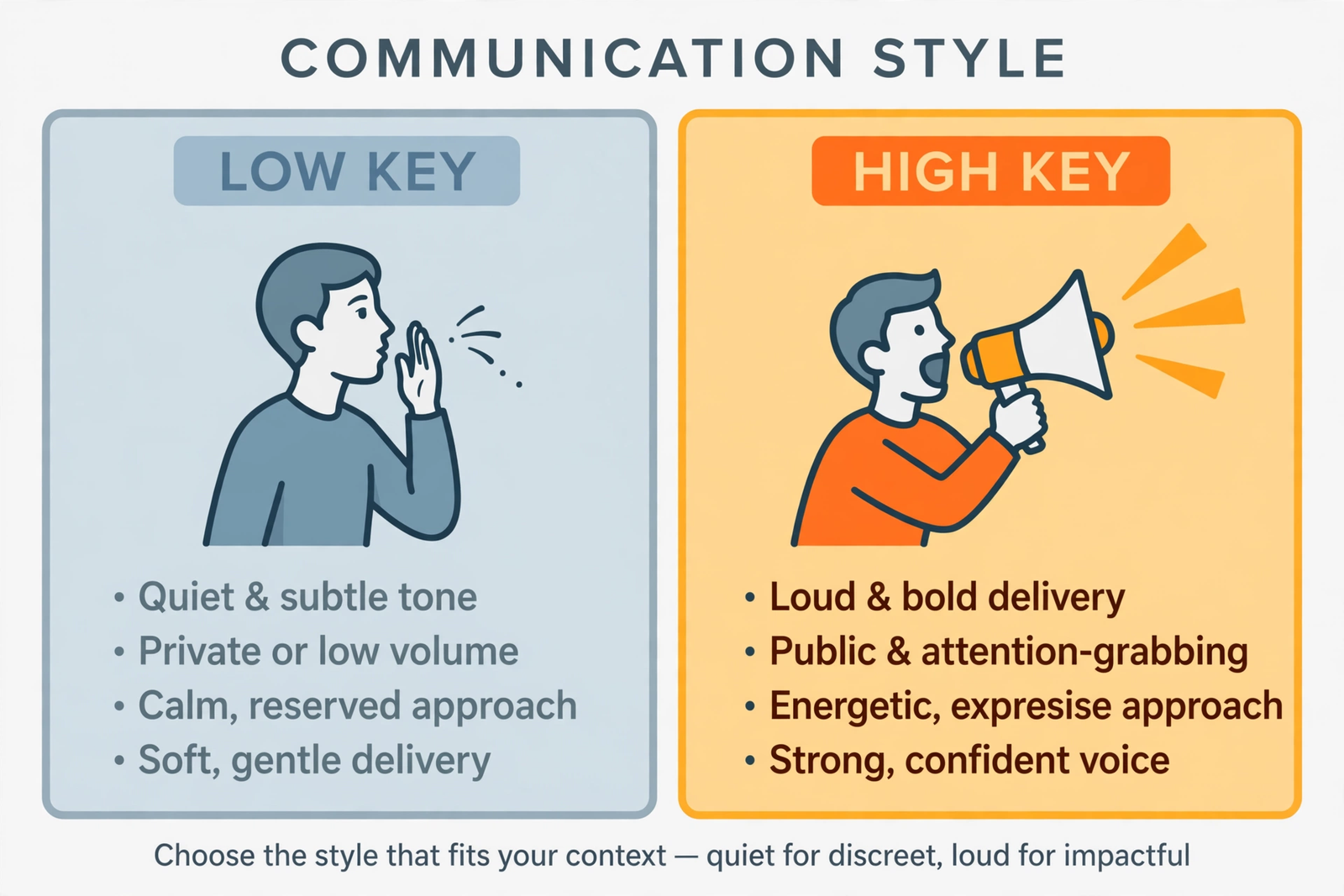
The term low key describes anything subtle, restrained, or kept on the down low. It is the opposite of “high key,” which means openly, obviously, or without any shame at all. If a party is low key, it is small and chill. If a crush is low key, you like that person but you are not about to announce it to the world. If someone says “low key, that movie was amazing,” they are quietly admitting something they might not say with full confidence in front of everyone.
Grammatically, low key works as both an adjective and an adverb. As an adjective, it describes a mood or an event: “It was a low key birthday, just pizza and a few friends.” As an adverb, it modifies how you feel or what you did: “I low key want to skip the meeting and stay home.” In both cases, the meaning stays the same: keep it quiet, keep it small, keep it real.
Here is the easiest way to remember it:
| Form | What it means | Example |
|---|---|---|
| Low key (adjective) | Quiet, relaxed, not flashy | “We are keeping the wedding low key.” |
| Low key (adverb) | Secretly, quietly, on the down low | “I low key love this song.” |
| Keep it low key | Do not draw attention to it | “Keep it low key, nobody knows yet.” |
| High key (opposite) | Openly, obviously, loudly | “I high key need a vacation.” |
One thing that confuses people is the spelling. You will see “low key,” “low-key,” and “lowkey” all over the internet, and all three are used. The two-word form “low key” is the most common in texts and captions, the hyphenated “low-key” is the traditional dictionary spelling, and the one-word “lowkey” is the fastest to type. They all mean the same thing, so use whichever feels natural — just stay consistent inside one message.
Introduction
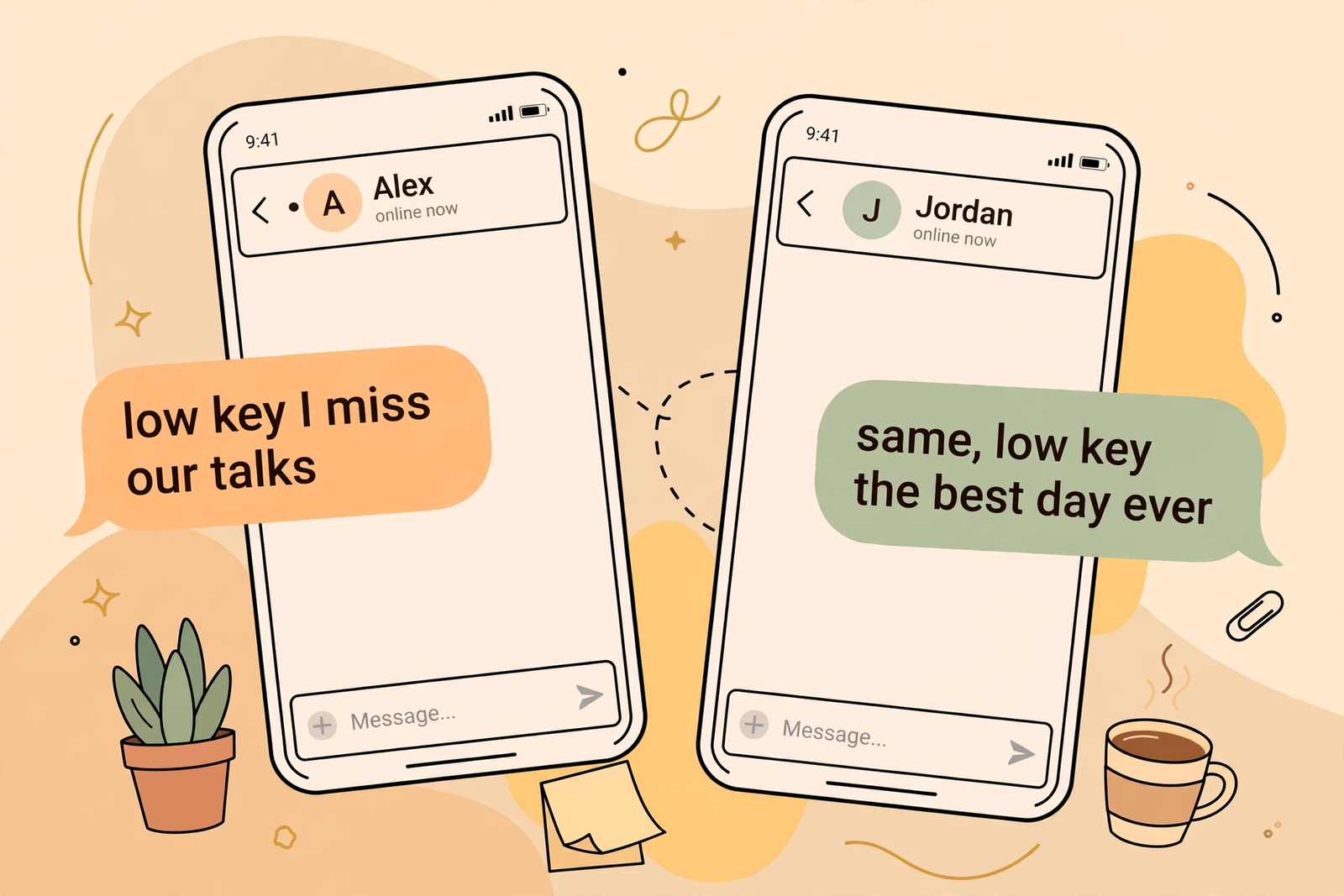
You have probably read it a hundred times without thinking twice: “low key the best day ever,” “I low key miss you,” or “let’s keep this low key.” The phrase is so baked into everyday online speech now that it barely registers as slang anymore. But for anyone who did not grow up texting in the 2010s, or for English learners trying to decode a group chat, low key slang can be genuinely confusing — because the literal words “low” and “key” have nothing to do with what it means.
That is exactly what this guide is for. We will break down what low key means in texting, where it came from, how it differs from “high key,” and how to use it without sounding forced. You will see real examples from friendly chats, work messages, and funny situations, a side-by-side comparison with similar slang, and the mistakes that make people misuse it. By the end, you will know exactly when to drop a “low key” into a sentence — and when to leave it out.

Origin
The phrase “low-key” is much older than TikTok, Instagram, or even texting. It started in music. In the early 1900s, musicians used “low-key” to describe a song played in a lower key or at a softer, more subdued pitch. From there it drifted into general English as a way to describe anything restrained or not intense: a low-key party, a low-key personality, a low-key celebration. Merriam-Webster defines “low-key” as quiet and relaxed, not very noticeable or showy — which is exactly how the slang is used today.
So how did a quiet little music term become internet slang? The jump happened in hip-hop and Black American English in the 2000s, where “low key” took on a second life as an adverb meaning “secretly” or “on the down low.” Rappers and online communities started using it to confess feelings they were not ready to say out loud — “I low key miss her” hits differently than just “I miss her,” because the “low key” adds a layer of privacy to it.
By the mid-2010s, the phrase had gone fully mainstream. Twitter, Tumblr, and then TikTok carried it into everyday speech for millions of young people, and today it is one of the most common slang adverbs in American English online. It survived while hundreds of other slang terms faded, because it fills a real gap: sometimes you need a word that says “I feel this strongly, but I am only telling you quietly.”
Popularity
Low key is not a passing trend. It has been in heavy rotation for more than a decade, and it keeps showing up because it is useful in almost any conversation. A few reasons explain why it stuck around while other slang terms burned out fast:
- It is versatile. It works for feelings, events, opinions, plans, and confessions. Almost any sentence can take a “low key” and still make sense.
- It is relatable. Everyone has felt something they were not ready to say loudly. Low key gives that feeling a name.
- It fits short-form content. TikTok captions, tweets, and text messages reward short, punchy words. “Low key” is two syllables of pure meaning.
- It sounds natural. Unlike slang that feels forced or try-hard, low key slides into normal sentences without changing how you talk.
- It has an opposite. Paired with “high key,” it forms a complete little system for describing how openly you feel about something, which makes both words more useful.
You will find it in TikTok comments (“low key obsessed with this sound”), Instagram captions (“low key the best weekend”), Twitter posts, group chats, gaming lobbies, and even the occasional work Slack message. It has crossed from youth slang into general casual English, which is the final test of whether a slang term has truly arrived.
How It Is Used
Most of the time, people use low key in one of four ways. Once you recognize the pattern, you will spot it everywhere.
1. To admit a feeling quietly
This is the most common use. Someone likes something, misses someone, or wants something — but saying it plainly feels too bold. “Low key” softens the confession. “I low key want to text him” means “I really want to text him, but I am not sure I should.” The phrase lets you be honest and cautious at the same time.
2. To describe a relaxed event or mood
“Let’s keep tonight low key” means no big plans, no dressing up, no drama — just something simple and easy. A low key hangout is the opposite of a wild night out. It is pizza on the couch instead of a crowded club.
3. To ask for secrecy
“Keep this low key” is a direct request: do not tell anyone. It is the modern version of “keep this between us.” If a friend says “low key, I am quitting my job next month,” they are trusting you with information that is not public yet.
4. To downplay something impressive
Sometimes people use low key to stay humble. “Low key, I got the highest score in the class” softens a brag into something that sounds almost accidental. It is a way of sharing good news without looking like you are showing off.
The tone matters a lot. Said warmly, low key feels intimate and honest. Said with a laugh, it can be playful or even a little sarcastic — “low key, that was the worst date of my life” is clearly a joke, not a secret. Context and punctuation do the heavy lifting, so read the whole message before you decide what someone means.
Examples
Real examples make the meaning click faster than any definition. Here are the ways low key shows up in everyday conversations, grouped by tone.
Friendly Examples
- “Low key, you are my favorite person to talk to.”
- “I low key miss our late-night talks.”
- “That was low key the best birthday I have ever had.”
- “Low key, I saved you the last slice of pizza.”
- “We should low key plan a trip this summer, just the two of us.”
Professional Examples
- “Low key, I think we should rethink the deadline before the client meeting.”
- “I low key prefer the first design — it feels cleaner.”
- “Let’s keep the launch low key this time and skip the big announcement.”
- “Low key, the new workflow is actually saving us a lot of time.”
- “I low key agree with your point, even if I did not say it in the meeting.”
Notice how the professional examples still work: low key softens an opinion at work without making you sound unsure. It signals honesty with a light touch, which is why it shows up in Slack and team chats more than people expect. Just keep it out of formal emails and client-facing documents — it is casual by nature.
Funny Examples
- “Low key, I have been talking to my plants and they are thriving.”
- “I low key ate the entire pizza and I regret nothing.”
- “Low key, my bed is the only relationship I am committed to right now.”
- “I low key googled my own name just to check.”
- “Low key, I pretended to be busy so I could stay home and watch TV.”
The funny examples work because low key turns a small confession into a punchline. Admitting something quietly makes it funnier — the understatement is the joke.
Comparison with Similar Terms
Low key has a few close cousins in slang, and mixing them up is easy. This table sorts out the differences so you can pick the right word every time.
| Term | Meaning | How it differs from low key |
|---|---|---|
| Low key | Quietly, secretly, without fuss | The baseline: restrained and private |
| High key | Openly, obviously, without shame | The exact opposite — loud and public |
| On the down low | Kept secret from others | Almost the same, but more about secrecy than mood |
| Lowkey flex | A humble brag, showing off subtly | A specific use: bragging while pretending not to |
| Chill | Relaxed, easygoing | Describes a vibe, not a secret feeling |
| Undercover | Hidden, secret identity or plan | Much stronger — implies real concealment |
| Subtle | Not obvious, understated | Formal English cousin; low key is the casual version |
The closest pair is low key and high key, and they are worth learning together. If you say “I low key love this song,” you are admitting it quietly. If you say “I high key love this song,” you are shouting it from the rooftops. Same feeling, completely different energy. Many people use both in the same conversation, switching between them to show exactly how strongly — and how publicly — they feel.
Another useful comparison is with “on the down low.” The two overlap heavily, but “on the down low” is almost always about keeping information from other people, while low key can also describe a mood, an event, or a personality. A “low key person” is calm and unflashy; you would never call someone “a down low person” to mean that.
Alternate Meanings
Most of the time, low key means what this article describes. But like any popular phrase, it has picked up a few alternate shades of meaning depending on where you see it.
| Context | Alternate meaning |
|---|---|
| Music | Played in a lower key or at a soft, subdued volume — the original meaning |
| Personality | Someone calm, private, and not attention-seeking: “She is very low key.” |
| Events | Small, simple, and relaxed: “a low key wedding with twenty guests” |
| Emotions | A feeling that is real but not intense or dramatic: “I am low key happy about it” |
| Gaming / streaming | Playing casually without try-harding: “just a low key stream tonight” |
The core idea never changes, though: something restrained, quiet, or understated. Whether it is a wedding, a feeling, or a stream, low key always points in the same direction — smaller, softer, less showy.
Professional or Polite Alternatives
Low key is perfect for friends and group chats, but it does not belong everywhere. In a job interview, a formal email, or a conversation with someone you do not know well, these alternatives carry the same meaning with a more professional tone:
- “Quietly” — “I quietly think this is our best option.” Clean, simple, and always safe.
- “To be honest” — Works when low key is softening a confession: “To be honest, I prefer the first design.”
- “In a subtle way” — Good for describing events or moods: “We kept the launch subtle this time.”
- “Privately” — Use it when low key means secret: “She told me privately that she is leaving.”
- “Understated” — The polished version for events and style: “an understated celebration with close family.”
- “On a smaller scale” — For plans and events: “Let us do this on a smaller scale.”
- “Between us” — For secrecy: “Between us, I am already looking for a new role.”
A good rule of thumb: if you would not use an emoji in the message, you probably should not use “low key” either. Save it for casual conversations and pick one of these alternatives when the setting calls for polish.
Common Mistakes
Low key is easy to use, but a few mistakes show up again and again. Avoid these and you will sound natural every time.
1. Using it in formal writing
Putting “low key” in a cover letter, a school essay, or a business proposal makes the writing look careless. It is casual slang, and formal readers will notice. Use “quietly” or “subtly” instead.
2. Overusing it in every sentence
“I low key went to the store and low key bought milk and it was low key amazing” is exhausting to read. One low key per message is usually enough. Like any strong flavor, it works best in small amounts.
3. Confusing low key with high key
They are opposites, so mixing them up flips your meaning completely. “I high key want to keep this a secret” is a contradiction — if you want it secret, it is low key. Double-check which one you mean before you hit send.
4. Using it when you mean “a little bit”
Low key does not mean “slightly.” Saying “I low key like him a little” is redundant and slightly off. Low key describes how openly you admit something, not how strongly you feel it. You can low key love something with your whole heart — you are just saying it quietly.
5. Spelling it inconsistently in one message
Switching between “low key,” “low-key,” and “lowkey” inside a single post looks sloppy. All three spellings are fine, but pick one and stick with it for that message.

Quick Tips
- Start small. If you are new to the phrase, try it first in a text to a close friend, not in a group chat with twenty people.
- Pair it with real feelings. Low key lands best when the feeling behind it is genuine. Forced slang is easy to spot.
- Use it to soften honesty. It is at its most useful when you are saying something true that feels a little risky to say out loud.
- Match your audience. Friends, siblings, and casual group chats are the home turf of low key slang. Formal settings are not.
- Remember the opposite. Learning “high key” alongside “low key” doubles your range — you can dial any feeling up or down.
- Read the room. If everyone in the chat is speaking casually, low key fits right in. If the conversation is serious or professional, pick a plainer word.
- Do not explain the joke. Never write “low key (meaning secretly)” in the same message. If the person does not know the term, they will figure it out from context — or ask.


FAQ
What does low key mean in slang?
In slang, low key means quietly, secretly, or without making a big deal of something. Saying “I low key love this song” means you love the song but are admitting it in a quiet, understated way rather than announcing it loudly.
What does “low key” mean in texting?
In texting, “low key” usually works as an adverb meaning “secretly” or “quietly.” For example, “I low key miss you” means “I miss you, but I am only admitting it softly.” It can also describe a relaxed plan: “Let’s keep tonight low key” means keep it simple and chill.
What is the difference between low key and high key?
Low key and high key are opposites. Low key means quietly or secretly, while high key means openly and obviously. “I low key like him” is a quiet confession; “I high key like him” is a loud, proud admission of the same feeling.
Is low key the same as “on the down low”?
They are very close but not identical. “On the down low” is almost always about keeping information secret from other people. Low key is broader — it can describe a secret feeling, but also a relaxed event, a calm personality, or a modest celebration.
How do you spell low key: low key, low-key, or lowkey?
All three spellings are used and understood. “Low key” (two words) is the most common in texts and social media, “low-key” (hyphenated) is the traditional dictionary spelling, and “lowkey” (one word) is the fastest to type. Pick one spelling per message and stay consistent.
Can you use low key at work?
In casual team chats with coworkers you know well, a light “low key” is usually fine. In formal emails, reports, meetings with clients, or job applications, use a professional alternative instead, such as “quietly,” “privately,” or “to be honest.”
What does “keep it low key” mean?
“Keep it low key” means do not draw attention to something — keep it quiet, simple, and private. It can refer to a secret (“Keep it low key, nobody knows yet”) or to a plan (“Let’s keep the party low key, just close friends”).
Where did low key slang come from?
The phrase started in music, where “low-key” described a song played in a lower key or at a softer volume. It moved into general English meaning “restrained,” then into hip-hop and Black American English in the 2000s as slang for “secretly.” Social media carried it mainstream in the 2010s, and it has stayed in everyday use ever since.
Conclusion
Low key slang is one of those rare phrases that is simple, useful, and built to last. At its heart it means one thing: something felt or done quietly, without fuss or fanfare. Whether you are admitting a crush, planning a chill night in, or asking a friend to keep a secret, it gives you a way to be honest without being loud about it.
The key takeaways are easy to remember. Use low key for feelings you want to admit softly, for events you want to keep small, and for information you want to keep private. Keep it out of formal writing, do not use it in every sentence, and never confuse it with its opposite, high key. And if you want to explore more everyday internet language, check out our guides to slang translator tools, cool synonym slang words, and yfm meaning slang — plus the middle school slang guide if you are trying to decode what the kids are saying. Once low key clicks, you will start noticing it everywhere — low key, you probably already use it more than you think.
