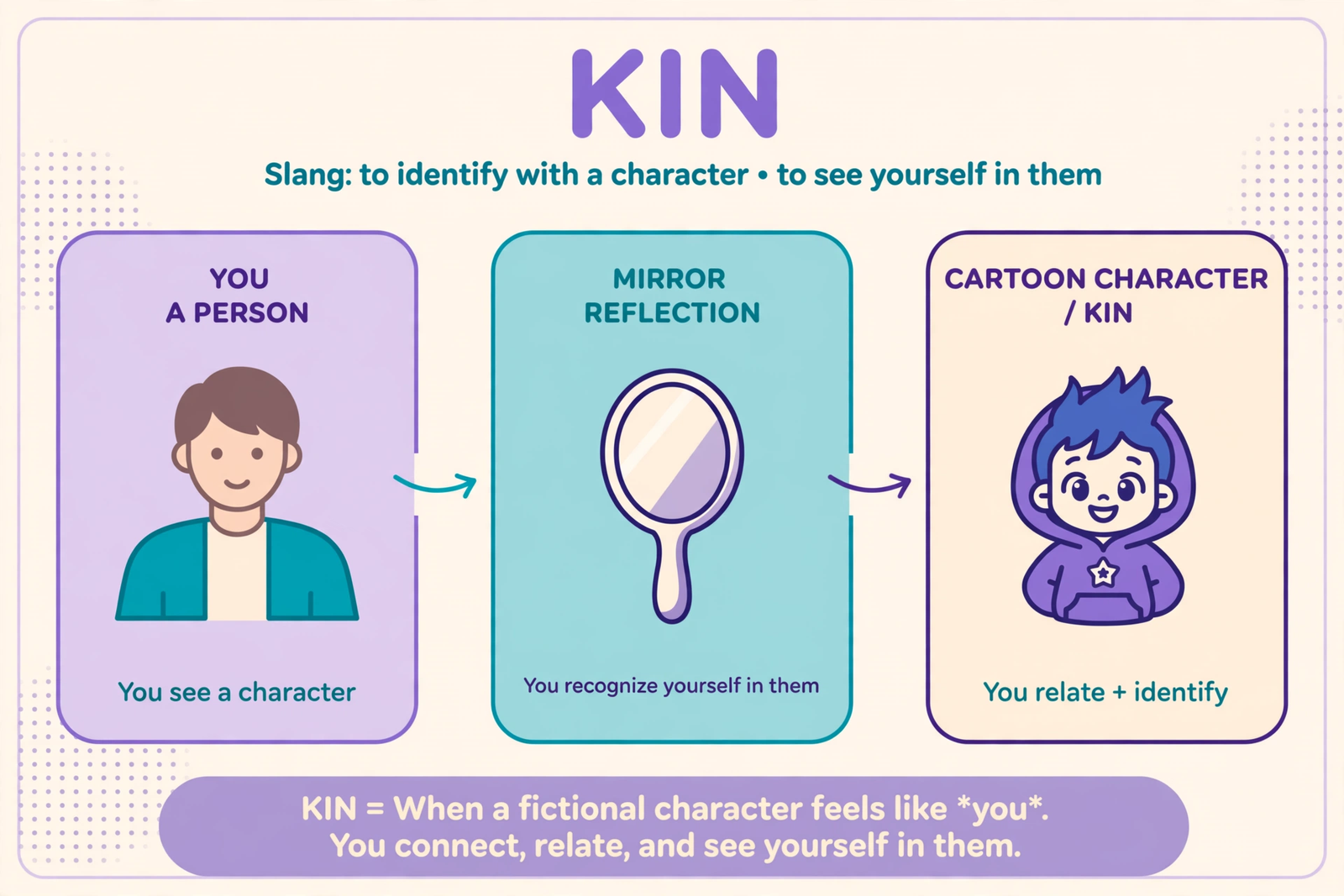
Quick definition: In slang, kin means to identify with or relate deeply to a character, celebrity, or personality — to see yourself in them. When someone says “I kin him,” they mean “that character is so me.” The word comes from the old idea of kinship and family, but online it is all about emotional connection, not blood relations.
kin meaning slang & Definition
The kin meaning slang is simple once you hear it in context: to kin someone is to feel that a fictional character (or sometimes a real person) reflects your personality, your struggles, your humor, or your whole vibe. It is stronger than just liking a character. Liking means you enjoy watching them. Kinning means you recognize yourself in them.
Think of it this way. You watch a show, and one character overthinks everything, makes sarcastic jokes when they are nervous, and secretly cares too much about their friends. You turn to your friend and say, “That is literally me. I kin them so hard.” That sentence carries the whole meaning of the word: recognition, relatability, and a little bit of “someone finally gets me.”
Kin works as more than one part of speech:
- Kin (noun): A character you deeply relate to. “Gojo is my kin.”
- Kin (verb): To identify with a character. “I kin that tired, sarcastic side character.”
- Kinning (verb, present tense): The act of relating to or identifying with a character. “She has been kinning that villain all season.”
- Kinnie (noun): A person who kins a character. “He is such a kinnie for that anime protagonist.”
- Kins (noun, plural): A list of characters someone relates to, often shown in a social media bio. “My kins: Levi, Miles Morales, Wednesday Addams.”
The key point is that kinning is about identification, not admiration. You can admire a character without kinning them, and you can kin a character you would never want to be. Plenty of people kin villains, messy side characters, or anxious overthinkers — not because they look up to them, but because the character feels uncomfortably familiar.
Introduction
Scroll through TikTok, X (Twitter), Discord, or any fandom corner of the internet and you will run into the word kin sooner or later. “New kin unlocked.” “I kin her so bad.” “POV: you kin the character with abandonment issues.” If you did not grow up in anime or Tumblr fandom spaces, the word can look confusing — especially because kin is also a perfectly normal English word for family. So what changed?
Online, kin took its old meaning — family, people who belong to you — and stretched it into something emotional. Your “kin” became the characters who feel like you. The ones whose reactions you would have, whose jokes you would make, whose bad decisions you completely understand. It is a shortcut for saying “I see myself in this person” without writing a whole paragraph about your personality.
That is why the word spread so fast. Fandom culture runs on recognition. People bond over shared favorites, shared jokes, and shared feelings, and kin gives that bond a single word. It shows up in TikTok captions, in Discord bios, in Reddit threads, and in everyday texting between friends who watch the same shows. And like delulu, another fandom-born slang term that escaped into mainstream TikTok, kin started in a niche community and is now something you will hear far beyond it.
In this guide, we will break down the full kin meaning slang, where it came from, how it is used on TikTok and in texts, how it compares to similar slang, the mistakes people make with it, and the polite alternatives to use when “kin” does not fit the room.
Origin
The word kin itself is ancient. It comes from the Old English word cynn, which meant family, race, or kind — the people you belong to by blood. Merriam-Webster defines kin as family or relatives, and that traditional meaning is still alive today, especially in Southern and Appalachian English in the United States, where people say things like “He is my kin” or “all my kith and kin” to talk about relatives.
The slang meaning grew out of that same idea of belonging — but it grew online, not in everyday speech. In the early 2010s, Tumblr fandom communities started using “kin” to describe a deep identification with a fictional character. Back then, the meaning was often more serious and personal than it is today. In some communities, saying you “kinned” a character meant you felt a spiritual or identity-level connection to them — that on some level, you were that character. Related communities formed around terms like otherkin and fictionkin, where the identification went beyond fandom and into personal identity.
By the mid-2010s, the word had loosened up. On Tumblr, Reddit, and anime forums, “kin” started to mean something lighter: heavy relatability rather than literal identity. You did not have to believe you were the character — you just had to feel deeply seen by them. That shift is what made the word portable. It moved from identity forums into fanfiction circles, roleplay servers, cosplay groups, and personality-type communities.
Then TikTok arrived and pushed kin into the mainstream. Around 2020 and 2021, TikTok creators began making “POV: you kin this character because…” videos, listing relatable traits over clips of anime and TV characters. The hashtag #kin gathered hundreds of millions of views. What had been fandom shorthand became a mainstream Gen Z slang word, used by people who had never set foot on Tumblr and had no idea the word once carried a much deeper meaning.
Popularity
Kin is popular because it solves a communication problem. Before kin, explaining that a character felt like you took a sentence or two. Now it takes one word. That efficiency is exactly what internet slang rewards, and it is the same reason terms like Aura Points took off on TikTok: a whole social judgment, compressed into a phrase everyone instantly understands.
A few forces pushed kin into the spotlight:
- Anime and fandom growth: Anime went mainstream in the 2020s, and with it came the fandom vocabulary built around it. Characters from shows like Attack on Titan, Jujutsu Kaisen, Spider-Verse, and Wednesday became shared reference points for millions of people.
- TikTok’s POV format: “POV: you kin…” videos are built for the For You Page. They are short, funny, and instantly relatable — perfect for comments like “called out” and “this is literally me.”
- Bio culture: People list their kins in their bios on TikTok, Discord, and X, the same way they list their zodiac sign or MBTI type. A kin list is a personality summary in character form.
- Relatability as content: The entire “literally me” meme culture runs on recognition. Kin is the fandom version of that feeling, and it fits neatly into captions, comments, and reaction videos.
Today, kin is most common among Gen Z and younger millennials, in fandom spaces, anime communities, gaming Discords, and TikTok comment sections. It is still growing: new shows and new characters mean new kins, and every viral character spawns a fresh round of “I kin them” posts. The word has stayed relevant because it keeps adapting — from Tumblr identity term, to fandom shorthand, to everyday TikTok slang.
How It Is Used
Kin is flexible, and that flexibility is part of its charm. Here is how it shows up in real conversations:
As a verb — “I kin them.” This is the most common use. It means “I relate to this character deeply.” Example: “I kin Miles Morales so much — same energy, same family pressure.”
As a noun — “He is my kin.” This names the character you relate to. Example: “Wednesday Addams is my kin, no explanation needed.”
As a list — “My kins are…” People post their kin lists in bios and profiles as a quick personality snapshot. Example: “kins: Gojo, Levi, Mikey.”
As a reaction — “New kin unlocked.” Said when you discover a new character you relate to, often after watching a show or a clip. Example: “Just watched that episode. New kin unlocked: the tired, sarcastic side character.”
As a joke — “I kin that struggle.” Kin can also apply to situations, not just characters. “I kin that feeling of pretending to be fine in a group chat” means you relate to the experience itself.
As an adjective-like label — “kinnie.” A kinnie is someone who kins a particular character. “She is a total Levi kinnie” means she strongly identifies with Levi.
The tone matters. Most of the time, kin is used lightly and playfully — a joke, a compliment to a character, a way of bonding with friends over a shared favorite. But it can also be sincere. When someone says they kin a character who deals with anxiety, grief, or feeling like an outsider, they are often saying something real about themselves. Context tells you which one it is.
Examples
Here is how kin actually sounds in texts, TikTok comments, and everyday chats.
Friendly Examples
- “Omg I kin her so bad, she is literally me when someone cancels plans.”
- “You kin that character too? We are the same person, honestly.”
- “My kins are all chaotic characters and I am not even sorry about it.”
- “New kin unlocked: the girl who overthinks a two-word text for an hour.”
Professional Examples
Kin is casual slang, so it rarely belongs in a work email or a formal message. But it does show up in relaxed, creative workplaces and in content about fandom, social media, or youth culture:
- “For our social campaign, we are leaning into the ‘kin’ trend — characters our audience sees themselves in.”
- “The audience kins the underdog character, which is why that storyline performs so well.”
- “In the comments, fans keep saying they kin the main character’s work-life balance struggle.”
If you are writing for a general or professional audience, use it only when the audience knows the slang — otherwise, “relate to” or “identify with” is the safer choice.
Funny Examples
- “Why do I kin every tired, sarcastic character? Send help.”
- “I kin that character who says ‘I’m fine’ and then dramatically stares out a window.”
- “POV: you kin the villain because the hero is honestly kind of annoying.”
- “Me: I’m a mature adult. Also me: I kin a cartoon character with abandonment issues.”

Comparison with Similar Terms
Kin sits close to several other slang words, but each one means something slightly different. Here is the breakdown:
| Term | What It Means | How It Differs from Kin |
|---|---|---|
| Kin | You see yourself in a character; deep identification. | The baseline — it is about identity and recognition. |
| Relate / “Literally me” | You recognize yourself in something. | Broader and more casual; kin is fandom-specific and usually character-based. |
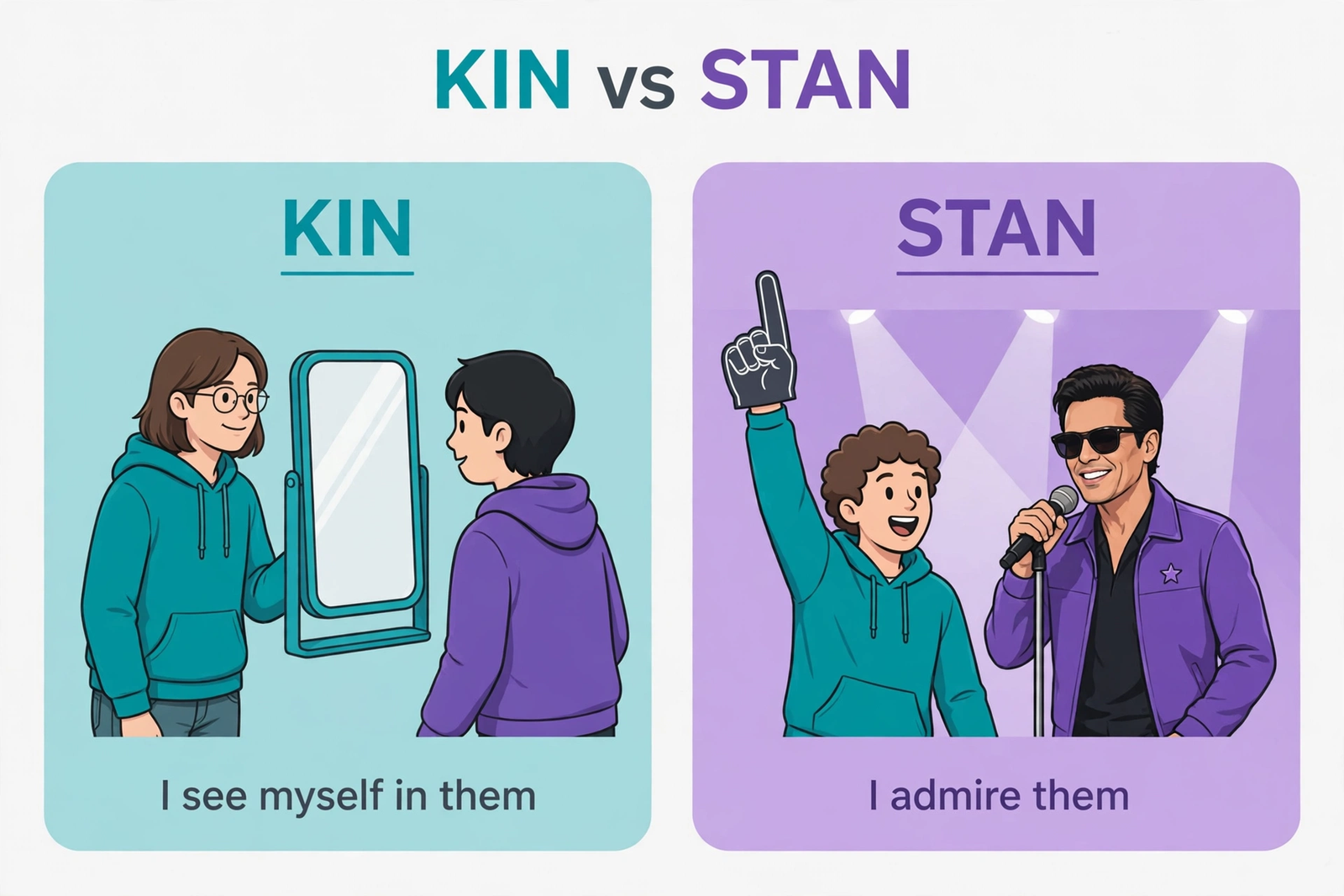
| Stan | You are an obsessive, devoted fan of someone. | Stan is about admiration and devotion; kin is about identification. You can stan a character you do not kin. |
| Favorite / Fave | The character you like most. | Your favorite is who you enjoy most; your kin is who you are most like. They are often different characters. |
| Mood | A feeling or vibe you share right now. | “Mood” is temporary and situational; kin is a deeper, lasting identification. |
| Delulu | Being delightfully delusional, often about a celebrity crush. | Delulu is playful fantasy; kin is recognition of the self. See our delulu meaning guide for the full breakdown. |
| Kink | An unconventional interest, often in dating or fandom contexts. | Completely different word — do not confuse them. Our kink meaning slang guide explains that term separately. |
The most useful rule of thumb: if you are saying “that character is me,” you mean kin. If you are saying “I love that character more than anything,” you mean stan. If you are saying “that character is my favorite to watch,” you mean favorite. And if you are saying “I relate to that feeling right now,” you mean mood.
Alternate Meanings
Kin has a few meanings beyond the slang one, and context decides which applies:
- Family or relatives (traditional): The original meaning. “All my kin are coming for the holidays” means your relatives. “Next of kin” is the formal version used in hospitals and legal documents.
- Chosen family: In casual speech, especially in Southern US English and in music, people call close friends kin. “You are my kin” can mean “you are like a brother or sister to me.”
- Otherkin / fictionkin (identity communities): In some online communities, “kin” historically described people who identify as a fictional character or non-human being on a deep, identity level. This is a more serious usage than the casual TikTok version, and it deserves respect — if someone uses kin this way, they usually mean it sincerely.
- Kin as a name or place: Kin also appears as a surname and in place names, but those uses have nothing to do with the slang meaning.
When you see kin online, the slang meaning is almost always the right one. When you hear it from an older relative at a family gathering, it almost certainly means family. Context does the work.
Professional or Polite Alternatives
Kin is casual internet slang. In formal writing, at work, or with people who do not know fandom culture, these alternatives carry the same idea without the slang:
| Instead of | Say | When to Use It |
|---|---|---|
| “I kin that character.” | “I really identify with that character.” | Reviews, essays, professional writing. |
| “She is my kin.” | “Her personality really resonates with me.” | Conversations with people outside fandom. |
| “New kin unlocked.” | “I just found a character I relate to.” | General audiences, social posts for mixed ages. |
| “I kin that struggle.” | “I can relate to that experience.” | Work chats, formal messages. |
| “My kins are…” | “The characters I relate to most are…” | Profiles or bios for a general audience. |
The rule is simple: use kin with friends, fandom spaces, and TikTok. Use “identify with” or “relate to” everywhere else.
Common Mistakes
Kin is a small word with a specific meaning, and people get it wrong in a few predictable ways:
- Confusing kin with kink: They sound similar but mean completely different things. Kin is about identifying with a character. Kink is about unconventional interests. Mixing them up can be embarrassing — double-check which word you mean.
- Using kin to mean “favorite”: Your favorite character is not automatically your kin. You can love a confident hero while kinning the anxious side character. Kin is about similarity, not admiration.
- Using kin to mean “like”: “I kin that video” is vague. Kin works best when it points to a character, a person, or a specific relatable experience — not to everything you enjoy.
- Claiming a kin you do not actually relate to: People sometimes list popular characters as kins to fit in. It is harmless, but it misses the point: a kin list is supposed to say something real about you.
- Using kin in formal settings: Dropping “I kin the CEO’s energy” in a meeting will confuse most people over thirty. Save it for casual contexts.
- Mocking otherkin or fictionkin communities: Some people use kin in a deep, identity-based way. Joking about that usage in front of them is rude, even if you only mean the casual TikTok version.
- Overusing it: If every character is your kin, none of them is. The word works because it is specific — save it for the characters that genuinely feel like you.

Quick Tips
- Start with one kin, not ten: Pick the character you relate to most. A short, honest kin list says more than a long one.
- Explain the why: “I kin her because she overthinks everything” is more interesting — and more relatable — than just naming the character.
- Use it in bios carefully: A kin list is a personality snapshot. Make sure the characters you list are ones you are happy to be associated with.
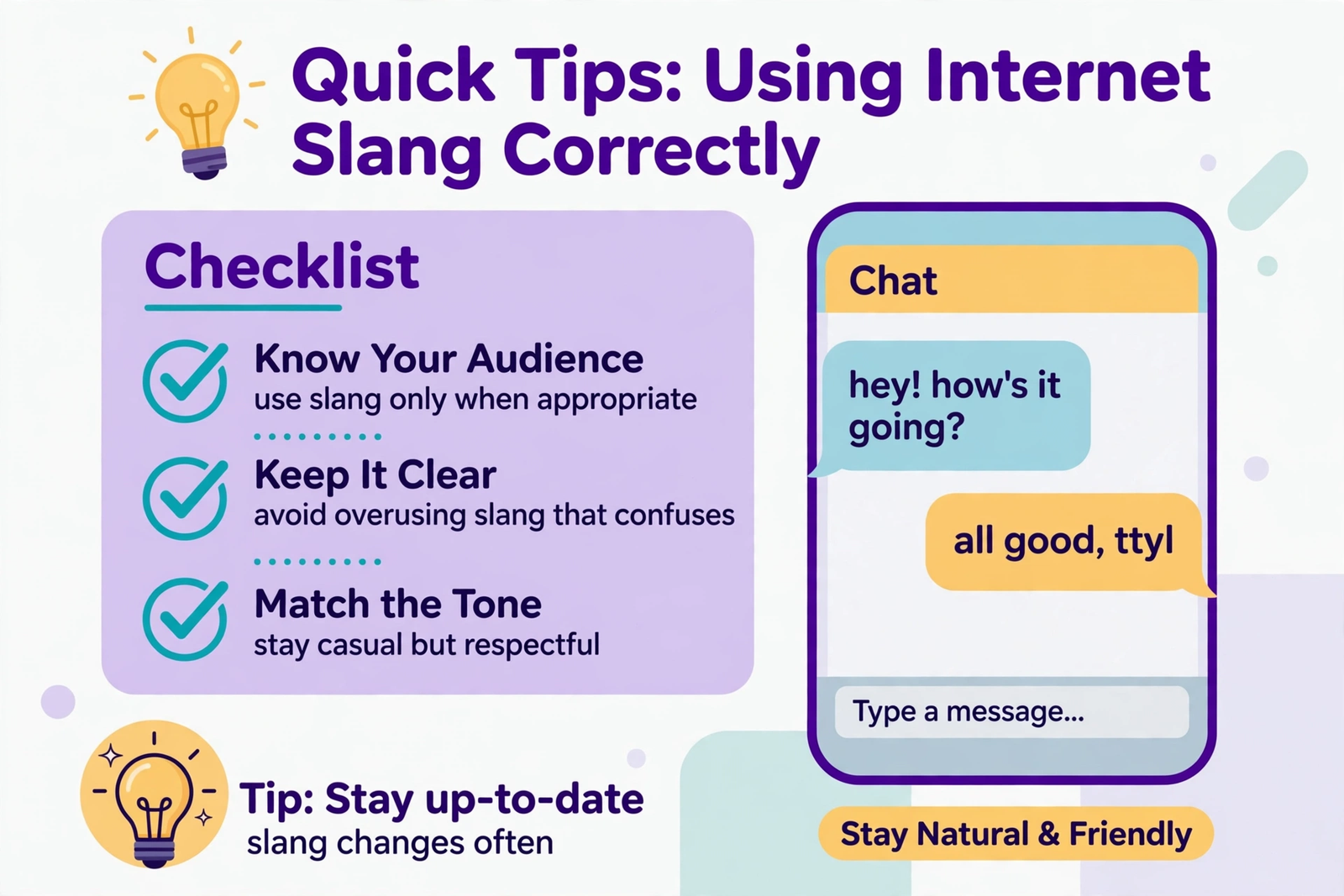
- Match the room: Kin is perfect for TikTok comments, Discord, and fandom chats. In mixed or professional company, say “I relate to” instead.
- Do not force it: If no character feels like you, that is fine. Kin is a tool for expressing recognition, not a test you have to pass.
- Respect the deeper meaning: Some people use kin in a serious, identity-based way. If someone tells you they kin a character, take it at face value.
- Pair it with examples: “I kin that character” lands better with a detail: “I kin her — the way she rehearse-argues in the shower is literally me.”

FAQ
What does kin mean in slang?
In slang, kin means to identify with or relate deeply to a character, celebrity, or personality. When someone says “I kin them,” they mean “I see myself in that character” — their personality, struggles, or vibe feel like their own.
What does “I kin that character” mean on TikTok?
On TikTok, “I kin that character” means the person feels a strong personal connection to the character in a video. It is usually said about anime, TV, or movie characters whose traits, reactions, or life situations match the viewer’s own.
Is kin the same as favorite character?
No. Your favorite character is the one you enjoy watching most. Your kin is the one you are most like. They can be the same character, but often they are not — people frequently love a confident hero while kinning a quieter, messier side character.
What is a kinnie?
A kinnie is a person who kins a particular character. If someone says “I’m a Levi kinnie,” it means they strongly identify with the character Levi. The term is common in anime and fandom communities.
What does “new kin unlocked” mean?
“New kin unlocked” is a playful way of saying you just discovered a new character you deeply relate to, usually after watching a show, a movie, or a TikTok clip. It is often used as a caption or a comment.
Where did kin slang come from?
The slang use of kin started in Tumblr fandom communities in the early 2010s, where it described identifying with a fictional character. It spread through anime forums, Reddit, and Discord, then exploded on TikTok around 2020–2021, where it became mainstream Gen Z slang.
Is kinning the same as roleplaying?
No. Kinning is about feeling that a character reflects who you are. Roleplaying is about acting as a character for fun or storytelling. You can kin a character without ever roleplaying as them, and you can roleplay a character you do not kin at all.
Can you kin a real person?
Yes, though it is less common. People sometimes say they kin a celebrity, a creator, or a friend whose personality or experiences mirror their own. Most of the time, though, kin refers to fictional characters.
Conclusion
The kin meaning slang comes down to one simple idea: seeing yourself in someone else. What started as an old English word for family became Tumblr fandom shorthand, then a TikTok staple, and now a everyday way for millions of people to say “that character is so me” in a single word.
Use kin when a character genuinely feels like you — when their jokes, their anxiety, their loyalty, or their chaos matches your own. List your kins in your bio if you want a quick personality snapshot. And remember the line that matters most: your favorite character is who you love to watch, but your kin is who you actually are. That distinction is the whole word.
If this guide helped, you may also enjoy our breakdown of FYP — the TikTok feed where most people discover their next kin in the first place. Now go find your kin. They are probably already on your For You Page.

1 thought on “Kin Meaning Slang: What Does Kin Mean in Texting, TikTok & Fandom?”