
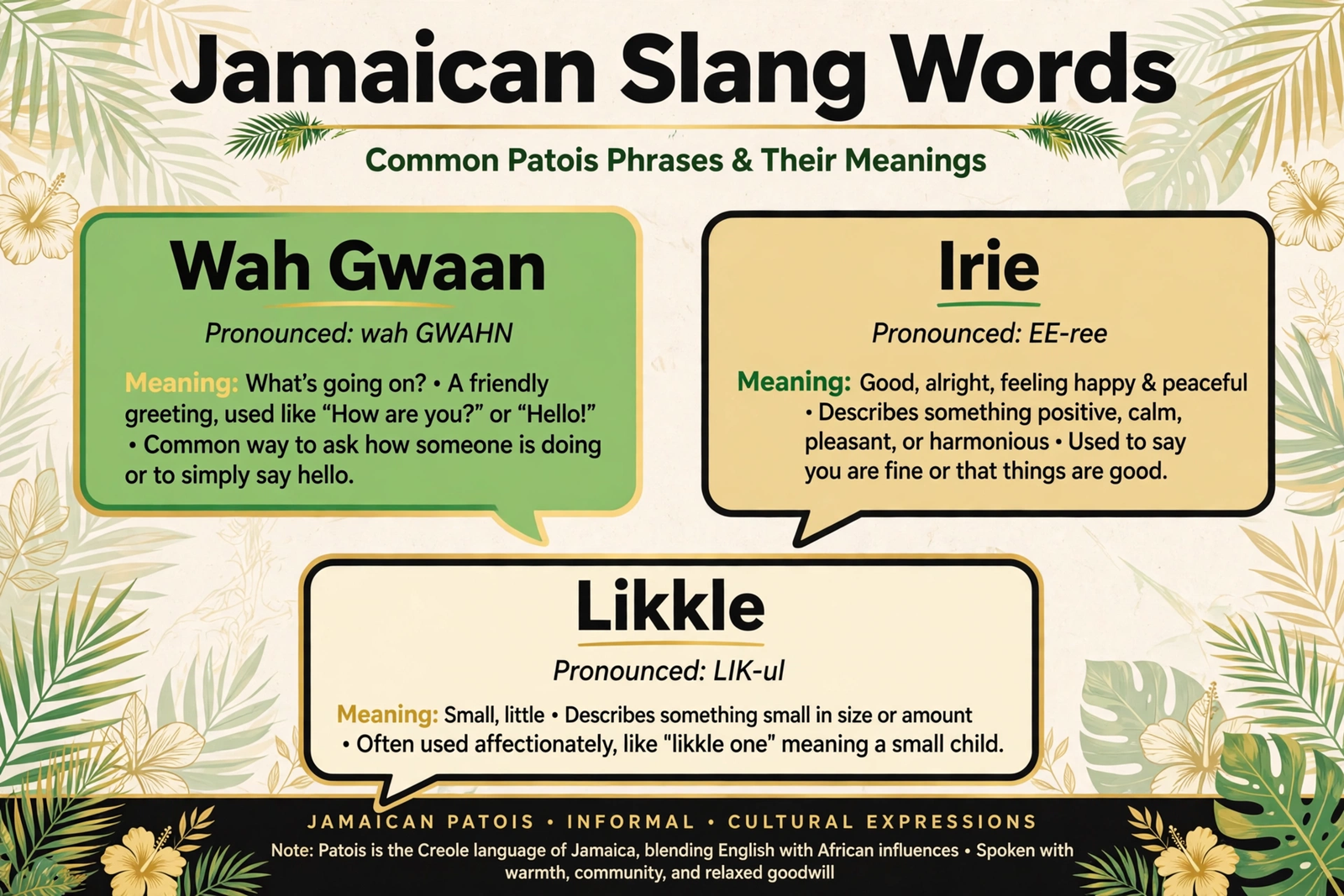
Quick definition: Jamaican slang words are informal words and phrases from Jamaican Patois — the English-based Creole spoken in Jamaica — used to greet people, express feelings, and describe everyday life. Popular examples include wah gwaan (what’s going on), irie (feeling good or alright), and yard (home or Jamaica itself). Below you will find 50+ Jamaican slang words with meanings, pronunciations, and real examples so you can understand them — and use them correctly.
Jamaican Slang Words Meaning & Definition
Jamaican slang words are the colorful, rhythmic expressions of Jamaican Patois (also called Patwa), the language most Jamaicans speak every day alongside standard English. Patois grew out of the languages enslaved Africans brought to the island, blended with English, Spanish, and West African words, and shaped by centuries of Jamaican culture, music, and street life.
When people search for Jamaican slang words, they usually want one of three things: to understand a lyric, a TikTok caption, or a friend’s message; to learn how to greet someone the Jamaican way; or to sound natural when they visit Jamaica. This guide covers all three. You will learn the greetings everyone uses, the words for friends and family, the expressions for money, food, and feelings, and the phrases you should avoid — because some Jamaican slang words are affectionate in one context and deeply insulting in another.
A quick note on pronunciation: Patois drops the “h” sound in many words, turns “th” into “d” or “t,” and often drops the final consonant. So that becomes dat, three becomes tree, and with becomes wid. The spelling in this guide follows the way Jamaicans actually write these words in texts and on social media.
Introduction
Walk through Kingston, scroll through dancehall TikTok, or listen to a Bob Marley record, and you will hear Jamaican slang words everywhere. They are short, musical, and packed with attitude — a single word like irie can carry a whole mood, and a greeting like wah gwaan can open any conversation on the island.
Jamaican slang is not just street talk. It is the everyday language of a whole country, spoken by taxi drivers, teachers, grandmothers, and Grammy-winning artists alike. Reggae and dancehall carried it around the world, so today you will hear Jamaican slang words in London, Toronto, New York, and Lagos — often from people who have never set foot in Jamaica.
That global spread is exactly why so many people get these words wrong. A phrase that sounds friendly in a song can be rude in a real conversation, and a word that means one thing in Kingston can mean something else entirely in a London group chat. This guide gives you the meaning, the tone, and the context for every term, so you can enjoy Jamaican slang without embarrassing yourself.
Origin
Jamaican Patois began in the 1600s and 1700s, when enslaved Africans from West and Central Africa were brought to Jamaica to work on sugar plantations. They spoke different African languages — Twi, Igbo, Yoruba, Kongo, and others — and had to communicate with English-speaking plantation owners and with each other. The result was a Creole: a new language built mostly on English vocabulary, but with African grammar, rhythm, and sentence structure. Linguists classify it as an English-based Creole, and you can read the full history of Jamaican Patois to see how it developed its own grammar and sound system.
Over time, Patois picked up words from other influences too. Spanish left its mark from Jamaica’s early colonial years, and later waves of Indian, Chinese, and Lebanese immigrants added their own words to the mix. Rastafari culture in the 1930s added a whole spiritual vocabulary — words like irie, Zion, and Babylon — that later spread worldwide through reggae.
For a long time, Patois was looked down on as “broken English” and banned in Jamaican classrooms. That changed in the late 20th century. Today, Patois is celebrated as a national treasure: it has its own Bible translation, its own dictionary, and a campaign for official recognition alongside English. Jamaican slang words are the most casual, creative layer of that language — the part that keeps changing with every new dancehall hit and every viral video.
Popularity
Jamaican slang words went global on the back of music. Bob Marley made irie and Zion known on every continent in the 1970s. Dancehall artists in the 1990s and 2000s — Sean Paul, Beenie Man, Vybz Kartel — turned slang into chart hooks. And in the 2020s, TikTok and Instagram did the rest: a dance challenge or a viral sound can push a Jamaican phrase into millions of group chats overnight.
Outside Jamaica, the biggest audiences for Jamaican slang are in the United Kingdom, Canada, and the United States, where large Jamaican diaspora communities keep the language alive. In London especially, words like wagwan (the British spelling of wah gwaan), mandem, and peng have blended Jamaican Patois with London street slang into a whole new dialect.
Search interest in Jamaican slang spikes whenever a dancehall song goes viral or a Caribbean artist trends on social media. Travelers also drive it: Jamaica welcomes millions of visitors a year, and many arrive wanting to greet locals properly instead of sounding like a textbook. If you are one of them, the greetings section below is your starting point.
How It Is Used
Jamaican slang words work differently from textbook English. A few rules will help you read any Patois sentence:
- Greetings come first, always. In Jamaica, jumping straight to business without a greeting is considered rude. Wah gwaan is the all-purpose hello.
- Tone changes meaning. Mi deh yah (“I’m here”) can be a calm answer or a warning, depending on how it is said. Listen to the tone before you copy the words.
- Words do double duty. Yard means both your house and Jamaica itself. Bloodclaat is both an intensifier and one of the strongest insults on the island — never use it casually.
- Short sentences win. Patois drops linking verbs: “You are hungry?” becomes Yuh hungry? and “I am going” becomes Mi a go.
- Context is everything. The same phrase between friends is playful; from a stranger, it can be a challenge. When in doubt, smile, stay polite, and let locals lead.
The tables below organize the most useful Jamaican slang words by category, so you can find the right word for any situation — greeting a friend, ordering food, or just understanding what the lyrics mean.
The 50+ Most Popular Jamaican Slang Words
Greetings & Everyday Phrases
| Jamaican Slang Word | Pronunciation | Meaning | Example |
|---|---|---|---|
| Wah gwaan | wah GWAHN | What’s going on / hello | “Wah gwaan, mi bredrin?” |
| Wagwan | WAH-gwahn | Same as wah gwaan (UK spelling) | “Wagwan, fam?” |
| Mi deh yah | mee deh YAH | I’m here / I’m fine | “Mi deh yah, yuh know.” |
| Yuh alright? | yuh all-RIGHT | Are you okay? | “Yuh alright? Long time mi nuh see yuh.” |
| Big up | big UP | Respect / shout-out | “Big up yuhself, king!” |
| Respect | re-SPEKT | Goodbye / showing respect | “Respect, mi a go now.” |
| Bless up | bless UP | Take care / God bless | “Bless up, see yuh tomorrow.” |
| Likkle more | LIK-kle more | See you later | “Likkle more, mi soon come back.” |
| Good morning / Mawnin | MAWN-in | Morning greeting | “Mawnin, Miss Brown!” |
| Walk good | walk GOOD | Take care (farewell) | “Walk good, mi friend.” |
People, Friends & Family
| Jamaican Slang Word | Pronunciation | Meaning | Example |
|---|---|---|---|
| Bredrin | BRED-rin | Close male friend / brother | “Dat a mi bredrin from school days.” |
| Sistren | SIS-tren | Close female friend / sister | “Mi sistren a come over later.” |
| Yardie | YAR-dee | A Jamaican person (often abroad) | “Di yardie dem a run di party.” |
| Yute | YOOT | A young person / kid | “Di yute dem a play football.” |
| Don | DON | A respected leader / boss | “Him a di don a di area.” |
| Gyal | GYAL | Girl / woman | “Di gyal dem a dance.” |
| Bwoy | BWOY | Boy / man | “Come yah, bwoy!” |
| Pickney | PICK-nee | Child / children | “Di pickney dem hungry.” |
| Madda | MAD-da | Mother (affectionate) | “Mi madda a cook ackee.” |
| Babymother / Babyfather | BAY-bee-madda | Co-parent of one’s child | “Mi babymother a pick up di pickney.” |
Feelings, Vibes & Attitude
| Jamaican Slang Word | Pronunciation | Meaning | Example |
|---|---|---|---|
| Irie | EYE-ree | Feeling good / alright / peaceful | “Every likkle ting irie.” |
| Ya mon | yah MON | Yes / of course / no problem | “Ya mon, mi a go help yuh.” |
| No problem | no PROB-lem | You’re welcome / it’s fine | “Tank yuh.” — “No problem.” |
| Zeen | ZEEN | Understood / okay / I get it | “Zeen, mi soon reach.” |
| Blessed | BLESSED | Doing well / grateful | “How yuh stay?” — “Blessed.” |
| Chillax | chill-LAX | Relax and take it easy | “Just chillax, nuh worry.” |
| Mad | MAD | Crazy good / impressive (positive) | “Di party did mad last night!” |
| Nice up | nice UP | To enjoy / have a great time | “Wi a go nice up di place.” |
| Cool and deadly | cool and DEAD-lee | Calm and confident | “Him just cool and deadly.” |
| Tuff | TUFF | Tough / strong / impressive | “Dat car tuff, eeh?” |
Food, Money & Everyday Life
| Jamaican Slang Word | Pronunciation | Meaning | Example |
|---|---|---|---|
| Yard | YARD | Home / Jamaica itself | “Mi a go back a yard.” |
| Nyam | NYAM | To eat | “Come nyam some food.” |
| Jerk | JERK | Spicy grilled meat style | “Wi a buy jerk chicken.” |
| Patty | PAT-tee | Baked pastry snack | “Gimme a beef patty.” |
| Ital | EYE-tal | Natural / vegetarian Rasta food | “Ital food good fi di body.” |
| Dollar / Dolla | DOL-lah | Money | “Mi need some dolla fi di taxi.” |
| Papaa | pah-PAH | Father / daddy (affectionate) | “Mi papaa a come later.” |
| Soon come | soon COME | I’ll be there soon (flexible timing!) | “Soon come, hold on.” |
| Reach | REECH | To arrive | “Mi soon reach a di shop.” |
| Bellyful | BELL-ee-full | Full after eating / satisfied | “Mi bellyful now.” |
Popular Expressions You Will Hear in Songs & on TikTok
| Jamaican Slang Word | Pronunciation | Meaning | Example |
|---|---|---|---|
| Dem a run di place | dem a run di PLACE | They’re in charge / dominating | “Di gyal dem a run di place.” |
| Tek weh yuhself | tek weh yuh-SELF | Leave me alone / go away | “Tek weh yuhself, man.” |
| Stop chat | stop CHAT | Stop talking nonsense | “Stop chat, yuh nuh know nutten.” |
| A weh di money deh? | a weh di MONEY deh | Where’s the money? | “A weh di money deh, bredrin?” |
| Wi a fawud | wee a FAH-wood | We’re moving forward / let’s go | “Wi a fawud, no time fi waste.” |
| Outta order | OUT-tah OR-der | Out of line / disrespectful | “Yuh outta order, bredrin.” |
| Nuh bodda | nuh BOD-dah | Don’t bother / don’t worry | “Nuh bodda yuhself.” |
| Mi nuh know | mee nuh KNOW | I don’t know | “Mi nuh know a weh him deh.” |
| Waam | WAHM | Warm / hot (attractive or cool) | “Di song waam, eeh?” |
| Fyah bun | FYAH bun | Fire burns (Rasta chant, passion) | “Fyah bun fi di wicked!” |
Examples
The best way to learn Jamaican slang words is to see them in real sentences. Notice how short the sentences are — Patois wastes no words.
Friendly Examples
- “Wah gwaan, mi bredrin? Long time mi nuh see yuh!” — What’s up, my friend? It’s been a long time since I’ve seen you!
- “Mi deh yah, blessed and irie.” — I’m here, doing well and feeling good.
- “Big up yuhself! Yuh did great today.” — Respect to you! You did great today.
- “Come nyam wid wi, wi have plenty food.” — Come eat with us, we have plenty of food.
- “Walk good, mi sistren. Likkle more!” — Take care, my sister. See you later!
Professional Examples
Jamaican slang also shows up in workplaces, especially among colleagues who know each other well. But here the rule is: keep it light and respectful.
- “Mawnin, boss. Mi a go sort out di report soon come.” — Good morning, boss. I’ll sort out the report shortly.
- “Respect, mi a go now. Bless up.” — Thank you, I’m leaving now. Take care.
- “No problem, mi a go handle it.” — No problem, I’ll take care of it.
- “Zeen, mi understand di plan.” — Understood, I get the plan.
With customers or senior managers, most Jamaicans switch toward standard English. Slang is for people you know — that is the real rule of Jamaican politeness.
Funny Examples
- “Di yute think him a don, but him cyaan even cook rice!” — The kid thinks he’s a boss, but he can’t even cook rice!
- “Yuh bellyful already? Wi just start nyam!” — You’re full already? We just started eating!
- “Soon come” in Jamaica can mean five minutes — or two hours. Ask any Jamaican and they will laugh before they deny it.
- “Mi madda say if yuh nuh nyam yuh food, yuh cyaan go play.” — My mom says if you don’t eat your food, you can’t go play.

Comparison with Similar Terms
Jamaican slang words often look similar to words from other English dialects, but the meanings can be very different. This table clears up the most common mix-ups.
| Jamaican Term | Meaning in Jamaica | Similar Term Elsewhere | Key Difference |
|---|---|---|---|
| Wah gwaan | Hello / what’s up | “What’s going on?” (US/UK) | Used as a greeting, not a real question — answer with “Mi deh yah,” not a life update |
| Yard | Home / Jamaica | “Yard” (US/UK: garden) | In Jamaica it means your home country, not a lawn |
| Irie | Feeling good, at peace | “Alright” (US/UK) | Irie carries a calm, spiritual, Rasta-rooted feeling — stronger than just “okay” |
| Bredrin | Close friend, like a brother | “Brethren” (UK church) / “Bro” (US) | Bredrin implies a deep, loyal bond — not just any acquaintance |
| Yute | Young person | “Youth” (standard English) | Yute is casual and affectionate; “youth” in formal English is just an age group |
| Don | Respected leader | “Don” (mafia boss, US/Italy) | In Jamaica a don is a community leader, not necessarily a criminal |
| Mad | Amazing, crazy good | “Mad” (angry, US/UK) | In Patois, “di party did mad” is high praise, not a complaint |
| Bloodclaat | Extreme intensifier / insult | “Bloody” (UK swear) | Far stronger and more offensive than “bloody” — never use it casually |
The comparison matters because many people borrow Jamaican words into US or UK slang — wagwan in London, irie in California — and the borrowed version often loses its original weight. Learning the Jamaican meaning keeps you from using a heavy word lightly. If you enjoy decoding slang across dialects, you will also like guides like based and CSL meaning in text, which break down internet slang the same way.

Alternate Meanings
Several Jamaican slang words change meaning completely depending on who says them and where:
- Yard: your house, your neighborhood, or Jamaica itself (“back a yard” = back home in Jamaica). Abroad, “yardie” can even be a label for a Jamaican immigrant.
- Mad: angry in standard English, but “mad” in Patois usually means impressive or wild in a good way. “Him mad” can mean he is crazy — or that he is brilliantly talented. Tone decides.
- Don: a respected elder or community leader in one neighborhood; in another context, a gang leader. Visitors should never call someone a don unless locals do first.
- Babylon: in Rasta culture, the corrupt system or the police; in everyday speech, it can just mean the authorities or “the system.” It is a spiritual word with political weight.
- Ital: strictly, the natural, salt-free Rasta diet — but in wider slang, “ital” now also means anything pure, natural, or vital.
- Zion: a holy place, Ethiopia, or heaven in Rasta belief; in songs, it often means a place of peace and freedom.
The pattern is simple: the deeper the word’s roots in Rastafari or street culture, the more meanings it carries — and the more careful you need to be with it.
Professional or Polite Alternatives
Jamaican slang is warm and expressive, but it is not for every setting. Here is how to translate the most common slang into polite, professional English:
| Jamaican Slang | Polite / Professional Alternative | When to Use It |
|---|---|---|
| Wah gwaan | Good morning / Hello, how are you? | Meeting someone for the first time, formal settings |
| Mi deh yah | I’m doing well, thank you | Answering a colleague or a customer |
| Ya mon | Yes, certainly / Of course | Agreeing in a meeting or with a client |
| Zeen | Understood / I understand | Confirming instructions at work |
| Bredrin / Sistren | My friend / My colleague | Referring to someone in a professional context |
| Soon come | I’ll be with you shortly | When a customer is waiting |
| Nuh bodda | Please don’t worry about it | Reassuring a guest or client |
| Big up | Thank you / I appreciate you | Praising someone formally |
Rule of thumb: with elders, strangers, officials, and customers, use standard English with a Jamaican accent and a warm smile. Save the slang for friends, family, and people who use it with you first.
Common Mistakes
These are the mistakes visitors and new learners make most often with Jamaican slang words:
- Using bloodclaat casually. It is one of the strongest swear words in Jamaica, tied to a sanitary cloth. Tourists who drop it for laughs can genuinely offend people. Never say it unless you fully understand the weight — and even then, do not.
- Calling everyone bredrin. A bredrin is a close, trusted friend. Calling a stranger your bredrin on first meeting can feel presumptuous or even fake.
- Taking soon come literally. In Jamaica, “soon come” is a flexible promise, not a time. It can mean five minutes or the afternoon. Relax and go with the flow.
- Overdoing the accent. Copying a heavy Patois accent as a visitor often comes across as mocking. Use the words, keep your own accent, and let locals set the pace.
- Mixing up irie and high. Irie means peaceful and content, not intoxicated — although the two ideas overlap in Rasta culture, using “irie” to mean “high” is a shallow reading of a spiritual word.
- Using gyal for any woman. It is casual and often affectionate among friends, but calling an older woman or a professional colleague “gyal” can be disrespectful.
- Assuming every Jamaican speaks only Patois. Most Jamaicans switch smoothly between Patois and standard English depending on the situation. Both are real Jamaican speech.

Quick Tips
- Learn five greetings first: wah gwaan, mi deh yah, ya mon, bless up, and walk good. Those five cover almost every hello and goodbye you will need.
- Listen before you speak. Spend a day hearing how locals use a word before you try it yourself — especially with words like don or mad.
- Pair slang with a smile. A warm tone covers a multitude of learner mistakes in Jamaica. People appreciate the effort.
- Use slang to understand, not to perform. The goal is to follow lyrics, captions, and conversations — not to sound like you grew up in Kingston.
- Learn the food words. Nyam, jerk, patty, ital, and ackee will serve you three times a day on any trip to Jamaica.
- Watch dancehall videos with lyrics. Artists like Sean Paul and Vybz Kartel are walking dictionaries of Jamaican slang words — and the comments section usually explains the newest ones.
- Ask when you are unsure. Jamaicans are famously proud of their language and usually happy to explain a word — asking shows respect, not ignorance.

FAQ
What is the most common Jamaican slang word?
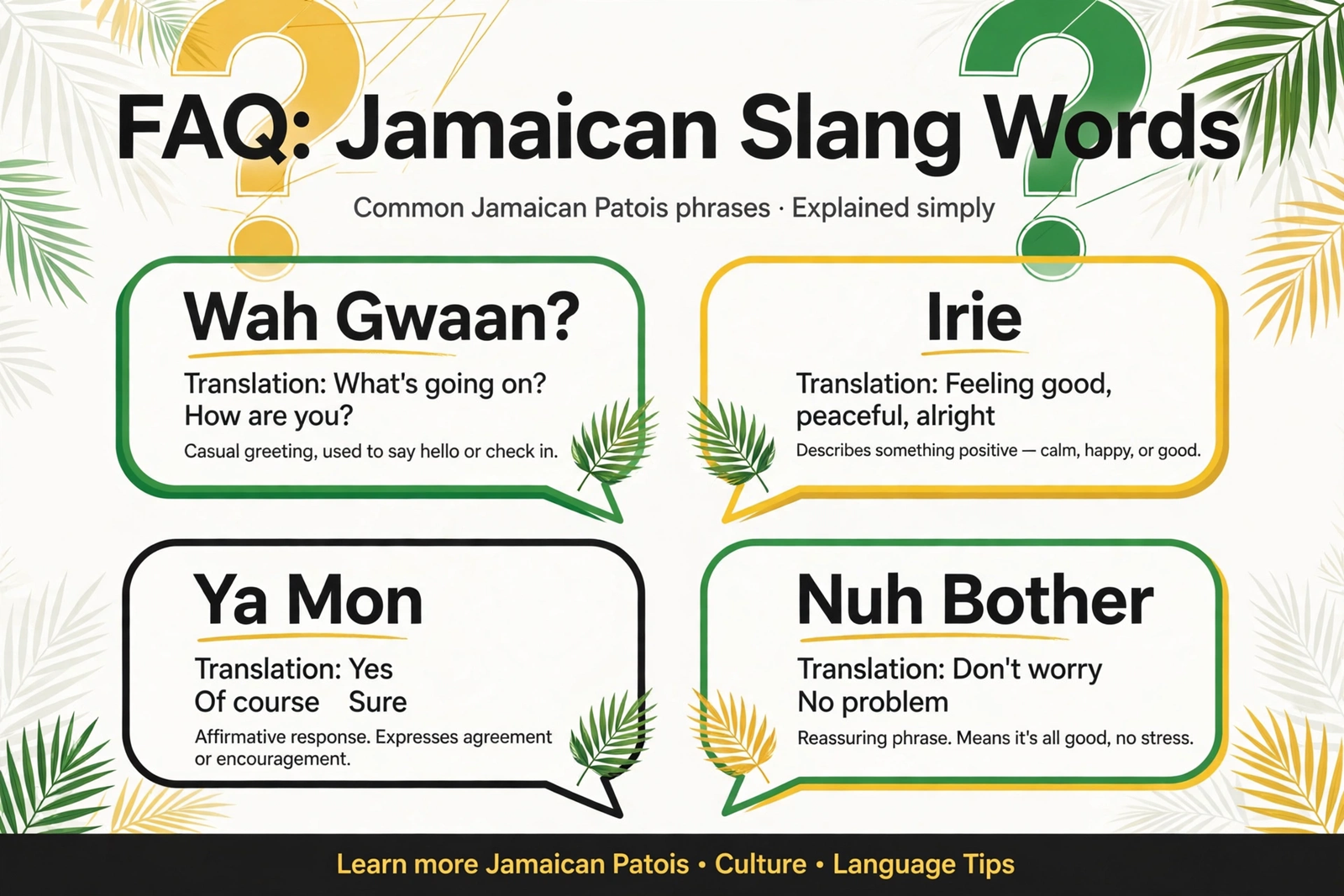
Wah gwaan is the most common Jamaican slang word. It means “what’s going on” and works as a universal greeting — the Jamaican equivalent of “hey, what’s up?” You will hear it dozens of times a day anywhere on the island.
What does “irie” mean in Jamaican slang?
Irie means feeling good, alright, or at peace. It comes from Rastafari culture and describes a calm, positive state of mind. “Every likkle ting irie” means everything is fine. It is one of the most positive Jamaican slang words and is safe to use in almost any friendly context.
What does “ya mon” mean?
Ya mon means yes, of course, or no problem. It is an agreement, an answer, and a whole attitude in two words. If someone asks “Yuh a come?” (Are you coming?) and you say “Ya mon,” you have said yes with confidence.
What does “bredrin” mean in Jamaican slang?
Bredrin means a close male friend — literally “brethren,” but used for a friend who is like a brother. The female equivalent is sistren. It implies loyalty and a long bond, so it is best used for real friends, not strangers.
Is it rude to use Jamaican slang as a tourist?
No — Jamaicans generally love it when visitors try a few words, especially greetings like wah gwaan and bless up. What is rude is overdoing it, mocking the accent, or using heavy words like bloodclaat. Keep it light, respectful, and friendly, and you will be welcomed.
What is the difference between Patois and Jamaican slang?
Patois (Patwa) is the full language — a Creole with its own grammar, spoken by most Jamaicans daily. Jamaican slang words are the informal, trendy, expressive layer within Patois: the greetings, the attitude words, and the street expressions that change fastest. All slang is Patois, but not all Patois is slang.
What does “yard” mean in Jamaican slang?
Yard means home — your house, your neighborhood, or Jamaica itself. “Mi a go a yard” means “I’m going home.” A Jamaican living abroad is often called a yardie. It is one of the warmest words in the language because home is central to Jamaican identity.
What are some Jamaican slang words for money?
Common Jamaican slang words for money include dolla (money in general), money itself used emphatically (“a weh di money deh?”), and in dancehall, bankroll and paper. In everyday speech, most Jamaicans just say dolla or money — simple and direct.
Conclusion
Jamaican slang words are more than fun phrases to drop into a caption — they are the living voice of a language that survived slavery, crossed oceans on reggae records, and now lives in group chats from Kingston to London to Toronto. From wah gwaan to irie, from bredrin to yard, these words carry history, humor, and warmth in a handful of syllables.
The key takeaways are simple. Start with the greetings — they open every door in Jamaica. Learn the feeling words like irie and ya mon so you can follow any conversation. Respect the heavy words and skip them entirely. And remember that the best way to learn Jamaican slang words is the Jamaican way: listen first, speak with a smile, and enjoy the rhythm of it.
Whether you are planning a trip to Jamaica, decoding a dancehall lyric, or just trying to understand what your friend’s text means, you now have 50+ Jamaican slang words with meanings, pronunciations, and real examples. Walk good, bless up — and ya mon, yuh ready now. For more slang explained the same way, explore guides like FN meaning in text and what does merch mean in slang, and keep building your vocabulary one word at a time.

3 thoughts on “Jamaican Slang Words: 50+ Patois Terms, Meanings & Examples”