Quick definition: Jewish slang is the colorful set of Yiddish and Hebrew words and expressions — like mensch, chutzpah, kvetch, and schlep — that moved from Jewish homes and neighborhoods into everyday American English. Most people use these words without realizing where they came from, and the jewish slang meaning is really about warmth, humor, and saying in one word what English needs a whole sentence to explain.
Jewish Slang Meaning & Definition
The phrase jewish slang meaning is searched by people who keep hearing words like oy vey, mazel tov, and nosh in movies, TV shows, group chats, and everyday conversation — and want to know what they actually mean. The short answer: Jewish slang is mostly Yiddish, the historic language of Ashkenazi Jews in Central and Eastern Europe, mixed with a smaller set of Hebrew words. Over the last hundred years, dozens of these words crossed into mainstream English, and today millions of Americans use them without speaking a word of Yiddish.
What makes this slang special is its personality. Yiddish is famously expressive: it has a perfect word for the friend who always complains (kvetch), the person with unbelievable nerve (chutzpah), the exhausting trip across town (schlep), and the rare person of true character (mensch). English has words for these things, but none of them carry the same flavor. That is exactly why Jewish slang survived — it fills gaps in English with humor and precision.
It is worth one clarification up front. When people say “Jewish slang,” they almost always mean Yiddish slang. Hebrew is the ancient language of prayer and of modern Israel, while Yiddish grew up in Europe as the everyday language of Jewish communities, blending German, Hebrew, and Slavic influences. Most of the slang words in this article are Yiddish, with a few Hebrew favorites like mazel tov and shalom mixed in.
Introduction
You have heard Jewish slang even if you have never met a Yiddish speaker. A coworker calls someone a mensch for covering their shift. A friend says she had to schlep three suitcases through the airport. Your grandmother sighs oy vey when the Wi-Fi goes down for the third time today. These words are everywhere — in sitcoms like Seinfeld, in stand-up comedy, in newsrooms, and in group chats — because they are funny, specific, and impossible to replace with a plain English word.
So what is the real jewish slang meaning behind each of these words, and how do you use them without sounding like you are trying too hard? This guide covers the 25 most popular Jewish slang words, with their pronunciations, real meanings, and examples you can actually use. You will also learn where the words came from, how they became mainstream, the mistakes people make with them, and polite alternatives for formal situations.
Origin
Yiddish began around a thousand years ago, when Jewish communities in Central Europe started speaking a blend of Middle High German with Hebrew and Aramaic words woven in. As Jewish families moved east into Poland, Russia, and Ukraine, the language picked up Slavic words too. For centuries, Yiddish was the language of the kitchen table, the marketplace, and the synagogue courtyard — warm, funny, and full of proverbs.
Between 1880 and 1920, more than two million Yiddish-speaking Jews immigrated to the United States, settling mostly in New York City. Their words entered American English through the Lower East Side, through vaudeville and the Borscht Belt comedy resorts of the Catskills, and later through radio, film, and television. Comedians loved Yiddish because it was punchy: a single word like schmuck or nudnik could get a bigger laugh than a whole setup. According to Britannica, Yiddish became one of the most widely spoken Jewish languages in the world before the Second World War, and its words still shape American speech today.
The journey from Yiddish to mainstream slang followed a familiar path. First, the words lived inside Jewish families. Then Jewish comedians and writers carried them onto the stage. Then Hollywood and TV picked them up. Finally, the internet finished the job — today a teenager in Texas who has never heard Yiddish spoken can still call a bad situation a shanda or tell a friend to stop kvetching, because the words traveled through memes, shows, and group chats.
Popularity
Jewish slang is popular for a simple reason: it is useful. English has “complain,” but kvetch says so much more — it describes a particular kind of dramatic, ongoing, almost artistic complaining. English has “nerve,” but chutzpah captures a whole attitude: bold, shameless, maybe admirable, maybe infuriating. These words survived because they do a job no English word does quite as well.
Pop culture keeps the words alive. Seinfeld made yada yada yada a national catchphrase. The Marvelous Mrs. Maisel filled its dialogue with Yiddish flavor. Comedians from Mel Brooks to Sarah Silverman built routines around words like schlemiel and schlimazel. And on social media, Yiddish words are having a second life: people caption photos with mazel tov, describe a long day as a schlep, and call a kind stranger a mensch in the comments.
The words also spread because they are fun to say. Yiddish is full of sounds English does not use much — the kh in chutzpah, the sh in schlep and schmuck, the rolling rhythm of oy gevalt. Saying them feels a little theatrical, and that theatrical quality is part of the charm. Like other slang traditions, from Jamaican slang to internet slang, Jewish slang survives because it gives people a more colorful way to talk about everyday life.
How It Is Used
Jewish slang shows up in four main places. First, in family life: grandparents (bubbe and zayde) use these words naturally, and grandchildren pick them up without ever studying them. Second, in comedy and entertainment, where Yiddish words are shorthand for a whole personality — the kvetching neighbor, the mensch hero, the schmuck villain. Third, in casual conversation, where words like nosh (a snack) and schmooze (to chat and network) have become so normal that most speakers have no idea they are Yiddish at all. And fourth, online, where short, punchy words fit perfectly into captions, comments, and memes.
The tone matters. Most Jewish slang is affectionate and humorous rather than formal. You would call a friend a mensch in a thank-you text, but you would not write it in a job application. You might say you are going to nosh on some pretzels at a party, but you would say you are going to “have a light snack” at a business lunch. The words are casual, warm, and a little playful — that is their natural home.
One more thing to know: some Yiddish words are insults, and a few are genuinely offensive. Schmuck literally refers to a part of the male anatomy, which is why older generations considered it far ruder than most people realize today. Knowing which words are compliments and which are insults is the difference between sounding fluent and accidentally offending someone.
Examples
The best way to learn Jewish slang is to see the words in real sentences. Here are the 25 most common words, grouped by how people actually use them.
Friendly Examples
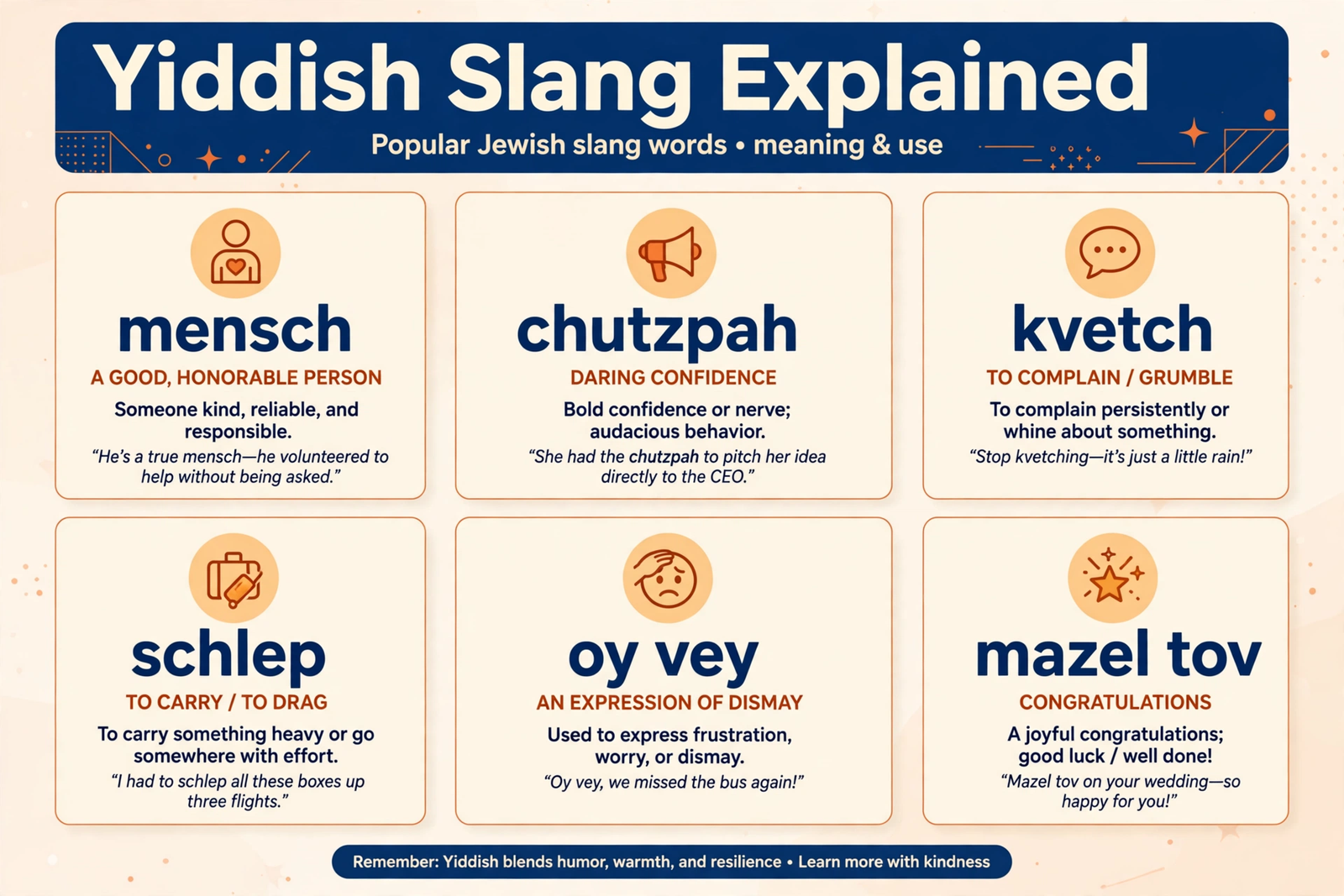
- Mensch (MENCH) — a genuinely good, honorable person. “My neighbor drove me to the airport at 5 a.m. What a mensch.”
- Kvell (k-VELL) — to burst with pride over someone else. “My mom was kvelling when I got the promotion.”
- Mazel tov (MAH-zel TOV) — congratulations, literally “good luck.” “Mazel tov on the new baby!”
- Bubbe (BUB-beh) — grandmother. “Bubbe makes the best chicken soup in the world.”
- Zayde (ZAY-deh) — grandfather. “Zayde tells the same story every holiday, and we love it.”
- Nosh (NOSH) — a light snack, or to snack. “Let’s grab a quick nosh before the movie.”
- Schmooze (SHMOOZ) — to chat warmly, often to network. “He spent the whole party schmoozing with the clients.”
- Shalom (shah-LOHM) — hello, goodbye, or peace. “Shalom! Great to see you again.”
Professional Examples
- Chutzpah (KHOOTS-pah) — nerve or boldness. “It took real chutzpah to ask for a raise after two months.”
- Schlep (SHLEP) — to haul something with effort. “I had to schlep the boxes up four flights of stairs.”
- Kvetch (KVECH) — to complain. “Stop kvetching about the traffic and enjoy the ride.”
- Bissel (BISS-el) — a little bit. “Could you move over just a bissel?”
- Kibitz (KIB-itz) — to offer unsolicited advice or commentary. “My uncle loves to kibitz while I cook.”
- Oy vey (OY VAY) — oh no, an expression of dismay. “Oy vey, I left my wallet at home again.”
- Plotz (PLOTZ) — to collapse or burst, usually from shock or laughter. “When I heard the news, I almost plotzed.”
Funny Examples
- Schmuck (SHMUCK) — a fool or jerk. “Don’t be a schmuck — just apologize.”
- Schlemiel (shleh-MEEL) — a clumsy person who always spills things. “I’m such a schlemiel, I dropped my coffee twice today.”
- Schlimazel (shlih-MAH-zel) — a chronically unlucky person. “The schlemiel spills the soup; the schlimazel is the one it lands on.”
- Nudnik (NUD-nik) — a pest, a boring annoyance. “He’s a lovable nudnik who never stops talking.”
- Shmendrick (SHMEN-drik) — a weak, foolish little man. “That shmendrick couldn’t fix a lightbulb.”
- Mishegas (mish-eh-GOSS) — craziness, nonsense. “The whole plan is pure mishegas.”
- Oy gevalt (OY geh-VAHLT) — oh my goodness, a stronger oy vey. “Oy gevalt, the rent went up again!”
- Shanda (SHAHN-dah) — a shame or scandal. “Forgetting your own anniversary? What a shanda.”
- Tchotchke (CHOTCH-keh) — a small decorative trinket. “Her shelf is full of little tchotchkes from every trip.”
- Gelt (GELT) — money. “I need a little more gelt before payday.”

Comparison with Similar Terms
Jewish slang is often confused with other slang traditions, but it has its own flavor. This table shows how it compares with similar words people mix it up with.
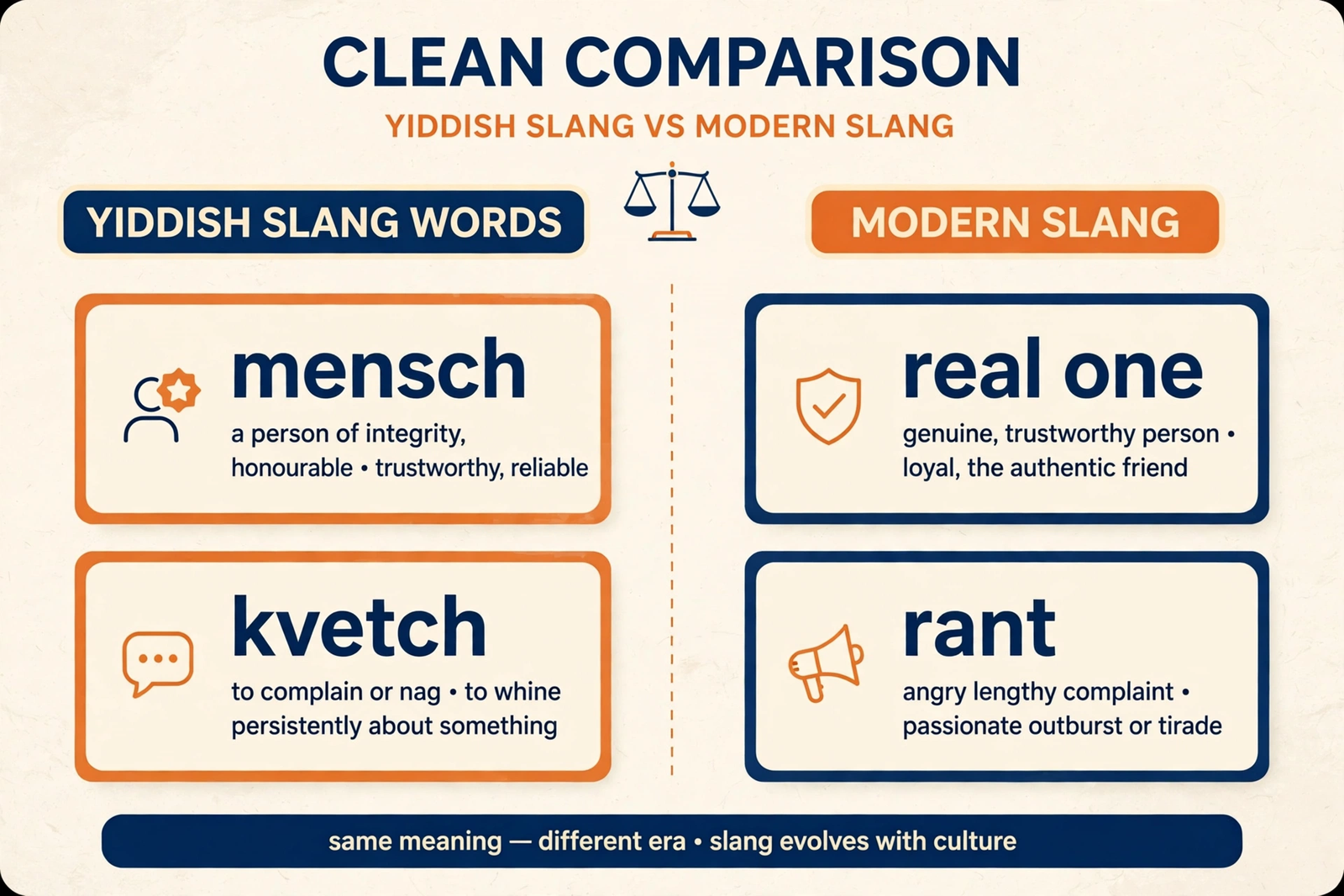
| Jewish Slang Word | Meaning | Closest English Equivalent | Closest Gen Z Slang |
|---|---|---|---|
| Mensch | A person of real character | A stand-up person | A real one |
| Kvetch | To complain dramatically | To whine | To rant |
| Chutzpah | Bold nerve | Audacity | Main character energy |
| Schlep | To haul with effort | To lug | A whole mission |
| Schmuck | A fool or jerk | An idiot | A clown |
| Nosh | A snack | A bite | A snack (same word!) |
| Oy vey | Oh no | Oh dear | I’m screaming |
| Mazel tov | Congratulations | Well done | Let’s gooo |
Notice how the Gen Z equivalents are looser and more emotional, while the Jewish slang words are more specific. “A real one” could mean many things, but mensch always means someone with integrity. That precision is why the words have lasted for generations while internet slang often fades in a year.
Alternate Meanings
A few Jewish slang words have more than one meaning, and context decides which one applies. Chutzpah is the classic example: it can be a compliment (“She had the chutzpah to start her own company”) or an insult (“He had the chutzpah to eat the last slice and blame me”). The difference is entirely in the tone and the situation.
Schlep works the same way. It can mean carrying something heavy (“schlep the groceries”) or dragging yourself somewhere unwillingly (“I have to schlep all the way downtown”). As a noun, a schlep is the long, annoying trip itself. Kvetch is both a verb (to complain) and a noun (a complainer): “He is a real kvetch.” And nosh is both the snack and the act of snacking.
Some words also have a literal Hebrew or Yiddish meaning that differs from the slang one. Mazel tov literally means “good luck” or “good constellation,” but everyone uses it to say “congratulations.” Shalom literally means “peace,” but it works as hello, goodbye, and a wish for wellbeing all at once. Knowing the literal meaning helps you understand why the word feels the way it does.
Professional or Polite Alternatives
Jewish slang is casual by nature, so in formal settings it helps to swap in plainer English. Here are polite alternatives for the most common words:
| Slang Word | Formal Alternative | Example |
|---|---|---|
| Mensch | A person of integrity | “She is a person of great integrity.” |
| Kvetch | To raise concerns | “He raised concerns about the schedule.” |
| Chutzpah | Confidence / boldness | “She showed real confidence in the meeting.” |
| Schlep | To transport / carry | “I transported the equipment to the venue.” |
| Nosh | A light snack | “We will serve light refreshments.” |
| Oy vey | Oh no / unfortunately | “Unfortunately, the delivery is delayed.” |
| Schmooze | To network | “She networked with several clients.” |
The insults — schmuck, shmendrick, schlemiel — have no polite version. In a professional setting, just describe the behavior instead: “He made a careless mistake” works better than any Yiddish insult, and it keeps you out of trouble.
Common Mistakes
People make the same few mistakes with Jewish slang, and they are easy to avoid once you know them.
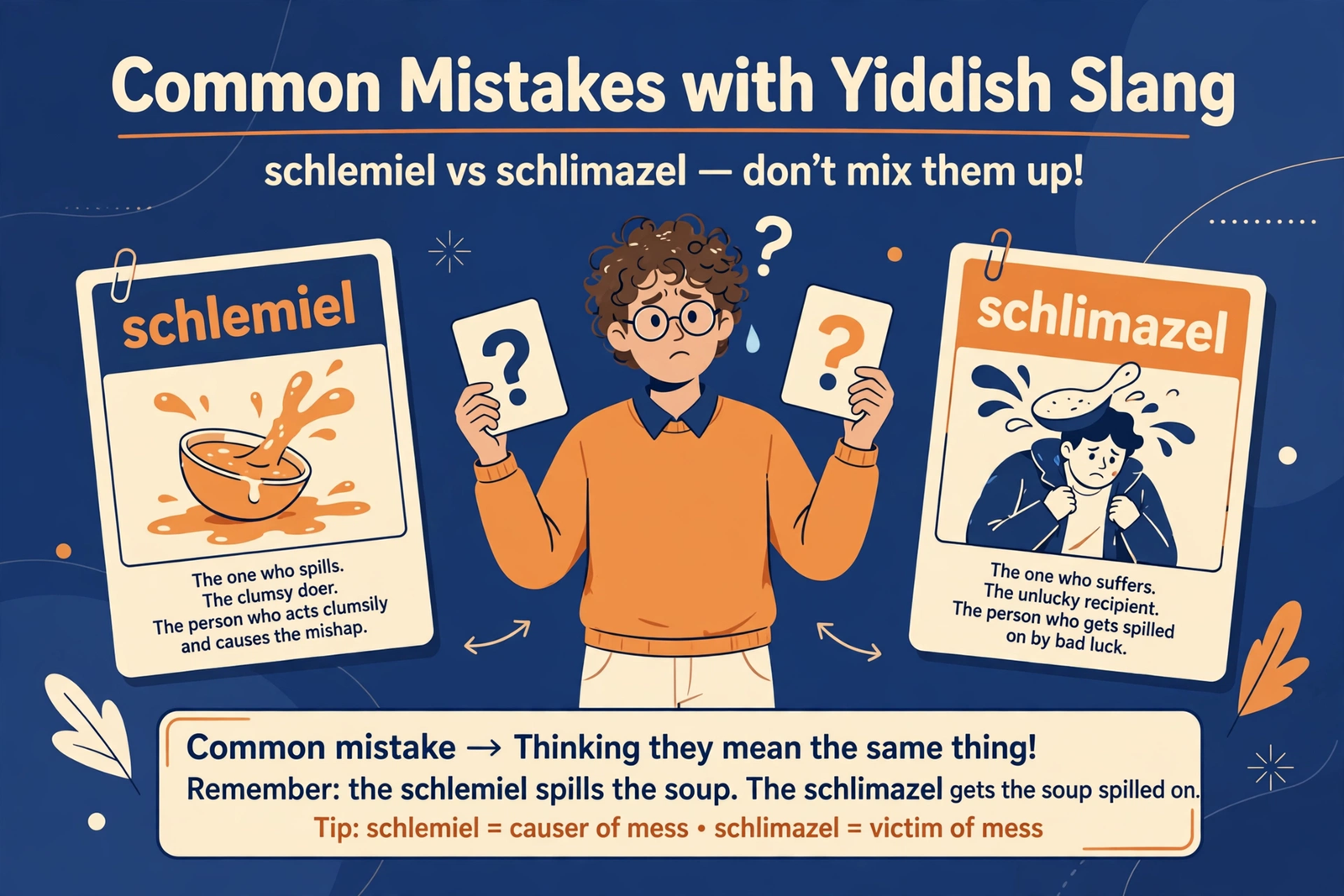
Mixing up schlemiel and schlimazel. The old joke explains it perfectly: the schlemiel is the one who spills the soup, and the schlimazel is the one it lands on. One is clumsy, the other is unlucky. They are a pair, not synonyms.
Using schmuck lightly. Many people think schmuck just means “jerk,” but its literal meaning is much cruder, and older Jewish speakers still hear it that way. Use it with friends who know the word, not with strangers or in front of children.
Calling everything chutzpah. Confidence is not chutzpah. Chutzpah has an edge — it is nerve that surprises people, for better or worse. Asking for a well-earned raise is confidence. Demanding a refund for a meal you already ate is chutzpah.
Pronouncing oy vey wrong. It is “oy VAY,” not “oy VEE.” Small detail, but native speakers notice instantly.
Using the words as a costume. Dropping five Yiddish words into one sentence to sound funny usually has the opposite effect. One word, used naturally, lands far better than a whole performance. The jewish slang meaning of each word is best honored by using it the way it was meant: casually, warmly, and only when it fits.
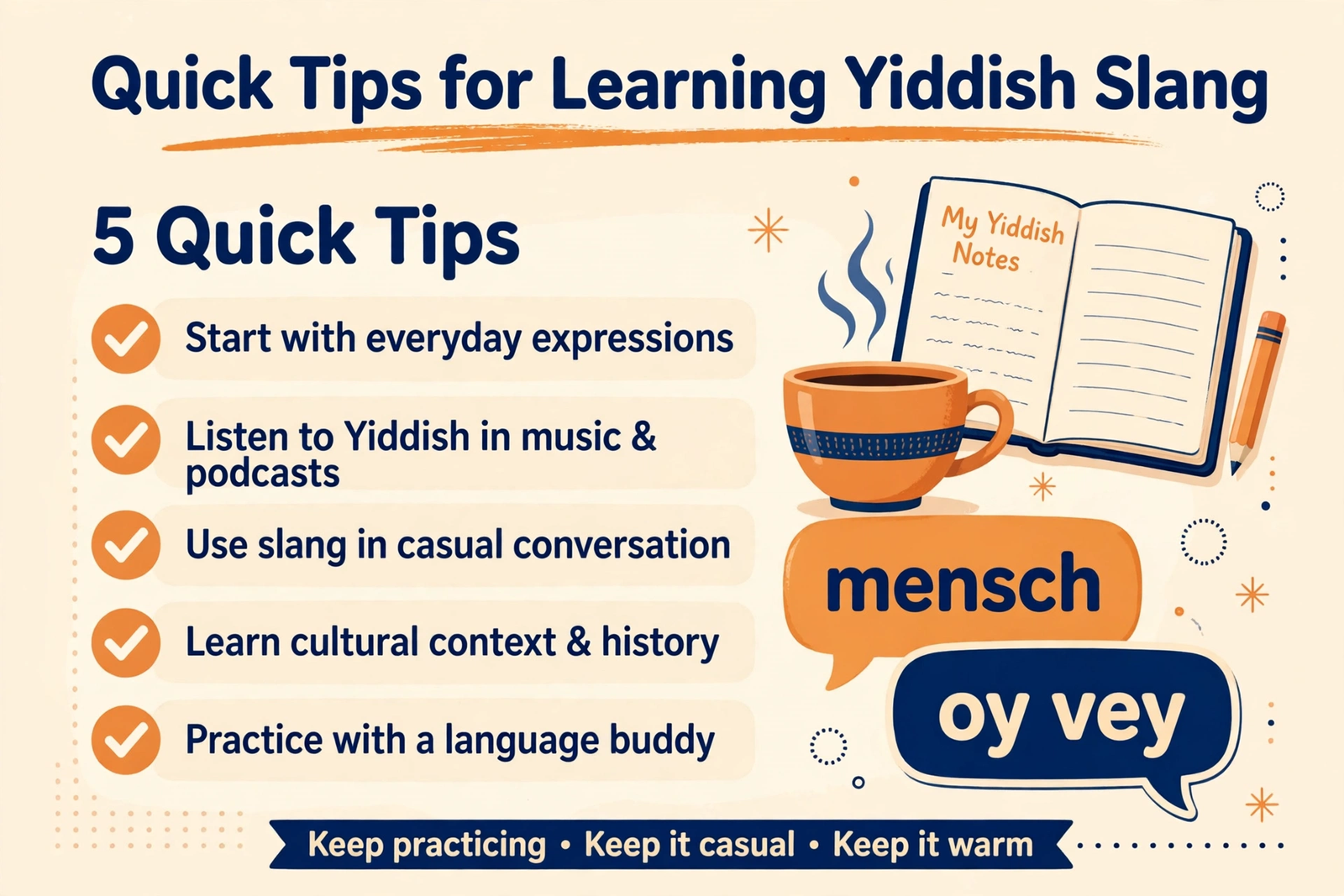
Quick Tips
- Start with the easy ones. Mensch, oy vey, mazel tov, and nosh are safe, friendly, and almost impossible to misuse.
- Learn the pronunciation. The ch in chutzpah is a throaty sound, like clearing your throat gently — not a hard “k” and not the “ch” in “chair.”
- Match the tone. These words are warm and funny. If the room is serious, save them for later.
- Use one at a time. A single well-placed kvetch is charming; five Yiddish words in one sentence is a comedy routine.
- Know your audience. With Jewish friends and family, the words feel like home. With strangers, the friendly ones are fine, but skip the insults.
- Listen first. The fastest way to learn is to hear how native speakers use the words — in shows, podcasts, and real conversations — and copy their timing.
- Respect the roots. These words come from a real culture and a real history. Using them with appreciation, not as a joke at someone’s expense, is what keeps them welcome.
FAQ
What does Jewish slang mean?
Jewish slang is the set of Yiddish and Hebrew words and expressions — like mensch, chutzpah, kvetch, and schlep — that entered everyday English from Jewish communities. The jewish slang meaning is usually warm and humorous: these words describe people, feelings, and everyday situations more vividly than plain English.
What is the most famous Jewish slang word?
Chutzpah is probably the most famous, followed closely by mensch and oy vey. Chutzpah means nerve or audacity, mensch means a person of true character, and oy vey is an expression of dismay that works like “oh no.”
Is Yiddish the same as Jewish slang?
Almost, but not quite. Yiddish is a full language with its own grammar and literature. Jewish slang is the small set of Yiddish (and some Hebrew) words that crossed into English. Most English speakers who say schlep or nosh do not speak Yiddish at all.
What does oy vey mean?
Oy vey means “oh no” or “oh woe” — it is an exclamation of dismay, frustration, or exasperation. People say it when something goes wrong, when they hear bad news, or when they are overwhelmed. The stronger version is oy gevalt.
What does mensch mean?
Mensch means a genuinely good, decent, honorable person — someone who does the right thing even when nobody is watching. It comes from the Yiddish word for “human being,” and calling someone a mensch is one of the highest compliments in Jewish culture.
Is it offensive to use Jewish slang if you are not Jewish?
Generally no — these words are part of mainstream American English now, and most Jewish people are happy to hear them used correctly and respectfully. The key is to use them naturally and warmly, not as a mocking imitation, and to avoid the ruder insults like schmuck in polite company.
What does mazel tov mean?
Mazel tov literally means “good luck,” but it is used to say “congratulations.” Say it at weddings, births, graduations, new jobs, and any happy milestone — it is the Jewish equivalent of “well done!”
What is the difference between schlemiel and schlimazel?
The schlemiel is the clumsy one who spills the soup; the schlimazel is the unlucky one the soup lands on. One causes the accident, the other suffers it. The two words are a classic comedy pair, and mixing them up is the most common mistake people make with Jewish slang.
Conclusion
Jewish slang is one of the great gifts Yiddish gave to English: a set of words that are funnier, warmer, and more precise than the plain alternatives. Now that you know the jewish slang meaning behind words like mensch, chutzpah, kvetch, and schlep, you can hear them everywhere — in comedies, in group chats, and in the mouths of grandparents who have been using them for decades.
The best way to keep learning is to listen for these words in real life and try the friendly ones yourself. Call a kind coworker a mensch. Say mazel tov the next time a friend shares good news. And when the day feels long, admit that you had to schlep across town — everyone will know exactly what you mean. If you enjoy slang like this, you will also like our guides to ops meaning in slang, no cap meaning, and the fire slang meaning — each one breaks down a popular term the same way, with real examples you can use right away.
