
ISO Slang: What Does ISO Mean in Texting, Dating Apps, and Gaming?
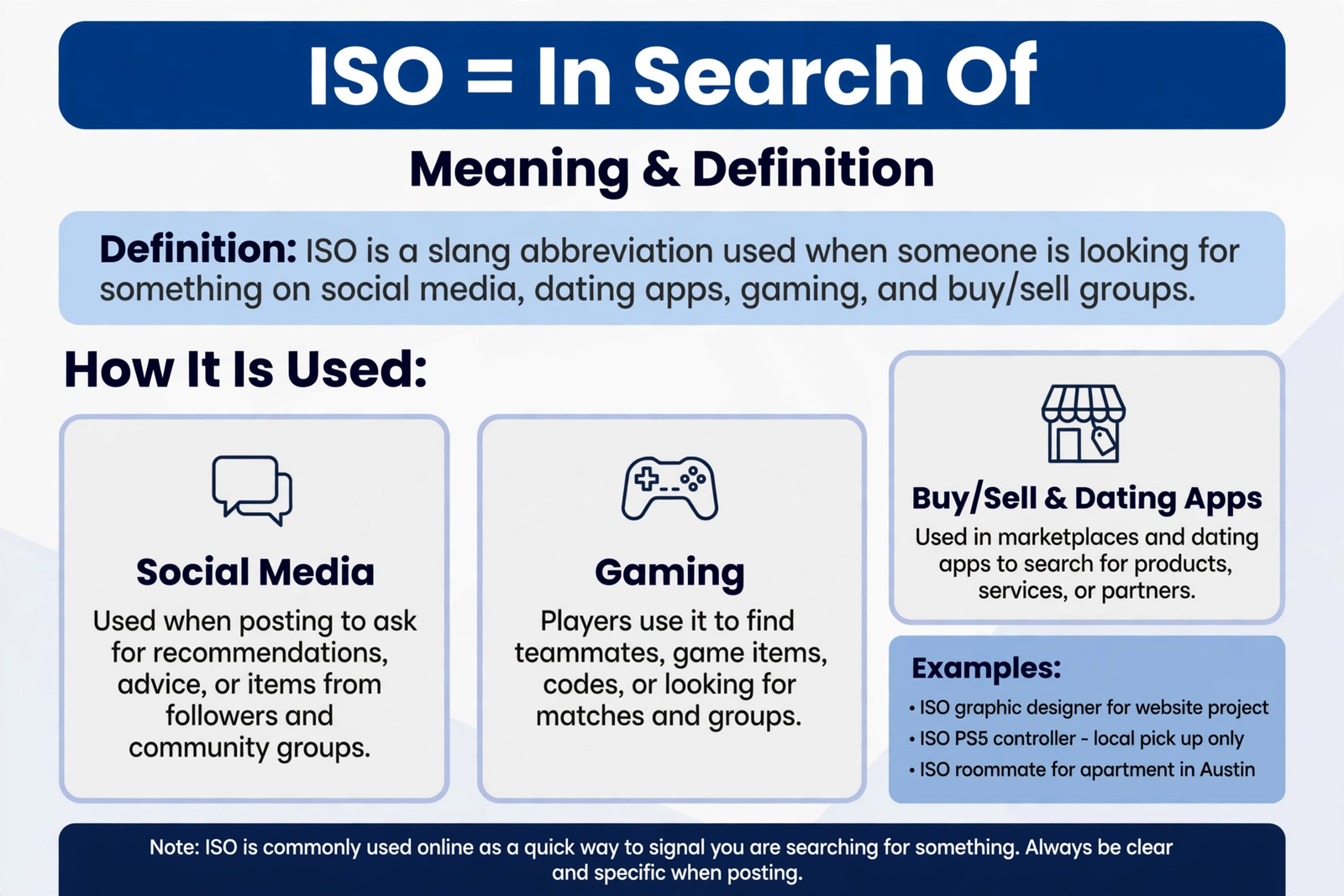
Quick definition: In slang, ISO stands for “in search of.” People write “ISO” at the start of a post or message when they are looking for something — an item to buy, a person to date, a teammate, a ticket, or even a piece of information. It is a shortcut that tells everyone reading, “I want this, and I am hoping someone here can help me find it.”
ISO Slang Meaning & Definition
ISO slang is one of the oldest abbreviations on the internet, and it is still everywhere in 2026. The letters I-S-O stand for “in search of,” and the term works like a little flag you wave in a crowded room. Instead of writing a long sentence like “I am looking for someone who can sell me two concert tickets,” you simply write “ISO two concert tickets” — and everyone in that group, forum, or comment section instantly understands what you want.
The beauty of ISO is its flexibility. It works in almost any situation where a person is looking for something:
- Buying and selling: “ISO a used PS5 in good condition, budget $300.”
- Dating and personals: “ISO someone to explore the city with this weekend.”
- Gaming: “ISO a healer for tonight’s raid, must have mic.”
- Tickets and events: “ISO 2 tickets to Friday’s show, will pay face value.”
- Collecting: “ISO the 2019 limited-edition vinyl, any condition considered.”
- Jobs and services: “ISO a reliable dog sitter for next week.”
Unlike many slang terms that are tied to one platform or one generation, ISO is platform-neutral. You will see it on Facebook Marketplace, Reddit, Craigslist, Discord, TikTok comments, Twitter (X), Instagram, dating apps, and even in old-school forum threads from twenty years ago. It survived because it solves a real problem: it makes a request short, clear, and instantly searchable.
One thing to note right away: ISO is almost always written in all capital letters, even in otherwise lowercase messages. The capitalization is part of the signal — it marks the word as an abbreviation rather than the English word “iso,” and it helps the post stand out when people are scrolling quickly through a busy feed.
Introduction
Imagine you open a Facebook buy-and-sell group with 50,000 members. Hundreds of posts go up every day. Some people are selling, some are giving things away, and some are asking for help. If you write “I was wondering if anyone happens to have a second-hand bike for sale,” your post will blend into the noise. But if you write “ISO: second-hand bike, adult size, under $150,” your message is clear in under ten words — and people who have a bike to sell will stop scrolling.
That is the entire job of ISO slang. It is a request label, not a conversation word. You would not normally say “I am so ISO right now” the way you might say “I am so over this.” Instead, ISO sits at the front of a request and frames everything that follows it as something the writer wants to find.
Because it is so practical, ISO has outlived countless slang trends. Terms like “on fleek” and “YOLO” rose and faded, but ISO stayed useful. New users keep rediscovering it every time they join a marketplace group, a gaming clan, or a dating app — which is why it still appears in millions of posts every year.
Origin
ISO comes from the world of classified ads, long before social media existed. In print newspapers, every word in a classified ad cost money, so advertisers squeezed their messages into the shortest possible form. “In search of” became “ISO,” just as “for sale” became “FS” and “wanted to buy” became “WTB.” The abbreviation moved from newspaper columns to early internet forums and Usenet groups in the 1990s, where space was not the issue but speed was — and short, standardized labels helped people scan long lists of posts.
From there, ISO spread through the places where strangers helped strangers find things:
- Craigslist (launched 1995): ISO became a standard tag in the “wanted” section, so much so that many listings were titled simply “ISO” followed by the item.
- eBay and trading forums: Collectors used ISO in “want lists” for trading cards, comics, vinyl records, and sneakers.
- Early dating personals: Newspaper and website personals used ISO to open ads like “ISO: kind, funny woman who loves hiking.”
- Gaming forums and MMOs: Players looking for guildmates, raid partners, or rare items adopted ISO because it was already familiar from trading.
By the time Facebook groups and Reddit took over in the 2010s, ISO was already a settled part of internet English. It needed no explanation inside those communities — a new member could figure it out from context within minutes, and moderators often wrote it directly into group rules (“Start wanted posts with ISO”). Community dictionaries such as Urban Dictionary’s entry for ISO list “in search of” as the leading slang definition, with thousands of upvotes from users across buying, dating, and gaming communities.
There is also a much older, completely different ISO: the International Organization for Standardization, the body behind the ISO 9001 quality standard and the ISO camera sensitivity setting on your phone. That meaning is unrelated to the slang, but it is worth knowing because it explains why you will sometimes see “ISO” in photography and tech contexts where “in search of” makes no sense at all.
Popularity
ISO is not a viral trend — it is infrastructure. It does not spike and crash the way meme slang does; instead, it holds a steady, high level of use across the platforms where people ask strangers for things. That is why it still matters in 2026, even though it has been around for decades.
Where ISO is most popular today:
| Platform | How ISO Is Used | Typical Post |
|---|---|---|
| Facebook Marketplace & buy/sell groups | The default label for wanted posts | “ISO a couch, must deliver” |
| Reddit (r/hardwareswap, city subreddits) | Wanted threads and megathreads | “[USA] ISO RTX 4070, PayPal ready” |
| Craigslist | “Wanted” section listings | “ISO moving boxes, free or cheap” |
| Discord & gaming servers | Looking for players, items, or clans | “ISO 2 DPS for ranked tonight” |
| Dating apps & personals | Opening line of a profile or post | “ISO someone who likes road trips” |
| TikTok & Instagram comments | Asking where to find a product | “ISO this exact jacket, link please?” |
Search interest in ISO stays consistent year-round, with small bumps around the holidays (people hunting for sold-out gifts) and around big concert or sneaker releases (people hunting for tickets and drops). It is also one of the rare slang terms that older and younger users share without any generation gap — a 55-year-old on Facebook and a 19-year-old on Discord both know exactly what it means.
How It Is Used
Using ISO correctly is simple, but the placement matters. ISO almost always comes first, at the very beginning of the request, followed by the thing you want. Think of it as a label on a folder: the label tells the reader what kind of post this is before they read a single detail.
The standard formula is:
ISO + [the thing you want] + [helpful details like budget, location, or deadline]
Here are the most common patterns:
- ISO + item: “ISO a Nintendo Switch OLED, used is fine.”
- ISO + item + budget: “ISO a reliable used car under $5,000.”
- ISO + item + location: “ISO a wedding photographer in Austin for June.”
- ISO + person/role: “ISO a bassist for our indie band, practice twice a week.”
- ISO + information: “ISO recommendations for a good dentist in Chicago.”
- ISO + item + condition: “ISO the blue colorway, new with tags only.”
ISO also pairs naturally with a few companion abbreviations. You will often see it next to WTB (“want to buy”), LF (“looking for”), WTT (“want to trade”), and LFG (“looking for group”). In most cases these are near-synonyms, and the choice between them is a matter of community habit: trading communities lean toward WTB, gaming communities lean toward LF or LFG, and general buy/sell groups lean toward ISO.
One habit worth copying: good ISO posts always include the details that let someone say yes quickly. A vague post like “ISO a laptop” gets ignored, while “ISO a MacBook Air M2, 256GB, budget $700, can pick up in Denver this week” gets replies — because the reader can tell in one second whether they can help.
Examples
ISO sounds slightly different depending on the setting. The core meaning never changes — “in search of” — but the tone, the details, and the etiquette around it shift from place to place. Here are realistic examples from the contexts where ISO shows up most.
Friendly Examples
Friendly ISO posts are casual, warm, and often include a little personality. They are common in local community groups, hobby groups, and friend circles:
- “ISO someone to join our Sunday hiking group! All levels welcome, we go slow and stop for coffee after.”
- “ISO a good home for my extra tomato plants — free to anyone who wants them, just bring a pot!”
- “ISO recommendations for a cozy café to study in — bonus points if they have oat milk lattes.”
- “ISO a running buddy for early mornings. I am slow, I complain, but I show up!”
- “ISO the name of that song from your story yesterday — it has been stuck in my head all day.”
Notice how these posts are not really transactions. The writer is looking for people, recommendations, or shared experiences — and the friendly tone is what gets strangers to respond.
Professional Examples
In professional and semi-professional settings, ISO keeps the same structure but drops the jokes and adds specifics. Hiring posts, service requests, and business-to-business asks all use it:
- “ISO a freelance graphic designer for a one-month project, brand guidelines provided, remote OK.”
- “ISO a licensed electrician available this week for a panel upgrade. Please DM quotes and availability.”
- “ISO a co-working space with 24-hour access near downtown, budget up to $300/month.”
- “ISO a reliable supplier of compostable packaging for our bakery, minimum order 500 units.”
- “ISO a keynote speaker on sustainable fashion for our October conference. Honorarium available.”
Professional ISO posts work because they respect the reader’s time. They state exactly what is wanted, what the terms are, and how to respond — no guessing required.
Funny Examples
ISO also shows up in jokes and memes, where the thing being searched for is deliberately absurd. The humor works precisely because everyone knows the format is normally serious:
- “ISO my motivation. Last seen on Monday. Reward if found. Will not ask questions.”
- “ISO someone to explain to my cat that 4 a.m. is not breakfast time.”
- “ISO the remote control. It was here five minutes ago. I blame the couch.”
- “ISO a version of me that goes to the gym regularly and meal preps. Willing to trade my current self.”
- “ISO an adult who has their life together so I can ask them how they did it.”
These jokes spread well on social media because the ISO format is so recognizable that the punchline lands in the first three words. If you see “ISO my sleep schedule” in a comment thread, you do not need the rest of the sentence to get the joke.

Comparison with Similar Terms
ISO is not the only abbreviation for “I want this.” Several near-synonyms circulate in the same communities, and choosing the right one is mostly about matching the local habit. Here is how they compare:
| Term | Stands For | Where It Is Used Most | Best For |
|---|---|---|---|
| ISO | In search of | Facebook groups, Craigslist, Reddit, dating | General wanted posts, any category |
| WTB | Want to buy | Trading forums, marketplaces, sneaker groups | Buying a specific item, price-focused |
| WTT | Want to trade | Collectibles, gaming, sneaker communities | Swaps where money is not involved |
| LF | Looking for | Gaming, Discord, Reddit | Players, teammates, or in-game items |
| LFG | Looking for group | Gaming, especially MMOs and ranked play | Finding a team to play with right now |
| WTS | Want to sell | Marketplaces, trading forums | The opposite of ISO — you have the item |
| FS | For sale | Classifieds, marketplace listings | Simple sale posts |
The key difference is scope. ISO is the most general of the group — it covers items, people, services, and information, and it does not imply a purchase the way WTB does. If you are looking for a free moving box, a hiking partner, or a restaurant recommendation, ISO is the natural choice; WTB would sound wrong because nothing is being bought. If you are buying a graphics card in a trading subreddit, WTB and ISO are interchangeable, and most readers will not notice which one you picked.
One more distinction: ISO is a request, while FS and WTS are offers. Mixing them up is the most common beginner mistake in marketplace groups, and moderators will often correct it — an “ISO” post that is actually selling something wastes everyone’s time.

Alternate Meanings
Like many three-letter abbreviations, ISO has other meanings that depend entirely on context. If you see ISO somewhere and “in search of” does not fit, one of these is probably the intended meaning:
- International Organization for Standardization: The global body that publishes standards like ISO 9001 (quality management). This is the source of the letters in the first place.
- Camera ISO: In photography, ISO is the sensor’s sensitivity to light. A higher ISO lets you shoot in the dark but adds grain to the image; a lower ISO gives a cleaner photo in bright light. When photographers say “bump the ISO,” they mean the camera setting, not a wanted post.
- ISO file / disc image: In computing, an .iso file is a complete copy of a CD or DVD. “Download the ISO” means getting an operating system installer, not searching for something.
- Isolated / isolation (gaming and fitness slang): In some gaming and workout contexts, “iso” is short for an isolation exercise or an isolated play — a one-on-one situation. This is much rarer than “in search of,” but it does appear in gym and sports talk.
- ISO as a name: “Iso” is also used as a nickname and a given name in some cultures, and as a brand name — none of which relate to the slang.
The context almost always resolves the ambiguity. If the post is in a buy/sell group, ISO means “in search of.” If the conversation is about cameras, it means the sensitivity setting. If someone is talking about installing Linux, it means a disc image. When in doubt, read the rest of the sentence — the meaning that fits the sentence is the right one.
Professional or Polite Alternatives
ISO is casual internet shorthand. It is perfect for group posts and chat messages, but in formal writing — a business email, a job posting on a company site, or a letter — you should spell the request out in full sentences. Here are polite alternatives that carry the same meaning:
- “I am looking for…” — the simplest direct replacement: “I am looking for a reliable accountant for our small business.”
- “We are seeking…” — slightly more formal, good for job posts: “We are seeking a part-time social media manager.”
- “Wanted:” — the traditional classifieds label, still used in print and formal listings.
- “In search of…” — the full phrase ISO abbreviates; use it when you want the same flavor with complete words.
- “Does anyone have…” — a friendly, conversational opener: “Does anyone have a spare charger I could borrow?”
- “Recommendations wanted for…” — best when you want advice rather than an item: “Recommendations wanted for a family-friendly hotel in San Diego.”
That said, do not overcorrect. In a Facebook group or a Discord server, writing “I am looking for” instead of “ISO” is perfectly fine — nobody will think less of the post. ISO is a convenience, not a requirement, and the clearest post is always the best one, whatever label it uses.
Common Mistakes
ISO is easy to use, but a few mistakes show up again and again in marketplace and gaming groups. Avoiding them will get your post answered faster — and keep moderators happy.
- Forgetting the details: “ISO a phone” tells nobody anything. Add the model, the budget, and the location, and your replies will triple.
- Using ISO when you are selling: ISO means you want something. If you have the item and want to sell it, use FS (for sale) or WTS (want to sell) instead.
- Posting ISO in the wrong group: A wanted post in a “for sale only” group will be removed. Read the group rules before posting, and check whether there is a dedicated ISO or “wanted” thread.
- Writing “ISO” in lowercase as “iso”: It is not wrong exactly, but all-caps is the recognized form. Lowercase “iso” can be confused with the camera setting or the file format.
- Being vague about payment: In buy/sell groups, say how you will pay and whether you can pick up. “ISO a bike, cash on pickup in Brooklyn” gets far more replies than “ISO a bike.”
- Spamming the same ISO post: Reposting every hour annoys the group and can get you muted. Most groups allow one bump per day — use it, then wait.
- Not saying what you will accept: If used is fine, say so. If you need it new with tags, say that too. “ISO the red one, used is fine” saves everyone a round of messages.

Quick Tips
Want your ISO post to actually get results? These seven tips cover almost everything that separates a post that gets answered from one that gets ignored:
- Lead with ISO and the item: Put the two most important words first — “ISO concert tickets” beats “Hi everyone, I hope you’re all doing well, I was wondering if by any chance…” every time.
- Add a budget: Even a range helps. “Budget $100-150” filters out sellers who cannot help and invites the ones who can.
- Say where you are: Location decides whether a deal is possible. Add your city or neighborhood, and whether you can travel or need delivery.
- Set a deadline: “Need it by Friday” creates urgency and stops the post from lingering for weeks.
- Use one ISO per post: A post hunting for five different things is hard to answer. Split them up and each one will do better.
- Reply fast: When someone answers your ISO post, respond quickly. The best deals go to the person who messages first and follows through.
- Close the loop: When you find what you were looking for, edit the post to say “Found, thanks!” — it stops extra messages and helps the next person searching the group.

FAQ
What does ISO mean in slang?
ISO stands for “in search of.” It is used at the start of a post or message to say that the writer is looking for something — an item to buy, a person, a service, or information.
What does ISO mean on Facebook Marketplace?
On Facebook Marketplace and in buy/sell groups, ISO labels a “wanted” post. It tells other members that the poster wants to buy or find something, rather than sell it.
What does ISO mean on dating apps?
On dating apps and in personals, ISO opens a short description of the kind of person or relationship the writer is looking for, for example “ISO someone who loves live music and weekend trips.”
What does ISO mean in gaming?
In gaming, ISO usually means a player is looking for teammates, a guild, or a rare in-game item — “ISO a tank for tonight’s raid.” It is similar to LF (looking for) and LFG (looking for group).
Is ISO the same as WTB?
Almost. WTB means “want to buy” and is used when money is definitely involved. ISO is broader — it also covers free items, people, services, and recommendations. In a buying context, the two are interchangeable.
Why is ISO written in capital letters?
Because it is an abbreviation of “in search of,” and the capitals mark it as a label rather than a regular word. The all-caps form also helps the post stand out when people scroll through a busy group feed.
What does ISO mean in photography?
In photography, ISO is a camera setting that controls how sensitive the sensor is to light — it has nothing to do with the slang. A high ISO helps in dark scenes but adds grain; a low ISO gives cleaner images in bright light.
Can I use ISO in a professional email?
You can, but it is better to spell it out. In formal writing, use “I am looking for…” or “We are seeking…” instead. Save ISO for group posts, chats, and other casual settings where everyone knows the shorthand.

Conclusion
ISO slang is a small abbreviation with a big job: it turns a vague wish into a clear, searchable request in three letters. Born in the classified ads of print newspapers, carried through Craigslist, forums, and trading communities, and now standard in Facebook groups, Discord servers, and dating apps, it has survived for decades because it solves a problem that never goes away — how to ask a crowd of strangers for exactly what you need.
The rules are simple. Put ISO first, name what you want, and add the details that let someone say yes: budget, location, deadline, and condition. Do not use it when you are selling — that is FS or WTS — and remember that it covers people and advice as well as things. And when you find what you were looking for, close the loop with a quick “Found, thanks!” so the next person searching the group can move on.
Now that you know what ISO means, you will start noticing it everywhere — in marketplace groups, in gaming chats, in comment threads asking where to buy a sold-out jacket. It is one of those pieces of internet English that quietly holds whole communities together, one wanted post at a time.
Want to decode more of the shorthand you will meet in the same groups? Check out our guides to FN meaning in text, CFS meaning in text, IKTR meaning in text, and glizzy meaning — the abbreviations people actually use, explained in plain English.
