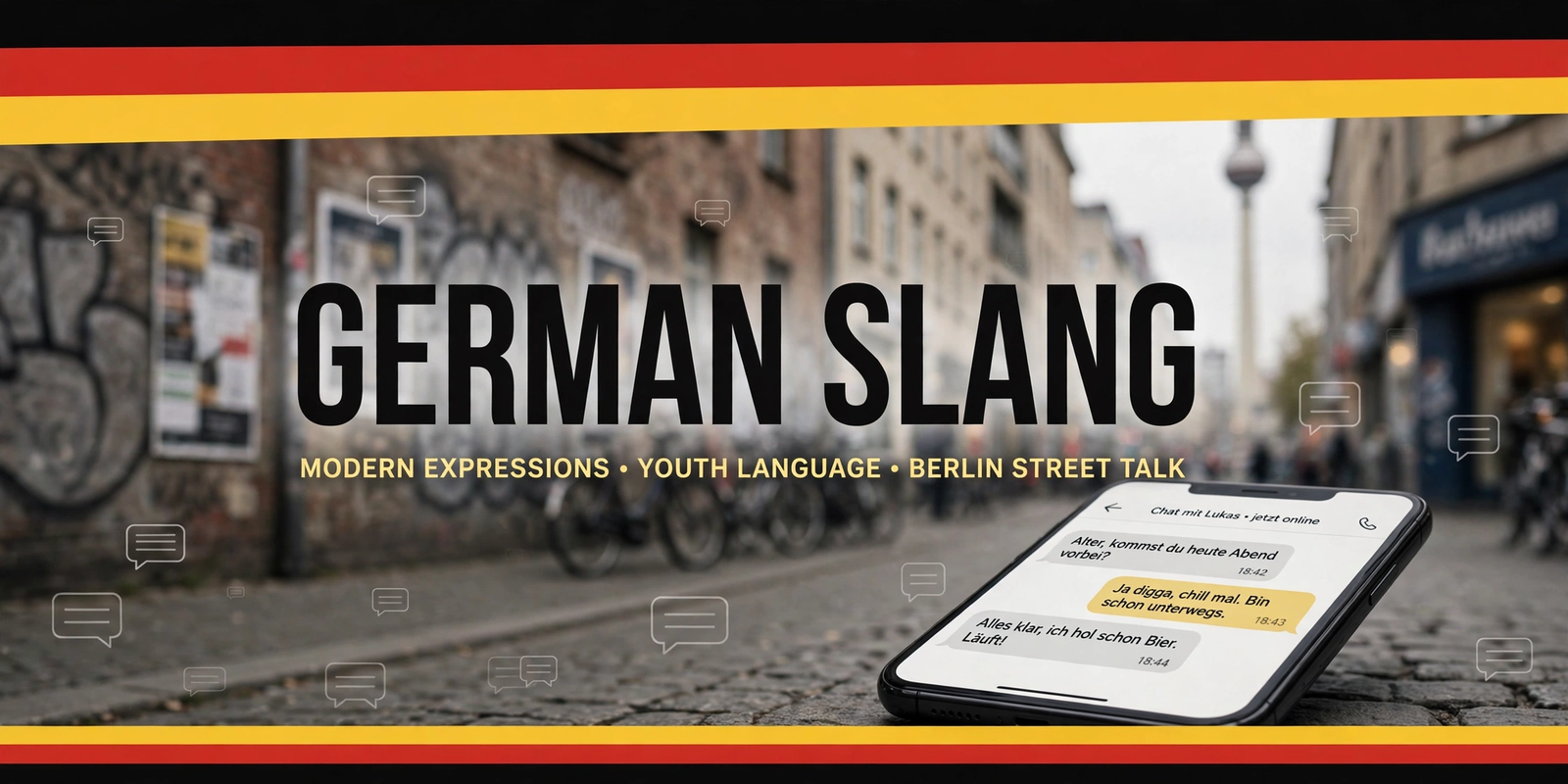
Quick Definition: German slang is the informal, everyday vocabulary Germans actually use in casual conversation, texts, and social media — words like geil (awesome), krass (crazy/extreme), and Digga (bro) that you will never find in a textbook. It is called Umgangssprache in German, and knowing it is the fastest way to sound like a local instead of a language learner.
German Slang Meaning & Definition
German slang means the casual words, phrases, and abbreviations that native German speakers use when they are not speaking formally. It is the language of friends chatting in a Berlin café, teenagers messaging on WhatsApp, football fans celebrating a goal, and colleagues joking around after work. While standard German (Hochdeutsch) is what you learn in class, German slang is what you actually hear on the street.
The word Germans use for this kind of speech is Umgangssprache, which literally means “language of Umgang” — the language people use when dealing with each other day to day. It covers everything from single words like Alter (dude) to whole expressions like Das ist mir Wurst (I couldn’t care less — literally “that’s sausage to me”). Some German slang is understood everywhere in Germany, Austria, and Switzerland, while other words are deeply regional: a Hamburg teenager says Digga, a Bavarian says Servus, and a Berliner says ick instead of ich.
German slang also changes fast. Words like krass and geil have been popular for decades, but every year brings new youth words — the annual Jugendwort des Jahres (Youth Word of the Year) picks, like Ehrenmann in 2018 and Talahon more recently, show how quickly the slang landscape moves. That is exactly why a current guide matters: the German slang that makes you sound fluent in 2026 is not the same list your textbook printed ten years ago.
Introduction
Imagine you have studied German for two years. You know your grammar, you can order food, and you can hold a polite conversation. Then you arrive in Germany, sit down with a group of twenty-somethings, and hear: “Digga, das war so krass geil! Kein Bock auf Labern, lass mal chillen.” You understand maybe half of it — and that is the moment most learners realise that textbook German and real German are two different languages.
German slang is the missing piece. It is how Germans show warmth, humour, excitement, and attitude. A single word like geil can turn a boring sentence into an enthusiastic one, and a well-timed Alter! can make you sound like you have lived in Hamburg your whole life. But slang is also a minefield: use the wrong word with the wrong person — calling your boss Digga, for example — and you can sound rude instead of relaxed.
This guide fixes that. You will learn 40+ real German slang words and phrases, grouped by what they actually do: words for “cool”, greetings, money, food, partying, texting, and even playful insults. Every entry comes with its real meaning, a natural example sentence with an English translation, and notes on when to use it — and when to avoid it. By the end, you will not just understand German slang; you will know how to use it without embarrassing yourself.

Origin
German slang has two main roots: the streets and the regions. For centuries, each German region developed its own dialect and its own informal vocabulary. Moin, the famous northern greeting, comes from Low German and is still the default “hello” in Hamburg and Bremen. Servus comes from Latin via Bavaria and Austria. Digga started as Dicker (“fat one”) — an affectionate Hamburg nickname among close friends — before spreading across the whole country through hip-hop and social media.
The second root is youth culture. German teenagers and young adults have always invented words to mark their generation, and the internet made that process instant. A word can be born on a TikTok video on Monday, appear in millions of comments by Friday, and win Jugendwort des Jahres by December. Words like Ehrenmann (a stand-up guy, literally “man of honour”) and cringe — borrowed directly from English — show how German youth slang now mixes German creativity with heavy English influence, exactly like youth slang everywhere else.
Immigration and multicultural city life added a third layer. In Berlin, Turkish-German youth slang (Kanak Sprak) gave German words like lan and wallah, while Arabic and Turkish expressions now appear in everyday Berlin speech. This is why modern German slang feels so mixed: it is regional dialect, youth invention, and multicultural street language all at once.
Popularity
German slang is more popular — and more visible — than ever before. Germany has over 84 million native speakers, and German is the most spoken native language in the European Union. On TikTok, YouTube, and Instagram, German creators use slang constantly, which means learners all over the world now hear words like krass, Digga, and geil long before they ever set foot in Germany.
Search interest tells the same story. “German slang” is one of the most searched language-learning topics in English, and learners specifically look for German Gen Z slang, German texting slang, and funny German slang phrases. Language apps and blogs have responded with huge lists — some with 100+ words — but most of them are just word dumps with no guidance on tone, region, or context. That is the gap this guide fills: not just what the words mean, but how real Germans actually use them.
Slang also matters because Germans judge fluency by it. Speaking perfect textbook German can actually mark you as a foreigner faster than making a small grammar mistake, because no native speaker talks like a textbook. Dropping a natural Kein Ding (no problem) or Alles klar (all good) into conversation signals that you understand German culture, not just German grammar — and that is what makes people relax around you.
How It Is Used
German slang shows up in four main places: spoken conversation between friends, text messages and social media, music and streaming shows, and casual workplaces. It almost never shows up in formal writing, job applications, or conversations with strangers you want to impress. The golden rule is simple: slang is for people you are comfortable with.
Here is how the most common German slang words work in real life:
- As reactions: Geil! (Awesome!), Krass! (Crazy!), Hammer! (Brilliant!) — one-word reactions to good or shocking news.
- As greetings and address: Alter!, Digga!, Brudi! — the German equivalents of “dude”, “bro”, and “mate”.
- As intensifiers: sau (literally “sow”) goes before adjectives to mean “super”: sau gut (really good), sau teuer (really expensive).
- As softeners: halt, eben, and mal make sentences sound casual: Chill mal! (Just relax!).
- In texting: abbreviations like hdl (hab dich lieb — love you), kA (keine Ahnung — no idea), and bb (bis bald — see you soon).
Tone matters more than vocabulary. The same word can be friendly, funny, or insulting depending on who says it and how. Alter between two close friends is warm; Alter said sharply to a stranger is a challenge. Spacko (weirdo) is playful among friends and genuinely offensive to anyone else. When in doubt, listen first: hear how Germans around you use a word before you try it yourself.
| German Slang Word | Pronunciation | English Meaning | Example Sentence |
|---|---|---|---|
| Geil | guy-l | Cool, awesome, amazing | Das Konzert war so geil! (The concert was so awesome!) |
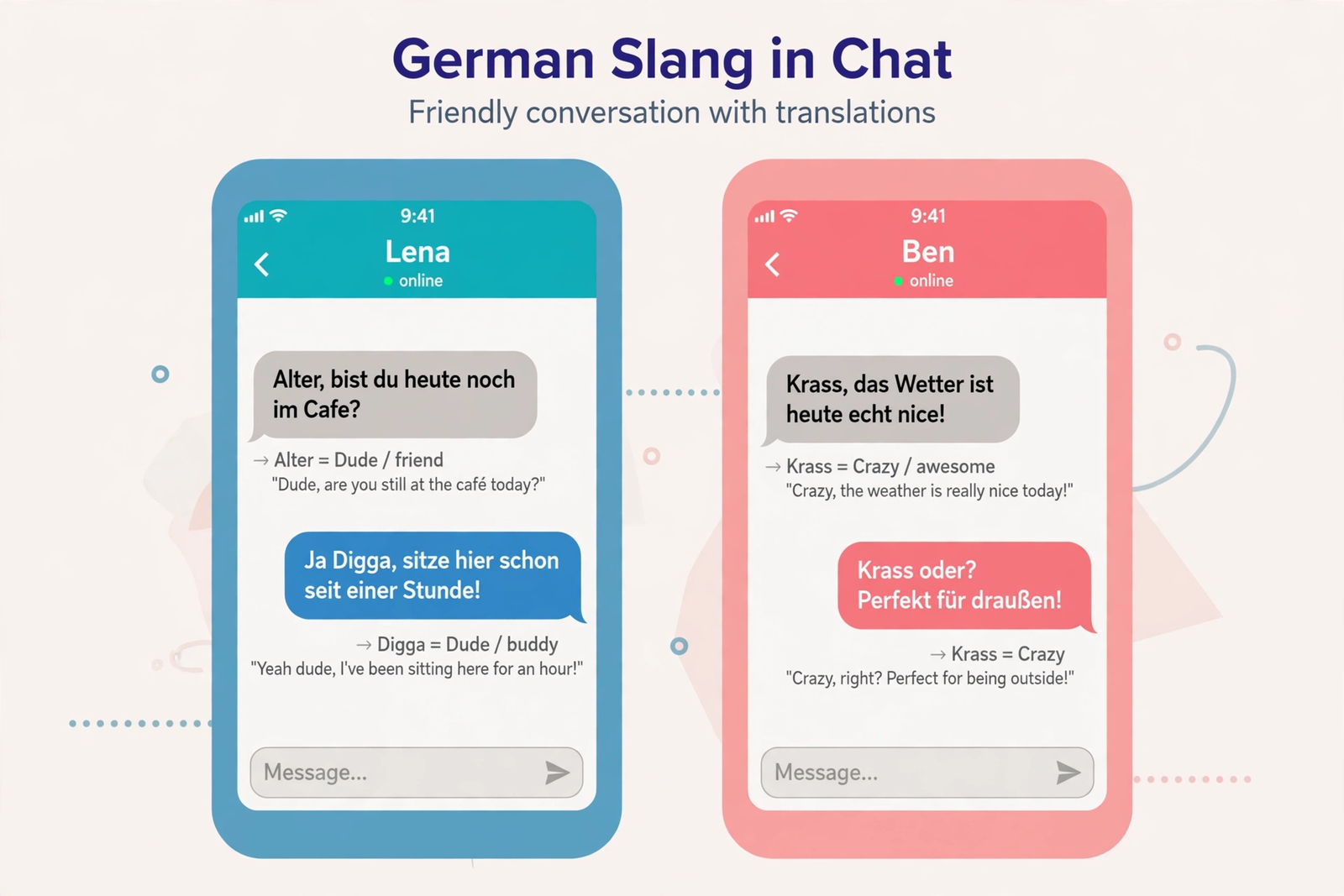
| Krass | krahs | Extreme, crazy, unbelievable | Das ist ja krass! (That’s crazy!) |
| Alter / Alte | AHL-ter | Dude, man, bro | Alter, was machst du da? (Dude, what are you doing?) |
| Digga / Diggah | DIG-gah | Bro, dude, mate | Digga, das ist nicht dein Ernst! (Bro, you can’t be serious!) |
| Hammer | HAH-mer | Brilliant, amazing | Das ist der Hammer! (That’s amazing!) |
| Kohle / Knete | KOH-leh / KNEH-teh | Money (like “bucks”) | Ich hab keine Kohle mehr. (I’m out of money.) |
| Chillen | CHIL-len | To relax, hang out | Lass uns heute chillen. (Let’s just chill today.) |
| Bock haben | bock HAH-ben | To feel like doing something | Ich hab keinen Bock. (I don’t feel like it.) |
| Quatsch | kvahtsh | Nonsense, rubbish | Das ist doch Quatsch! (That’s nonsense!) |
| Stabil | shtah-BEEL | Cool, solid, impressive | Der Typ ist voll stabil. (That guy is really solid.) |
These ten words alone will cover most casual German conversations. If you only memorise a handful of German slang words, make it these — they are understood everywhere, used by every age group, and almost impossible to misuse badly.
Examples
The best way to learn German slang is to see it in real conversations. Here are examples grouped by tone, so you can match the word to the moment.
Friendly Examples
- “Na, Alter, wie geht’s?” — Hey dude, how’s it going? The classic friendly greeting between male friends. Alter here is pure warmth, like “mate” in British English.
- “Alles fresh, Brudi?” — Everything good, bro? Brudi (short for Bruder, brother) is the affectionate way young Germans address close friends.
- “Moin! Alles klar bei dir?” — Morning! Everything alright with you? Moin is the northern German greeting that works any time of day, and Alles klar is the most useful casual phrase in the language.
- “Kein Ding, mach ich gern.” — No problem, happy to do it. Kein Ding (literally “no thing”) is the relaxed German “no worries”.
- “Lass mal was zocken heute Abend?” — Wanna play some games tonight? Zocken means to play (video games or cards) and is standard among gamers.
Professional Examples
Slang at work exists, but it is lighter. In a relaxed German office you might hear:
- “Das Meeting war echt krass lang.” — That meeting was insanely long. Krass is safe at work because it just means “extreme”.
- “Alles klar, ich kümmere mich drum.” — All good, I’ll take care of it. Perfectly acceptable in most workplaces.
- “Kein Stress, wir schaffen das.” — No stress, we’ll manage it. A common reassuring phrase among colleagues.
- “Feierabend! Endlich.” — Quitting time! Finally. Feierabend is the beloved German word for the end of the working day, and everyone uses it.
Never use Digga, Alter, or Spacko with a boss or a client. Save the heavier slang for friends, and use the light words — krass, alles klar, kein Stress — when you want to sound relaxed but still professional.
Funny Examples
- “Das ist mir Wurst.” — I couldn’t care less. Literally “that’s sausage to me”, this is one of the funniest German slang phrases and Germans love hearing foreigners say it correctly.
- “Ich glaub, ich spinne!” — I think I’m going crazy! Literally “I believe I spider” — used when something is unbelievable or absurd.
- “Alles für die Katz!” — All for nothing! Literally “all for the cat” — when a big effort comes to nothing.
- “Du hast wohl nicht mehr alle Tassen im Schrank!” — You must have lost your marbles! Literally “you don’t have all your cups in the cupboard” — the classic German way to call someone crazy, and it always gets a laugh.
- “Pille-Palle!” — Easy-peasy! A silly-sounding word for something trivially easy.
Comparison with Similar Terms
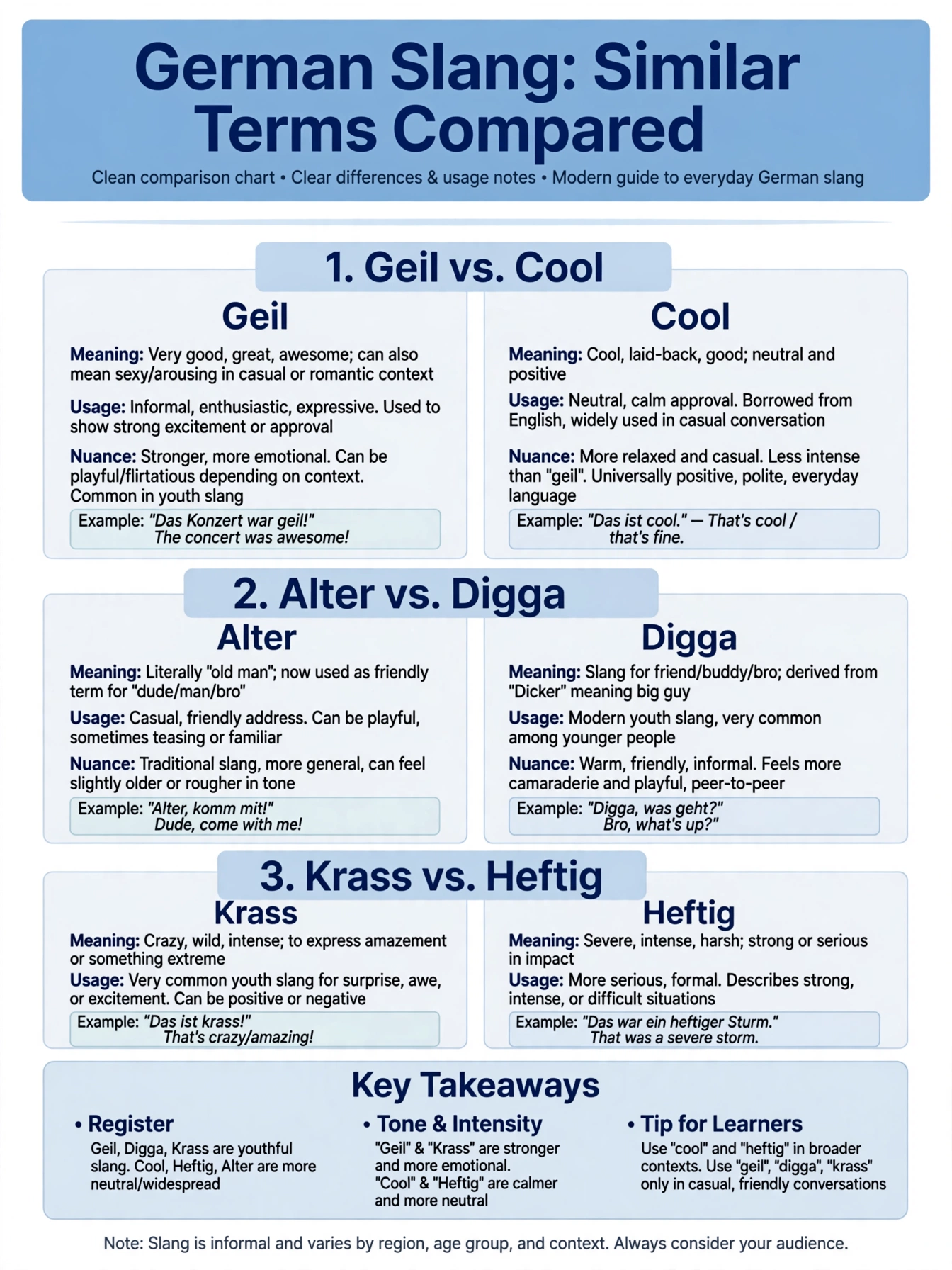
German slang overlaps with slang in other languages — and with other German words that look similar but mean different things. This table clears up the confusion.
| German Slang | Similar Term | Difference |
|---|---|---|
| Geil (awesome) | Cool (cool) | Geil is stronger and more enthusiastic; cool is calmer. Germans use both, but geil shows real excitement. |
| Krass (extreme) | Heftig (intense) | Nearly interchangeable, but krass is more casual and more common with young people. |
| Alter (dude) | Digga (bro) | Alter is used all over Germany; Digga started in Hamburg and sounds younger and more urban. |
| Kohle (money) | Knete (money) | Both mean money; Kohle (coal) is the classic one, Knete (dough) is a playful alternative. |
| Chillen (to relax) | Abhängen (to hang out) | Chillen is borrowed from English and means relaxing; abhängen is the native German verb for hanging out with friends. |
| Quatsch (nonsense) | Blödsinn (nonsense) | Quatsch is lighter and more playful; Blödsinn sounds a bit more annoyed. |
| Bock haben (to feel like it) | Lust haben (to fancy it) | Bock haben is slang and casual; Lust haben is standard German and safe everywhere. |
German slang also has cousins in other languages. Just as Japanese slang has its own internet words and French slang borrows from English, German slang constantly mixes native words with English loans like chillen, cringe, and nice. If you already know slang from another language, you will spot the pattern quickly — every language has its “cool”, its “bro”, and its “no way”.
Alternate Meanings
Many German slang words have a completely different literal meaning — and some have more than one slang meaning. Knowing the alternates stops you from misunderstanding a conversation.
- Geil: Originally meant “horny” or “lecherous” and still can in the right context. In everyday slang it almost always means “awesome” or “cool” — context tells you which one.
- Krass: Can mean amazingly good (krass gut) or shockingly bad (krass schlimm). It is an intensifier first and a judgement second, so listen to the adjective that follows it.
- Hammer: Literally a hammer (the tool). As slang it means something outstanding: Das ist der Hammer! (That’s amazing!).
- Bombe: Literally a bomb. As slang it means awesome: Die Party war eine Bombe! (The party was a blast!).
- Fett: Literally “fat”. As slang it means cool or awesome: Das ist ja fett! — especially common in hip-hop and youth culture.
- Sau: Literally “sow” (female pig). As slang it is an intensifier before adjectives: sau gut (really good), sau cool (really cool).
- Karre: Literally an old cart. As slang it means a car, usually an old or unimpressive one: Meine alte Karre (my old banger).
- Labern: Means to talk nonsense or ramble: Hör auf zu labern! (Stop talking rubbish!). The noun Gelaber means gibberish.
Professional or Polite Alternatives
Slang is great with friends, but there are plenty of moments when you need the polite version. Here is how to say the same thing formally:
| German Slang | Polite / Formal Alternative |
|---|---|
| Alter! / Digga! | Hey! / Hallo! / Entschuldigung (excuse me) |
| Kein Bock. | Ich habe leider keine Zeit. (I unfortunately don’t have time.) |
| Quatsch! | Das stimmt so nicht. (That’s not quite right.) |
| Krass! | Das ist ja unglaublich! (That’s unbelievable!) |
| Kein Ding. | Gern geschehen. / Kein Problem. (You’re welcome / no problem.) |
| Chillen | Sich entspannen / sich ausruhen (to relax / to rest) |
| Das ist mir Wurst. | Das ist mir egal. (I don’t mind.) |
| Labern | Viel reden / plaudern (to talk a lot / to chat) |
Rule of thumb: if you are talking to someone older, in a position of authority, or someone you just met, use the right-hand column. If you are with friends your own age, the left-hand column is exactly right — and using it is what makes you sound natural rather than stiff.
25 More German Slang Words to Know
Here are 25 more German slang words and phrases that real Germans use every day, so this guide actually covers the 40+ words the title promises:
| German Slang | English Meaning | Example |
|---|---|---|
| Ehrenmann / Ehrenfrau | A stand-up guy / legend | Er ist ein echter Ehrenmann. (He’s a real stand-up guy.) |
| Jein | Yes and no (ja + nein) | Jein, ich bin mir nicht sicher. (Yes and no, I’m not sure.) |
| Futtern | To scoff food, eat greedily | Wir haben alles weggefuttert. (We scoffed the lot.) |
| Schlappen | Slippers; also to be exhausted | Ich bin total schlapp. (I’m completely knackered.) |
| Moin | Hello (Northern Germany) | Moin, wie läuft’s? (Hi, how’s it going?) |
| Servus | Hello / goodbye (Bavaria, Austria) | Servus, bis morgen! (Bye, see you tomorrow!) |
| Hallöchen | Hi there (cute, friendly) | Hallöchen, alles gut? (Hiya, all good?) |
| Etepetete | Fussy, picky | Sei nicht so etepetete! (Don’t be so fussy!) |
| Balla-balla | Crazy, cuckoo | Der ist total balla-balla. (He’s completely bonkers.) |
| Pille-Palle | Easy-peasy, trivial | Das ist Pille-Palle. (That’s easy-peasy.) |
| Kladderadatsch | A mess, a crash | Alles ist Kladderadatsch. (Everything’s a mess.) |
| Pusemuckel | The middle of nowhere | Er wohnt in Pusemuckel. (He lives in the middle of nowhere.) |
| Abgehen | To party hard, to go off | Die Party geht ab! (The party is going off!) |
| Abklatschen | To high-five | Klatsch ab! (Give me five!) |
| Brettern | To speed (in a vehicle) | Er brettert über die Autobahn. (He’s speeding down the motorway.) |
| Schoki | Chocolate (cute short form) | Ich brauche Schoki! (I need chocolate!) |
| Horst / Dulli | Idiot, clumsy person | So ein Horst! (What an idiot!) |
| Bescheuert | Stupid, nuts, crazy | Das ist doch bescheuert! (That’s just stupid!) |
| Genau | Exactly, precisely | Genau! So ist es. (Exactly! That’s how it is.) |
| Alles klar | All good, OK, understood | Alles klar, bis dann! (All good, see you then!) |
| Kein Stress | No stress, no worries | Kein Stress, alles gut. (No stress, all good.) |
| Talahon | Youth slang for a flashy, macho young guy | Jugendwort des Jahres contender — use with care, it can sound mocking. |
| Cringe | Embarrassing, awkward (from English) | Das war so cringe! (That was so cringe!) |
| Wallah | I swear (from Arabic, via Berlin youth slang) | Wallah, ich hab’s nicht gewusst! (I swear, I didn’t know!) |
| Feierabend | End of the working day | Endlich Feierabend! (Finally, quitting time!) |
For a deeper dive into pronunciation and regional variations, the Rosetta Stone German slang guide is a solid companion resource with audio examples.
Common Mistakes
German slang is easy to get wrong. These are the mistakes learners make most often — and how to avoid them:
- Using heavy slang with strangers or bosses. Calling your German boss Digga or your professor Alter will not make you sound cool — it will make you sound disrespectful. Keep heavy slang for friends.
- Overusing geil without knowing its other meaning. Geil can still mean “horny” in some contexts. Saying Du bist geil to someone is very different from saying Das ist geil about a concert. Use it for things, not people, until you are confident.
- Mixing up krass as always positive. Krass is neutral — it means extreme. Krass gut is amazing, krass schlecht is terrible. Listen for the word that follows it.
- Saying Digga everywhere in Germany. It started in Hamburg and is strongest in the north and in youth culture. In Bavaria or with older people it can sound forced. Alter is the safer all-round choice.
- Translating English slang word for word. “That’s sick!” does not become Das ist krank! in German slang — Germans say Das ist krass! or Das ist der Hammer! instead.
- Using insult slang like Spacko or Assi as a joke. These are genuinely offensive to most people. Even among friends, they can land badly — leave them out until you really know the group.
- Forgetting regional differences. Moin in Munich will get you a smile but mark you as a northerner; Servus in Hamburg will do the opposite. Match your greeting to the region you are in.

Quick Tips
- Start with the safe five: geil, krass, Alles klar, Kein Ding, and Kein Stress. They work everywhere and are almost impossible to misuse.
- Listen before you speak: spend a week noticing which slang words the Germans around you actually use, then copy those — not a list from the internet.
- Watch German content: shows like Dark and How to Sell Drugs Online (Fast), plus German YouTubers and TikTokers, are full of natural, current slang in context.
- Learn the intensifier sau: adding it before an adjective (sau gut, sau teuer, sau lustig) instantly makes your German sound more native.
- Master the texting abbreviations: kA (keine Ahnung — no idea), hdl (hab dich lieb — love you), bb (bis bald — see you soon), vg (viele Grüße — best regards).
- Do not force it: one natural krass beats ten awkward slang words. Germans respect learners who speak clearly far more than learners who show off.
- Keep a slang notebook: every time you hear a new word, write it down with the sentence you heard it in. Context is what turns a word list into real fluency.
- Compare with other languages: if you enjoy slang guides, check out our Spanish slang and Australian slang guides — the patterns of greetings, insults, and intensifiers repeat in every language.

FAQ
What does German slang mean?
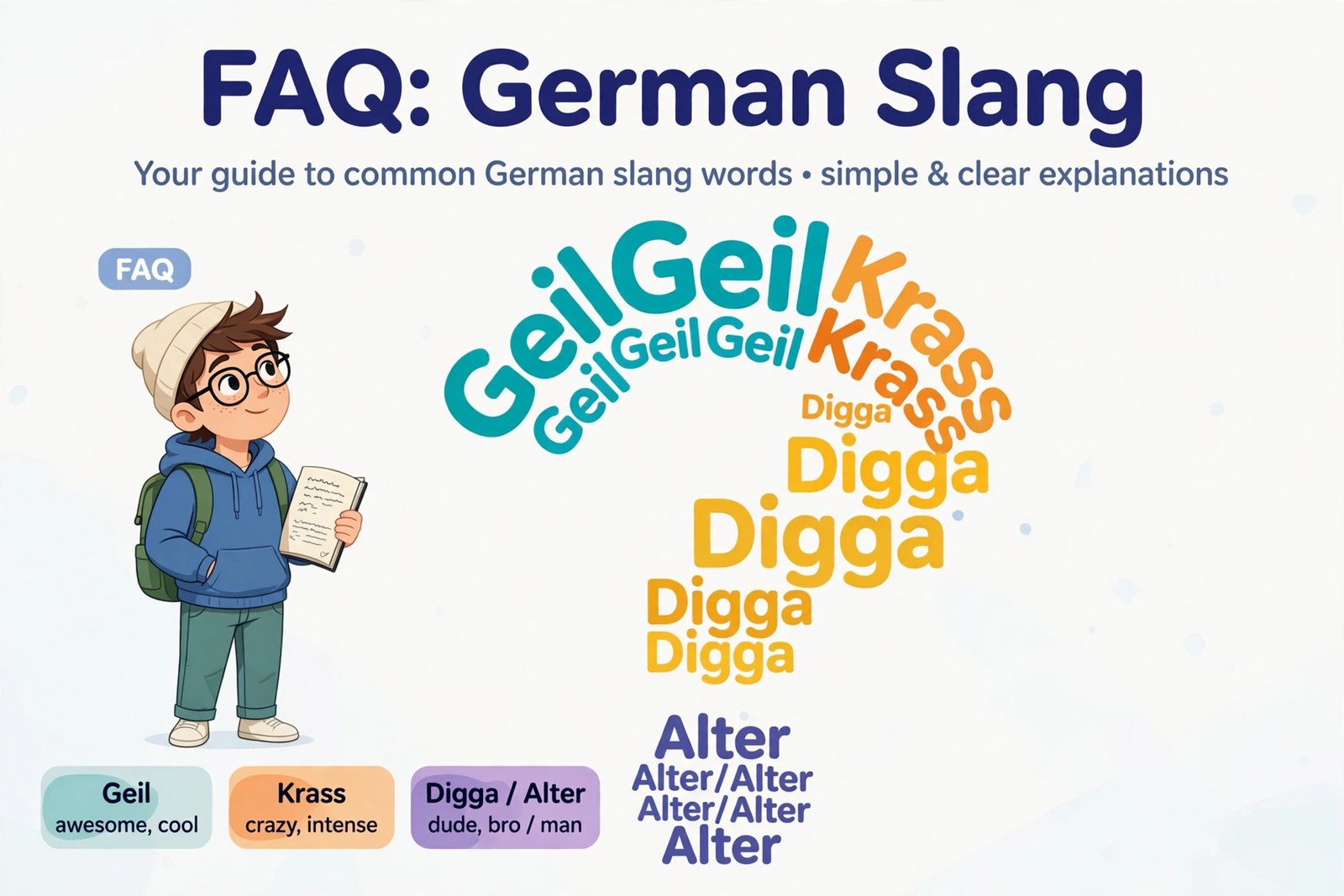
German slang is the informal vocabulary Germans use in casual conversation, texts, and social media — words like geil (awesome), krass (crazy), and Digga (bro). It is called Umgangssprache and is different from formal textbook German.
What is the most common German slang word?
Geil is probably the most common — it means “awesome” or “cool” and is used by all ages across Germany. Krass and Alter are close behind.
What does Digga mean in German?
Digga (also spelled Diggah or Digger) means “bro”, “dude”, or “mate”. It comes from Dicker (fat one), a Hamburg term of affection among friends, and is now popular with young people all over Germany.
What does krass mean in German slang?
Krass means extreme, intense, or unbelievable — it can be positive or negative depending on context. Krass gut means amazingly good; krass schlimm means terribly bad.
Is German slang rude?
Most German slang is not rude — words like geil, krass, and Alles klar are friendly and normal. But some words (Spacko, Assi, Horst) are insulting, and even friendly slang can sound rude if you use it with a boss or a stranger.
How do Germans say “cool” in slang?
The most common ways are geil, krass, Hammer, stabil, and fett. Geil is the safest all-round choice; stabil and fett sound younger and more urban.
What is German Gen Z slang?
German Gen Z slang mixes German words with English loans: Digga, Ehrenmann, Talahon, cringe, Girlmath/Boymath, and checkst du? (you get it?). It changes fast, with a new Jugendwort des Jahres (Youth Word of the Year) chosen every year.
How can I learn German slang fast?
Watch German shows and YouTubers, follow German TikTok creators, and practise the safe starter words (geil, krass, Alles klar, Kein Ding) in real conversations. Learning slang in context — not from a bare word list — is what makes it stick.
Conclusion
German slang is the difference between speaking German and sounding German. Words like geil, krass, Digga, and Alter are not just vocabulary — they are how Germans show excitement, friendship, and humour, and learning them is the fastest way to move from textbook sentences to real conversations.
The key takeaways are simple: start with the safe, universal words; match your slang to the person and the situation; listen before you copy; and never use heavy or insulting slang with people you do not know well. Regional words like Moin and Servus are worth learning too — they instantly mark you as someone who understands Germany, not just German.
Now it is your turn. Pick five words from this guide, use them in your next German conversation or text message, and notice how people react — a natural Das ist ja krass! or a friendly Alles klar, Digga! will get you a smile that no grammar exercise ever could. And if you want more, explore our other slang guides — from Japanese slang to Texas slang — and keep building your slang vocabulary one language at a time.
