
Quick definition: Texas slang is the colorful, friendly set of words and sayings people use across the Lone Star State — from “howdy” and “y’all” to “fixin’ to” and “all hat, no cattle.” It blends Southern English, Spanish vaquero ranching terms, and frontier humor into a way of speaking that is warm, direct, and instantly recognizable. If someone in Texas tells you they are “fixin’ to head over yonder,” they simply mean they are about to go over there.
Texas Slang Meaning & Definition
Texas slang meaning is easy to grasp once you hear it in context: it is the informal vocabulary and expressions that Texans use in everyday conversation. Unlike internet slang that appears and disappears in a few months, Texas slang has been shaped over centuries by cattle ranchers, cotton farmers, oil workers, Mexican vaqueros, German settlers, and generations of Southern families. The result is a dialect that sounds like home to 30 million people — and like a fun puzzle to everyone else.
At its core, Texas slang does three things. First, it shortens and softens everyday speech: “you all” becomes “y’all,” “how do you do” becomes “howdy,” and “I am about to” becomes “I’m fixin’ to.” Second, it paints pictures instead of stating facts: a braggart is not just arrogant, he is “all hat and no cattle,” and a hot day is not just warm, it is “hotter than a fur coat in Marfa.” Third, it carries manners with it — “yes, ma’am” and “no, sir” are not old-fashioned in Texas; they are basic politeness.
Texas slang is not one single accent or word list. A rancher in West Texas, a college student in Austin, and a grandmother in East Texas all sound Texan, but they reach for different expressions. What they share is the rhythm: unhurried, good-humored, and generous with the listener. Understanding Texas slang meaning is less about memorizing a dictionary and more about learning how Texans turn ordinary sentences into something warmer and more vivid.
Introduction
Picture this: you land in Dallas, walk into a barbecue joint, and the woman behind the counter greets you with “Howdy, y’all! What kinda Coke do y’all want?” In the space of one sentence, you have heard three pieces of Texas slang — and if you order a Dr Pepper when she asks about Coke, you have already passed the test. That is the charm of Texas talk: it is welcoming, a little playful, and full of small surprises for newcomers.
Texas slang shows up everywhere, not just on ranches. You will hear it in Houston boardrooms (“Let’s circle back right quick”), in Austin coffee shops (“I’m fixin’ to grab lunch — y’all want anything?”), and in Friday night football stands (“That boy ain’t got a pot to piss in, but he sure can throw”). It appears in country songs, in TV shows, in memes, and in the group chats of Texans who moved away but never stopped sounding like home. Like other slang you might already know — the kind of shorthand people use in texts, where a short phrase like FN can carry a whole attitude in two letters — Texas slang packs big meaning into small, memorable phrases.
This guide explains Texas slang meaning in full: the most common words and sayings, where they came from, how to use them without sounding forced, the mistakes visitors make, and polite alternatives for formal situations. Whether you are moving to Texas, visiting for a weekend, texting a Texan friend, or just curious about what “bless your heart” really means (spoiler: it depends), you will find the answer here.

Origin
Texas slang was born on the frontier, where several cultures and languages collided. In the 1700s and 1800s, Spanish-speaking vaqueros — the original cowboys — worked cattle across South and West Texas, and their words drifted into English: “rodeo” (from rodear, to round up), “lasso,” “stampede,” and “corral” all entered American English through Texas. When Anglo settlers arrived, they borrowed the vocabulary along with the cattle-handling skills, and the borrowed words picked up a Texas drawl.
The Southern roots run just as deep. The Scots-Irish settlers who moved through Appalachia into Texas brought expressions and speech patterns with them, including the ancestor of “y’all.” As one Texas history of the word notes, the Scots-Irish used “ye all” as a plural form of “you,” and over generations it softened into “y’all” — a contraction of “you all” that solves one of English’s oldest problems: the word “you” is both singular and plural, and Texans wanted a clear way to address a group. Wiktionary’s entry for “y’all” traces the contraction back centuries and confirms its role as the standard second-person plural pronoun of Southern American English.
Ranching gave Texas slang its most famous metaphors. On the open range, a man’s hat and his cattle were the visible signs of his success, so “all hat and no cattle” became the perfect insult for a show-off. Cattle drives, branding, and roundups supplied dozens of expressions: “this ain’t my first rodeo” (I have done this before), “get along, little dogies” (move along), and “until the cows come home” (a very long time). Oil booms added their own flavor — “gusher,” “wildcatter,” “roughneck” — and the state’s huge size contributed sayings about distance and weather, because in Texas the drive to the next town really can take all day.
German and Czech settlers in the Hill Country, African American communities across East Texas, and Mexican American families along the border each added phrases and rhythms of their own. The result is not a single slang list but a layered dialect: Southern politeness on top, Spanish ranching vocabulary in the middle, and frontier humor running all the way through.
Popularity
Texas slang has never been more popular. Country music carries it worldwide — artists from George Strait to Kacey Musgraves have put “howdy,” “y’all,” and “ain’t my first rodeo” into songs heard far beyond the state line. Television and film, from Friday Night Lights to Yellowstone, made Texas speech a shorthand for toughness and warmth on screen. And social media did the rest: TikTok creators explain Texas sayings to millions of viewers, and “Texas slang” videos regularly rack up millions of views from people who have never set foot in the state.
Search interest tells the same story. Lists of “50 Texas slang words” and guides to “speaking like a true Texan” are among the most-read pages on Texas culture sites, and new guides keep appearing every year because visitors and newcomers keep asking the same questions: What does “fixin’ to” mean? Why does everyone say “Coke” when they mean Sprite? Is “bless your heart” a compliment or an insult? (It is both — context decides.)
Inside Texas, the slang is also a badge of identity. Texans who move to New York or California report that strangers recognize them by “y’all” within minutes, and many wear it proudly. At the same time, the slang keeps evolving: younger Texans mix classic sayings with internet language, so a group chat might jump from “y’all” to a piece of texting shorthand without missing a beat — much like how people switch between full sentences and abbreviations such as HBU when they want a fast reply. The old words survive because they still work: they are short, vivid, and friendly, and they say “you belong here” faster than any formal greeting could.
How It Is Used
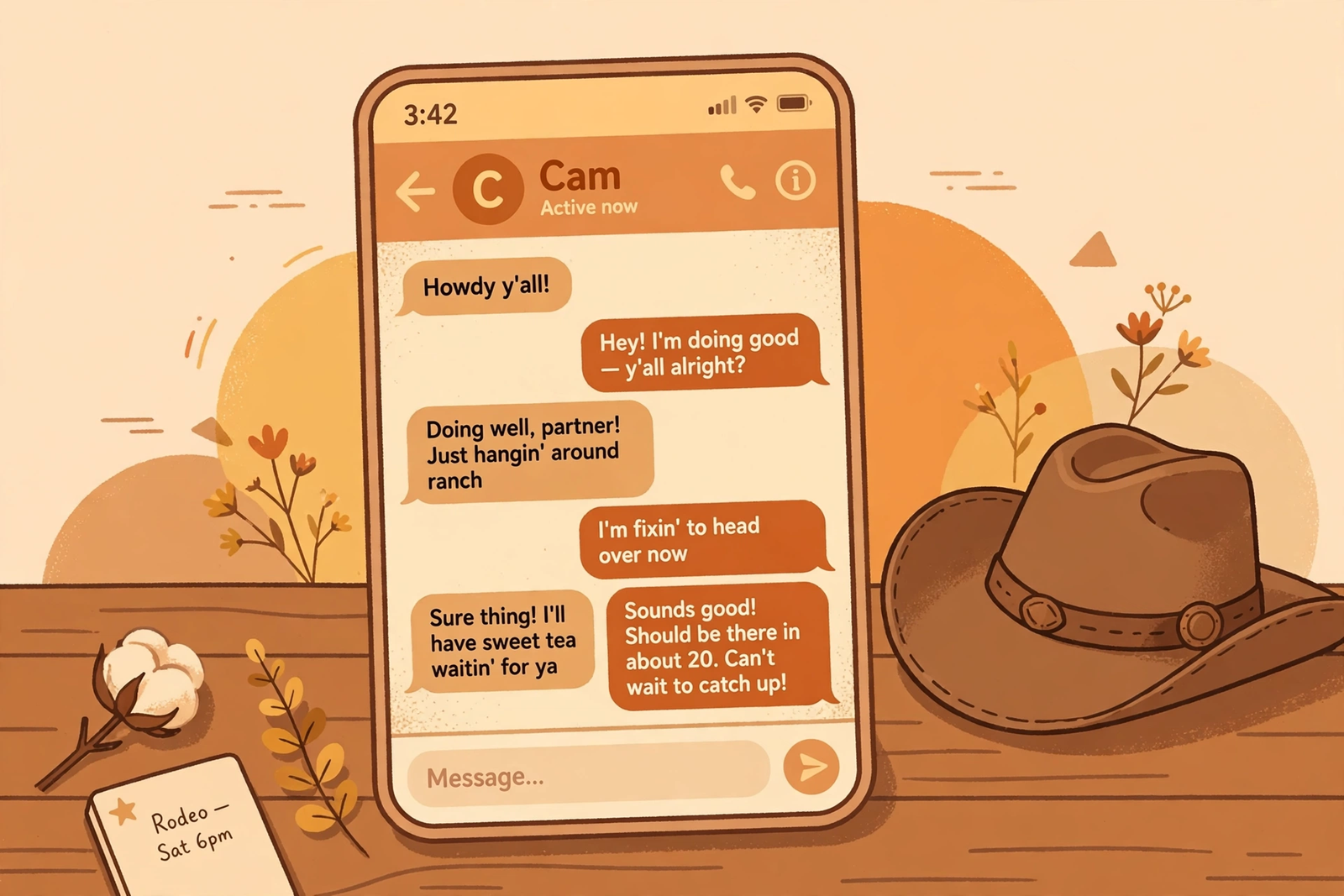
Texas slang is used in almost every casual setting in the state, and the rules are simple: it is for friendly conversation, not formal writing. You will hear it at family barbecues, in pickup trucks, at high school football games, in diners, and in text messages. A Texan might tell a friend “I’m fixin’ to head to H-E-B, y’all need anything?” and nobody blinks — that is just how people talk.
The slang works differently depending on who is speaking. Older Texans tend to use the full classic set — “yes, ma’am,” “over yonder,” “might could,” “pitch a hissy fit” — while younger Texans use a lighter mix, keeping “y’all” and “howdy” but dropping some of the older ranching phrases. In cities like Houston, Dallas, and Austin, Texas slang shares space with the speech of newcomers from all over the world, so you will hear it blended with other accents and expressions. In small towns, it is thicker and more constant.
Tone matters more than vocabulary. Texas slang is almost always warm or humorous, even when it is teasing. “Bless your heart” can be genuine sympathy or a velvet-gloved insult, and the difference is entirely in the tone and the situation. “All hat and no cattle” sounds funny, but it is a real put-down. The safest way to use Texas slang as a visitor is to start with the friendly words — “howdy,” “y’all,” “yes, ma’am” — and let the idioms come later, once you have heard how locals use them.
One important note: Texas slang is spoken far more than it is written. In texts and social media, Texans do write “y’all” and “fixin’ to,” but the long colorful idioms usually stay in speech. When Texans do write slang in messages, it sits alongside the same texting abbreviations everyone uses — a quick “y’all” next to a quick IMK is a perfectly normal Texas group chat.
Examples
The best way to learn Texas slang meaning is to see the words in real sentences. Here are the essential terms grouped by tone, with examples you can actually use.
Friendly Examples
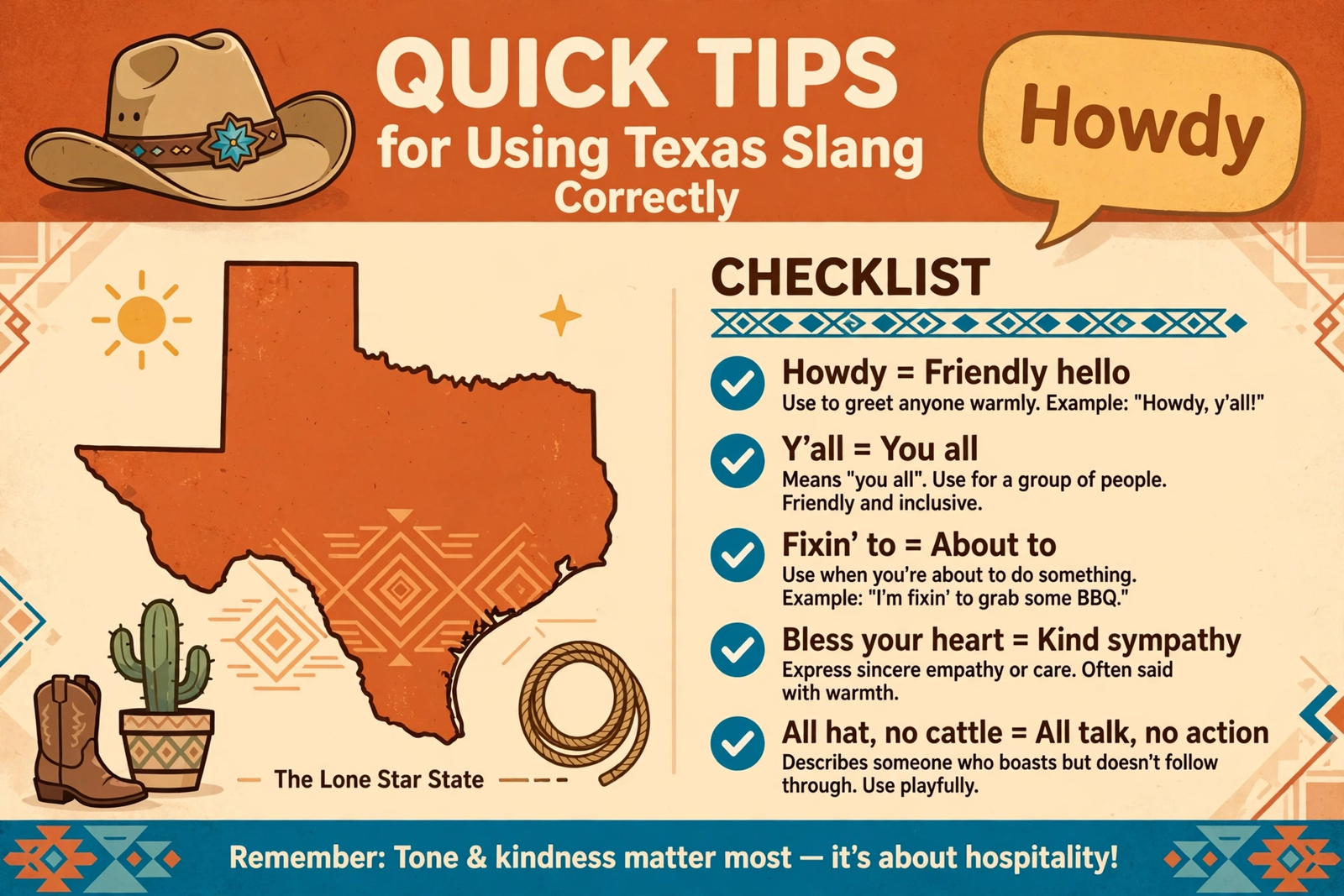
- Howdy — the classic Texas hello. “Howdy, neighbor! Come on in, supper’s almost ready.” Short for “how do you do,” it is the official greeting of Texas A&M University and the friendliest word in the state.
- Y’all — you all; two or more people. “Are y’all coming to the cookout on Saturday?” For a bigger crowd, upgrade to “all y’all”: “All y’all need to hear this story.”
- Fixin’ to — about to do something, right now. “I’m fixin’ to leave in five minutes, so grab your jacket.” It signals immediate intention, not a vague plan.
- Right quick — immediately, without delay. “I’ll be back right quick — just running to the store.”
- Over yonder — over there, usually with a point of the finger. “The restroom is just over yonder, past the barn.”
- Yes, ma’am / No, sir — respectful replies that Texans teach their children early. “Yes, ma’am, I’d love some more pie.”
- Coke — any carbonated soft drink, not just Coca-Cola. “What kinda Coke do y’all want?” “I’ll take a Dr Pepper.” This one confuses visitors more than any other Texas word.
- Hankerin’ — a craving. “I’ve got a hankerin’ for some brisket tonight.”
Professional Examples
Texas slang does appear at work, but Texans choose the milder words in professional settings:
- “Let’s circle back right quick before the meeting ends.” (quickly)
- “Y’all did a great job on this project — thank you.” (warm, inclusive, and perfectly fine in a Texas office)
- “I’m fixin’ to send over the contract this afternoon.” (common in business emails across Texas)
- “That proposal was a real gullywasher of an idea — it covered everything.” (a “gullywasher” is a heavy rainstorm, used here to mean something big and thorough)
- “We need to get this done come hell or high water.” (no matter what it takes — determined, and acceptable when the stakes are high)
In formal writing — reports, contracts, applications — Texans switch to standard English. The slang stays in conversation, meetings, and friendly emails, which is exactly where it works best.
Funny Examples
- All hat and no cattle — a big talker with nothing to back it up. “He brags about his ranch, but he’s all hat and no cattle.”
- Bless your heart — sweet on the surface, but often a polite way to call someone naive. “He tried to parallel park a dually downtown, bless his heart.”
- This ain’t my first rodeo — I know what I’m doing; I’ve done this before. “Don’t worry about me driving in the rain — this ain’t my first rodeo.”
- Hotter than a fur coat in Marfa — extremely hot. Marfa is a West Texas desert town, and a fur coat there would be pure misery.
- What in tarnation? — what on earth? A colorful, old-fashioned way to express surprise. “What in tarnation happened to my truck?”
- Pitch a hissy fit — throw a dramatic tantrum. “Mama pitched a hissy fit when she saw the muddy boots on the carpet.”
- Can’t beat that with a stick — an irresistible deal. “Two brisket plates for ten bucks? You can’t beat that with a stick.”
- Doesn’t have a pot to piss in — extremely broke. Blunt, funny, and definitely not for polite company.
- Like a chicken with its head cut off — running around in a panic with no direction. “He was running around like a chicken with its head cut off before the wedding.”
- That dog won’t hunt — that idea will not work. “You can’t fix the budget by cutting the barbecue fund — that dog won’t hunt.”
Comparison with Similar Terms
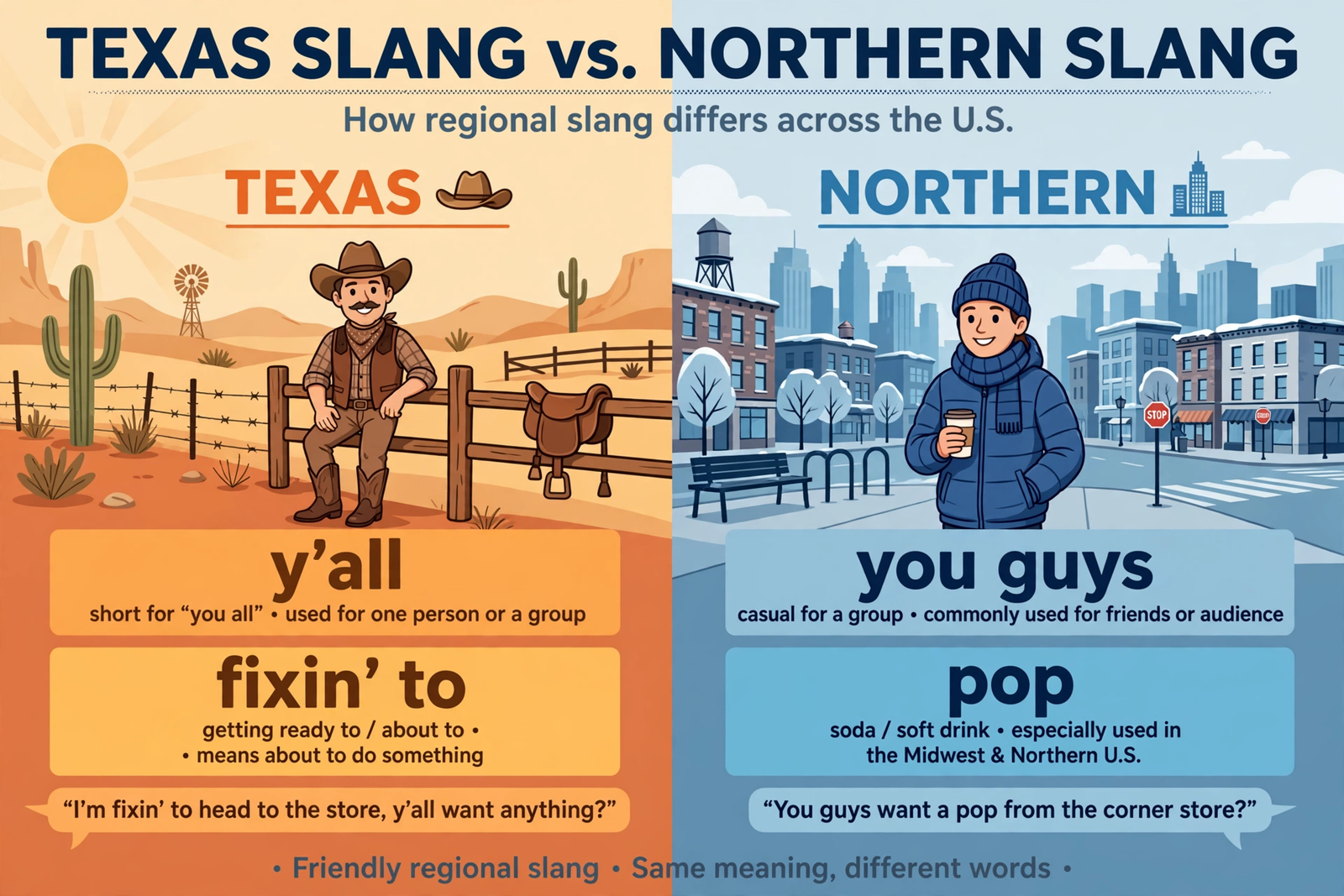
Texas slang overlaps with general Southern slang, but several words are distinctly Texan. This table shows how Texas expressions compare with similar terms from other regions.
| Texas Slang | Meaning | Similar Term Elsewhere | Difference |
|---|---|---|---|
| Y’all | You all (plural) | You guys (North), youse (New York/New Jersey) | Y’all is the Southern standard; “you guys” is used even for women up North, while y’all is gender-neutral by nature. |
| Fixin’ to | About to do something | “Gonna” / “about to” (general US) | Fixin’ to signals immediate, active preparation — you are already moving — while “gonna” can mean any future plan. |
| Coke | Any soda | “Pop” (Midwest), “soda” (Northeast/West) | Only Texas (and parts of the South) uses a brand name as the generic word for all soft drinks. |
| All hat, no cattle | All talk, no substance | “All bark, no bite” (general US) | The Texas version is a ranching image and a sharper social insult — it questions a person’s wealth and status, not just their courage. |
| Bless your heart | Sympathy — or a polite insult | “Oh, honey” (general South) | Bless your heart is uniquely double-edged; tone decides whether it is kindness or a put-down. |
| Howdy | Hello | “Hey y’all” (general South), “Howdy” (also rural West) | Howdy is Texas’s signature greeting and the official hello of Texas A&M; elsewhere it can sound old-fashioned. |
| Might could | Might be able to | “Might be able to” (standard English) | A double modal — two helping verbs stacked together — that softens a statement and sounds less pushy: “I might could help you tomorrow.” |
| Over yonder | Over there | “Over there” (standard) | Yonder adds a friendly, rural flavor and usually comes with a gesture; “over there” is neutral. |
The pattern is clear: Texas takes ordinary Southern speech and adds ranching imagery, Spanish flavor, and a bigger sense of humor. A Southerner from Georgia will understand most Texas slang instantly, but the cattle and oil references — rodeo, cattle, gushers, Marfa heat — are pure Lone Star.
Alternate Meanings
Like most slang, Texas expressions can mean different things depending on context, and a few words have meanings that surprise newcomers.
- Bless your heart — Genuine sympathy (“Your dog passed away? Oh, bless your heart”) or a disguised insult (“He failed the test again, bless his heart”). Listen to the tone and watch the smile: a slow, sweet delivery usually means the insult version.
- Coke — In Texas it means any soda, but if a Texan in another state asks for “a Coke,” they usually do mean Coca-Cola. The generic meaning only works inside Texas and the South.
- Fixing — “Fixin’ to” means “about to,” but “fixing dinner” in Texas means preparing or cooking it, not repairing it. “I’m fixing supper” is an invitation, not a maintenance report.
- Directly — In Texas, “directly” can mean “soon” rather than “immediately.” “I’ll be there directly” means “I’ll be there shortly” — do not expect the speaker in thirty seconds.
- Carry — Texans sometimes say “carry me to the store” when they mean “drive me” or “take me.” It comes from older Southern usage and still appears in rural areas.
- Mash — “Mash the button” means press it. A small word, but it marks a speaker as Southern the moment they say it.
- Ugly — “Don’t get ugly with me” does not mean “don’t become unattractive”; it means “don’t get rude or confrontational.”
- Pretty — Texans use “pretty” as an intensifier: “pretty good,” “pretty tired,” “pretty far.” It means “fairly” or “quite,” not “beautiful.”
Professional or Polite Alternatives
Texas slang is wonderful in casual conversation, but some expressions do not belong in a job interview, a courtroom, or a formal email. Here are polite swaps for the most common situations:
| Texas Slang | Polite / Professional Alternative |
|---|---|
| Y’all | “Everyone,” “all of you,” or “the team” |
| Fixin’ to | “About to,” “planning to,” or “preparing to” |
| Howdy | “Hello,” “good morning,” or “good afternoon” |
| Ain’t my first rodeo | “I have experience with this” |
| All hat and no cattle | “Their claims do not match their results” |
| That dog won’t hunt | “That approach will not work” |
| Bless your heart (insult version) | Say nothing — or offer genuine sympathy instead |
| Pitch a hissy fit | “They became very upset” |
| Doesn’t have a pot to piss in | “They are in a difficult financial situation” |
| What in tarnation? | “What happened?” or “Could you explain?” |
| Yes, ma’am / No, sir | Keep these! They are polite everywhere. |
Note that “y’all,” “howdy,” and “yes, ma’am” are so widely accepted in Texas that using them in a Texas workplace is usually a plus, not a problem. The words to swap out are the idioms that judge people (“all hat and no cattle”) or the crude ones (“doesn’t have a pot to piss in”). When in doubt, keep the greeting and drop the insult.
Common Mistakes
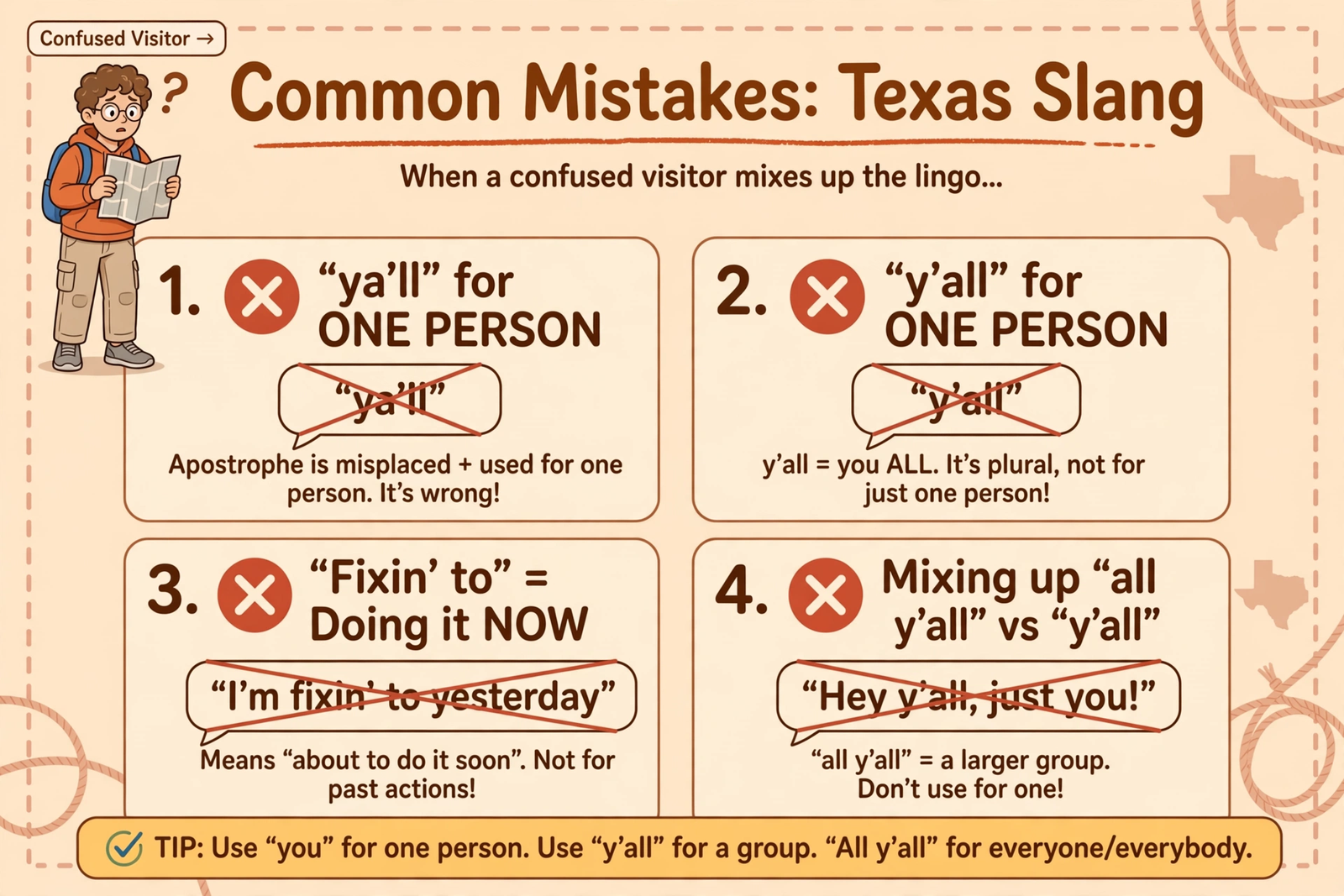
Visitors make the same handful of mistakes with Texas slang. Avoid these and you will sound respectful instead of like a caricature:
- Using “y’all” for one person. Y’all is always plural. Addressing a single person with “how are y’all?” sounds wrong to every Texan ear — unless that person represents a group (“What time do y’all close?” to a shopkeeper). For one person, say “how are you?”
- Spelling it “ya’ll.” The apostrophe replaces the missing “ou” in “you,” so the correct spelling is “y’all,” never “ya’ll.” The possessive is “y’all’s” (“Is this y’all’s truck?”).
- Overusing the slang. Dropping “howdy,” “fixin’ to,” and “ain’t my first rodeo” into every sentence sounds like a costume, not a conversation. Texans use these words naturally and sparingly — one or two per conversation, not ten.
- Ordering “a Coke” and expecting Coca-Cola. If the waitress asks “What kinda Coke do you want?” she is asking which soda. Answering “Coke” will get you a Coca-Cola; answering “Dr Pepper” will get you a Dr Pepper. Both are correct.
- Taking “bless your heart” at face value. It is genuine sympathy about half the time and a polite insult the other half. If someone says it right after you do something foolish, it was not a compliment.
- Using “fixin’ to” for distant plans. “I’m fixin’ to retire next year” is wrong — fixin’ to means you are about to do it now. For future plans, use “planning to.”
- Faking the accent. Texas slang is vocabulary, not a voice. You can use the words in your own accent and sound perfectly natural; forcing a drawl sounds mocking.
- Calling everything “y’all” in writing. In formal emails and documents, write “you all” or “everyone.” Save “y’all” for conversation, texts, and friendly messages.
Quick Tips
- Start with the big three: “howdy,” “y’all,” and “fixin’ to” cover most everyday Texas conversations. Master those three and you will understand about half of what you hear.
- Listen before you speak: spend a day hearing how locals use an expression before trying it yourself — especially double-edged ones like “bless your heart.”
- Answer the Coke question correctly: when a server asks “What kinda Coke?” name the soda you want, whether that is Dr Pepper, Sprite, or actual Coca-Cola.
- Keep “yes, ma’am” and “no, sir” in your pocket: they cost nothing, work with strangers of any age, and mark you as polite everywhere in the state.
- Use slang to connect, not to perform: one natural “y’all” beats five forced idioms. Texans can spot a performance instantly and would rather hear you be yourself.
- Learn the food words too: “barbecue” in Texas means smoked brisket, “fixings” are the side dishes, and “tea” means sweet tea unless you say otherwise.
- When texting Texans, match their energy: a quick “Howdy y’all! Who’s fixin’ to come to the lake?” is normal — just as texting shorthand like CFS is normal in other group chats. Short, warm, and direct is the Texas texting style.
- Ask when you are unsure: Texans love explaining their sayings. “What does that mean?” is always welcome — it usually starts a story.
FAQ
What does Texas slang mean?
Texas slang is the informal vocabulary and sayings used across Texas — words like “howdy” (hello), “y’all” (you all), and “fixin’ to” (about to), plus colorful idioms like “all hat and no cattle.” It blends Southern English, Spanish ranching terms, and frontier humor.
What does “y’all” mean in Texas?
“Y’all” is a contraction of “you all” and means two or more people. It is the standard plural form of “you” in Texas and the South. For a large group, Texans say “all y’all.” It is always plural — using it for one person is the most common mistake visitors make.
What does “fixin’ to” mean?
“Fixin’ to” means “about to do something right now.” “I’m fixin’ to leave” means the speaker is gathering their things and walking out the door. It signals immediate intention, not a distant plan.
What does “all hat and no cattle” mean?
It describes someone who talks big about wealth, toughness, or success but has nothing to back it up. The image comes from 19th-century cattle ranching, where a man’s hat and his herd were the visible signs of his success.
Is “bless your heart” a compliment or an insult?
Both — context and tone decide. Said with genuine warmth after bad news, it is real sympathy. Said slowly with a sweet smile after someone does something foolish, it is a polite way of calling them naive. When in doubt, listen to the tone.
Why do Texans call every soda “Coke”?
In Texas and much of the South, “Coke” became the generic word for any carbonated soft drink, the same way some regions say “pop” or “soda.” When a server asks “What kinda Coke do you want?” they are asking which soda you would like — Dr Pepper, Sprite, root beer, or actual Coca-Cola.
What does “this ain’t my first rodeo” mean?
It means “I have done this before and I know what I’m doing.” The rodeo image comes from Texas ranching culture, and the phrase is used to show confidence and experience — usually with a smile.
How can I learn Texas slang fast?
Start with “howdy,” “y’all,” and “fixin’ to,” then learn one idiom at a time from real conversations, country songs, and Texas shows. Listen to how locals use each phrase before trying it yourself, and do not be afraid to ask what something means — Texans enjoy explaining their sayings.
Conclusion
Texas slang meaning comes down to this: it is the warm, witty, picture-painted way Texans talk — a living mix of Southern manners, Spanish ranching history, and frontier humor that turns an ordinary greeting into “howdy, y’all” and an ordinary plan into “I’m fixin’ to.” From “y’all” and “fixin’ to” to “all hat and no cattle” and “bless your heart,” these words do more than decorate a sentence; they signal friendliness, confidence, and belonging.
Now you know the essentials: what the most common words mean, where they came from, how to use them in friendly and professional settings, the comparison with other regional slang, the mistakes to avoid, and the polite alternatives for formal moments. The next time a Texan tells you they will be back “right quick” or asks what kinda Coke you want, you will know exactly what they mean — and you will know how to answer like you belong.
So go ahead: greet the next Texan you meet with a friendly “howdy,” ask “how are y’all doing,” and if someone asks what you are doing this weekend, tell them you are “fixin’ to” enjoy it. That is Texas slang — and now it is yours too.
