Quick Definition: Coffee slang is the informal vocabulary people use to talk about coffee — nicknames for the drink itself (joe, java, bean water), shorthand for espresso drinks (red eye, flat white, cortado), and the behind-the-counter words baristas use with each other (dialing in, pulling a shot, microfoam). If you have ever stared at a cafe menu and felt like everyone else was speaking a secret language, coffee slang is the language you were missing.
Coffee Slang Meaning & Definition
Coffee slang means the casual, everyday words and phrases that coffee drinkers, baristas, and cafe regulars use instead of formal drink names. It is not a separate language and it is not written in any textbook. It is a living layer of English that grew up around coffeehouses, diners, offices, military bases, and, more recently, TikTok and meme culture.
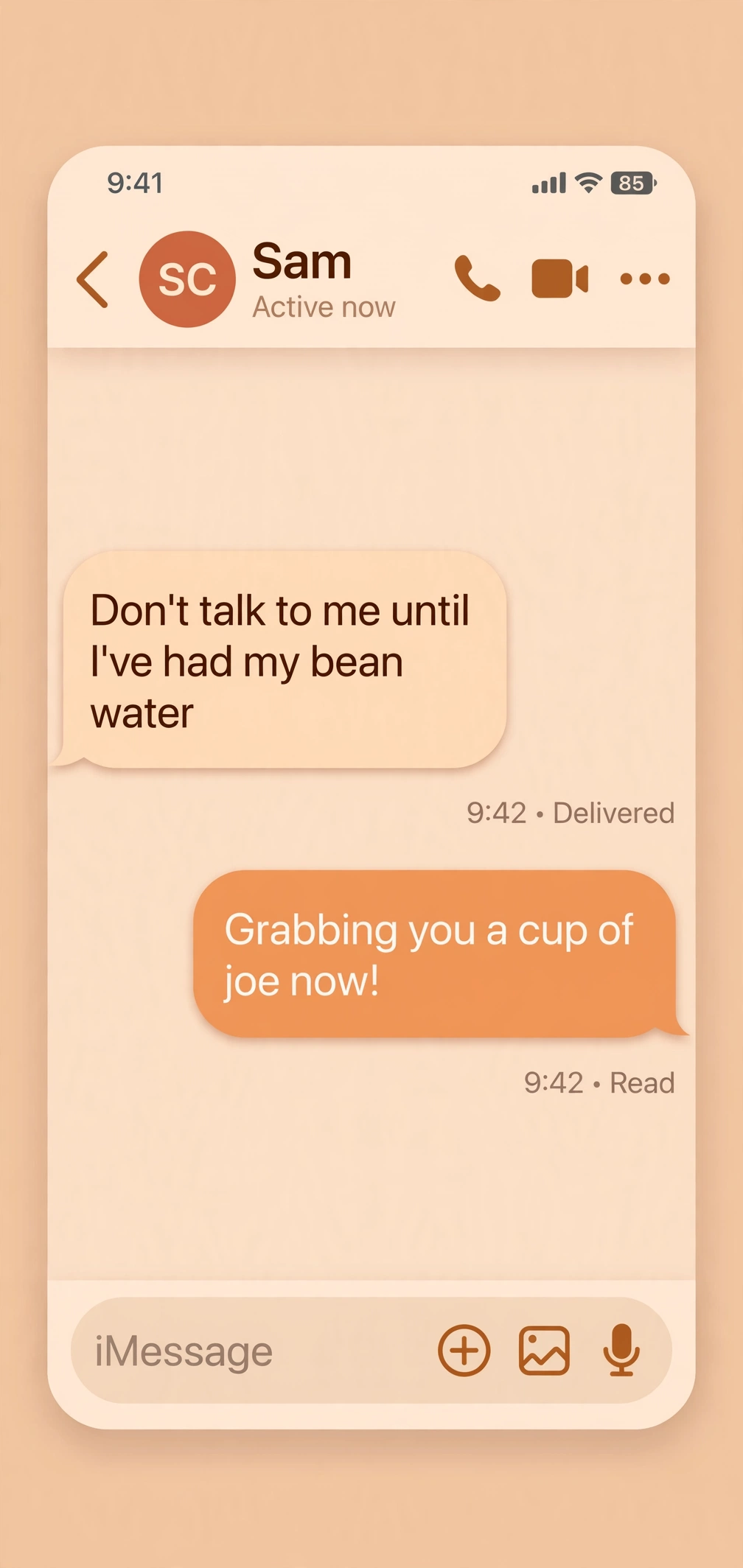
At its simplest level, coffee slang gives the drink itself a nickname. Nobody in a hurry says “I need a cup of caffeinated hot beverage” — they say “I need my joe,” “pass the java,” or “don’t talk to me before my bean water.” At a deeper level, coffee slang is also a working vocabulary. A barista who says a shot is “dialed in” is telling a coworker the grind, dose, and extraction time are all correct. A customer who orders a “red eye” is asking for drip coffee with a shot of espresso in it. A menu that lists a “flat white” is promising a specific ratio of espresso to velvety steamed milk, not just “coffee with milk.”
What makes coffee slang worth learning is that it does three jobs at once. It saves time — one short word replaces a long explanation. It signals belonging — ordering like a regular tells the barista you know the place. And it adds personality — calling your morning cup “rocket fuel” says something about your day that “coffee” never could. This guide covers the full world of coffee slang: the classic nicknames, the espresso-bar vocabulary, the third-wave terms, the regional differences, and the internet-era jokes, all with real examples you can actually use.
Introduction
Picture this: you walk into a busy cafe, and the person ahead of you orders a “double ristretto, bone dry, extra hot.” The barista nods like it is the most normal sentence in the world. Then your friend texts you: “Death before decaf, bring me the go juice.” You nod along, but honestly, you have no idea what anyone just said.
That is the everyday reality of coffee slang. Coffee is the most widely consumed drink on the planet after water, and after centuries of drinking it, people have invented hundreds of words for it. Some of them are centuries old, like “java,” named after an Indonesian island. Some of them were born on Navy ships, in truck stops, or in Italian espresso bars. And some of them — “bean water,” “dirt,” “cupped lightning” — were born on the internet in the last few years and spread faster than any coffee trend before them.
The good news is that coffee slang is not hard once someone explains it. Most terms fall into a few clear groups: names for coffee itself, names for drinks, words baristas use behind the counter, regional ordering words, and jokes. Learn the big ones in each group and you will understand almost any cafe conversation, group chat, or meme. This guide explains 30+ coffee slang terms with their meanings, origins, and real examples — plus the mistakes to avoid, so you sound like a regular instead of someone reading a dictionary out loud. And if you enjoy decoding everyday language, you will find the same kind of breakdown in our guide to Australian slang, where one word can mean five different things depending on the city.

Origin
Coffee slang did not come from one place. It came from everywhere coffee went — and coffee went everywhere. Four streams of history feed the vocabulary we use today.
The trade routes gave us the first nicknames. Coffee reached Europe from Yemen in the 1600s, and the Dutch began growing it on the Indonesian island of Java. So much coffee shipped out of Java that the island’s name became a word for the drink itself. “Java” is still one of the most common coffee slang terms in American English, more than 300 years later. “Mocha” followed a similar path, named after the Yemeni port of Al-Makha, and it still survives today as both a coffee-chocolate drink and a slang word for coffee.
The military and the workplace gave us the tough nicknames. In the early 1900s, American sailors and soldiers drank coffee constantly, and they gave it blunt, funny names. “Joe” is the most famous — the leading theory credits Josephus Daniels, the US Secretary of the Navy, who banned alcohol aboard ships in 1914 and left coffee as the strongest drink available. Sailors supposedly started calling it “a cup of Joe” in his honour. Other theories link it to “jamoke” or simply to the average “Joe,” but the Navy story is the one most people repeat. Truckers and night-shift workers added “mud,” “rocket fuel,” and “go juice” — names that describe coffee as fuel for people who cannot afford to fall asleep. The National Coffee Association traces coffee’s long journey from Ethiopian legend to global habit, and the slang followed every step of that journey.
Italy gave us the espresso vocabulary. When espresso machines spread from Italy in the 20th century, they brought Italian words with them: “espresso” itself, “ristretto” (a restricted, shorter shot), “lungo” (a long pull), “doppio” (a double), “macchiato” (marked with foam), and “barista” (the person who makes it). These words started as technical terms and became everyday coffee slang as cafes spread across America, Britain, and Australia.
The internet gave us the joke names. In the last decade, meme culture deliberately renamed coffee in the most reductive way possible: “bean water.” The joke is that coffee is literally just water flavoured with beans — and saying it that way is funnier than saying “coffee.” “Dirt,” “bean juice,” and “cupped lightning” belong to the same family. These terms spread through TikTok and Twitter because they are short, visual, and instantly shareable, which is exactly how modern slang travels.
Popularity
Why is coffee slang so popular right now? Three forces are pushing it.
First, coffee culture itself exploded. The “third wave” movement treats coffee like wine — with named farms, tasting notes, and precise brewing methods — and that created a whole new layer of coffee slang. Words like “single origin,” “microlot,” “natural process,” and “cupping” moved from trade journals into ordinary cafe menus. At the same time, chains like Starbucks invented their own vocabulary — tall, grande, venti — and pushed it into millions of daily conversations.
Second, coffee is social media’s favourite prop. The “morning coffee” photo, the “but first, coffee” mug, and the “don’t talk to me before coffee” meme are some of the most shared images online. Each one carries a piece of coffee slang with it, and each share teaches the phrase to a few more people. When a phrase like “death before decaf” appears on a million mugs and T-shirts, it stops being a joke and becomes part of the language.
Third, coffee slang is genuinely useful. A cafe is a fast environment. Customers want to order quickly, and baristas want to hear the order once. Short, precise words — “flat white,” “red eye,” “skinny latte” — are simply faster than long descriptions. That is why coffee slang survives: it is not just fun, it is efficient. And because coffee is a daily habit for billions of people, the words get practised every single morning.
How Coffee Slang Is Used
Coffee slang shows up in four main places, and the words change slightly depending on where you hear them.
Ordering at the counter. This is where precision matters. “I’ll have a flat white” is a complete order. “Make it a double” adds a second shot. “Skinny” swaps in nonfat milk. “Bone dry cappuccino” means foam only, no steamed milk. Getting these right means getting the drink you actually wanted.
Behind the counter. Baristas use coffee slang as work shorthand. “Dialing in” means adjusting the grinder until the shot pulls in the target time, usually 25 to 30 seconds. “Pulling a shot” means making an espresso. “The puck” is the compressed disc of grounds in the portafilter, and “tamping” is pressing it down. “Channeling” is the barista’s nightmare — water finding a crack in the puck and racing through instead of extracting evenly. You will rarely hear these words as a customer, but they are the reason your drink tastes the same every day.
In texts and group chats. This is where the nicknames live. “Grab me a cup of joe on your way back.” “I need my morning java before I can function.” “Don’t talk to me until I’ve had my bean water.” The tone is casual, funny, and slightly dramatic — coffee slang in chats is half request, half performance.
On social media and memes. Internet coffee slang is the most exaggerated version: “death before decaf,” “but first, coffee,” “coffee is my love language,” “espresso yourself.” These phrases work as captions, mug slogans, and bios because they turn a daily habit into an identity.
Examples
Real examples are the fastest way to learn coffee slang, because the words only make sense in context. Here are the most common terms grouped by the tone people use them in.
Friendly Examples
Friends use the warm, funny nicknames. “Morning! Coffee run — want your usual flat white?” “I survived Monday on pure bean water and spite.” “Grab me a cup of joe, you’re a lifesaver.” “Life’s too short for bad coffee — let’s go to the good place.” These are the phrases that make coffee feel like a shared ritual instead of a transaction.
Another friendly classic is the “cuppa” — borrowed from British tea culture but now widely used for coffee too, especially on the East Coast of the US. “Fancy a cuppa?” is an invitation, not just a question about a drink. And “morning fix” is the honest version: “I need my morning fix before the meeting or nobody is safe.”
Professional Examples
In work settings, coffee slang gets more precise and less jokey. “I’ll take a double shot Americano, black, no sugar.” “Can I get that skinny, with oat milk?” “The client meeting is at ten — let’s dial in the presentation and grab a cortado after.” Even in offices, the ordering words stay: nobody asks for “a coffee beverage with steamed milk foam,” they ask for a cappuccino.
Baristas in a professional setting use the technical layer: “That shot is channeling — I’m going to re-pull it.” “We’re dialing in the new single origin today, so the first few shots might run fast.” “Can you steam the milk to microfoam for the latte art?” If you hear these words, you are listening to people who take coffee seriously — and now you know what they mean.
Funny Examples
Funny coffee slang is where the vocabulary gets creative. “I’m not a morning person, I’m a coffee person.” “Decaf? I don’t speak that language.” “My blood type is espresso.” “I like my coffee like I like my mornings: dark and silent.” “This mud could strip paint — in a good way.” And the internet favourite: “Don’t talk to me until I’ve had my bean water, Brenda.”
The funniest terms are the ones that insult coffee on purpose. “Dirt” for cheap instant coffee. “Mud” for thick, over-brewed diner coffee. “Rocket fuel” for the cup so strong it could power a launch. People who love coffee the most are often the ones who joke about it the hardest.
Comparison with Similar Terms
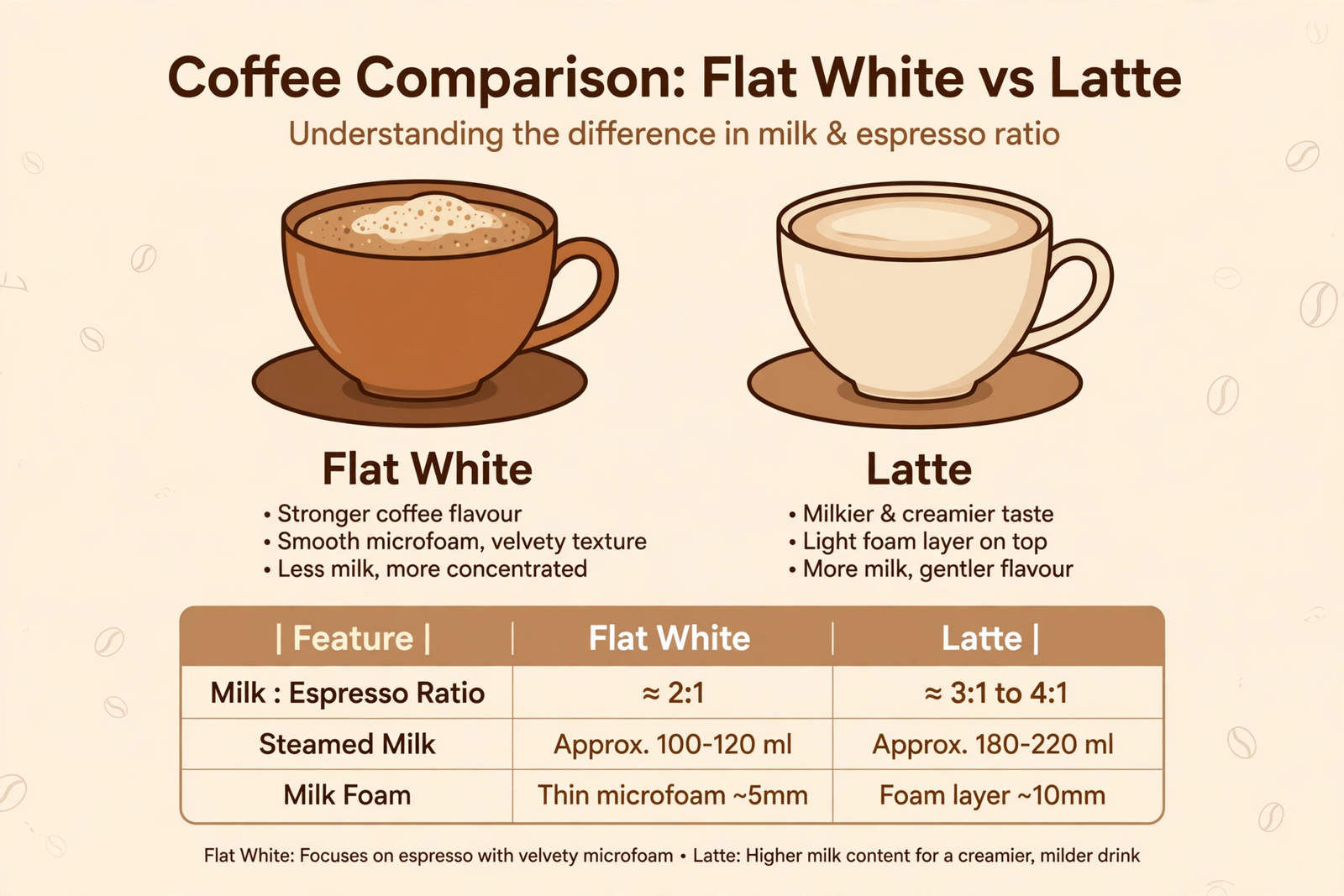
Coffee slang can be confusing because several terms sound alike but mean different things. The table below sorts out the pairs people mix up most often.
| Term | What It Means | How It Differs |
|---|---|---|
| Joe vs. Java | Both are nicknames for coffee itself | “Joe” comes from American Navy culture; “java” comes from the Indonesian island. Same drink, different history. |
| Flat white vs. Latte | Both are espresso with steamed milk | A flat white has less milk, more espresso flavour, and velvety microfoam. A latte is milkier and milder. |
| Cappuccino vs. Latte | Both are espresso, steamed milk, and foam | A cappuccino has much more foam and a stronger coffee taste. A latte is mostly steamed milk with a little foam. |
| Ristretto vs. Lungo | Both describe an espresso pull | A ristretto is a short pull — less water, sweeter, more concentrated. A lungo is a long pull — more water, thinner, more bitter. |
| Red eye vs. Black eye | Drip coffee with espresso added | A red eye has one extra shot. A black eye has two. A “dead eye” has three — order at your own risk. |
| Skinny vs. Breve | Both change the milk in a drink | “Skinny” means nonfat milk. “Breve” means half-and-half instead of milk — richer and heavier. |
| Wet vs. Dry cappuccino | Both describe foam levels | “Wet” means more steamed milk and less foam. “Dry” means more foam and less milk. “Bone dry” is foam only. |
| Single origin vs. Blend | Both describe the beans | Single origin comes from one farm or region. A blend mixes beans from several places for a consistent flavour. |
Once you can tell a flat white from a latte and a red eye from a black eye, you already know more coffee slang than most people who drink coffee every day. Comparisons like this are also how slang works in general — just as “flat white” and “latte” look similar but are not the same drink, slang terms that sound alike often carry different meanings, something you will also see in our breakdown of TBT meaning in slang.
Alternate Meanings
Most coffee slang terms have one main meaning, but a few of them change completely depending on where you hear them.
“Regular” is the biggest trap. In Boston and across New England, ordering coffee “regular” means with cream and sugar — not black. Order a “regular” in most other parts of the US and you will get a plain black coffee, and the barista will assume that is what you wanted. In Australia, a “regular” is a size — roughly a medium — and in parts of the UK it can mean a standard filter coffee. Always check the local meaning before you order.
“Mud” can be affectionate or insulting. A trucker who calls his coffee “mud” usually means it fondly — strong, thick, no nonsense. A coffee snob who calls your coffee “mud” is not being fond at all. Context and tone decide which one you are hearing.
“Shot” is not always coffee. In a bar, a “shot” is alcohol. In a cafe, a “shot” is a single serving of espresso. In photography, it is a photo. The word is harmless in a coffee shop and confusing everywhere else — which is why baristas always say “shot of espresso” when they want to be clear.
“Skinny” has two lives. In coffee, it means nonfat milk. Outside coffee, it describes a person’s body, and using it casually can sound rude. Inside the cafe it is standard ordering language; outside the cafe, leave it there.
“Cuppa” is tea first, coffee second. In Britain and Australia, “cuppa” almost always means tea. In the US, it has drifted toward coffee. If a British friend offers you a cuppa, expect tea — and do not correct them, because in their world, coffee slang borrowed the word and never gave it back.
Professional or Polite Alternatives
Coffee slang is fun with friends, but there are moments when plain language works better. In a formal meeting, a job interview, or a first visit to a high-end cafe, the polished version of each term keeps you sounding confident instead of casual.
- Instead of “gimme some joe,” say “a black coffee, please.”
- Instead of “rocket fuel,” say “a strong black coffee” or “a double espresso.”
- Instead of “bean water,” say “coffee” — the joke lands with friends, not with a client.
- Instead of “mud,” say “a full-bodied dark roast.”
- Instead of “death before decaf,” say “I prefer regular coffee, thank you.”
- Instead of “skinny,” you can say “with skimmed milk, please” — clearer and more polite.
- Instead of “bone dry,” say “a cappuccino with extra foam, please.”
The trick is knowing your audience. With a barista you know, “the usual, extra shot” is perfect. With a new client, “a flat white, please” is enough — you still sound like you know coffee slang, you just keep it professional. The same rule applies to all slang: use the fun version where it builds connection and the clean version where it builds credibility.
Common Mistakes
Even regular coffee drinkers make these mistakes with coffee slang. Avoid them and you will sound like you have been ordering for years.
Ordering a “regular” without knowing the local meaning. As explained above, “regular” means cream and sugar in New England and black coffee almost everywhere else. If you are travelling, say what you actually want: “black, no sugar” leaves nothing to chance.
Mixing up a flat white and a latte. They are not interchangeable. A flat white is smaller, stronger, and has thin velvety foam. A latte is larger and milkier. Ordering one and expecting the other is the most common cafe disappointment in the world.
Calling every strong coffee a “red eye.” A red eye is a specific drink: drip coffee plus one espresso shot. A double espresso is not a red eye, and a dark roast is not a red eye either. Use the term only when the drink actually matches.
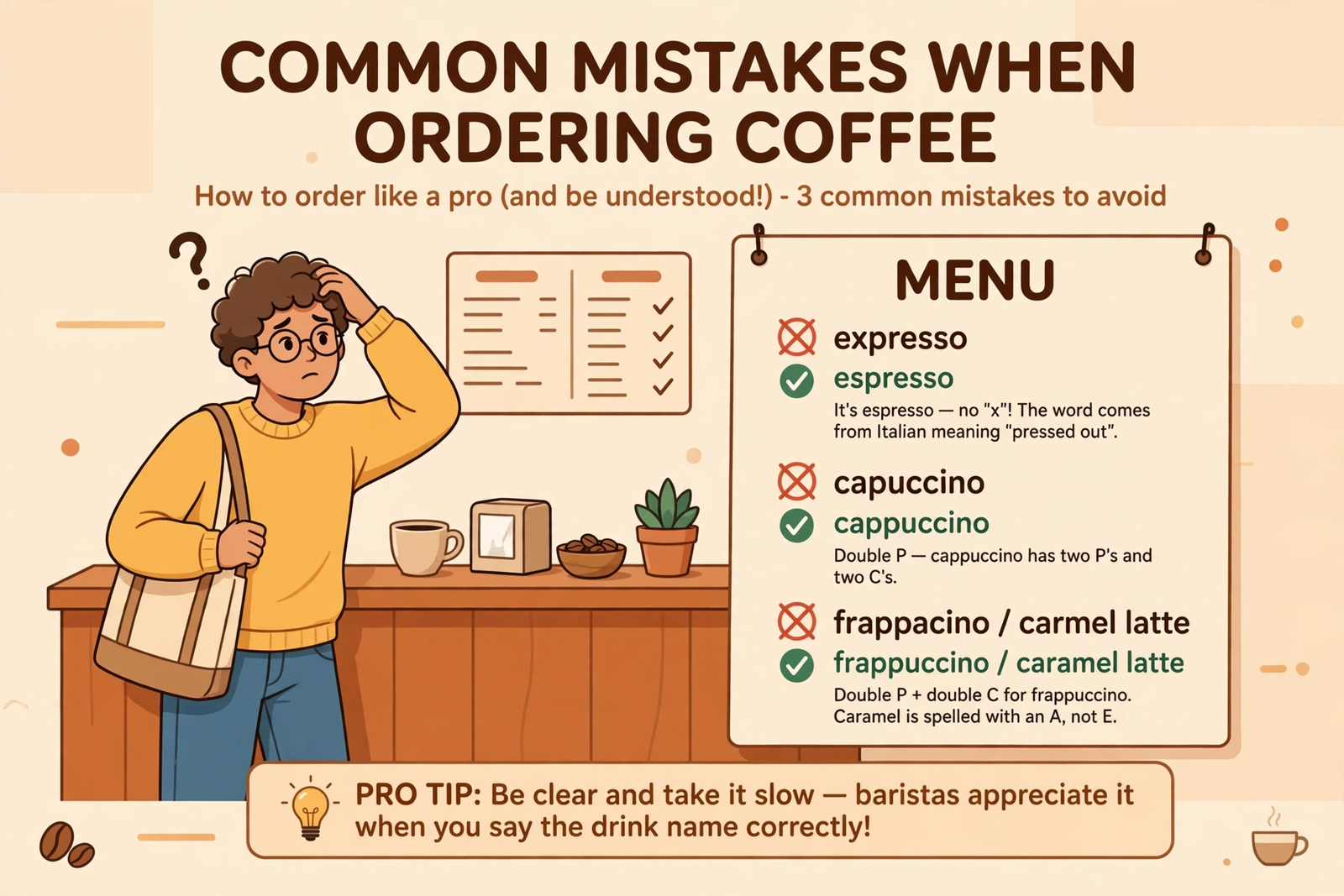
Using “espresso” as a plural or saying “expresso.” The word is “espresso” — from the Italian for “pressed out” — and the plural is “espressos.” “Expresso” is the most famous mispronunciation in coffee slang, and baristas notice it every single time.
Assuming “decaf” means “no caffeine.” Decaf coffee still contains a small amount of caffeine — usually 2 to 5 milligrams per cup, compared with about 95 in a regular cup. If someone says “death before decaf,” they are joking about taste, not chemistry.
Ordering “skinny” and expecting it to taste the same. Nonfat milk steams differently and tastes thinner than whole milk. A skinny latte is a real choice, but it is a different drink from the full-milk version — expect the difference instead of being surprised by it.
Quick Tips
Here are the fastest ways to use coffee slang correctly, starting today.
- Learn five terms first: joe, java, flat white, red eye, and ristretto. Those five cover most real conversations.
- Listen before you order: hear what the regulars ahead of you say, and copy the local wording.
- Ask the barista: “What’s the difference between your flat white and your latte?” is a question baristas love answering.
- Use nicknames with friends, precise terms at the counter: “bean water” is a text message word; “double shot” is an ordering word.
- Match the region: in Boston, “regular” means cream and sugar. In Sydney, a “long black” is the default. Learn the local version when you travel.
- Don’t force it: saying “joe” once sounds natural. Saying “joe,” “java,” “bean water,” and “rocket fuel” in one sentence sounds like you memorised a list.
- Remember the joke terms are jokes: “death before decaf” is funny on a mug. Saying it to someone who drinks decaf for health reasons is not.
- Keep learning: coffee slang changes every year as new drinks and new memes appear. The terms in this guide are the core — the rest you will pick up one cafe at a time.

FAQ
What does coffee slang mean?
Coffee slang is the informal vocabulary used to talk about coffee — nicknames for the drink (joe, java, bean water), names for espresso drinks (flat white, red eye, cortado), and the working words baristas use behind the counter (dialing in, pulling a shot, microfoam).
What is another word for coffee in slang?
The most common coffee slang words are joe, java, brew, mud, bean water, go juice, rocket fuel, cuppa, and jitter juice. “Joe” and “java” are the classics; “bean water” is the internet-era favourite.
Why is coffee called joe?
The leading theory credits Josephus Daniels, US Secretary of the Navy, who banned alcohol on Navy ships in 1914. Coffee became the strongest drink available, and sailors supposedly began calling it “a cup of Joe” in his honour. Other theories link it to “jamoke” or to the average “Joe.”
What does “red eye” mean in coffee slang?
A red eye is drip coffee with one shot of espresso added. A black eye has two shots, and a dead eye has three. The name is a joke about the red eyes of someone who stayed up all night — the drink is meant to keep you awake.
What is the difference between a flat white and a latte?
A flat white is smaller and stronger, with a double shot of espresso and thin, velvety microfoam. A latte is larger and milkier, with more steamed milk and a thicker layer of foam. The flat white tastes more like coffee; the latte tastes more like milk.
What does “dialing in” mean in coffee slang?
“Dialing in” is what baristas do when they adjust the grinder — finer or coarser — until the espresso shot pulls in the target time, usually 25 to 30 seconds. It is the process of tuning the machine so every shot tastes right.
What is “bean water” slang for?
“Bean water” is internet slang for coffee. It is a deliberately literal joke — coffee is, after all, water flavoured with beans. It became popular on TikTok and Twitter as a funny, self-aware way to say “coffee,” usually in the phrase “don’t talk to me until I’ve had my bean water.”
Is coffee slang the same everywhere?
No — coffee slang changes by region. In New England, “regular” means cream and sugar. In Australia, a “long black” is the standard black coffee and a “flat white” was invented there. In Italy, a cappuccino is small and finished before mid-morning, while an American cappuccino is much larger and sold all day. Always learn the local version when you travel.
Conclusion
Coffee slang is more than a list of funny words — it is the shared language of a daily ritual that billions of people repeat every morning. Words like joe and java carry centuries of history. Terms like flat white, ristretto, and red eye carry the precision of people who care about how coffee tastes. And jokes like bean water and death before decaf carry the humour of a culture that loves coffee enough to laugh at it.
The key takeaways are simple. Learn the five core terms first — joe, java, flat white, red eye, and ristretto — and you will understand most cafe conversations. Use nicknames with friends and precise terms at the counter. Respect regional differences, especially the “regular” trap in New England. And never force the slang: the people who sound most natural are the ones who use one term at a time, in the right place.
Slang is always a window into how people actually live, and coffee slang opens a window onto mornings, workplaces, friendships, and cities all over the world. If you enjoyed decoding this vocabulary, keep going — from Ohio slang to swag meaning in slang, every corner of everyday language has its own secret words waiting to be explained. Now go order something — and this time, order it like you mean it.
