
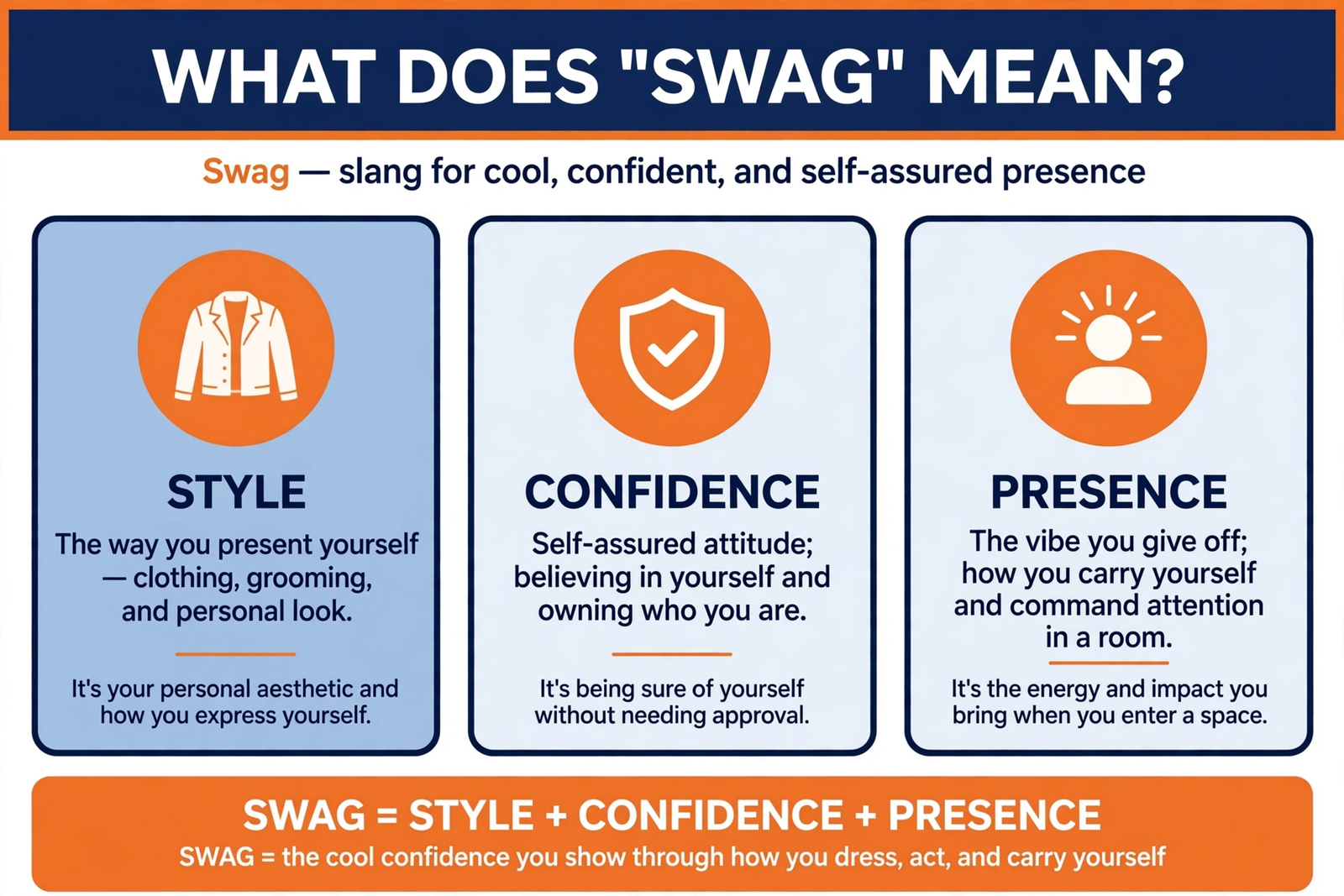
Quick Definition: The swag meaning slang searchers want is simple — swag means cool confidence, effortless style, and the natural flair someone carries in how they walk, talk, dress, and present themselves. It is short for “swagger,” and in modern slang it describes that hard-to-define quality that makes a person look impressive without trying too hard. When someone says “he’s got swag” or “she’s got that swag,” they mean the person has style, self-assurance, and presence — not that they own expensive things.
Swag Meaning & Definition
Swag is a noun in slang that describes a person’s style, confidence, and overall vibe. If someone walks into a room and everyone notices — not because they are loud, but because they carry themselves with calm self-belief and look put together — that is swag. The word covers a mix of things at once: the way someone dresses, the way they move, the way they speak, and the attitude behind all of it.
The swag meaning slang covers three closely related ideas. First, style: the clothes, accessories, haircut, and overall look that make someone stand out. Second, confidence: the relaxed self-assurance that says “I know who I am” without needing to announce it. Third, presence: the energy a person brings into a room, a photo, or even a text conversation. Real swag is the combination of all three — style without confidence looks like a costume, and confidence without style is just attitude.
| Part of Swag | What It Means | Everyday Example |
|---|---|---|
| Style | How you dress and present yourself | Clean sneakers, a fitted jacket, a look that fits your personality |
| Confidence | Calm self-belief, not arrogance | Speaking slowly and clearly instead of rushing to impress |
| Presence | The energy you bring into a room | Walking in relaxed, smiling, making eye contact |
| Flair | A personal touch that is uniquely yours | A signature accessory, a catchphrase, a way of laughing |
Swag can also work as an adjective. A “swag outfit” is a stylish outfit. Someone can be “swaggy,” meaning full of swag. And “swagged out” means dressed up with maximum style — fresh haircut, clean shoes, the whole look on point. The word is flexible, which is part of why it has survived in slang for so long while other trendy words faded away.
One important thing to understand: swag is not about money. A person in a plain t-shirt and old jeans can have more swag than someone wearing a designer outfit head to toe. Swag is about how you carry what you wear and who you are, not the price tag. That is why the word resonates so strongly — it rewards attitude and authenticity over wealth.
Introduction
Scroll through TikTok, read the comments under a music video, or listen to a group of friends hyping each other up, and you will hear it: “Bro’s got swag.” “Her swag is unmatched.” “Turn my swag on.” The word has been everywhere for more than fifteen years, yet it still confuses people who are new to it. Is it about clothes? Confidence? Money? Music? The honest answer is a little bit of all of them — and that is exactly what makes swag such a useful word.
Unlike slang that means one very specific thing, swag is a vibe word. It is the kind of word you use when a single word like “cool” or “stylish” does not quite capture the whole picture. When you say someone has swag, you are really saying several things at once: they look good, they know it, and they do not have to try very hard to prove it. It is a compliment with layers.
This guide breaks down the full swag meaning slang in plain English. You will learn where the word came from — its journey is longer and stranger than most people expect, going back hundreds of years before hip-hop ever touched it — how it exploded through music and social media, how people use it in texts and captions today, how it compares to similar words like drip, sauce, and aura, and the mistakes that make people sound like they are trying too hard. By the end, you will know exactly what swag means and how to use it without sounding forced.
Origin
The story of swag starts much earlier than most people think. The word “swagger” — the parent of swag — first appeared in English in the late 1500s. William Shakespeare used it in A Midsummer Night’s Dream, and in the centuries that followed it meant to walk or behave with an arrogant, blustering air. By the 1800s, dictionaries defined swagger as boasting noisily or strutting with an overconfident attitude. The word already carried the same core idea it has today: a confident, showy way of carrying yourself.
The shorter word “swag” has an even older and stranger history of its own. Centuries ago it meant stolen goods or loot — a thief’s “swag bag” was the bag used to carry stolen property. In the 1960s it picked up another meaning: the free promotional items handed out at events, the “swag bags” you still get at conferences today. And in the 2000s, hip-hop culture gave it its newest and most famous meaning: an attitude of swaggering self-confidence. Merriam-Webster notes that this slang sense appears mainly in African-American usage and only entered print at the start of the 21st century, as a shortened form of swagger.
Hip-hop is where swag became a cultural force. The first hip-hop artists to use “swagger” on record were the group Brand Nubian in their 1990 song “Slow Down.” Through the 1990s and early 2000s, the word was a favorite of MCs whenever they wanted to boast on a track. Jay-Z helped push it into the mainstream in the early 2000s — he even rapped that he invented swag — and the word kept climbing from there.
The turning point came around 2008. Soulja Boy’s hit “Turn My Swag On” made the word unavoidable, and the same year brought the all-star collaboration “Swagga Like Us” from T.I., Jay-Z, Kanye West, and Lil Wayne. Suddenly swag was not just a hip-hop word — it was in advertising, in fashion magazines, and in everyday conversation. Brands jumped on it, comedians mocked it, and teenagers adopted it as a daily compliment. The word had officially gone mainstream.
Popularity
Swag peaked in the late 2000s and early 2010s, when it seemed like every song, commercial, and meme used it. Old Spice built an entire campaign around it. Clothing brands printed it on t-shirts. For a few years, you could not escape the word — and, as often happens with slang, that overexposure made some people declare it dead. Critics said it had been ruined by brands and overuse, and new words like “drip” and “sauce” started competing for the same space.
But swag never actually went away. Unlike slang that was tied to one moment or one trend, swag describes something timeless: the combination of style and confidence. New generations keep rediscovering it on TikTok, in music, and in everyday conversation. It has become what linguists call a “legacy slang” word — one that survives its peak because the thing it describes never stops mattering. People will always want a word for that effortless cool, and swag is still the best one we have.
Today, swag shows up in several places at once. On TikTok and Instagram, it appears in captions and comments — “swag level: expert” under a fit check video. In music, it remains a staple of rap lyrics. In everyday texting, friends use it as a quick compliment: “that fit got swag.” And in fashion and streetwear culture, it is still the standard word for describing a look that works. The word has settled into the language as a permanent resident rather than a passing trend.
Part of the reason for its staying power is flexibility. Swag works as a noun (“he’s got swag”), an adjective (“a swag outfit”), a verb phrase (“turn your swag on”), and even as an exclamation — a simple “Swag!” can work as a nod of approval, the way “Word!” or “Facts!” does. Few slang words are that versatile, and versatility keeps a word alive.
How It Is Used
In everyday language, swag is almost always a compliment. Saying someone “has swag” means they carry themselves well — they look good and they know it, without being arrogant about it. The word is used most often by young people and in casual settings, but it has spread widely enough that almost everyone recognizes it now.
Here are the most common ways people use it:
- As a compliment about style: “That jacket gives you so much swag.” “Her swag is on another level today.”
- As a compliment about confidence: “He walked in with so much swag, everyone turned to look.” “She answered the question with total swag.”
- As a description of a look: “That whole outfit is swag.” “The new sneakers have crazy swag.”
- As a verb phrase: “Turn my swag on” — to switch into confident mode, to bring your best energy. “He came to the party and swagged it out” — he showed up in full style.
- As a standalone approval: “Swag!” — a quick way to say “nice,” “cool,” or “I respect that.”
The tone matters as much as the words. “He’s got swag” said with genuine admiration is a real compliment. The same sentence said sarcastically can mean the opposite — that someone is trying too hard. Context, tone of voice, and your relationship with the person all shape the meaning, which is true of most slang.
Swag also appears in compound forms. “Swaggy” means full of swag. “Swagged out” means fully dressed up with style. “Swagless” is the opposite — someone with no style or confidence at all. And “swagger jacker” is an old-school hip-hop term for someone who steals another person’s style instead of developing their own. These variations let people fine-tune exactly what they mean.
Examples
The best way to understand a slang word is to see it in real sentences. Here are examples of swag used in the tones you will actually encounter it — friendly, professional, and funny.
Friendly Examples
- “Bro walked into the party with so much swag, everyone noticed.” (Complimenting a friend’s entrance and confidence.)
- “Your new haircut gave you so much swag, not gonna lie.” (Friendly praise for a fresh look.)
- “She’s got that natural swag — she doesn’t even have to try.” (The highest form of the compliment: effortless.)
- “That fit is pure swag. Where’d you get the jacket?” (Praising an outfit and asking where it came from.)
- “We all need a little more swag in our lives.” (A lighthearted, general statement.)
Professional Examples
Swag is casual slang, so it rarely belongs in formal writing — but it does appear in creative industries, entertainment, and marketing, where a relaxed tone is normal:
- “The brand’s new campaign is all about confidence and swag.” (Marketing copy for a fashion label.)
- “He brings real swag to the stage — the crowd feeds off his energy.” (Describing a performer’s presence.)
- “Our new collection is designed for people with their own swag.” (A fashion brand speaking to its audience.)
- “The interviewer said she loved his swag — calm, confident, and genuine.” (An informal comment on someone’s demeanor.)
In professional settings, it is safer to use words like “confidence,” “presence,” or “style” instead. Save “swag” for casual conversation, social media, and creative work.
Funny Examples
- “My dad thinks wearing socks with sandals is swag. It is not.” (Gentle teasing about a bad fashion take.)
- “I put on sunglasses indoors and suddenly I had main character swag.” (Joking about instant confidence from one accessory.)
- “His swag disappeared the moment he tripped over his own shoelaces.” (The classic confidence crash.)
- “Turn my swag on — and then immediately trip on the stairs.” (Self-deprecating humor about trying to look cool.)
- “My cat walks around the house like she owns it. That is swag.” (Animals with attitude get the compliment too.)
| Situation | Text Example | Tone |
|---|---|---|
| Complimenting a friend’s outfit | “That jacket is pure swag 🔥” | Friendly |
| Reacting to a great photo | “The swag in this pic is unreal” | Admiring |
| Hyping yourself up | “Time to turn my swag on” | Confident |
| Joking with friends | “Bro thinks he has swag in Crocs” | Playful teasing |
| Praising a performer | “Her stage swag is unmatched” | Respectful |

Comparison with Similar Terms
Swag has several cousins in slang, and the differences between them are subtle but real. Knowing them helps you pick the exact right word instead of using them all the same way.
| Term | What It Means | How It Differs from Swag |
|---|---|---|
| Swag | Style + confidence + presence combined | The all-rounder — covers look, attitude, and energy together |
| Drip | Fashion and style, especially expensive or flashy clothes and jewelry | Drip is mostly about the outfit and the money behind it; swag is about the person wearing it |
| Sauce | A special quality or flair that makes someone stand out | Sauce is more mysterious and harder to define — it is the secret ingredient; swag is the visible result |
| Aura | The energy or vibe a person gives off | Aura is about feeling and presence only; swag adds the visual style element too |
| Rizz | Charisma, especially romantic or flirting charm | Rizz is specifically about attracting people; swag is broader and not necessarily romantic |
| Steez | Style with ease — a person’s distinctive way of doing things | Steez is the closest cousin; it is more about personal style, while swag adds confidence and swagger |
| Flex | Showing off wealth, success, or achievements | Flex is about displaying what you have; swag is about how you carry yourself, with or without money |
| Swagger | The original, longer form of swag | Nearly identical in meaning; swagger sounds slightly more formal and old-school, swag sounds more modern and casual |
A simple way to remember it: drip is what you wear, aura is what you feel, rizz is how you charm, and swag is the whole package — how you look, move, and carry yourself all at once. Someone can have drip without swag (expensive clothes, no confidence), and someone can have swag without drip (plain clothes, huge presence). The best compliment covers both, but swag alone already says a lot.

Alternate Meanings
Swag is one of the most multi-meaning words in English, and the slang meaning is only the newest one. Depending on context, the same word can mean something completely different — which is why the people around you and the situation matter so much.
- Stolen goods or loot: The oldest slang sense. “The thieves ran off with the swag” means they took the stolen property. This meaning dates back centuries and is still used in crime stories and old movies.
- Free promotional items: “Swag bags” at conferences, concerts, and trade shows contain free merchandise — t-shirts, stickers, samples — given to attendees. If someone says “I got so much swag at the expo,” they might mean freebies, not style.
- A bag or bundle: In Australian English, a “swag” is a bedroll or bundle carried by a traveler, and a “swagman” is an itinerant worker carrying one. The famous Australian song “Waltzing Matilda” is about a swagman.
- To sway or sag: As a verb, swag can mean to sway, lurch, or sag — an old sense that survives in phrases like “the shelf swagged under the weight.”
- Money or cash: In some older slang, swag meant money, especially money obtained quickly or easily.
- Secretly awesome, got it free: A popular backronym claims SWAG stands for “Stuff We All Get” (free promotional items) — a fun but unofficial explanation.
When you see the word online, the surrounding words tell you which meaning applies. “His swag is crazy” is about style. “Free swag at the event” is about giveaways. “They stole the swag” is about loot. Most of the time in 2026, especially on TikTok, Instagram, and in music, the style-and-confidence meaning is the one people intend.
Professional or Polite Alternatives
Swag is casual slang, so there are situations — job interviews, formal emails, professional bios, and conversations with people who do not follow internet culture — where a different word works better. Here are natural alternatives that carry the same idea:
| Instead of Swag, Try | Best For |
|---|---|
| Confidence | Professional settings, interviews, formal writing |
| Style / sense of style | Fashion discussions, compliments to anyone |
| Presence / stage presence | Performers, speakers, leaders |
| Charisma | Describing someone’s personal magnetism |
| Poise | Elegant, calm self-assurance |
| Flair | A distinctive, attractive personal touch |
| Effortless cool | Casual but slightly more polished descriptions |
| Self-assurance | Formal writing about confidence |
For example, instead of “She has amazing swag” in a work recommendation, you could write “She has remarkable confidence and presence.” The meaning is the same — the register is different. Matching your words to the room is itself a kind of swag: knowing when to use slang and when to switch it off shows social awareness, which is the real skill behind the word.
Common Mistakes
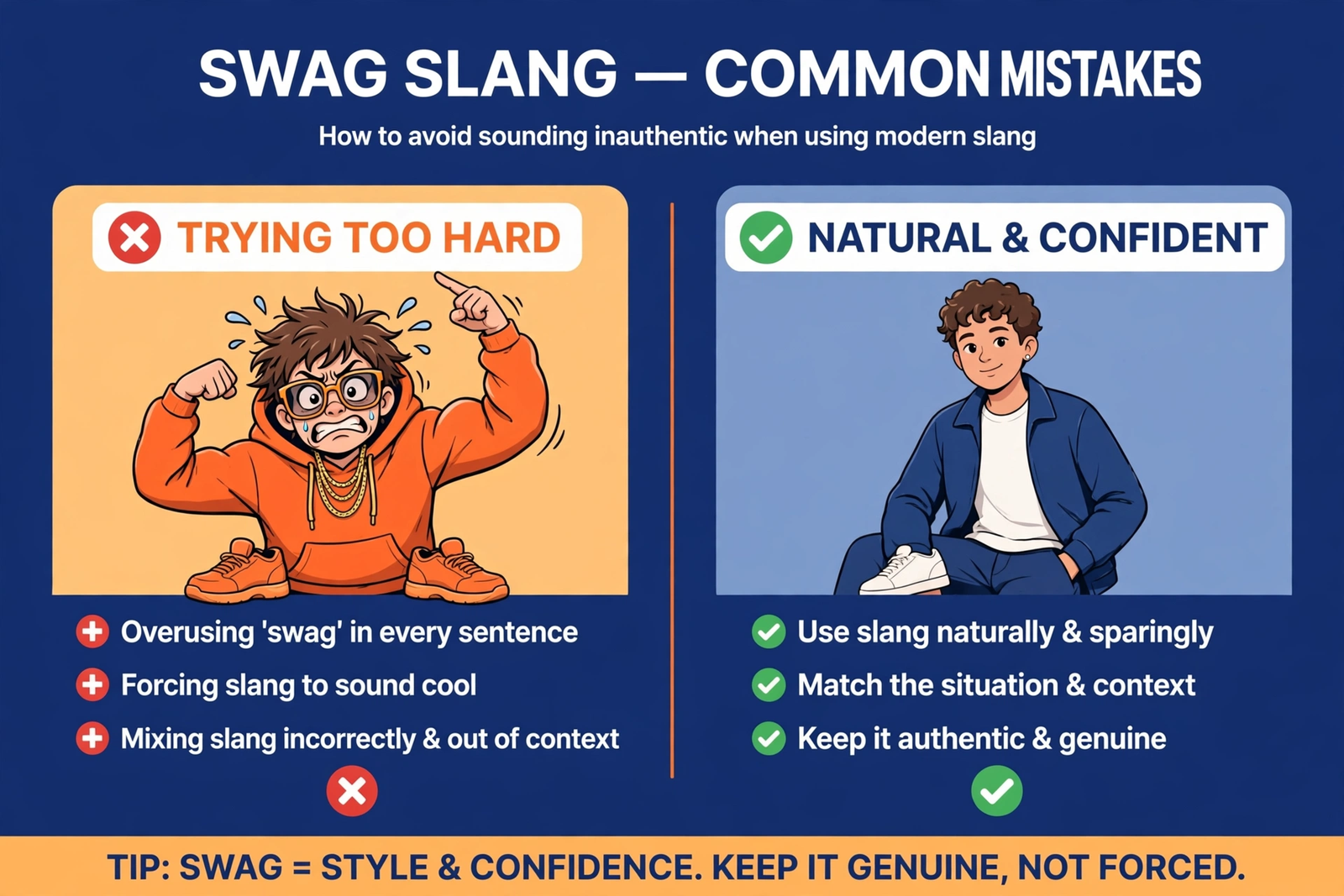
Swag is easy to use and easy to misuse. These are the mistakes that make people sound like they are trying too hard — the exact opposite of what swag is supposed to be.
- Calling yourself swaggy: Swag is a compliment other people give you, not a label you put on yourself. Saying “I’m so swaggy” almost always sounds like bragging. Let other people say it about you — that is how the compliment works.
- Confusing swag with money: Expensive clothes and jewelry are drip or flex, not necessarily swag. Buying the most expensive outfit in the store does not buy swag. Confidence and personal style cannot be purchased.
- Overusing the word: Calling everything swag — the food, the weather, your homework — drains the word of meaning. Save it for people, style, and presence, where it actually fits.
- Using it in formal settings: Telling your boss or a client about someone’s “swag” in a meeting will usually land badly. Use “confidence” or “presence” instead.
- Forcing the walk: The “swagger” walk — exaggerated strutting — looks ridiculous when it is performed rather than natural. Real swag looks relaxed, not rehearsed.
- Copying someone else’s style exactly: That is what hip-hop calls being a “swagger jacker.” Swag has to be yours. Taking inspiration is fine; copying someone head to toe is not.
- Assuming it is only about men: Swag applies to everyone. Women, men, and anyone else can have swag — the word has no gender.
The golden rule is simple: swag is the opposite of trying too hard. The moment you are visibly forcing it — overusing the word, exaggerating the walk, announcing your own coolness — the swag is gone. Relax, be yourself, and let the compliment come to you.
Quick Tips
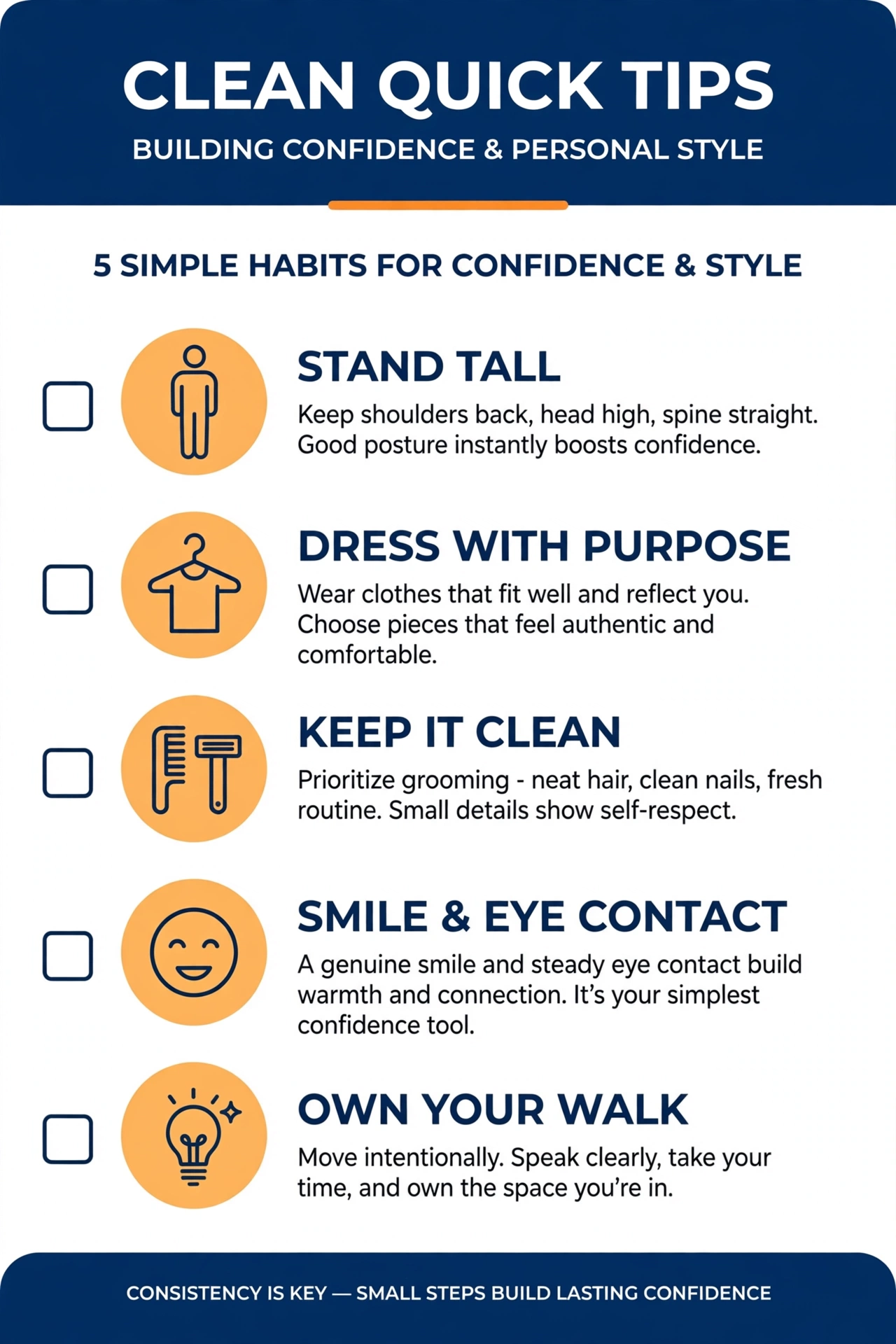
Want to build real swag? It is not a costume you put on — it is a set of habits. Here is what actually works:
- Dress for yourself, not for applause: Find a style that fits your body and your personality. Clothes that fit well beat expensive clothes that do not.
- Fix your posture: Stand up straight, shoulders back, head level. Good posture is the fastest, cheapest swag upgrade there is.
- Slow down: Confident people do not rush. Walk at a relaxed pace, speak clearly, and pause before answering. Calm reads as confidence.
- Take care of the basics: Clean shoes, fresh haircut, good hygiene. Swag is built on details, and the basics are the foundation.
- Develop your own touch: A signature accessory, a favorite color, a way of styling your hair — one personal detail makes a look yours.
- Be kind and relaxed: The most magnetic people are the ones who make others comfortable. Arrogance pushes people away; warmth pulls them in.
- Practice in low-stakes moments: Try a new outfit or a bolder look on an ordinary day, not only for big events. Confidence grows with repetition.
- Do not announce it: Never tell people you have swag. The word works best when someone else says it about you.
FAQ
What does swag mean in slang?
In slang, swag means cool confidence, style, and effortless flair. It describes the way a person carries themselves — how they dress, walk, talk, and present themselves — in a way that looks impressive without trying too hard. It is short for “swagger.”
What does “he’s got swag” mean?
It is a compliment. It means he has style, confidence, and presence — he looks good, carries himself well, and makes an impression without forcing it. It is one of the strongest casual compliments you can give someone about their overall vibe.
Is swag short for swagger?
Yes. Swag is the shortened form of “swagger,” which dates back to Shakespeare’s time and means to walk or behave with confident, showy self-assurance. Hip-hop culture shortened swagger to swag in the 2000s, and the short form became the standard slang word.
What does “turn my swag on” mean?
It means to switch into confident mode — to bring your best energy, style, and self-assurance to a situation. The phrase was made famous by Soulja Boy’s 2008 hit “Turn My Swag On.” People use it before a party, a performance, a date, or any moment they want to feel their best.
Is swag still used in 2026?
Yes. Although the word peaked in the late 2000s and early 2010s, it never disappeared. It is still used on TikTok, Instagram, and in music, and it has become a long-lasting slang word because it describes something timeless — style plus confidence. Newer words like drip and aura compete with it, but swag is still widely understood.
What is the difference between swag and drip?
Drip is mostly about fashion and expensive clothes — what you wear and how much it costs. Swag is broader: it includes style, but also confidence, attitude, and presence. Someone can have drip without swag (expensive outfit, no confidence) or swag without drip (plain clothes, huge presence).
Can girls have swag?
Absolutely. Swag has no gender. It describes style, confidence, and presence, and anyone can have it. The phrase “she’s got swag” is just as common as “he’s got swag.”
Is it okay to call yourself swaggy?
It is better not to. Swag works best as a compliment from other people. Calling yourself swaggy usually sounds like bragging, which is the opposite of the relaxed confidence the word describes. Let others notice — that is the point.
Conclusion
Swag is one of those rare slang words that survived its own hype. It started as “swagger” in Shakespeare’s England, traveled through centuries of English, got shortened and supercharged by hip-hop in the 2000s, and settled into everyday language as the go-to word for style plus confidence. It is not about money, not about a single outfit, and not about trying hard — it is about the calm, natural way a person carries themselves when style and self-belief line up.
The next time you hear someone say “he’s got swag” or “turn my swag on,” you will know exactly what they mean — and you will know the long, surprising history behind those four letters. Use the word as a genuine compliment, build the real habits behind it (good posture, clothes that fit, relaxed confidence, a personal touch), and remember the golden rule: real swag never announces itself. It just shows up.
Want to decode more internet slang? Check out what FN means in text, how HBU is used in chat, the full guide to IMK meaning in text, and the 2010s slang words that defined a decade — and keep building a vocabulary that helps you read the internet like a native. For a dictionary reference on the word’s history, see the Merriam-Webster history of swag.
