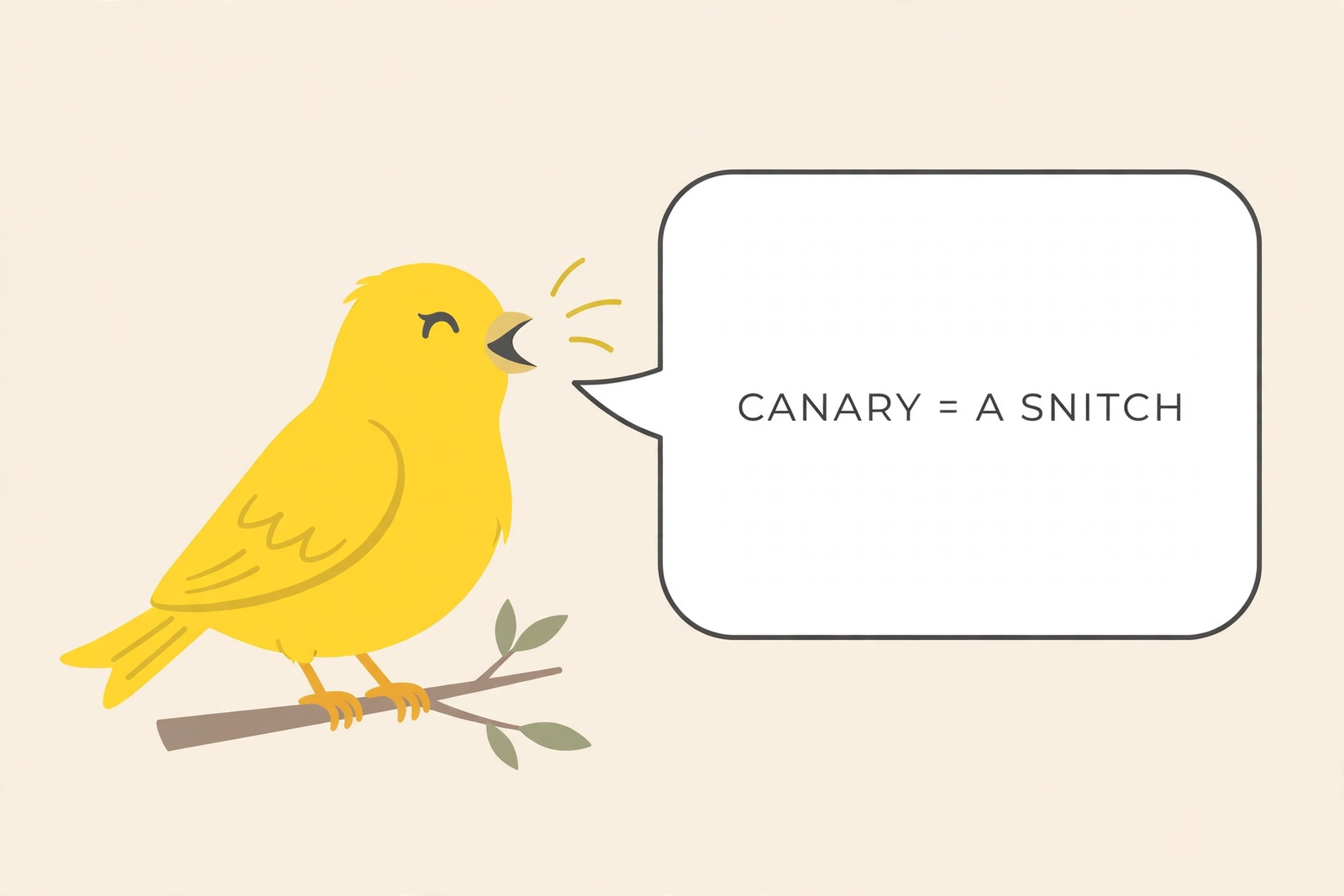
Quick definition: In slang, a canary is an informer or snitch — someone who “sings” to the police, a teacher, a boss, or another authority figure and reveals secrets that were supposed to stay private. The phrase comes from the idea that canaries sing, and in underworld and street language, “singing” means talking to the authorities. When someone says “he sang like a canary,” they mean that person confessed or informed on others, usually quickly and in full detail.
Canary Slang Meaning & Definition
Canary slang means a person who informs on others, especially to the police or another authority. The canary slang meaning is rooted in one simple image: a little yellow songbird that cannot stop singing. In the same way, a human “canary” cannot stop talking when the pressure is on. They spill names, plans, and secrets — the exact things a group wanted to keep quiet.
The term is almost always negative. Nobody calls themselves a canary with pride. It is a label other people stick on someone who broke the code of silence, whether that silence was about a crime, a prank, a workplace scheme, or a group-chat secret. If you hear someone called a canary in a movie, a song, or a text thread, the speaker is accusing that person of betrayal, not complimenting their voice.
That said, context decides everything. The same word can show up in a joke between friends, in a serious warning, or in a news report about a criminal trial. The core canary slang meaning stays the same — someone who talks when they should have stayed quiet — but the tone shifts with the situation. A friend who tells your mom about the party is a canary in a playful sense. A witness who testifies against a gang is a canary in a much heavier one.
It also helps to know that “canary” has more than one slang life. Beyond the snitch meaning, it can describe a female singer, a bright yellow color, a warning sign (the famous “canary in the coal mine”), and even a verb meaning to inform on someone. This guide covers the main meaning first, then walks through the alternate meanings so you never mix them up.
Introduction
Picture a coal mine a hundred years ago. Before modern sensors existed, miners carried a small yellow canary in a cage down into the tunnels. The bird was far more sensitive to poisonous gas than any human, so if the canary stopped singing — or worse, died — the miners knew to get out fast. The bird was a living alarm system, and its song was the signal.
Now flip that image. In the slang world, the canary is not the warning — it is the person doing the singing. And the song is not a cheerful tune. It is a confession, a tip-off, a name dropped to the wrong ears at the wrong time. That is the strange journey of this word: from a beloved pet bird, to a miner’s safety tool, to one of the sharpest insults in the language of loyalty and betrayal.
You have probably heard the phrase even if you never knew what it meant. “He sang like a canary.” It shows up in crime movies, police shows, rap lyrics, and everyday arguments. Someone gets caught, the police put pressure on them, and within an hour they have told everything. The phrase is so common that most people use it without thinking about the bird at all — but the bird is the whole point.
This guide explains the canary slang meaning in full: where it came from, how it spread from prisons and police stations into group chats and social media, how people use it today, and how to use it correctly without sounding like you stepped out of a 1940s gangster film. You will also find real examples, a comparison with similar words like snitch and rat, the alternate meanings that trip people up, and a simple FAQ that answers the questions people actually search for.
Origin
The word “canary” itself is old. It comes from the Canary Islands, the Atlantic islands off the coast of Africa where the little songbird is native. The bird’s name traveled through Spanish (canario) and French (canarie) into English, and by the 1600s the word was already in use for the bird, the bright yellow color, and even a sweet wine from the islands.
The slang meaning took much longer to arrive. The key step was the verb “to sing.” In underworld and street language, “singing” has meant talking to the police since at least the early 1900s. The connection is obvious: a singer makes noise, and a person who informs makes noise to the authorities. Once “singing” meant informing, the jump to “canary” was almost inevitable — what sings more famously than a canary?
The idiom “to sing like a canary” is the bridge between the bird and the betrayal. It appears in print in the mid-20th century, in crime writing and police reporting, and it quickly became a staple of American English. The phrase made its way into prison slang and police jargon, where getting caught gave a person two options: stay silent or sing. The ones who could not keep the secret were tagged as canaries, and the label stuck.
There is also a second, quieter thread in the origin story. In Australia in the 1800s, convicts were sometimes called “canaries” because of the yellow uniforms they wore and the cages they lived in — a detail recorded in early colonial writing. The nickname tied the bird’s color to the prison system, and it reinforced the word’s association with crime and punishment long before the modern snitch meaning settled in. The canary in the coal mine added yet another layer: the bird as a warning sign. When a miner’s canary went quiet, danger was coming. When a group’s canary starts singing, trouble is coming too — just for the group instead of the miner.
For the broader picture of how informants are described in law enforcement, the Wikipedia article on informants lists canary alongside snitch, rat, stool pigeon, and grass as slang terms for someone who supplies secret information to an agency — and it confirms the singing connection directly.
Popularity
Canary slang peaked as a street and crime-world term in the mid-20th century, the era of film noir, detective novels, and mafia stories. Gangster films made “sing like a canary” a household line, and newspapers covering famous trials used it constantly. If a mobster turned state’s evidence in the 1950s, the headline practically wrote itself.
The term never really died, but its home changed. As organized crime faded from the headlines, the word moved into hip-hop, where “snitch” culture made loyalty a central theme, and into television, where police procedurals kept the phrase alive for new generations. Rappers and TV writers both love the word because it is vivid: one image — a little yellow bird that will not shut up — says everything about a person who talks too much.
Today, canary slang is less common than “snitch” or “rat” in everyday conversation, but it survives in a few clear places. It shows up in true-crime podcasts and documentaries, in crime fiction, in memes about someone who spills a secret in the group chat, and in the idiom “canary in the coal mine,” which has become a mainstream metaphor for an early warning sign in politics, business, and climate discussions. The bird meaning keeps the word alive even where the snitch meaning has faded.
It also gets a regular boost from search culture. People hear “canary” in a song lyric or a TV show, look it up, and discover the snitch meaning for the first time. That steady stream of curious listeners is exactly why slang dictionaries keep the entry current. The word is not trending like a TikTok term, but it is durable — the kind of slang that has survived for decades because the image behind it is so clear.
How It Is Used
Canary slang is used in three main ways today: as a noun, as a verb, and as part of the idiom “sing like a canary.” The noun is the most common: “Don’t trust him, he’s a canary.” That sentence is an accusation and a warning at the same time. It tells the listener that this person has talked to the authorities before and will probably do it again.
As a verb, “to canary” means to inform or snitch on someone. It is rarer than the noun, and it sounds deliberately old-fashioned, which is why writers and lyricists like it. “He canaried on the whole crew” is the kind of line you hear in a song or a novel, not in a normal text message. But it is a real usage, and knowing it helps when you come across it.
The idiom is the version most people actually use. “Sing like a canary” means to confess everything, usually quickly and under pressure. “The cops picked him up at noon, and by dinner he was singing like a canary.” The phrase works because everyone understands the picture: a small bird that sings and sings, and a person who talks and talks. It is also the most flexible form, because it works in playful contexts too. A friend who admits they ate the last slice of pizza after two seconds of questioning “sang like a canary” — and everyone laughs.
In texts and social media, the word usually appears in memes and jokes about secrets. Someone posts a screenshot of a friend who revealed a surprise party, with the caption “the canary strikes again.” Or a group chat turns on the one person who told the teacher about the homework answers. The tone is teasing, but the message is the same as the serious version: you talked, and we noticed.
One more usage note matters. Canary slang is almost never used upward — to a boss, a teacher, or a client — because it is an insult, not a compliment. It belongs to the language of peers and groups, where loyalty is a currency. Calling someone a canary to their face is a confrontation. Using it behind their back is a warning. Either way, it is a strong word, and it lands harder than a casual “he told on us” ever could.
Examples
The best way to understand canary slang is to hear it in context. The same word changes weight with the situation, the relationship, and the delivery. The examples below show it at work in three everyday registers.
Friendly Examples
Between friends, canary slang is teasing and fast. It is the language of group chats, road trips, and inside jokes — a dramatic word for a small betrayal.
- “I told Jake about the surprise party in confidence, and the canary sang within five minutes. Now everyone knows.” — The canary here is the friend who could not keep a secret. The tone is annoyed but affectionate.
- “Bro, don’t tell Maya anything. She’s a total canary — she’ll spill the tea before you even finish the sentence.” — A warning between friends. If you want to know how “spilling the tea” works, our guide to tea meaning slang breaks it down.
- “The teacher asked who threw the paper plane, and Tom sang like a canary. Classic Tom.” — Playful, schoolyard usage. Nobody is in real trouble, so the word is a joke, not an accusation.
- “We were planning a prank on Dad, and little Emma canaried on us before breakfast. The canary strikes again.” — A family joke. The word makes a small moment sound like a crime movie, and that is exactly why it is funny.
Professional Examples
In professional settings, canary slang mostly appears in its softened, metaphorical forms — the warning-sign meaning rather than the snitch meaning. The raw insult stays outside the office.
- “Our support tickets are the canary in the coal mine. When complaints spike, a bigger problem is coming.” — This is the early-warning meaning, and it is perfectly professional. It says the tickets are a signal, not a person.
- “We need a confidential way to report safety issues — nobody should feel like a canary for speaking up.” — Here the word names the fear of being labeled an informer, which is a real concern in workplaces.
- “The intern accidentally told the client our launch date. He didn’t mean to canary on the team, but the damage was done.” — A gentle, slightly humorous use. The word softens the blame by framing it as an accident.
- “In compliance training, they made it clear: reporting fraud is not snitching, and you are not a canary for doing the right thing.” — A deliberate reframing. The trainer uses the slang term to name the stigma, then rejects it.
Funny Examples
When the stakes are low, canary slang becomes a punchline. The gap between a cute yellow bird and a dramatic betrayal is the whole joke.
- “I asked my dog who ate the shoes. He looked at the cat and sang like a canary.” — The dog, obviously, did not sing. The joke is the image of a pet testifying against another pet.
- “My grandma asked who broke her vase, and my little brother pointed at me and canaried in three seconds flat.” — A family classic. The younger sibling is the canary, and everyone knows it.
- “We swore a blood oath never to reveal the group chat password. Dave lasted four minutes. Four. The canary has no chill.” — The exaggeration is the humor: a blood oath versus four minutes of silence.
- “The canary in our friend group is whoever has the weakest poker face. Spoiler: it is always Marcus.” — A running joke. Every group has one person who cannot keep a secret, and the nickname sticks.

Comparison with Similar Terms
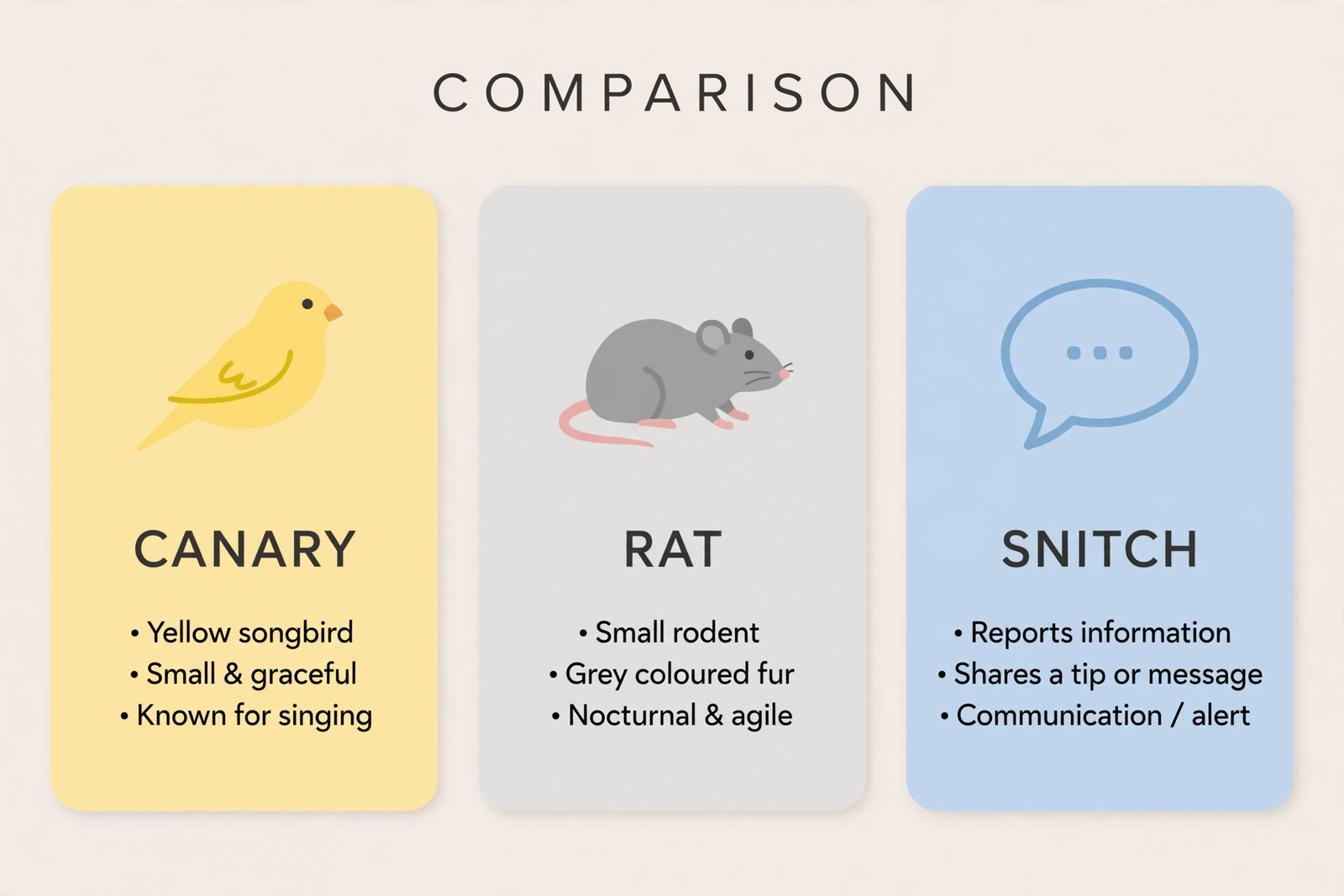
Canary slang overlaps with several other words for informers, but each one carries a different flavor. The table below shows how they compare, so you can pick the right word for the right moment.
| Term | Core Meaning | Tone | Where You Hear It |
|---|---|---|---|
| Canary | An informer who “sings” to the authorities | Colorful, old-school, dramatic | Crime films, novels, memes, idioms |
| Snitch | Someone who tells on others, usually to the police or a teacher | Direct, angry, everyday | Street slang, school, hip-hop, group chats |
| Rat | An informer who betrays their own group | Harsh, contemptuous, personal | Mafia stories, street slang, rap lyrics |
| Stool pigeon | A police informant, often a criminal who cooperates | Old-fashioned, formal, dated | Classic crime writing, old films |
| Narc | A narcotics officer or someone who reports drug activity | Specific, accusatory | Drug culture, school slang, TV |
| Grass | An informer (British slang) | British, casual, street-level | UK slang, British crime dramas |
The biggest difference is the image. “Snitch” and “rat” are blunt — they name the act and the contempt in one syllable. “Canary” is theatrical. It paints a picture, which is why writers love it and why it survives in idioms long after people stop using it in everyday speech. If you want to sound modern and direct, say snitch. If you want to sound like a crime novel, say canary.
There is also a difference in who the word targets. A snitch can be anyone who tells on anyone — a kid who tells the teacher, a coworker who reports a coworker. A canary is more specific: it suggests someone who talked to the police or to an authority about something serious, usually after being caught. That is why “he sang like a canary” feels heavier than “he snitched.” The canary confessed. The snitch just talked.
Finally, canary is the only term in the list with a whole second life as a warning sign. Nobody says “the snitch in the coal mine.” The bird’s double meaning — the singer and the alarm — gives the word a range the others do not have, and it is the main reason the term has stayed in the language for so long.
Alternate Meanings
Canary has several meanings beyond the snitch, and mixing them up is the most common mistake people make with this word. Here are the main ones.
1. The bird itself. A canary is a small songbird, a finch native to the Canary Islands, usually bright yellow in domesticated varieties. This is the literal meaning, and it is the source of all the slang ones. When someone says “my canary,” they might just mean their pet.
2. A female singer. In old show-business slang, a “canary” was a female singer, especially one who performed with a dance band. The image is the same — a woman with a beautiful singing voice — but the tone is affectionate, not insulting. This usage is dated now, but it still appears in vintage writing and old movies.
3. The color canary yellow. “Canary” is also a light, clear shade of yellow. A canary dress, a canary car, a canary highlighter — all of these use the bird’s color as a color name. There is nothing slangy about this one, and it is completely harmless.
4. A canary in the coal mine. This is the early-warning meaning. A canary in the coal mine is a person or thing that gives an early warning of danger. “Small bookshops are the canary in the coal mine for the high street” means that when bookshops start closing, bigger trouble is coming. This meaning is now fully mainstream and is used in politics, business, and science.
5. A test subject. In software and tech, a “canary” is a small group of users or machines that get a new feature first, so problems show up early before everyone else gets it. This comes directly from the coal mine idea — the canary tests the air before the miners go in. “Canary deployment” and “canary release” are standard terms in the tech world.
6. A drug slang (dated). In older drug slang, a “canary” could mean a yellow capsule of a barbiturate. This usage is rare today and mostly appears in historical slang dictionaries. You are unlikely to hear it in a modern conversation.
Context is your best friend here. If the sentence is about the police, a trial, or a secret, the snitch meaning applies. If it is about music, it is probably the singer. If it is about a warning sign, it is the coal mine. And if it is about a color, it is just yellow.
Professional or Polite Alternatives
Because canary slang is an insult, you need polite words for the same ideas in formal settings. Here are the best swaps.
- Instead of “he’s a canary”: say “he shared information with the authorities,” “he cooperated with the investigation,” or “he disclosed what he knew.” These are neutral and factual.
- Instead of “she sang like a canary”: say “she gave a full statement,” “she confessed,” or “she told them everything she knew.” All three say the same thing without the slang.
- Instead of “don’t be a canary”: say “please keep this confidential,” “let’s keep this between us,” or “I’d rather this stayed private.” These ask for discretion without accusing anyone.
- Instead of “canary in the coal mine”: you can keep this one — it is already professional. Alternatives include “early warning sign,” “leading indicator,” or “bellwether.”
- When praising someone who reported a problem: say “whistleblower” or “the person who raised the concern.” These words carry respect, which is the opposite of what “canary” does.
The rule is simple: use canary slang with friends, in jokes, and in creative writing. In a workplace, a classroom, or any formal conversation, use the neutral words. They say the same thing, and nobody will feel insulted.
Common Mistakes
People make a few predictable mistakes with canary slang. Avoid these and you will always sound natural.
Mistake 1: Calling someone a canary for telling the truth. A canary is not just someone who talks. It is someone who reveals a secret or betrays a group. A witness who tells the truth in court is not a canary — they are a witness. A person who reports a crime is not a canary either. The word implies disloyalty, not honesty.
Mistake 2: Using it as a compliment. “He’s a real canary” is not praise, even if the person has a lovely singing voice. If you mean the singing, say “singer” or “songbird.” Save canary for the snitch meaning, or for the coal mine metaphor.
Mistake 3: Confusing it with the bird. If someone says “I love my canary,” they almost certainly mean a pet bird, not an informer. The slang meaning needs a context of secrets, police, or betrayal. Without that context, the bird wins.
Mistake 4: Overusing it. Canary slang is vivid, which makes it tempting to use everywhere. But it is an old-fashioned word, and using it in every sentence about secrets makes you sound like a character in a gangster movie. Use it once, let it land, and move on. “Snitch” or “told on us” is the natural choice for everyday situations.
Mistake 5: Using it in a serious professional setting. Calling a coworker a canary in a meeting is a confrontation, not a joke. In formal settings, the word reads as an accusation. If you need to discuss someone sharing information, use the neutral language from the section above.

Quick Tips
- Check the context first. Secrets, police, or betrayal? It is the snitch meaning. Music, color, or a warning sign? It is one of the alternate meanings.
- Use the idiom, not just the noun. “Sang like a canary” is the most natural and widely understood form of the slang. The bare noun “canary” is stronger and more old-fashioned.
- Keep it playful with friends. The word lands best as a joke about a spilled secret in the group chat, not as a real accusation.
- Pair it with the coal mine metaphor carefully. “Canary in the coal mine” is a separate, professional idiom. Do not mix it with the snitch meaning in the same sentence.
- Know your audience. Older listeners and crime-movie fans will get the reference instantly. Younger listeners may only know the bird — so give them the context in the same sentence.
- Do not use it to describe a whistleblower. A whistleblower exposes wrongdoing for the public good. A canary talks to save themselves. The two are not the same, and mixing them up is unfair.

FAQ
What does canary slang mean?
Canary slang means an informer or snitch — someone who “sings” to the police or another authority figure and reveals secrets. It comes from the idea that canaries sing, and in street and underworld language, “singing” means talking to the authorities.
What does “sing like a canary” mean?
“Sing like a canary” means to confess everything, usually quickly and under pressure. It describes a person who, once caught, tells the police or an authority figure everything they know. The phrase can also be used playfully, for example when a friend admits a small secret after barely being asked.
Is calling someone a canary an insult?
Yes. Calling someone a canary is an insult in almost every context. It accuses the person of betraying a group by revealing secrets. The only exception is the coal mine metaphor, where “canary in the coal mine” is a neutral description of an early warning sign.
Where did canary slang come from?
It comes from the verb “to sing,” which has meant informing to the police in underworld slang since at least the early 1900s. Because canaries are famous singers, the bird became the natural symbol for someone who talks. The phrase “sing like a canary” spread the meaning through crime films, police reporting, and prison slang in the mid-20th century.
Is canary slang still used today?
Yes, but it is less common than “snitch” or “rat” in everyday speech. It survives in crime fiction, true-crime shows, memes about spilled secrets, and the idiom “canary in the coal mine,” which is now a mainstream metaphor for an early warning sign.
What is the difference between a canary and a snitch?
A snitch is anyone who tells on others, in any setting. A canary is more specific and more dramatic: it suggests someone who talked to the police or an authority about something serious, usually after being caught. “Sang like a canary” also sounds more old-fashioned and theatrical than “snitched.”
What does “canary in the coal mine” mean?
It means an early warning sign of danger. Miners once carried canaries underground because the birds were sensitive to poisonous gas — if the bird stopped singing, the miners knew to escape. Today the phrase describes any person or thing that signals trouble before it arrives, from falling sales to a closing bookshop.
Can “canary” mean anything else in slang?
Yes. It can also mean a female singer (old show-business slang), a bright yellow color, a test subject in software (“canary deployment”), and, in dated drug slang, a yellow barbiturate capsule. Context tells you which meaning applies.
Conclusion
The canary slang meaning is a small lesson in how language works. A little yellow bird that sings becomes, step by step, a symbol of the person who cannot keep a secret. The miners’ alarm, the singer’s voice, and the prisoner’s confession all meet in one word — and the word has survived for decades because the image is so clear. Nobody forgets a canary once they have heard it sing.
Use the word with care. With friends, it is a funny, dramatic way to call out a spilled secret. In a serious conversation, it is an accusation that lands hard. And in the coal mine version, it is a useful, professional metaphor for an early warning. Knowing which canary you mean is the whole skill.
If you enjoyed this guide, you may also like our breakdown of ratchet slang, another term with a colorful history, or our look at brat meaning slang, which shows how a single word can carry a whole attitude. And the next time someone in your group chat “sings,” you will know exactly what to call them — just maybe say it with a smile.
