
Quick definition: In slang, “slope” has more than one meaning — and one of them is serious. Historically, it was used as an offensive ethnic slur for a person of East Asian descent, a usage that is still hurtful today and should be avoided. In everyday modern talk, though, most people meet “slope” in harmless contexts: skiers say “hit the slopes” to mean go skiing, Brits say “slope off” to mean slip away quietly, and online meme culture sometimes uses “slope” or “sloped” as a playful roast. The meaning depends entirely on context — and this guide breaks down every one of them.
Slope Slang Meaning & Definition
The word “slope” looks simple. In school, it meant the steepness of a hill or a line on a graph. In slang, however, it picked up several very different lives over the last 150 years. Some of those lives are fun and harmless — ski trips, sneaking out of boring parties — while one is a painful piece of history that still matters. If you searched for “slope slang” because you saw the word in a text, a song lyric, or a Twitch chat, the table below gives you the fastest answer, and the rest of this article explains each meaning in full.
| Meaning | Context | Safe to use? |
|---|---|---|
| Offensive ethnic slur for an East Asian person | Vietnam War era; still heard in old films and edgy memes | No — never use it for a person |
| To leave quietly or slip away (“slope off”) | British slang, casual conversation | Yes |
| To go skiing or snowboarding (“hit the slopes”) | Ski culture, winter sports, travel | Yes |
| A roast or diss (“you got sloped”) | Twitch chat, Twitter/X, meme culture | Risky — easily misunderstood |
| To run away or decamp | Old West American slang (1800s) | Yes, but dated |
The key takeaway is simple: when “slope” describes a person, it is a slur. When it describes an action — skiing, leaving, or slipping away — it is ordinary slang. Keep that line clear and you will never misuse the word. Dictionaries such as Dictionary.com’s entry for “slope” label the personal sense as “extremely disparaging and offensive,” which is the strongest warning a dictionary gives.
Introduction
Maybe a friend texted “let’s hit the slopes this weekend” and you pictured a ski trip. Maybe a streamer typed “slope” in chat and everyone laughed. Or maybe you heard the word in a song — Coach K’s track “SLOPES” uses it as a dismissive brush-off — and wondered what it was supposed to mean. You are not the only one confused: “slope” is one of those English words that quietly collected half a dozen slang meanings across different eras, countries, and subcultures.
That confusion is exactly why this guide exists. Slang only works when everyone in the conversation shares the same definition, and “slope” is a word where the definitions genuinely clash. A skier means something completely different from a 1960s war movie, and a British office worker saying “I sloped off early” means something different again. In the sections below, you will learn where each meaning came from, how people actually use it today, and — just as importantly — which meaning to avoid completely. Whether you are decoding a text, writing a caption, or just curious, you will leave knowing exactly what “slope slang” means in every context where it shows up, including how it compares to similar slang like 80s slang words that also changed meaning over time and the regional flavor of California slang.

Origin
The slang story of “slope” starts in the 1800s, long before skiing resorts or the internet existed. In Old West American slang, recorded in frontier glossaries, “slope” meant to run away, decamp, or slip away — as in, “he sloped when the sheriff showed up.” It came from the literal idea of sliding away down a slope, quietly and quickly. The same root gave British English “slope off,” meaning to leave a place furtively, often to dodge work, school, or an awkward situation. That sense survives today in the UK: “He sloped off before the meeting ended” is still perfectly normal British office slang.
The darker chapter began during the Vietnam War in the 1960s. American soldiers used “slope” — short for the equally offensive “slopehead” — as a contemptuous term for Vietnamese people, and later for East Asian people more broadly. It spread through war films, books, and veteran slang, and dictionaries now mark it as extremely disparaging and offensive. Understanding this origin matters because it explains why the word still carries a sting: it was not a neutral nickname that drifted into slang, but a wartime slur built on a physical stereotype.
The ski meaning developed in parallel and has nothing to do with either of those histories. As downhill skiing became a popular leisure activity in the 20th century, “the slopes” simply became shorthand for ski runs, and “hit the slopes” became the standard way to say “go skiing.” Winter sports media, travel ads, and eventually social media made the phrase universal. Finally, in the 2020s, internet meme culture gave the word one more twist: in some Twitch chats and Twitter/X roasts, “slope” or “sloped” appears as an edgy diss, a remix of the old slur softened into a cryptic inside joke — a usage that is risky precisely because many readers still hear the original meaning.
Popularity
Why are so many people searching for “slope slang” right now? Three forces keep pushing the word back into timelines. First, winter is a cycle: every ski season, searches for “hit the slopes” spike as people plan trips, post snow photos, and caption their weekends. Second, music keeps recycling it — lyrics like Coach K’s “hit slopes” introduce the word to listeners who have never set foot on a mountain, and they go looking for the lyric’s meaning. Third, meme culture never really lets a controversial word die: clips, reaction images, and ironic “slope” jokes circulate on TikTok and X, and each wave sends a fresh batch of curious searchers to Google.
There is also a quieter reason. As conversations about respectful language have grown, more people pause when they hear an old word used as a joke and check whether it is actually okay to repeat. That is a healthy instinct. “Slope” sits right on the line between a harmless ski term and a hurtful slur, so checking the meaning before using it is exactly the right move — and it is why a clear, honest guide matters more than a one-line dictionary entry.
How It Is Used
Context decides everything with “slope slang.” The same five letters can be an invitation, an exit, or an insult depending on who says it, where, and about whom. Here are the main ways people use it today, from the most common to the most sensitive.
1. Skiing and snowboarding. This is the most common everyday use. “Hit the slopes” means go skiing or snowboarding, usually for fun. You will see it in travel posts, group chats planning a weekend, and resort advertising. Variations include “a day on the slopes,” “slope day,” and “bunny slope” for the gentle beginner area where new skiers learn.
2. Slipping away quietly. “Slope off” is the British way to say leave without drawing attention. “I sloped off after lunch” means you left early and hoped nobody noticed. The American Old West version, “he sloped,” meant the same thing — to run away or disappear — though it sounds dated now.
3. As a dismissive brush-off. In song lyrics and street slang, “hit slopes” can mean “go away” or “get lost,” said with a shrug. Coach K’s line “I told her hit slopes” is a dismissal: leave, move on, stop bothering me. It borrows the skiing phrase and turns it into a cold goodbye.
4. As a meme roast. In some Twitch chats and edgy meme circles, “slope” or “you got sloped” is used as a roast, roughly meaning someone got insulted or shut down. This usage is deliberately cryptic — it lets the speaker sound savage while staying just vague enough to dodge moderation. It is also the usage most likely to be misunderstood, because it echoes the slur.
5. As a slur (do not use). When “slope” is aimed at a person because of their East Asian background, it is an ethnic slur, full stop. It does not become acceptable because it appears in an old movie, a meme, or a lyric. If you hear it used this way, the right response is not to repeat it — it is to use one of the neutral alternatives listed later in this article.
Examples
Real examples make the differences obvious. Notice how the same word changes completely when the scene changes — and notice which examples feel friendly and which ones should never leave your mouth.
Friendly Examples
- “We are hitting the slopes at 7 a.m. — bring your own goggles, the rental line is brutal.” (A ski trip plan between friends.)
- “First time on the slopes and I only fell four times. New personal record!” (A proud beginner posting a snow selfie.)
- “Let’s skip the bunny slope this year. I can finally turn without falling.” (A skier showing off progress.)
- “The slopes were empty this morning — fresh powder and no lift lines.” (A happy ski report.)
Professional Examples
- “Half the team sloped off right after the client call, so we rescheduled the review.” (British office talk — casual but work-appropriate.)
- “The conference ends at four, but most people slope off after the keynote.” (Describing an event, not a person.)
- “Our resort package includes three days on the slopes and two spa afternoons.” (Travel and tourism copy.)
- “Please avoid using dated slang in customer-facing content — check the style guide first.” (An editor flagging risky wording.)
Funny Examples (if applicable)
- “Me: I will just do one run. Also me, four hours later: still on the slopes, legs gone.” (A relatable ski meme.)
- “He tried to slope off from washing the dishes and got caught holding the sponge.” (A joke about sneaking away from chores.)
- “My skiing style is best described as ‘controlled falling with confidence.'” (Self-deprecating slope humor.)
- “Chat said I got sloped and I still have no idea whether that was an insult or a compliment.” (A streamer reacting to meme slang.)

Comparison with Similar Terms
“Slope” overlaps with several other slang words, but the differences matter — especially when one of them is offensive and the others are not. Use this table to pick the right word for the situation.
| Term | What it means | How it differs from “slope” |
|---|---|---|
| Hit the slopes | Go skiing or snowboarding | The safe, standard ski phrase; “slope” alone is vaguer and riskier |
| Slope off | Leave quietly, sneak away | British and specific to leaving; “slope” alone does not carry this meaning clearly |
| Shred / shredding | Ski or snowboard skillfully | Ski slang too, but it describes skill, not the act of going |
| Dip / bounce | Leave a place quickly | Modern casual slang for leaving; no ski connection and no offensive history |
| Bunny slope | The beginner ski area | A place, not an action — the easiest part of the mountain |
| Slant | Also once used as a slur | Shares the same offensive history; avoid it for people too |
| Powder day | A day with fresh snow | Ski culture, but about conditions rather than the mountain itself |
The pattern is clear: when you mean skiing, say “hit the slopes” in full — it is unambiguous and friendly. When you mean leaving, “dip,” “bounce,” or “head out” are safer modern choices than the old-fashioned “slope off.” And when a word describes a person, check it against the slur list before you use it; if it has ever been a slur, leave it out of your vocabulary.

Alternate Meanings
Beyond slang, “slope” has several literal and technical meanings that sometimes cause confusion in search results. Knowing them helps you tell a math question from a slang question at a glance.
- Ski slope: A snow-covered downhill run at a ski resort, graded by difficulty — green for beginners, blue for intermediate, black for experts.
- Math slope: In algebra and geometry, the slope of a line measures how steep it is — “rise over run.” Students searching “slope meaning” often want this definition, not the slang one.
- Roof slope: In construction, the angle of a roof, which decides how rain and snow run off it.
- Slope off (verb phrase): As covered above, to leave quietly or sneak away, mostly British usage.
- “Slopes” in lyrics: In hip-hop and street slang, “hit slopes” can mean leave or get lost, a dismissive brush-off rather than a ski reference.
- Geography: A hillside or the side of a mountain — “the southern slope of the valley.”
If someone says “the slope is steep today,” they probably mean skiing or math. If they say “he is a slope,” they are using the slur — and that is the one meaning you should never repeat.
Professional or Polite Alternatives
Good communication is mostly about choosing the word that cannot be misunderstood. Here are safe swaps for every situation where “slope” might appear, so you never have to gamble on whether your listener hears the ski trip or the slur.
| Instead of saying | Say this | Why it is better |
|---|---|---|
| “Let’s hit the slope” | “Let’s go skiing” | Clear, warm, and impossible to misread |
| “He sloped off early” | “He left early” / “He headed out” | Neutral and modern; no old-fashioned baggage |
| “You got sloped” (roast) | “You got roasted” / “That was a clean comeback” | Same joke, zero risk of echoing a slur |
| Using “slope” for a person | Use the person’s name, or “Asian person” if background is relevant | Respectful and accurate; never a slur |
| “Hit slopes” (dismissal) | “Please leave” / “I need some space” | Direct and polite instead of cryptic |
In professional writing — emails, captions, video scripts, customer content — the rule is simple: use “slope” only for skiing and mountains. If your sentence is about a person, rewrite it. That one habit keeps your content safe on every platform, from TikTok comments to workplace Slack.
Common Mistakes
Most mistakes with “slope slang” come from hearing one meaning and assuming it is the only one. Here are the traps people fall into most often — and how to avoid each one.
1. Repeating the slur because a meme did. The most serious mistake. Just because a streamer or a meme page uses “slope” as a joke does not make it safe. Memes travel without context, and the person reading your message may only know the wartime meaning. Never use “slope” to describe a person.
2. Assuming “slope” always means skiing. “Hit the slopes” is ski talk, but a bare “slope” in a chat or lyric can mean leaving, a roast, or worse. Read the whole sentence — and who said it — before deciding what it means.
3. Using “slope off” in formal American settings. It is British and casual. In a US workplace email, “sloped off” can sound odd or even evasive. “Left early” or “stepped out” fits better.
4. Confusing “slope” with “slant.” Both words share the same offensive history, so swapping one for the other fixes nothing. If a word has a slur in its past, treat it the same way.
5. Captioning ski photos with edgy slang. A photo of your ski trip captioned with a meme-style “slope” joke can read very differently to strangers than it does to your friends. Keep ski captions about skiing: fresh powder, blue skies, and your best run of the day.
6. Correcting someone rudely. If a friend uses the slur without knowing its history, a calm “hey, that word has an offensive history — here’s a better way to say it” works far better than a public call-out. Most people simply never learned the background.

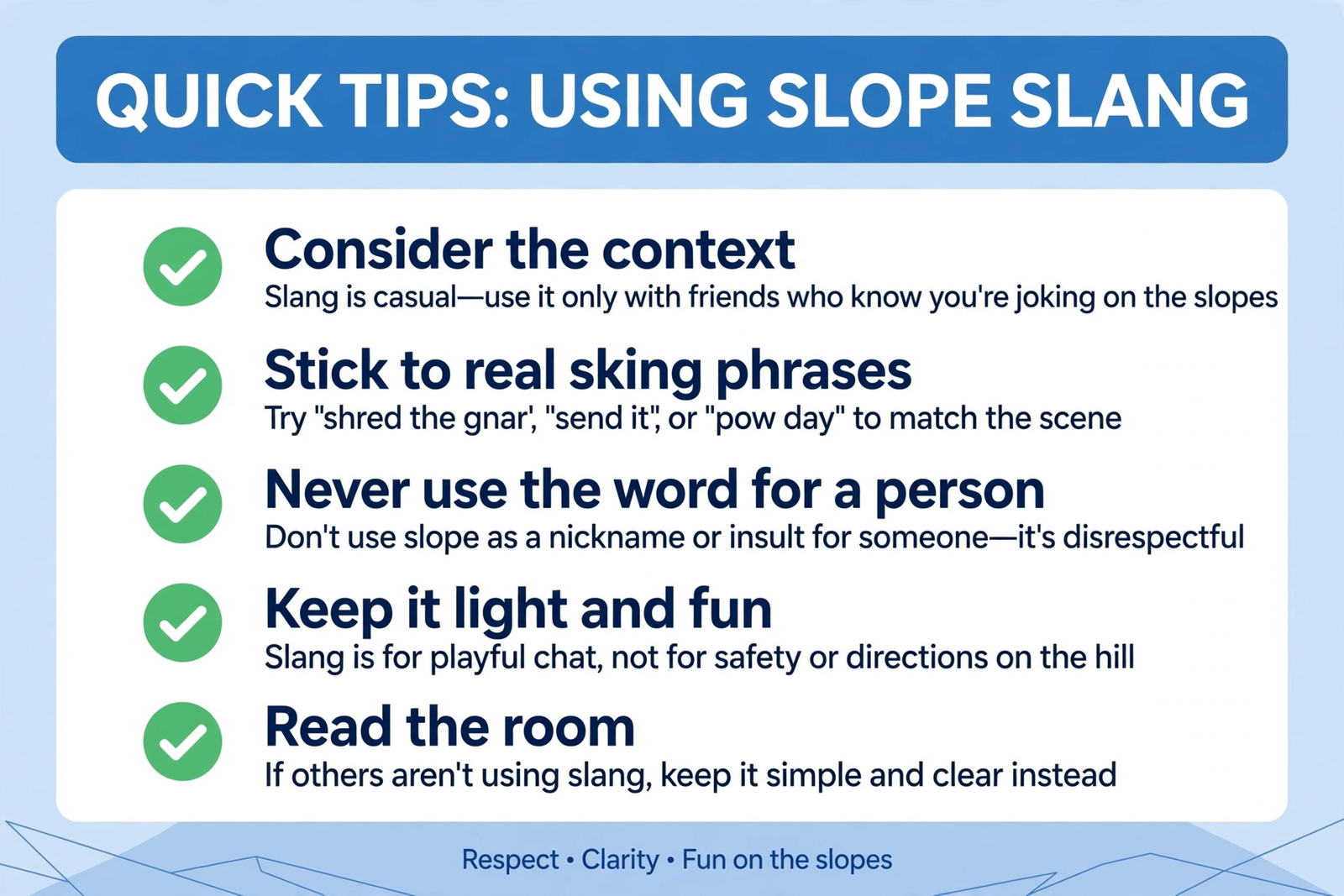
Quick Tips
- Context first: Before using or repeating “slope,” ask what the speaker meant — skiing, leaving, or something worse.
- Skiing? Say the full phrase: “Hit the slopes” is clear and friendly. A lone “slope” invites confusion.
- Never aim it at a person: If the word describes someone’s background, do not say it. Use their name instead.
- Leaving quietly? Try “head out,” “dip,” or “slip away” — all modern, all safe.
- Writing content? Use “slope” only for mountains and ski runs in anything public or professional.
- Heard it in a song? Check the lyric’s context — “hit slopes” in lyrics usually means “leave” or “get lost,” not skiing.
- Teaching kids or new English learners? Teach the ski meaning and the “slope off” phrase, and explain plainly that the personal sense is an offensive word they should not repeat.
FAQ
What does slope mean in slang?
“Slope slang” has several meanings. Most often it refers to skiing — “hit the slopes” means go skiing or snowboarding. It can also mean to slip away quietly (“slope off”), or, in meme chats, to roast someone. Historically, it was also used as an offensive ethnic slur for a person of East Asian descent, a meaning that is still hurtful and should never be used for a person.
Is slope a bad word or offensive?
It depends on how it is used. For skiing and mountains, “slope” is completely harmless. But when it is aimed at a person because of their East Asian background, it is an offensive ethnic slur with roots in the Vietnam War era. Dictionaries label that sense as extremely disparaging and offensive. Never use it to describe a person.
What does “hit the slopes” mean?
“Hit the slopes” means to go skiing or snowboarding, usually for fun — for example, “We are hitting the slopes this weekend.” In some song lyrics and street slang, though, “hit slopes” is used as a dismissive brush-off meaning “leave” or “get lost,” so the context of the sentence matters.
What does “slope off” mean?
“Slope off” is British slang meaning to leave a place quietly or sneak away, often to avoid work or an awkward situation — for example, “He sloped off before the meeting ended.” In American English, “head out” or “slip away” are more natural equivalents.
What does “sloped” mean in Twitch chat or memes?
In some Twitch chats and meme circles, “slope” or “you got sloped” is used as an edgy roast, roughly meaning someone got insulted or shut down. It is a risky usage because it echoes the historical slur, so many readers will hear the offensive meaning even if the speaker meant it as a joke.
Where did slope slang come from?
The word has three separate roots. The “slip away” sense dates to 1800s Old West and British slang. The slur sense comes from the Vietnam War era, when soldiers used “slope” as a contemptuous term for Vietnamese people. The ski sense grew with downhill skiing in the 20th century, and meme culture added the roast usage in the 2020s.
What does “slope” mean in a song lyric?
In lyrics, “slope” or “hit slopes” usually means “leave” or “move on” — a cold dismissal, as in Coach K’s “SLOPES” (“I told her hit slopes”). It can also appear in ski imagery, but in hip-hop the brush-off meaning is more common. Always check the surrounding lines for the intended sense.
What can I say instead of slope?
For skiing, say “go skiing” or “hit the slopes.” For leaving quietly, say “head out,” “slip away,” or “dip.” For a roast, say “you got roasted.” And if you ever catch yourself using “slope” for a person, stop and use the person’s name instead — there is no polite version of a slur.
Conclusion
“Slope slang” is a small word with a big split personality. On the mountain, it is pure fun: fresh powder, bluebird days, and friends shouting “hit the slopes!” before the first lift. In British conversation, it is a quiet exit — someone sloping off before the boring part starts. And in meme chats, it is a cryptic roast that is easy to misread. But behind all of that sits a serious history: for decades, “slope” was also used as a hurtful slur, and that meaning has not disappeared just because the word found new jobs.
The smart way to handle it is simple. Use “slope” freely for skiing, mountains, and snow days. Use “slope off” when you mean slipping away — or swap in “head out” if you want a modern, neutral phrase. And never use it for a person. That one rule protects you in every context, from a group chat to a published article. If you enjoy decoding words like this, explore more of our slang guides, from slang for cool to the regional flavor of Baltimore slang — every word has a story, and knowing it is what keeps your language sharp and respectful.
