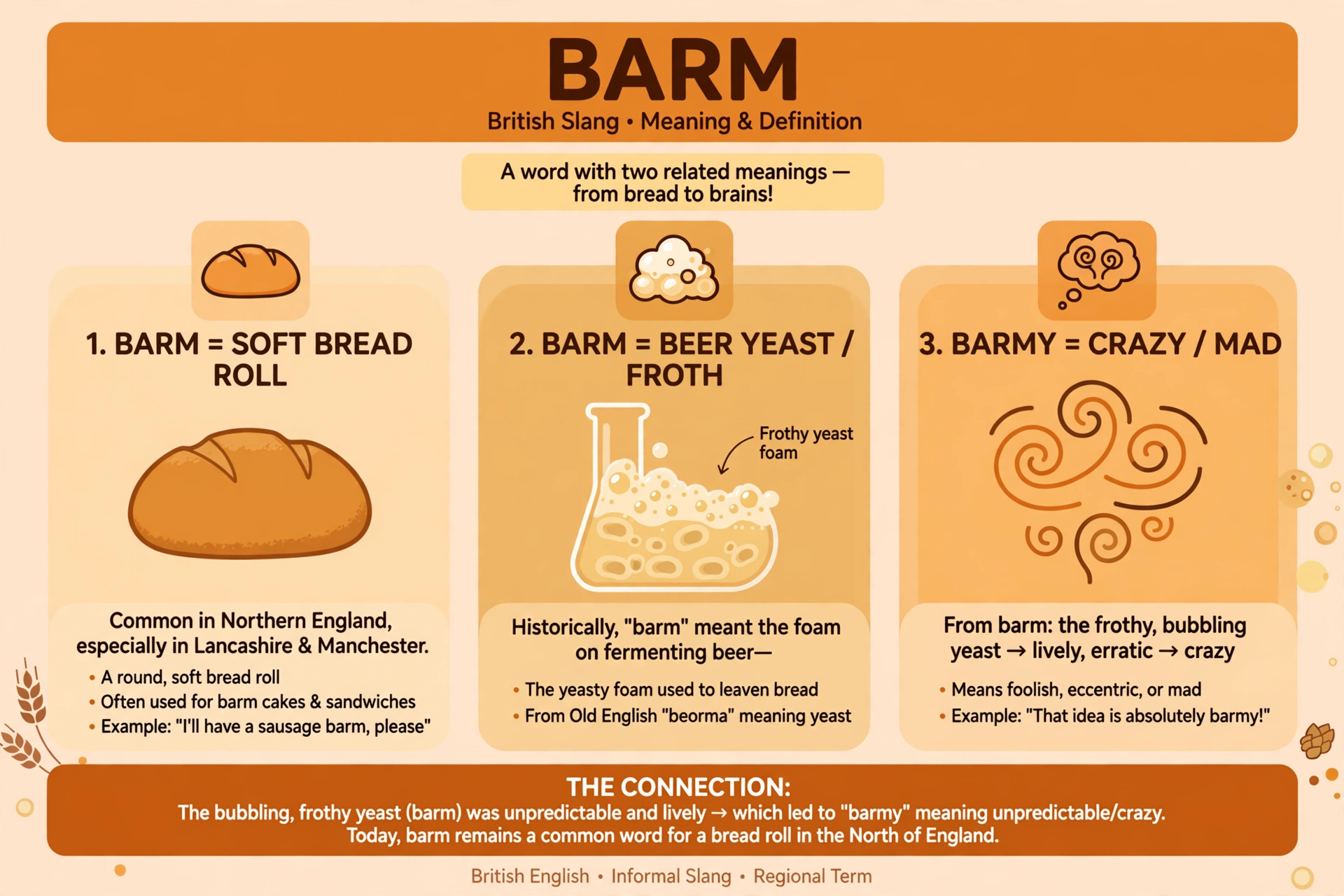
Quick definition: In slang, barm is a British word with two everyday lives. As a noun in the North West of England, a barm (or barm cake) is a soft bread roll. As the root of barmy, it means crazy, mad, or eccentric — as in “you’ve gone barmy.” The word comes from the froth on fermenting beer, and both meanings trace back to that same foamy yeast.
Barm Definition Slang Meaning & Definition
When someone searches for the barm definition slang, they usually mean one of two things — and the answer depends on where in Britain the speaker is standing. In Manchester, Bolton, or Wigan, asking for a “barm” at a bakery gets you a bread roll. In London or Yorkshire, calling an idea “barmy” means it is completely mad.
Here is the simplest way to remember it:
- Barm (noun): A soft, floury bread roll, especially in North West England. “I’ll have a chip barm, please.”
- Barmy (adjective): Crazy, foolish, or eccentric. “That plan is absolutely barmy.”
- Go barmy: To lose your temper or your mind, or to go wild with excitement. “The crowd went barmy when the goal went in.”
- Barm (brewing): The original, literal meaning — the frothy yeast that forms on top of fermenting beer or ale.
Unlike fast-moving TikTok slang, barm is not new. It has been in the English language for centuries, which is exactly why it confuses people: it is old, regional, and it wears more than one meaning at the same time. If you have ever read a British novel, watched a UK comedy, or argued with a Mancunian about what to call a bread roll, you have already met this word.
Introduction
Picture this: you are visiting Manchester for the first time, you walk into a chippy, and the person in front of you orders a “chip barm.” You nod politely and wonder what on earth a barm is. Later that same day, a friend texts you about a wild night out and says the whole group “went barmy.” Same word family, two completely different meanings — and both are correct.
That is the charm of the barm definition slang. It is one of those British words that quietly connects food, beer, history, and humour. It shows up in pub conversations, in regional arguments about bread, in classic British comedy, and in the texts of people who grew up hearing it from their grandparents. Americans rarely use it, which is why so many US readers land on this page confused after hearing it in a show like Coronation Street or a Guy Ritchie film.
In this guide, you will learn exactly what barm means in slang, where it came from, how it differs from barmy, when to use it, when not to use it, and the common mistakes that give non-Brits away instantly. By the end, you will be able to order a barm in Wigan, call a bad idea barmy in London, and understand both without missing a beat. If you enjoy decoding regional words like this, our Australian slang guide is a fun next stop — every English-speaking country has its own barm-style arguments.
Origin
The story of barm starts in a brewery, not a bakery. The word comes from the Old English beorma, meaning yeast, which itself traces back to the Proto-Germanic root bhermen, meaning to ferment or bubble up. In brewing, barm is the frothy, yeasty foam that rises to the top of beer while it ferments. Brewers skimmed it off, and bakers used it to leaven bread — which is how the same word ended up naming both a brewing by-product and a bread roll.
So how did beer froth become a word for “crazy”? The link is wonderfully literal. Barm is light, frothy, bubbly, and unstable — it rises, fizzes, and disappears. People began describing someone whose head seemed full of froth — light-headed, excitable, not thinking straight — as barmy, literally “full of barm.” The Oxford English Dictionary traces the “foolish” sense of barmy back to the late 19th century, although the word had been floating around in dialect for much longer.
There is also a famous folk theory worth knowing about, even though linguists consider it a myth. Barming, a village in Kent, was home to the county psychiatric hospital (Barming Asylum) from 1833, and some people claim “barmy” comes from the village name. The dates do not support it — the “crazy” sense of barmy predates the asylum — but the story survives because it sounds so believable. It is a good reminder that slang etymology is often messier than the neat story people repeat in pubs.
The bread-roll meaning follows the same yeast logic. A barm cake is a roll leavened with barm — the brewer’s yeast — so the name stuck in the towns where bakers bought their yeast from local breweries. That is why the word is strongest in the North West, around Manchester, Lancashire, and parts of Yorkshire, where the brewing and baking trades sat side by side for centuries.
Popularity
Barm will never trend on TikTok the way a word like “rizz” does, but its popularity is deep rather than wide. It is a staple of Northern English speech, and it surges in popularity every time the great British bread-roll debate flares up online. Ask a room full of Brits whether the correct word is bap, barm, cob, teacake, roll, or bun, and you will start an argument that can run for hours — researchers at Manchester University even surveyed 1,400 English speakers on exactly this divide.
The word also gets a second life through British television and comedy. Shows set in the North West drop “barm” into dialogue without explanation, and international viewers head straight to Google. Meanwhile, “barmy” enjoys steady, nationwide use: it appears in newspapers, football commentary (“the fans went barmy”), and everyday speech across the UK and Ireland. It is the kind of word that sounds old-fashioned to younger Brits but never actually dies, because there is no exact modern replacement for its gentle, affectionate version of “crazy.”
For Americans encountering the word, the popularity curve is simple: almost nobody in the US uses “barm” in conversation, which is exactly why it ranks as a curiosity word. Search interest spikes whenever a British show or a viral bread-roll debate crosses the Atlantic, and most searchers want the same two answers — the bread roll and the “crazy” meaning — in one place.
How It Is Used
The barm definition slang changes with context, so here is how each version actually works in real sentences.
As a bread roll (North West England): This is a straightforward noun, used exactly like “roll” or “bun.” You order it, you fill it, you eat it. “Two sausage barms and a tea, love.” The plural is “barms,” and the full form “barm cake” is common in Lancashire. Nobody in Manchester will misunderstand you — but order a “barm” in London and the server may blink, because in the south the same object is a “roll” or a “bap.”
As “barmy” (crazy or eccentric): This is the version most people meet first. It is an adjective, usually light and teasing rather than cruel. “Don’t be barmy — it’s pouring with rain.” “He’s gone completely barmy over that football team.” It describes ideas, plans, people, and behaviour, and it almost always carries a smile with it. Unlike harsher words for mental illness, “barmy” is soft, old-fashioned, and safe to use about friends.
As “go barmy” (lose control): This phrasal version means to go wild, lose your temper, or become extremely excited. Football fans go barmy when their team scores. A teacher might “go barmy” if the class misbehaves all afternoon. The tone is dramatic but playful — nobody is actually being called mentally ill.
As weather (rare): In some older British usage, “barmy” is a variant of “balmy,” describing mild, pleasant weather. “A barmy summer evening.” This sense is uncommon today and mostly appears in older writing, but it is worth knowing so you are not confused when you meet it in a novel.
Tone matters more than grammar here. “Barmy” is informal and warm. It suits friends, family, and casual writing. It does not suit a formal email, a medical conversation, or a job interview — not because it is rude, but because it sounds like something your grandmother says, and in formal settings that reads as unserious.
Examples
Examples make the difference between knowing a definition and actually using the word. Here is how “barm” and “barmy” sound in real conversations, sorted by tone.
Friendly Examples
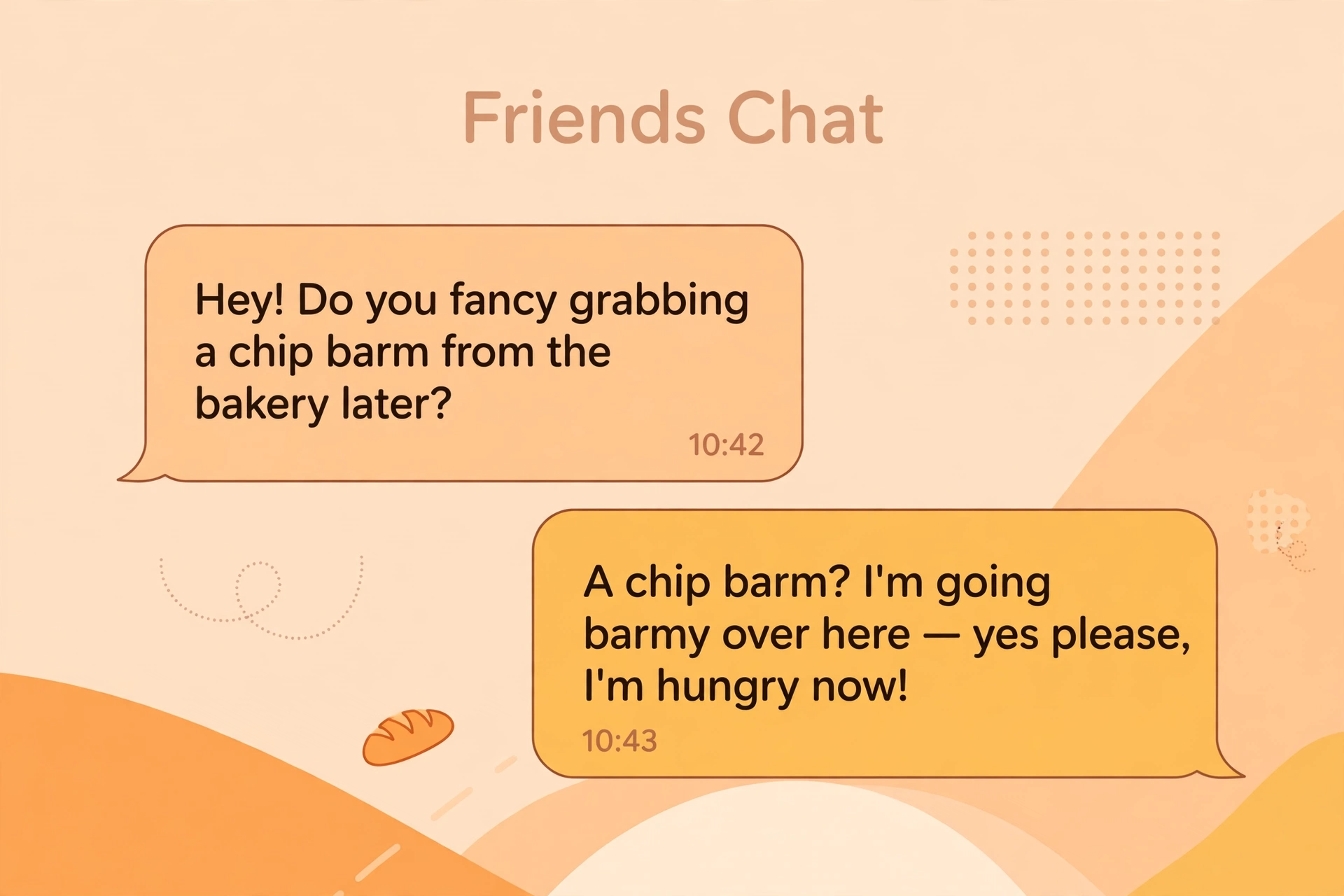
- “You want a chip barm? I’m going to the chippy anyway.” — A perfectly ordinary Northern offer. Nobody is being insulted; lunch is being arranged.
- “She’s a bit barmy, but honestly, she’s the funniest person I know.” — Affectionate teasing. The speaker clearly likes the person being described.
- “We went barmy when our team scored in the last minute. The whole pub erupted! 🎉” — Shared excitement, not madness.
- “Don’t be barmy, of course I’m coming to your birthday!” — A warm way of saying “don’t be silly.”
Professional Examples
- “The client thought the timeline was barmy, so we sent a revised schedule.” — Acceptable in a casual British workplace, but most professionals would write “unrealistic” in the actual email.
- “A barm cake with soup is our lunch special today.” — Menus in the North West list barm cakes without a second thought.
- “Let’s not go barmy with the budget — keep the launch simple.” — A gentle way to say “don’t go overboard” in a meeting.
- In a bakery order: “Twelve barms, please — six white, six brown.” — Completely normal, completely regional.
Funny Examples
- “He tried to fix the leak himself and flooded the kitchen. Absolutely barmy — but you’ve got to admire the confidence. 😂”
- “I’m not paying £8 for a barm. It’s bread, not a mortgage.” — The eternal Northern complaint about southern prices.
- “Our group chat went barmy last night. Two hundred messages about a chip barm. Two hundred.” — Peak British group-chat energy.
- “My grandad says the weather’s gone barmy — sunshine, rain, and hail before lunch.” — Weather small talk, Northern edition.
Comparison with Similar Terms
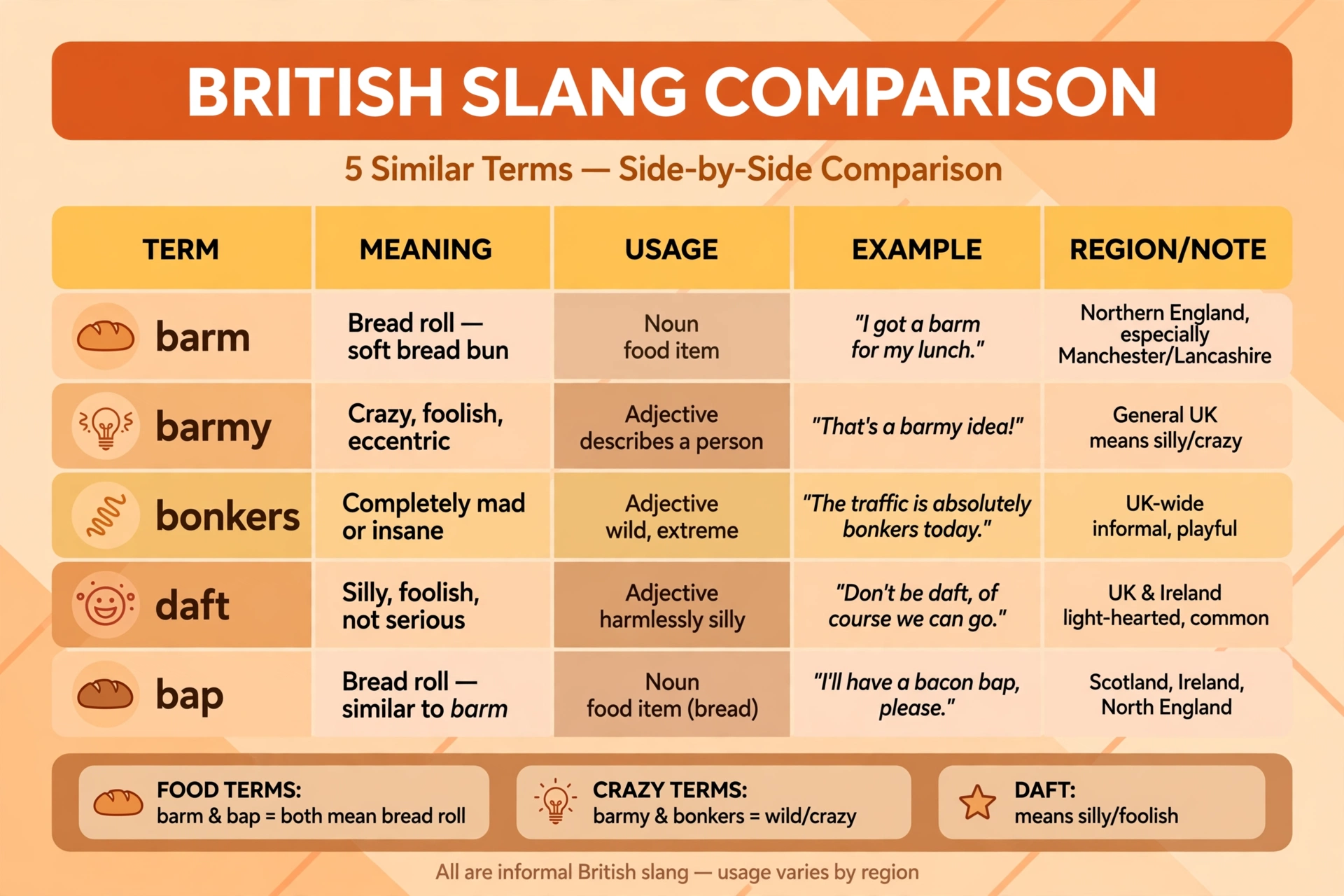
Barm and barmy sit in a crowded neighbourhood of British words for “crazy” and “bread roll.” This table sorts out the closest lookalikes so you can pick the right one every time.
| Term | Meaning | Where It Is Used | Tone |
|---|---|---|---|
| Barm | A soft bread roll | North West England | Neutral, everyday |
| Barmy | Crazy, mad, eccentric | UK and Ireland, nationwide | Light, affectionate, teasing |
| Bonkers | Crazy or mad | UK, very common | Playful, slightly stronger than barmy |
| Daft | Silly or foolish | Northern England and Scotland | Gentle, often fond |
| Balmy | Mild weather; also crazy (US) | US (crazy); UK (weather) | Neutral to old-fashioned |
| Bap | A soft bread roll | Scotland, Northern Ireland, North England | Neutral, everyday |
| Cob | A bread roll | East Midlands | Neutral, everyday |
| Teacake | A bread roll (sometimes sweet) | Parts of Yorkshire and Lancashire | Neutral, everyday |
| Mad | Crazy, angry, or enthusiastic | Everywhere | Depends on context |
| Nuts | Crazy | US and UK | Casual, slightly blunt |
The most useful distinction is between barmy and bonkers. Both mean crazy, but bonkers is a little louder and a little more modern, while barmy sounds older and softer — the word a grandparent would choose. The other key distinction is the bread-roll family: barm, bap, cob, and teacake all name roughly the same object, and which one you hear tells you where in Britain you are. If you love this kind of regional detective work, our guide to CSL meaning in text shows how even a three-letter abbreviation can hide a regional story — slang is rarely as simple as it first looks.
Alternate Meanings
Barm has more meanings than the two famous ones, and knowing them stops embarrassing mix-ups.
- Brewing barm: The literal, original meaning — the frothy yeast skimmed from fermenting beer or ale. Brewers still use the word, and homebrewers will know it instantly.
- Barm cake: The full name of the North West bread roll. A “barm cake” is not a cake at all; it is a savoury roll, usually white and floury, often filled with chips, sausage, or bacon.
- Barmy weather: The rare “balmy” sense — mild, warm, pleasant air. You will meet this mostly in older books and poems, not in a group chat.
- Barm as a surname and place element: Barm appears in place names and family names across northern England, another sign of how old and rooted the word is.
- “Barmy army”: Not a military unit — the nickname for England’s travelling cricket supporters, famous for singing, chanting, and going (affectionately) barmy in the stands.
None of these meanings is rude. The worst mistake you can make with barm is a geographical one — ordering a barm where nobody knows the word — not a social one. That makes it one of the safest British slang words to learn, and one of the most useful for sounding like you actually understand the North.
Professional or Polite Alternatives
Because “barmy” is informal and regional, there are moments when a different word lands better. Here are polite swaps for each situation.
- Instead of “barmy” (crazy idea): “unrealistic,” “impractical,” “ambitious,” or “unconventional.” In a work email, “That timeline seems unrealistic” beats “That timeline is barmy” every time.
- Instead of “gone barmy” (lost temper): “became upset,” “lost his patience,” or “got very frustrated.” Save “went barmy” for friends.
- Instead of “barm” (bread roll): Outside the North West, just say “roll” or “bun.” In the south of England, “roll” is understood everywhere, while “barm” may earn a blank stare.
- Instead of “barmy” (eccentric person): “eccentric,” “quirky,” “unconventional,” or “colourful character.” These carry the same affection without the slang.
- Instead of “barmy” (weather): “mild” or “balmy” — which is the standard spelling for the weather sense anyway.
The rule of thumb is simple: use barm and barmy with people who use them back. In formal writing, in international business, or with strangers from outside the UK, choose the plainer word. Your meaning will be clearer, and nobody will think you are performing a British accent you do not own.
Common Mistakes
Most mistakes with this word come from mixing up its two lives. Here are the ones to avoid.
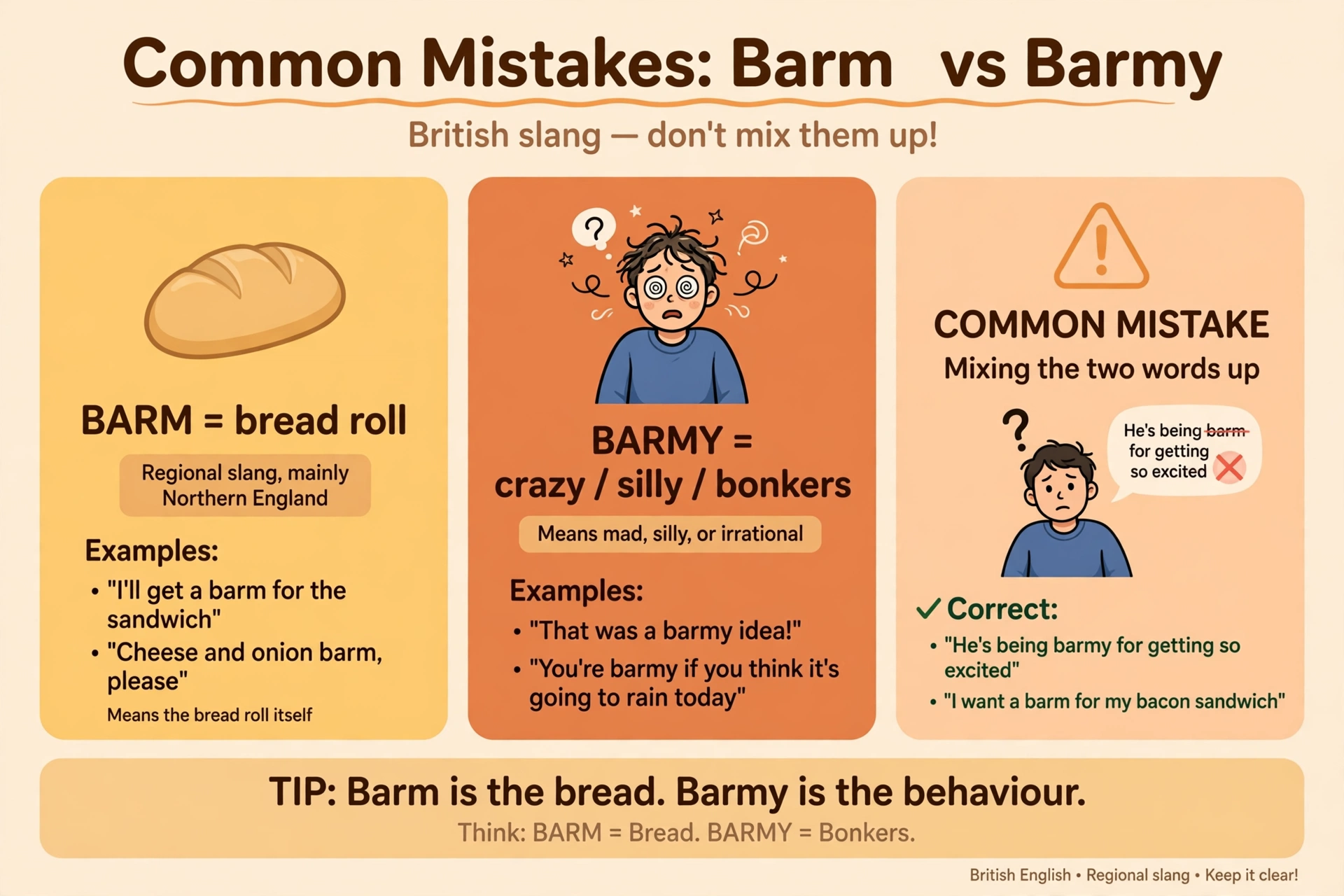
- Calling a bread roll “barmy”: “I’ll have a barmy, please” will get you a laugh in a Manchester bakery. The roll is a barm; the person who orders twelve of them at 8 a.m. might be barmy.
- Using “barm” to mean crazy: “That idea is barm” is not standard. The adjective is always barmy. “Barm” on its own is the noun — the froth or the roll.
- Assuming everyone in Britain says “barm”: Most southerners say “roll,” and many Scots say “bap.” Using “barm” in Brighton marks you as a visitor, not a local.
- Spelling it “balmy” when you mean “barmy”: Balmy is weather (and American slang for crazy). Barmy is the British “crazy.” They sound alike, they share a history, but in writing they are different words.
- Using “barmy” in a serious context: Never use it about real mental illness. It is a joke word for silly behaviour. In a medical or sensitive conversation, it sounds dismissive.
- Believing the asylum myth: The Barming Asylum story is a great pub tale, but the word predates the hospital. Repeating it as fact is the fastest way to get corrected by a linguist.
- Overusing it to sound British: One “barmy” in a conversation is charming. Five in one paragraph sounds like a costume. Like all slang, it works best in small doses.
Quick Tips
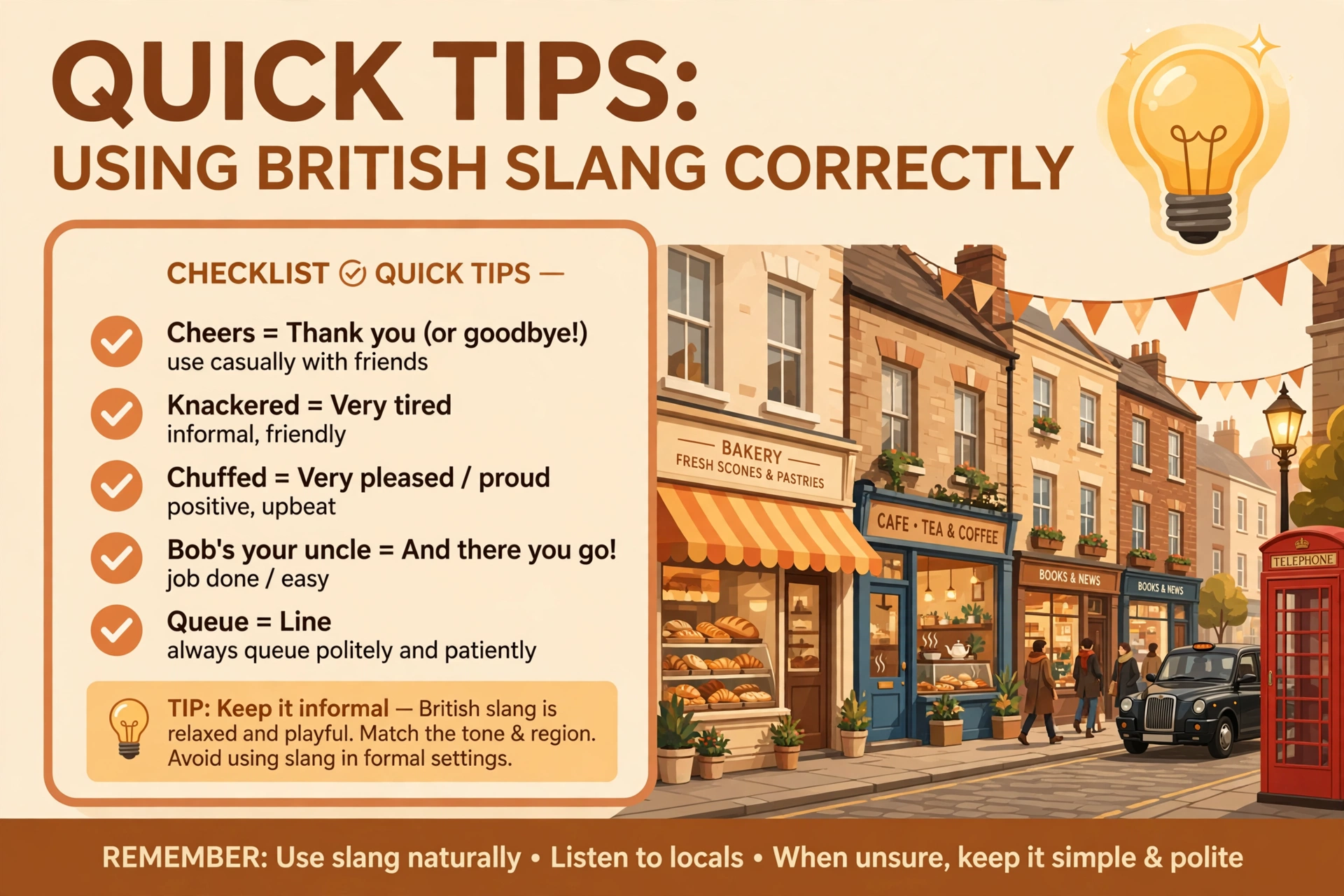
- Learn the pair together: Barm is the noun (roll or froth); barmy is the adjective (crazy). If you remember the pair, you will never mix them up.
- Match the region: In Manchester, order a barm with confidence. In London, say roll. In Scotland, try bap. Regional words are a map — read it before you speak.
- Use “go barmy” for excitement: It is the most versatile form of the word. Fans, crowds, group chats, and toddlers all “go barmy,” and everyone understands the joy in it.
- Keep it affectionate: Say it with a smile. “Barmy” works when the target is a plan, a joke, or a beloved eccentric — not when you genuinely mean to insult someone.
- Pair it with context: If you are texting an American friend, add a quick gloss the first time: “went barmy (went wild).” Short abbreviations cause the same confusion — our FN meaning in text guide shows how fast a two-letter word can be misread without context.
- Listen before you use it: Spend five minutes in a Northern pub or a British comedy and you will hear the exact rhythm of “barmy” — where it sits in a sentence, and how light it sounds.
- Remember the bread debate: If a Brit asks “barm or bap?” they are not testing your vocabulary. They are inviting you into one of Britain’s oldest friendly arguments. Pick a side and enjoy it.
FAQ
1. What does barm mean in slang?
In British slang, barm has two main meanings. In North West England, a barm is a soft bread roll (a barm cake). As the root of “barmy,” it connects to the slang meaning “crazy” or “mad” — someone who has “gone barmy” is acting wild or irrational. Both meanings come from the froth on fermenting beer.
2. What does barmy mean?
Barmy means crazy, mad, silly, or eccentric in British English. It is a light, affectionate word — “Don’t be barmy” means “Don’t be silly.” It comes from “barm,” the frothy yeast on fermenting beer, suggesting a head full of froth.
3. Is barm the same as a bap?
Almost. A barm and a bap are both soft bread rolls, but the words belong to different regions. “Barm” is used in North West England (Manchester, Lancashire), while “bap” is more common in Scotland, Northern Ireland, and parts of northern England. In the Midlands the same roll is a “cob,” and in the south it is usually just a “roll.”
4. Where does the word barm come from?
Barm comes from the Old English beorma, meaning yeast, from the Proto-Germanic root bhermen (to ferment). It originally named the frothy yeast on fermenting beer. Bakers used that yeast to leaven bread, which gave the name to the bread roll, and the frothy, unstable nature of the foam gave rise to “barmy” (crazy).
5. Do Americans use the word barm?
Almost never in conversation. Americans are more likely to know “balmy” (mild weather, or slang for crazy in the US). Most Americans meet “barm” through British TV, books, or travel — which is why it is such a common search term in the US despite being rare in American speech.
6. What does “go barmy” mean?
“Go barmy” means to go wild, lose your temper, or become extremely excited. Football fans go barmy when their team scores, a crowd goes barmy at a concert, and a parent might go barmy if the kids make a mess. It is dramatic but playful, never a clinical description.
7. Is barmy rude or offensive?
No — barmy is not rude. It is informal, old-fashioned, and usually affectionate. However, you should not use it to describe real mental illness, and it sounds out of place in formal or professional settings. For polite alternatives, use “eccentric,” “unrealistic,” or “unconventional” depending on the context.
8. What is a chip barm?
A chip barm is a Northern English classic: a soft barm cake (bread roll) filled with hot chips (fries), often with butter, ketchup, or gravy. It is cheap, filling, and beloved in Manchester, Wigan, and Bolton — and it is the single most common sentence in which visitors first hear the word “barm.”
Conclusion
The barm definition slang turns out to be three stories in one word: a brewer’s froth, a baker’s roll, and a gentle way of calling something crazy. That is a lot of history for four letters, and it is why the word has survived for centuries while trendier slang burns out in a season. A barm is a bread roll in the North West, barmy is “mad” across the whole UK, and going barmy is what happy crowds do.
The key takeaways are simple. Use “barm” for the roll and “barmy” for the madness, match the word to the region you are in, keep it affectionate, and save it for casual moments. If you remember the beer froth at the root of it all, you will never confuse the meanings again — foam rises, bubbles over, and disappears, exactly like a barmy idea.
Now you can order a chip barm in Manchester, laugh when someone calls a wild plan barmy, and explain the difference to the next person who asks. Language is at its best when a single small word carries a whole culture with it, and barm carries breweries, bakeries, football crowds, and grandmothers in one neat package. Keep exploring regional words — from IDT meaning in text to the newest slang guides — and you will never be lost in a British conversation again.
