
Quick definition: In texting and social media slang, ASF means “as f***” — a blunt intensifier that works exactly like “extremely,” “very,” or “really.” When someone writes “I’m tired ASF,” they mean “I’m extremely tired.” It is casual, informal, and best kept far away from school, work, and formal messages.
asf meaning slang & Definition
The asf meaning slang is simple once you see it in action: ASF is short for “as f***,” and it exists for one job only — to turn the volume all the way up on whatever word sits in front of it. “Hungry ASF” is not just hungry. “Bored ASF” is not just a little bored. It is the texting equivalent of shouting a feeling in all caps.
Unlike most slang abbreviations, ASF does not describe a thing, a person, or an action. It modifies. It attaches itself to adjectives and feelings — tired, hungry, happy, annoyed, cold, broke, confused — and makes them louder. That is why you will almost never see it standing alone in a sentence. It needs a word to supercharge.
Here is the asf meaning slang at a glance:
| Term | Full Form | Works Like | Tone |
|---|---|---|---|
| ASF | As f*** | Extremely / very / really | Very informal |
| AF | As f*** | Extremely / very / really | Very informal |
| asf | As f*** | Extremely / very / really | Casual, lowercase texting style |
ASF and AF mean the same thing. ASF is simply the three-letter version, while AF is the shorter two-letter form. Some people prefer ASF because the extra “S” makes it feel more deliberate, but in practice the two are interchangeable.
Introduction
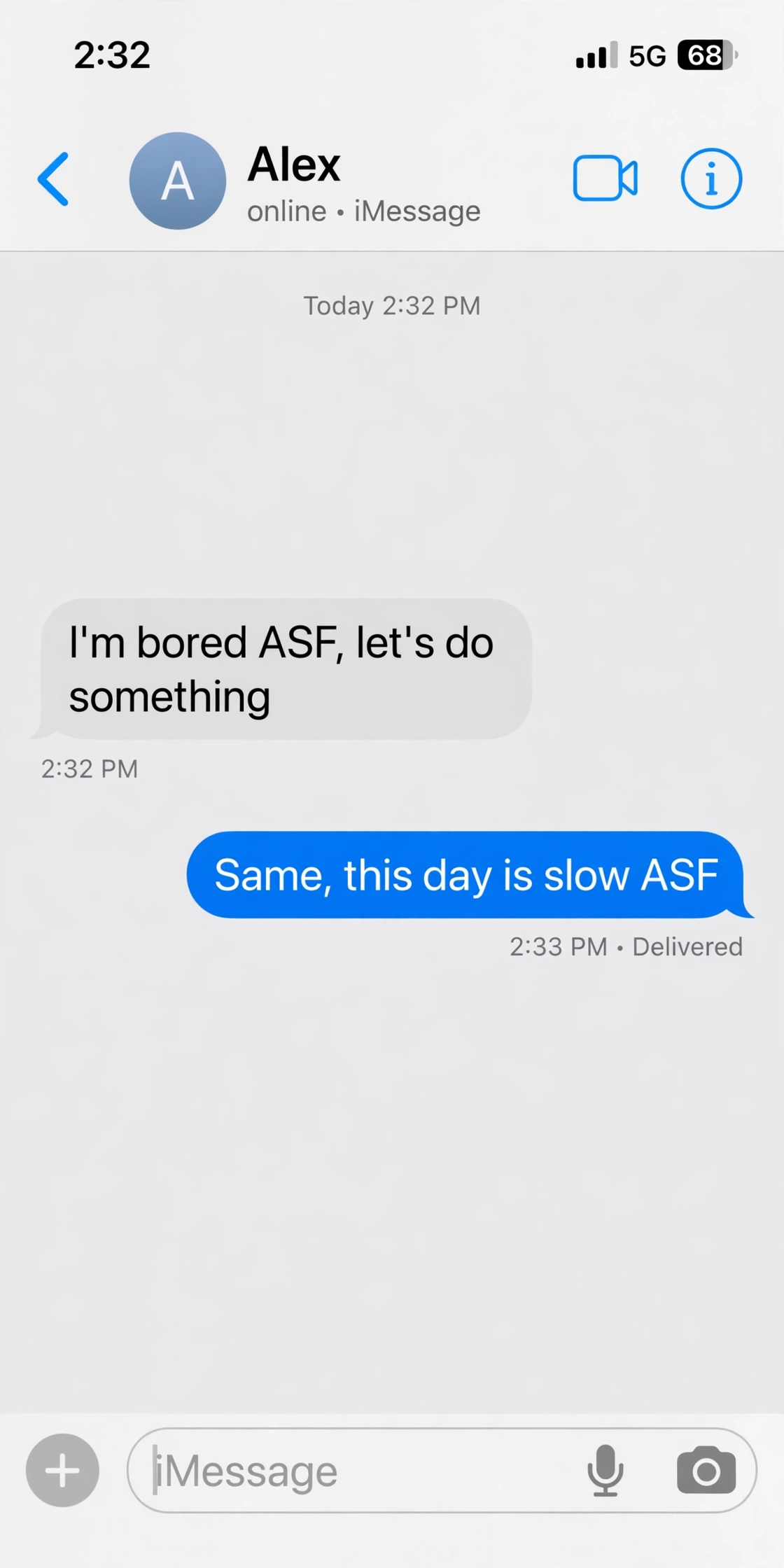
You are scrolling TikTok at midnight and a comment says “this song is good ASF.” A friend texts “I’m bored ASF, let’s do something.” A caption on Instagram reads “tired ASF but still showing up.” If you grew up texting, you probably read those sentences without pausing. If you did not, you might wonder why three random letters keep showing up at the end of perfectly normal sentences — and whether they are rude, funny, or both.
They are a little of both. ASF is one of the most common intensifiers in modern internet slang, right alongside AF, “lowkey,” “deadass,” and “no cap.” It shows up everywhere teenagers and young adults type fast: TikTok comments, Instagram captions, Snapchat streaks, Discord chats, and group texts. Like other slang terms covered on this site — for example, our guide to OTP meaning in text slang — it started in a small corner of the internet and spread because it is short, punchy, and instantly understood by anyone under thirty.
In this guide, you will learn exactly what ASF means, where it came from, how people use it in real conversations, how it compares with similar slang, what else it can stand for, and — just as importantly — when you should never use it. By the end, you will read “hungry ASF” the same way a native texter does: not as a mystery, but as a mood.

Origin
The phrase “as f***” has lived in spoken English for decades, long before anyone typed it as ASF. It comes from informal American English, with roots in African American Vernacular English (AAVE), where “as” plus a strong word has long been used to exaggerate a description — “funny as hell,” “mad as hell,” “tired as hell.” The profane version, “as f***,” was simply the most extreme version of that pattern, and extreme is exactly what slang loves.
The abbreviation itself was born the way most texting slang is born: someone got tired of typing. On early internet forums, chatrooms, and SMS keyboards, “as f***” was shortened first to “AF” and then, in some corners, to “ASF.” The three-letter form kept the “S” from “as,” making the abbreviation a slightly more faithful echo of the full phrase. Both versions spread through the 2010s on Twitter, Tumblr, and Reddit, and then exploded on TikTok, where captions and comments reward the shortest possible way to say something big.
It is worth noting that ASF was never a word with a formal debut. No dictionary committee voted on it. It went viral the way slang always does: one person typed it, a thousand people copied it, and a platform’s algorithm did the rest. Dictionary.com now documents it in its slang coverage, confirming that ASF is a text and social media abbreviation for “as f***” — the same phrase, just compressed for the feed.
Popularity
ASF is not a fading trend. It is part of the everyday vocabulary of Gen Z and younger millennials, and its popularity tracks with the platforms where short, emotional captions win. On TikTok, “ASF” appears in video captions (“me when the Wi-Fi dies ASF”), in comment sections (“this is funny ASF”), and in on-screen text. On Instagram, it softens or sharpens a caption depending on the mood — “happy ASF” under a birthday post, “stressed ASF” under a finals-week photo.
Why did it stick when hundreds of other abbreviations died? Three reasons:
- It is fast. Three letters replace an entire phrase, and on a phone keyboard that matters.
- It is flexible. It works after almost any adjective — tired, hungry, happy, broke, cold, bored, excited, annoyed — so it fits nearly any feeling.
- It sounds like how people actually talk. Saying “I’m tired ASF” out loud sounds natural in casual conversation, which is why it jumped from text back into speech.
Search interest in the term has stayed steady rather than spiking and crashing, which is the signature of slang that has become infrastructure rather than a meme. People are not looking it up because it is new — they are looking it up because they keep seeing it and want to be sure they are reading it right. If you are one of them, you are in the right place.
How It Is Used
The grammar of ASF is delightfully simple. It almost always comes after the adjective or feeling it intensifies. Think of it as a booster that plugs into the end of a sentence:
- “I’m tired ASF.” → I’m extremely tired.
- “That movie was good ASF.” → That movie was really good.
- “It’s cold ASF outside.” → It is extremely cold outside.
- “She’s funny ASF.” → She is incredibly funny.
You will also see it after nouns used as descriptions (“a whole vibe ASF”), after verbs in casual speech (“I’m stressing ASF”), and in standalone reactions (“ASF 😭” under a relatable post). The lowercase form, “asf,” is the most common in texts because it feels softer and more natural; the uppercase “ASF” reads louder, like a shout.
ASF also works as a reply all by itself. If a friend says “that exam was brutal,” replying “fr ASF” means “for real, extremely.” And in group chats, it often appears with an emoji for extra color: “bored ASF 😩,” “hungry ASF 🍕,” “happy ASF 🥹.” The emoji does the emotional work; ASF does the volume work.
One thing ASF does not do is create a new meaning. It never changes what the word before it means — it only makes it stronger. “Tired ASF” is still tired. “Funny ASF” is still funny. That is the whole trick, and it is why the term is so easy to learn once you know the trick.
Examples
Real examples are the fastest way to lock in the asf meaning slang. Below are everyday situations — friendly chats, professional settings where it should not appear, and funny uses — so you can see the tone in context.
Friendly Examples
- Ana: “Are you coming to the party tonight?”
Mia: “Obviously. I’m bored ASF at home.” - Jay: “Did you try the new burger place?”
Leo: “Yeah, it’s good ASF. We’re going again Friday.” - Sara: “How was the concert?”
Tom: “Loud ASF but worth every second.” - Zoe: “I miss summer already.”
Max: “Same. It’s cold ASF today.”
In friendly chats, ASF adds warmth and exaggeration. Nobody is offended, because everyone in the conversation has agreed — silently — that casual language is fine here.
Professional Examples
Here is the honest truth: there are almost no professional examples of ASF, because it does not belong in professional communication. Do not use it in work emails, Slack messages to your manager, job applications, or client chats. If you want the same energy at work, say “extremely,” “incredibly,” or “very.”
- ❌ “The deadline is tight ASF.” → ✅ “The deadline is extremely tight.”
- ❌ “I’m tired ASF today.” → ✅ “I’m very tired today — I’ll still get the report done by 3.”
- ❌ “This client is picky ASF.” → ✅ “This client has very specific requirements.”
The only semi-professional exception is a creative or social-media role where casual slang is part of the brand voice — and even then, only if the brand explicitly uses it. When in doubt, leave ASF out of work entirely.
Funny Examples
- “My bank account is empty ASF and it’s only the 5th.”
- “The Wi-Fi went down during my exam. I was stressed ASF.”
- “Me: I’m going to sleep early tonight. Also me at 3 a.m.: wide awake ASF.”
- “That plot twist was crazy ASF. I need a minute.”
Funny uses work because the exaggeration is the joke. The situation is relatable, and ASF turns a normal complaint into a punchline. That is also why it appears so often in memes: the letters do the shouting so the image does not have to.
Comparison with Similar Terms
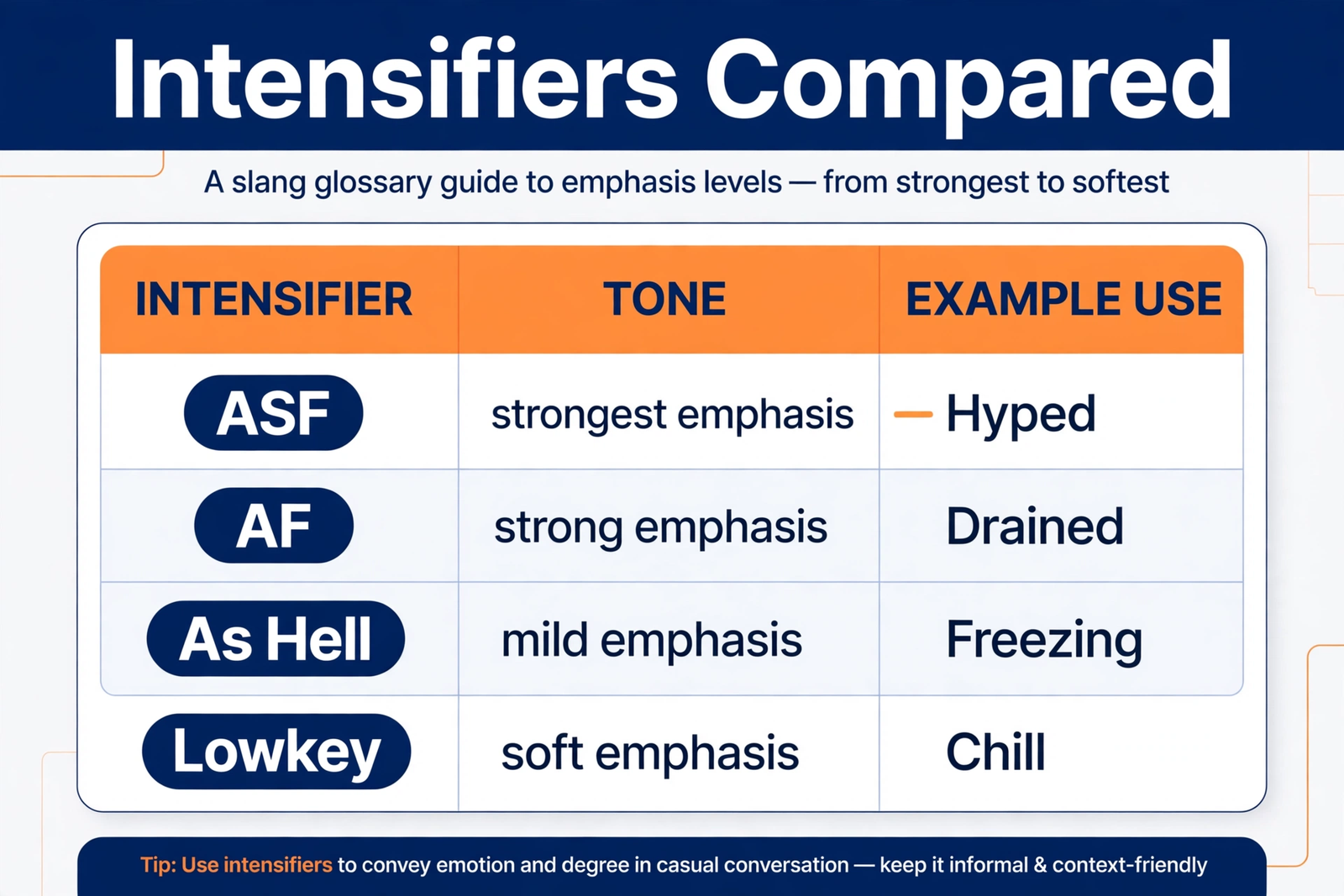
ASF is not the only intensifier in the slang toolbox. It competes with several cousins that do nearly the same job with slightly different flavor. Here is how they stack up:
| Term | Meaning | Tone | Best For |
|---|---|---|---|
| ASF | As f*** | Very informal, profane | Maximum emphasis in casual chats |
| AF | As f*** | Very informal, profane | Same as ASF, one letter shorter |
| As hell | Extremely | Informal, milder profanity | Spoken emphasis, older speakers |
| Deadass | Seriously / for real | Very informal, NYC slang | Emphasizing truth, not just intensity |
| Mad | Very / a lot | Informal, regional (NYC) | “Mad tired,” “mad funny” |
| Hella | Very / a lot | Informal, West Coast | “Hella tired,” “hella good” |
| Lowkey | Somewhat / secretly | Casual | Soft emphasis — the opposite of ASF |
The closest match is AF. If someone writes “tired AF” and someone else writes “tired ASF,” they mean the same thing, and arguing about which is correct is a waste of a group chat. “As hell” is the older, slightly tamer sibling — “tired as hell” has been around since before texting existed. “Deadass” is different: it emphasizes that something is true, not just intense. And “lowkey” is ASF’s mirror image: where ASF turns the volume up, “lowkey” turns it down.
If you are learning slang systematically, it helps to compare terms side by side. Our guide to WYBD meaning breaks down another abbreviation that confuses people for a similar reason — it looks simple, but the context changes everything.
Alternate Meanings
Outside of casual texting, ASF can stand for completely different things. Context is everything, and in a professional or technical setting the slang meaning is usually the wrong one:
- Apache Software Foundation — the nonprofit behind open-source projects like Apache HTTP Server and Hadoop. In tech, “ASF” almost always means this.
- Advanced Systems Format — Microsoft’s media file format (the .asf file extension for audio and video).
- African Swine Fever — a serious viral disease of pigs, used in veterinary and agricultural news.
- And so forth — an older, rare abbreviation for “and so on,” mostly seen in informal lists.
- Age, Sex, From — an old chatrooms-era variant of ASL (“age, sex, location”), asking where someone is from.
- Airport and airline codes — ASF is also an IATA code and appears in aviation contexts.
How do you tell which meaning applies? Look at the room. In a TikTok comment, ASF means “as f***.” In a software engineering meeting, it means the Apache Software Foundation. In a farming report, it means African Swine Fever. The letters are the same; the world around them does the deciding. For more on how one abbreviation can hide several meanings, see our breakdown of PMTFO meaning in text, where context flips the definition just as sharply.
Professional or Polite Alternatives
Because ASF contains profanity, you need a clean swap for every situation where it does not fit. Here are polite alternatives that keep the emphasis without the edge:
| Instead of | Say this | Where it works |
|---|---|---|
| “I’m tired ASF.” | “I’m extremely tired.” | Work, school, family |
| “That’s funny ASF.” | “That’s absolutely hilarious.” | Anywhere |
| “It’s cold ASF.” | “It’s freezing outside.” | Anywhere |
| “I’m hungry ASF.” | “I’m starving.” | Anywhere |
| “This is hard ASF.” | “This is incredibly difficult.” | Work, school |
| “She’s talented ASF.” | “She’s remarkably talented.” | Work, formal praise |
The pattern is simple: replace ASF with “extremely,” “incredibly,” “absolutely,” “really,” or a stronger adjective (“starving” instead of “hungry,” “freezing” instead of “cold”). You lose nothing in meaning and you gain the ability to say it to your grandmother, your teacher, or your boss.
Common Mistakes
Most ASF mistakes are not about grammar — they are about audience. Here are the ones people actually make:
- Using it with strangers or elders. ASF reads as rude to anyone who does not already know your casual style. With a new acquaintance, a teacher, or a parent, skip it.
- Using it at work. Even in a relaxed office, “as f***” in writing creates a paper trail you do not want. Save it for friends.
- Using it in every sentence. ASF is an intensifier, and intensifiers lose power fast. If everything is “good ASF,” “funny ASF,” and “tired ASF,” nothing stands out. Use it once per conversation, not once per message.
- Putting it in the wrong spot. ASF goes after the adjective: “tired ASF,” not “ASF tired.” Reversing it sounds wrong to native texters and marks you as someone guessing.
- Assuming it is always profane. In a tech or farming context, ASF is innocent. Do not correct someone who writes “ASF license” or “ASF outbreak” — they are not swearing at you.
- Using it to be mean. “You’re ugly ASF” is not playful; it is an insult with a booster attached. The intensifier makes cruelty worse, not funnier.

Quick Tips
- Match your audience: friends only. If you would not swear in front of someone, do not type ASF to them.
- Place it last: adjective first, ASF second — “happy ASF,” never “ASF happy.”
- Use it sparingly: one ASF per conversation keeps it punchy; five in a row makes it noise.
- Lowercase is the default: “asf” feels natural in texts; “ASF” feels like shouting. Choose the volume you actually want.
- Pair it with an emoji: “tired ASF 😴” lands softer than the letters alone and shows the feeling, not just the intensity.
- Know the room: TikTok, Instagram, and group chats are home turf. Email, school, and work are not.
- When unsure, swap it: “extremely” always works and offends no one.

FAQ
1. What does ASF mean in texting?
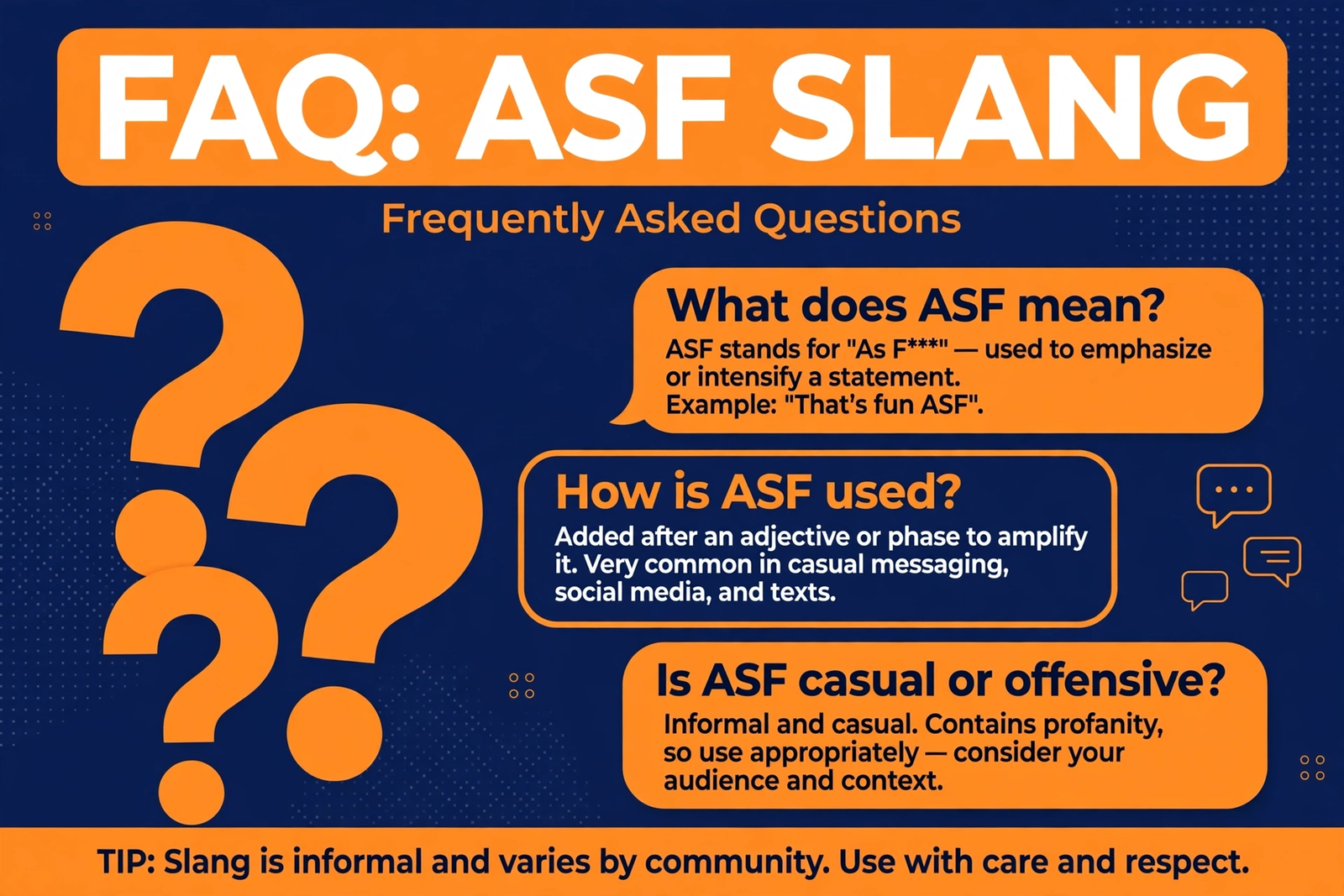
In texting, ASF means “as f***.” It is an informal intensifier that works like “extremely,” “very,” or “really.” For example, “I’m tired ASF” means “I’m extremely tired.”
2. Is ASF the same as AF?
Yes. ASF and AF both stand for “as f***” and mean exactly the same thing. ASF is the three-letter version and AF is the two-letter version. People use whichever one they prefer.
3. Is ASF rude or offensive?
It can be. The full form contains profanity, so ASF is rude in formal settings, at work, at school, or with people you do not know well. Among close friends in casual chats, it is normal and rarely offensive.
4. What does ASF mean on TikTok?
On TikTok, ASF means the same thing it means in texting: “as f***,” used for emphasis. You will see it in captions (“tired ASF”), comments (“this is funny ASF”), and on-screen text over relatable videos.
5. What does ASF mean on Snapchat and Instagram?
On Snapchat and Instagram, ASF is the same intensifier — “as f***.” It shows up in stories, captions, and DMs, usually after an adjective: “bored ASF,” “happy ASF,” “hungry ASF.”
6. Can ASF mean something other than “as f***”?
Yes. In tech it can mean the Apache Software Foundation, in media it can mean Advanced Systems Format, and in agriculture it can mean African Swine Fever. It can also rarely mean “and so forth” or “age, sex, from.” Context decides which meaning applies.
7. Should I use ASF in professional messages?
No. Do not use ASF in work emails, job applications, or messages to managers and clients. Use “extremely,” “incredibly,” or “very” instead — they carry the same emphasis without the profanity.
8. How do you use ASF in a sentence?
Put ASF after the adjective or feeling you want to strengthen: “I’m happy ASF,” “That movie was good ASF,” “It’s hot ASF today.” Never put it before the adjective, and use it only in casual conversations with people who are comfortable with slang.
Conclusion
The asf meaning slang is one of those rare pieces of internet language that is both simple and easy to misuse. Simple, because it does exactly one thing: it takes a feeling and makes it bigger. “Tired ASF” is extremely tired. “Funny ASF” is incredibly funny. Once you know that ASF stands for “as f***” and works like “extremely,” you will never misread it again.
Easy to misuse, because the same three letters that are harmless among friends are rude in a classroom, a workplace, or a message to someone’s parents. The rule is not complicated: friends and casual chats, yes; work, school, and strangers, no. And when you are unsure, “extremely” is always waiting — it says the same thing and offends nobody.
Slang keeps moving, and ASF is a good reminder of how it moves: a spoken phrase gets shortened for a keyboard, a keyboard habit gets copied a million times, and suddenly three letters carry a whole mood. If you want to keep decoding the slang you see every day, our guide to what SMD means in slang breaks down another abbreviation that confuses just as many people. And for the record, Dictionary.com confirms ASF as a text and social media abbreviation for “as f***” — the same definition you just learned, straight from the source.
