Quick definition: Puerto rican slang words are the colorful, everyday expressions used across Puerto Rico — from boricua (a Puerto Rican person) and corillo (your crew of friends) to janguear (to hang out) and wepa (an excited cheer). Shaped by Taíno roots, Spanish, African influences, and American English, these words are how Boricuas greet friends, crack jokes, and say exactly what they mean without saying it the textbook way.
puerto rican slang words Meaning & Definition
The puerto rican slang words you hear on the island are not just informal Spanish — they are a whole dialect of attitude. Puerto Rican Spanish, often called español boricua, blends standard Spanish with Taíno words, African rhythms, and English loanwords picked up over more than a century of close contact with the United States. The result is a vocabulary that sounds familiar to any Spanish speaker but means something slightly — or completely — different in Puerto Rico.
Take chavo. In Mexico it can mean a young guy. In Puerto Rico, chavo means money. Chulería means “insolence” in some countries, but on the island it means something is cool, fun, or beautiful. And guagua, which means “baby” in parts of Latin America, is simply the bus in Puerto Rico. Context is everything, and that is exactly why visitors — and even fluent Spanish speakers from other countries — can feel lost for a few days until their ear adjusts.
This guide covers the puerto rican slang words you will actually hear: on the street in San Juan, in a reggaetón lyric, in a family group chat, or at a chinchorro (a roadside food and drink spot) during a night of chinchorreo. Each term comes with its real meaning, its origin where it matters, and examples that show how it is used in real life.
Introduction
If you have ever listened to Bad Bunny, watched a Puerto Rican creator on TikTok, or landed at Luis Muñoz Marín International Airport, you have heard Puerto Rican slang in action — probably before you even realized it. Someone shouts ¡Wepa! when the music starts. A friend texts ¿Qué es la que? instead of a plain hello. Your cousin says he is going to janguear with his corillo tonight, and you nod along while quietly wondering what half of those words mean.
Puerto Rican slang is one of the most recognizable and most imitated ways of speaking Spanish in the world, and it is easy to see why. It is warm, funny, fast, and full of personality. Words get shortened, English gets bent into Spanish shapes, and a single phrase can carry a joke, a greeting, and a mood all at once. The slang also travels: with millions of Puerto Ricans living in New York, Orlando, Chicago, and beyond, these words now show up in group chats and music lyrics far from the island itself — the same way everyday texting abbreviations like the ones in our guide to tysm meaning have spread far beyond their original circles.
In this guide, we will break down the most useful puerto rican slang words completely: where they come from, why they became popular, how to use them without sounding forced, the mistakes that give newcomers away, and the polite alternatives for formal situations. You will also get real examples, a comparison with similar terms from other Spanish-speaking countries, and answers to the questions people ask most. By the end, you will understand Boricua slang well enough to follow a conversation — and maybe even join one.
Origin
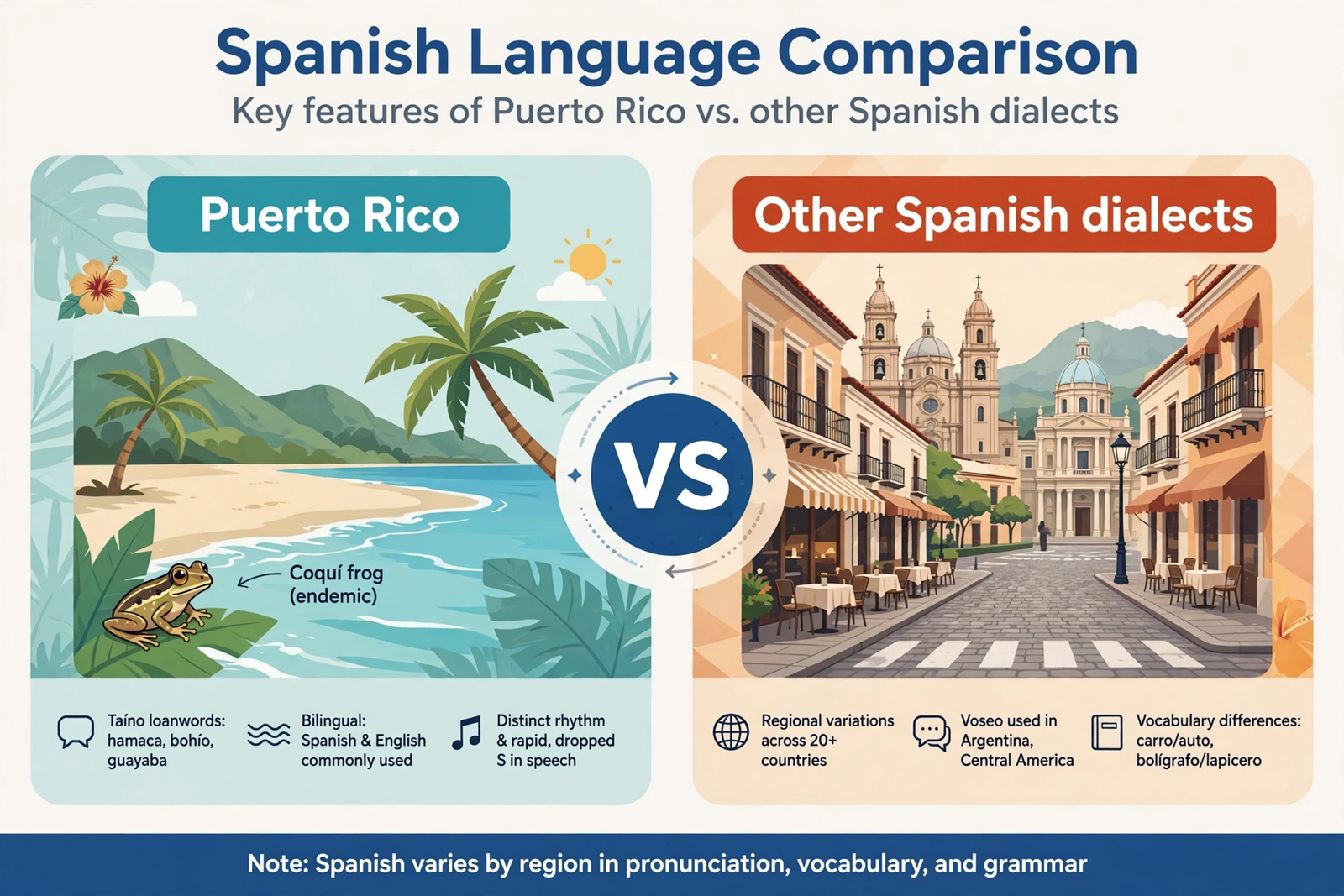
Puerto Rican slang grew out of the island’s layered history, and every layer left words behind. The Taíno people, the island’s Indigenous inhabitants, gave Puerto Rico its original name — Borikén — and from it came boricua, the word Puerto Ricans proudly use for themselves. Taíno words also survive in everyday vocabulary: hamaca (hammock), huracán (hurricane), and tabaco all trace back to Taíno roots.
Spanish colonization added the base language, but Puerto Rican Spanish developed its own sound and vocabulary over centuries, influenced by African languages brought by enslaved people and by later waves of migration from the Canary Islands, Corsica, and other parts of the Caribbean. Words like bembé (a big party) carry that Afro-Caribbean heritage, and the island’s relaxed pronunciation — dropping the “s” at the end of syllables, softening the “r” — gives the slang its unmistakable rhythm.
The biggest modern influence is English. Puerto Rico has been a U.S. territory since 1898, and the constant flow of people, music, and media between the island and the mainland turned English words into Spanish slang. Janguear comes straight from “to hang out.” Gufear comes from “to goof around.” Pichea (ignore it, never mind) borrows from “pitch” in baseball — to throw something away. Even bichote, slang for an important person or big shot, is a playful reshaping of the English “big shot.” Reggaetón, born in Puerto Rico in the 1990s and 2000s, then broadcast all of it to the world: artists like Daddy Yankee, Don Omar, and later Bad Bunny turned local slang into global lyrics, and listeners everywhere started repeating words they had never heard before.
Popularity
Puerto Rican slang is more popular today than at any point in the island’s history, and music is the main reason. Reggaetón and Latin trap dominate global streaming charts, and their lyrics are packed with Boricua slang. When Bad Bunny drops a line full of corillo, perreo, and bellakeo, millions of listeners look the words up the same day. Searches for puerto rican slang words spike every time a major Puerto Rican artist releases an album or headlines a festival.
Social media multiplied the effect. Puerto Rican creators on TikTok and Instagram use slang naturally in skits, reaction videos, and day-in-the-life content, and their audiences — many of them second- and third-generation Puerto Ricans in the U.S. who grew up hearing the words at home — share the clips with friends who want to learn. Language-learning apps and blogs have noticed too: listicles of Puerto Rican slang now rank among the most-read Spanish-learning content online.
There is also a pride factor. For decades, some Spanish speakers looked down on Caribbean Spanish as “incorrect.” That attitude has flipped. Today, speaking like a Boricua is a point of cultural pride, and Puerto Ricans living off the island use slang as a way to stay connected to home. The words are identity markers as much as they are vocabulary — saying ¡Ay bendito! instead of a generic “oh no” tells people exactly where you are from.
How It Is Used
Puerto rican slang words show up in almost every casual setting on the island: at home, on the street, at the beach, in the group chat, and in song lyrics. They are rarely used in formal writing, job interviews, or official settings — that is where standard Spanish takes over. But in everyday conversation, slang is the default, not the exception.
Most of these words work as greetings, reactions, and social glue. ¿Qué es la que? opens a conversation the way “what’s up?” does in English. Acho or chacho — short for muchacho (guy) — works like “well…” or “man,” a filler that keeps a story moving. ¡Diache! expresses surprise the way “wow!” or “oh man!” does. And ¡Wepa! is pure celebration, shouted at parties, concerts, and whenever something good happens.
The slang is also deeply situational. Chinchorrear describes a specific Puerto Rican pastime — hopping from one roadside chinchorro to another for food, drinks, and music — and there is no single English word for it. Bregar means to deal with something, to work on it with effort, and it carries a sense of hustle that “to handle it” only partly captures. Understanding when to use each word matters as much as knowing what it means, which is why the examples below put every term in a real sentence.
Examples
Here are the puerto rican slang words you are most likely to hear, grouped by how people actually use them — with the meaning, the origin, and a real example for each.
Essential everyday words
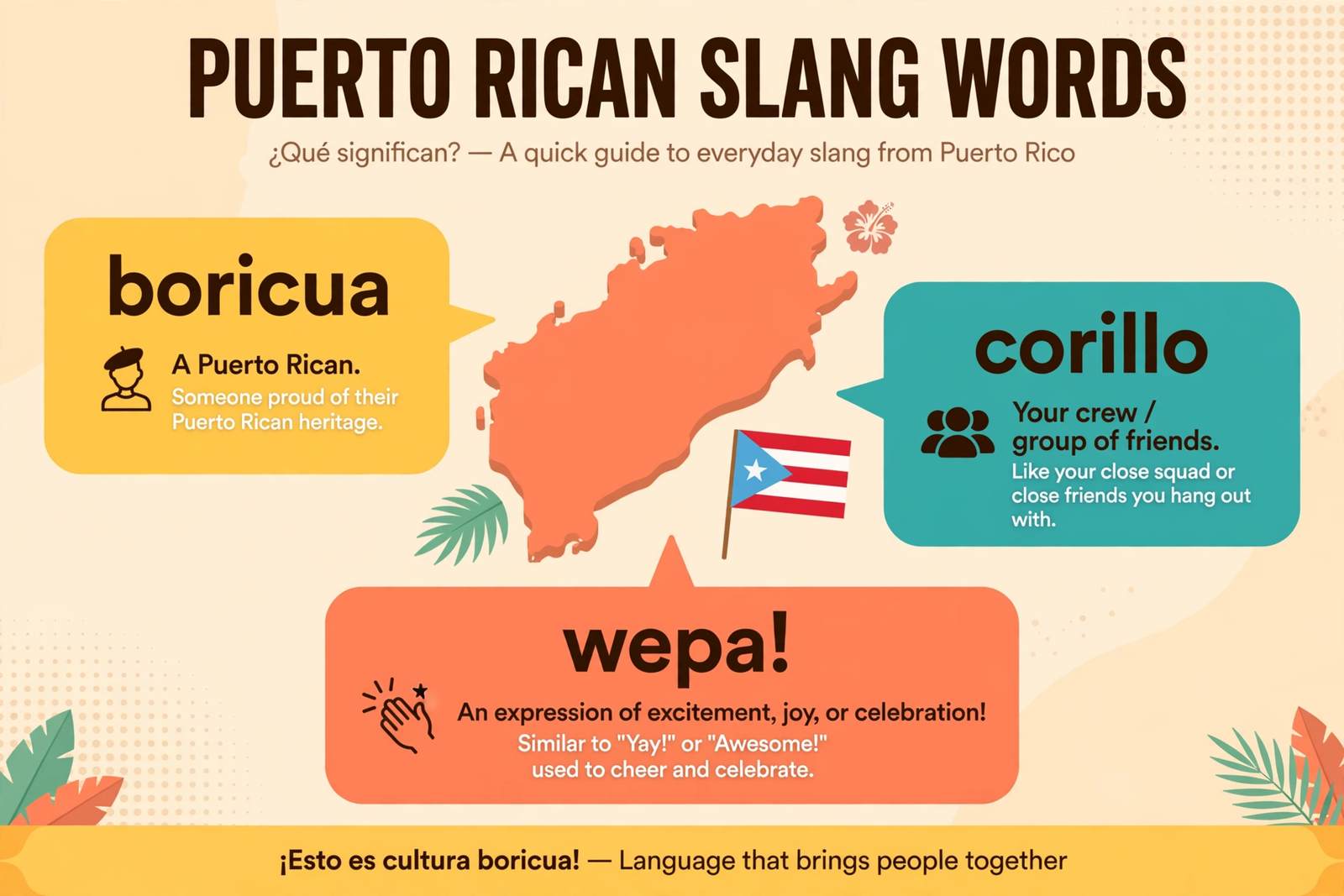
- Boricua — a Puerto Rican person. From Borikén, the Taíno name for the island. “Orgulloso de ser boricua.” (Proud to be Boricua.)
- Corillo — your crew, your group of friends. “Voy pa’ la playa con el corillo.” (I’m going to the beach with the crew.)
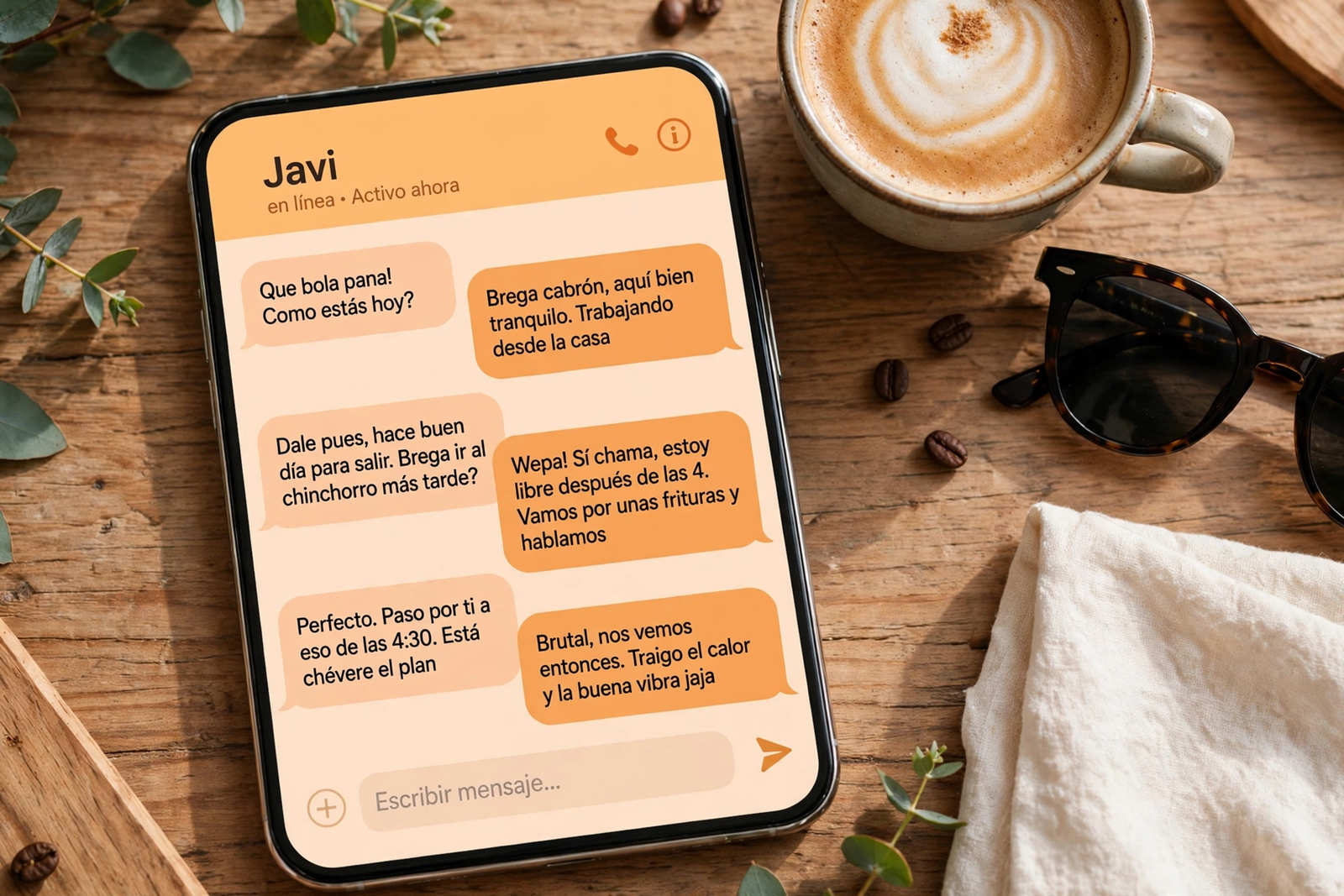
- Janguear — to hang out. From English “hang out.” “¿Vamos a janguear esta noche?” (Are we hanging out tonight?)
- Broki — buddy, bro. From English “bro” with an affectionate ending. “Broki, ¿qué tú haces?” (Buddy, what are you up to?)
- Pana — friend, pal. “Ese es mi pana de toda la vida.” (That’s my lifelong friend.)
- Chavo / chavos — money. “No tengo chavos pa’ salir hoy.” (I don’t have money to go out today.)
- Jevo / jeva — boyfriend / girlfriend. “Mi jeva me llamó anoche.” (My girlfriend called me last night.)
- Guagua — bus. “Coge la guagua en la esquina.” (Catch the bus at the corner.)
- Zafacón — trash can. Unique to Puerto Rico. “Tira eso en el zafacón.” (Throw that in the trash can.)
- Chinchorro / chinchorrear — a roadside food-and-drink spot / bar-hopping between them. “El domingo nos fuimos a chinchorrear.” (On Sunday we went chinchorro-hopping.)
Reactions and exclamations
- ¡Wepa! — an excited cheer, like “woo-hoo!” or “let’s go!” Shouted at parties and concerts.
- ¡Ay bendito! — “aww, poor thing” or “oh my God.” Used with sympathy or surprise. “¡Ay bendito, se cayó!” (Oh no, he fell!)
- ¡Diache! — “wow!” or “oh man!” An expression of surprise. “¡Diache, qué caro está todo!” (Wow, everything is so expensive!)
- Acho / chacho — short for muchacho; used like “man,” “well,” or “what’s up.” “Acho, ¿qué tú dices?” (Man, what are you saying?)
- ¡Mano! — short for hermano (brother); used like “bro!” “¡Mano, eso estuvo brutal!” (Bro, that was awesome!)
- ¿Qué es la que? / ¿Qué lo que hay? — “what’s up?” The standard casual greeting.
- Wao — “wow,” borrowed from English. “Wao, qué vista más linda.” (Wow, what a beautiful view.)
Attitude, moods, and situations
- Al garete — wild, out of control, a mess. Originally a sailing term for a ship adrift. “La fiesta se fue al garete.” (The party went wild.)
- Enfogonao / enfogonado — angry, fired up. “Está enfogonao porque perdió el juego.” (He’s mad because he lost the game.)
- Gufiao — cool, funny, awesome. From gufear (to goof around). “Ese carro está gufiao.” (That car is cool.)
- Chulería — something cool, fun, or beautiful. “¡Qué chulería de vestido!” (What a beautiful dress!)
- A fuego — amazing, on fire, excellent. “La música estaba a fuego.” (The music was on fire.)
- Bregar — to deal with, to hustle, to work on something. “Hay que bregar con eso mañana.” (We have to deal with that tomorrow.)
- Pichea / pichear — to ignore it, forget about it, never mind. “Pichea eso, no vale la pena.” (Forget that, it’s not worth it.)
- A mí, plín — “I don’t care.” Literally “to me, plink.” “Que digan lo que quieran, a mí, plín.” (Let them say what they want, I don’t care.)
- Jartera — being stuffed full after eating. “Tengo una jartera, comí demasiado.” (I’m stuffed, I ate too much.)
- Bichote — an important person, a big shot. From English “big shot.” “Ese tipo se cree el bichote del barrio.” (That guy thinks he’s the big shot of the neighborhood.)
- Tiraera / tiradera — a diss, a verbal feud. Common in reggaetón rivalries. “La tiraera entre los dos cantantes está brutal.” (The diss feud between the two singers is intense.)
- Tumbao — swagger, attitude, groove. “Ese tipo camina con tumbao.” (That guy walks with swagger.)
Friendly Examples
Texting a friend about weekend plans is where most of these words live. “Broki, ¿vamos a janguear con el corillo el sábado? Después chinchorreamos un rato.” (Buddy, are we hanging out with the crew on Saturday? Then we’ll hop around the chinchorros for a bit.) It is warm, casual, and unmistakably Boricua — the kind of message that gets an instant “¡Wepa, dale!” (Let’s go!) back. If you want to see how short friendly abbreviations work the same way in English-language chats, our guide to imk meaning in text shows the same idea in three letters.
Professional Examples
In a work setting, most Puerto Rican slang stays in the break room, not the meeting room — but light versions slip in between colleagues who know each other well. “¿Qué es la que, pana? ¿Bregamos con el reporte después del almuerzo?” (What’s up, friend? Do we deal with the report after lunch?) The tone is friendly, not formal, and it signals closeness. With a client or a boss, the same person would switch to standard Spanish: “Buenos días, ¿cómo está? Trabajemos en el reporte después del almuerzo.” Knowing when to switch is part of speaking the slang well.
Funny Examples
Puerto Rican humor runs on exaggeration, and the slang is built for it. “Acho, comí tanto lechón que tengo una jartera que no me puedo ni mover. ¡Ay bendito!” (Man, I ate so much roast pork that I’m stuffed and can’t even move. Oh my God!) Or when a friend shows up late again: “Llegó al garete, como siempre.” (He showed up a total mess, as always.) The words do half the joking by themselves — jartera is funnier than “I’m full,” and al garete is funnier than “chaotic.”
Comparison with Similar Terms
Puerto Rican slang often confuses Spanish speakers from other countries because the same word can mean something different elsewhere — or because Puerto Rico has its own word where other countries share one. This table clears up the most common mix-ups.
| Puerto Rican word | Meaning in Puerto Rico | What it means elsewhere | Similar term in other countries |
|---|---|---|---|
| Chavo | Money | A young guy (Mexico) | Plata (money, South America), lana (Mexico) |
| Guagua | Bus | Baby (Andes, Chile) | Camión (bus, Mexico), colectivo (Argentina) |
| Chulería | Something cool or beautiful | Insolence, cheekiness (Spain) | Qué chévere (cool, Caribbean) |
| Janguear | To hang out | Not used | Parchar (Colombia), pasarla (general) |
| Corillo | Crew, group of friends | Not used | Parche (Colombia), pandilla (general) |
| Zafacón | Trash can | Not used | Basurero (general), bote de basura (Mexico) |
| Pana | Friend, pal | Bread roll (parts of South America) | Cuate (Mexico), parcero (Colombia) |
| Bregar | To hustle, to deal with | To fight or struggle (general Spanish) | Resolver (to sort out, general) |
The pattern is clear: Puerto Rican slang borrows heavily from English and from the island’s own history, while other countries solved the same problems with different words. That is why a Mexican, a Colombian, and a Puerto Rican can all speak “Spanish” and still need a minute to understand each other’s slang.
Alternate Meanings
Like most slang, several puerto rican slang words change meaning with context, and some have alternate meanings that catch learners off guard.
Tirar normally means “to throw,” but in Puerto Rican slang it can also mean to hit on someone, to diss someone, or — in rougher contexts — to shoot. “Le está tirando” could mean he is flirting with her or dissing her, and only the situation tells you which. Chacho works as a noun (guy), a greeting (what’s up?), and a filler word (well…), all in the same conversation. Duro / dura literally means “hard,” but as slang it means someone is really good at what they do: “Esa cantante está dura” means the singer is amazing, not that she is hard.
Some words also carry a second, food-related meaning that only makes sense on the island. Limber is a homemade frozen treat, not just an adjective. Mofongo is not slang at all — it is a beloved dish of mashed plantains — but visitors often mistake it for a slang word because it sounds so unfamiliar. And bembé means a big party, but it can also describe the lively, drum-driven atmosphere of the party itself. The safest rule: if a word sounds like it could mean two things, ask or watch the context before using it yourself.
For a fuller reference on the historical list, the Wikipedia entry on Puerto Rican slang words and phrases catalogues many of these terms with their origins and notes on usage.
Professional or Polite Alternatives
Slang is for friends, family, and casual settings. In formal situations, swap it for standard Spanish that everyone understands:
- Instead of ¿Qué es la que?, say ¿Cómo estás? (How are you?) or Buenos días (Good morning).
- Instead of broki or pana, use the person’s name, or amigo / amiga (friend).
- Instead of bregar, say resolver (to resolve) or encargarse de (to take care of).
- Instead of chavos, say dinero (money).
- Instead of ¡Diache! or ¡Ay bendito!, a simple ¡Qué sorpresa! (What a surprise!) or ¡Qué lástima! (What a shame!) keeps things polite.
- Instead of al garete, say desorganizado (disorganized) or fuera de control (out of control).
- Instead of pichea, say no te preocupes (don’t worry) or olvídalo (forget it).
- Instead of janguear, say salir con amigos (to go out with friends) or pasar el rato (to spend time together).
The switch matters most at work, in school, with older people you do not know well, and in any official conversation. Puerto Ricans code-switch constantly — slang with friends, standard Spanish with strangers — and doing the same is the fastest way to sound natural rather than rehearsed.
Common Mistakes
Learning puerto rican slang words is fun, but a few common mistakes make newcomers easy to spot — and sometimes cause real misunderstandings.
Using slang in formal settings. Dropping broki or ¿qué es la que? in a job interview or a business email reads as careless, not cool. Save the slang for casual moments until you know the room.
Overusing one word. Repeating acho or wepa in every sentence sounds forced. Native speakers sprinkle slang through a sentence; they do not build every sentence out of it. One or two slang words per sentence is plenty.
Mixing up meanings across countries. Telling a Mexican friend you need chavos for the bus and then asking for the guagua will get you confused looks — in Mexico, chavo is a guy and guagua is not a bus at all. Always remember which country’s slang you are speaking.
Using rough words casually. Some Puerto Rican slang, like tiraera in its rougher sense or words tied to street culture, carries an edge. Using them lightly with people you just met can come across as aggressive or disrespectful. When in doubt, stick to the friendly words — corillo, janguear, wepa, chulería — and leave the rest until you understand the context.
Pronouncing every letter. Puerto Rican Spanish softens or drops sounds: the “s” at the end of syllables fades, and para becomes pa’. You do not have to copy the accent, but pronouncing every letter crisply can make slang sound stiff. Listen to how locals say the words and imitate the rhythm, not just the spelling.
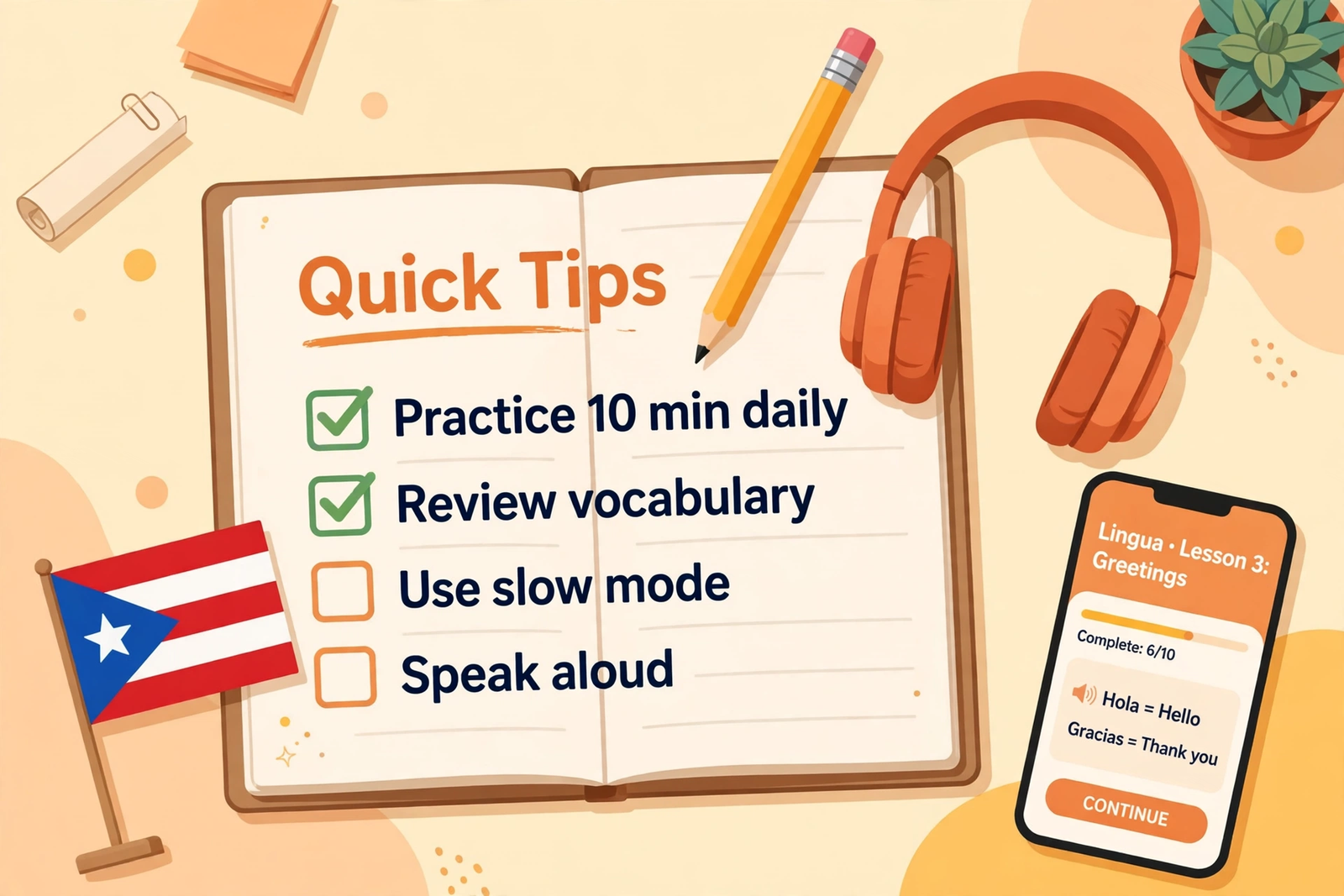
Quick Tips
- Start with five words: boricua, corillo, janguear, wepa, and ¿qué es la que? cover most casual conversations.
- Learn the greeting first: ¿Qué es la que? plus a smile opens almost any friendly conversation in Puerto Rico.
- Listen before you speak: spend a day hearing how locals use a word before trying it yourself — context teaches what a dictionary cannot.
- Use music as a textbook: reggaetón lyrics are full of these words in natural sentences; look up one song’s lyrics and you will learn ten terms.
- Match the energy: slang is warm and playful — use it with a relaxed tone, not a stiff one.
- Keep a small list: write down new words you hear with the sentence you heard them in; the sentence is what makes the meaning stick.
- Ask locals: Puerto Ricans are usually happy to explain a word — asking “¿qué significa eso?” is a great conversation starter, not a weakness.
- Do not force it: if a word feels unnatural, skip it. Natural use of three slang words beats awkward use of thirty.
FAQ
What are the most common puerto rican slang words?
The most common puerto rican slang words are boricua (Puerto Rican), corillo (crew of friends), janguear (to hang out), broki (buddy), wepa (an excited cheer), ¿qué es la que? (what’s up?), chavos (money), and ¡ay bendito! (oh my God / poor thing). These eight cover most everyday conversations on the island.
What does “boricua” mean?
Boricua means a Puerto Rican person. It comes from Borikén, the Taíno name for the island of Puerto Rico before Spanish colonization. Puerto Ricans use it with pride — “soy boricua” is a statement of identity, not just nationality.
What does “janguear” mean?
Janguear means to hang out or spend time with friends. It comes from the English phrase “to hang out” and is one of the clearest examples of English influence on Puerto Rican slang. “Vamos a janguear” means “let’s hang out.”
What does “wepa” mean in Puerto Rican slang?
¡Wepa! is an exclamation of excitement, joy, or celebration — similar to “woo-hoo!” or “let’s go!” in English. You will hear it at parties, concerts, and whenever something good happens. It is one of the most recognizable Puerto Rican expressions in the world.
What does “corillo” mean?
Corillo means your crew or group of friends — the people you hang out with regularly. It can also mean a group of kids when parents use it. “Voy con el corillo” means “I’m going with my crew.”
Is Puerto Rican slang different from Mexican slang?
Yes, very different. Puerto Rican slang borrows heavily from English and Taíno words — janguear, corillo, boricua — while Mexican slang has its own words like cuate (friend), lana (money), and órale (okay/wow). Some words even mean different things: chavo means money in Puerto Rico but a young guy in Mexico, and guagua means bus in Puerto Rico but baby in parts of Latin America.
How do you say “what’s up” in Puerto Rican slang?
The most common way is ¿Qué es la que?, often shortened in speech to something like “¿qué e’ la que?” You can also say ¿Qué lo que hay? or simply ¿Qué hay? All three work as casual greetings between friends.
What does “ay bendito” mean?
¡Ay bendito! literally combines “ay” (an expression of lament) with “bendito” (blessed). In practice it means “aww, poor thing,” “oh my God,” or “oh no” depending on the tone — sympathy for bad news, surprise at something unexpected, or gentle teasing when a friend messes up.
Conclusion
Puerto rican slang words are more than a list of fun expressions — they are the sound of the island itself. From the Taíno roots of boricua to the English borrowings in janguear and gufear, every word carries a piece of Puerto Rican history: Indigenous heritage, Spanish colonization, African influence, and a century of close ties with the United States. That mix is what makes the slang so distinctive, and so hard to fake.
The practical takeaway is simple. Start with the friendly core — boricua, corillo, janguear, wepa, ¿qué es la que? — and use them in real conversations. Listen for how locals use the rest, learn the polite alternatives for formal settings, and avoid the classic mistakes of overusing slang or mixing it up with other countries’ words. Do that, and you will not just understand Puerto Rican slang — you will sound like you belong in the conversation.
And the next time a reggaetón song, a TikTok, or a friend from San Juan drops a ¡Wepa! or an acho into the chat, you will know exactly what it means — and exactly what to say back. If you enjoy decoding the way people really talk online, you may also like our guides to fn meaning in text and hbu meaning in chat, which break down everyday texting slang the same way.
