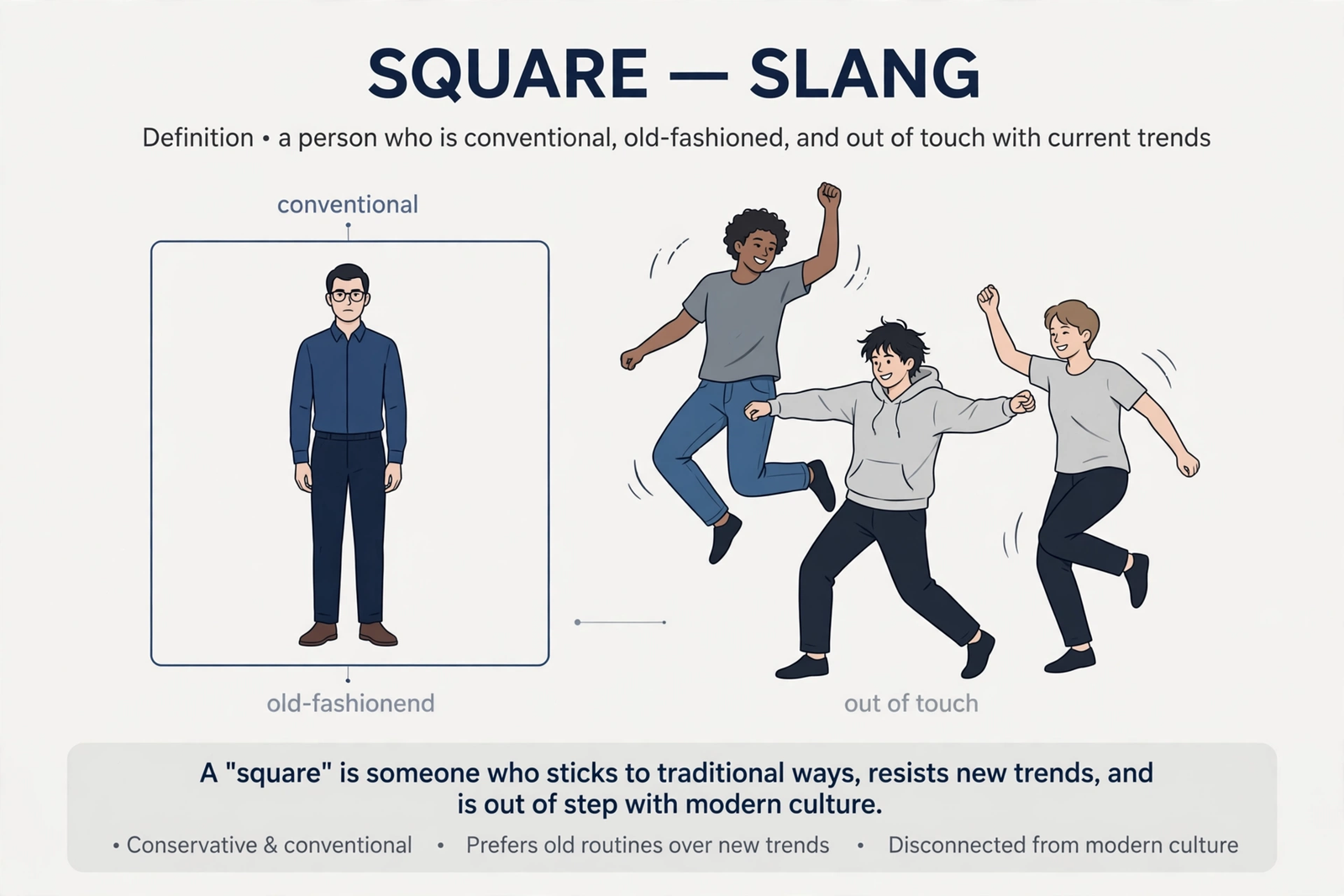
Quick Definition: In slang, a “square” is a person who is conventional, old-fashioned, or out of touch with current trends — someone who follows the rules, avoids risks, and does not keep up with what is cool right now. The square meaning slang definition is almost always used teasingly, not as a compliment: calling someone a square means they are boring, stiff, or behind the times.
Square Meaning Slang & Definition
So, what does square mean in slang? At its core, a square is the opposite of someone who is “hip” or “cool.” A square plays it safe. A square goes to bed early, follows every rule, listens to music their parents liked, and thinks the newest trend is a waste of time. The word is almost always used as a noun (“He is such a square”) but it also works as an adjective (“That is so square of you”).
The square meaning slang carries a light, mocking tone. Nobody proudly calls themselves a square — it is a label other people stick on you when you refuse to loosen up. A friend might joke, “Don’t be such a square, come to the party,” and the meaning is clear: stop being so serious and have some fun.
Major dictionaries list the same sense — Dictionary.com defines square in slang as a person who is old-fashioned, conventional, or conservative, and uninterested in current fads.
It is worth knowing that “square” has lived many lives in English. It started as a shape, became a word for honest and fair (“a square deal”), and then flipped in the 1940s jazz scene into an insult for people who were not in on the music and the culture. That jazz-era meaning is the one that survives today in texts, TikTok comments, and everyday conversation.
Context decides everything. “My dad is a square” in a group chat means he is old-fashioned. “That outfit is square” means it looks dated. And “three squares a day” has nothing to do with slang at all — it just means three solid meals. When you see the word, read the sentence around it before deciding which square you are looking at.
Introduction
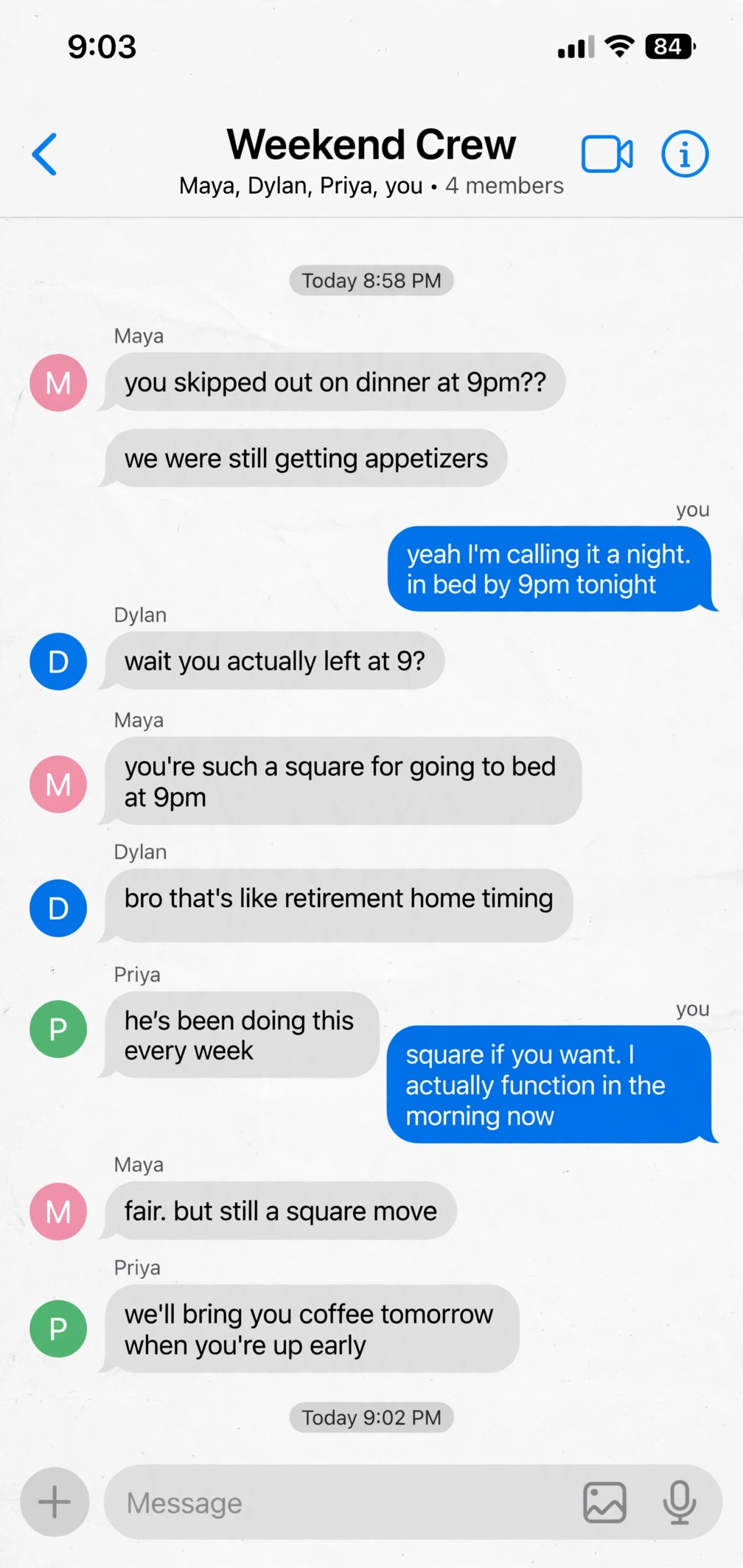
Picture this: your friends are planning a midnight drive, a spontaneous road trip, or a last-minute concert, and one person in the group says, “No way, I have to be home by nine.” Someone rolls their eyes and types, “Bro is a certified square.” Everyone laughs — everyone except the square.
That is the world of square meaning slang. It is one of the oldest insults in American slang, and it refuses to die. It travelled from smoky jazz clubs in the 1940s to Beat poetry, to hippie slang, to sitcoms, and now to TikTok comments and group chats, where Gen Z uses it to roast anyone who acts too careful, too traditional, or too out of touch.
This guide explains the square meaning slang in full — the exact definition, where it came from, how people actually use it in texts and on TikTok, what it is not, and the mistakes to avoid if you ever use it yourself. You will find real examples, a comparison with similar slang, polite alternatives, and answers to the questions people search for most.
Origin
The slang meaning of square starts in the jazz world of the 1940s. Jazz musicians and their fans divided the world into two groups: the “hip” people who understood the music, the slang, and the lifestyle — and the “squares” who did not. A square was someone conventional, a person who lived a straight, predictable life and looked down on the jazz scene. The first known printed use of square in this sense dates to 1944.
Why a square? The shape itself tells the story. A square has four equal sides, four sharp corners, and nothing unexpected about it. It is rigid, boxed in, and perfectly predictable — the opposite of jazz, which is loose, improvised, and free. Calling someone a square was a visual joke: their thinking was as boxy and unbending as the shape.
The word had older, positive roots too. Since the 1500s, “square” meant honest and fair — “a square deal,” “fair and square,” “square with the facts.” A square person was once someone you could trust. The jazz scene flipped that meaning: the same honesty and rule-following that once earned respect now marked you as dull and behind the times. Honest became boring; reliable became rigid.
From jazz, the word spread into Beat culture in the 1950s, then into hippie slang in the 1960s, where “square” became the standard label for anyone in mainstream society — parents, teachers, bosses, police officers, anyone who represented “the establishment.” Television and movies carried it further, and by the 1970s almost every American knew what it meant to call someone a square.
Popularity
Square is not a new viral word — it is a survivor. Unlike slang that explodes on TikTok and vanishes in a month, square has stayed in the language for eighty years, quietly doing its job. It dips in and out of fashion, but it never disappears, because every generation needs a word for “person who is not fun.”
Today the word pops up in a few clear places:
- Group chats and texts: the classic roast — “You are being so square right now” — when someone refuses a plan.
- TikTok and Reels: creators use it in skits about strict parents, rule-following coworkers, or friends who will not try anything new.
- Music and lyrics: hip-hop and pop artists still drop “square” as a quick way to call someone boring or fake.
- Everyday conversation: parents call their own parents square, teens call their teachers square, and coworkers call the office rulebook square.
Its staying power comes from its flexibility. Square works for a person, a habit, a choice, a party, or an outfit. It is short, visual, and instantly understood — and because it is mild, it works in places where a harsher insult would not. You can call your boss square in a joke and probably survive; try that with a stronger word and you might not.
How It Is Used
Square is used in three main ways, and the grammar tells you which one you are seeing:
- As a noun: “He is a square.” This labels the whole person — conventional, boring, out of touch.
- As an adjective: “That is such a square move.” This labels one action or choice, not the whole person.
- As a joke or roast: “Okay, square.” This is the dismissive version — a quick way to brush off someone who is being too serious.
The tone is almost always playful or mildly insulting, never truly hateful. Square is a soft insult. It stings a little, but it is closer to teasing than to a real attack. That is why it survives in friendly groups: it lets you roast someone without starting a real fight.
It also works as a warning. “Don’t be a square” does not just describe someone — it pressures them. It says: loosen up, take a chance, stop hiding behind the rules. In that sense square is social pressure in a single word, and everyone who hears it understands the demand instantly.
One more usage to know: in some circles, especially in older American slang, a “square” can also mean a cigarette (“bum a square”), and “a square meal” means a full, satisfying meal. Those meanings are separate from the insult, and context makes them obvious — nobody asking for “a square” outside a bar is calling you boring.
Examples
The best way to learn any slang is to see it in real sentences. Here is how square shows up in friendly chats, at work, and in jokes.
Friendly Examples
- “Come on, don’t be such a square — one night out won’t kill you.”
- “My brother is a total square. He irons his jeans and goes to bed at 9 p.m.”
- “She called me a square because I have never tried sushi. Fair enough, honestly.”
- “We are all going to the concert. Are you in, or are you going to be square about it?”
- “He brought a briefcase to a beach party. Certified square behaviour.”
Professional Examples
- “Our manager is a bit of a square — he prints every email and files it in a binder.”
- “The new dress code feels pretty square to me. No jeans, no sneakers, no fun.”
- “I suggested a casual Friday and got called a rebel. This office is square.”
- “He is the most square guy in the department, but he is also the most reliable.”
Funny Examples
- “You thought I was going to the party? Nah, I’m a square now. I have a bedtime.”
- “My dad just called TikTok ‘the Tikky Tokky.’ Biggest square energy ever.”
- “She asked what ‘rizz’ means and then wrote it down in a notebook. Peak square.”
- “He said ‘groovy’ unironically in 2026. That man is a square from another era.”
Comparison with Similar Terms
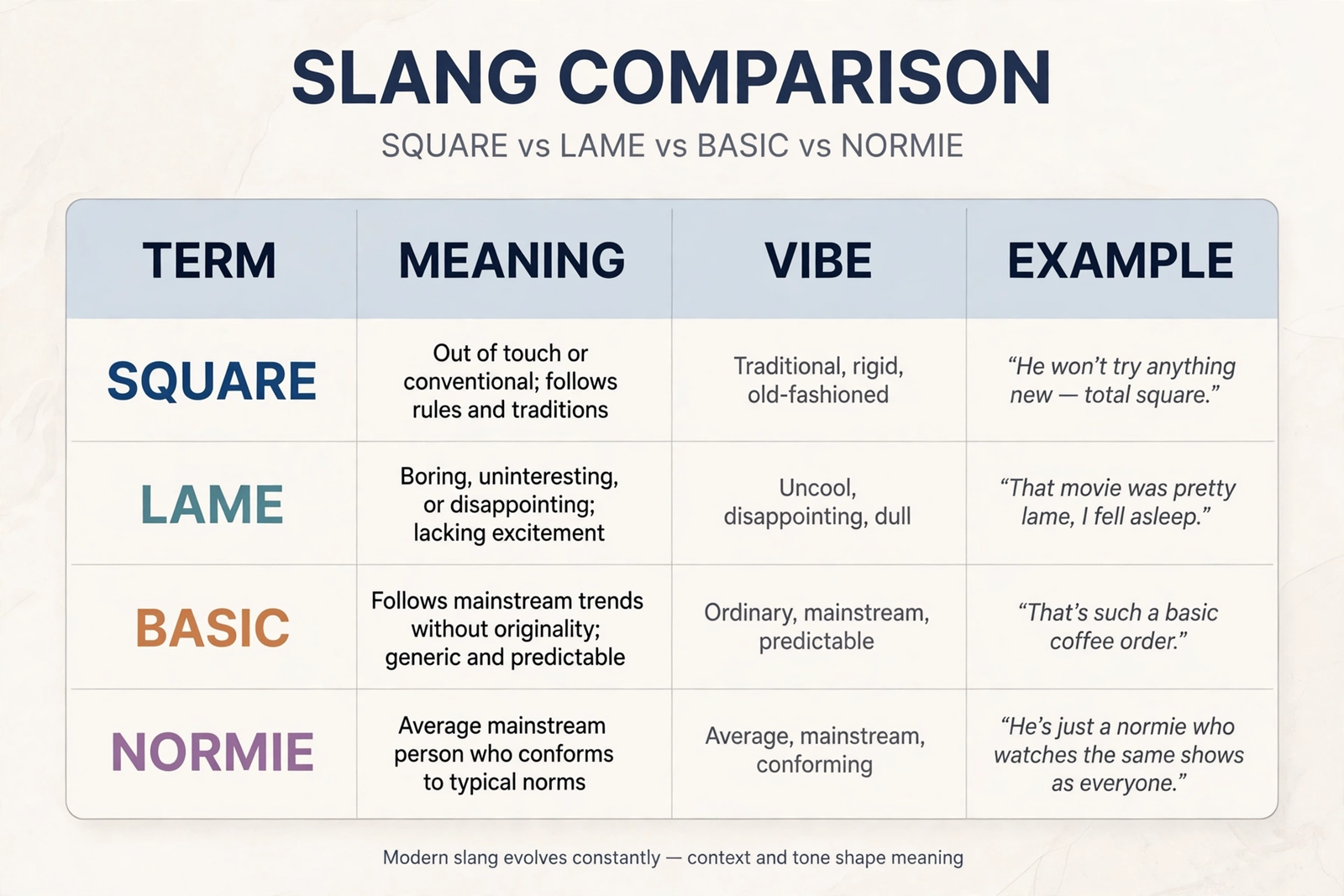
Square is not the only word for “boring and conventional.” Here is how it stacks up against its closest cousins, so you can pick the right one every time.
| Term | What It Means | How It Differs from Square |
|---|---|---|
| Square | Conventional, old-fashioned, out of touch | The classic, mildest version — about lifestyle and attitude |
| Lame | Boring, uncool, disappointing | Broader and harsher; a lame party, a lame joke, a lame excuse |
| Basic | Unoriginal, following mainstream trends | About taste, not rules — a basic person copies trends, a square avoids them |
| Normie | A normal, mainstream person | Internet slang for someone outside a subculture; softer and more neutral |
| Boomer | An older person stuck in old ways | Age-based; a square can be any age, a boomer insult is about generation |
| Nerd / Dork | Socially awkward, overly into niche interests | About social skills and hobbies, not about being conventional |
| Mid | Mediocre, average, unimpressive | Describes quality, not personality — a mid song, a mid movie |
The key difference: square is about refusing to bend. A lame person is boring, a basic person is unoriginal, and a boomer is old — but a square is someone who chooses the safe, straight path and judges everyone who does not. If you want the full picture of how “mid” works as a modern insult, check out our guide on mid meaning slang.
Alternate Meanings
Square is a busy word. Beyond the slang insult, it has several other meanings you will meet in everyday English. Knowing them keeps you from misreading a sentence.
- The shape: a four-sided figure with equal sides and right angles. The original meaning, and still the most common one in maths and geometry.
- Honest and fair: “a square deal,” “fair and square,” “square with me.” This is the old positive sense — straightforward and trustworthy.
- A cigarette: in older American slang, a “square” is a regular tobacco cigarette, as opposed to a joint. “Can I bum a square?” means “Can I have a cigarette?”
- A square meal: a full, satisfying, nutritious meal. “Three squares a day” means three proper meals.
- To settle or balance: “Let’s square up later” means “Let’s settle the bill.” “Square away” means to put things in order.
- A public plaza: a town square, like Times Square in New York — an open area where streets meet.
- The # symbol: in the UK, the hash key on a phone is sometimes called a “square.”
- A well-defined torso: in some UK street slang (MLE), a “square” can mean a muscular, well-defined body — almost the opposite of the boring sense.
For a fuller tour of old-fashioned words that still show up in modern slang, see our list of old slang words — many of them, like square, started decades ago and never really left.
Professional or Polite Alternatives
Square is mild, but it is still an insult. In a professional setting, or when you want to be kind, these alternatives say the same thing without the sting:
- Traditional — “He has a traditional approach to work.” Neutral and respectful.
- Conventional — “She prefers conventional methods.” Accurate, zero insult.
- By-the-book — “He is very by-the-book.” Describes rule-following without judging it.
- Cautious — “He is cautious about new trends.” Frames it as carefulness, not dullness.
- Old-fashioned — “She is a little old-fashioned.” Gentler than square, and widely understood.
- Reserved — “He is reserved at parties.” Polite, and often a compliment.
- Risk-averse — “The team is risk-averse this quarter.” Perfect for business language.
- Set in their ways — “He is set in his ways.” Honest, but soft enough for family talk.
The rule is simple: with friends, “square” is a fun roast. With your boss, a client, or your grandmother, pick one of the alternatives above. The meaning survives, the offence does not.
Common Mistakes
Square is easy to use, but people still get it wrong. Avoid these five mistakes:
- Using it for age alone: being old does not make someone a square. A 70-year-old who surfs and DJs is not a square; a 20-year-old who refuses every plan is. It is about attitude, not age.
- Confusing it with “lame”: a lame joke is a bad joke. A square person is a conventional person. The words overlap but they are not interchangeable — a square can tell great jokes.
- Saying it to the wrong person: “square” is teasing, but it still labels someone as boring. Do not use it in a job interview, a formal email, or the first time you meet someone’s parents.
- Mixing up the meal meaning: “three squares a day” is about food, not personality. If someone says they need a square, offer them lunch, not a lecture.
- Forgetting the positive sense: “fair and square” and “a square deal” are compliments. If you hear “square” in a business context, it probably means honest — check the sentence before assuming an insult.
Quick Tips
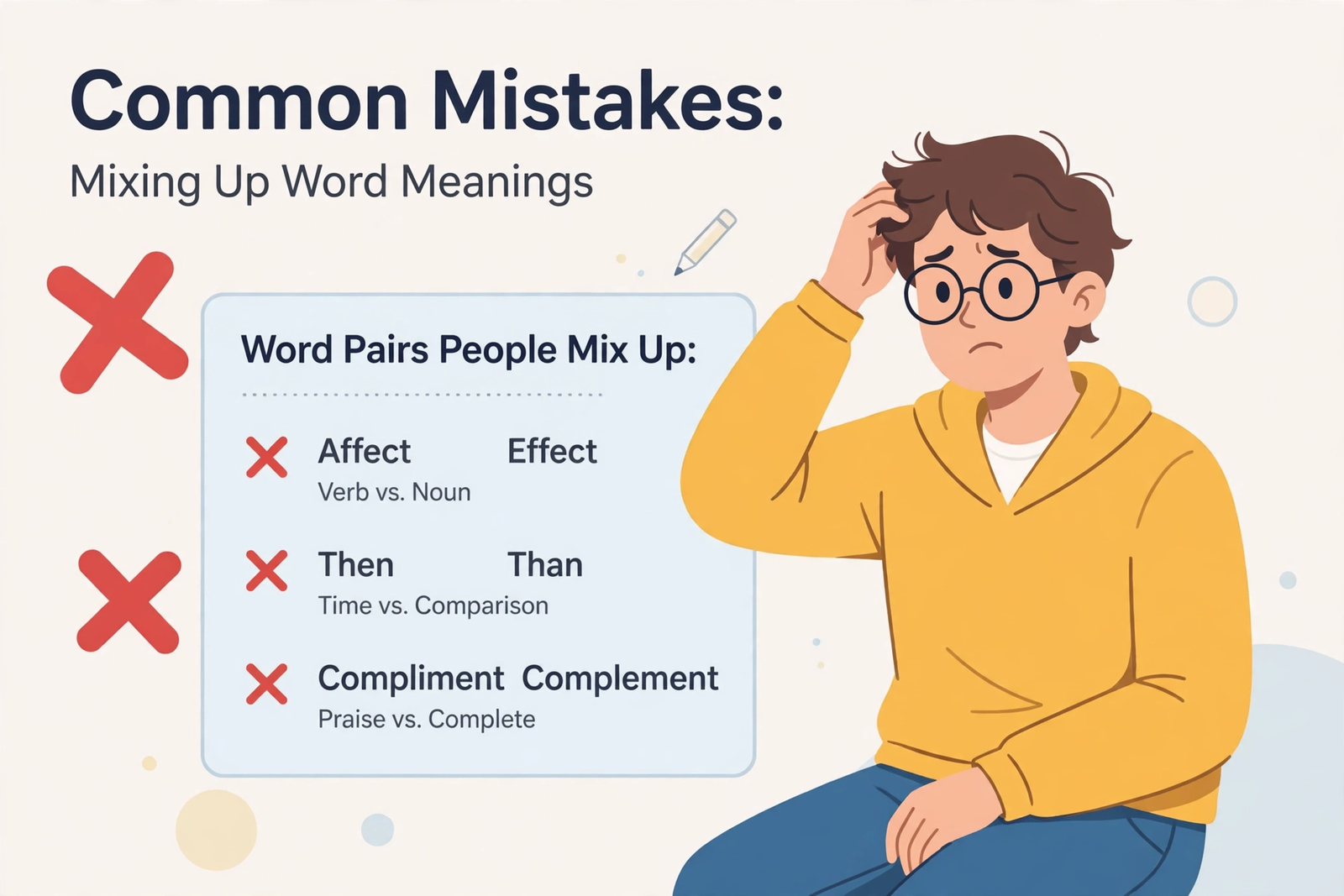
- Read the room: square is a roast, so save it for people who know you are joking. With strangers, it lands as an insult.
- Use it as a noun for people, an adjective for choices: “He is a square” (person), “That is a square decision” (choice). Both work, and both are common.
- Pair it with humour, not anger: “Okay, square” with a laugh is a joke. Said coldly, it is a judgement. Tone is everything.
- Do not overuse it: calling everyone a square makes you the boring one. Save it for the moments that deserve it.
- Know the comeback: if someone calls you a square, the classic reply is to own it — “Yeah, and I sleep eight hours a night. Jealous?” Confidence beats the insult every time.
- When in doubt, translate: if you are unsure whether someone will get it, just say “old-fashioned” instead. Same meaning, zero confusion.
FAQ
1. What does square mean in slang?
In slang, a square is a person who is conventional, old-fashioned, or out of touch with current trends. The square meaning slang definition is almost always teasing: it describes someone who follows the rules, avoids risks, and does not keep up with what is cool.
2. Is calling someone a square rude?
It is mildly rude, but it is one of the softest insults in English. Among friends it is a playful roast. With strangers, bosses, or in formal settings, it can feel disrespectful — use “traditional” or “conventional” instead.
3. What does square mean on TikTok?
On TikTok, square is used in skits and comments to roast someone who acts too careful or old-fashioned — a strict parent, a friend who will not try a trend, or anyone with “square energy.” It means the same as everywhere else: boring and behind the times.
4. Where did the slang term square come from?
It comes from the 1940s jazz scene, where musicians called conventional, mainstream people “squares” — the opposite of “hip” people who understood the music and culture. The first known printed use dates to 1944.
5. What is the opposite of a square?
The opposite is “hip” — someone in the know, cool, and up to date. Modern equivalents include “cool,” “down,” or “with it.” In jazz slang, the pair was always hip vs. square.
6. Can a young person be a square?
Absolutely. Square is about attitude, not age. A 20-year-old who refuses every plan, irons their jeans, and goes to bed at 9 p.m. can be a total square, while a 70-year-old who surfs is not one at all.
7. What does “three squares a day” mean?
It means three full, satisfying meals a day. This is a separate, older meaning of square that has nothing to do with the slang insult — it comes from “a square meal,” meaning a proper, filling meal.
8. How do I reply when someone calls me a square?
Own it with humour. Try: “Yeah, and I sleep eight hours a night — jealous?” or “Guilty. Somebody has to be the responsible one.” Confidence takes the sting out of the word, and a good comeback usually ends the roast.
Conclusion
Square is small but mighty: one little shape, eighty years of slang, and a permanent seat in the English language. The key takeaway is simple — square means conventional, old-fashioned, and out of touch. It started in 1940s jazz clubs as the opposite of “hip,” survived Beat poetry, hippie slang, sitcoms, and TikTok, and it still does the same job today: a quick, playful way to call someone boring.
Now you will not just understand the square meaning slang — you will use it with confidence, dodge the common mistakes, and even land the comeback when someone aims it at you. And the next time a friend texts you “don’t be such a square,” you will know exactly what they are asking for. (It is probably to come to the party. But now you know when it is not.) For more on how viral slang labels people, our guide on what is a munch slang shows how a single song can turn an ordinary word into a label overnight — and for the classic shorthand that started it all, see fn meaning in text.
Quick recap: square = conventional · old-fashioned · out of touch · the opposite of hip. Use it as a friendly roast, never in formal settings, and when clarity counts, say “traditional” instead.
