Quick Definition: new york slang words are the informal words, phrases, and expressions that New Yorkers use every day in texts, on the subway, in bodegas, and on the stoop. Words like deadass, mad, brick, OD, and facts pack a whole attitude into a syllable or two — and if you want to understand what people in the five boroughs actually mean, this is the vocabulary you need.
New York Slang Words Meaning & Definition
So what exactly are new york slang words? They are the street-level vocabulary of New York City — a mix of African American Vernacular English (AAVE), Caribbean and Latino influences, hip-hop culture, and old-school neighborhood talk that has been shaped by more than eight million people living on top of each other. Unlike textbook English, NYC slang is fast, blunt, and emotional. A single word like “mad” can mean “very,” “a lot,” or “extremely,” while “deadass” can turn any sentence into a sworn statement of truth.
New York slang words are not just random cool words. They are a living record of the city’s history: immigration waves, block parties, subway rides, corner stores, and group chats. Some terms, like “bodega” and “schmear,” come from the city’s Spanish and Jewish food culture. Others, like “deadass” and “OD,” come from Black and Latino communities in Brooklyn, Queens, the Bronx, and Harlem — and then spread to the whole country through music, movies, and TikTok. When you learn these words, you are not just learning vocabulary; you are learning how New Yorkers think, joke, argue, and show love.
Introduction
Picture this: you step off the subway in Brooklyn on a January morning, and someone says, “Yo, it’s brick out here, deadass.” If you only know standard English, you just heard nonsense. But a New Yorker heard a weather report and a promise of honesty in one sentence. That is the magic of new york slang words — they compress feelings, facts, and attitude into a handful of syllables.
New Yorkers are famous for talking fast and saying a lot with a little. The city runs on speed: fast trains, fast walkers, fast talkers. Slang fits that pace. Instead of saying “I am being completely serious right now,” a New Yorker says “deadass.” Instead of “it is extremely cold outside,” they say “it’s brick.” Instead of “there were very many people at the concert,” they say “mad people was there.” Every word earns its place.
This guide covers the 25 new york slang words you will actually hear in 2026 — not a dusty dictionary list, but the terms New Yorkers use in real texts, real group chats, and real conversations on the street. You will get plain meanings, real examples, a comparison with similar terms, the mistakes outsiders always make, and quick tips so you can use each word without sounding like a tourist. Whether you are visiting the city, moving there, texting a New Yorker, or just trying to understand your favorite rapper’s lyrics, this is your complete guide.
Origin
New York slang did not come from one place. It came from everywhere at once — which is exactly what New York is. The city’s slang is a layered mix built over more than a century of immigration, music, and street life.
The oldest layer comes from the city’s immigrant neighborhoods. “Bodega” is Spanish for a small grocery store, and “schmear” comes from Yiddish, meaning a thick spread of cream cheese on a bagel. “The City” as a name for Manhattan goes back generations, when the outer boroughs were still seen as separate towns and Manhattan was the center of everything.
The biggest modern layer comes from African American Vernacular English and hip-hop culture. Words like “deadass,” “mad,” “facts,” “son,” “whip,” and “grill” were born in Black and Latino neighborhoods in the Bronx, Brooklyn, Queens, and Harlem, then carried around the world by hip-hop — the genre itself was invented at a Bronx block party in 1973. Rappers turned neighborhood words into global vocabulary, and today a teenager in Ohio or London can say “deadass” without ever visiting New York.
The newest layer comes from the internet. TikTok, group chats, and memes have made new york slang words travel faster than ever. A phrase that starts on a Brooklyn stoop can be trending worldwide by the weekend. That is why the list keeps growing — and why some words fade fast while the classics (“mad,” “brick,” “deadass”) stay strong year after year. The city’s ghetto slang roots still shape much of this vocabulary, and many of today’s terms trace back to the same streets and soundsystems.
Popularity
New York slang is more popular now than at any point in history. It is not just a New York thing anymore — it is an American thing, and increasingly a global thing. Here is why it keeps spreading:
- Hip-hop and drill music: New York rappers from every era — from Biggie and Jay-Z to Pop Smoke and Ice Spice — put NYC words into songs that billions of people hear. Drill music especially made terms like “deadass,” “OD,” and “whip” mainstream.
- TV and movies: Shows set in New York, from classic sitcoms to modern dramas, teach the whole world how New Yorkers talk. One famous line can make a word famous overnight.
- TikTok and social media: Short videos reward short, punchy language. NYC slang is built for that — two syllables that carry a whole feeling. Creators from the city post “day in my life” videos full of local words, and millions copy them.
- Sports and gaming: NBA players, streamers, and gamers use New York terms constantly in interviews and on mic, spreading them to audiences who have never been to the city.
- The city itself: More than 60 million tourists visit New York every year. They hear the slang, bring it home, and use it with their friends.
Searches for NYC slang spike every winter (when everyone wants to know why it is “brick” outside) and every time a New York artist drops a viral song. The words have become a kind of cultural export — as famous as the pizza, the skyline, and the yellow cabs.
How It Is Used
New York slang words show up in almost every kind of conversation, but the rules change with the setting. Here is how the same words work in different places:
- In texts and group chats: This is where NYC slang lives most of the time. “Deadass,” “mad,” “facts,” and “OD” appear constantly, usually at the start or end of a sentence for emphasis. Example: “that party was mad lit, deadass.”
- On the street: Short greetings and quick reactions dominate. “Wassup, son?” “Yerrr!” “Good looks.” Nobody has time for long sentences on a crowded sidewalk.
- In music and lyrics: Rappers stack slang for rhythm and identity. A verse full of NYC words signals where the artist is from before they ever say it.
- At work or school: Most New Yorkers code-switch. They use full slang with friends and soften it with teachers, bosses, and strangers. Knowing when to switch is part of knowing the slang.
- On social media: Captions, comments, and replies are full of terms like “no cap,” “facts,” and “wildin’.” A single word can be the whole comment.
The golden rule: new york slang words are casual and emotional. They are for friends, family, group chats, and the street — not for a job interview or a formal email. Use them where the vibe is relaxed, and you will sound natural. Use them in the wrong room, and you will sound like you are trying too hard.
25 new york slang words You Need to Know in 2026
Here is the full list — the terms you will actually hear, with plain meanings and real examples. The first five are the essentials; the rest round out your NYC vocabulary.
| Slang Word | Meaning | Example |
|---|---|---|
| Deadass | Seriously; for real; I am not joking | “Deadass, I forgot my keys again.” |
| Mad | Very; a lot; extremely | “That pizza was mad good.” |
| Brick | Extremely cold (weather) | “Yo, it’s brick outside today.” |
| OD | Overdoing it; way too much; extra | “She’s OD happy right now.” |
| Facts | That’s true; I agree completely | “The subway is always late.” “Facts.” |
| No cap | No lie; I’m being honest | “No cap, that’s the best slice in the city.” |
| The City | Manhattan specifically | “I’m heading to the City tonight.” |
| Bodega | Corner convenience store | “Grab me a sandwich from the bodega.” |
| Schmear | A thick spread of cream cheese on a bagel | “Bagel with a schmear, please.” |
| Baconeggandcheese | The classic NYC breakfast sandwich | “Baconeggandcheese on a roll, please.” |
| Grill | To stare someone down angrily | “Why you grilling me like that?” |
| Son | Friend; bro; a casual way to address someone | “What’s good, son?” |
| B / Ma | Casual terms for a friend or a woman | “Yo, b, you coming?” |
| Whip | A car, usually a nice one | “He pulled up in a new whip.” |
| Wildin’ | Acting crazy or out of control | “She was wildin’ at the party last night.” |
| Tight | Really cool — or really angry, depending on tone | “That jacket is tight!” |
| Dumb | Very; extremely (like “mad”) | “It’s dumb cold out here.” |
| Good looks | Thank you; I appreciate it | “Good looks for holding the door.” |
| Word to (my mother) | I swear it’s true; I promise | “Word to my mother, I didn’t take it.” |
| Yerrr | A loud, friendly greeting | “Yerrr! What you doing out here?” |
| Stoop | The steps outside a building; where people hang out | “We chilling on the stoop tonight.” |
| Frontin’ | Faking; pretending to be something you’re not | “Stop frontin’, you don’t even like that.” |
| Chopped | Ugly; messed up; not looking good | “That haircut is chopped, bro.” |
| On the reg | Regularly; all the time | “He be at that spot on the reg.” |
| Guap / Cake / Cheese | Money | “He’s making mad guap now.” |
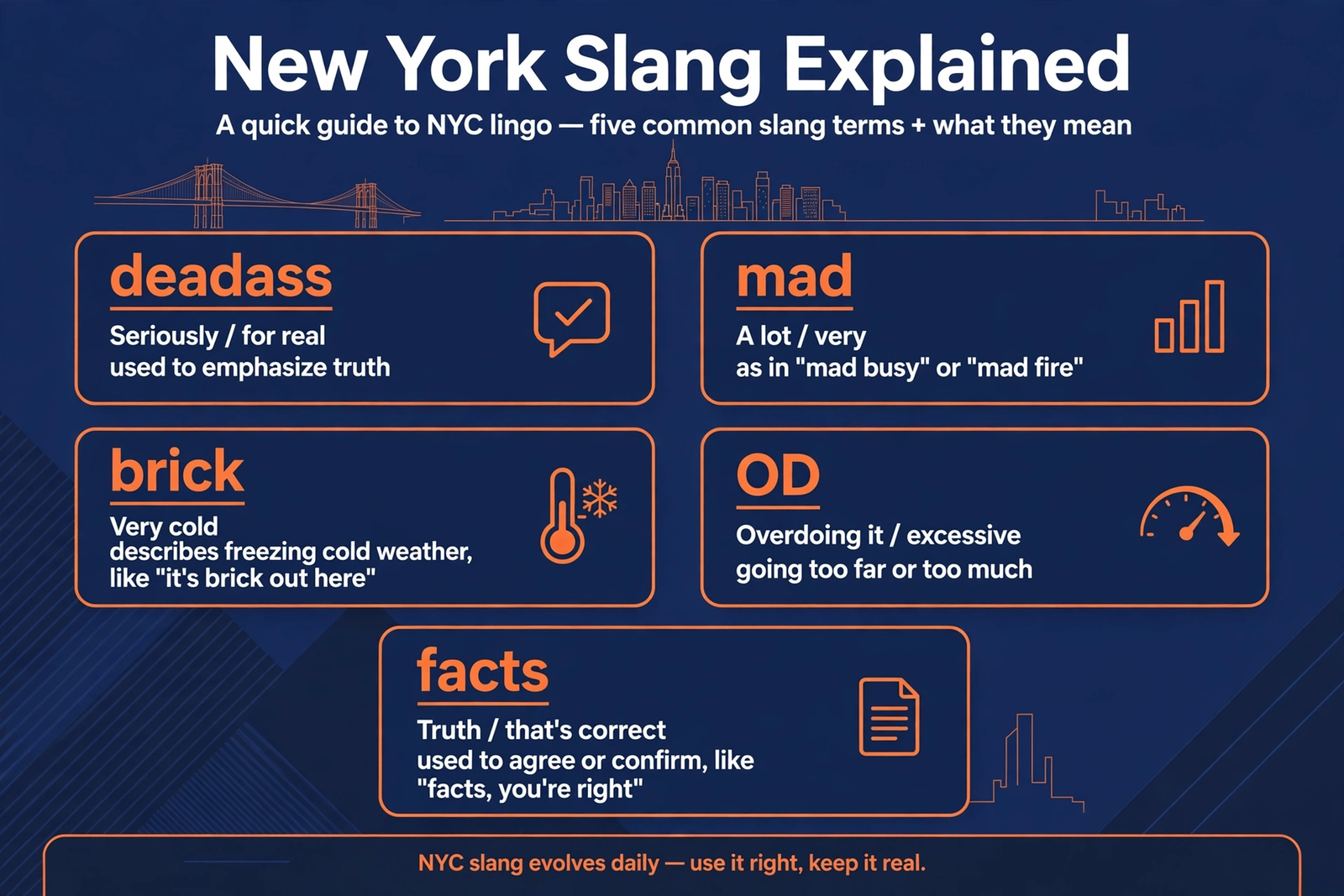
Five of these deserve a closer look, because they carry the most meaning and get used the most:
Deadass — the NYC stamp of honesty
“Deadass” is the most New York word there is. It means “seriously” or “for real,” and it works as an adverb (“I deadass forgot”), an adjective (“That’s deadass”), or a question (“Deadass?”). It comes from AAVE and hip-hop culture, and it is the fastest way to tell someone you are not playing around. When a New Yorker says “deadass,” the joking stops.
Mad — the volume knob
“Mad” is the city’s favorite intensifier. It does the job of “very,” “really,” “a lot,” and “extremely” all at once. “Mad people,” “mad cold,” “mad expensive,” “mad long” — it fits almost anywhere an intensifier fits. It is so common that many New Yorkers do not even notice they are using it. If you learn only one word from this list, learn “mad.”
Brick — the winter warning
“Brick” means freezing cold, and it is the word every New Yorker reaches for between December and March. “It’s brick outside” means more than cold — it means the kind of wind that hits you between tall buildings and goes straight through your jacket. The word is so tied to winter that hearing it in July would confuse everyone.
OD — the extra meter
Short for “overdose” or “overdoing it,” “OD” measures anything that goes too far. “That’s OD funny” means extremely funny. “You OD’ing” means you are doing way too much. It can praise or criticize depending on tone — context decides.
Bodega — more than a store
A bodega is a small corner store, usually family-owned, that sells everything from coffee and sandwiches to phone chargers at 2 a.m. But in New York, the bodega is also a landmark, a meeting point, and a piece of neighborhood identity. The “baconeggandcheese” — said as one fast word — is its most famous product, and ordering one correctly is a small rite of passage for every newcomer.
Examples
The best way to learn new york slang words is to see them in real sentences. Here are examples for friendly, professional, and funny situations — plus a chat example showing how they actually look in a text thread.
Friendly Examples
- “Yo, what’s good, son? We still hitting the City tonight?”
- “Good looks for the ride, b. I owe you one.”
- “That new spot on the ave is mad good, deadass.”
- “We on the stoop later if you trying to chill.”
Professional Examples
At work, New Yorkers usually soften the slang — but a little of it still slips in, especially with coworkers they know well:
- “The client meeting was mad long, but we got the deal done.”
- “It’s brick outside, so let’s do the call from the office instead.”
- “No cap, that presentation was the best one this quarter.”
- “Good looks for sending the report early — really appreciate it.”
Funny Examples
- “Bro thought the train was coming in five minutes. It’s been mad long — we still waiting.”
- “I went outside in a hoodie. Deadass, I turned right back around. It’s brick.”
- “He was wildin’ at karaoke last night. OD, for real.”
- “Word to my mother, I only went in the bodega for water and came out with a whole meal.”
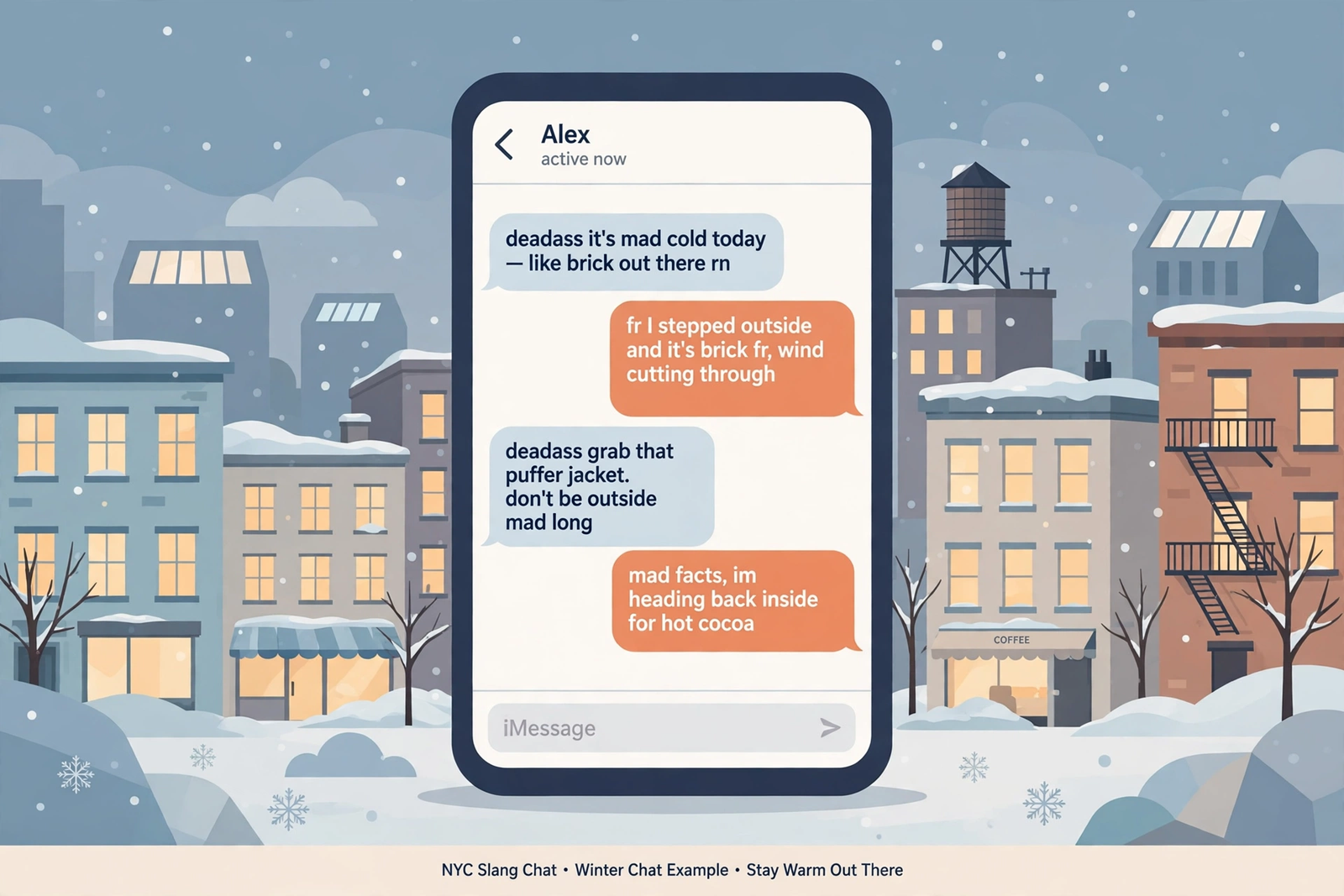
Example Chat Using New York Slang Words
| Person | Message |
|---|---|
| Maya | Yo it’s brick outside, wear a real jacket 😭 |
| Jay | Deadass? I was about to go out in a hoodie |
| Maya | Yeah mad cold. Grab a baconeggandcheese on the way? |
| Jay | Facts. Bodega on the corner? |
| Maya | Yerrr, on the reg spot. Good looks 🙏 |
Comparison with Similar Terms
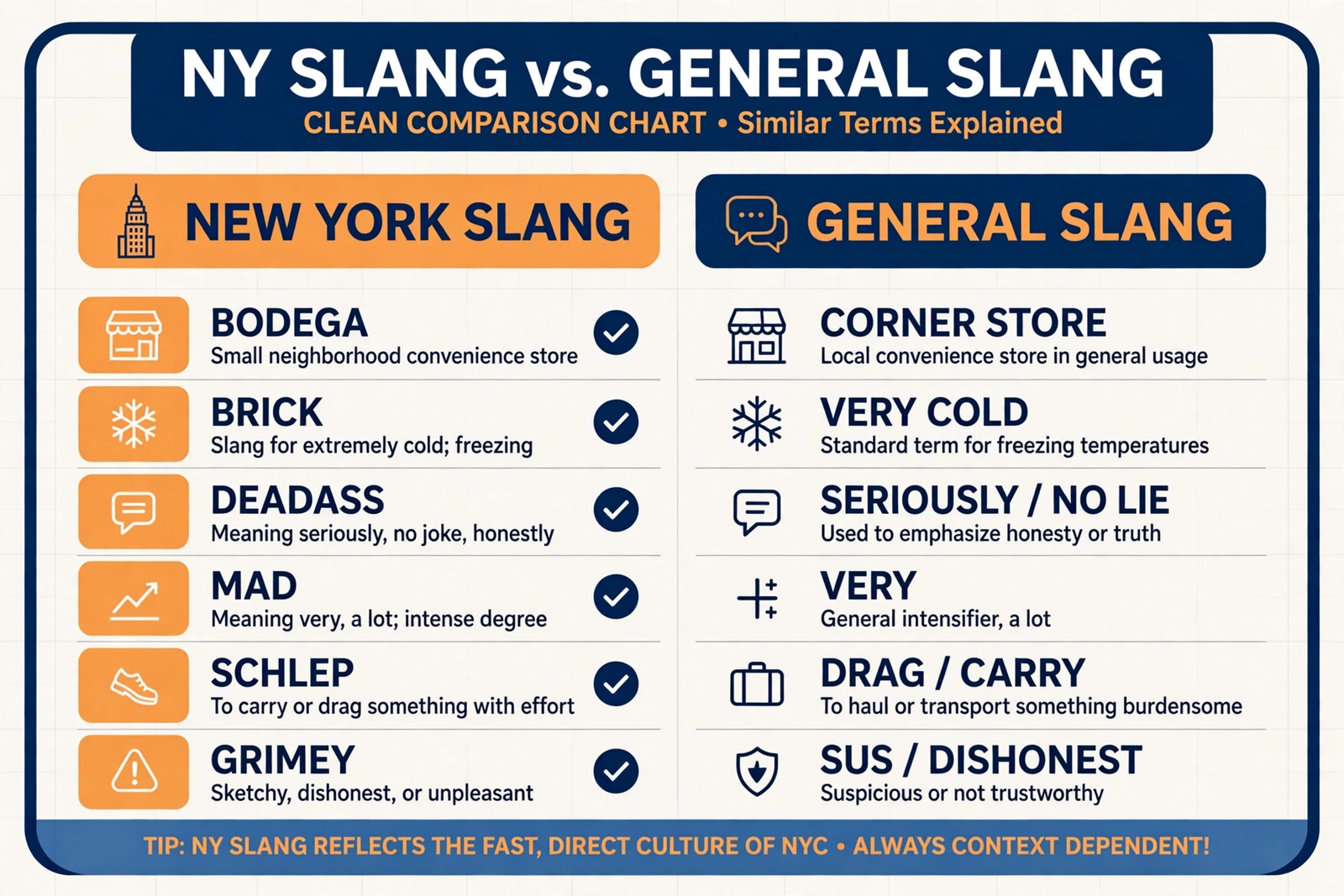
New York slang often overlaps with general American slang, but the NYC version has its own flavor — shorter, blunter, and more attitude. Here is how the most famous terms compare with similar words from other regions and from standard slang:
| NYC Slang | Similar Term | Difference |
|---|---|---|
| Deadass | For real / Seriously | “Deadass” is stronger and more casual — it swears the statement is true. |
| Mad | Hella (West Coast) / Very | “Mad” is the East Coast version of “hella”; both mean “very.” |
| Brick | Freezing / Cold AF | “Brick” is NYC-only and paints a harder, heavier kind of cold. |
| No cap | No lie / Honestly | “No cap” comes from hip-hop culture — it means “I’m not lying,” and it is often paired with cap meaning a lie. |
| Facts | True / Exactly | “Facts” is faster and doubles as agreement and applause. |
| OD | Extra / Over the top | “OD” is shorter and can be used as a verb: “You OD’ing.” |
| Whip | Car / Ride | “Whip” usually implies a nice or flashy car. |
| Son | Bro / Dude / Man | “Son” is warmer and more NYC-specific than “bro.” |
| Good looks | Thanks / Appreciate it | “Good looks” is casual thanks between friends, not formal gratitude. |
| The City | Downtown / Manhattan | Only New Yorkers call Manhattan “the City” — everyone else says “Manhattan.” |
Notice the pattern: NYC words are almost always shorter than the standard version. The city rewards speed, and its slang is built for it. That is also why so many of these words spread so easily — they are easier to say, easier to text, and more fun to use than the plain version.
Alternate Meanings
Some new york slang words change meaning depending on tone, context, or who is speaking. Getting these right matters more than memorizing the list:
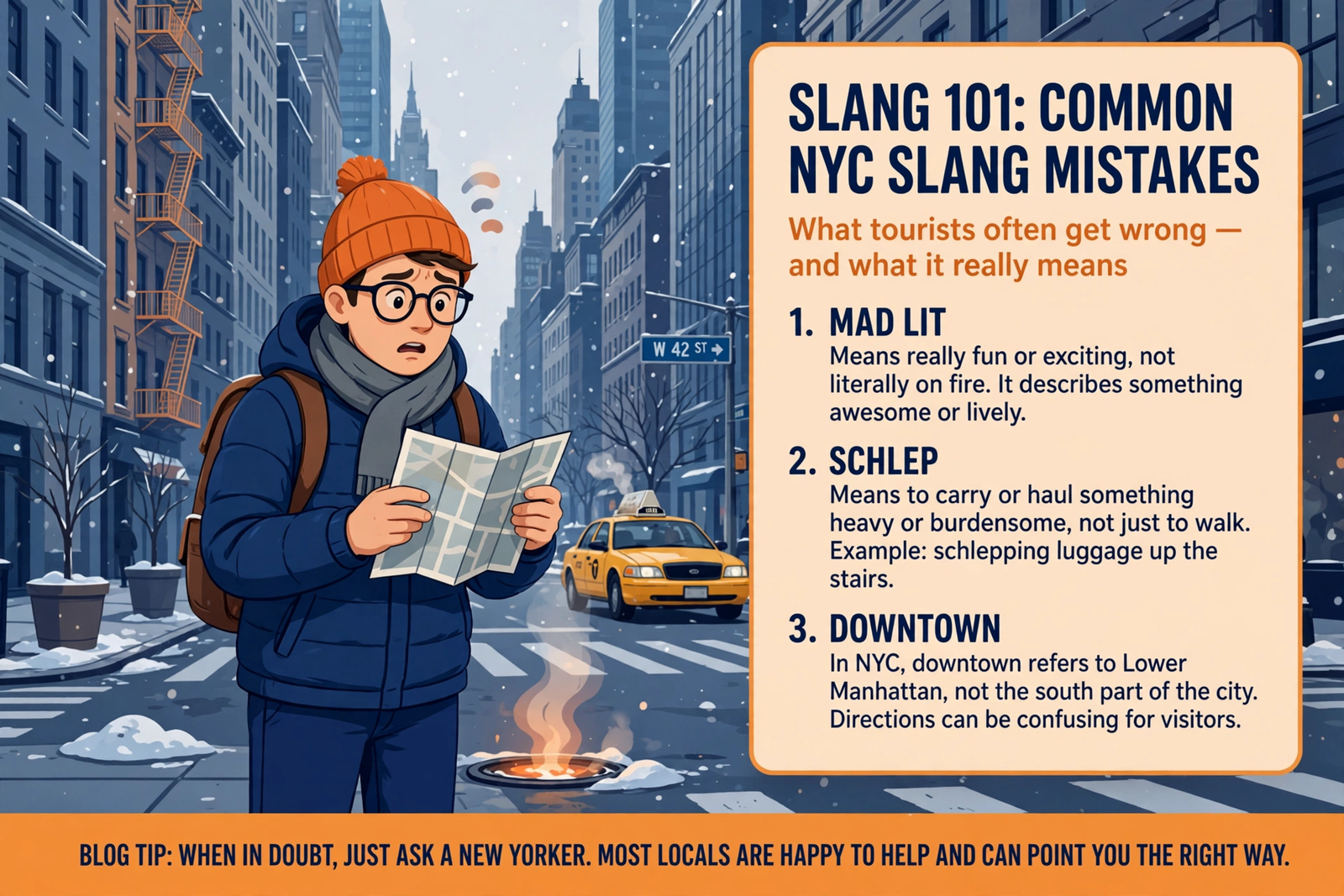
- Mad: In standard English, “mad” means angry. In New York, it usually means “very” — “mad happy” means very happy, not angrily happy. But if someone says “I’m mad tight,” then “mad” is an intensifier and “tight” means angry. Context decides.
- Tight: Can mean “really cool” (“That fit is tight!”) or “really angry” (“I’m tight right now”). Tone and situation tell you which one it is.
- Dead: Can mean “seriously” (“I’m dead serious”) or “dying of laughter” (“I’m dead at that joke”). Both are common, and both are positive in their own way.
- Dumb: Normally a negative word, but in NYC slang “dumb” is just an intensifier like “mad” — “dumb good” means extremely good.
- Grill: As a noun, a “grill” can be a set of gold teeth. As a verb, “to grill” means to stare someone down. Same word, two very different uses.
- Chopped: Usually means ugly or messed up, but in a friendly roast it can just mean “not your best look today” — light teasing, not a real insult.
- Brick: Mostly weather, but “brick” can also describe something solid or heavy in other contexts — though weather is the meaning you will hear 99% of the time.
Professional or Polite Alternatives
New York slang is for casual settings. Here are polite, professional swaps for the same ideas, so you can code-switch like a real New Yorker:
| Slang | Professional Alternative |
|---|---|
| Deadass | Seriously / To be completely honest |
| Mad | Very / Extremely / A great deal |
| Brick | Extremely cold / Freezing |
| OD | Excessive / Over the top |
| No cap | Honestly / Truthfully |
| Facts | That’s correct / I agree |
| Good looks | Thank you / I appreciate it |
| Wildin’ | Acting out of control / Being disruptive |
| Frontin’ | Being insincere / Pretending |
| Yerrr | Hey! / Hello! / Hi there! |
A good rule: if you are texting friends, ordering food, or hanging out, slang is welcome. If you are emailing a boss, a teacher, or a client, use the professional version. Real New Yorkers switch between the two without thinking — that is part of the skill.
Common Mistakes
Outsiders make the same mistakes with new york slang words over and over. Avoid these and you will already sound more natural than most visitors:
- Using “mad” to mean angry: The number one mistake. “I’m mad happy” does not mean you are angrily happy — it means you are very happy. If you actually are angry, say “I’m tight” or just “I’m mad” on its own.
- Saying “brick” in summer: “Brick” is only for freezing cold. Saying it on a warm day makes no sense and marks you as someone who learned the word from a list, not from the street.
- Forcing “deadass” into every sentence: Real New Yorkers use it for emphasis, not as a filler word. Dropping “deadass” three times in one sentence sounds like a parody. One strong use beats five weak ones.
- Calling every borough “the City”: “The City” means Manhattan. If you are in Brooklyn and say “I’m going to the City,” you mean Manhattan. If you say it while standing in Manhattan, people will laugh.
- Using slang with strangers or elders: “Yo, son” to a stranger or an older person can come across as rude. Save the familiar words for people you actually know.
- Mixing up “cap” and “no cap”: “Cap” means a lie; “no cap” means no lie. Getting them backwards flips your whole sentence. If you want the full story, read our guide to cap meaning and origin.
- Overdoing the accent: Slang is vocabulary, not a costume. You do not need a fake New York accent to use these words — just use them naturally and sparingly.
- Using “son” or “b” with everyone: These are friendly, familiar terms. With close friends they are warm; with strangers they can feel too familiar. Match the word to the relationship.
Quick Tips
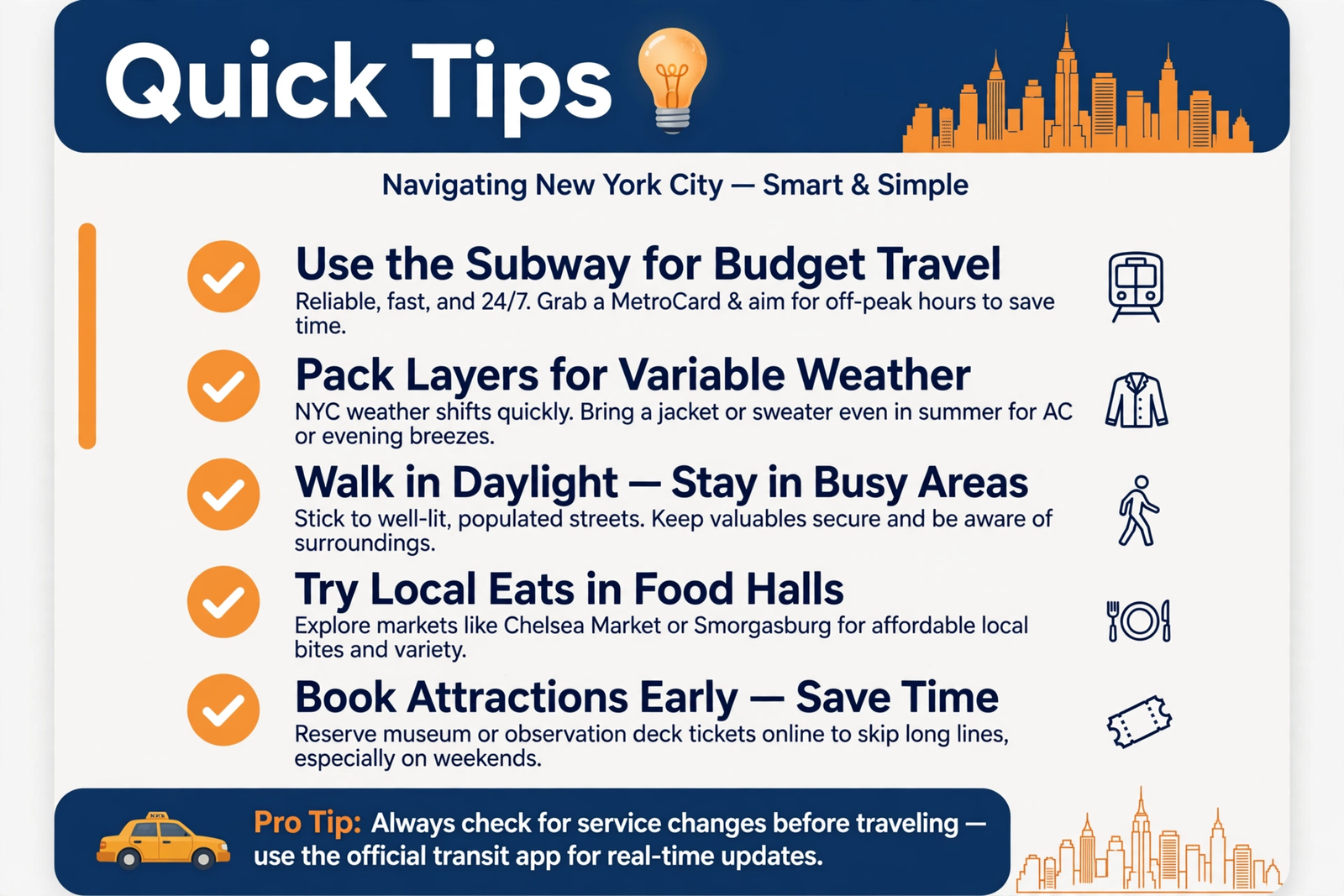
- Start with the big five: Learn deadass, mad, brick, OD, and facts first. They cover most everyday situations, and the rest will come naturally.
- Listen before you speak: Spend a day listening to how New Yorkers actually use these words — on the subway, in a bodega, in a group chat. The rhythm matters as much as the meaning.
- One slang word per sentence is enough: Stacking four slang words into one sentence sounds forced. Real speech mixes slang with plain words.
- Match the room: Friends and group chats: go for it. Work emails, classrooms, and formal events: use the polite alternatives.
- Learn the food words: “Bodega,” “schmear,” and “baconeggandcheese” are not just vocabulary — they are how you order breakfast like a local. Practice them out loud before your first morning in the city.
- Watch New York creators: TikTok and YouTube creators from the city are the fastest way to hear the words in real context, with real tone and timing.
- Do not force it: If a slang word does not feel natural yet, skip it. Forcing it is always more awkward than just speaking plainly.
- Remember the seasons: “Brick” belongs to winter. “Stoop” season is summer. Using the right word at the right time of year is a small detail New Yorkers notice.
FAQ
What are the most popular new york slang words?
The most popular new york slang words are deadass (seriously), mad (very), brick (extremely cold), OD (overdoing it), facts (that’s true), no cap (no lie), the City (Manhattan), bodega (corner store), and whip (car). These nine cover most of what you will hear every day in the city.
What does “deadass” mean in New York slang?
“Deadass” means seriously, for real, or “I’m not joking.” New Yorkers use it to emphasize that a statement is completely true. It comes from African American Vernacular English and hip-hop culture, and it works as an adverb, an adjective, or even a standalone question: “Deadass?” means “Really? Seriously?”
What does “brick” mean in NYC slang?
“Brick” means extremely cold, and it is used almost only for weather. “It’s brick outside” means it is freezing — the kind of cold that hits you between tall buildings in January. The term is so tied to winter that New Yorkers rarely use it in any other season.
What does “mad” mean in New York slang?
In New York slang, “mad” means very, a lot, or extremely — not angry. “Mad good” means very good, “mad people” means a lot of people, and “mad long” means a very long time. It is the city’s favorite intensifier and one of the most used words in everyday NYC speech.
What does “the City” mean to New Yorkers?
When New Yorkers say “the City,” they mean Manhattan specifically — not all five boroughs. Someone in Brooklyn or Queens who says “I’m going to the City” is heading to Manhattan. It is a habit left over from when Manhattan was the center of everything and the outer boroughs felt like separate towns.
Is New York slang the same as Gen Z slang?
Not exactly, but they overlap a lot. Many new york slang words, like “deadass,” “no cap,” and “OD,” started in New York and then became Gen Z slang nationwide through hip-hop and TikTok. Other NYC words — like “bodega,” “schmear,” and “the City” — are local and stay mostly in New York. If you want to compare, our drip slang meaning guide shows how one NYC-born term went global.
Can I use New York slang if I’m not from New York?
Yes — as long as you use it naturally and in the right setting. Start with the common words (mad, facts, no cap), use one per sentence, and save the familiar terms like “son” and “b” for people you actually know. Nobody minds an outsider using NYC slang; they only mind it when it sounds forced or overdone.
Where can I learn more New York slang words?
The best teachers are New Yorkers themselves: listen to local music, watch NYC creators on TikTok, and pay attention to how the words sound in real conversations. For written guides, Berlitz’s guide to New York slang is a solid outside reference, and you can keep exploring related terms here on MeansToday — from ASF meaning to the wider world of street and ghetto slang.
Conclusion
New York slang words are more than a list of cool terms — they are the sound of the city itself. “Deadass” carries honesty, “mad” carries emphasis, “brick” carries winter, and “bodega” carries a whole neighborhood in six letters. Together, these words tell the story of eight million people, five boroughs, and a hundred years of immigration, music, and street life — all packed into a vocabulary you can learn in a single afternoon.
The smartest way to use them is the New York way: sparingly, naturally, and in the right room. Learn the big five first, listen before you speak, and let the rest come with time. Before long, you will not just know what “it’s brick, deadass” means — you will feel it. And the next time someone asks you what the best new york slang words are, you will have 25 answers ready, plus the stories behind them.
Keep exploring: every slang term on this site connects to another, and every one of them makes the next group chat, song lyric, or subway conversation a little easier to understand. Word to my mother — once you start noticing NYC slang, you will hear it everywhere.
