
Quick definition: 50s slang is the casual, colorful vocabulary of 1950s America — words like cool cat, daddy-o, dig it, and far out that teenagers, jazz musicians, greasers, and beatniks used to sound hip, relaxed, and in the know. Today, people use 50s slang in retro parties, movies, themed captions, and nostalgic conversations to bring back the rock-and-roll spirit of the decade.
50s Slang Meaning & Definition
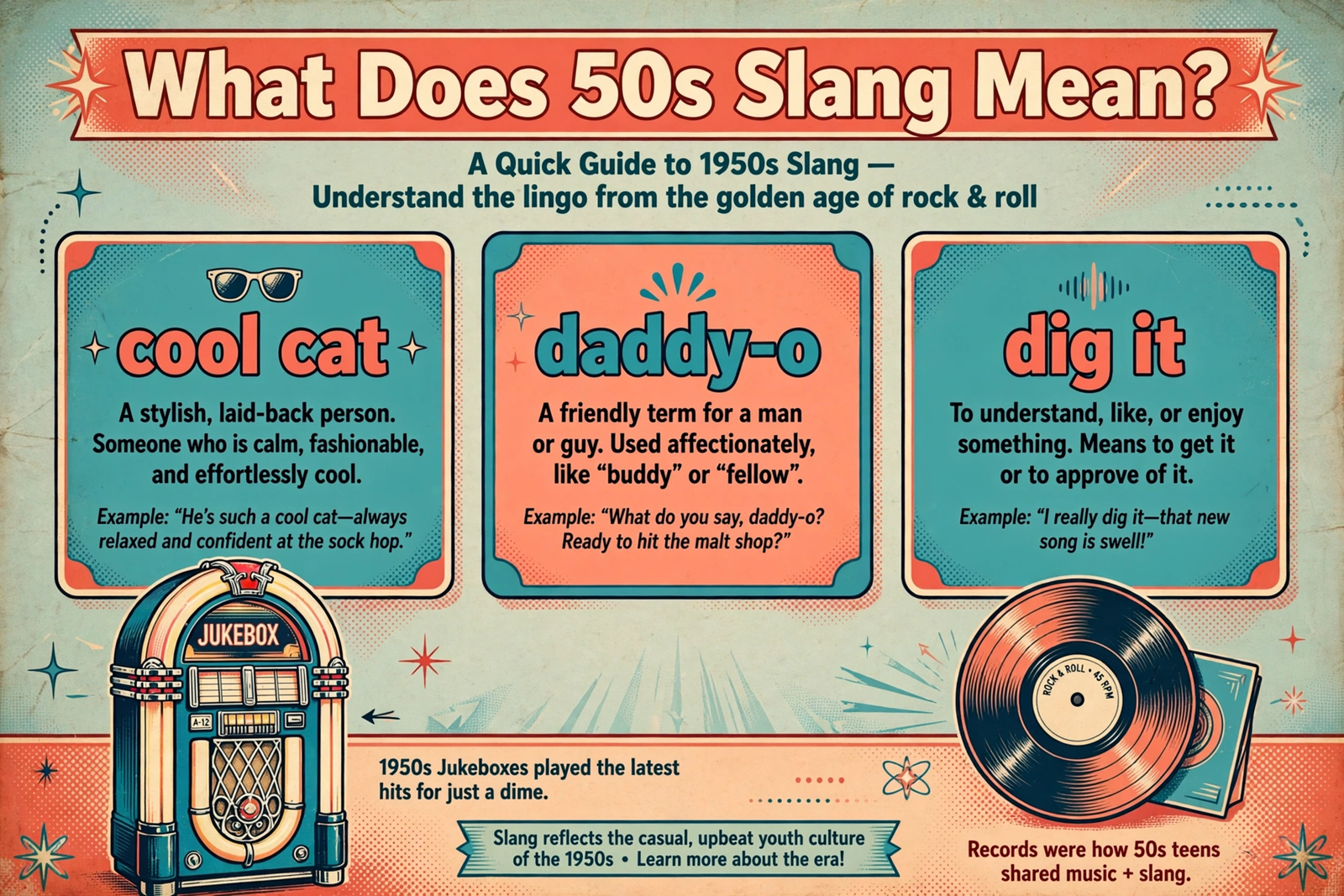
50s slang means the informal words and expressions that were popular in the United States during the 1950s. It was the everyday language of teenagers hanging out at soda fountains, jazz fans in smoky clubs, and young rebels in leather jackets cruising in hot rods. If someone in 1955 called you a cool cat, that was a compliment — it meant you were stylish, calm, and impressive. If they said don’t be a square, they were telling you not to be boring or old-fashioned.
Unlike the slang of today, which spreads through TikTok and group chats in hours, 50s slang traveled through jukeboxes, radio shows, drive-in movies, and magazines. It mixed jazz culture, beatnik poetry, hot-rod racing, and early rock and roll into one playful way of speaking. The words sounded smooth and musical because many of them came straight from jazz musicians who invented a private vocabulary to describe music, people, and moods.
In simple terms, 50s slang is retro American slang from the 1950s. People still use it today when they want to sound fun, vintage, or nostalgic — at 1950s-themed parties, in Halloween costumes, in movie dialogue, and in social media captions that celebrate the golden age of rock and roll.
Introduction
Picture this: it is 1957, the jukebox is playing Elvis, and a teenager in a leather jacket leans against a shiny Chevrolet and says, “Hey daddy-o, that ride is the most!” Nobody around him is confused. Everyone knows exactly what he means — the car is amazing, the music is great, and life is good. That is the magic of 50s slang: a handful of playful words could turn an ordinary moment into something cool.
The 1950s were a decade of big changes in America. After World War II, teenagers suddenly had money, cars, record players, and free time — and they invented their own culture to match. Rock and roll exploded, drive-in theaters filled up on Friday nights, and a new generation wanted a language that belonged to them, not to their parents or teachers. So they borrowed words from jazz clubs, mixed in car culture and surfer talk, and created a slang that still sounds fun nearly seventy years later.
In this guide, you will learn the real meaning of 50s slang, where it came from, how people used it, and the 50+ best words and phrases from the decade. You will also find real examples, a comparison with modern slang, common mistakes to avoid, and quick tips for using these words today without sounding forced. Whether you are planning a retro party, writing a story set in the 1950s, or just love vintage language, this is your complete guide to talking like a true 1950s cool cat.
Origin
50s slang did not appear out of nowhere. It grew from several cultures that collided in post-war America, and each one added its own flavor to the vocabulary.
Jazz culture came first. Long before the 1950s, jazz musicians in New Orleans, Chicago, and New York were already using words like cool, cat (a person), dig (to understand or enjoy), and hip (aware and stylish). Jazz was the coolest music in America, and teenagers who loved it copied the musicians’ language to feel part of that world. The word cool itself, meaning calm and stylish, came from jazz — a cool player was one who stayed relaxed under pressure, and the Merriam-Webster dictionary traces cool as slang back to this jazz-era sense of composure and style.
Beatniks added the poetry. In the late 1950s, the Beat Generation — writers and artists like Jack Kerouac and Allen Ginsberg — popularized words such as far out, square, and beat. Beatniks hung out in coffeehouses, read poetry aloud, and rejected mainstream life. Their slang sounded dreamy and rebellious, and young people who admired them picked it up fast.
Car culture and greasers added the attitude. Hot-rod racers and greasers — teenagers with slicked-back hair, leather jackets, and customized cars — contributed words like rod (a hot rod car), cherry (something in perfect condition), and burn rubber (to speed away). Movies like Rebel Without a Cause (1955) with James Dean made greaser style and speech famous across the whole country.
Teenagers and high schools spread it everywhere. Once radio DJs, teen magazines, and movies started using the slang, it traveled from big cities to small towns in months. Words that started in a jazz club in New York could end up in a high school hallway in Ohio by the next semester. That is how 50s slang became a national language for an entire generation.
Popularity
50s slang became popular because the 1950s created the modern teenager. For the first time in history, young people had their own music, their own movies, their own fashion, and their own money to spend — and they wanted their own words too. Slang was a badge of belonging: if you knew the words, you were in the group; if you did not, you were a square.
Radio and television pushed the slang further than ever before. DJs like Alan Freed, who helped popularize rock and roll, used teen slang on the air every day. TV shows such as American Bandstand brought teenagers dancing to the latest hits into living rooms across America, and the dancers’ language went with them. Movies sealed the deal — James Dean, Marlon Brando, and Elvis Presley made slang sound tough, romantic, and irresistible all at once.
By the end of the decade, 50s slang was everywhere: in comic books, in advertisements aimed at teens, in song lyrics, and even in the way parents jokingly imitated their kids. Some words faded when the 1960s arrived, but the best ones never really left. Cool is still one of the most used words in English. Dig it, far out, and hip still appear in movies, songs, and everyday speech. Today, 50s slang is enjoying a second life at retro parties, in vintage fashion communities, and on social media, where creators use it to give their content a fun, nostalgic flavor.
How 50s slang Is Used
Using 50s slang today is mostly about fun and flavor. Nobody speaks full 1950s slang in daily life anymore, but the words work beautifully in the right setting. Here is how people use 50s slang in modern life:
- At retro and themed parties: Guests greet each other with “Hey daddy-o!” and call the music “the most” to set the mood. A 1950s party without the slang feels like a costume without the attitude.
- In movies, plays, and stories: Writers use 50s slang to make characters from the decade sound authentic. A greaser who says “Don’t be a square, man” instantly feels real.
- On social media: Creators caption vintage photos with lines like “Feeling like a real cool cat today 😎” or “This outfit is the most!” to add retro charm.
- In music and fashion: Rockabilly bands, vintage car shows, and retro fashion brands use 50s slang in names, slogans, and event themes.
- In everyday jokes: Friends drop a playful “Dig it?” or “That’s far out, man” to make each other laugh. The words are so familiar that everyone gets the joke instantly.
The key is light use. One or two 50s slang words in a sentence sound fun and natural. A whole paragraph of them sounds like a parody. Pick the words that fit the moment, say them with a smile, and let the retro charm do the work.
Examples
Here are real examples of 50s slang in action, grouped by tone so you can see how the same words change feeling with context.
Friendly Examples
- “Hey, cool cat! Great to see you at the sock hop tonight.” — a warm, stylish greeting between friends.
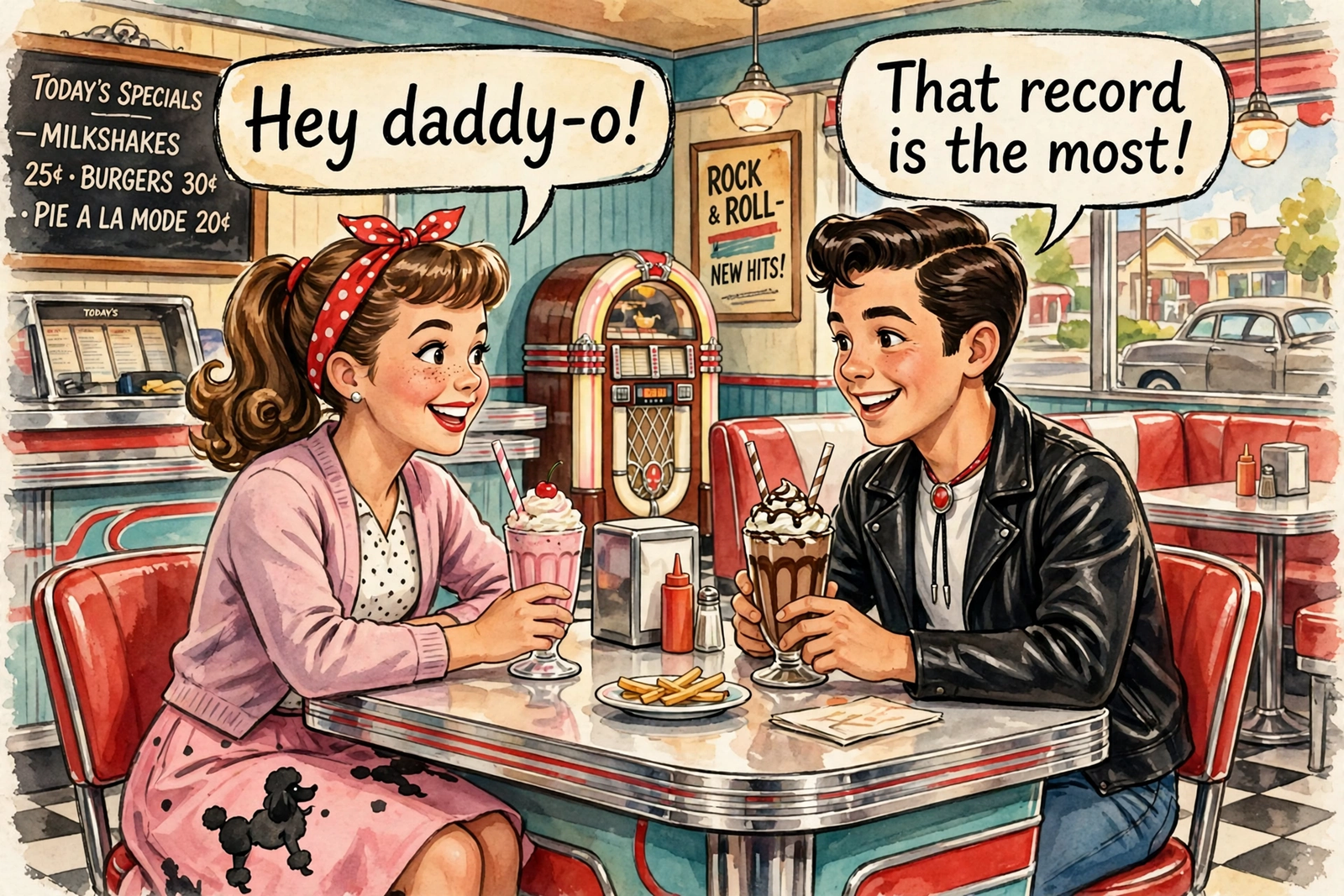
- “That new record is the most — I can’t stop playing it!” — praising a favorite song.
- “You’re really hep, man. You always know the best places.” — telling a friend they are smart and in the know.
- “Let’s cruise down to the diner and grab a malt, daddy-o.” — inviting a friend out for a casual drive and a milkshake.
- “I dig your new threads — that jacket is sharp!” — complimenting someone’s clothes (threads means clothes).
Professional Examples
50s slang was rarely professional even in the 1950s, but in creative work today it appears in marketing, entertainment, and themed events:
- “Our retro diner brings back the coolest vibes of the 1950s — come dig the scene.” — a business using slang in advertising.
- “The car show judges called the cherry ’57 Chevy the most impressive ride of the day.” — an announcer borrowing slang for color.
- “This playlist is pure 1950s gold — every track is a real gone classic.” — a DJ describing a set.
Funny Examples
- “Dad tried to say ‘far out’ at dinner and we all lost it.” — parents using teen slang usually gets laughs, then and now.
- “He showed up in a leather jacket, slicked his hair back, and said, ‘Don’t be a square’ — to his own grandmother.” — the joke is the wrong audience.
- “My car didn’t start, so I told my friends it was just ‘taking a chill pill’ — 1950s style.” — mixing eras for comic effect.
- “She called the cafeteria food ‘the pits’ and the whole table agreed in perfect 1957 unison.” — the pits meant the worst.
50+ classic 50s slang words and phrases: cool cat, daddy-o, dig it, far out, hip, hep, square, the most, groovy (late 50s), gone, real gone, cherry, threads, cruisin’, burn rubber, hot rod, sock hop, malt shop, jukebox hero, make the scene, don’t flip your wig, wig out, pad (home), bread (money), loot, babe, chick, doll, fella, swell, keen, nifty, boss, keen-o, peachy, dreamy, hunky-dory, outta sight, solid, crazy (meaning great), mad (meaning a lot), blast, bash, bop, rock around the clock, blue suede shoes, greaser, beatnik, hep cat, cool breeze, later gator, see you later alligator, in a while crocodile, what’s buzzin’ cousin, the pits, drag (a bore), flip your lid, hang loose, split the scene, take a powder, and dig the scene.
Comparison with Similar Terms
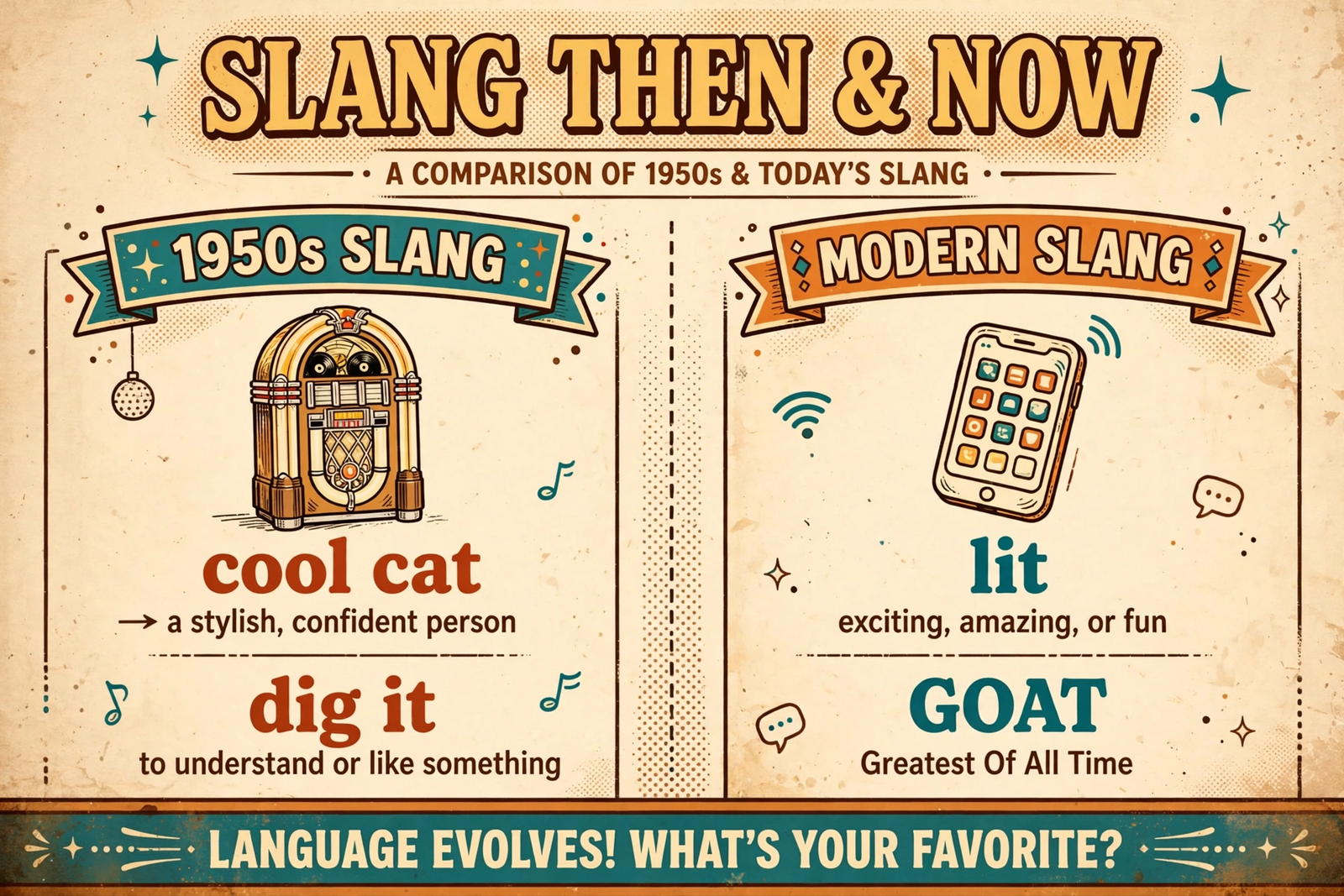
50s slang shares ideas with slang from other decades, but each era has its own flavor. This table shows how similar feelings were expressed across generations — and why 50s slang still stands out for its smooth, musical sound.
| Meaning | 50s Slang | Modern Slang | Difference |
|---|---|---|---|
| Something great | The most / Outta sight | Fire / Lit / Slaps | 50s words sound smooth; modern words sound intense |
| A cool person | Cool cat / Hep cat | Legend / GOAT | 50s words come from jazz; modern words come from sports and gaming |
| To understand | Dig it | I feel you / Got it | Dig is musical; modern phrases are plain |
| Someone boring | Square | Basic / Cringe | Square is geometric and visual; modern words are judgmental |
| Money | Bread / Loot | Bread / Bag | Bread survived; bag is newer |
| Amazing / wild | Far out / Real gone | Insane / Wild | 50s words sound dreamy; modern words sound extreme |
| Clothes | Threads | Fit / Drip | Threads is still used; drip is newer and flashier |
| Goodbye | Later, gator | Peace out / I’m out | 50s goodbyes rhyme and play; modern ones are short |
If you love this kind of word history, you may also enjoy our guide to synonyms for cool slang, where the word cool — the most famous gift of the 1950s — gets a full modern breakdown. And if you want to see how tough-guy talk evolved, our tuff slang meaning guide shows how attitude words changed from the 50s to today.
Alternate Meanings
Like most slang, 50s slang words often carried more than one meaning, and context decided which one applied:
- Cool: It could mean stylish and impressive (“a cool cat”), calm under pressure (“stay cool”), or literally cold. In jazz, a cool player was relaxed and in control — that musical sense is the one that survived.
- Dig: It meant to understand (“Do you dig what I’m saying?”), to enjoy (“I really dig this song”), or to look at with approval (“Dig those shoes!”). It almost never meant digging a hole in slang use.
- Crazy: In the 1950s, calling something crazy was often a compliment — it meant wild, exciting, and great (“That solo was crazy, man!”). The negative sense of crazy existed too, so tone mattered.
- Mad: It meant a lot of something (“mad skills” came later, but “mad money” and “mad about it” were 50s usage) as well as angry. “I’m mad about that car” meant you loved it, not that you were furious.
- Square: Beyond meaning a boring person, it could describe anything mainstream or uncool — square music, square clothes, a square party. Beatniks used it as the ultimate insult for conformity.
- Cat: It meant a person, usually a man (“a cool cat”), but also a jazz musician. It had nothing to do with the animal in this context.
- Pad: It meant home or apartment (“Come by my pad later”), not a writing pad. The word survived into 1960s and 70s slang with the same meaning.
Professional or Polite Alternatives
50s slang is fun, but it is not right for every situation. Here are polite, professional alternatives for common 50s slang words:
| 50s Slang | Meaning | Polite / Professional Alternative |
|---|---|---|
| Daddy-o | Hey man / friend | Hi there / Hello, friend |
| Cool cat | A stylish person | A fashionable person / Someone with great taste |
| Dig it | I understand / I like it | I understand / I appreciate it |
| The pits | The worst | Not great / disappointing |
| Square | Boring / conventional | Traditional / conservative |
| Bread / loot | Money | Money / funds |
| Far out | Amazing / strange | Impressive / unusual |
| Chick / doll | A young woman | A young woman / lady |
Rule of thumb: use 50s slang at parties, in creative writing, and with friends who enjoy retro humor. In job interviews, formal emails, and serious conversations, switch to the polite alternatives. The slang will still be there when the party starts.
Common Mistakes
People love 50s slang, but a few mistakes can make it fall flat. Avoid these:
- Using too much at once: Saying “Hey daddy-o, this pad is the most, dig it? Don’t be a square, it’s far out!” in one breath sounds like a costume, not a conversation. One or two slang words per sentence is plenty.
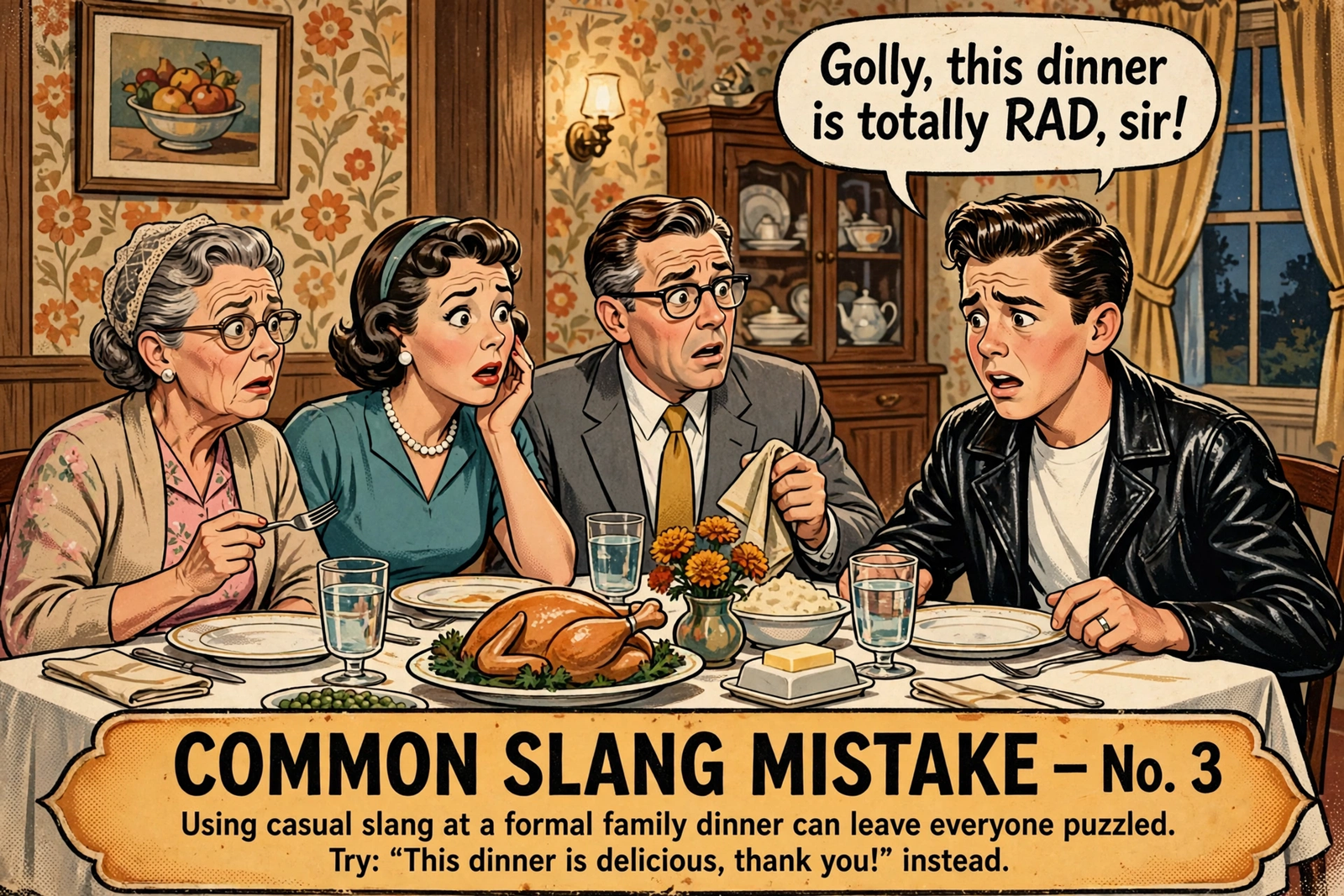
- Mixing decades: Groovy is mostly 1960s, and rad is 1980s. Mixing them into 50s slang confuses the theme. Stick to true 1950s words for an authentic feel.
- Using it in formal settings: Calling your boss daddy-o or telling a client something is the pits will not land well. Keep slang for casual moments.
- Getting the meaning backwards: Square is an insult, not a compliment. Crazy in 50s slang was often praise, not criticism. Check the meaning before you use a word.
- Overdoing the accent: You do not need a fake 1950s accent to use the slang. Say the words naturally and let the vocabulary carry the retro flavor.
- Calling everyone “daddy-o”: In the 1950s, daddy-o was used between friends and in jazz circles. Using it with strangers or elders today can feel awkward. Save it for friends who are in on the joke.
Quick Tips
Want to use 50s slang like a natural? Follow these tips:
- Start with the classics: Cool, dig it, far out, and the most are the easiest words to use because almost everyone already knows them.
- Match the moment: Use slang at retro parties, in themed photos, and in fun conversations — not in serious or formal situations.
- Learn the top 10 first: Master cool cat, daddy-o, dig it, far out, square, the most, hep, cherry, threads, and pad before adding rarer words.
- Watch a classic movie: Grease, Rebel Without a Cause, and American Graffiti are full of natural 50s slang in context — the fastest way to learn how it really sounded.
- Use it in captions: A vintage photo with “Feeling like a cool cat 😎” gets more smiles than a plain caption, and it is a safe place to practice.
- Pair it with the look: Slang sounds best with the style — a leather jacket, a polka-dot dress, or a classic car in the background makes the words feel at home.
- Keep it playful: 50s slang is supposed to be fun. If it starts feeling forced, drop it and speak normally — the charm is in the lightness.

FAQ
1. What does 50s slang mean?
50s slang means the informal words and phrases popular in 1950s America, such as cool cat, daddy-o, dig it, and far out. It was the language of teenagers, jazz fans, greasers, and beatniks, and today people use it for retro parties, movies, and nostalgic fun.
2. What is the most famous 50s slang word?
Cool is the most famous 50s slang word. It started in jazz culture meaning calm, stylish, and in control, and it became so popular that it is still one of the most used words in English today.
3. What does “daddy-o” mean in 50s slang?
Daddy-o was a friendly way to address a man, similar to saying “hey man” or “buddy.” It came from jazz culture and was used between friends to sound relaxed and hip.
4. What does “dig it” mean?
Dig it means “I understand” or “I like it.” For example, “I really dig this song” means you enjoy the song, and “Do you dig what I’m saying?” means “Do you understand me?”
5. What is a “square” in 50s slang?
A square was a boring, conventional person who did not understand youth culture, jazz, or rock and roll. Beatniks and teenagers used it as the opposite of hip or cool.
6. Is 50s slang still used today?
Yes, but mostly for fun. Words like cool, dig it, and far out still appear in everyday speech, movies, and music. The rest of 50s slang shows up at retro parties, in vintage fashion, and in social media captions.
7. What is the difference between 50s slang and 60s slang?
50s slang sounds smooth and jazz-influenced — cool cat, daddy-o, dig it. 60s slang sounds more psychedelic and hippie-influenced — groovy, far out (which carried over), peace, and love-in. Both share some words, but the attitude is different.
8. How can I learn 50s slang quickly?
Start with the top 10 words in this guide, watch classic movies like Grease and Rebel Without a Cause, and listen to 1950s rock and roll. Using one or two words at a retro party is the fastest way to make them feel natural. For more old-school word guides, check our cowboy slang and digs slang meaning articles.
Conclusion
50s slang is more than old words — it is the sound of a generation that invented the teenager, rock and roll, and cool itself. From the jazz clubs where cool cat and dig it were born, to the drive-ins and sock hops where daddy-o and the most ruled the night, these words captured a decade of freedom, music, and fun.
The best part is that 50s slang still works today. A well-timed “far out!” at a retro party, a “cool cat” in a photo caption, or a “later, gator” goodbye can make any moment lighter and more memorable. Just remember the golden rules: use a little, not a lot; match the moment; and keep it playful.
Quick recap: 50s slang = the informal vocabulary of 1950s America (cool cat, daddy-o, dig it, far out, square, the most). It came from jazz, beatniks, and car culture, spread through radio and movies, and still adds retro charm to parties, captions, and stories today. Now you know the words — go out there and be the coolest cat in the room.
