
Quick definition: In slang, “digs” means the place where someone lives — their apartment, house, room, or temporary lodging. When a friend says “Come round to my digs,” they simply mean “Come to my place.” The word is informal, a little old-fashioned, and still widely understood in the US, the UK, and online.
digs slang meaning & Definition
The digs slang meaning is simple: your home, your room, or wherever you are staying right now. It is always used in the plural — nobody says “my dig is nice” when they mean their apartment. The correct form is “my digs are nice,” “her digs are tiny,” or “our digs are close to campus.”
Think of it as a warmer, more casual cousin of words like “place,” “pad,” or “crib.” Saying “I love your digs” feels friendlier and more personal than saying “I love your apartment,” which is exactly why people keep using it in texts, captions, and everyday conversation.
Here is the definition in one line:
- Digs (noun, plural, informal): a person’s home or lodgings, especially a rented room, shared apartment, or temporary place to stay.
The word also carries a second, completely different slang life. A “dig” can be a sharp, teasing remark — as in “he took a dig at me” — and the verb “to dig” can mean to understand or enjoy something, as in “I really dig this song.” Context tells you which meaning is in play, and in this article we will cover all of them so you never mix them up.
Introduction
You have probably seen the word pop up in a text, a movie, or a social media caption: “Check out my new digs!” “Her digs are insane.” “Come over to my digs after work.” If you paused for a second, you are not alone. “Digs” is one of those slang words that sounds simple but hides a long history and a few surprising second meanings.
Part of the confusion is that “digs” looks like it should be about digging holes. It is not — at least, not in slang. Another part is that the word has travelled a long way: from nineteenth-century British boarding houses to American college dorms, from soldiers’ barracks to TikTok house tours. Along the way it picked up new shades of meaning, and today it shows up everywhere from casual chats to song lyrics.
This guide explains the digs slang meaning in plain English. You will learn where the word came from, when to use it, how it compares with similar words like “crib” and “pad,” the mistakes people make with it, and plenty of real examples you can copy into your own conversations. By the end, you will know exactly what someone means when they invite you to their digs — and whether you should say yes.

Origin
The slang use of “digs” goes back further than most people expect. According to Etymonline, “digs” has been used as slang for lodgings since the 1890s, growing out of the older noun “dig” — a place where someone had settled in, or “dug in.” The image is easy to picture: you dig in, make yourself comfortable, and the place becomes your digs.
In Victorian Britain, the word was tied to rented rooms and boarding houses. Students, young workers, and travellers who could not afford a whole house rented a room — their “digs.” Landladies advertised “digs to let,” and letters home talked about finding “decent digs” near work or school. It was practical, everyday language, not the fashionable slang of any one group.
The word crossed the Atlantic and settled into American English by the early twentieth century. Soldiers and sailors helped spread it: barracks, boarding houses, and any temporary place to sleep became “digs.” By the 1940s and 1950s, American slang dictionaries were recording “digs” as a standard casual word for a person’s home or apartment, and it has stayed in the language ever since.
There is also a connection to the verb “to dig.” In 1930s African American English, “I dig you” meant “I understand you,” and “I dig that song” meant “I like it.” The idea was that something you liked was worth settling into — you dug in. That warm, approving feeling is part of why “digs” still sounds affectionate today: your digs are not just where you sleep, they are the place you have made your own.
Popularity
“Digs” never became the trendiest slang word on the internet, and that is actually part of its charm. It is not a word that spikes and disappears with one viral video. Instead, it has been quietly popular for more than a hundred years, moving between generations without ever fully going out of style.
Today you will hear it most often in a few places. In the UK and Ireland, it is still everyday speech — students talk about their digs, workers talk about finding digs near a job site, and estate agents sometimes use it in listings to sound friendly. In the US, it is more of a casual, slightly playful choice. An American is more likely to say “my place” or “my crib,” but “my digs” shows up when someone wants to sound relaxed, funny, or a little retro.
Online, the word gets a second life. House-tour videos, apartment reels, and “new digs” announcements are common on TikTok and Instagram. A creator moving into a new apartment will often caption the video “new digs, who dis?” — a joke that works precisely because everyone already knows what digs means. The phrase “nice digs” is also a reliable compliment in comment sections, on Reddit threads about home setups, and in gaming streams when someone shows off their room.
Search interest backs this up. People regularly look up what “digs” means in slang, whether it can also mean clothes (it usually cannot — more on that below), and how it differs from words like “crib” and “pad.” The word survives because it fills a gap: it is shorter than “my apartment,” warmer than “my residence,” and cooler than “my house.”
How It Is Used
“Digs” works as a noun, and it is almost always plural. You will hear it in three main situations: talking about your own home, complimenting someone else’s home, or describing temporary accommodation.
When people talk about their own place, the pattern is simple: “my digs,” “our digs,” or “his/her/their digs.” It is a casual replacement for “my apartment” or “my house.” It fits texts, voice notes, and face-to-face chat, and it sounds natural in sentences like “Come to my digs tonight” or “My digs are a mess right now, fair warning.”
The second common use is the compliment. “Nice digs!” is a classic — short, friendly, and instantly understood. It works when you walk into a friend’s new apartment, when you see a photo of someone’s renovated kitchen, or when a colleague shows their home office on a video call. It is warmer than “nice place” because it carries a hint of personality, as if you are admiring not just the rooms but the way the person lives in them.
The third use is about temporary stays. Students, travellers, and workers on short contracts use “digs” for wherever they are crashing. “I found digs near the site” means rented accommodation for the job, not a permanent home. A friend sleeping on your couch for a week might joke, “Thanks for the digs.” In this sense the word keeps its oldest meaning: lodgings, a place to stay for a while.
A few grammar notes will keep you sounding natural. “Digs” takes a plural verb: “My digs are small,” not “My digs is small.” You do not need an article in front of it the way you would with “apartment” — “I’m at my digs” is correct, while “I’m at the digs” sounds odd unless you are talking about a specific place everyone already knows. And the word is informal, so it fits friends, family, and social media, but you would not write “my digs” in a formal email to a landlord or a job application.
Examples
The best way to learn a slang word is to see it in real sentences. Here are examples of “digs” in different tones, so you can match the word to the moment.
Friendly Examples
- “Come check out my new digs this weekend — I finally got the couch I wanted.”
- “Your digs are so cozy! I love what you did with the balcony.”
- “Let’s just hang at my digs tonight. I’ll order pizza.”
- “She just moved into new digs downtown, right above that bakery.”
- “Nice digs, man. That view is unreal.”
Notice how relaxed these all sound. “Digs” makes an invitation feel low-pressure: you are not hosting a formal dinner, you are just having people over to your place. That is why it works so well between friends.
Professional Examples
In work settings, “digs” shows up when people talk about accommodation for a job, a project, or a trip. It is still casual, so save it for colleagues you know well or for spoken conversation rather than formal documents.
- “The company sorted out digs for the crew near the site, so nobody has a long commute.”
- “I’m working from my digs today — the office Wi-Fi is down again.”
- “When I started the internship, finding affordable digs near campus was the hardest part.”
- “Our new digs in the city are smaller, but the team loves the location.”
A quick tip: in a professional email, “accommodation” is the safer word. In a Slack message or a call with your team, “digs” is perfectly fine and sounds human.
Funny Examples
- “Welcome to my humble digs — mind the laundry mountain, it’s load-bearing.”
- “New digs, who dis? The landlord finally fixed the heating.”
- “My digs are so small the Wi-Fi reaches the neighbours better than it reaches my bedroom.”
- “I told my mum my digs were ‘cosy.’ She said, ‘You mean tiny.’ She’s right.”
Humour is where “digs” really shines. Because the word is a little old-fashioned, using it about a tiny flat or a messy student room adds a comic, self-aware touch — as if you are a character in an old novel rather than someone paying too much rent.

Comparison with Similar Terms
“Digs” is not the only casual word for home. “Crib,” “pad,” “spot,” “place,” and “flat” all overlap with it, but each one carries a different flavour. The table below shows how they compare, so you can pick the right word for the right moment.
| Term | What it means | Tone | Best for |
|---|---|---|---|
| Digs | Your home or lodgings, often rented or temporary | Warm, informal, slightly old-fashioned | Inviting friends over, complimenting a home, talking about rented rooms |
| Crib | Your house or apartment | Cool, urban, confident | Showing off a place, hip-hop and street culture, social media captions |
| Pad | Your apartment or flat, often a bachelor pad | Relaxed, a little retro | Talking about a small stylish apartment or a single person’s place |
| Spot | A place you hang out or live | Very casual, vague | Meeting up: “Let’s meet at my spot” |
| Place | Your home, in the most general sense | Neutral, safe | Any situation — the default choice when you are unsure |
| Flat | An apartment (mainly British English) | Neutral, regional | Everyday British conversation, property listings |
The key difference is feel. “Crib” sounds confident and a little flashy — you show off a crib. “Pad” sounds laid-back and often small or stylish. “Digs” sounds warm and lived-in, and it is the only one of the group that naturally covers temporary stays like student rooms and work accommodation. If you are talking about a rented room near a job site, “digs” is the most natural choice. If you are posting a house-tour video, “crib” might fit better. Context decides.
There is one more useful comparison: “digs” versus “dwelling.” A dwelling is simply a place where someone lives, and it is a formal, legal-sounding word you would find in contracts and official forms. “Digs” is the human version of the same idea — the word you use when you are actually talking to a person, not filling in paperwork.

Alternate Meanings
Like many old slang words, “digs” has more than one meaning. Most of the time it means a home, but the same root word — “dig” — branches into a few other uses that are worth knowing.
1. A dig: an insult or a jab
A “dig” (singular) is a sharp, teasing remark aimed at someone. “She took a dig at his cooking” means she made a sarcastic comment about it. “That was a dig, wasn’t it?” means “that comment was meant to sting.” This use is common in everyday speech and in celebrity gossip: headlines love “takes a dig at” because it is short and punchy.
2. To dig something: to like or understand it
“I dig this song,” “I dig your style,” “Do you dig what I’m saying?” In all three, “dig” means to enjoy, approve of, or understand. This use comes from 1930s jazz and African American English, and it is still alive in casual conversation and song lyrics. If someone says “I dig your new digs,” they are using both meanings at once — they like your place. That is a joke, but it is also a perfect summary of how the word works.
3. Dig: excavation
The literal meaning never went away. An archaeological “dig” is a site where people excavate, and “digs” in that world can mean the excavation site itself — though this is rare in everyday talk. If an archaeologist says “I’m heading back to the digs,” they might mean the site, not their hotel. Context makes it clear, and most readers will never meet this use outside a documentary.
4. Digs and clothes: a common confusion
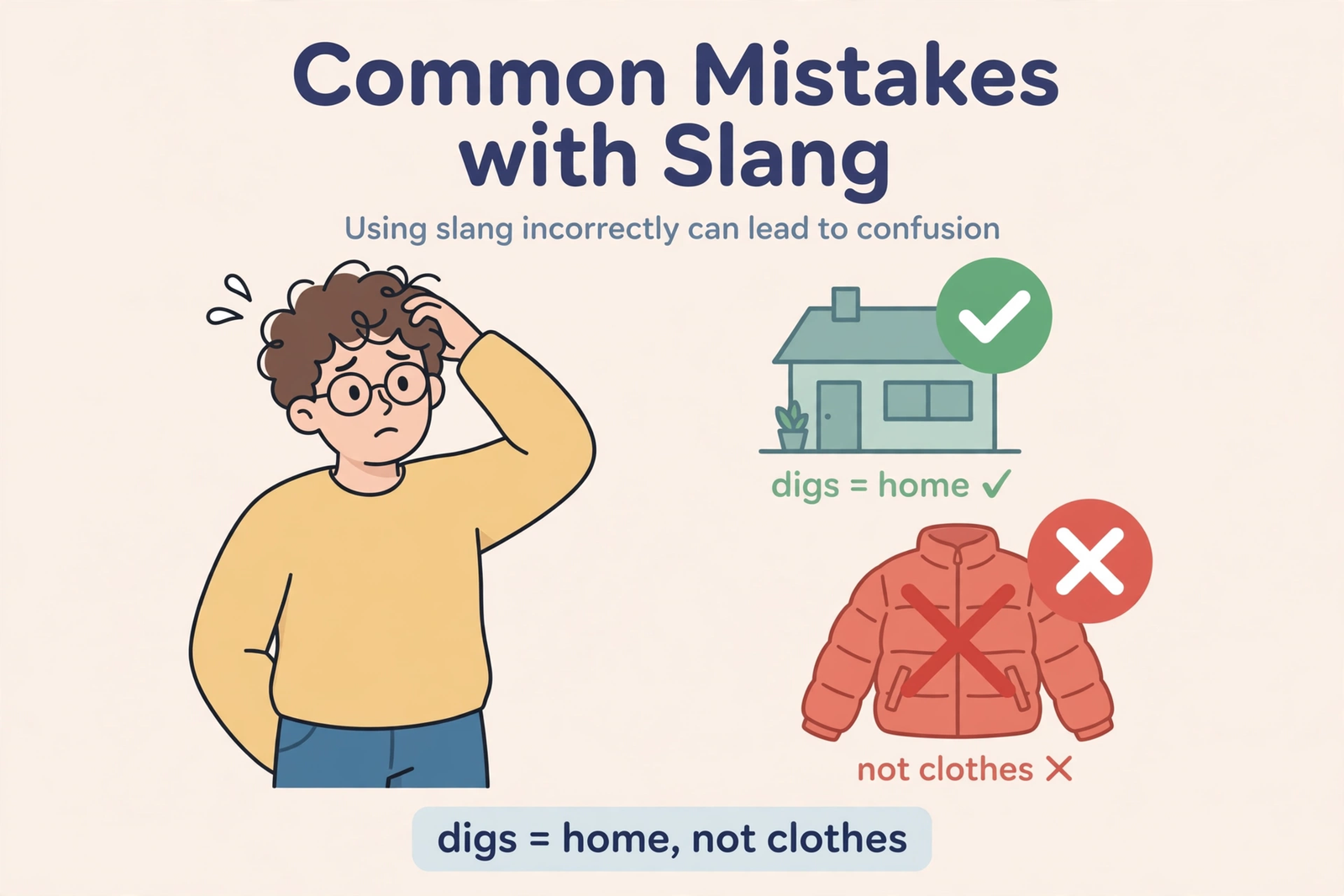
Some people wonder whether “digs” can mean clothes or an outfit — as in “nice digs” meaning “nice outfit.” In modern English, that is not standard. The confusion usually comes from “duds,” a long-standing slang word for clothes, and from words like “threads,” “gear,” and “fit,” which really do mean outfits. If someone says “nice digs” today, almost every listener will think of a home, not a jacket. If you mean clothes, say “nice fit” or “nice outfit” and save “digs” for the place you live.
Professional or Polite Alternatives
“Digs” is informal, so there are moments when a different word works better. Here are polite alternatives, matched to the situation:
- Home — the warmest neutral choice. “Welcome to our home” works everywhere.
- Residence — formal and safe for official forms, leases, and legal documents.
- Accommodation — the standard word for work trips, hotels, and university housing. “The company arranged accommodation” sounds professional; “the company arranged digs” sounds like a chat message.
- Apartment / flat — clear and neutral. Use these when you need to be precise about the type of home.
- Place — the easiest all-purpose swap. “Come to my place” means the same thing as “come to my digs” and fits every audience.
- Lodgings — slightly old-fashioned but polite, and the closest formal cousin of “digs.” Good for writing about rented rooms.
The rule of thumb is simple: use “digs” with friends, on social media, and in casual speech. Switch to “home,” “apartment,” or “accommodation” in formal writing, with strangers in a professional setting, or anywhere the reader might not know the slang. You will never go wrong with “my place” as a middle ground.
Common Mistakes
“Digs” is a forgiving word, but a few mistakes show up again and again. Avoid these and you will sound natural every time.
- Using the singular for a home. “My dig is nice” is wrong when you mean your apartment. The home meaning is always plural: “my digs are nice.” Save the singular “dig” for the insult (“that was a dig”) or the verb (“I dig it”).
- Using it for clothes. As covered above, “nice digs” means a nice home, not a nice outfit. If you compliment someone’s jacket with “nice digs,” they will probably think you are talking about their house. Use “nice fit” for clothes.
- Using it in formal writing. “Digs” in a job application, a lease agreement, or a formal email looks careless. Write “residence” or “accommodation” instead.
- Forgetting the plural verb. “My digs is close to work” is a common slip. It should be “my digs are close to work.” Treat “digs” like “clothes” or “scissors” — plural, even when it means one thing.
- Overusing it. “Digs” is charming in small doses. If every sentence in your house-tour caption says “digs,” the joke wears thin. Mix it with “place,” “apartment,” and “home.”
- Confusing it with “duds.” “Duds” means clothes; “digs” means a home. They sound a little alike, and learners mix them up. Remember: you wear duds, you live in digs.
Quick Tips
- Start with “nice digs.” It is the easiest, safest way to use the word — a compliment that works in almost any situation.
- Use it for invitations. “Come to my digs” sounds warmer and more relaxed than “come to my apartment.”
- Pair it with “new.” “New digs” is the standard phrase for a recent move, and it makes a great caption: “New digs, same me.”
- Keep it casual. “Digs” belongs in texts, chats, captions, and friendly conversation — not in contracts or cover letters.
- Watch the verb. “Digs are,” never “digs is.” Say it out loud a few times and it becomes automatic.
- Use it for temporary stays. Student rooms, work trips, and crashing at a friend’s place are all natural “digs” territory.
- Learn the second meaning. Knowing that “a dig” can also be a teasing insult stops you from misreading sentences like “he took a dig at me.”
- Try it in a caption. A photo of your room with “humble digs” as the caption is a classic — self-deprecating, friendly, and instantly understood.


FAQ
What is the digs slang meaning?
The digs slang meaning is a person’s home or lodgings — their apartment, house, room, or temporary place to stay. “Come to my digs” means “come to my place.” It is informal British and American slang that has been in use since the 1890s.
Is “digs” singular or plural?
“Digs” is plural when it means a home, and it takes a plural verb: “My digs are small.” The singular “dig” means something else — a teasing insult, as in “he took a dig at me.”
Can “digs” mean clothes?
Not in standard modern English. “Nice digs” almost always means a nice home. The clothes meaning is a confusion with “duds,” which is the slang word for clothes. For outfits, use “fit,” “threads,” or “outfit.”
Where does the word “digs” come from?
It comes from nineteenth-century British slang for lodgings, traced to the 1890s and the noun “dig” — a place where someone had “dug in” and settled. It spread through soldiers, sailors, and students, and became common in American English by the 1940s and 1950s.
What is the difference between “digs” and “crib”?
Both mean home, but “crib” sounds cooler and more confident, while “digs” sounds warmer and a little old-fashioned. “Crib” is for showing off; “digs” is for inviting people over. “Digs” also covers temporary stays like student rooms, which “crib” rarely does.
Is it rude to say “nice digs”?
No — it is a friendly compliment. “Nice digs!” is one of the most positive things you can say when you visit someone’s home. It only turns rude if you add a sarcastic tone, as in “nice digs” said about a tiny messy room — but that is the tone, not the word.
Can I use “digs” at work?
In casual conversation with colleagues, yes — especially when talking about accommodation for a trip or a project. In formal emails or documents, use “accommodation” or “apartment” instead. If you are unsure, “my place” is the safe middle ground.
What does “I dig your digs” mean?
It is a playful sentence that uses two meanings at once: “I like your place.” “I dig” means “I like” or “I approve,” and “your digs” means “your home.” It is a compliment, and a small joke about the word itself.
Conclusion
“Digs” is a small word with a long story. It started in nineteenth-century British boarding houses, travelled with soldiers and students, picked up a second life in jazz-era slang, and landed in today’s group chats and house-tour videos. The digs slang meaning is refreshingly simple — it is the place you call home, whether that is a rented room, a shared apartment, or a house you have lived in for years.
The word survives because it does a job no other word does quite as well. It is warmer than “residence,” more personal than “apartment,” and more relaxed than “crib.” It covers permanent homes and temporary stays in a single syllable, and it turns a plain invitation into something friendly: “Come to my digs” is not just an address, it is a welcome.
Use it well and it will serve you for years. Say “nice digs” when you like someone’s place, say “new digs” when you move, and remember the grammar — plural word, plural verb — and the one big trap: digs are where you live, not what you wear. If you want to keep building your slang vocabulary, check out our guides to fn meaning in text and csl meaning in text, and for a fun contrast, see what kinky meaning covers. Slang changes fast, but the words that last — like “digs” — are the ones worth knowing properly. For the dictionary side of the story, Vocabulary.com’s entry for “dig” traces the verb’s many meanings, including the 1930s slang sense of “to understand or enjoy.”

1 thought on “Digs Slang Meaning: What Are Digs and How People Use the Word in 2026”