
Wurst Meaning Slang & Definition
Quick definition: In slang, wurst is a playful, deliberate misspelling of the word “worst” — used as a pun on the German sausage. When someone writes “the wurst day ever” or “wurst case scenario,” they mean the worst day ever or the worst-case scenario, but they are saying it with a joke built in. It is internet humor at its simplest: one swapped letter turns a complaint into a punchline.
The word wurst itself comes from German, where it simply means “sausage.” English speakers borrowed it centuries ago for foods like bratwurst and liverwurst, and somewhere along the way, the internet discovered that “wurst” sounds exactly like “worst.” That happy accident gave birth to a whole family of sausage puns — “the wurst is yet to come,” “wurst intentions,” “hope for the best, prepare for the wurst” — that now show up in texts, memes, social media captions, and even on T-shirts and mugs.
So if you have ever seen a friend text “this is the wurst” and wondered whether they were talking about dinner, the answer is almost always no. They are complaining, joking, or both at the same time — and now you will know exactly how to read it, use it, and reply to it.
Introduction
Slang moves fast, but some jokes are so simple that they never really die. “Wurst” is one of them. It does not need a dictionary update or a viral TikTok dance to survive; it just needs someone having a bad day and a keyboard. The pun works because everyone already knows the word “worst,” and everyone already knows what a sausage is. Put them together and you get a complaint that makes people smile instead of sigh.
You will see wurst slang most often in casual, lighthearted contexts: a friend venting about a bad exam, a coworker joking about a Monday morning, a meme account captioning a photo of a burnt dinner. It is rarely serious and almost never angry. The whole point is to soften the complaint — to say “this is terrible” while signaling “but I am laughing about it.”
In this guide, we will break down the wurst meaning in slang from every angle: where the joke came from, why it became popular, how people actually use it in texts and on social media, real examples in different tones, how it compares to similar slang, the mistakes people make with it, and quick tips for using it naturally. By the end, you will not only understand the joke — you will be ready to make it yourself.

Origin
The story of wurst slang starts with two words that were never meant to meet. On one side is the German word Wurst, meaning sausage, which entered English through food. German immigrants brought bratwurst, knockwurst, and liverwurst to the United States in the 19th century, and the word settled into English as a food term. On the other side is the English word “worst,” the superlative of “bad,” which has been in the language for over a thousand years.
Because the two words are pronounced almost identically — “wurst” and “worst” are true homophones for most English speakers — the pun was probably inevitable. Puns like “the wurst is yet to come” (a play on “the worst is yet to come”) have appeared on novelty items, greeting cards, and joke books for decades. What the internet did was give the joke a second life: suddenly a pun that used to live on a coffee mug could be dropped into any text message, tweet, or meme in seconds.
The slang usage really took off with the rise of meme culture and deliberate misspellings online. Internet users love swapping letters for comic effect — think of “boi,” “thicc,” or “smol” — and “wurst” fits that pattern perfectly. It is not a typo; it is a choice. Typing “wurst” instead of “worst” tells the reader that you know exactly what you are doing, and that the joke is the point.
Food puns also have a long history in English humor, from “lettuce turnip the beet” to “you are the wurst.” Sausages are especially popular targets because they are funny-sounding, slightly absurd, and universally familiar. That combination — a familiar food, a perfect homophone, and a complaint everyone relates to — is why wurst slang has stuck around while other internet jokes have faded.
Popularity
Wurst slang is not a chart-topping viral trend, and that is actually part of its charm. It is a steady, low-key joke rather than a flash-in-the-pan meme. It pops up in waves: a meme account posts a sausage joke, a few thousand people share it, and the word drifts back into everyday texting for a while. Because the pun is so easy to understand, it never really needs an explanation, which means new people keep discovering it on their own.
Search interest in “wurst meaning slang” has grown as more people encounter the word outside of food contexts. Someone sees “wurst day ever” in a comment section, or a friend texts “hope for the best, prepare for the wurst,” and they look it up to confirm what they suspected. That steady curiosity is a sign of a healthy, long-lived piece of slang rather than a dying fad.
The joke also travels well across platforms. It works on X (Twitter), Instagram captions, TikTok comments, Reddit threads, Discord chats, and plain old text messages. It works in memes with pictures of sausages, in reaction GIFs, and in completely text-only jokes. And because it is clean, family-friendly humor, it shows up in places where edgier slang cannot — work group chats, classroom jokes, and greeting cards.
Perhaps most importantly, wurst slang has staying power because bad days are universal. As long as people have Mondays, bad Wi-Fi, burnt toast, and disappointing plot twists, they will need a funny way to say “this is the worst” — and “wurst” will be waiting.
How It Is Used
In practice, wurst slang almost always replaces “worst” in a familiar phrase. The most common patterns are easy to spot once you know them:
- “The wurst” — a standalone complaint. “I failed my driving test. This is the wurst.”
- “Wurst case scenario” — a play on “worst-case scenario,” used when imagining the most disastrous outcome.
- “The wurst is yet to come” — a darkly funny twist on “the worst is yet to come,” often used with a joking tone about something getting worse.
- “Wurst day ever” — a dramatic way to describe a bad day, usually with obvious exaggeration.
- “Hope for the best, prepare for the wurst” — a motivational-sounding joke that is really just a pun.
- “You are the wurst” — a playful insult, the sausage version of “you are the worst,” usually said to a friend with a laugh.
- “Wurst intentions” — a pun on “worst intentions” or “best intentions,” used when a plan goes wrong.
Tone matters a lot here. Wurst is almost always lighthearted. If someone is genuinely furious or upset, they will usually just say “worst” — the pun softens the message, so it signals that the speaker is annoyed but coping with humor. That is why it works so well in texts: it lets you vent without sounding like you are having a meltdown.
You will also see wurst used as a noun on its own in jokes about food, especially around Oktoberfest, barbecues, and German-themed events. “Bring on the wurst!” at a cookout can mean both the sausages and the chaos. Context tells you which meaning is intended, and half the fun is the double meaning.
Examples
Here is how wurst slang sounds in real conversations, across different tones and situations. Notice how the same word can be friendly, professional (lightly), or funny depending on the context.
Friendly Examples
- “My phone died right before the concert. This is the wurst day ever 😭”
- “You forgot the snacks? You are the wurst, honestly. Still love you though.”
- “Rain on our beach day?? The wurst luck, I swear.”
- “Wurst case scenario, we just order pizza and stay in. Not mad about it.”
- “I studied all night and still blanked on the test. The wurst.”
Professional Examples
Wurst slang is casual, so it rarely belongs in formal emails or serious work messages. But in a relaxed team chat, it can land well — as long as the workplace culture is informal and the situation is low-stakes.
- “The printer broke again on deadline day. Wurst timing ever.” (team chat)
- “Wurst case scenario, we push the launch by a day and nobody panics.” (planning call)
- “Monday meeting got moved to 8 a.m.? The wurst. Coffee first, then work.” (coworker chat)
The rule is simple: if you would not joke with the person face to face, do not drop a sausage pun into the conversation. When in doubt, keep it for friends and informal chats.
Funny Examples
- “I told my trainer I wanted to be the best. He said, ‘No, you are the wurst.’ I have never felt so seen — or so hungry.”
- “Hope for the best, prepare for the wurst. And by wurst, I mean bring extra sausages.”
- “My diet started today and someone brought bratwurst to the office. The wurst temptation.”
- “Life gave me lemons. I asked for the wurst instead. At least it comes with mustard.”
- “The wurst is yet to come — said every German grandmother at a barbecue, probably.”

Comparison with Similar Terms
Wurst is not the only playful way to say something is bad. Here is how it stacks up against similar slang and expressions, so you can pick the right one for the moment.
| Term | Meaning | Tone | Best For |
|---|---|---|---|
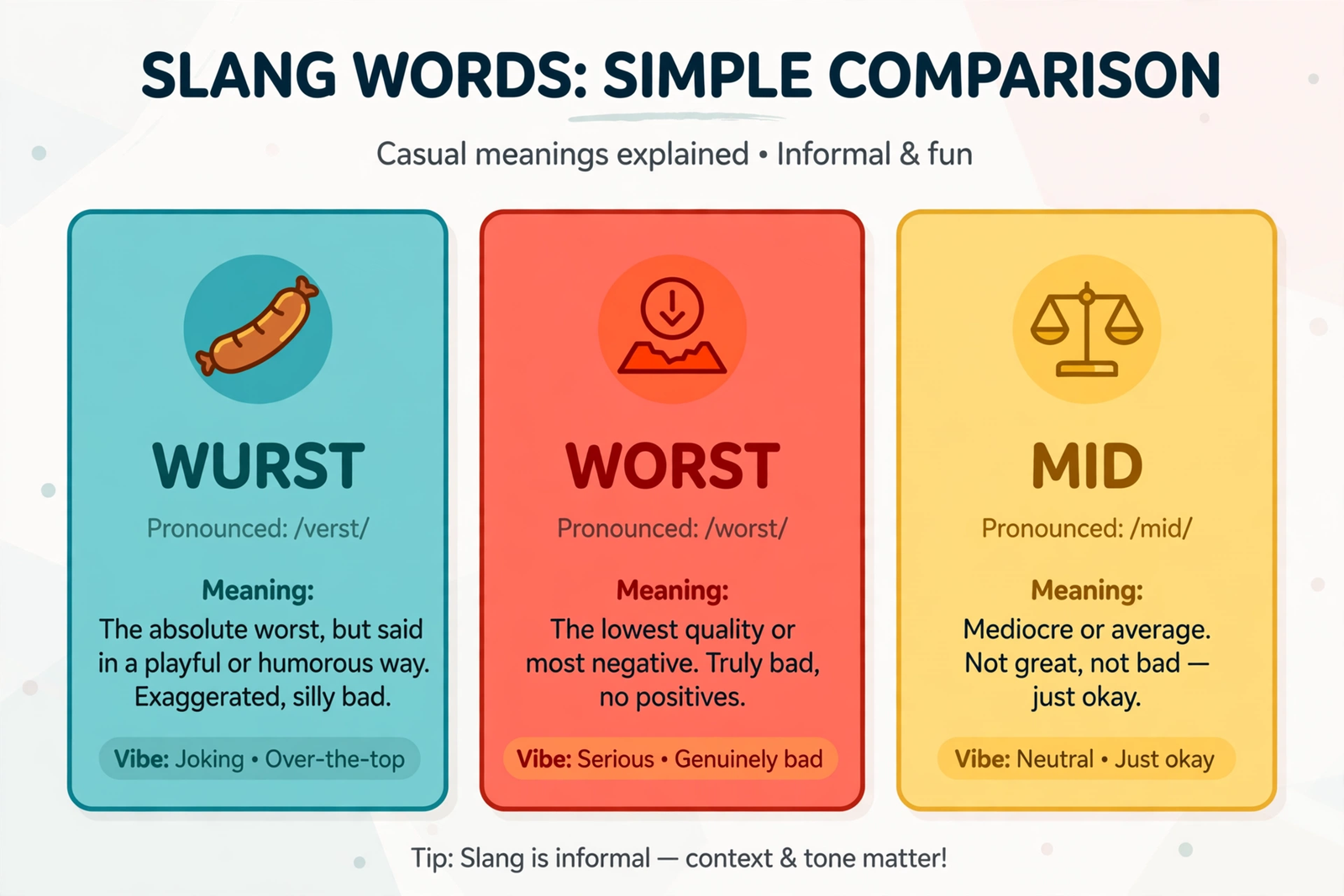
| Wurst | Playful misspelling of “worst,” sausage pun | Light, funny, self-aware | Casual texts, memes, jokes with friends |
| Worst | Most bad; the superlative of “bad” | Neutral to serious | Any situation, including formal ones |
| The worst | Standard complaint phrase | Neutral, can be annoyed | Everyday venting |
| Trash | Something is terrible or low quality | Blunt, dismissive | Gaming, sports, roasting friends |
| Mid | Mediocre, average, disappointing | Casual, Gen Z | Rating food, music, movies, events |
| L (take the L) | A loss or failure | Playful, competitive | Gaming, sports, friendly banter |
| Brat | Short for bratwurst — or a spoiled person | Context-dependent | Food talk; also teasing someone |
The key difference is that wurst is a joke about complaining, while most of the others are direct complaints. Saying “this is trash” is a judgment; saying “this is the wurst” is a judgment wrapped in a pun. That extra layer of humor is exactly why people reach for it when they want to vent without sounding negative.
Wurst is also gentler than slang like “trash” or “mid.” It is hard to offend someone with a sausage pun, which makes it safe for mixed company, family group chats, and public comments. If you are unsure which word to use, wurst is usually the friendliest option on the list.
Alternate Meanings
Before it was slang, wurst was simply food — and that meaning has not gone anywhere. In fact, the food meaning is the reason the slang works. Here are the main ways the word is used:
- German sausage (literal meaning): In German, Wurst means sausage. In English, it appears in the names of specific sausages: bratwurst (a grilled pork sausage), knockwurst (a short, thick sausage), liverwurst (a spreadable liver sausage), and weisswurst (a traditional Bavarian white sausage). If a menu says “wurst,” it means sausage — no joke intended.
- The pun / slang meaning: A deliberate, humorous stand-in for “worst.” This is the meaning covered in this article, and it only applies when the context is clearly playful.
- “Wurst case scenario” jokes: A fixed pun phrase rather than a separate meaning — it always means “worst-case scenario” with a wink.
- Brand and place names: “Wurst” shows up in restaurant names, food trucks, and novelty products, almost always leaning into the sausage pun on purpose.
Context is everything. “I love wurst” at a German restaurant means the food. “I love the wurst” in a meme about a bad day means the joke. When you see the word, check the setting first — food context means sausage, complaint context means slang.
Professional or Polite Alternatives
Sometimes a sausage pun is not the right move. In a job interview, a formal email, or a serious conversation, you will want a straightforward alternative that says the same thing without the joke. Here are some polite options:
- “The worst” — the plain, correct version. Safe everywhere.
- “Not ideal” — a gentle, professional way to say something went badly.
- “Less than ideal” — slightly formal, good for work emails.
- “A challenging situation” — professional language for a bad outcome.
- “Could have gone better” — an honest, low-drama way to describe a disappointment.
- “A rough day” — friendly but not jokey, good for talking to a manager or a client.
- “Disappointing” — direct and neutral, works in almost any setting.
Save wurst for the group chat and the meme comments. In professional settings, the alternatives above will keep you sounding polished while still getting the point across.
Common Mistakes
Wurst slang is simple, but people still get it wrong. Here are the most common mistakes — and how to avoid them.
- Using it in a serious situation: Telling someone “this is the wurst” after genuinely bad news can come across as tone-deaf. If someone is truly upset, drop the pun and be sincere first.
- Spelling it “worst” and expecting the joke to land: The entire joke is the spelling. If you type “worst,” there is no pun — it is just a normal complaint.
- Overusing it: One sausage pun in a conversation is funny. Five in a row is a dad-joke marathon. Use it once, let it land, and move on.
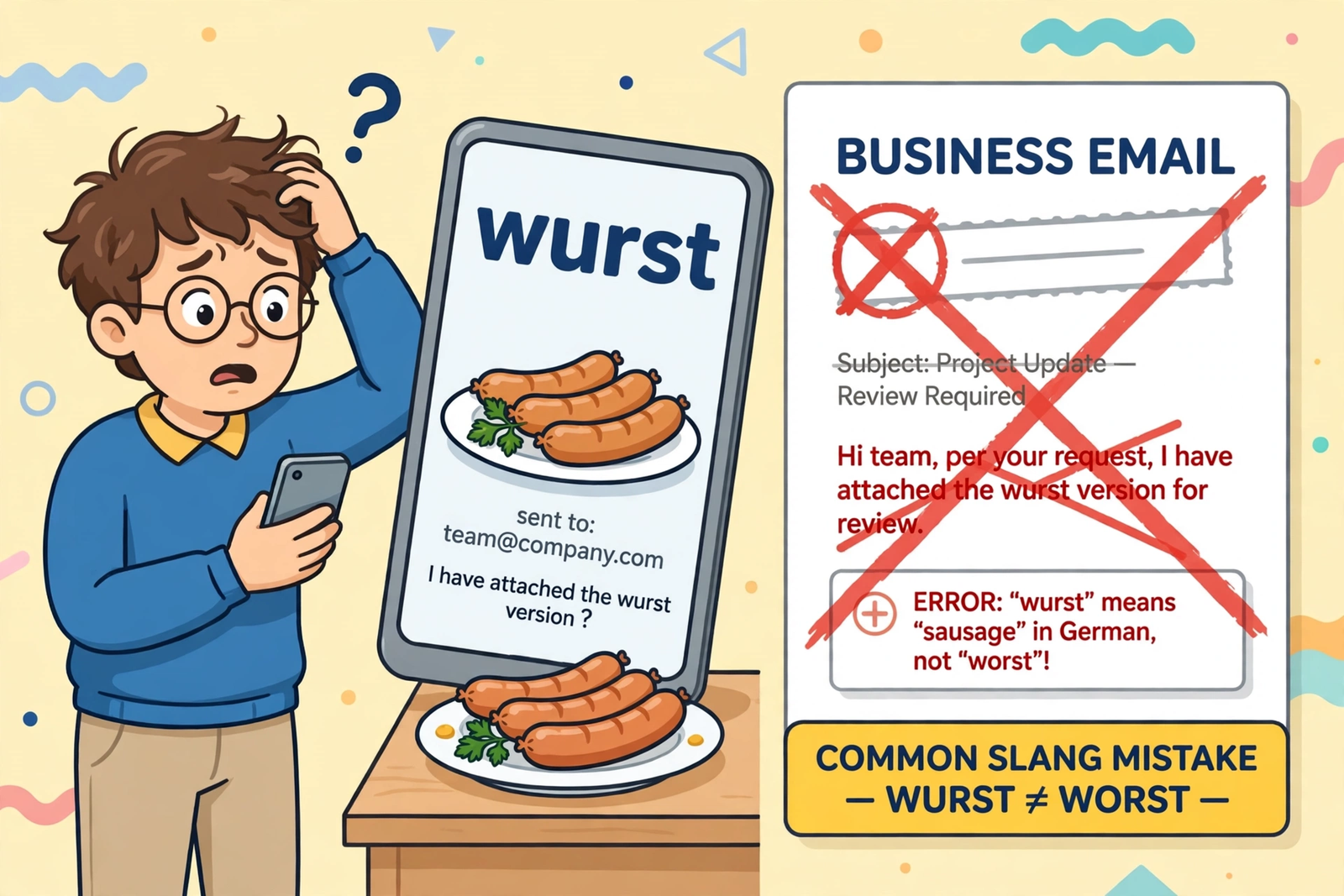
- Using it with people who will not get it: Non-native English speakers, or people unfamiliar with the “worst” homophone, may be confused rather than amused. If your audience might miss the joke, it is better to say what you mean plainly.
- Forcing it into formal writing: Wurst has no place in essays, resumes, cover letters, or official documents. It is slang, and slang belongs in casual contexts.
- Mispronouncing it: “Wurst” is pronounced like “worst” (wurst), not “woorst” or “wurst-uh.” Getting the pronunciation right is what makes the pun work out loud.
- Assuming it always means sausage: In a text about a bad day, “wurst” is almost never about food. Reading it literally is the most common misunderstanding for newcomers.
Quick Tips
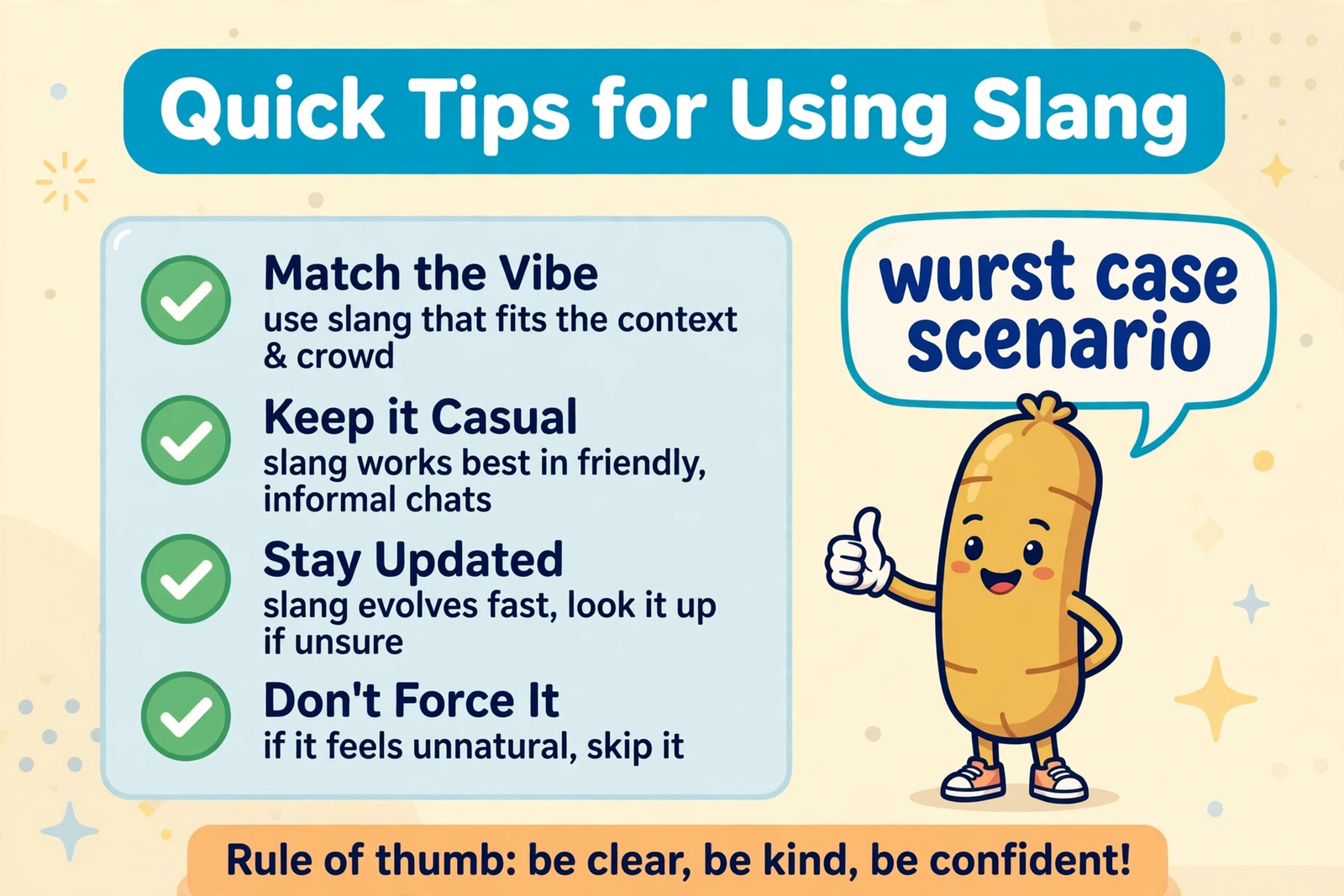
Want to use wurst slang like a natural? Keep these tips in mind:
- Use it once per joke: One “wurst” per message is plenty. The pun is the punchline, not the whole routine.
- Pair it with a familiar phrase: “Wurst case scenario” and “the wurst is yet to come” work instantly because people already know the original phrase.
- Add an emoji for clarity: A sausage emoji 🌭 or a laughing emoji 😂 signals that you are joking, especially with people who might not know the slang.
- Save it for light complaints: Bad Wi-Fi, a rainy day, a burnt dinner — perfect. A real crisis — not the time.
- Let the other person react: The best wurst jokes get a groan, a laugh, or a sausage emoji back. If someone replies with confusion, just explain the pun once and move on.
- Use it in captions: Wurst puns make great Instagram and TikTok captions for food photos, bad-day posts, and Oktoberfest content.
- Know your audience: Friends who love puns will love this. People who hate puns will groan — which, honestly, is also part of the fun.
FAQ
What does wurst mean in slang?
In slang, wurst is a playful misspelling of “worst.” It is a pun on the German word for sausage, used to turn a complaint into a joke — for example, “this is the wurst day ever” means “this is the worst day ever,” but said with humor.
Is wurst just a typo for worst?
No. When used as slang, “wurst” is a deliberate choice, not a typo. The writer knows it is spelled differently and is using the sausage spelling on purpose to make a pun. That is what separates slang from a spelling mistake.
Where did the wurst joke come from?
The joke comes from the fact that “wurst” (German for sausage) and “worst” are homophones — they sound the same. The pun has appeared on novelty items and greeting cards for decades, and internet meme culture gave it a second life in texts and social media.
Is wurst slang rude or offensive?
Not at all. Wurst is clean, family-friendly humor. It is one of the gentlest pieces of slang out there, which is why it works in group chats, public comments, and even casual workplace messages where edgier slang would not fit.
Can I use wurst in a professional setting?
Only in very casual workplace chats with people you know well. In formal emails, meetings, or documents, use “worst” or a polite alternative like “not ideal” instead. Save the sausage puns for friends and informal conversations.
What is “wurst case scenario”?
“Wurst case scenario” is a pun on “worst-case scenario.” It means imagining the most disastrous possible outcome, but phrased as a joke. People use it when planning for problems while keeping the mood light.
What is the difference between wurst and worst?
“Worst” is the standard English word meaning most bad. “Wurst” is the German word for sausage. In slang, “wurst” is used in place of “worst” purely for the pun — same pronunciation, different spelling, and a joke built in.
Why do people say “the wurst is yet to come”?
It is a play on the phrase “the worst is yet to come.” People use it jokingly when they expect things to get worse, often with a self-aware or darkly funny tone — as if to say, “brace yourself, and also, here is a sausage joke.”

Conclusion
Wurst meaning slang is simple: it is the word “worst” dressed up as a sausage joke. What makes it special is not the complexity — it is the charm. In a world of slang that is often edgy, confusing, or short-lived, wurst is clean, instantly understandable, and genuinely funny. One swapped letter turns a complaint into a punchline, and that is a trick worth knowing.
The next time your day goes sideways — the Wi-Fi drops, the rain starts, the test goes badly — you now have a choice. You can say “this is the worst,” or you can say “this is the wurst” and make someone smile. The situation is the same either way, but the second version is a lot more fun to live through.
Just remember the golden rules: use it once, keep it light, save it for casual moments, and never force it into formal writing. Do that, and your wurst jokes will always land. And if they do not? Well — hope for the best, prepare for the wurst. If you enjoy decoding playful internet slang, you may also like our guide to fn meaning in text, and for another friendly abbreviation check out tysm meaning. When someone drops a confusing abbreviation in the group chat, our breakdown of cfs meaning in text can help too. For the formal definition of the sausage itself, Merriam-Webster defines wurst as a German-style sausage.
