
Quick definition: Cowboy slang is the colorful, picture-packed language of the American West — words and phrases like howdy, yee-haw, maverick, and tenderfoot that cowboys invented on cattle drives in the 1800s. Today, cowboy slang still shows up in movies, country songs, memes, and everyday American English.
Cowboy Slang Meaning & Definition
Cowboy slang means the informal vocabulary and sayings created by cowboys, ranch hands, and cowpunchers of the American frontier. It is a mix of Spanish vaquero words, poker-table talk, horse and cattle terms, and plain frontier humor — short, vivid phrases that painted a picture in a few words. When a cowboy said someone was “all hat and no cattle,” everybody on the ranch instantly understood: the person talked big but had nothing to back it up.
Unlike formal English, cowboy slang was built for speed and color. Cowboys spent months on the trail with little to do but talk, so their language became a kind of campfire entertainment — exaggeration, metaphor, and jokes were the point. That is why so many cowboy slang terms still feel fun to say today: they were designed to be memorable.
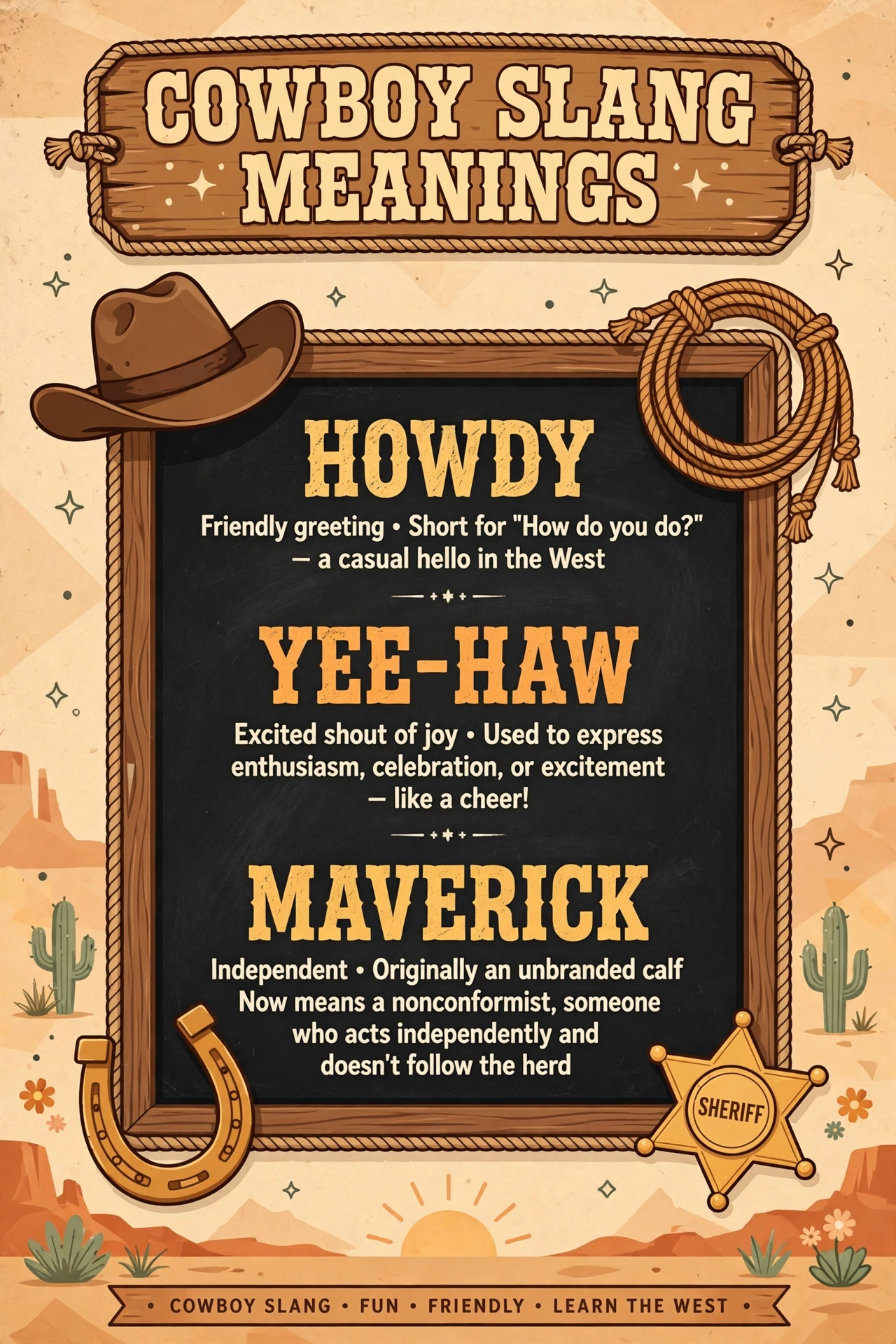
In modern use, cowboy slang is not just history. People drop howdy as a friendly greeting, call a stubborn independent thinker a maverick, and tell a friend to cowboy up when life gets tough. The words have outlived the cattle drives that created them, and they now belong to everyday American English.
Introduction
Picture a dusty trail in 1870s Texas: a line of cowboys moving two thousand head of cattle north, sleeping under the stars, and cooking beans over an open fire. There were no phones, no radios, and very long silences — so the cowboys filled the air with talk. They turned horses into “hosses,” water into “Adam’s ale,” and a good time into “a hog-killin’ time.” Their slang was practical, funny, and tough, just like the life that produced it.
Fast-forward to today, and cowboy slang is everywhere. You hear it in Western movies and country music, in rodeo announcements, in video games like Red Dead Redemption, and even in office slang — because who has not heard a manager call someone a “maverick” or tell the team to “saddle up” before a big project? The Old West may be gone, but its language never really left.
This guide explains cowboy slang from the ground up: what it means, where it came from, the 50+ most useful terms with plain-English meanings, real examples you can use, and the mistakes to avoid so you sound like a ranch hand, not a “mail-order cowboy.” Whether you are writing a story, planning a Western-themed party, or just want to understand what your grandpa meant by “acknowledge the corn,” you will find it here.
Origin
Cowboy slang was born on the great cattle drives of the 1860s to the 1880s, when young men — many of them teenagers — drove herds hundreds of miles from Texas to railheads in Kansas. The work was lonely, dangerous, and repetitive, and the men who did it came from everywhere: former soldiers, freedmen, Mexican vaqueros, Irish and German immigrants, and drifters from the East. Their languages collided on the trail, and a brand-new vocabulary came out of the mix.
The biggest influence was Spanish. The first cowboys of the American Southwest were Mexican vaqueros, and their words entered English almost unchanged: lariat from la reata (the rope), buckaroo from vaquero, rodeo from rodear (to round up), and corral. Even lasso traces back to the Spanish lazo. If a cowboy slang word sounds Spanish, it probably is.
The second influence was the poker table. Cowboys gambled around campfires every night, and card terms leaked into everyday speech. An “ace in the hole” was originally a hidden card — then a hidden gun, then any secret advantage. “Above board” meant honest play, and “according to Hoyle” meant doing something by the book. The language of the saloon became the language of the range.
Folklorist Ramon Adams captured this world in his 1936 book Cowboy Lingo, recording hundreds of terms from working cowboys before they disappeared. His work — along with the Legends of America dictionary of Western slang — remains the foundation for almost every cowboy slang list published since. The slang survived because writers, moviemakers, and country singers kept repeating it long after the last great cattle drive ended.
Popularity
Cowboy slang peaked in everyday speech in the late 1800s, but it has never really gone away. Hollywood gave it a second life: John Wayne, Clint Eastwood, and the westerns of the 1950s and 60s turned phrases like “howdy, partner” and “this town ain’t big enough for the both of us” into global catchphrases. Millions of people who had never seen a ranch learned to talk like a cowboy from the screen.
Country music kept the fire burning. Songs by Johnny Cash, Willie Nelson, and modern stars like Tyler Childers and Zach Bryan are packed with cowboy slang, and rodeo culture — from the National Finals Rodeo to local county fairs — still uses the real vocabulary of the working ranch. In Texas, Oklahoma, Wyoming, and Montana, words like wrangler, tenderfoot, and bronco are still ordinary speech, not costume talk.
Then came the internet. Memes, TikTok, and video games gave cowboy slang a third life: “yee-haw” became a reaction GIF, “cowboy up” became motivational-poster language, and games like Red Dead Redemption 2 introduced a whole new generation to words like varmint and waddie. Western-themed parties, Halloween costumes, and country weddings keep the vocabulary in circulation, and slang dictionaries now list cowboy terms alongside Gen Z words — proof that good slang does not expire.
Interestingly, several cowboy slang words have escaped into standard English so completely that people forget their origin. Maverick now means any independent thinker. Bronco is a Ford SUV. Wrangler is a brand of jeans. When a word jumps from the saddle into the boardroom, you know the slang did its job.
How It Is Used
Cowboy slang is used in three main ways today: as a greeting or exclamation, as a colorful description of people and situations, and as storytelling flavor. The greeting use is the simplest — “howdy” replaces “hello,” “yee-haw” expresses excitement, and “adiós, partner” ends a conversation with a smile. These are the terms most people know, and they are the safest to use anywhere.
The descriptive use is where cowboy slang really shines. Instead of saying someone is inexperienced, a cowboy calls him a tenderfoot. Instead of saying someone is a coward, he is yellow-bellied. Instead of saying a plan is failing, the whole outfit is “all down but nine.” The slang replaces a flat description with a little picture, and that picture is what makes people remember it.
In writing and storytelling, cowboy slang sets a scene in seconds. A novelist who writes “the old wrangler spat, hitched up his britches, and allowed as how the tenderfoot was all hat and no cattle” has told you everything about both characters without a single adjective of explanation. Screenwriters, game designers, and songwriters use it the same way — a few well-chosen terms do the work of a paragraph.
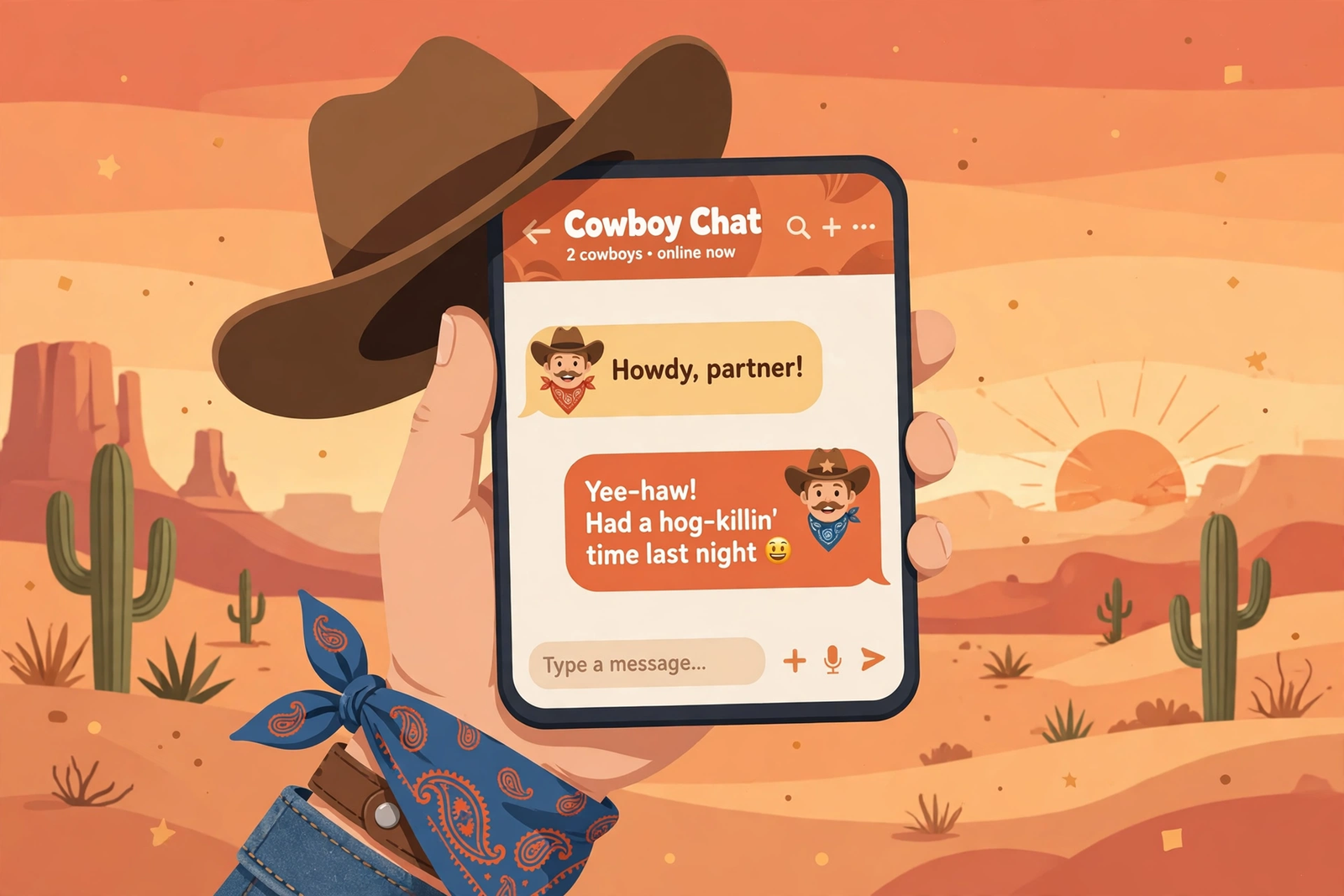
In modern texting and social media, cowboy slang shows up as playful shorthand. “Cowboy up” appears in gym captions, “howdy 🤠” opens friendly DMs, and “yee-haw” punctuates good news. The tone is almost always light and fun — nobody uses cowboy slang to sound formal. It signals warmth, humor, and a little bit of swagger.
| Cowboy Slang Term | Meaning | Example |
|---|---|---|
| Howdy | Hello; short for “how do you do?” | “Howdy, neighbor — good to see ya.” |
| Yee-haw | A shout of excitement or joy | “We won the game — yee-haw!” |
| Maverick | An unbranded calf; now, an independent person | “She’s a real maverick — never follows the crowd.” |
| Tenderfoot | A newcomer; someone new to ranch life | “Don’t mind him, he’s just a tenderfoot.” |
| Wrangler | A ranch hand who works with horses | “The wrangler saddled up the horses at dawn.” |
| Cowboy up | Toughen up; don’t quit | “It’s a hard week — time to cowboy up.” |
| Yellow-bellied | Cowardly; afraid to stand up | “Only a yellow-bellied fool would run from that.” |
| All hat and no cattle | All talk, no substance | “He brags a lot, but he’s all hat and no cattle.” |
| Bronco | A wild, untamed horse | “That bronco threw three riders today.” |
| Buckaroo | A cowboy, especially from the Great Basin | “The old buckaroo knew every trail in Nevada.” |
Examples
The best way to learn cowboy slang is to see it in action. The same phrase can sound friendly, professional, or funny depending on the situation — and the cowboys knew it. Here are real examples grouped by tone, so you can pick the right one for the moment.
Friendly Examples
- “Howdy, partner! Pull up a chair and stay a while.” — The classic warm welcome. Partner here means friend, not business partner.
- “We had us a hog-killin’ time at the rodeo dance last night.” — A hog-killin’ time means a really great time. Use it after any fun night out.
- “You’ve got sand, that’s fer shore.” — Sand means guts or courage. This is a cowboy compliment: you are brave.
- “Well, butter my butt and call me a biscuit — look who’s here!” — A playful, exaggerated way to say you are surprised and delighted to see someone.
- “Happy trails to you, ’til we meet again.” — A warm goodbye, made famous by Roy Rogers. Still used at the end of friendly gatherings in the West.
Professional Examples
- “She’s a maverick in the best sense — she questions the old way of doing things and usually turns out to be right.” — In business, maverick is a compliment for an independent thinker.
- “Let’s saddle up and get this project moving.” — A folksy way to say “let’s get started.” Common in Texas and Oklahoma workplaces.
- “He’s the top wrangler on the crew — nobody handles a difficult client better.” — Wrangler now also means someone who manages something difficult, like data or a team.
- “We need to separate the mavericks from the strays before the meeting.” — In ranch talk, strays are cattle that wandered off; in office talk, it is a light way to describe unfocused ideas.
- “Don’t be a tenderfoot on this one — you’ve done harder jobs before.” — A gentle push: you are not new at this, so act like it.
Funny Examples
- “He’s so all-fired lazy he won’t even get out of his own way.” — All-fired means very or extremely. The exaggeration is the joke.
- “That story was pure balderdash — not a word of truth in it.” — Balderdash means nonsense, and it is funny precisely because it sounds so old-fashioned.
- “The desert canary brayed all night and nobody slept.” — A desert canary is a donkey. Cowboys loved giving animals silly nicknames.
- “He came in dressed like a mail-order cowboy — shiny boots, brand-new hat, never touched a horse.” — The old insult for a fake cowboy still lands today.
- “I’m so hungry I could eat the north end of a southbound mule.” — Classic cowboy exaggeration for being very hungry. Use it before lunch and watch people laugh.
Comparison with Similar Terms
Cowboy slang is often confused with general Western talk, Southern slang, and modern rodeo slang — but each one has its own flavor. Cowboy slang comes from the working ranch and the cattle trail; Southern slang comes from the wider American South; rodeo slang comes from the arena. They overlap, but they are not the same thing.
| Term | Type | Meaning | When to Use It |
|---|---|---|---|
| Howdy | Cowboy slang | Friendly greeting | Any casual Western hello |
| Y’all | Southern slang | You all | General Southern speech, not specifically cowboy |
| Yee-haw | Cowboy slang | Shout of excitement | Celebrations, rodeos, fun moments |
| Fixin’ to | Southern slang | About to do something | Southern US, everyday plans |
| Maverick | Cowboy slang | Independent, unbranded | Describing people or ideas |
| Bless your heart | Southern slang | Polite sympathy (or shade) | Southern politeness, often ironic |
| Buckaroo | Cowboy slang | A cowboy of the Great Basin | Western stories, ranch talk |
| Roughstock | Rodeo slang | Bronc and bull riding events | Rodeo and competition talk |
| Tenderfoot | Cowboy slang | A newcomer | Describing a beginner |
| Greenhorn | General old slang | An inexperienced person | Broader than cowboy use; also nautical |
The key difference is origin and attitude. Cowboy slang is practical and horse-centered — its metaphors come from saddles, ropes, cattle, and weather. Southern slang is more about manners and community. Rodeo slang is technical and competitive. If a phrase mentions a horse, a brand, a rope, or a trail, it is almost certainly cowboy slang. If it is about being polite while delivering an insult, it is probably Southern.
Another useful comparison is cowboy slang versus pirate slang. Both are colorful, exaggerated, and tied to a romanticized job — but pirate slang is nautical (“ahoy,” “matey,” “walk the plank”), while cowboy slang is landlocked and ranch-based. Mixing the two is the fastest way to sound like a costume, not a cowboy.

Alternate Meanings
Many cowboy slang words have more than one meaning, and some have drifted far from their ranch roots. Knowing the alternate meanings keeps you from misunderstanding an old novel — or a modern conversation.
- Maverick: On the ranch, an unbranded calf. In modern English, an independent person who refuses to follow the crowd. In business, it can also describe a company that breaks industry rules — and in pop culture, it is the call sign of Tom Cruise’s character in Top Gun.
- Bronco: A wild horse that bucks. Today it is also a Ford SUV, a Denver football team (the Broncos), and college mascots across the West.
- Wrangler: A horse handler on a ranch. Now also a brand of jeans, a job title for people who manage data (“data wrangler”), and a term for anyone who organizes something unruly.
- Buckaroo: A cowboy, from the Spanish vaquero. In some regions it also describes the distinctive flat-hat, high-heel-boot style of Great Basin cowboys — a whole subculture, not just a job.
- Stampede: A sudden rush of frightened cattle. In everyday speech, any wild rush of people, as in “a stampede for the exits” or “a stampede of Black Friday shoppers.”
- Corral: A fenced pen for livestock. Figuratively, to gather or round up people or things — “let’s corral the team for a quick meeting.”
- Lasso: A rope loop for catching cattle. In casual speech, to catch or capture anything, from a job to a date — “she lassoed a promotion this year.”
- Iron horse: A railroad train, named by people who had only known real horses. The phrase is mostly historical now, but it shows how cowboys named new things with old words.
Professional or Polite Alternatives
Cowboy slang is fun, but it is not always the right register. In a job interview, a formal email, or a meeting with clients, you usually want the same idea in plain professional English. Here is how to translate the most common cowboy slang terms when the situation calls for it:
| Cowboy Slang | Professional Alternative |
|---|---|
| Howdy, partner | Hello, it’s good to see you |
| Cowboy up | Stay resilient and push through |
| All hat and no cattle | Strong on promises, light on delivery |
| Tenderfoot | New team member / someone new to the role |
| Yellow-bellied | Reluctant to take responsibility |
| Saddle up | Let’s get started |
| Maverick | Independent thinker |
| A hog-killin’ time | A wonderful time / a great experience |
| Pull in your horns | Please step back / let’s de-escalate |
| Acknowledge the corn | Admit the mistake / own up to it |
The trick is knowing your audience. With friends at a barbecue, “cowboy up” gets a laugh. In a performance review, “stay resilient” gets the same point across without the costume. Good communicators keep both versions in their pocket — just like a cowboy kept both a work rope and a dress rope.
Common Mistakes
Cowboy slang is easy to love and easy to get wrong. These are the mistakes people make most often — and how to avoid them:
- Using it like a costume: Dropping “howdy, partner” into every sentence does not make you sound Western — it makes you sound like a theme-park employee. Use one or two terms naturally, not a whole dictionary at once.
- Calling everyone “partner”: On the ranch, partner meant a trusted friend or workmate, not a stranger. Overusing it with people you just met can feel forced or even condescending.
- Mixing cowboy slang with pirate or Southern slang: “Yee-haw, y’all, shiver me timbers” is three different worlds in one sentence. Pick one flavor and stay with it.
- Using “maverick” as an insult: In modern use, maverick is usually a compliment — independent, bold, original. Calling someone a maverick to mean “difficult” misses the point and can backfire.
- Getting the terms wrong: A wrangler works with horses; a waddie is a hired hand who tends cattle; a buckaroo is a specific kind of cowboy. Swapping them casually is like calling a pilot a sailor — close, but wrong.
- Forgetting the tone: Some old terms are genuinely insulting — “mail-order cowboy” and “yellow-bellied” were fighting words on the trail. Using them as jokes with the wrong person can still sting.
- Overdoing the accent in writing: Writing “git along, little dogies” in an email is charming once; doing it in every message is exhausting. Let the vocabulary carry the flavor, not a phonetic accent.

Quick Tips
- Start with the big three: Learn howdy, yee-haw, and cowboy up first. They cover greetings, excitement, and encouragement — the three situations where cowboy slang comes up most.
- Use one term per conversation: A single well-placed “that’s a real maverick move” lands better than five slang words in one sentence.
- Match the moment: Cowboy slang fits celebrations, country events, Western movies, and friendly chats. It does not fit condolence cards, legal letters, or serious apologies.
- Learn the stories behind the words: Knowing that maverick comes from a rancher named Samuel Maverick makes the word stick — and gives you a great story to tell at dinner.
- Watch a classic Western: Films like True Grit, Lonesome Dove, and The Magnificent Seven use cowboy slang the way real speakers do — in context, with the right rhythm.
- Read the original dictionaries: Ramon Adams’ Cowboy Lingo and the Legends of America Western slang guide are the gold standards, and both are still quoted by every modern list — including this one.
- Pair it with the right slang family: If you like cowboy slang, you will probably enjoy our guides to Gen Alpha slang and sigma slang — same idea, very different century.

FAQ
What does cowboy slang mean?
Cowboy slang means the informal words and phrases invented by American cowboys during the cattle-drive era of the 1800s — terms like howdy, maverick, tenderfoot, and yee-haw that described ranch life with humor and vivid metaphor. Today it also means any of those terms used in modern speech, movies, or music.
What is the most famous cowboy slang word?
Howdy is the most famous cowboy slang word — a shortened form of “how do you do?” that became the standard Western greeting. Yee-haw is a close second as the most recognized cowboy exclamation, thanks to movies, rodeo, and memes.
What does “cowboy up” mean?
“Cowboy up” means to toughen up, stop complaining, and face a hard situation with courage — the way a cowboy gets back on a horse after being thrown. It is used as encouragement in sports, work, and everyday challenges: “It’s going to be a tough week, so cowboy up.”
What does “all hat and no cattle” mean?
“All hat and no cattle” describes someone who talks big and dresses the part but has nothing real to back it up — no experience, no results, no substance. It is the cowboy version of “all talk, no action,” and it is still one of the sharpest insults in Western speech.
What does “maverick” mean in cowboy slang?
On the ranch, a maverick was an unbranded calf, named after Texas rancher Samuel Maverick, who famously did not brand his cattle. In modern English, a maverick is an independent person who thinks for themselves and refuses to follow the crowd — usually meant as a compliment.
What does “tenderfoot” mean?
A tenderfoot is a newcomer — someone new to ranch life whose feet are not yet toughened by boots and long days on the trail. The word is still used today for any beginner, from a new employee to a first-time camper.
Is cowboy slang still used today?
Yes. Words like howdy, maverick, wrangler, and bronco are still in everyday American English, and phrases like “cowboy up” and “saddle up” appear in sports, business, and social media. Rodeos, country music, Western films, and video games keep the vocabulary alive for new generations.
What is the difference between cowboy slang and Southern slang?
Cowboy slang comes from the working ranch and the cattle trail — its metaphors involve horses, ropes, brands, and weather. Southern slang comes from the broader American South and is more about manners, community, and everyday life (like “y’all” and “bless your heart”). The two overlap in the South, but their origins and flavor are different.
Conclusion
Cowboy slang is more than a list of funny old words — it is a window into a way of life. Every term carries a story: maverick remembers a rancher who refused to brand his cattle, ace in the hole remembers a poker game by the campfire, and howdy remembers a time when a greeting was also a promise of hospitality. The cowboys who invented this language are gone, but the words still do their job — they make plain speech a little brighter, a little tougher, and a lot more fun.
The best way to keep cowboy slang alive is to use it — lightly, naturally, and in the right moment. Greet a friend with “howdy,” tell a struggling teammate to “cowboy up,” and save “all hat and no cattle” for the one person who truly deserves it. Just remember the golden rule of the trail: one good term at a time, and never dress up like a mail-order cowboy.
For the full historical dictionary behind many of these terms, the Legends of America guide to Western slang, lingo, and phrases is the best free source — it draws on period newspapers, books, and century-old dictionaries. And if you enjoy decoding modern slang as much as old Western talk, check out our guides to mewing and glizzy — the same kind of colorful language, from a very different century.

1 thought on “Cowboy Slang: 50+ Wild West Words, Meanings & Examples”