
Quick definition: 1920s slang is the colorful, playful vocabulary of America’s Roaring Twenties — words like “the bee’s knees,” “flapper,” and “giggle water” that captured the jazz, rebellion, and humor of the decade.
1920s Slang Meaning & Definition
1920s slang refers to the informal words and phrases that became popular in the United States during the 1920s, a decade often called the Roaring Twenties or the Jazz Age. It was the language of flappers and sheiks, jazz clubs and speakeasies, bootleggers and college kids. Some of it was clever, some of it was silly, and a surprising amount of it is still alive today — words like “bluenose,” “big cheese,” and “blind date” all started in this era.
What made 1920s slang special was its attitude. After the First World War, young Americans were done with stiff, formal Victorian manners. They wanted language that sounded as modern as they felt: fast, funny, and a little bit rebellious. So they invented words for everything — dancing, drinking, dating, cars, money, and people they liked or did not like. If a word made people laugh, it spread. If it sounded old, it died.
Introduction
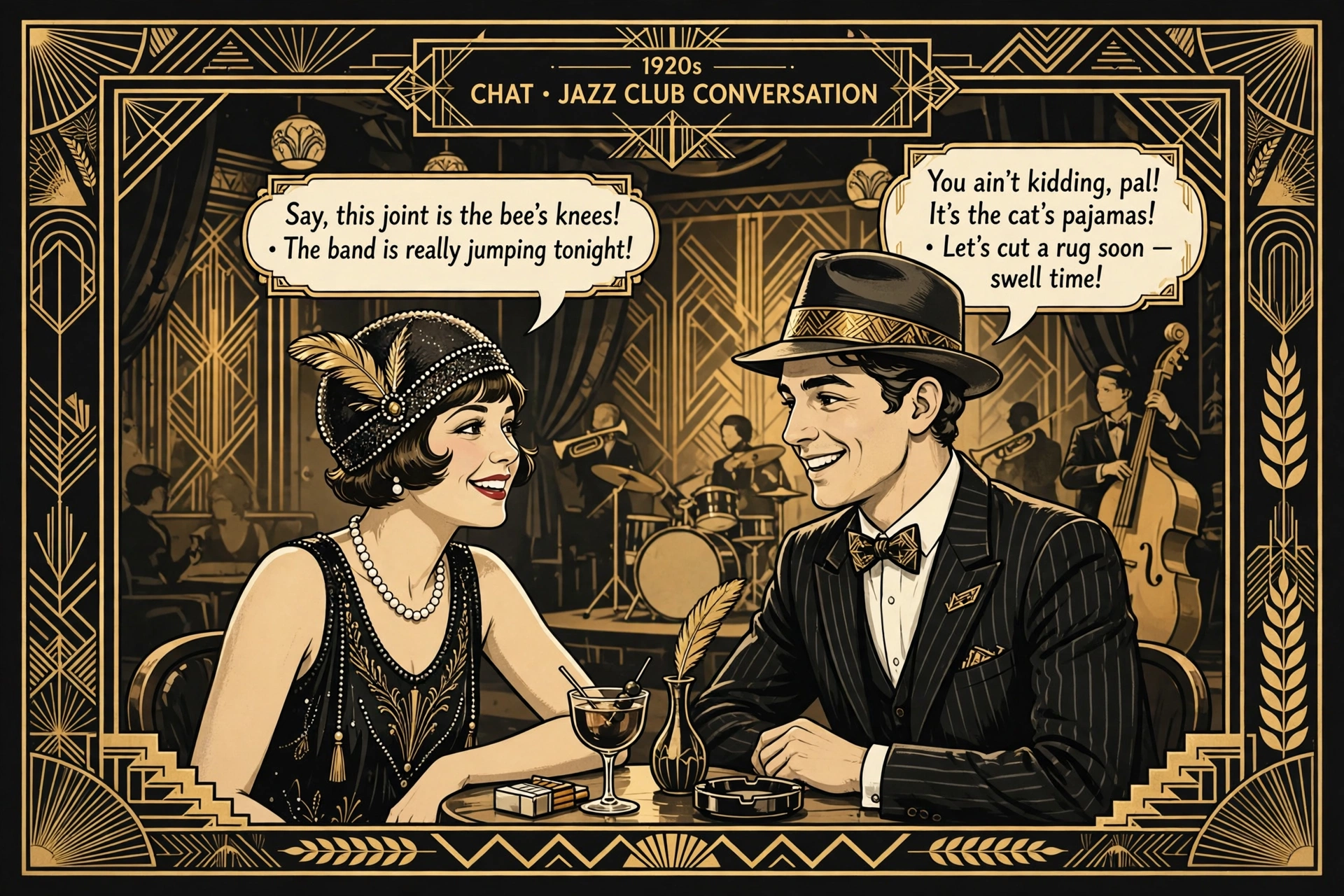
Picture a smoky jazz club in 1925. A band is swinging, couples are dancing the Charleston, and someone leans over and says, “Say, this joint is the cat’s pajamas!” Nobody is talking about an actual cat. They mean the place is wonderful — the best of the best. That is the magic of 1920s slang: it turns ordinary praise into a punchline.
The Roaring Twenties gave us some of the most creative slang in American history. Prohibition made drinking illegal, so people invented secret words for alcohol and the hidden bars that served it. Cars became affordable, so drivers invented words for bad cars and fast driving. Women cut their hair, shortened their skirts, and claimed a new kind of freedom — and the word “flapper” became famous around the world.
Today, 1920s slang is back in style. It shows up in movies like The Great Gatsby, in themed parties, in crossword puzzles, and all over social media, where people love throwing a vintage phrase into a modern caption. Unlike a lot of modern internet slang, which can feel confusing, 1920s slang is easy to enjoy because it is playful and visual. When you call something “the bee’s knees,” everyone gets the joke. This guide explains what 1920s slang means, where it came from, and how to use the best words from the decade — with a complete glossary you can actually use at your next Gatsby party.

Origin
1920s slang did not appear out of nowhere. It grew out of several big changes happening at the same time. First, the First World War had just ended, and soldiers came home with military slang and a taste for blunt, funny language. Second, Prohibition began in 1920, banning the sale of alcohol — and whenever something is banned, people invent code words for it. That is why the decade is full of drink slang: “giggle water” for liquor, “juice joint” for a speakeasy, “hooch” for bootleg whiskey, and “blind pig” for an illegal bar.
Third, jazz music exploded. Jazz clubs, dance halls, and radio brought Black American musical culture — and its slang — to a national audience. Words like “hep” (later “hip”), “jive,” and “jam” all traveled through jazz. Fourth, young women — the famous flappers — were rewriting the rules of behavior, and the press loved writing about them. Newspapers in 1922 even published a “flapper dictionary” explaining words like “sheba” (a pretty girl) and “sheik” (a handsome man) to baffled parents.
Finally, the movies helped. Silent films and early talkies carried slang from New York and Chicago to small towns everywhere. A phrase heard in a movie theater on Friday could be heard on a school playground by Monday. Slang had become mass entertainment.
Popularity
1920s slang was popular for the same reason slang is always popular: it made insiders feel like insiders. If you knew that “applesauce” meant nonsense and “know your onions” meant you knew what you were talking about, you were part of the crowd. College students, jazz fans, and city kids traded new words like baseball cards.
Some words became so popular they never left. “Big cheese” still means the boss. “Blind date” still means a date with a stranger. “Dumb Dora” faded, but “jalopy” hung around for decades as a word for a beat-up old car. Other words, like “the bee’s knees” and “the cat’s pajamas,” became so famous that they turned into symbols of the whole decade — even people who have never seen a flapper dress know those phrases.
The slang also stayed popular because it is fun to say. Try saying “hotsy-totsy” or “bee’s knees” without smiling. The words bounce. They rhyme. They paint pictures. Modern slang works the same way — just as today’s teens invent new words for everything, from zesty to glazing, the kids of the 1920s invented words that fit their world. Slang is how every generation says, “This is ours.”
How It Is Used
Most 1920s slang works as praise, insult, or description, and the grammar is simple. You can drop a phrase into a normal sentence without changing anything else:
- As praise: “That band is the bee’s knees!” / “Her dress is the cat’s meow.”
- As an insult: “Don’t be a flat tire.” / “That idea is all wet.”
- As description: “He’s a real cake-eater.” / “We went to a juice joint last night.”
- As an exclamation: “Applesauce!” (meaning “Nonsense!”) / “Horsefeathers!” (the same idea, stronger).
The tone matters more than the dictionary meaning. Most 1920s slang is playful, not serious. People used it to joke with friends, flirt, show off, and complain without sounding angry. A “drugstore cowboy” was not a real cowboy — he was a guy who hung around street corners trying to impress girls. A “sheba” was not a queen — she was just a very attractive woman. The humor was the point.
Today, people mostly use 1920s slang for fun: at themed parties, in costumes, in writing, and in jokes online. It is rarely used seriously anymore, which is actually a strength — it signals that you are being playful, not literal. If your friend posts a photo from a vintage party and you comment “the bee’s knees!”, everyone knows you mean it as a compliment with a wink.
Examples
Here are real examples of 1920s slang in action, sorted by tone.
Friendly Examples
- “You look hotsy-totsy tonight!” — You look perfect, just right.
- “Everything is Jake.” — Everything is fine, all good.
- “That party was the berries!” — That party was wonderful.
- “Come on, let’s get a wiggle on.” — Let’s hurry up, get moving.
Professional Examples
- “She really knows her onions when it comes to jazz.” — She really knows her stuff.
- “He’s the big cheese around here.” — He’s the boss, the most important person.
- “Don’t be a flat tire in the meeting — bring some energy.” — Don’t be a boring, dull person.
- “Let’s level with each other about the budget.” — Let’s be honest with each other.
Funny Examples
- “Ah, applesauce! You can’t dance the Charleston at all!” — Nonsense! You’re terrible at it (said with a grin).
- “He showed up in his jalopy and it broke down twice.” — His old, run-down car barely made it.
- “My dogs are barking after dancing all night.” — My feet hurt (dogs = feet).
- “Don’t take any wooden nickels!” — Don’t be fooled, don’t do anything stupid.
Comparison with Similar Terms
1920s slang is often confused with other vintage or modern slang. Here is how it compares:
| Term / Era | What It Means | How It Differs from 1920s Slang |
|---|---|---|
| 1920s slang | Jazz Age words like “bee’s knees” and “flapper” | Playful, rhyming, Prohibition-era; mostly compliments and party talk |
| 1930s–40s slang | Depression and wartime words like “swell” and “hubba-hubba” | More about toughness and the war; less about parties |
| 1950s slang | Words like “cool,” “daddy-o,” and “sock hop” | Rock-and-roll era; “cool” actually survives from this period |
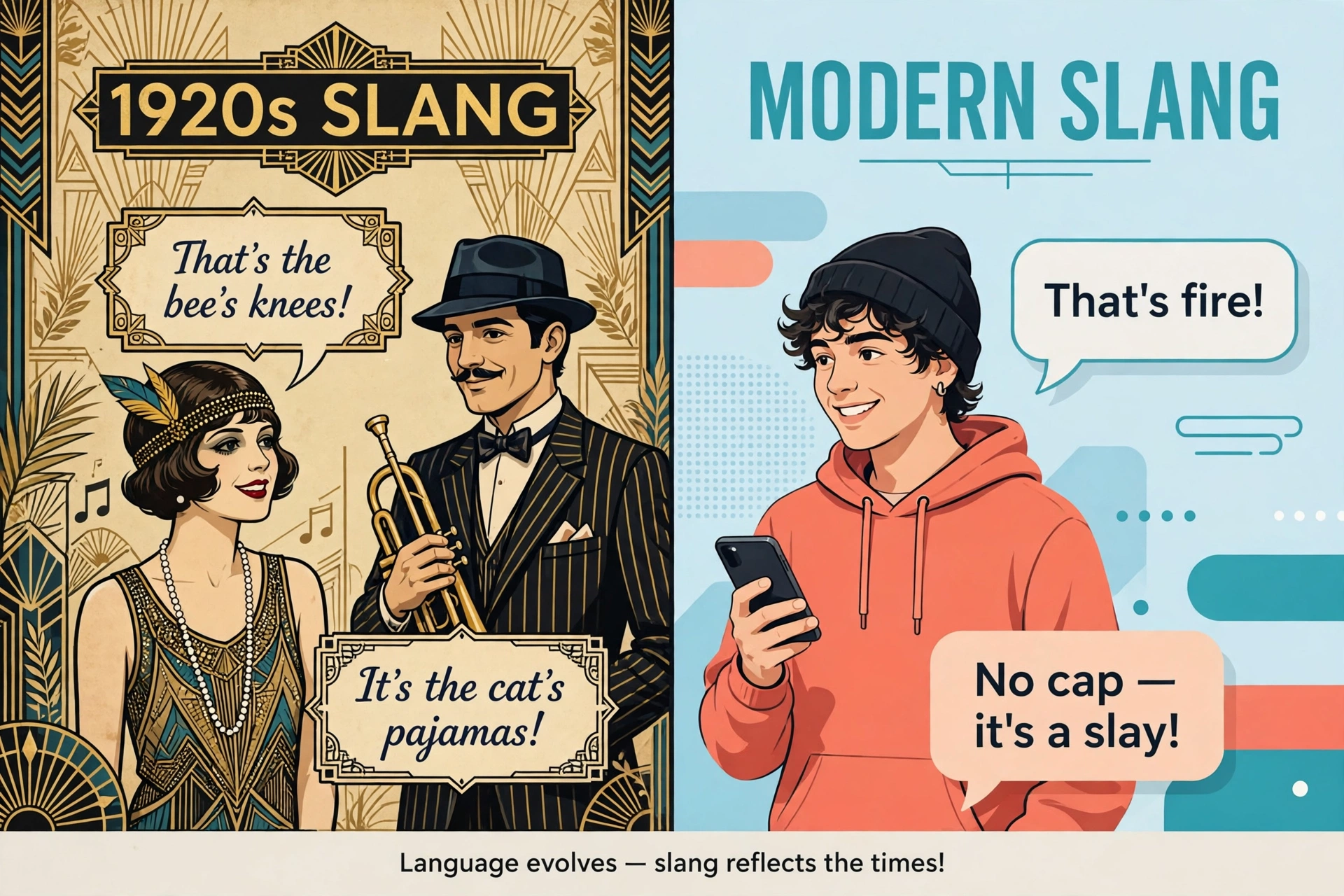
| Modern internet slang | Words like “rizz,” “slay,” and “no cap” | Born on social media; spreads in days, not years |
| British 1920s slang | Words like “spiffing” and “old bean” | Same decade, different country; much more upper-class in tone |
The closest cousins to 1920s slang are the praise words. “The bee’s knees,” “the cat’s pajamas,” and “the cat’s meow” all mean roughly the same thing — something excellent — but they were not exact copies. “Bee’s knees” was the most general, “cat’s pajamas” leaned fashionable, and “cat’s meow” leaned stylish. Think of them like modern praise words: just as muse and other modern terms each carry their own shade of meaning, each 1920s praise word had its own flavor.
Alternate Meanings
Like all slang, 1920s words sometimes meant more than one thing, and some of them changed meaning over time:
- Flapper: Originally a young woman with short skirts and bobbed hair. In Britain, it earlier meant a young girl whose hair was not yet “put up.” The American meaning is the one that stuck.
- Joint: In the 1920s, a “joint” was a place — a club, bar, or restaurant (“a nice little joint”). Only decades later did it gain its drug-related meaning.
- Crush: A crush meant an infatuation then, exactly as it does now — one of the rare words whose meaning barely moved in 100 years.
- Gold digger: In the 1920s it meant a woman who married for money. The meaning is the same today, though the word is now used more carefully.
- Keen: In the 1920s, “keen” meant attractive or appealing (“a keen dress”). Today it mostly means enthusiastic (“keen to go”), though the old meaning survives in some places.
- Darb: A “darb” was an excellent person or thing. It is almost completely forgotten now, which is a shame — it is a great word.
Professional or Polite Alternatives
1920s slang is fun, but it is not right for every situation. Here are polite, modern alternatives for the most common phrases:
| 1920s Slang | Polite / Modern Alternative |
|---|---|
| The bee’s knees / the cat’s pajamas | Excellent, outstanding, wonderful |
| Everything is Jake | Everything is fine, all good |
| Know your onions | Know your subject well, be knowledgeable |
| Big cheese | The person in charge, the boss |
| Flat tire (a dull person) | Not very lively, a bit boring |
| Applesauce / horsefeathers | Nonsense, that’s not true |
| Get a wiggle on | Hurry up, let’s get going |
| Giggle water | Alcohol, a drink |
At work or in formal writing, use the modern column. At a party, in a story, or in a playful message, the 1920s column is much more fun — and that is exactly why these words survived.
Common Mistakes
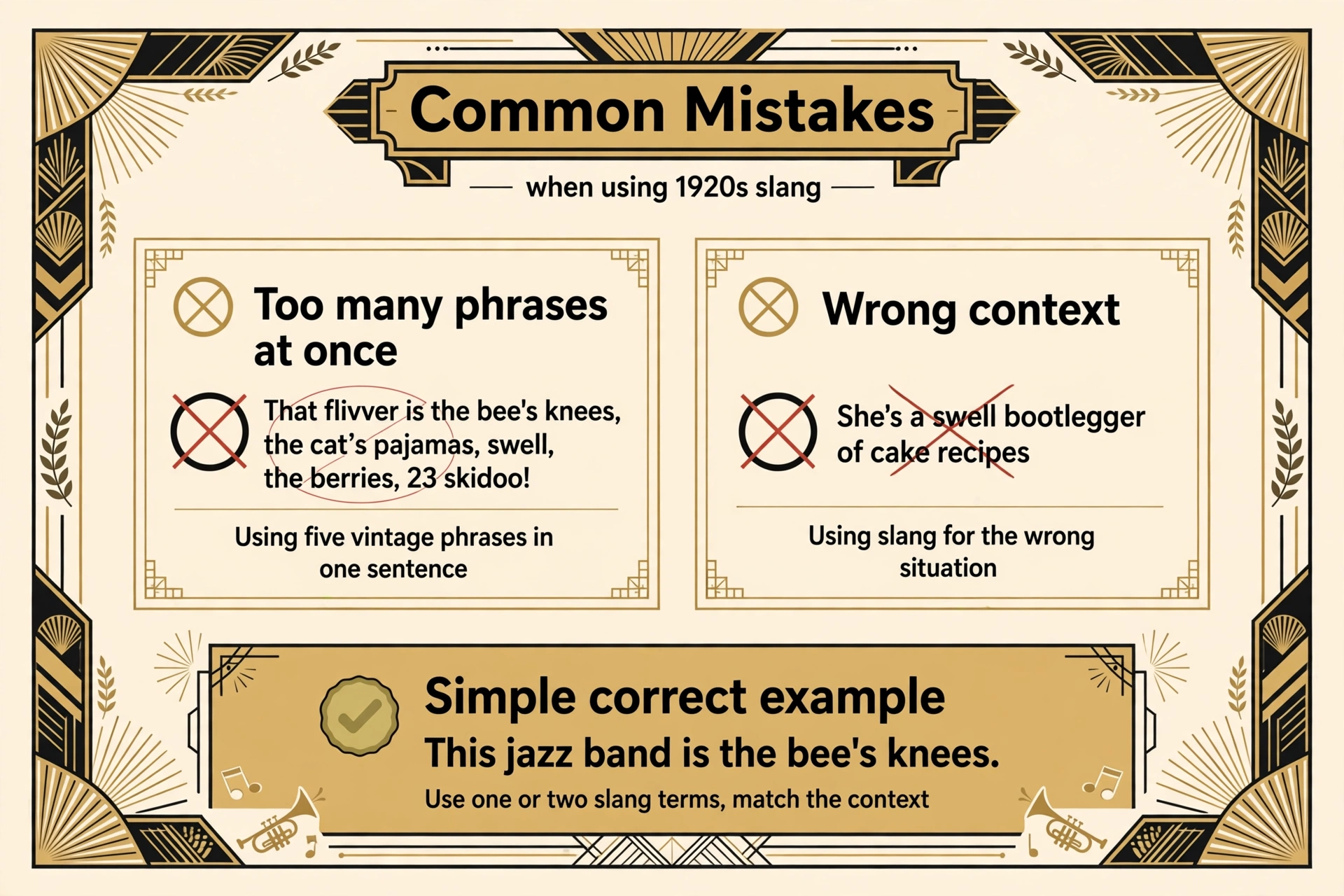
- Using too many phrases at once: One vintage phrase in a sentence is charming. Five in a row sounds like a costume, not a conversation. Pick one gem and let it shine.
- Mixing decades: “Groovy” is 1960s, “rad” is 1980s, “the bee’s knees” is 1920s. Mixing them in one sentence breaks the illusion if you are going for a real 1920s vibe.
- Using insult words seriously: Words like “dumb Dora” or “flat tire” were insults even then. Using them about a real person today can come across as rude, not retro.
- Getting the meaning backwards: “All wet” does not mean cool — it means wrong. “Applesauce” does not mean delicious — it means nonsense. Check the glossary before you use a new word.
- Forgetting the context: Some 1920s words came from Prohibition crime culture (“bump off” means to murder). They are fine in a gangster movie quote, but odd in a wedding toast.
- Over-explaining the joke: If you say “the bee’s knees” and then explain what it means, the joke dies. Trust your audience — or pick a word they already know.
Quick Tips
- Start with the famous three: “The bee’s knees,” “the cat’s pajamas,” and “flapper” are the safest, most recognized 1920s words. Everyone knows them.
- Use slang as seasoning, not the main dish: One phrase per message or caption is the sweet spot.
- Match the setting: 1920s slang shines at themed parties, in historical fiction, in captions for vintage photos, and in playful texts.
- Learn the glossary below: The more words you know, the less likely you are to use one wrong.
- Pair old with new: Mixing one vintage phrase with modern slang (“That outfit is the bee’s knees, no cap”) is a fun, modern way to use it — and it is how slang stays alive.
- Watch The Great Gatsby or Chicago: Hearing the words spoken in context teaches you the tone faster than any list.

Ready to sound like a real flapper or sheik? Here is the full glossary — the words that defined the decade.
Complete 1920s Slang Glossary
| Word / Phrase | Meaning |
|---|---|
| All wet | Wrong, mistaken (“Your theory is all wet.”) |
| Applesauce | Nonsense; an exclamation like “Rubbish!” |
| Bee’s knees | Something excellent; the best |
| Berries | Something attractive or pleasing (“It’s the berries.”) |
| Big cheese | The boss; the most important person |
| Blind date | A date with someone you have never met |
| Bluenose | An overly strict, puritanical person |
| Cake-eater | A ladies’ man; a man who attends tea parties |
| Carry a torch | To have a crush on someone |
| Cat’s meow | Something splendid or stylish |
| Cat’s pajamas | Something excellent or fashionable |
| Cheaters | Eyeglasses |
| Clam | A dollar |
| Copacetic | Excellent; everything in order |
| Darb | An excellent person or thing |
| Dogs | Feet (“My dogs are barking.”) |
| Drugstore cowboy | A man who loiters on street corners trying to impress women |
| Dumb Dora | A silly or stupid woman (insult; dated) |
| Flapper | A fashionable, independent young woman of the 1920s |
| Flat tire | A dull, boring person or date |
| Gams | A woman’s legs |
| Giggle water | Alcohol; liquor |
| Gold digger | Someone who pursues a partner for money |
| Handcuff | An engagement ring |
| Heebie-jeebies | Nervous jitters; a creepy feeling |
| High-hat | To snub or ignore someone coldly |
| Hooch | Bootleg liquor |
| Hoofer | A dancer |
| Horsefeathers | Nonsense (stronger than “applesauce”) |
| Hotsy-totsy | Perfect; just right |
| Jake | Okay; fine (“Everything is Jake.”) |
| Jalopy | An old, run-down car |
| Juice joint | A speakeasy; an illegal bar |
| Keen | Attractive; appealing |
| Kisser | The mouth |
| Know your onions | To know your subject well |
| Level with me | Be honest with me |
| Sheba | A beautiful, glamorous woman |
| Sheik | A handsome man; a ladies’ man |
| Speakeasy | A secret, illegal bar during Prohibition |
| Don’t take any wooden nickels | Don’t be fooled; be careful |
For a fascinating look at how these words were actually explained to readers back then, check out the original 1922 flapper dictionary — a real newspaper guide to flapper lingo from the decade itself.

FAQ
What is 1920s slang?
1920s slang is the informal vocabulary of America’s Roaring Twenties — playful words and phrases like “the bee’s knees,” “flapper,” and “giggle water” that came from jazz culture, Prohibition, and the new freedoms of the decade.
What does “the bee’s knees” mean?
“The bee’s knees” means something excellent or outstanding. It is one of the most famous 1920s phrases, and it is still used today as a fun way to say something is the best.
What is a flapper in 1920s slang?
A flapper was a fashionable young woman of the 1920s who wore short skirts, bobbed her hair, listened to jazz, and challenged old-fashioned rules about how women should behave. The word became a symbol of the whole decade.
What is 1920s slang for cool?
The most common 1920s words for “cool” or excellent were “the bee’s knees,” “the cat’s pajamas,” “copacetic,” and “darb.” If something was great, any of these would do.
What is 1920s slang for alcohol?
During Prohibition, people called alcohol “giggle water,” “hooch,” “juice,” or “moonshine.” Bars that served it illegally were called “speakeasies,” “juice joints,” or “blind pigs.”
What does “know your onions” mean?
“Know your onions” means to know your subject really well — to be knowledgeable and competent. If someone says you know your onions, it is a compliment.
Is 1920s slang still used today?
Yes — words like “big cheese,” “blind date,” “crush,” and “the bee’s knees” are still in everyday use, and the rest of the vocabulary is popular at themed parties, in movies, and in playful social media captions.
How can I use 1920s slang without sounding silly?
Use just one phrase at a time, in a playful setting, and pick words your audience already knows — “the bee’s knees” or “the cat’s pajamas” are safe starters. One vintage word in a modern sentence is charming; five in a row is a costume.
Conclusion
1920s slang is more than a list of funny old words — it is a snapshot of a decade that changed America. In those ten years, young people invented a language for jazz, for rebellion, for romance, and for fun, and the best of it never died. “The bee’s knees” still makes people smile. “Flapper” still means freedom and style. “Know your onions” is still the perfect compliment for someone who knows their stuff.
The lesson of 1920s slang is the same lesson behind every generation’s slang, from the flappers to today’s YN slang and beyond: language belongs to the people who play with it. So go ahead — drop a “bee’s knees” into your next caption, call your friend’s vintage outfit “the cat’s pajamas,” and keep a century-old joke alive. After all, everything is Jake.

1 thought on “1920s Slang: 50+ Roaring Twenties Words, Phrases & Meanings”