
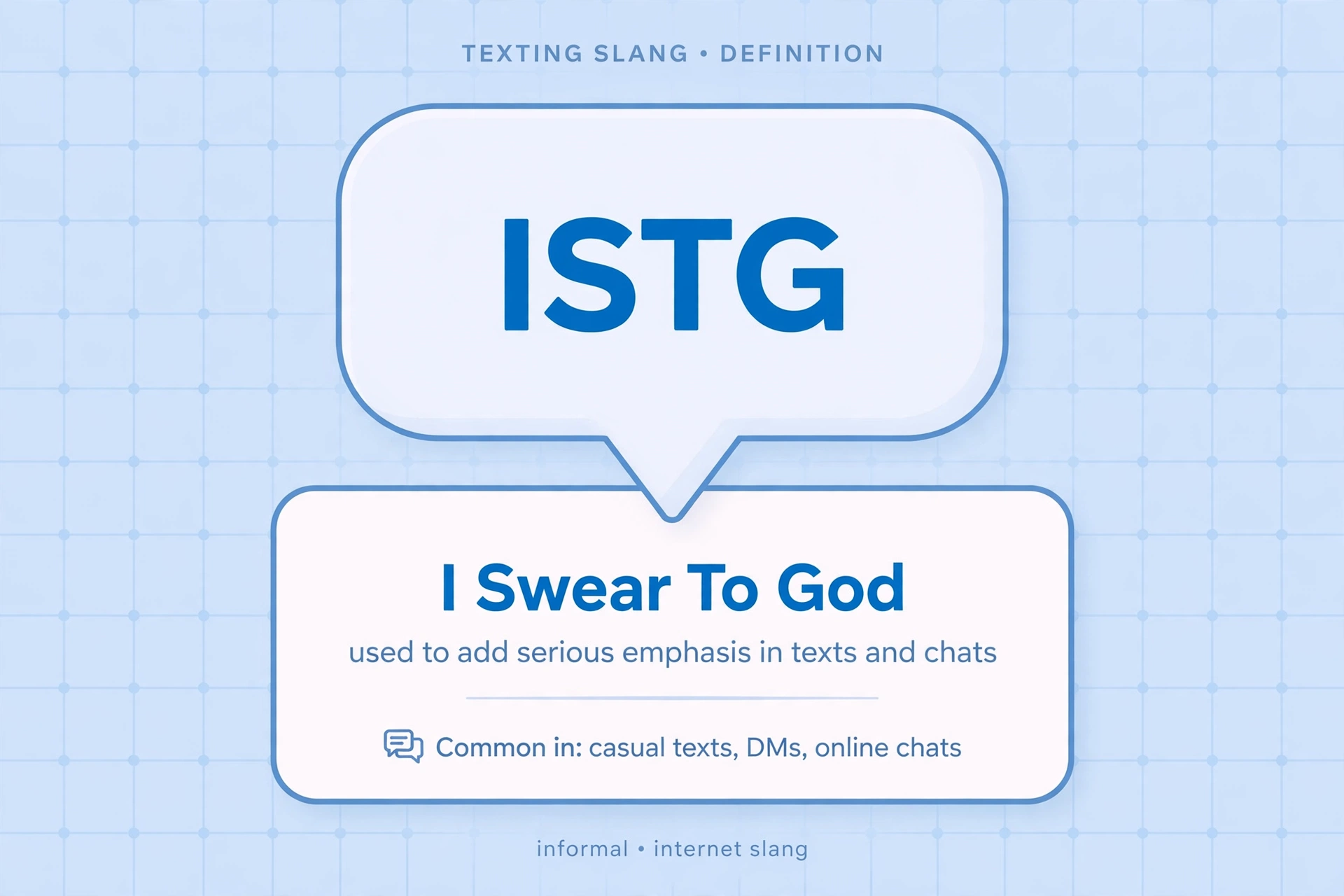
Quick definition: ISTG means “I swear to God” in texting and online conversations. People use it to add serious emphasis to what they’re saying — as a promise, a reaction to something unbelievable, or an outburst of frustration — like saying “I’m telling you the truth” or “you won’t believe this.”
ISTG Meaning & Definition
ISTG is a texting abbreviation for “I swear to God.” It is one of the most emotionally charged acronyms in internet slang, and it works exactly like the phrase it stands for: it turns an ordinary sentence into a declaration. When someone texts “istg,” they are telling you that they mean what they say — completely, no exaggeration, no joke.
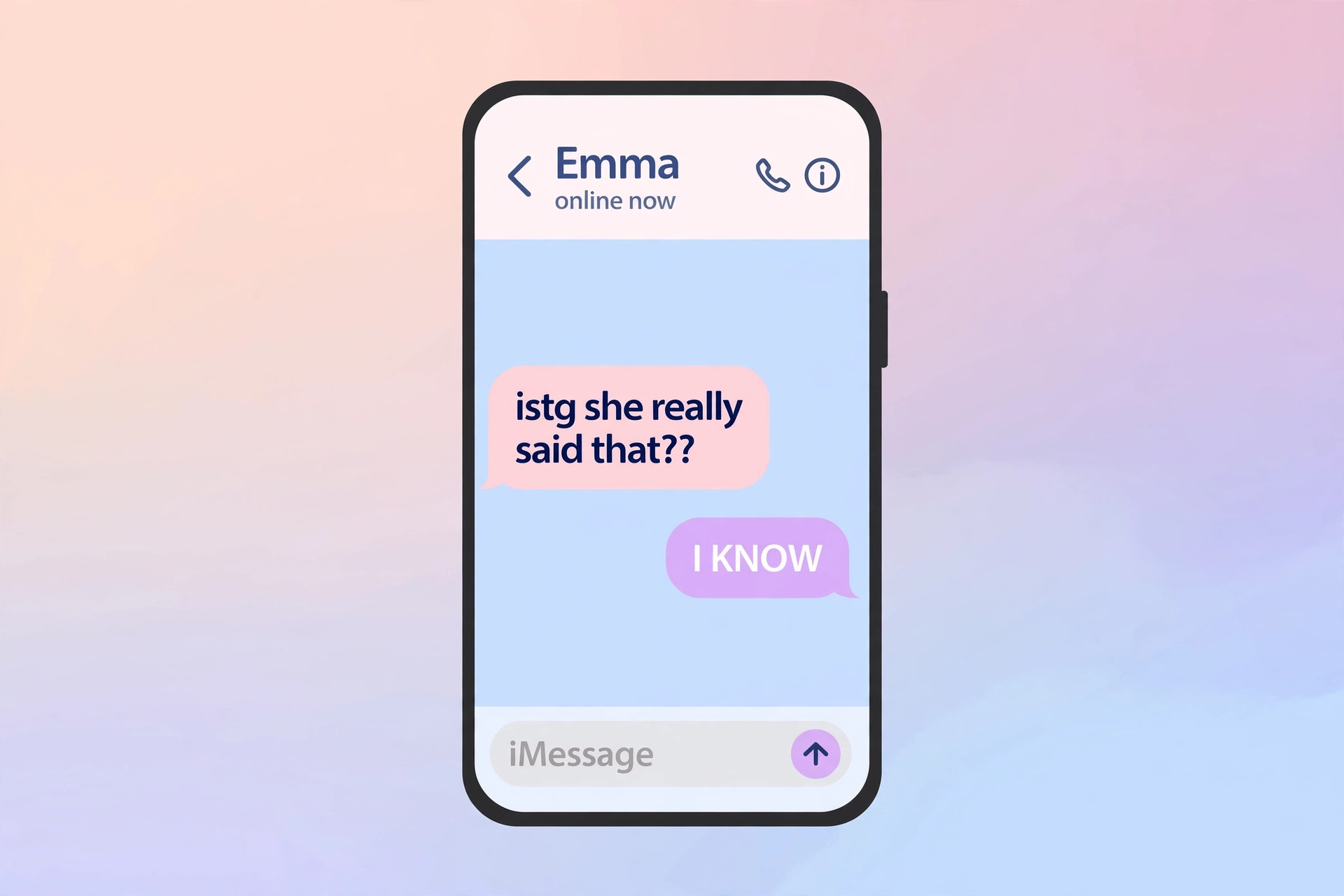
The istg meaning in text changes slightly depending on the mood of the conversation. In a happy context, it’s a promise: “istg I’ll send you the photos tonight” means a sincere commitment. In a shocked context, it’s disbelief: “istg she really said that??” means the speaker can barely process what happened. And in a frustrated context, it’s an outburst: “istg if the Wi-Fi drops one more time—” means the speaker is at the edge of their patience.
That versatility is the whole secret of ISTG’s staying power. It’s part promise, part exclamation mark, part emotional venting — all packed into four letters. It shows up in group chats, TikTok comments, gaming lobbies, and DMs, usually at the exact moment a conversation hits peak emotion.
Introduction
Few texting acronyms carry as much raw emotion as ISTG. While abbreviations like LOL or BRB are purely functional, ISTG is theatrical — it makes the reader feel something. Drop an “istg” into a sentence and the whole tone shifts: the message suddenly sounds urgent, genuine, and a little dramatic.
That’s why ISTG has survived every wave of internet slang. New terms appear and fade on TikTok every month, but ISTG keeps coming back, because the human need it serves never goes away: the need to make someone believe you. Whether you’re swearing a story is true, promising to finally do something, or reacting to something so wild it doesn’t feel real, ISTG is the shorthand for “I mean this with my whole chest.”
In this complete guide, we’ll break down the istg meaning in text from every angle: where it came from, why it blew up, how people use it in different tones, the real chat examples that show it in action, how it compares with similar slang like FRFR and S2G, the mistakes people make with it, and quick tips for using it naturally. By the end, you’ll know exactly when to drop an “istg” — and when to leave it out.
If you’re brushing up on texting slang in general, our guides to FRFR meaning in text and NGL meaning in text pair perfectly with this one — they cover the other heavy hitters of emotional internet shorthand.
Origin
The phrase “I swear to God” is centuries old — it’s a solemn oath that appears in courtrooms, religious texts, and everyday arguments long before the internet existed. The acronym ISTG, though, is a product of the digital age. It emerged in the early 2010s alongside other emotional acronyms like SMH (shaking my head) and IYKYK (if you know you know), when texting and instant messaging made short, punchy reactions more valuable than long sentences.
ISTG first gained real traction on platforms like Tumblr and Twitter, where character limits and fast-paced timelines rewarded brevity. On Tumblr, dramatic text posts like “istg if one more thing goes wrong today” became a whole genre of relatable content. Twitter’s quote-tweets and reaction culture pushed it further — “istg” was the perfect four-character way to react to something outrageous without writing a paragraph.
The acronym got its second big wave in the late 2010s and early 2020s with the rise of TikTok and meme culture. Reaction memes, POV videos, and comment-section drama all use ISTG as a punchline: captions like “istg the way my heart dropped 😭” became standard. Gaming culture adopted it too — “istg if he camps mid one more time” is practically a genre of lobby chat. Today, ISTG is mainstream internet vocabulary, understood by everyone from middle schoolers to millennials, even by many people who never learned newer slang.
Popularity
ISTG is one of the most consistently used slang acronyms online. Unlike trendy terms that spike for a month and vanish, ISTG has maintained steady usage for over a decade — a rare achievement in the fast-moving world of internet slang. Search interest stays high year-round, and it spikes whenever viral drama, celebrity moments, or shocking news gives people something to swear about.
You’ll find ISTG across every corner of the internet:
- TikTok & Instagram: captions and comments — “istg this song never gets old,” “istg the way I screamed.”
- Group chats: dramatic reactions — “istg y’all are not ready for this tea ☕.”
- Gaming: rage and hype — “istg this boss is impossible,” “istg that clutch was insane.”
- Reddit & Discord: story-time emphasis — “istg this actually happened to me yesterday.”
- Twitter/X: hot takes and quote-tweets — “istg the funniest show on television right now.”
Demographically, ISTG is most popular with Gen Z and younger millennials, but it’s crossed into general internet literacy. Part of its durability is that it’s easy to decode — even someone seeing it for the first time can often guess “I swear to God” from context, which helps it spread beyond slang-savvy circles.
How It Is Used
ISTG is almost always an emotional amplifier. It doesn’t add information to a sentence — it adds intensity. Here are the five main ways people use it:
1. As a Promise
“istg I’ll be there on time this time” — the speaker is swearing they’ll actually do it, usually because they’ve been doubted before.
2. As a Reaction to Disbelief
“istg did that really just happen??” — used when something is so surprising, funny, or outrageous that the speaker can barely believe it.
3. As Frustration or a Warning
“istg if he cancels again—” — the classic trailing-off threat. The sentence doesn’t even need to finish; the “istg” already communicates the consequences.
4. As Story Emphasis
“istg so I’m standing there and he just—” — used in storytelling to signal “this is the crazy part, and yes, it’s true.”
5. As Affectionate Drama
“istg I love you so much 😭” — used playfully between friends, where the “swearing” is pure exaggeration for comedic effect.
Placement matters: ISTG usually opens the sentence (“istg this is the best thing ever”) or attaches to the emotional peak (“I’m gonna cry istg”). It’s rarely buried in the middle of a neutral sentence, because its whole job is to spotlight the feeling.
Examples
The best way to understand ISTG is to see it in real conversations. Notice how the tone shifts from sincere to dramatic to funny:
Friendly Examples
- “istg you’re the funniest person I know 😭” — affectionate hype between friends.
- “istg that sunset pic is unreal, send me the full one!” — genuine admiration.
- “istg I’ll help you move this weekend, just tell me the time” — a sincere promise.
- “istg we need to plan that trip already, I’m so serious” — enthusiastic agreement.
Professional Examples
A quick reality check: ISTG is not professional language. The phrase “I swear to God” is too intense and informal for work emails, client messages, or official documents. The closest professional versions would be:
- “I assure you this will be resolved by Friday.” (instead of “istg it’ll be done”)
- “I can confirm this happened exactly as described.” (instead of “istg that’s what happened”)
- “I promise we’ll have the report ready.” (instead of “istg the report’s coming”)
In very casual internal team chats (Slack, Discord), a playful “istg this deploy is going to work this time” might pass among close colleagues — but keep it out of anything a manager or client will read.
Funny Examples
- “istg my dog understands English, he just chooses violence 😭”
- “istg if my alarm doesn’t go off tomorrow I’m suing the sun”
- “me: I’ll go to bed early. also me at 3am: istg one more episode”
- “istg the way my bank account evaporated after one shopping trip 💸”
Comparison with Similar Terms
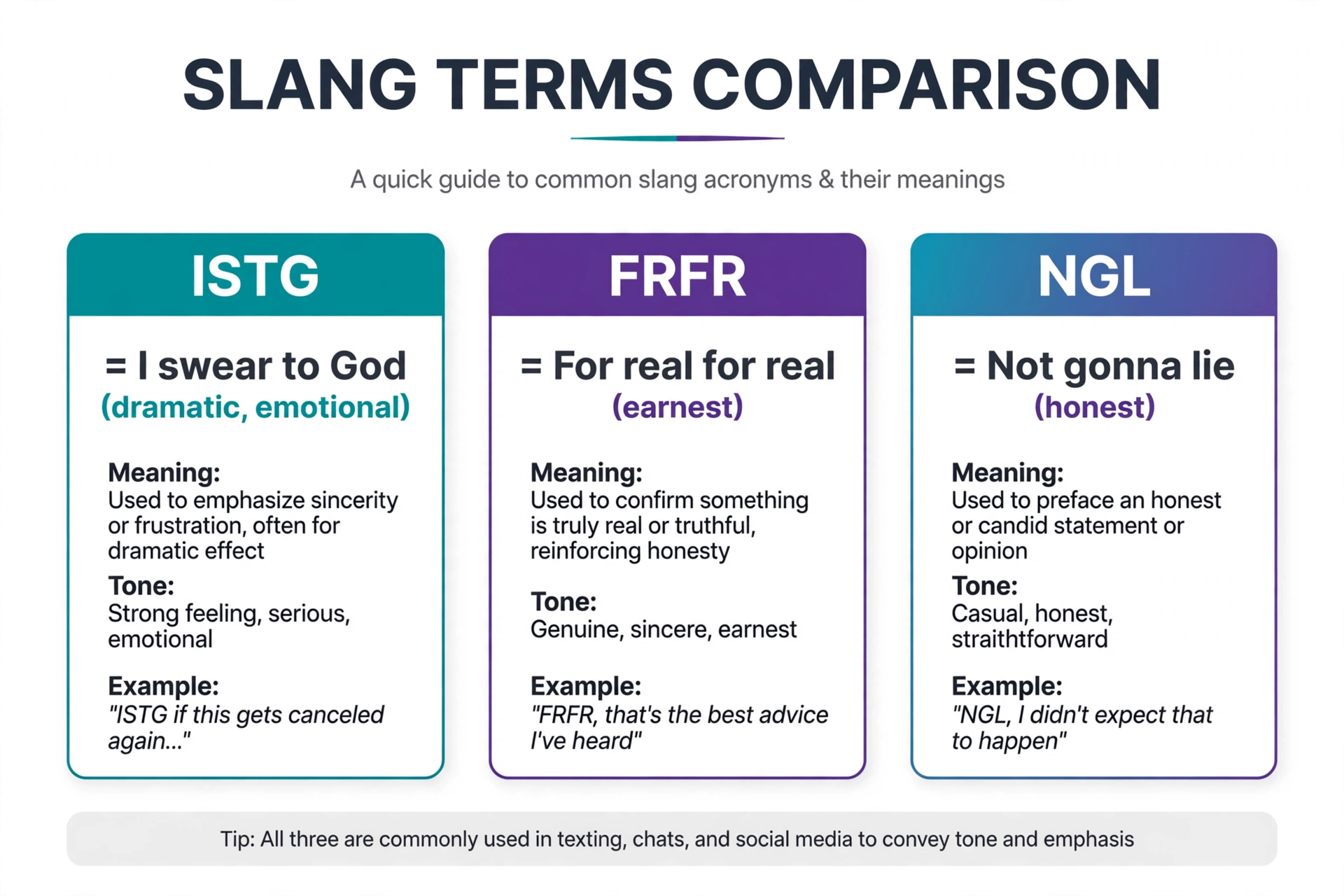
ISTG belongs to a whole family of “I’m serious” slang. Here’s how it stacks up against its closest relatives:
| Term | Means | Tone | When to use it |
|---|---|---|---|
| ISTG | I swear to God | Dramatic, emotional, intense | Promises, disbelief, frustration, big reactions |
| S2G | Swear to God | Same as ISTG, slightly more casual | Interchangeable with ISTG; pick whichever you like |
| FRFR | For real for real | Earnest, genuine, street-flavored | Agreeing or confirming something sincerely |
| NGL | Not gonna lie | Honest, confessional | Admitting an unpopular opinion or truth |
| ONG | On God | Solemn, hip-hop-influenced promise | Swearing something is true, staking credibility |
| TBH | To be honest | Candid, low-key | Soft honesty, much milder than ISTG |
The key difference: ISTG is the most dramatic of the bunch. NGL and TBH admit honesty calmly; FRFR confirms it earnestly; ONG stakes your word on it. ISTG does all of that with maximum emotion — it’s the one you reach for when the feeling is too big for the others.
S2G deserves a special note: it’s essentially a shorter twin of ISTG (dropping the “I”), and the two are used interchangeably. For the full breakdown, see our S2G meaning in text guide.
Alternate Meanings
In texting and on social media, ISTG almost always means “I swear to God.” But like many acronyms, it has a few alternate meanings in other contexts:
- “I swear to goodness”: a milder, family-friendly version some people use to avoid saying “God.”
- Instituto Superior Técnico e de Gestão (ISTG): a higher education institute in Portugal — you’d only see this in academic or Portuguese contexts.
- Misreadings: occasionally confused with “ITSG” or read as a typo — but in any casual conversation, assume “I swear to God.”
Bottom line: unless you’re reading a Portuguese university brochure, ISTG means “I swear to God.”
Professional or Polite Alternatives
Because ISTG invokes “God” and carries dramatic energy, it’s not appropriate for every setting. Here are alternatives by situation:
- Formal writing: “I assure you,” “I can confirm,” “I sincerely promise.”
- Work chats: “I promise,” “for real,” “no joke” (still casual, but milder).
- Around people who avoid religious references: “I swear,” “I promise you,” “I’m not kidding.”
- Expressing disbelief politely: “I honestly can’t believe it,” “that’s incredible.”
- Venting frustration professionally: “This is extremely frustrating,” “I need this resolved urgently.”
Common Mistakes
ISTG is simple, but people still misuse it. Avoid these common mistakes:
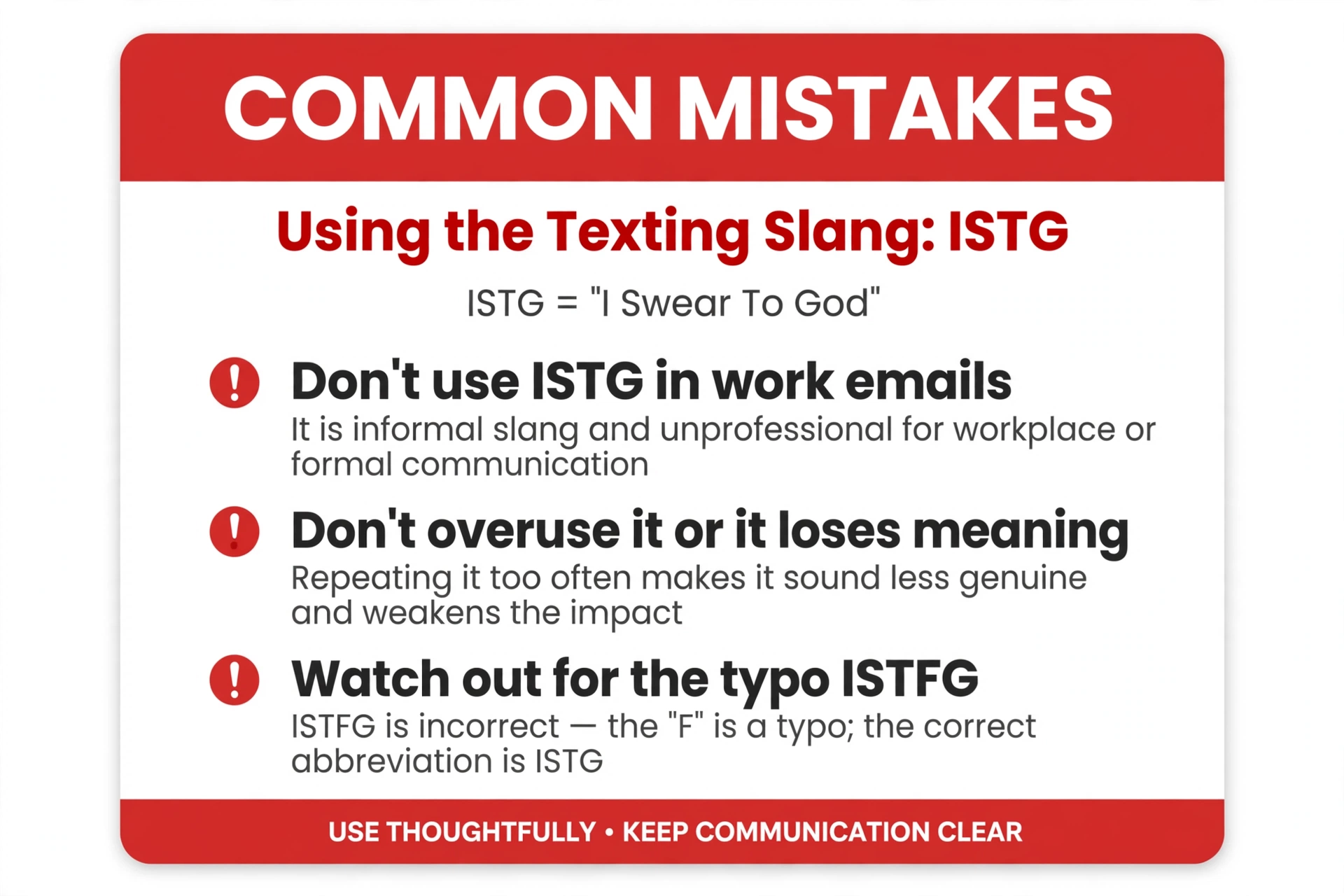
- Using it in professional settings. “istg the client will love it” in a work email reads as unprofessional. Keep ISTG in casual chats only.
- Overusing it until it loses meaning. If every message starts with “istg,” none of them sound serious anymore. Save it for moments that actually deserve the drama.
- Typing “istfg” by accident. Adding an F turns it into a profanity-laced variant (“I swear to f***ing God”) — much stronger and potentially offensive. Double-check your typing.
- Using it around people who find it offensive. Some people consider swearing on God’s name disrespectful. Read the room before dropping an ISTG.
- Pairing it with serious bad news insensitively. “istg he’s in the hospital” makes a crisis sound like a meme. Keep ISTG away from genuinely serious situations.
- Using it sarcastically without clear signals. “istg best day ever 🙄” works with the eye-roll emoji; without it, people may take the sarcasm literally.
Quick Tips
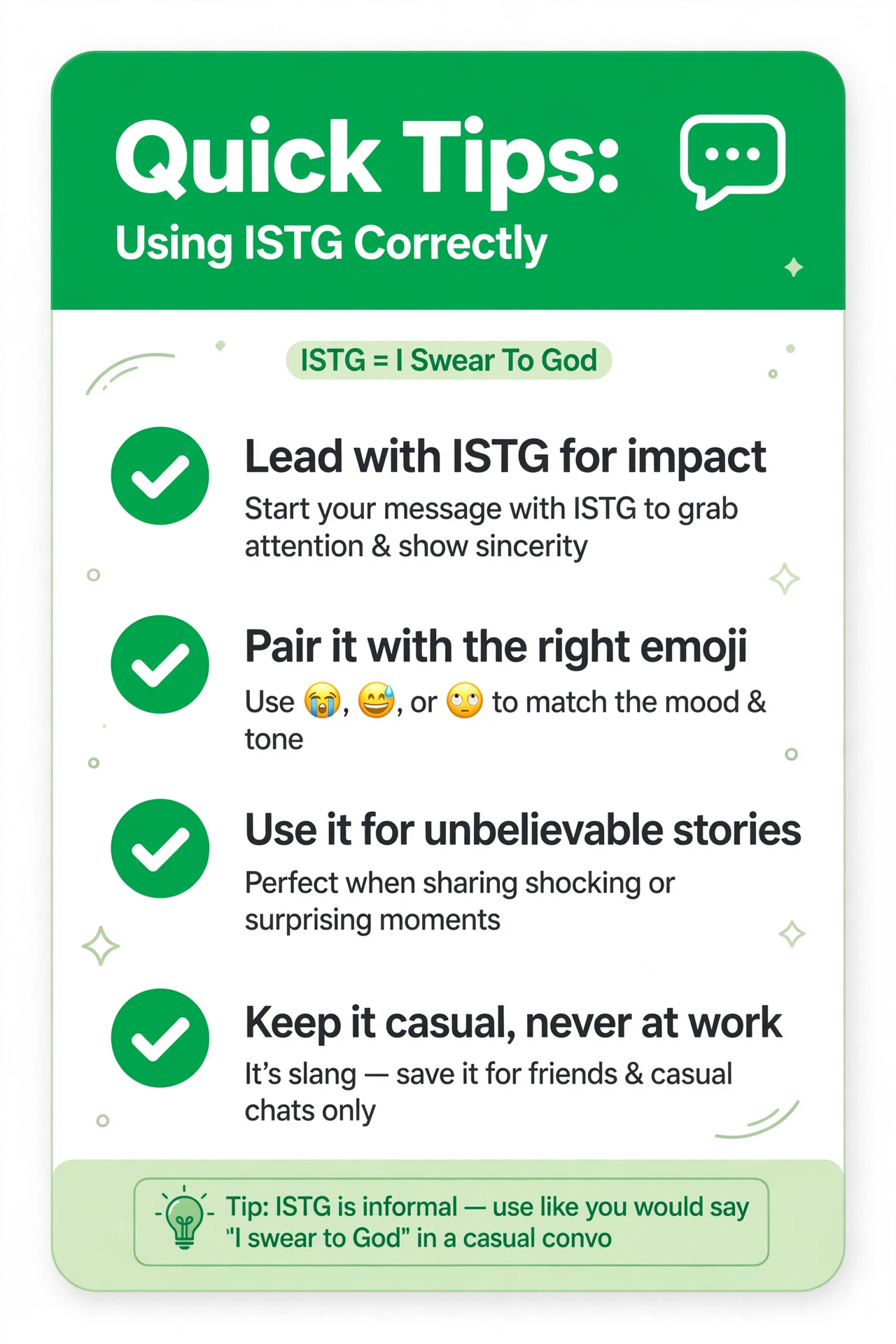
- Lead with it for impact: “istg this is the funniest thing I’ve seen all week” hits harder than burying it mid-sentence.
- Pair it with the emotion: add 😭 for drama, 💀 for disbelief, 😤 for frustration — emojis make the tone unmistakable.
- Use it to back up unbelievable stories: “istg this actually happened” is the internet’s way of saying “no cap, this is real.”
- Don’t stack it with every other acronym: “istg frfr ngl” is overkill — pick one amplifier per sentence.
- Try the trailing version for threats: “istg if this meeting could have been an email—” lets the reader finish the sentence.
- Know your audience: great for group chats, TikTok, and gaming; terrible for emails, interviews, and grandparents.
FAQ
What does ISTG mean in texting?
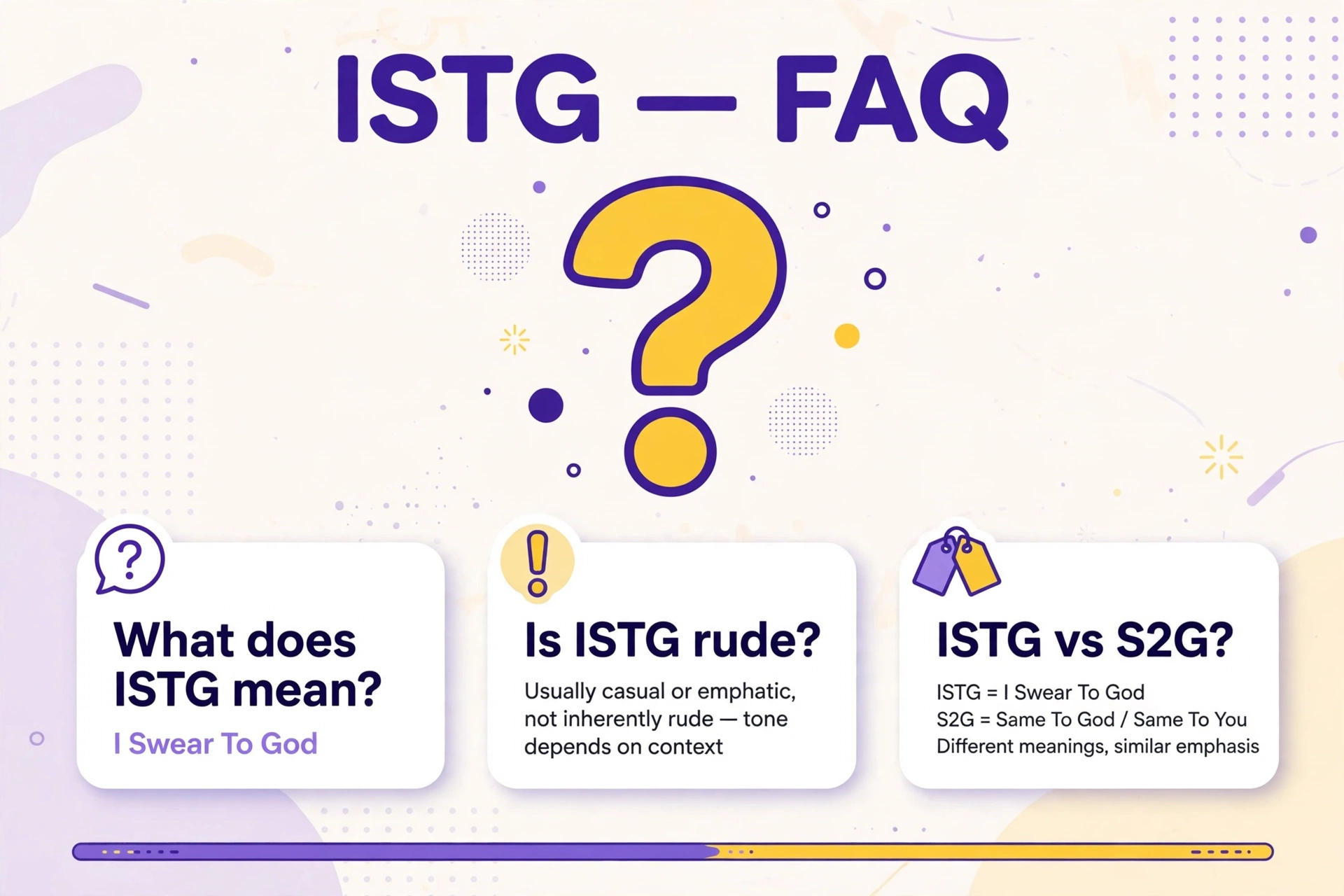
ISTG means “I swear to God.” It’s used to add serious emphasis to a message — as a promise, a reaction to something unbelievable, or an expression of strong frustration.
Is ISTG rude or offensive?
It’s not a swear word, but it can offend people who consider invoking God’s name in casual speech disrespectful. Among friends it’s totally normal; in formal or mixed company, use “I promise” or “I swear” instead.
What’s the difference between ISTG and S2G?
Almost nothing — S2G (“swear to God”) is just a slightly shorter version of ISTG (“I swear to God”). They’re used interchangeably in texting and mean the same thing.
What’s the difference between ISTG and FRFR?
ISTG (“I swear to God”) is dramatic and emotional, while FRFR (“for real for real”) is earnest and confirming. “istg this happened” sounds shocked; “frfr this happened” sounds sincere.
Can I use ISTG at work?
No — not in emails, meetings, or client messages. In very casual internal chats with close colleagues it might slide, but the safe rule is to keep ISTG out of anything professional.
Is “istg” lowercase or uppercase?
Lowercase “istg” is the standard casual form. ALL CAPS “ISTG” adds extra drama and emphasis — use it when the emotion is at maximum.
How do you respond when someone texts “istg”?
Respond to the emotion behind it. For a promise (“istg I’ll be there”), say “okay, holding you to it 😄.” For disbelief (“istg did that really happen”), react with them: “NO WAY, tell me everything.” For frustration, acknowledge it: “yeah that’s fair, I’d be mad too.”
Is ISTG still popular in 2026?
Yes — ISTG is one of the most durable slang acronyms online, in steady use for over a decade across TikTok, group chats, gaming, and social media. It’s not a passing trend; it’s core internet vocabulary at this point.
Conclusion
The istg meaning in text — “I swear to God” — is the internet’s favorite way to turn feelings up to maximum. From solemn promises to shocked reactions to dramatic threats that never quite finish their sentences, ISTG packs a whole emotional performance into four letters. Use it when you genuinely need the emphasis, pair it with the right emoji, keep it in casual spaces, and it will always land.
Want to keep building your slang fluency? Check out FRFR meaning in text for the art of earnest agreement, SMH meaning in text for the perfect disappointed reaction, and WDYM meaning in text for when confusion needs its own acronym. And for the record — istg, this is one slang term you’ll never forget. 😄
For a broader look at how slang dictionaries document terms like ISTG, see Urban Dictionary’s ISTG entry.
