
DTR means “define the relationship” in text. It is the shorthand people use when they want to stop guessing and start talking honestly about what two people are to each other — exclusive, casual, or somewhere in between.
DTR Meaning in Text: Meaning & Definition
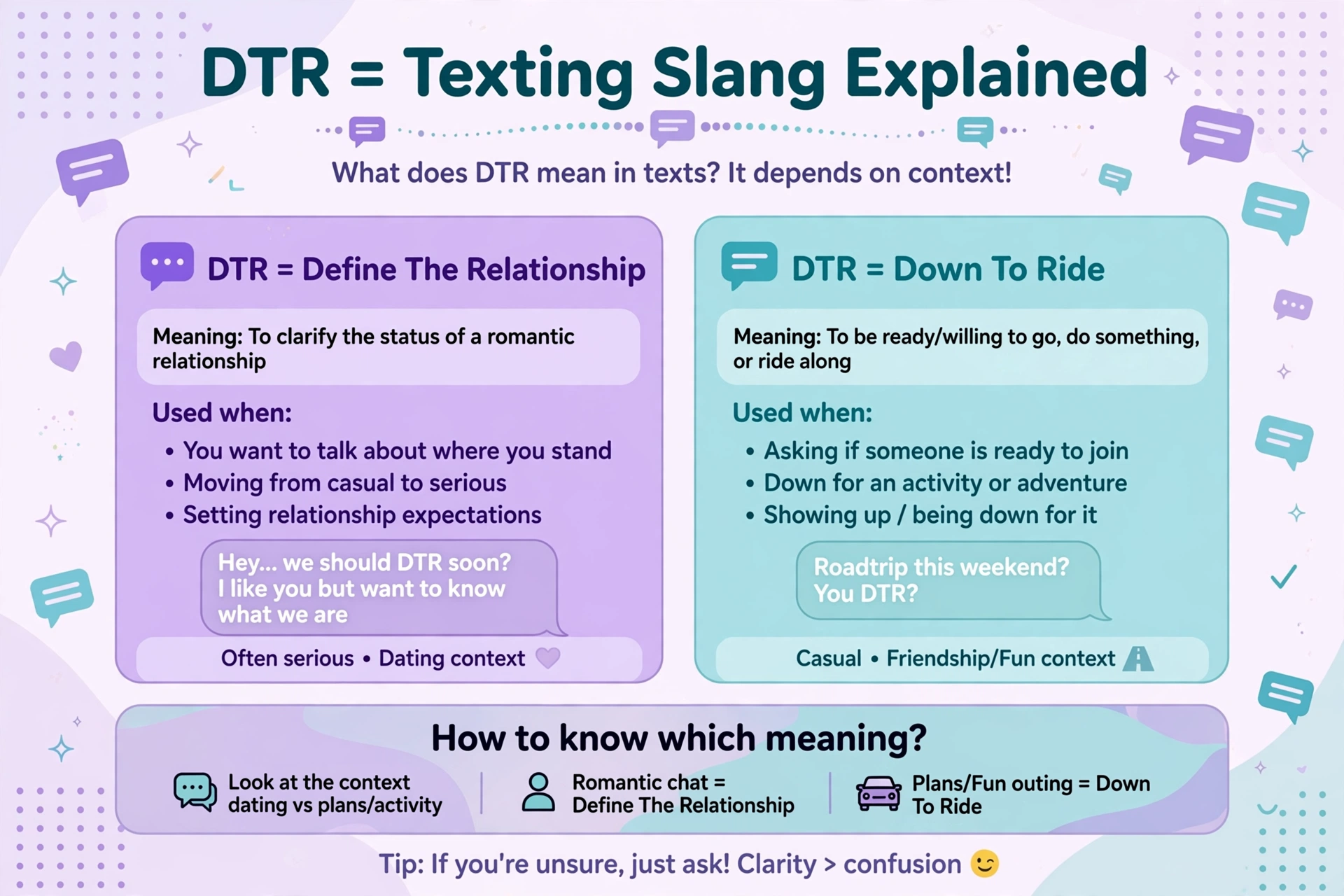
DTR is an abbreviation for “define the relationship.” When someone texts “we need to DTR,” they are not asking about a report or a technical term — they are suggesting it is time for an honest conversation about the status, expectations, and boundaries of a connection between two people.
The phrase does real social work. Instead of typing out “I think we should have a conversation about what our relationship means,” a person can simply type “I think we should DTR.” It is faster, lighter, and somehow less intimidating than spelling everything out.
In most texting contexts, DTR points to dating. But the meaning flexes depending on who is texting whom. Friends can DTR about where a friendship stands, and coworkers can use it loosely when roles feel unclear. According to Dictionary.com’s informal entry on the acronym, DTR is used in chat and texting at a critical point in a relationship, when one person wants clear answers from the other.
- Primary meaning: Define the relationship — a talk about status and expectations.
- Most common setting: Dating, situationships, and the talking stage.
- Tone: Can be serious, nervous, hopeful, or even playful depending on context.
- Key idea: Clarity replaces guessing.
Introduction
Few texts carry as much weight as “can we DTR?” Three little letters can make someone’s heart race, because everyone knows the conversation that follows could change everything. If you have ever stared at your phone wondering what those letters mean — or how to bring the topic up yourself — this guide has you covered.
DTR belongs to the same family of dating slang as FN and other short codes people drop into late-night texts, but it hits different. Most texting abbreviations describe a mood or a reaction. DTR describes an action: sitting down (or typing out) an honest talk about where two people stand.
In this guide you will learn the quick definition, where the term came from, how popular it has become, how people actually use it in real conversations, how it compares to similar terms, the alternate meanings you should know, the mistakes people make with it, and quick tips for handling the talk itself. By the end, you will know exactly what to say when the DTR moment arrives — whether someone asks you, or you decide to ask first. Like when you ask HBU in a chat, tone and timing matter just as much as the words.
Origin
The full phrase “define the relationship” has been floating around dating culture for decades — older than texting itself. Couples in the 1980s and 1990s had “the talk” face to face, usually over dinner or during a long phone call. Nobody needed an acronym back then because conversations happened in real time.
The abbreviation DTR caught on as online dating and texting exploded in the 2000s. Short messages reward short expressions, and a three-letter code fit perfectly into the new economy of characters. Dating apps normalized the situationship — that blurry middle ground between casual and committed — and with it came a need for a quick way to name the conversation that ends the blur.
Social media pushed it further. Hashtags like #DTR and #DTRTalk began showing up on Twitter and Instagram, and pop culture picked up the baton: Tinder even named a podcast series about modern dating “DTR,” and dating columns from outlets like Bustle and HelloGiggles treated the DTR talk as a recognized milestone. Today it is as standard a piece of dating vocabulary as “ghosting” or “exclusive.”
Popularity
DTR is solidly mainstream in dating-age texting culture, though it still feels fresh because the conversation it names never really goes away. A few things keep it popular:
- Situationships are everywhere. Research cited in dating coverage has found that roughly half of adults in their twenties have been in a situationship. Every situationship eventually hits the “so what are we?” moment — and DTR is its name.
- Dating apps made ambiguity normal. When everyone is chatting with several people at once, labels do not arrive automatically. DTR is the manual override.
- It works as both noun and verb. People say “the DTR” (the conversation), “let’s DTR” (let’s have it), and even “we DTR’d last night” (we had it). That flexibility keeps it in daily rotation.
- It softens a hard topic. Typing three letters feels braver than typing the whole scary sentence. The slang lowers the emotional temperature of asking for clarity.
You will see DTR most on dating apps (Tinder, Hinge, Bumble), in text threads between people a few weeks into dating, and in group chats where friends coach each other through the talk. It shows up less on professional platforms and almost never in formal writing — it is relationship vocabulary, through and through.
How It Is Used
In practice, DTR appears in a handful of recognizable patterns. The meaning barely changes, but the tone shifts a lot with the wording:
- “We need to DTR.” Direct and serious. The relationship has reached a point where expectations must be discussed.
- “Should we DTR?” Softer and collaborative. This invites the other person instead of declaring a verdict.
- “Are we going to DTR?” Slightly impatient. Usually sent after days of mixed signals.
- “I think it’s time to DTR.” Personal and honest. The sender is admitting they need clarity.
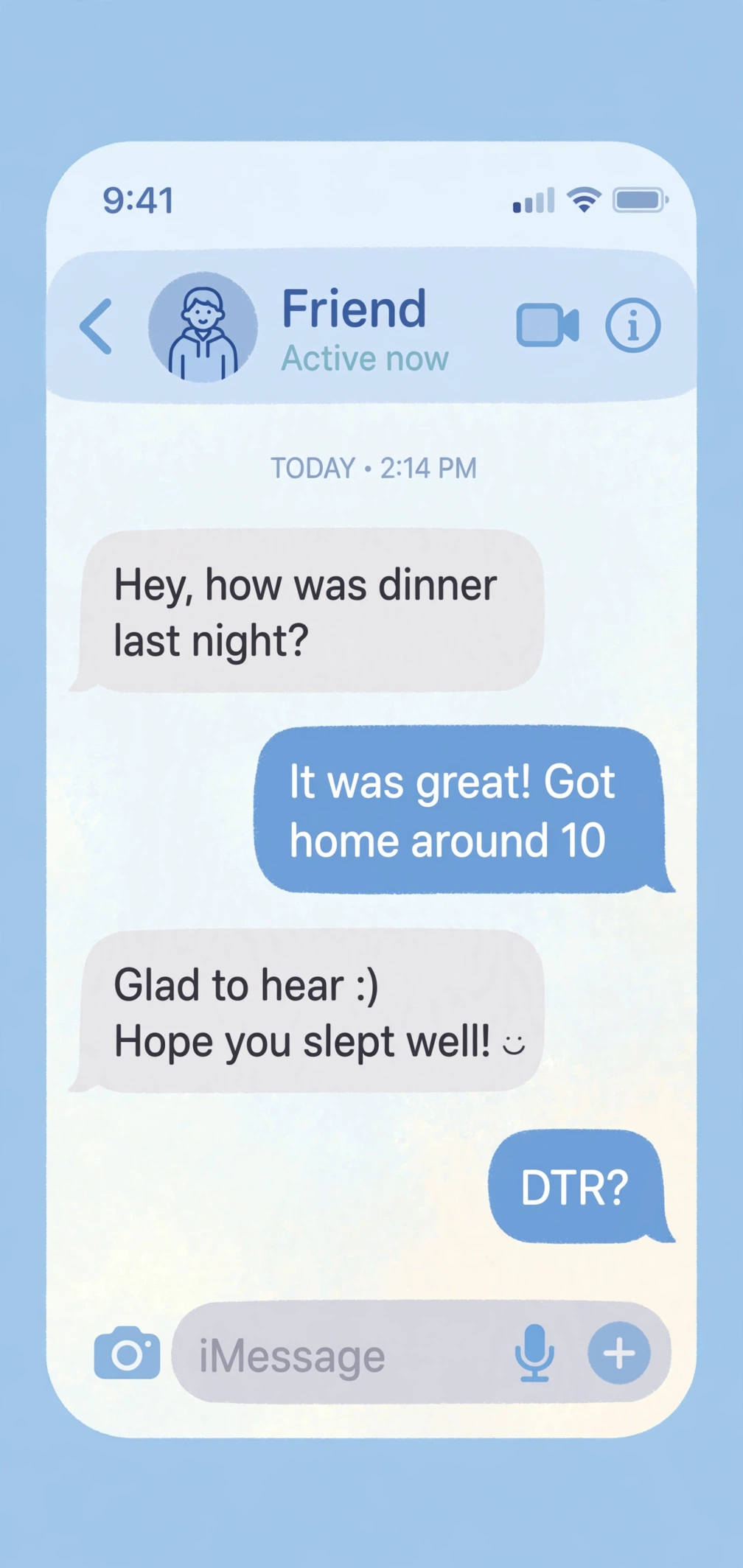
- “DTR tonight?” Casual scheduling, often playful — though the conversation itself usually turns serious.
Reading the room matters. A playful “wanna DTR?” after a great third date is very different from a tense “we NEED to DTR” after a week of short replies. Always read the whole thread before reacting — the tone of the conversation around the acronym tells you whether this is excitement, nerves, or frustration.
Common replies when someone brings it up include:
- “Yeah, I’ve been thinking the same thing.”
- “Can we talk about it tonight? I want to give you a real answer.”
- “I’m not ready to label it, but I’m happy to talk about where we’re headed.”
- “Honestly, I’ve been wanting to ask you that too.”
Notice that the best replies do not dodge. Even “I need more time” is a clearer answer than silence, and clarity is the whole point of DTR.
Examples
Friendly Examples
These are warm, low-pressure ways to raise the topic with someone you genuinely like:
- Person A: “I’m really enjoying getting to know you. DTR soon?”
Person B: “I’d like that. Coffee tomorrow?” - Person A: “So… are we going to DTR or keep pretending we’re ‘just hanging out’?”
Person B: “Haha okay, fair. I’m in if you are.” - Person A: “No pressure, but I’d love to know how you see us.”
Person B: “Honestly? I see this going somewhere.”
Professional Examples
DTR rarely belongs in actual workplaces, but it does show up in semi-professional contexts like freelance gigs, creative partnerships, and networking relationships:
- Freelancer: “Before we start phase two, can we quickly DTR on the project scope? I want to make sure we’re aligned on deliverables.”
Client: “Good call — let me send an updated brief.” - Collaborator: “We’ve been working together for a month. Let’s DTR what each of us is responsible for so nothing falls through the cracks.”
Partner: “Agreed. I’ll draft a quick list.” - Networking contact: “I’d love to DTR what this mentorship looks like — how often should we check in?”
Mentor: “Monthly calls work for me.”
Funny Examples
Friends love using DTR as a joke — because everyone recognizes how serious the real version is:
- Friend 1: “We’ve been gym buddies for 3 months and you still won’t spot me. We need to DTR.”
Friend 2: “Fine. We’re exclusive. No leg day without me.” - Friend 1: “You ate my fries AGAIN. This is our DTR moment.”
Friend 2: “I’ll buy you fries. Does that make us official?” - Friend 1: “We’ve watched 40 episodes together. I think we need to DTR this friendship.”
Friend 2: “We’re show-married. Accept it.”
Comparison with Similar Terms
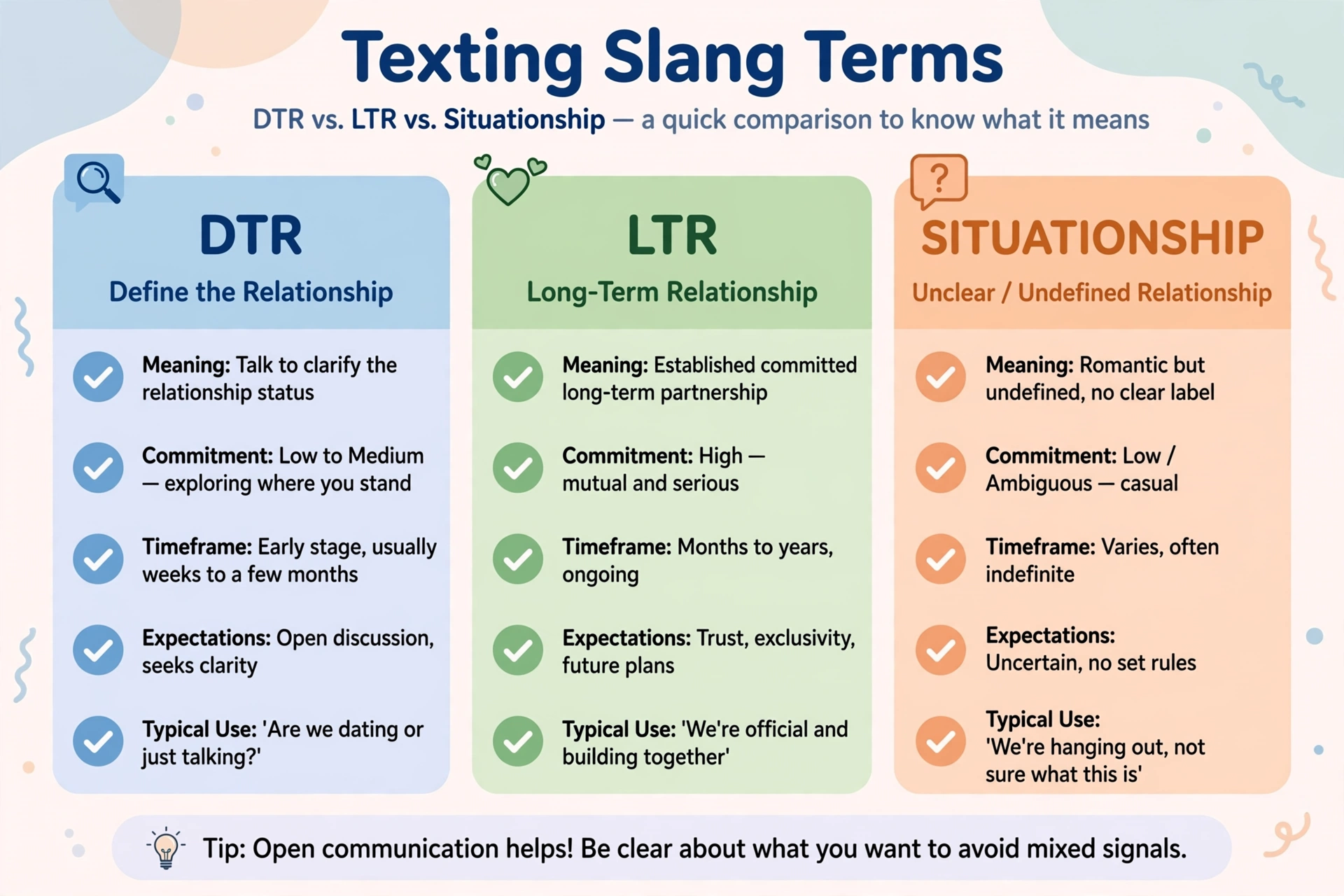
DTR gets confused with several nearby terms. Here is how it stacks up:
| Term | What It Means | How It Differs from DTR |
|---|---|---|
| Situationship | A romantic connection with no clear label or commitment | The situationship is the situation; DTR is the conversation that resolves it |
| Talking stage | Early getting-to-know-you phase before dating properly | The talking stage is a phase; DTR usually happens after it, when things get serious |
| The talk | General term for any serious relationship conversation | “The talk” can be about anything; DTR specifically means defining status and expectations |
| Exclusive | Agreement to date only each other | Exclusivity is one possible outcome of a DTR — DTR is the conversation, exclusive is a result |
| Relationship check-in | Revisiting how things are going in an established relationship | Check-ins happen inside a defined relationship; DTR creates the definition in the first place |
| Hard launch | Publicly announcing a relationship on social media | A hard launch shows the world; DTR is the private talk that happens before anyone posts |
Alternate Meanings
Context is everything. Outside of dating and texting, DTR can mean completely different things:
- Down to ride — Among friends, “DTR” can mean someone is up for plans. “Party tonight, you DTR?” means “are you coming?” This is the most common non-dating texting meaning, and it causes real confusion when a flirty text lands in the wrong context.
- Deep tendon reflex — In medicine, DTR refers to a neurological test (like the knee-tap test) that checks nerve and muscle response. You will see this in health records, not text threads.
- Daily task report — In some workplaces, a DTR is a document summarizing completed work for the day. Again, strictly professional.
- Other niche uses — Duty to report, digital trunked radio, and double treble crochet all exist, but you will only meet them in very specific fields.
How to tell which meaning someone intends: look at the relationship you have with the sender. A date saying “we need to DTR” is not asking about your reflexes. A friend saying “DTR tonight?” about concert tickets is not asking for relationship clarity. When in doubt, the dating meaning is the default in any romantic or flirty context.
Professional or Polite Alternatives
Sometimes “DTR” feels too casual or too loaded for the moment. Here are softer ways to say the same thing:
- “Can we talk about where we stand?” — Direct, mature, and hard to misread.
- “I’d love to check in about us.” — Gentle; frames it as care rather than confrontation.
- “How are you feeling about where this is going?” — Invites honesty without pressure.
- “Let’s make sure we’re on the same page.” — Collaborative and calm.
- “I want to be upfront about what I’m looking for.” — Leads with your own intentions, which feels safer for both people.
In semi-professional settings, skip the acronym entirely and say “align on expectations” or “clarify roles” — the clarity is the same without the dating baggage.
Common Mistakes
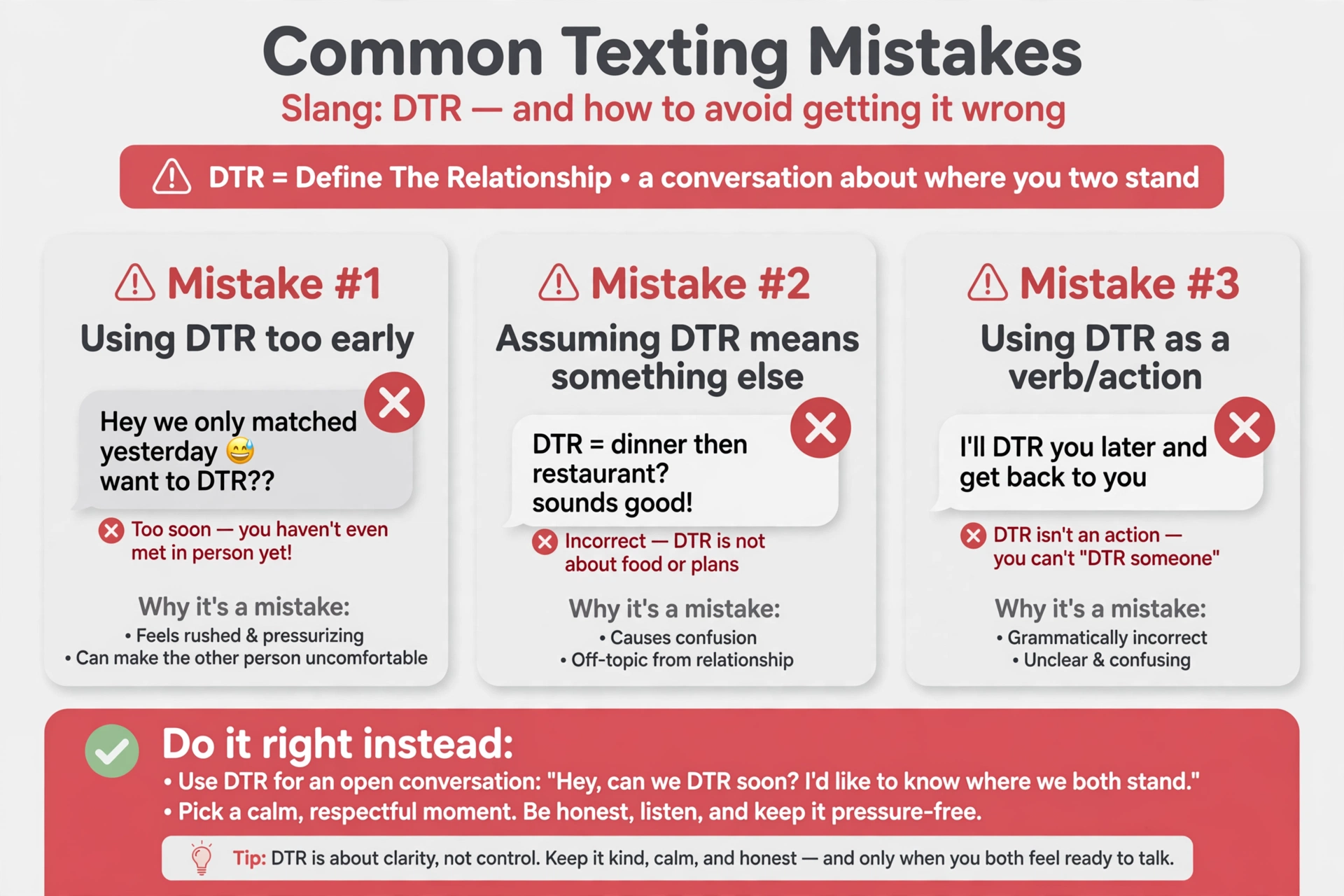
People mess up the DTR talk in predictable ways. Avoid these:
- Doing it entirely over text. Suggesting the talk over text is fine, but the actual conversation deserves a call or face-to-face. Tone gets lost in messages, and this talk needs tone.
- Leading with an ultimatum. “Define us or I’m done” turns an honest talk into a hostage negotiation. State what you want; do not threaten.
- Assuming the answer before asking. Walking in convinced they will say yes sets you up for a shock — and makes you a worse listener.
- Picking the worst possible moment. After an argument, when someone is exhausted, or in front of friends. Timing is half the talk.
- Confusing “down to ride” with “define the relationship.” Replying to a friend’s party invite with a heartfelt speech about your bond is funny in retrospect, embarrassing in the moment. Check the context.
- Treating it as a one-time event. Relationships evolve. A DTR from six months ago does not cover a totally different situation today.
- Using “we need to talk” as the opener. Those four words spike anyone’s anxiety. Name the topic kindly instead: “I’d like to talk about us.”
Quick Tips
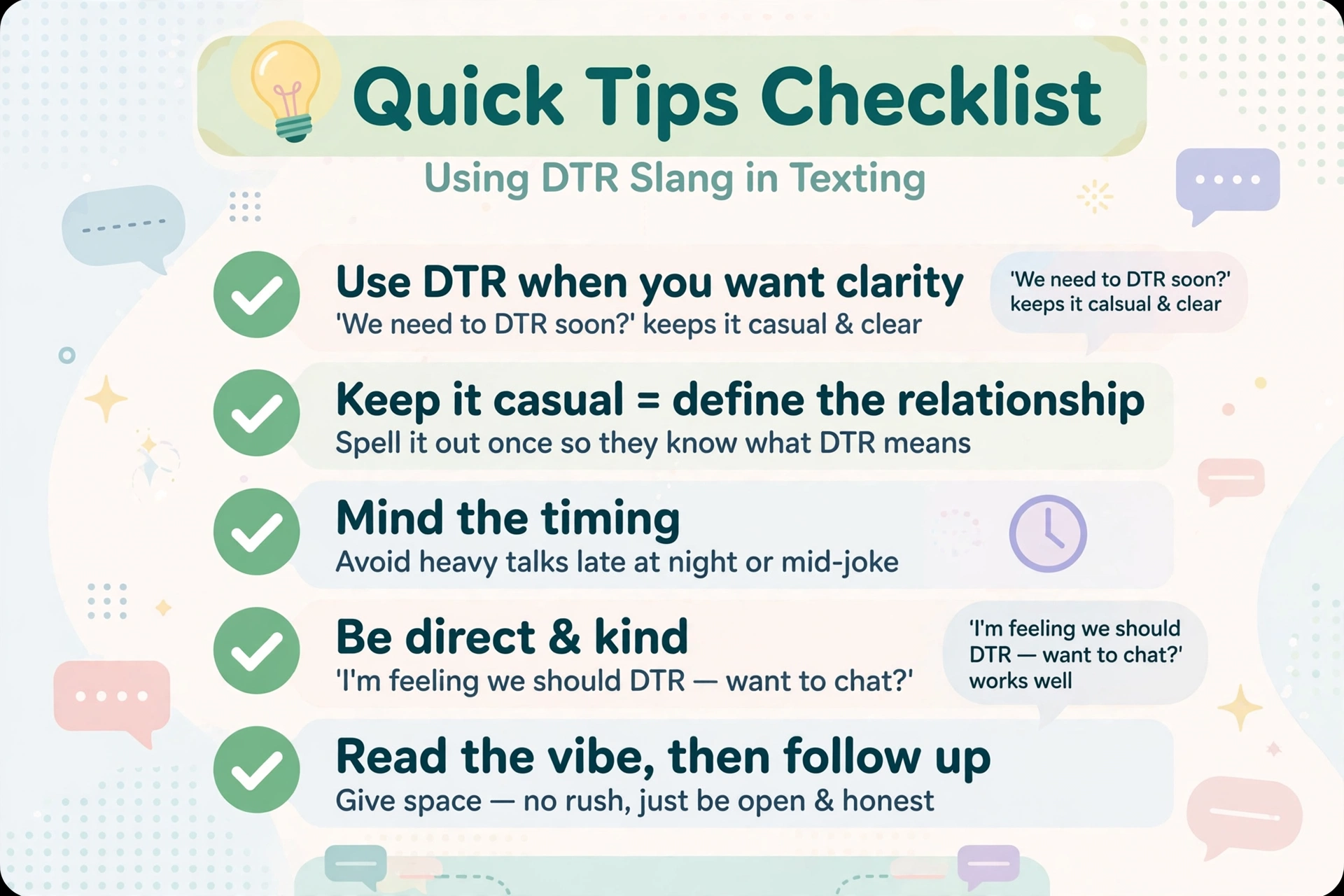
- Know what you want first. Before you ask “what are we,” be ready to answer “here’s what I’d like.” It keeps the talk honest instead of one-sided.
- Use “I” statements. “I feel confused about where we stand” lands better than “You’re confusing me.”
- Ask open questions. “How do you see us?” beats “So are we official or not?” — the first invites a real answer.
- Listen more than you pitch. The point is to learn where they stand, not to sell them on your version.
- Accept any honest answer. A clear “I want to keep it casual” hurts less long-term than months of guessing. Clarity is the win, whatever it is.
- Do not rush the reply. If they need a day to think, that is healthier than a panicked instant answer.
- Write down the outcome. Not literally — but make sure you both leave with the same understanding. “So we’re exclusive, right?” takes ten seconds and prevents weeks of doubt.
FAQ
What does DTR mean in text from a guy?
It means the same thing regardless of who sends it: he wants to define the relationship. When a guy texts “we should DTR,” he is usually asking where things stand — whether you are exclusive, casual, or heading somewhere serious. Read the tone of the surrounding messages to tell whether he is excited, nervous, or frustrated.
What does DTR mean in text from a girl?
Exactly the same — she wants clarity about the relationship’s status and expectations. When a girl brings up DTR, it often means she has been thinking about it for a while and decided to be direct. Take it as a compliment: she respects you enough to ask instead of guessing.
When should you have the DTR talk?
There is no magic number of dates. The right time is when you find yourself constantly wondering “what are we?” — that question is itself the signal. Common triggers include wanting exclusivity, making future plans together, feeling anxious about mixed signals, or noticing your feelings have grown beyond casual.
Can you DTR over text, or should it be in person?
Raising the topic over text is perfectly fine — “can we DTR this weekend?” works great as a heads-up. But the actual conversation goes better in person or on a call, where tone and body language keep things from being misread. Save texting for scheduling the talk, not having it.
What does DTR mean on dating apps like Tinder or Hinge?
On dating apps, DTR almost always means “define the relationship.” It usually appears a few weeks into chatting or after several dates, when one person wants to know if the match is becoming exclusive. It is a good sign — it means they are taking you seriously enough to want an answer.
What is the difference between DTR and being exclusive?
DTR is the conversation; exclusivity is one possible outcome of it. A DTR talk can end with exclusivity, with a decision to stay casual, with an agreement to revisit later — or with a breakup. Do not assume that agreeing to DTR means you have agreed to be exclusive.
How do you respond when someone wants to DTR?
Be honest and do not dodge. Good replies include “I’ve been thinking the same thing — when works for you?” or “I’m not ready to label it, but I’m happy to talk about where we’re headed.” Even asking for a day to think is better than silence. The worst reply is no reply.
What if the DTR talk does not go the way you wanted?
A disappointing answer is still a useful one. If they want something casual and you want commitment — or vice versa — you now know instead of spending months guessing. Thank them for honesty, take time to process, and make the decision that fits what you actually want.
Conclusion
DTR meaning in text boils down to three honest words: define the relationship. It is the conversation that turns guessing into knowing — whether the answer is “let’s be exclusive,” “let’s keep it casual,” or “let’s give it more time.” The talk can feel nerve-wracking, but the alternative is worse: weeks of decoding texts, rereading messages, and wondering where you stand.
The people who handle DTR well share one trait: they ask for clarity instead of waiting for it. Pick a calm moment, say what you feel, ask what they feel, and accept the honest answer. That is the entire playbook. And if the texting slang world still has you curious, keep exploring — from IMK to IDT, every abbreviation is just another shortcut for something humans have always wanted to say.
