TTM Meaning Text: The Complete Guide to This Chat Invitation
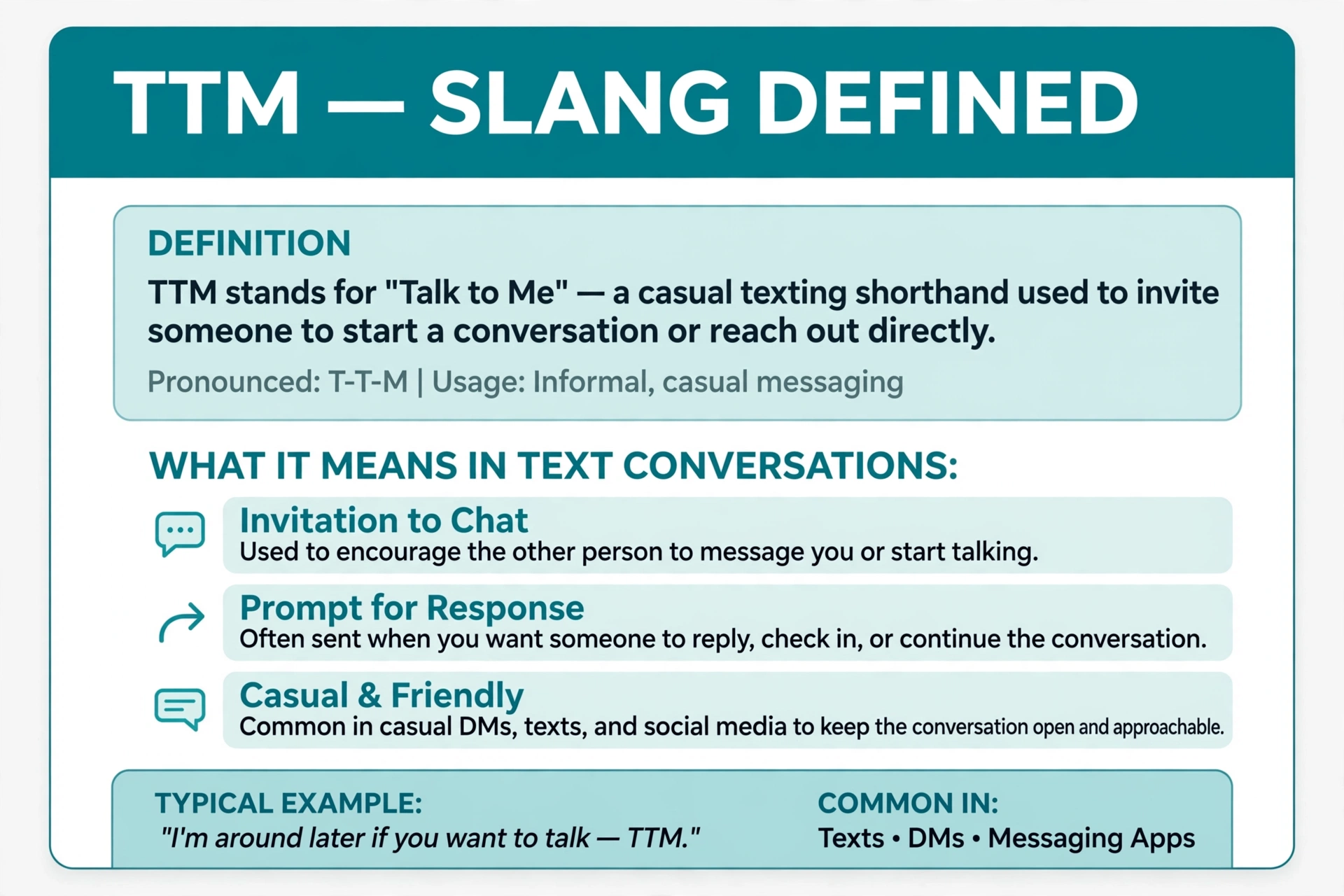
Quick definition: TTM means “Talk To Me” in text messages and online chats. It is a short, friendly invitation asking someone to start a conversation with you, reply to your message, or keep the chat going.
TTM Meaning Text – Meaning and Definition
If you have ever opened a message that just said “TTM” and stared at your screen wondering what on earth that was supposed to mean, you are not alone. TTM stands for “Talk To Me.” It is one of those small texting abbreviations that carries a lot of meaning in just three letters: I want to chat with you.
At its core, TTM meaning in text is simple. When someone sends you “TTM,” they are asking you to message them, reply, or open up a conversation. Think of it as a digital tap on the shoulder. It does not demand anything dramatic. It simply says, “Hey, I am here, and I would like to talk to you.”
The beauty of TTM is how flexible it is. It can be friendly, casual, playful, or even a little flirty, depending on who sends it and when. A best friend texting “TTM, I have news!” is sharing excitement. A crush texting “TTM?” late at night is signaling interest. A group chat friend typing “TTM guys” is just trying to get everyone’s attention. Same three letters, completely different vibes, all decided by context.
TTM is pronounced letter by letter: “tee-tee-em.” You will almost always see it written in chats rather than heard in spoken conversation, though younger speakers sometimes say it out loud as a joke. It belongs to the same family of abbreviations as fn meaning in text and tysm meaning – quick shorthand built for speed, not for grammar books. If you want to explore how modern slang keeps evolving in everyday language, Dictionary.com is a great place to see how informal terms earn their place in the dictionary.
Introduction
Picture this: you are scrolling through Instagram late at night when a DM pops up from someone you have not talked to in weeks. The message is just three letters: “TTM?” No greeting, no explanation, no context. Your brain starts racing. Is this an emergency? A joke? A typo? Should you be worried, flattered, or confused?
Relax. That tiny message is not a crisis – it is an invitation. The person is simply saying “talk to me,” the modern, lazy, lovable way. And honestly, once you learn what TTM means, you will start noticing it everywhere: in texts, in Snapchat captions, in TikTok comments, even in dating app conversations.
Texting slang moves fast, and keeping up can feel like a full-time job. Abbreviations like TTM save time and keep conversations flowing, but only if everyone knows the code. This guide breaks down everything you need to know about the ttm meaning in text: what it stands for, where it came from, how people actually use it, what it means when a guy or a girl sends it, how it compares to similar abbreviations, and the mistakes you should avoid. By the end, you will never have to Google “what does TTM mean” again.
Origin
TTM did not appear out of nowhere. Like most texting abbreviations, it was born out of necessity – the necessity to type less. Back in the late 1990s and early 2000s, SMS text messages had strict character limits, usually 160 characters per message, and many phone plans charged per text. Every letter cost money and space, so people got creative.
Abbreviations like LOL, BRB, TTYL, and eventually TTM became the survival tools of the texting generation. If you wanted someone to chat with you, typing “talk to me” took precious characters. “TTM” took three. The choice was obvious.
The phrase found a natural home in the chat platforms of the era. People on AOL Instant Messenger, MSN Messenger, and BlackBerry Messenger used it when they saw a friend come online. On MySpace, users dropped “ttm when you get online” on each other’s pages. Early Urban Dictionary entries for TTM date back to the mid-2000s, where users defined it as “talk to me” and shared examples of how it was used in instant messages. It was the 2000s version of poking someone.
Here is a fun twist: while the casual “talk to me” meaning grew out of chat culture, the letters TTM already had a completely different life in the business world. In finance, TTM has stood for “Trailing Twelve Months” since at least the 1980s, used in stock reports and company earnings. That meaning never crossed into texting, but it explains why you might see “TTM” in a work email and feel totally confused.
The abbreviation got its second wind with the rise of Snapchat and Instagram in the mid-2010s. Teens and young adults started using TTM in captions and stories – “bored, TTM” became a classic. Then TikTok gave it yet another boost, with creators using it in captions when they wanted comments and engagement. What started as a way to save characters in 2003 became a full-blown social media call to action by 2020.
Popularity
Today, TTM is firmly part of the texting vocabulary, especially among Gen Z and Millennials. It lives wherever fast, casual conversation happens: SMS texts, WhatsApp, Snapchat, Instagram DMs, Discord servers, and TikTok comment sections. It is not as famous as LOL or OMG, but among people under 35, it is instantly recognizable.
Search interest in “TTM meaning” has climbed steadily since 2020, particularly in the United States, the United Kingdom, and India. Usage tends to spike in the evenings and on weekends – exactly when people are bored, scrolling, and looking for someone to talk to. That pattern makes perfect sense: TTM is the abbreviation of boredom and connection.
A few platforms gave TTM its biggest popularity pushes. On Snapchat, “TTM” in a story caption is basically a neon sign saying “message me.” On TikTok, hashtags and captions using TTM invite duets, stitches, and comments. And on dating apps like Tinder, Bumble, and Hinge, TTM has become a low-pressure flirting tool. It is forward enough to show interest but casual enough not to feel intense – the perfect balance for early-stage chatting.
What keeps TTM popular is its emotional honesty. In a world of curated posts and filtered photos, sending “TTM” is refreshingly direct. It says, “I want your attention, and I am not pretending otherwise.” That directness is exactly why it resonates with younger generations who value authenticity over formality.
How It Is Used
TTM shows up in a surprising number of situations, and each one shades its meaning slightly differently. Here are the most common ways people use it in real life.
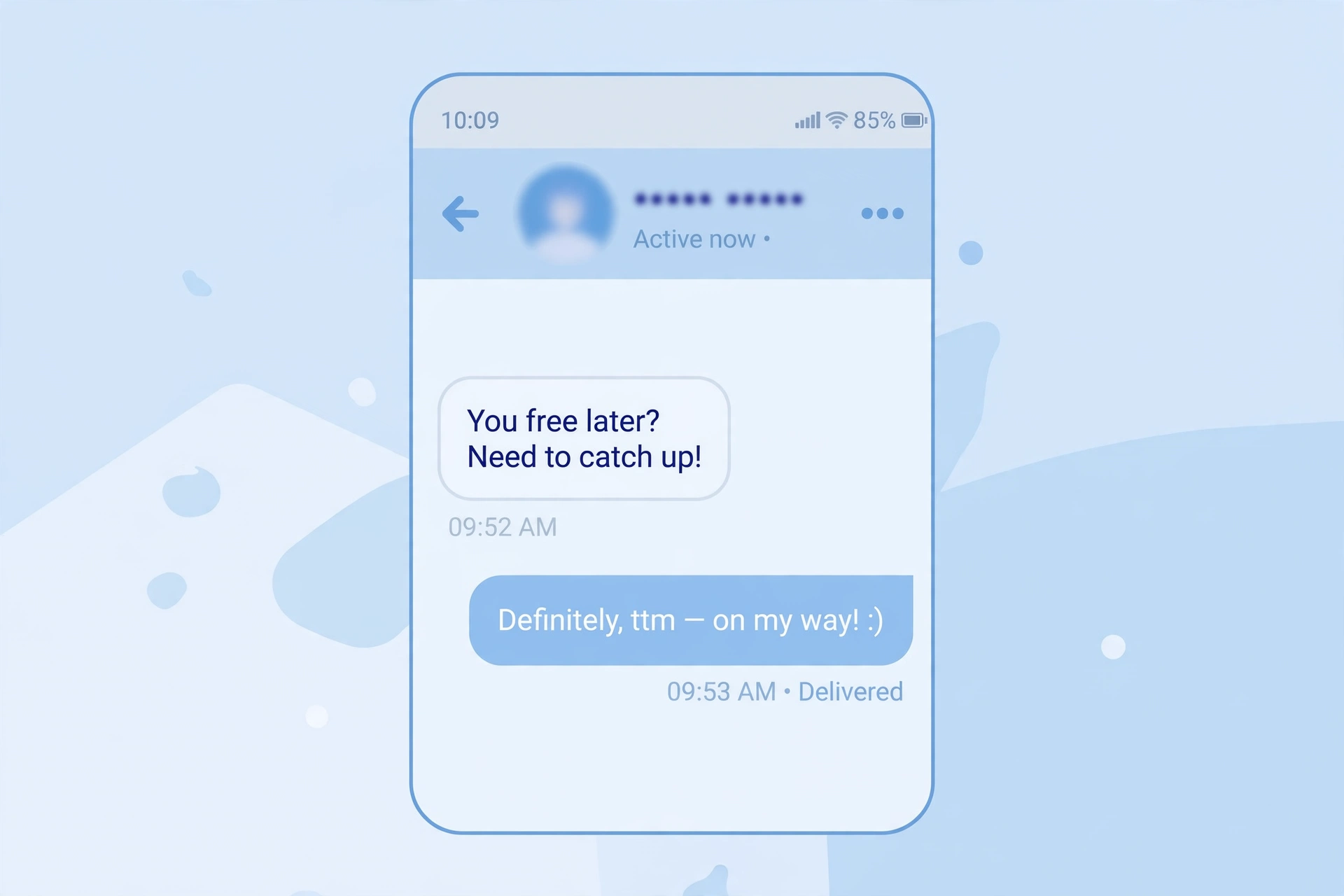
As a conversation starter. This is the classic use. Someone wants to talk but does not have a specific topic, so they open with “TTM.” It is the texting equivalent of sitting down next to someone and saying, “So, what’s up?” Example: “Hey, haven’t talked in forever. TTM!”
As a reply to a story or status. When someone posts an interesting photo or a cryptic status, a friend might reply “TTM” to say “tell me more about this.” It is curiosity in three letters.
In group chats. When a group chat goes quiet or someone has news, TTM grabs attention. “TTM guys, big news” is basically a digital drumroll.
After a long silence. When a conversation dies and one person wants to revive it, “TTM?” is a gentle nudge. It is softer than “why aren’t you replying?” and friendlier than double-texting a whole paragraph.
On social media captions. Creators and everyday users put “TTM” in TikTok or Instagram captions to invite comments and DMs. It is a call to action that feels personal rather than promotional.
With punctuation and emojis. The punctuation around TTM changes its energy. “TTM!” sounds excited. “TTM?” sounds curious or inviting. “TTM…” sounds a little sad or needy.
People also use handy variations of the abbreviation. TTML means “talk to me later,” TTMN means “talk to me now,” and DTTM means “don’t talk to me” – the grumpy opposite. Knowing these spin-offs helps you read the room even faster.
Examples
Seeing TTM in real conversations makes its meaning click instantly. Here are examples organized by tone, so you can see exactly how the same three letters can feel completely different.
Friendly Examples
- “Miss you! TTM when you’re free” – a warm check-in from an old friend.
- “That exam was brutal. TTM, I need to vent” – asking for a listening ear.
- “TTM! I have the funniest story to tell you” – excitement that cannot wait.
- “Saw your post, TTM. I need the full details” – friendly curiosity.
- “Bored out of my mind. TTM?” – the classic boredom text.
Professional Examples
Here is an important note: TTM is casual slang, so it rarely belongs in truly professional communication. But in relaxed work chats with friendly coworkers – think Slack DMs or casual team chats – it can appear. Even then, use it sparingly.
- “TTM when you get a sec, quick question about the report” – casual coworker chat.
- “Stuck on this design. TTM if you’ve dealt with this before” – asking a teammate for help.
- “TTM after lunch? Want your opinion on something” – informal meeting request.
In formal emails, job applications, or messages to your boss, never use TTM. Write the full phrase instead: “Could we talk when you have a moment?” We will cover better professional alternatives later in this guide.
Funny Examples
- “My phone is at 1%. TTM before I disappear forever” – dramatic and hilarious.
- “Just burned dinner again. TTM, I need emotional support and pizza” – comedy gold.
- “TTM. My dog just did something you won’t believe” – the ultimate clickbait.
- “Me: I’m going to be productive today. Also me: TTM, I’m bored” – painfully relatable.
The table below sums up how to read the most common TTM messages at a glance:
| Message | What It Really Means | Tone |
|---|---|---|
| “TTM!” | I have something exciting to share | Enthusiastic |
| “TTM?” | I’m here if you want to chat | Friendly, open |
| “TTM, tell me more” | Tell me more, I’m curious | Playful |
| “TTM, interested” | I’m interested in you | Flirty |
| “TTM…” | I feel a bit lonely or left out | Vulnerable |
| “TTM guys” | Everyone pay attention | Group announcement |
Comparison with Similar Terms
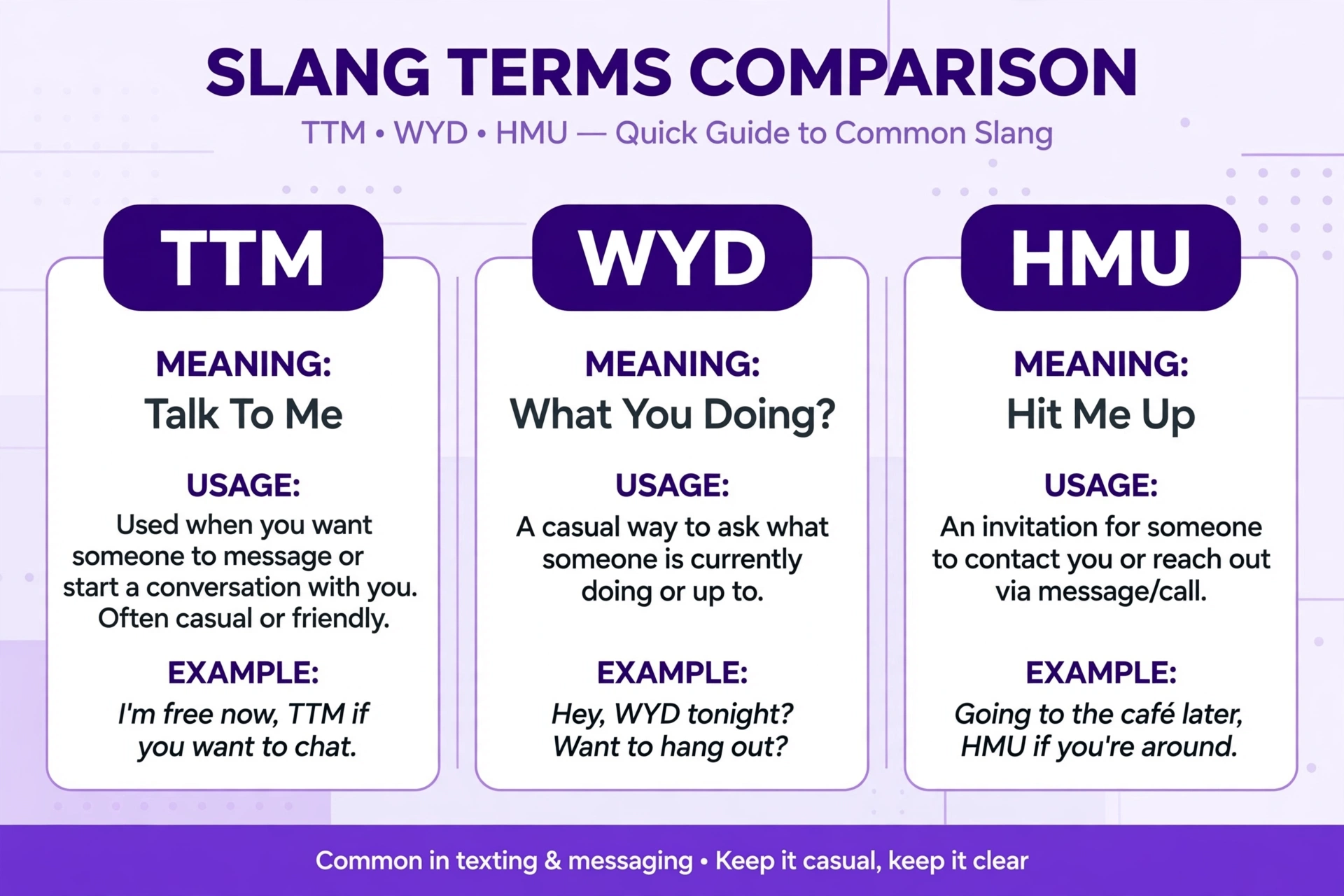
TTM has plenty of neighbors in the texting world, and mixing them up is easy. Each one invites contact in a slightly different way. Understanding the differences helps you pick the right abbreviation for the right moment.
| Abbreviation | Full Meaning | When to Use It | Key Difference from TTM |
|---|---|---|---|
| TTM | Talk To Me | When you want a conversation right now | The baseline: immediate, direct invitation to chat |
| HMU | Hit Me Up | When you want someone to contact you later | Future-oriented; “reach out sometime,” not “talk now” |
| DM me | Direct Message Me | On social media when you want a private chat | Platform-specific; TTM works anywhere, even SMS |
| TTYL | Talk To You Later | When you are ending a conversation | The opposite of TTM – a goodbye, not an invitation |
| WYD | What You Doing | To start casual small talk | Asks about their activity; TTM directly asks for conversation |
| LMK | Let Me Know | When you need information or a reply | Requests an answer to something specific, not open chat |
| TBH | To Be Honest | Before sharing an honest opinion | About honesty, not about starting a chat |
The most common mix-up is TTM vs HMU. They look similar, but their timing is different. TTM means “talk to me now” – it is about the present moment. HMU means “hit me up later” – it is about the future. If someone says “TTM,” they want your attention immediately. If they say “HMU,” they are keeping the door open for whenever.
TTM vs TTYL is another pair worth knowing, because they are conversational opposites. TTM opens a conversation; TTYL closes one. Sending the wrong one could cause real confusion – imagine saying goodbye with “TTM” and leaving your friend waiting for a chat that never comes.
TTM vs DM me comes down to platform. “DM me” only makes sense on social media with direct messages, like Instagram or Twitter. TTM works everywhere: text messages, WhatsApp, Discord, in person. If you want someone to text you on your actual phone number, “TTM” is the safer choice.
Alternate Meanings
Like many three-letter abbreviations, TTM wears different hats in different worlds. In casual texting, “Talk To Me” is the runaway winner, but it is worth knowing the other meanings so you are never caught off guard.
| Meaning | Context | How Common |
|---|---|---|
| Talk To Me | Texting, social media, dating apps | Very common – the default meaning |
| Text To Me | Casual texting | Fairly common – specifically asks for a text, not a call |
| Talking To Myself | Old chat rooms, early IM slang | Rare today – used when someone felt ignored (“ttms”) |
| That’s The Move | Informal slang, gaming | Uncommon – means “that’s the plan” |
| To The Max | Gaming, hype culture | Uncommon – as in “this game is awesome TTM!” |
| Too Much To Tell | Rare – suggests calling instead of texting | |
| Trailing Twelve Months | Finance, investing, business reports | Very common in finance – the standard meaning there |
| Time To Market | Business, product management | Common in business meetings and documents |
The two that cause the most confusion are “Text To Me” and “Talking To Myself.” “Text To Me” is basically a cousin of “Talk To Me” – the sender specifically wants a text message rather than a phone call or an in-person chat. “Talking To Myself” is vintage internet slang from the chat-room era; if you sent a message and nobody replied, you might type “ttms” to point out you were being ignored. You will rarely see this one today, but it is fun trivia.
In professional and financial contexts, forget “Talk To Me” entirely. If your boss writes “TTM revenue grew 12%,” they mean Trailing Twelve Months – the company’s performance over the past year. Context is everything with this abbreviation, which is why reading the whole message (and knowing who sent it) matters more than memorizing definitions.
Professional or Polite Alternatives
TTM is perfect for friends, but it has no place in formal communication. If you need to invite a conversation in a professional, respectful, or formal setting, these alternatives say the same thing without the slang.
- “Could we talk when you have a moment?” – polite and professional, works in emails.
- “I’d love to catch up – are you free sometime this week?” – warm but formal enough for colleagues.
- “Feel free to reach out whenever you’re available.” – gives the other person control of timing.
- “Let’s schedule a quick call to discuss this.” – clear and action-oriented for work.
- “I’m here if you’d like to talk.” – gentle and supportive, great for sensitive topics.
- “Ping me when you’re free.” – casual-professional, popular in workplace chat apps.
- “Would love to hear your thoughts on this.” – invites input without pressure.
The rule of thumb is simple: if the message involves your job, your school, a stranger, or anyone you want to impress, spell it out. Save TTM for the people who already know your texting style.
Common Mistakes
TTM is easy to use, but people still get it wrong. Here are the most common mistakes – and how to avoid them.
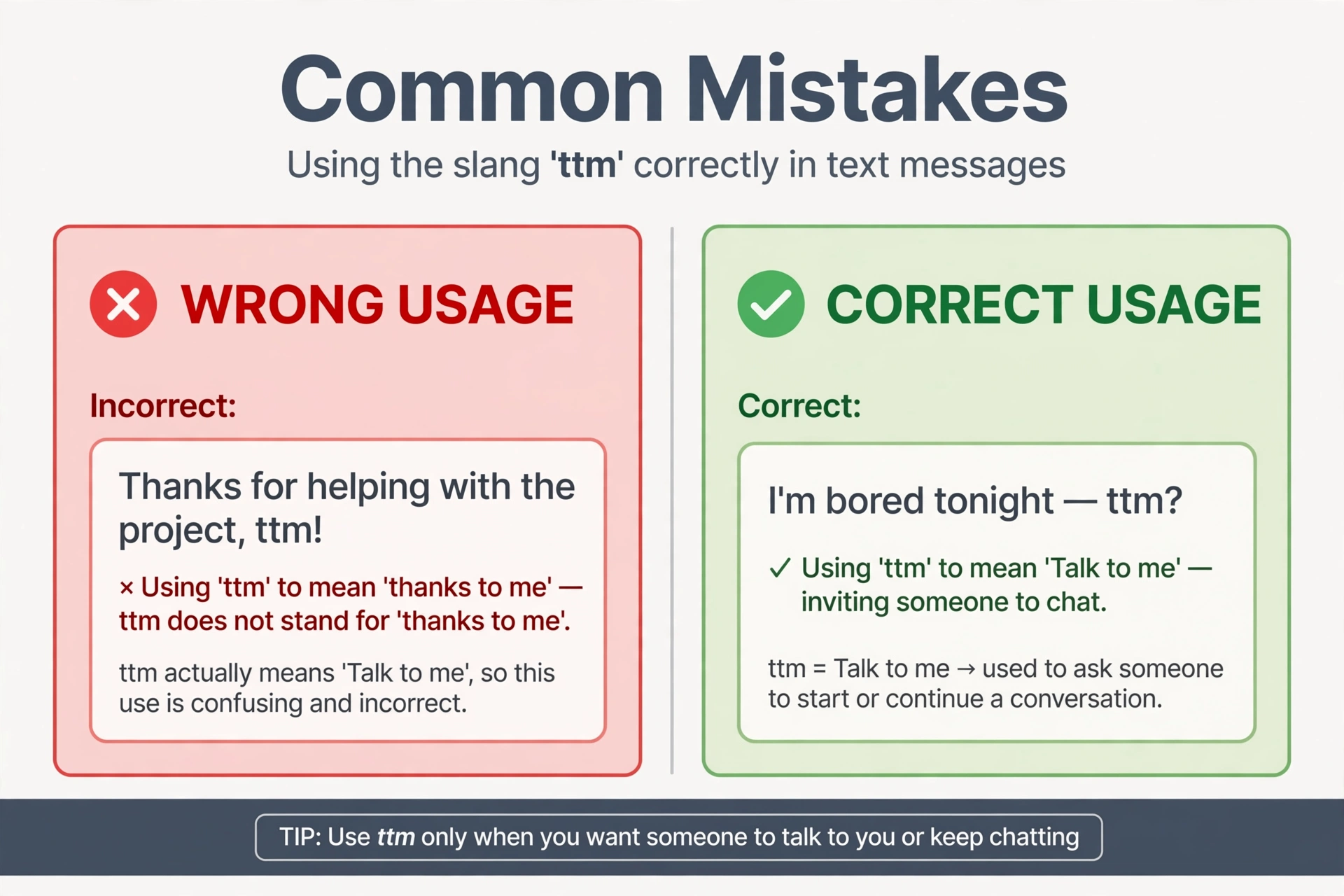
1. Using it in professional settings. This is the number one mistake. Sending “TTM” in a work email, a job application, or a message to your professor makes you look careless. In business contexts, TTM might even be read as “Trailing Twelve Months.” Always use full phrases at work.
2. Sending it to people you barely know. TTM is an ask for attention, and from a stranger it can feel pushy or overly familiar. If you just matched with someone on a dating app, opening with “TTM” might work – but in most new relationships, start with something warmer and more specific.
3. Overusing it. Sending “TTM” five times in a row does not make someone reply faster. It makes you look needy or impatient. Say it once, then give the person space. If they want to talk, they will.
4. Ignoring the tone. “TTM” alone is neutral, but “TTM.” with a period can read as annoyed, and “TTM!!!” can read as demanding. Match your punctuation and emojis to the feeling you actually want to convey.
5. Assuming everyone knows what it means. Not everyone speaks fluent texting slang. Parents, grandparents, and older colleagues may have no idea what TTM stands for. With them, just write “talk to me” – or better yet, call.
6. Confusing it with TTYL. These are opposites. TTM starts conversations; TTYL ends them. Double-check before you send, especially if you are ending a chat.
7. Using it during serious moments. If someone is upset, grieving, or having a difficult conversation, a breezy “TTM” can feel dismissive. In emotional moments, real words matter more than abbreviations. Try “I’m here for you, tell me what’s going on” instead.
Quick Tips
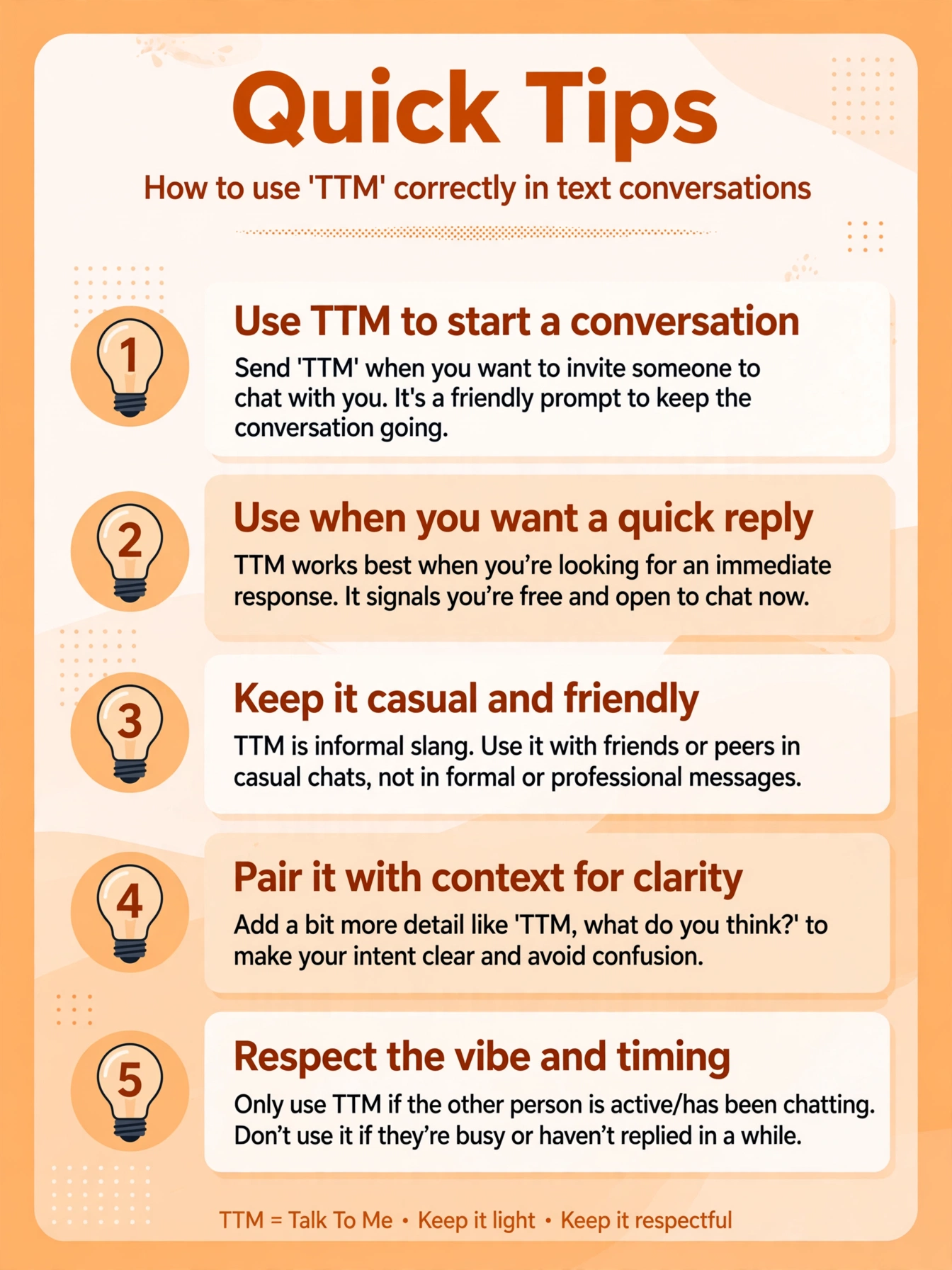
Want to use TTM like a pro? These practical tips will help you get the tone right every time.
- Know your audience. TTM is for friends, peers, and casual chats. The closer the relationship, the better it works.
- Add an emoji to soften it. “TTM” with a smile feels warm; “TTM” alone can feel blunt. One small emoji changes the whole message.
- Give them a topic. “TTM, I need advice about something” gets faster replies than a bare “TTM” because people know what they are walking into.
- Don’t spam it. Once is an invitation; five times is pressure. If someone does not reply, they are busy – not ignoring your abbreviation skills.
- Reply kindly when someone sends it to you. TTM is a small act of vulnerability – the person is asking for your time. A warm reply like “Hey! What’s up?” goes a long way.
- Watch the clock. A “TTM?” at 2 PM is casual. The same message at 2 AM carries a very different energy. Be aware of what late-night texting implies.
- Keep work and play separate. If your work chats and friend chats live in the same app, double-check which conversation you are in before sending slang.
- When in doubt, spell it out. “Talk to me” takes one extra second to type and is understood by literally everyone. Clarity beats coolness.
FAQ
1. What does TTM mean in a text message?
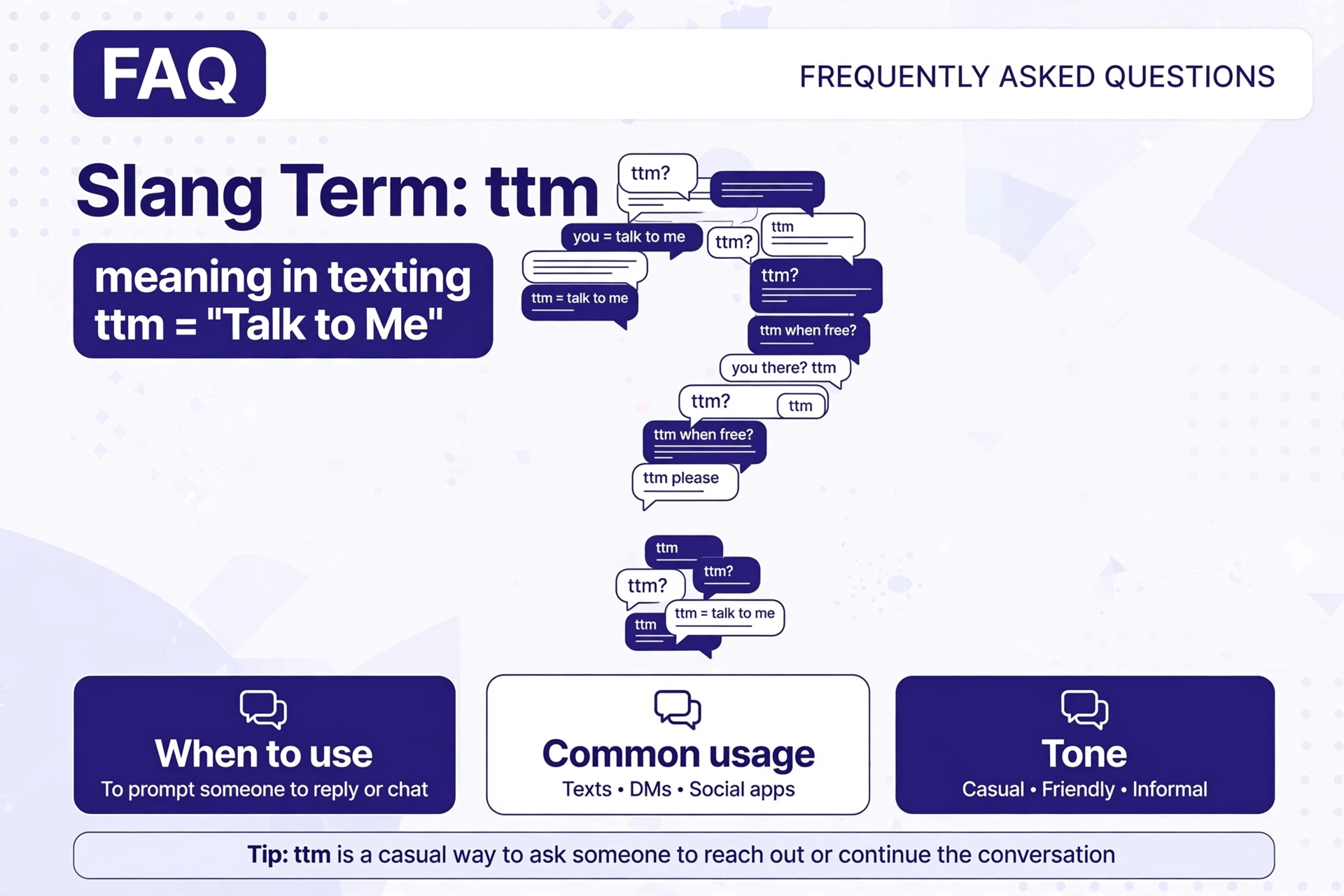
TTM most commonly means “Talk To Me” in text messages. It is a casual invitation asking the other person to start or continue a conversation with you. For example, “Hey, TTM when you’re free!” simply means “Hey, talk to me when you’re free!”
2. What does TTM mean when a guy sends it?
When a guy sends TTM, it usually means he wants your attention or wants to keep the conversation going. In a dating or flirting context, especially late at night, it often signals romantic interest – he is saying “I want to talk to you” in a playful, low-pressure way. Between friends, though, it is usually just friendly.
3. What does TTM mean when a girl sends it?
When a girl sends TTM, it generally means she wants to chat, catch up, or share something with you. It can be friendly (“TTM, I have gossip!”) or flirty (“TTM?”), depending on your relationship and the timing. Like with anyone, context and emojis tell you which one it is.
4. What does TTM mean on Snapchat, Instagram, and TikTok?
On Snapchat, Instagram, and TikTok, TTM still means “Talk To Me,” but it often works as a public call to action. In a story caption or video caption, “TTM” invites followers to send DMs or leave comments. Creators use it to boost engagement, and everyday users use it when they are bored and want company.
5. What does TTM stand for in business and finance?
In business and finance, TTM stands for “Trailing Twelve Months,” which refers to a company’s financial performance over the previous 12 consecutive months. It can also mean “Time To Market” in product management. These professional meanings have nothing to do with the texting slang – always check the context.
6. How should I reply when someone sends me TTM?
Reply warmly and naturally, just like you would to any conversation starter. Good responses include “Hey! What’s up?”, “Sure! What did you want to talk about?”, or “Always! What’s on your mind?” If you are busy, be honest: “Can’t talk right now, but TTM later tonight!”
7. Is TTM rude, needy, or flirty?
TTM is not inherently rude, but tone and frequency matter. Sent once with a friendly emoji, it is casual and inviting. Sent repeatedly, it can come across as needy or impatient. Late at night from a crush, it often reads as flirty. The abbreviation itself is neutral – the context gives it meaning.
8. What is the difference between TTM and HMU?
TTM means “Talk To Me” and asks for a conversation right now. HMU means “Hit Me Up” and asks someone to contact you later or whenever it is convenient. TTM is immediate and direct; HMU is relaxed and future-oriented. Use TTM when you want to chat now, and HMU when you are making loose plans.
Conclusion
So, what is the ttm meaning in text? In one sentence: TTM means “Talk To Me” – a short, friendly invitation to start or continue a conversation. It was born in the era of character limits and instant messengers, grew up on Snapchat and Instagram, and found new life on TikTok and dating apps. Today it is one of the most direct little abbreviations in the texting world: three letters that simply say, “I want to talk to you.”
The key takeaways are easy to remember. First, context decides everything – the same “TTM” can be friendly, flirty, bored, or professional-sounding depending on who sends it and where. Second, keep it casual: TTM belongs in chats with friends, not in work emails or formal messages. Third, do not overuse it – one invitation is charming, five in a row is pressure. And finally, when someone sends you TTM, take it as the small compliment it is: they chose you to talk to.
Texting slang only works when everyone understands the code, and now you do. The next time “TTM?” lights up your screen, you will know exactly what to do – just start talking. And if you enjoyed decoding this one, keep exploring: check out tmp meaning in text for another tricky abbreviation, or hbu meaning in chat to master the perfect reply to “how about you.” Happy texting!

1 thought on “TTM Meaning Text: The Complete Guide to This Chat Invitation”