
YDK Meaning: What Does YDK Mean in Texting & Slang?
Quick definition: YDK meaning in texting and slang is simple — YDK stands for “you don’t know.” People use it to playfully point out that someone is missing a piece of information, to tease a friend, or to correct someone who is confidently wrong. It is short, casual, and almost always lighthearted, though the exact tone depends on the conversation around it.
YDK Meaning & Definition
So, what does YDK actually mean? The letters stand for “you don’t know.” That is the whole definition — three words compressed into three letters — but like most internet slang, the meaning lives in how people use it, not just in what the letters spell out.
When someone drops a “YDK” into a chat, they are usually saying one of these things: “You clearly don’t know what you’re talking about,” “You’re missing the full story,” or “Let me fill you in, because you have no idea.” It can be a gentle tease between friends, a playful correction, or a dramatic way to introduce a surprising fact. The phrase works because it is blunt without being rude — most of the time.
Here is the key thing to understand about ydk meaning: it is almost never a neutral statement of fact. If someone wanted to neutrally say “you don’t know this,” they would just type the full sentence. Choosing the abbreviation adds attitude. It says, “I know something you don’t, and I’m enjoying that fact.” That little edge is exactly why the slang caught on in group chats, gaming lobbies, and comment sections.
YDK is also a close cousin of IDK — if IDK is the shrug (“I don’t know”), YDK is the finger-point (“you don’t know”). The two abbreviations show up together so often that many people learn them as a pair. One admits ignorance; the other calls it out. It belongs to the same family of blunt little abbreviations as NGL meaning in text, which is equally direct but turns the honesty inward instead of pointing it at someone else.
Introduction
Picture this: you are in a group chat, confidently explaining the plot of a movie you have never actually seen, when a friend replies with just three letters — “YDK.” No explanation, no emoji, no follow-up. Everyone else in the chat starts laughing. In that moment, those three letters did a lot of work. They told you that you were wrong, that everyone else knew it, and that your friend found the whole thing funny — all without a single full sentence.
That is the power of modern texting slang. Abbreviations like YDK compress an entire attitude into a few keystrokes, and they spread because they are fast, expressive, and fun to use. YDK is not the most famous slang abbreviation on the internet — it lives a few rungs below giants like LOL, OMG, and IDK — but it has carved out a loyal place in everyday digital conversation, especially among younger texters, gamers, and social media users.
In this guide, we will break down everything you need to know about YDK: what it stands for, where it came from, how popular it really is, and exactly how to use it without accidentally sounding rude. You will see real examples from friendly chats, professional settings, and funny situations, compare it with similar terms like IDK, IYDK, and YKYK, and learn the common mistakes people make with it. By the end, you will know precisely when a quick “YDK” is the perfect reply — and when a full sentence is the smarter choice.

Origin
Like most texting abbreviations, YDK does not have a single inventor or a neat birthday. It grew out of the same early-internet culture that gave us LOL, BRB, and IDK — the chat rooms, instant messengers, and SMS conversations of the late 1990s and early 2000s, where every character cost time and, on old mobile plans, actual money.
The logic was simple: if “I don’t know” could become IDK, then “you don’t know” could become YDK. Early users on platforms like AIM (AOL Instant Messenger), MSN Messenger, and Yahoo! Chat were already shortening everything they typed, and YDK fit the pattern perfectly. It was short, obvious once you saw it, and useful in exactly the kind of fast, teasing back-and-forth that chat rooms encouraged.
As texting moved to smartphones and social media, YDK travelled with it. It showed up in SMS conversations, then on Facebook and Twitter, then in gaming chats on Xbox Live and Discord, and eventually in TikTok comments and Instagram captions. Each new platform gave it a slightly different flavor — gamers used it to trash-talk opponents who did not understand a strategy, while friend groups used it as a gentle roast when someone missed an obvious joke.
One reason YDK never became as universal as IDK is that it is a little more confrontational. Saying “I don’t know” is safe; saying “you don’t know” points a finger. That small social difference kept it slightly niche — popular enough that most regular texters recognize it instantly, but not so mainstream that your grandmother would drop it in a family group chat. That balance is part of its charm: using YDK signals that you are fluent in internet culture without trying too hard.
The term also got a boost from its appearances on slang dictionaries. Urban Dictionary defines YDK as “you don’t know,” with user-submitted examples showing it used to call out someone who is clueless about a topic. Those community definitions helped standardize the meaning at a time when slang could easily splinter into a dozen different interpretations.
Popularity
YDK sits in the middle tier of internet slang popularity. It is nowhere near as common as LOL, OMG, or IDK, which appear in billions of messages a year, but it is far from obscure. If you spend time in group chats, gaming communities, or TikTok comment sections, you will run into it regularly — usually at exactly the moment someone is being playfully corrected.
Its popularity follows a familiar pattern for niche slang: it is strongest among teenagers and young adults, especially in the United States, and it spreads through friend groups rather than through mainstream media. Nobody learns YDK from a textbook or a news broadcast. They learn it because a friend used it on them, they asked what it meant, and then they started using it themselves. That word-of-mouth spread is why it feels like an “insider” term even though millions of people know it.
Search interest in “ydk meaning” has also grown steadily as more people encounter the abbreviation without context — in a meme, a TikTok caption, or a message from a younger relative — and turn to Google to decode it. That is the classic lifecycle of modern slang: a term simmers in chats and comments for years, then spikes in search as it crosses over to a wider audience that wants a quick definition.
Compared with its sibling IDK, YDK will probably never be as universal, and that is fine. Its slightly edgy, teasing tone is a feature, not a flaw. It fills a specific conversational gap: the moment when you want to say “you have no idea what you’re talking about” but you want to say it with a smile instead of a lecture. As long as people keep teasing their friends online, YDK will keep its place in the texting vocabulary.
How It Is Used
YDK is flexible, and that flexibility is why it survives. The same three letters can do several different jobs depending on the sentence around them and the relationship between the people talking. Here are the most common uses you will actually see:
- The playful correction. Someone states something wrong with total confidence, and a friend replies “YDK” to puncture the confidence gently. This is the most common use, and it is almost always friendly.
- The teasing call-out. In a group chat, YDK works like a light roast. When someone misses an obvious joke or a piece of gossip everyone else knows, “YDK” says “you’re the only one who didn’t get it” — with a laugh built in.
- The dramatic reveal. Sometimes YDK opens a message instead of closing one: “YDK… the concert got cancelled.” Here it functions like a drumroll, warning the reader that surprising news is coming.
- The gaming trash-talk. In multiplayer games, YDK shows up when one player does not understand a strategy, a map, or a mechanic. “YDK how this map works, do you?” It is competitive, but usually still playful among friends.
- The sarcastic reply. When someone gives an obviously wrong answer or a hilariously bad take, a lone “YDK” can be the entire reply. The brevity is the joke — it says everything without saying much at all.
Notice what all of these uses have in common: YDK is almost always aimed at someone else, and it almost always carries a little bit of attitude. That is why it works so well in casual conversation and so poorly in formal settings. In a work email or a message to a teacher, the same three letters would read as rude or dismissive. Among friends, they read as fun.
It is also worth noting where YDK usually appears: at the start of a sentence, on its own as a full reply, or tacked onto the end of a teasing statement. You will rarely see it buried in the middle of a long, serious paragraph. It is a punchy, conversational abbreviation, and it behaves like one.
Examples
Reading a definition is one thing; seeing YDK in real conversations is what makes it click. Here are examples from different kinds of chats, so you can feel how the tone changes with context.
Friendly Examples
- Alex: “The new season drops on Friday, right?”
Sam: “YDK, it got delayed to next month 😂” - Mia: “I’m pretty sure pineapple on pizza was invented in Italy.”
Jordan: “YDK, it was invented in Canada! Look it up.” - Chris: “There’s no way the teacher will check homework today.”
Taylor: “YDK, she literally said yesterday she’s collecting it.” - Priya: “I bet I can finish this level on the first try.”
Leo: “YDK how hard this boss is. Good luck though 😅”
In these friendly examples, YDK is doing gentle work. It corrects a wrong fact, warns a friend, or sets up a joke — and the conversation moves on without any hard feelings. The key ingredient is the relationship: these are people who tease each other all the time, so the abbreviation lands as affection, not an attack.
Professional Examples
YDK has almost no place in professional writing, and that is an important thing to know. You would not write “YDK” in a work email, a client message, or a formal report. But in a casual work chat between colleagues who already joke around, a softened version can occasionally appear — usually spelled out, not abbreviated.
- Colleague: “I think the client meeting is on Thursday.”
You: “Actually, you might not know — they moved it to Wednesday. Check the calendar!” - Teammate: “The file is in the shared drive, right?”
You: “Hmm, you may not have heard — we moved everything to the new folder last week.”
See the pattern? The professional version of YDK is a polite, complete sentence: “you might not know,” “you may not have heard,” or “just so you know.” The abbreviation itself stays in the group chat with friends. If you are ever unsure whether YDK fits, spell it out politely — that is the professional alternative, and it never backfires.
Funny Examples
- Friend 1: “I’m basically a professional chef now. I made toast.”
Friend 2: “YDK what a chef even is 😭” - Friend 1: “I could totally beat you in a race. I ran once in 2019.”
Friend 2: “YDK, I literally do track. Sit down.” - Friend 1: “This movie is so predictable, I knew the twist in the first five minutes.”
Friend 2: “YDK, there was no twist. You fell asleep.” - Friend 1: “I’m not scared of the haunted house, ghosts are fake.”
Friend 2: “YDK… wait till you hear the screaming from inside.”
The humor in these examples comes from the gap between confidence and reality. YDK is the sound of that gap closing — fast, funny, and just a little bit brutal. It works best when everyone involved knows it is a joke.
Comparison with Similar Terms
YDK is easy to mix up with other short abbreviations, especially the ones built from the same words. The table below clears up the confusion at a glance.
| Term | Stands For | What It Means | When to Use It |
|---|---|---|---|
| YDK | You don’t know | Pointing out that someone else lacks information | Teasing or correcting a friend |
| IDK | I don’t know | Admitting that you lack information | Answering a question honestly |
| IYDK | If you didn’t know | Sharing a fact someone may have missed | Starting a helpful update (“IYDK, the store closes early today”) |
| ICYDK | In case you didn’t know | Same idea as IYDK, slightly more formal | Giving someone a heads-up politely |
| YKYK | You know, you know | Referring to a shared joke or secret | Nodding at an inside joke only some people get |
| YKW | You know what | Starting a thought or changing the subject | Opening a casual statement (“YKW, let’s just order pizza”) |
| ISTG | I swear to God | Emphasizing that you are serious | Adding emphasis or frustration — see our guide to ISTG meaning in text |
The most important distinction is between YDK and IDK. They are mirror images: IDK points inward (“I don’t know”), YDK points outward (“you don’t know”). Mixing them up changes the entire meaning of a message, so double-check which one you mean before you send it. IYDK and ICYDK, on the other hand, are the polite cousins of YDK — they share information without the teasing edge, which makes them better choices when you want to be helpful rather than funny.

Alternate Meanings
In texting and social media, YDK almost always means “you don’t know.” But abbreviations can carry alternate meanings in other contexts, and YDK is no exception. Here are the less common interpretations you might run into:
- “You don’t know?” as a question. Sometimes YDK appears with a question mark — “YDK?” — turning the statement into a genuine question: “You don’t know [about this]?” Context and punctuation make the difference.
- A name or username. Some people use YDK as a handle, a gamertag, or a brand abbreviation. In those cases it has nothing to do with slang at all.
- Technical or organizational initials. Like any three-letter combination, YDK can stand for company names, product codes, or technical terms in specific industries. These uses are rare and always depend on context.
For everyday texting, though, the rule is simple: if you see YDK in a chat, a comment, or a caption, assume it means “you don’t know” unless the context clearly says otherwise. That reading will be right the overwhelming majority of the time.
Professional or Polite Alternatives
YDK is fun, but it is not universal. In any situation where politeness matters — work, school, messages to older relatives, or conversations with people you do not know well — use one of these alternatives instead:
- “Just so you know…” — the friendliest replacement. It shares the same information with zero teasing.
- “You might not know this, but…” — polite and clear, perfect for work chats and emails.
- “In case you didn’t know…” — the full form of ICYDK, and the safest choice for formal messages.
- “Heads up — …” — casual but professional, great for giving someone a quick update.
- “You may not have heard, but…” — soft, respectful, and ideal when the news might be disappointing.
The trick is matching the alternative to the relationship. With close friends, YDK is fine. With a manager, a teacher, or a new acquaintance, “just so you know” does the same job without any risk of sounding dismissive. Knowing both versions — the slang and the polite form — is what real fluency looks like.
Common Mistakes
YDK is short and simple, which makes people overconfident about using it. These are the mistakes that trip people up most often:
- Mixing up YDK and IDK. This is the number-one error. Remember: IDK is about you (“I don’t know”), YDK is about the other person (“you don’t know”). Swapping them flips the meaning of your message entirely.
- Using it with strangers or superiors. YDK carries a teasing edge. Dropping it on someone you barely know — or on a boss, a teacher, or a client — can come across as rude or condescending, even if you meant it playfully.
- Using it in serious conversations. If someone is sharing bad news, asking for help, or talking about something emotional, a “YDK” reply can feel dismissive. Save it for light, joking moments.
- Overusing it. Like any slang, YDK loses its punch if you use it in every message. One well-timed “YDK” in a group chat is funny; ten in a row is annoying.
- Assuming everyone knows it. Not every texter knows every abbreviation. If you drop YDK on someone who has never seen it, they may just be confused. With older relatives or less online friends, spell it out or skip it.
- Forgetting the tone. Text has no facial expressions or voice. A “YDK” that sounds playful in your head can read as harsh on someone else’s screen. When in doubt, add an emoji or a laughing face to soften it — or write the full sentence instead.

Quick Tips
- Use YDK to tease, not to insult. If the person on the other end would laugh, it is the right moment. If they would feel small, pick a kinder phrasing.
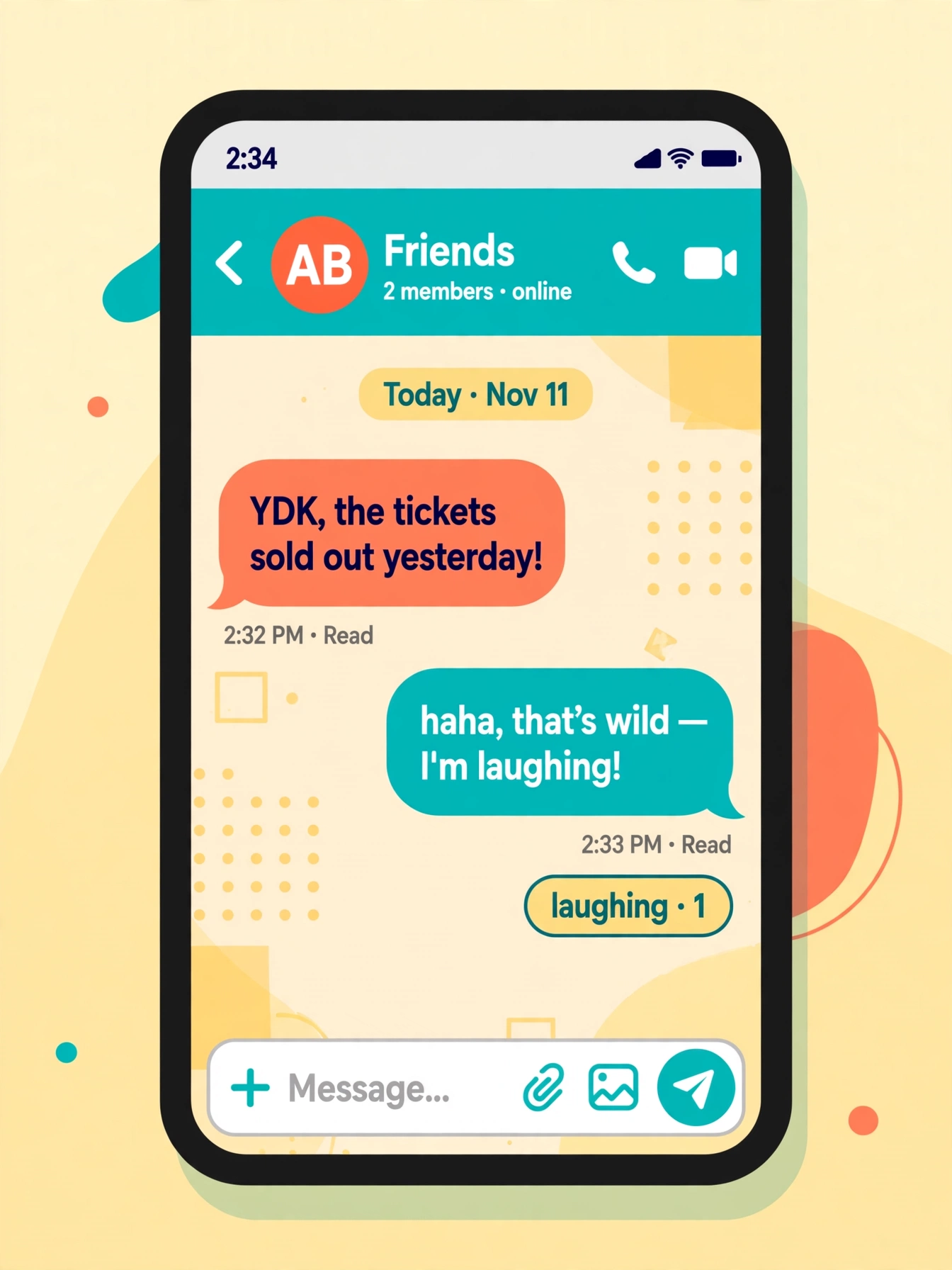
- Pair it with context. A lone “YDK” can confuse people. Add the missing fact right after it: “YDK, the tickets sold out yesterday.” Now it is helpful, not just cheeky.
- Add an emoji to set the tone. A 😂 or 😅 after YDK signals “I’m joking” instantly and prevents misunderstandings.
- Save it for casual chats. Group chats with friends, gaming lobbies, and social media comments are YDK territory. Work emails and formal messages are not.
- Learn the family. Once you know YDK, IDK, IYDK, and YKYK, you can read almost any teasing exchange in a group chat without missing a beat.
- When in doubt, spell it out. “You might not know this, but…” is never the wrong choice. The abbreviation is a shortcut, not a requirement.
FAQ
What does YDK mean in texting?
YDK stands for “you don’t know.” It is texting slang used to playfully point out that someone is missing information, is wrong about something, or has missed a joke. It is casual, teasing, and most common in group chats and social media comments.
What does YDK mean on TikTok?
On TikTok, YDK means the same thing as in texting — “you don’t know.” It usually appears in comments when someone corrects a creator or another commenter, or in captions as part of a joke about someone being clueless. The teasing tone fits TikTok’s playful comment culture perfectly.
Is YDK rude?
YDK is not usually rude, but it can be. Between friends who tease each other, it is friendly and funny. With strangers, superiors, or in serious conversations, it can sound dismissive or condescending. The relationship and the context decide whether it lands as a joke or an insult.
What is the difference between YDK and IDK?
IDK means “I don’t know” and points inward — you are admitting you lack information. YDK means “you don’t know” and points outward — you are saying the other person lacks information. They are mirror images, so mixing them up changes the meaning of your message completely.
Can I use YDK at work?
It is best not to use YDK at work. The abbreviation is casual and teasing, which does not fit professional communication. Instead, use polite alternatives like “just so you know,” “you might not know this, but…,” or “in case you didn’t know.”
What does YDK mean in gaming?
In gaming chats, YDK usually means “you don’t know” and is used as light trash-talk — for example, telling an opponent or a teammate that they do not understand a map, a strategy, or a game mechanic. Among friends it is playful; with strangers it can come across as taunting, so use it carefully.
Is YDK the same as IYDK?
No. IYDK stands for “if you didn’t know” and is used to share a fact someone may have missed, usually in a helpful way. YDK is more direct and teasing — it points out that someone does not know something, often as a joke. IYDK is the polite cousin; YDK is the cheeky one.
How do you reply to YDK?
It depends on the tone. If it was a friendly tease, laugh it off or fire back playfully (“Okay okay, you got me 😂”). If it came with a fact you genuinely missed, a simple “Oh, I didn’t know that — thanks!” works well. If it felt rude, you can ignore it or reply with the full context calmly.
Conclusion
YDK is a small abbreviation with a big personality. It stands for “you don’t know,” and in just three letters it manages to tease, correct, and entertain all at once. Born in the chat rooms and instant messengers of the early internet, it has earned a lasting place in group chats, gaming lobbies, and TikTok comments — the unofficial home of playful corrections everywhere.
The key takeaways are simple. First, YDK points outward: it is about what the other person does not know, which makes it the mirror image of IDK. Second, tone is everything — between friends it is a joke, with strangers it can sting, so read the room before you send it. Third, context turns it from a bare taunt into something genuinely useful: “YDK, the event moved to Saturday” is helpful, funny, and clear all at once.
Like all slang, YDK works best when you understand both the word and the world around it. Now that you know what it means, where it came from, and how to use it without stepping on toes, you will spot it everywhere — and you will know exactly when to drop a well-timed “YDK” of your own. And if you want to keep building your slang vocabulary, our guides to kink meaning in slang and the Gen Z slang guide for 2024 are good next stops.

1 thought on “YDK Meaning: What Does YDK Mean in Texting & Slang?”