
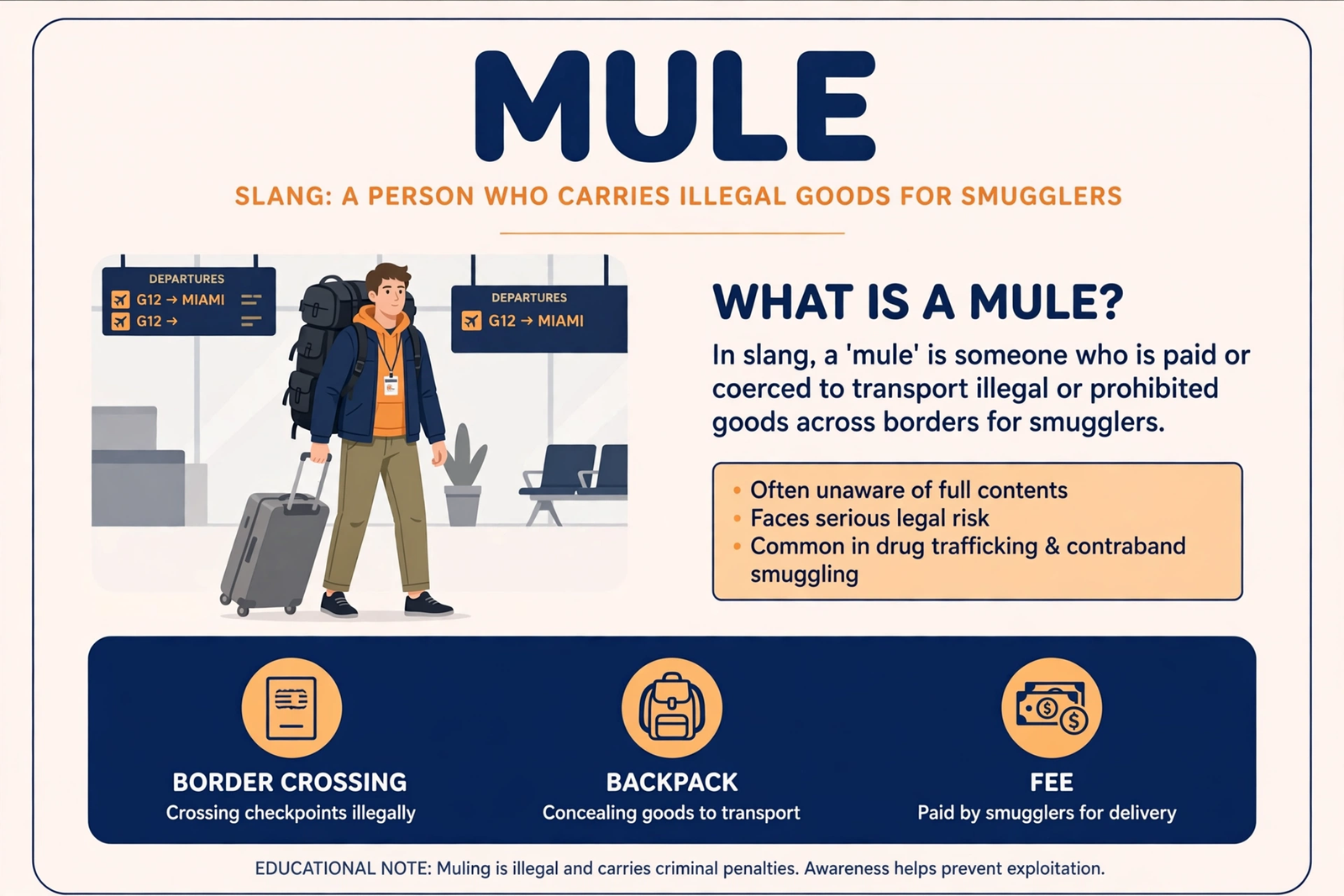
Quick definition: In slang, a mule is a person who carries or smuggles illegal drugs across a border or from one place to another for a dealer or a criminal organization. The mule slang meaning is all about carrying the load while someone else takes the profit and most of the risk stays with the carrier.
mule slang Meaning & Definition
The mule slang meaning is simple on the surface: a mule is a human courier for contraband, most often illegal drugs. Merriam-Webster defines the slang sense of mule as “a person who smuggles or delivers illicit substances (such as drugs).” When people say someone was “used as a mule,” they mean that person physically transported drugs for a smuggling group, usually for a small fee, and usually without owning the drugs or running the operation.
The word works because of the animal it borrows from. A real mule is a beast of burden — strong, stubborn, and used to carry heavy loads over long distances. In slang, the person called a mule plays the same role: they carry the load. The difference is that the load is illegal, the journey often crosses an international border, and getting caught can mean years in prison. That is why the word almost always shows up in crime news, court reporting, true-crime shows, and movies rather than in everyday small talk.
It helps to understand exactly what a mule is not. A mule is not the dealer who sells the drugs, not the boss who organizes the shipment, and not the customer who buys it. The mule is the middle link in the chain — the person in physical possession of the drugs while they move from point A to point B. According to research by the European Monitoring Centre for Drugs and Drug Addiction, a drug mule is typically a courier who is paid, coerced, or tricked into transporting drugs across an international border but who has no further commercial interest in the drugs themselves. That last detail matters: the mule usually does not profit from selling the drugs, only from the fee for carrying them.
Introduction
You have probably heard the word mule in a crime drama or a news headline: “Airport police arrest suspected drug mule,” or a character in a movie saying, “They needed a mule, and I needed the money.” The line lands because the word paints an instant picture — someone loaded up like a pack animal, walking straight into danger while someone else stays safe. But what does mule slang actually mean, where did it come from, and how is it different from words like dealer, courier, or trafficker?
This guide breaks down the mule slang meaning in plain English. You will learn the exact definition, the origin of the term, how it is used in real conversations and media, and the other meanings of mule that can cause confusion — from a stubborn person to a backless shoe to a Moscow mule cocktail. You will also see comparison tables, real examples, common mistakes, and safe alternatives you can use instead. If you want a full, honest answer to the question “what does mule mean in slang,” you are in the right place.
Origin
The slang use of mule comes directly from the animal. Mules have carried goods for humans for thousands of years. A mule is the offspring of a female horse and a male donkey, and it is famous for two traits: it can carry heavy loads over rough ground, and it is famously stubborn. When drug smuggling grew into an organized international business in the 20th century, traffickers needed ordinary-looking people to move drugs across borders — and the old word for a load-carrier was waiting to be borrowed.
The term spread through law enforcement and journalism first, then into movies, TV, and everyday speech. Smuggling organizations prefer using mules because it keeps the organizers away from the drugs. If a mule is caught, the organization loses one shipment and one replaceable person, while the people running the operation stay free. That cold logic is exactly why the word carries such a heavy, sad tone: in most reporting, mules are described as desperate, tricked, or pressured people — not criminal masterminds.
The Spanish connection also matters. In Spanish, “mula” has the same slang meaning, and much of the cocaine trade moving into the United States and Europe passed through Spanish-speaking countries. The word crossed into English the same way the trade routes did. By the 1980s and 1990s, “drug mule” was standard vocabulary in newspapers on both sides of the Atlantic, and the shorter form “mule” followed naturally. Today, the 2018 Clint Eastwood film “The Mule,” about an elderly man recruited to drive drugs for a cartel, introduced the term to a whole new audience.
Popularity
Mule slang is not a TikTok trend word like slay or tea, two of the trendiest slang terms on this site. You will rarely see teenagers calling each other mules in a group chat for fun. Its popularity lives in a different world: news coverage of airport arrests, true-crime documentaries, court cases, and crime dramas. Every time customs officers at a major airport seize drugs from a passenger’s luggage, headlines use the word within hours, and millions of readers absorb the meaning without ever looking it up.
That said, the word has been gaining fresh attention online. True-crime content is huge on TikTok, YouTube, and podcasts, and “drug mule” stories — especially stories about people who were tricked or forced into carrying drugs — regularly go viral. Travel warnings also keep the term in circulation: governments warn tourists that accepting a free trip or carrying a stranger’s bag can turn you into an unwitting mule. Search interest spikes whenever a high-profile arrest makes the news, which is why understanding the exact mule slang meaning is useful even if you never use the word yourself.
How It Is Used
In practice, mule slang shows up in a few clear contexts. Slang travels fast online — words like bougie jumped from small communities to everyone’s feed in months — but mule took the opposite path, moving from police reports and courtrooms into everyday speech. The most common settings are news reporting, movies and TV, travel warnings, casual jokes, and gaming.
Here is how the usage breaks down:
- In news reports: “drug mule” is the standard label for someone caught transporting drugs. It signals the person was a carrier, not the organizer.
- In movies and TV: A character becomes a mule when they agree — or are forced — to transport drugs for money. The story usually focuses on the risk and the moral trap.
- In warnings: Travel and safety advice uses the word to describe the danger of carrying luggage or packages for people you do not know well.
- In casual conversation: People sometimes joke, “I’m not your mule,” when a friend asks them to carry something heavy or run an errand — a light, figurative use borrowed from the literal meaning.
- In gaming and online communities: A “mule” can also mean an alternate account or character used to carry and store extra items, gold, or gear for a player’s main character.
Notice the tone in every case. Calling someone a mule is never a compliment. It suggests the person is being used — loaded up, sent into danger, and treated as disposable. Even the joking use (“I’m not your mule”) works because everyone understands the underlying idea: a mule does the heavy carrying while someone else benefits.
Examples
Real examples make the mule slang meaning click faster than any dictionary entry. The word appears in headlines, dialogue, and everyday jokes — and the meaning shifts slightly with the setting. Here are examples grouped by tone so you can see how the word actually sounds in the wild.
Friendly Examples
In casual conversation, mule is usually a joke about carrying things. A friend might say, “Can you grab my suitcase too? You are such a mule today,” and everyone laughs because the comparison is playful — nobody is talking about crime. Another common one: “I am not your mule, carry your own shopping bags.” The humor works because the serious meaning of the word is so well known that even the light use borrows a little of its edge.
Among gamers, the friendly use is practical rather than criminal. “My mule account holds all my extra crafting materials” is a normal sentence in games where one account stores items for another. In that world, a mule is just a pack horse for digital loot, and nobody blinks at the term.
Professional Examples
In professional and journalistic writing, mule is a precise term with a serious weight. A news report might read: “The defendant told the court she had been recruited as a drug mule after being promised $5,000 and a free holiday.” A law-enforcement statement might say: “Officers believe the suspect was acting as a courier, commonly known as a mule, for an organized crime group.” A travel advisory could warn: “Do not agree to transport packages for strangers. Criminal gangs recruit unwitting travelers as mules.”
In these settings, the word does real work: it tells the reader the person’s role in one word. It says “carrier, not organizer” — and that distinction can matter enormously in a courtroom, where a mule may face a very different sentence from a trafficker.
Funny Examples (if applicable)
Comedy borrows the word exactly because it sounds so loaded. A stand-up comic might say, “My gym bag is so heavy, I feel like a drug mule — except the only thing I am smuggling is protein bars.” A meme caption might read: “Me carrying all the groceries in one trip so I do not have to go back: certified mule.” The joke lands because the audience knows the serious meaning and enjoys the gap between smuggling contraband and smuggling snacks.
Even the stubborn-person meaning of mule feeds the jokes. “He is being a real mule about changing the restaurant” is a funny way of saying someone refuses to budge — and it works because mules are famously stubborn animals. Just remember that the funny uses only work when the context is clearly harmless.

Comparison with Similar Terms
Mule is often confused with other words from the world of smuggling and crime, but each term describes a different job. The table below shows how mule slang compares with the closest related terms, so you can pick the right word every time.
| Term | What the person does | Key difference from a mule |
|---|---|---|
| Mule | Physically carries drugs across a border or between locations for a fee | The baseline: a carrier with no ownership of the drugs |
| Drug courier | Transports drugs for an organization | Almost the same as a mule; courier is the formal, neutral term |
| Dealer | Sells drugs to buyers | A dealer profits from sales; a mule only gets a carrying fee |
| Trafficker | Organizes and controls the movement of drugs | A trafficker runs the operation; a mule is a small, replaceable part of it |
| Runner | Makes quick local deliveries, often on foot or by car | A runner works locally and fast; a mule usually crosses borders or long distances |
| Money mule | Moves illegal money through bank accounts | Carries money, not drugs, and often operates online |
| Smuggler | Moves illegal goods secretly across borders | A general term; a mule is one specific type of smuggler |
The most important distinction is between a mule and a dealer. A dealer sells. A mule carries. A mule may never meet a buyer, never handle money from a sale, and never know who the drugs belong to. That is also why “drug mule” appears so often in sympathetic reporting: many mules are poor, desperate, or deceived, and they take on enormous legal risk for a payment that is tiny compared with the value of the shipment.

Alternate Meanings
Mule is one of those words with a whole family of meanings, and only one of them is the slang sense this article is about. Knowing the alternates keeps you from misunderstanding a sentence — or embarrassing yourself by using the wrong one.
- The animal: A mule is the hybrid offspring of a female horse and a male donkey. Strong, sure-footed, and famously stubborn, it has been used as a pack animal for centuries. This is the root of every other meaning.
- A stubborn person: Informally, calling someone a mule means they are obstinate and refuse to change their mind. “She is a stubborn old mule” is about personality, not crime.
- A backless shoe: In fashion, mules are slip-on shoes or slippers with no back or heel strap. “Mule heels” are a popular style, and the word here is completely innocent.
- Moscow mule: A cocktail made with vodka, ginger beer, and lime, traditionally served in a copper mug. Ordering “a mule” at a bar gets you a drink, not a drug courier.
- Money mule: A person who transfers illegally obtained money for criminals, often through their own bank account. Money mules are a major tool of online fraud and romance scams, and banks warn customers about them constantly.
- Gaming mule: An alternate character or account used to hold extra items, gold, or equipment for a player’s main character. Harmless, and common in online games.
- Sneaker mule: In sneaker culture, a mule is someone who buys limited-edition shoes on behalf of a reseller, often for a small fee, so the reseller can get around purchase limits.
Context is everything. “He is a mule” in a crime documentary means something very different from “those mules are cute” in a shoe store. When in doubt, look at the sentence around the word — the setting almost always makes the meaning obvious.
Professional or Polite Alternatives
Because mule slang is tied to crime, it is usually better to use a neutral term in formal or professional settings — especially if you are writing a report, an essay, or a workplace message. Here are polite alternatives and when to use them:
- Courier: The cleanest formal replacement. “The courier transported the package” says the same thing without the slang edge.
- Carrier: Neutral and clear. “The carrier was unaware of the contents” works in legal and journalistic writing.
- Transporter: A slightly formal option for official documents and reports.
- Go-between: Useful when you want to describe someone who connects two parties without naming a crime.
- Errand-runner: For the joking, everyday use — “I am not your errand-runner” is polite and gets the same laugh without the criminal echo.
- Pack carrier / helper: For casual jokes about carrying heavy bags, “helper” or “pack carrier” keeps the tone light and friendly.
A good rule: in news, law, or academic writing, use courier or carrier. In casual conversation, the slang is fine when everyone understands the joke. And when you are talking about an actual person accused of a crime, the neutral term is not just polite — it is fairer, because it avoids labeling someone before the facts are known.
Common Mistakes
People make a few predictable mistakes with mule slang. Avoiding them keeps you sounding informed instead of confused.
- Calling a dealer a mule: A dealer sells drugs; a mule carries them. Mixing the two up changes the whole meaning of a sentence and can make a report inaccurate.
- Using it as a compliment: Mule is never praise. Saying someone is “a great mule” sounds like you are celebrating that they take risks for someone else’s profit. Do not use it to praise hard work — say “workhorse” instead.
- Confusing it with the shoe: In fashion writing, “mules” means shoes. Searching for “mule slang” and landing on shoe articles is a common confusion for beginners, so check the context before quoting a definition.
- Assuming every mule knows what they carry: Many mules are tricked or coerced, and some genuinely do not know what is in the bag. News reports often stress this, so do not assume guilt from the label alone.
- Using it casually about real people: Joking that a coworker is “my mule” can land badly, especially in a workplace or with people who do not know the slang. The criminal association is strong, so keep the joke for close friends.
- Thinking it only means drugs: A money mule moves cash, a gaming mule moves items, and a stubborn mule will not move at all. The drug sense is the most famous, but it is not the only one.
Quick Tips
- Use “drug mule” for clarity: The two-word form removes all doubt. “Mule” alone can mean a shoe, a cocktail, or a stubborn person — “drug mule” can only mean one thing.
- Keep it out of formal writing: In essays, reports, and professional emails, prefer courier or carrier.
- Check the context first: Before you react to the word mule, look at the sentence. Fashion, cocktails, and crime all use it differently.
- Never carry packages for strangers: This is the real-world lesson behind the slang. A free trip or a quick payment for carrying a bag is the classic way criminals recruit mules, and the legal consequences fall on the carrier.
- Remember the risk gap: Mules take the biggest legal risk for the smallest reward. That imbalance is the heart of the word’s meaning.
- Use the joke version carefully: “I’m not your mule” is funny with friends and awkward with strangers — know your audience.
- Pair it with the right verbs: People “act as,” “work as,” or “are used as” a mule. “He muled the package” is not standard English — use “he carried” instead.


FAQ
What does mule mean in slang?
In slang, mule means a person who smuggles or delivers illegal drugs for a smuggling organization. A mule physically carries the drugs — hidden in luggage, clothing, a vehicle, or even swallowed — across a border or between locations, usually for a small fee and without owning the drugs.
What is a drug mule?
A drug mule is someone who personally transports illegal drugs for a criminal group. Unlike a dealer who sells drugs or a trafficker who organizes the trade, a mule is the carrier. Mules are often paid a flat fee, and many are recruited because they are poor, desperate, or tricked with promises of free travel or quick money.
Is mule slang offensive?
The word itself is not a swear word, but it carries a heavy criminal association, so it can feel offensive or unfair when aimed at a real person — especially someone who has not been convicted of anything. In journalism and formal writing, the neutral term courier is usually preferred.
Where did mule slang come from?
It comes from the animal. Mules are pack animals famous for carrying heavy loads, so the word was borrowed to describe people who carry illegal loads for smugglers. The term spread through law enforcement, journalism, and crime fiction during the 20th century as international drug smuggling grew.
What is a money mule?
A money mule is a person who moves illegally obtained money for criminals, often by letting fraudsters use their bank account to receive and forward stolen funds. Money mules are common in online scams, and banks warn that acting as one is a crime even if the person did not know the money was stolen.
What does mule mean in texting?
In texting, mule is rare and almost always refers to the drug-courier meaning, usually when people discuss news, true crime, or movies. It is not a common texting abbreviation like zesty or other viral terms.
Can a mule also mean a shoe?
Yes. In fashion, mules are backless slip-on shoes or slippers, and “mule heels” are a popular style. The Moscow mule is also a cocktail made with vodka, ginger beer, and lime. Context tells you which meaning is intended — a shoe store and a crime report are very different settings.
Why do criminals use mules?
Criminals use mules to reduce their own risk. If a mule is caught, the organizers lose one shipment and one replaceable person, but they stay free and keep most of the profit. Mules are chosen because they look ordinary, may be desperate for money, or can be tricked into carrying something without knowing what it is.
Conclusion
The mule slang meaning is a window into how language borrows from the everyday world: a hardworking pack animal gave its name to one of the riskiest jobs in the criminal underworld. A mule is a person who carries illegal drugs for a smuggling group — not the boss, not the dealer, just the carrier holding the risk while someone else takes the profit. That imbalance is why the word feels so heavy, and why it shows up in news reports and courtrooms far more often than in casual chat.
At the same time, mule is a word with many lives: a stubborn person, a backless shoe, a copper-mug cocktail, a money mule in a bank scam, and a gaming mule holding extra loot. Context decides the meaning, and the two-word form “drug mule” removes all doubt when you need to be precise. Now you know the definition, the origin, the examples, and the mistakes to avoid — and the next time a headline calls someone a mule, you will know exactly what role they played and why it matters.
