
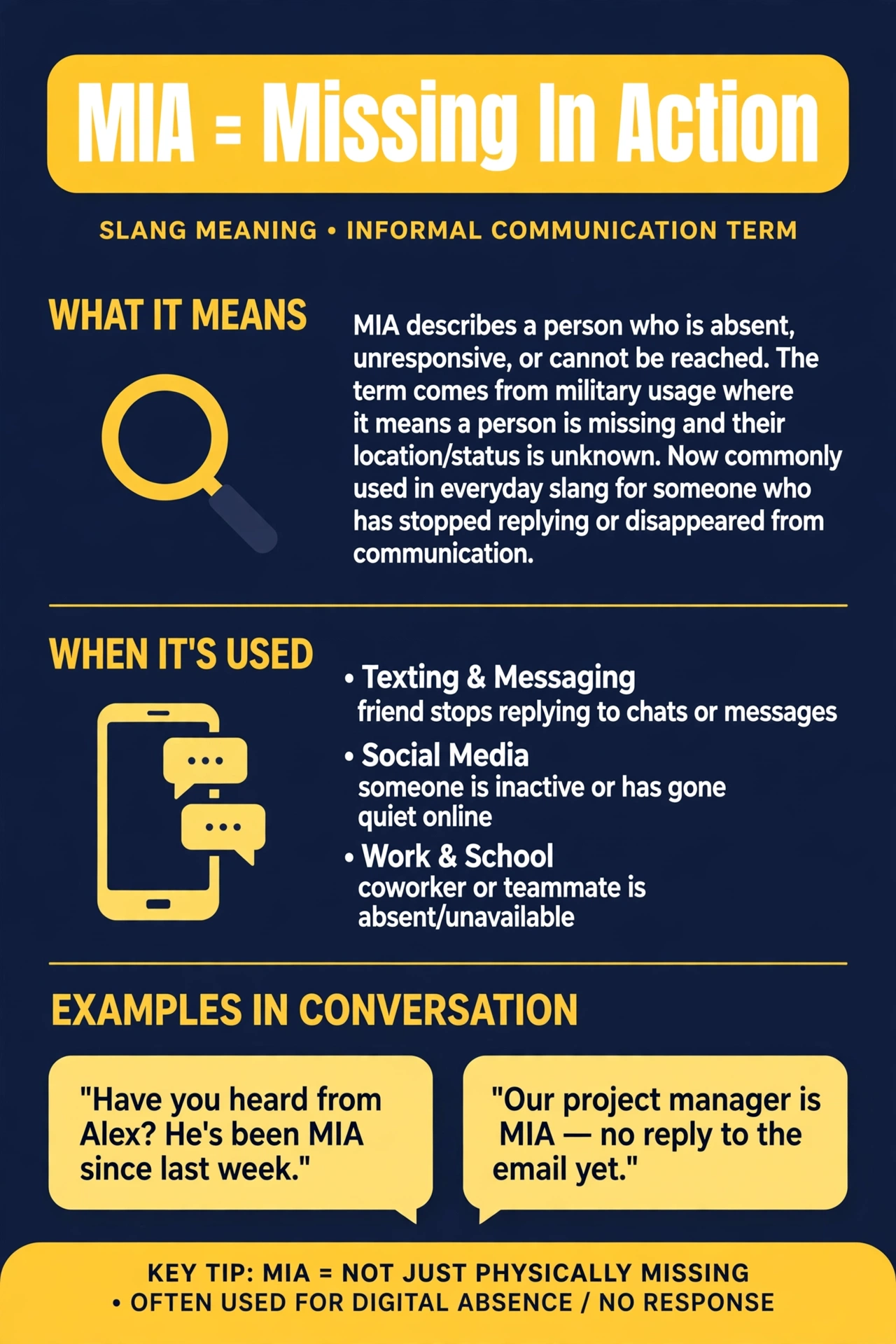
Quick definition: In slang, MIA stands for “Missing In Action.” People use it when someone has disappeared from a conversation, stopped replying to texts, skipped a plan, or gone quiet on social media without any explanation. It is a playful, slightly dramatic way of saying “where did you go?” — borrowed from military language and now a everyday part of texting, gaming, and group chats.
MIA Slang Meaning & Definition
The mia slang meaning is simple at its core: someone is absent when they were expected to be there. When a friend stops answering messages for three days, when a teammate vanishes mid-game, or when a coworker skips every meeting in a week, people say that person has “gone MIA.” The phrase does not usually mean something serious has happened. In casual conversation, it is almost always lighthearted — a nudge, a joke, or a gentle complaint wrapped in three capital letters.
What makes MIA so useful is how much it says in so little space. Instead of typing “you have not replied to any of my messages since Tuesday and I am starting to wonder where you are,” you can write “bro, you’ve been MIA” and everyone understands instantly. The word carries a tiny bit of drama on purpose: your friend is not actually missing in action, they just left you on read.
MIA works as both an adjective and a verb phrase. As an adjective, it describes a person’s status: “Sarah is MIA today.” As a verb phrase, “go MIA” describes the act of disappearing: “He went MIA right after I sent the invite.” You will also see it as a noun in gaming, where “an MIA” can mean an enemy player who has vanished from their lane. The meaning stays the same in every form — someone who should be present is not.
Introduction
It happens to everyone. You send a message, you see it delivered, and then… nothing. Hours pass. A day passes. The group chat moves on without them. Then someone finally types the three letters that sum up the whole situation: “MIA.”
MIA is one of those rare slang terms that almost everyone already understands, even if they have never looked it up. It shows up in texts between best friends, in Discord servers, in TikTok comments, in workplace Slack channels, and in gaming lobbies. It is short, it is expressive, and it works in almost any situation where someone has quietly vanished. Like other popular abbreviations such as sigma slang or the ever-growing world of Gen Alpha slang, MIA proves that the best internet slang is the kind that saves time while adding personality.
This guide covers everything about MIA: what it stands for, where it came from, how people use it in texting and gaming, how it compares to ghosting and AFK, and the polite alternatives for formal settings.
Origin
MIA began as a military term, not as internet slang. It stands for “Missing In Action,” the official classification given to a member of the armed forces whose whereabouts are unknown after a battle or operation. According to Merriam-Webster’s entry for “MIA”, the noun was first used in 1944, during the Second World War, and the adjective followed in 1946. For decades, the term belonged almost entirely to military reports and news coverage.
The jump from the battlefield to the group chat happened gradually. Merriam-Webster itself notes that MIA is “often used figuratively for someone or something notably or unexpectedly missing, absent, or inactive.” A photographer who never showed up to a wedding was “MIA”; a tennis star sidelined by injury was “MIA.” The word kept its sense of unexplained absence but lost its gravity, becoming a colorful way to describe anyone who was suddenly, noticeably gone.
The internet finished the transformation. In the 2000s and 2010s, as texting and online gaming exploded, MIA became a staple of digital shorthand. Gamers needed a fast way to warn teammates that an enemy had left their lane, so “MIA” became a callout. Friends needed a fast way to tease someone who had stopped replying, so “MIA” became a joke. Social media gave it a third life: influencers who stopped posting, celebrities who went quiet, and friends who skipped every plan were all described as MIA. The military origin is still there underneath, but for most people today, MIA is simply the funniest way to say “you vanished.”
Popularity
MIA is popular because it solves a problem every texter has: how to point out someone’s absence without sounding angry or writing a paragraph. A single word does the job, and the slight exaggeration makes it funny instead of confrontational. Saying “you’ve been MIA” lands much softer than “why are you ignoring me?” — and that softness is the whole point.
The term’s popularity also comes from its range. It works for a friend who has not replied in three days, a coworker who missed a week of stand-ups, a gamer who disconnected mid-match, and an influencer who has not posted in a month. It is equally at home in a casual text, a TikTok caption, a Discord callout, and a lighthearted work message. That flexibility keeps it in constant use, while more narrow slang terms fade after a season.
How It Is Used
MIA is used in three main ways, and the context tells you which one applies.
1. To describe someone who stopped replying. This is the most common use. “You’ve been MIA all week” means “you have not answered anyone’s messages.” The tone is usually teasing rather than upset, especially between friends. It is the digital version of waving at someone across a room and asking where they have been.
2. To describe someone who missed a plan or an event. When a friend skips the group dinner, the game night, or the weekend trip without much explanation, they get called MIA. “Jake went MIA on us again” means Jake was expected and did not show up. It can carry a little more annoyance here, but it is still casual.
3. As a gaming callout. In games like League of Legends, “MIA” is a warning: an enemy player has left their lane and could be heading toward you. Players type “mia mid” or “bot mia” to alert their team. In this context, it is not a joke at all — it is practical, fast communication. The same three letters also describe a teammate who disconnected or rage-quit mid-match: “Our healer went MIA and we lost the round.”
The term is almost always informal. It fits texts, group chats, social media comments, Discord, and casual workplace chats between friendly colleagues — not formal emails or official announcements, where “unavailable” or “absent” are better choices. It also describes a temporary absence: if someone has been gone for months with no word at all, people usually switch to stronger words like “ghosted.”
Examples
The best way to understand MIA is to see it in real conversations. The meaning stays the same, but the tone shifts with the situation — playful with friends, frustrated in a game, and gently direct at work.
Friendly Examples
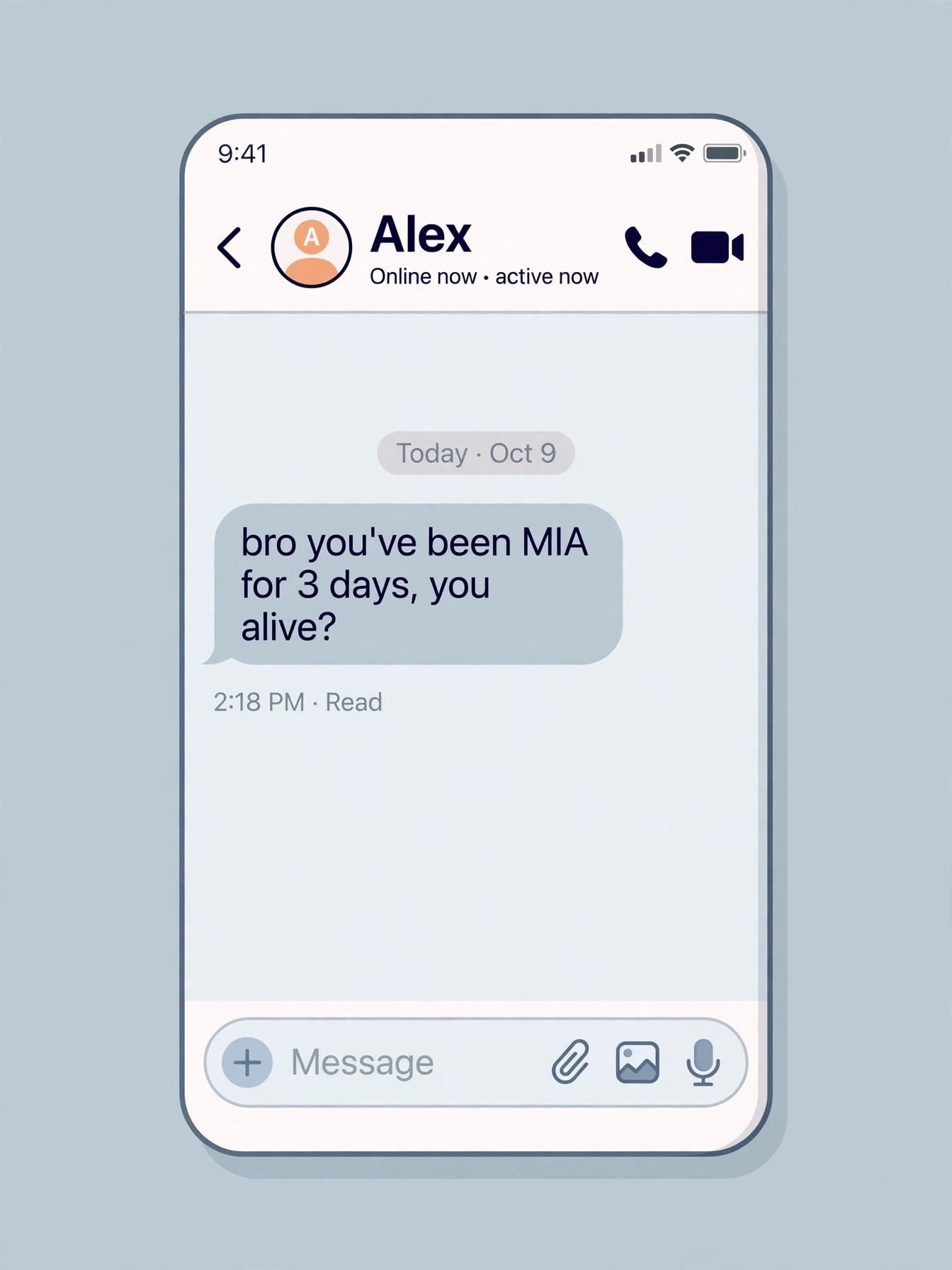
- You: “Bro, you’ve been MIA for 3 days. You alive?”
Alex: “Sorry, my phone was dead and I was at my cousin’s place all weekend.” - Emma: “Our group chat has been so quiet without Mia lol”
Zoe: “She went MIA right after exams started. She’ll be back.” - You: “Where were you last night? You went MIA right before the movie.”
Ryan: “My mom made me stay home for dinner 😭 next time I promise.”
Professional Examples
- Team lead: “Has anyone heard from Mark? He’s been MIA since Tuesday’s stand-up.”
Colleague: “He’s on sick leave, he’ll update us tomorrow.” - You: “The client went MIA after we sent the proposal — no reply in a week.”
Manager: “Send a polite follow-up today, then we’ll wait until Monday.” - Coworker: “Our designer has been MIA in the group chat all morning.”
You: “She’s in back-to-back meetings, she’ll catch up after lunch.”
Funny Examples
- You: “My motivation has been MIA since Monday. Has anyone seen it?”
Friend: “Last seen near the fridge. It’s not coming back.” - Leo: “My Wi-Fi went MIA in the middle of the boss fight 💀”
Max: “Classic. The Wi-Fi always betrays you at the worst moment.” - You: “I went MIA for one weekend and the group chat made 400 messages about me.”
Friend: “We held a full investigation. You were the main suspect.”
Notice how flexible the word is. In the funny examples, MIA does not even describe a person — it describes motivation and Wi-Fi. That is how slang grows: once a word works for people, they start applying it to everything that disappears on them.
Comparison with Similar Terms
MIA is often confused with ghosting, AFK, and a few other “disappearance” words. They overlap, but they are not the same. The differences are mostly about how long the absence lasts and whether it was intentional.
| Term | Meaning | Typical Duration | Tone & Intention |
|---|---|---|---|
| MIA | Temporarily missing or unresponsive | Hours to a few weeks | Neutral or playful; no blame attached |
| Ghosting | Deliberately cutting off all contact | Weeks to permanent | Negative; implies the person chose to vanish |
| AFK | Away from keyboard; briefly stepped away | Minutes to a few hours | Technical and neutral; common in gaming |
| Radio silence | No communication at all, usually on purpose | Days to weeks | Serious or tense; often a deliberate choice |
| DC’d | Disconnected from a game or call | Seconds to minutes | Technical; usually accidental |
| Left on read | Message seen but not answered | Minutes to days | Mildly annoyed; about one message, not the person |
The key difference is intent. Ghosting is a decision: someone ends a conversation or a relationship by going silent, and they do not plan to come back. MIA is a status: someone is not around right now, and nobody is sure why. They might be busy, their phone might be dead, or they might just need space — but the door is still open. That is why friends say “you went MIA” as a joke, while “you ghosted me” is an accusation.
AFK is even narrower: it only means someone stepped away from their keyboard for a short time and is expected back soon. If your friend is AFK for ten minutes, you wait. If they are MIA for three days, you start asking questions. MIA is the lightest of the group, which is exactly why it works in so many situations.

Alternate Meanings
Like most short abbreviations, MIA has a few other meanings that depend entirely on context. In everyday texting, “Missing In Action” is by far the most common, but you may run into these:
- Made In America: Used in shopping, fashion, and product discussions. “These boots are MIA” on a clothing tag means they were manufactured in the United States, not that the boots disappeared.
- Miami International Airport: The airport code for Miami International Airport is MIA. Travelers write “landing at MIA at 6 p.m.” and nobody thinks they are missing in action.
- M.I.A. (the artist): M.I.A. is the stage name of British-Sri Lankan singer and rapper Mathangi Arulpragasam, known for the hit “Paper Planes.” In music conversations, “MIA” usually means her, not an absence.
- Mia (the name): Mia is also a common first name. “Mia has been quiet lately” is about a person named Mia, not about someone going missing. Capitalization and context make the difference, and a lowercase “mia” in the middle of a sentence is almost always the name.
- Missing In Action (gaming): In games like League of Legends, MIA is a specific tactical call meaning an enemy champion is missing from their lane. This is the same phrase as the slang use, but with a precise, technical meaning inside the game.
Context almost always clears up the confusion: flights mean the airport, a silent friend means the slang, and a music chat usually means the artist.
Professional or Polite Alternatives
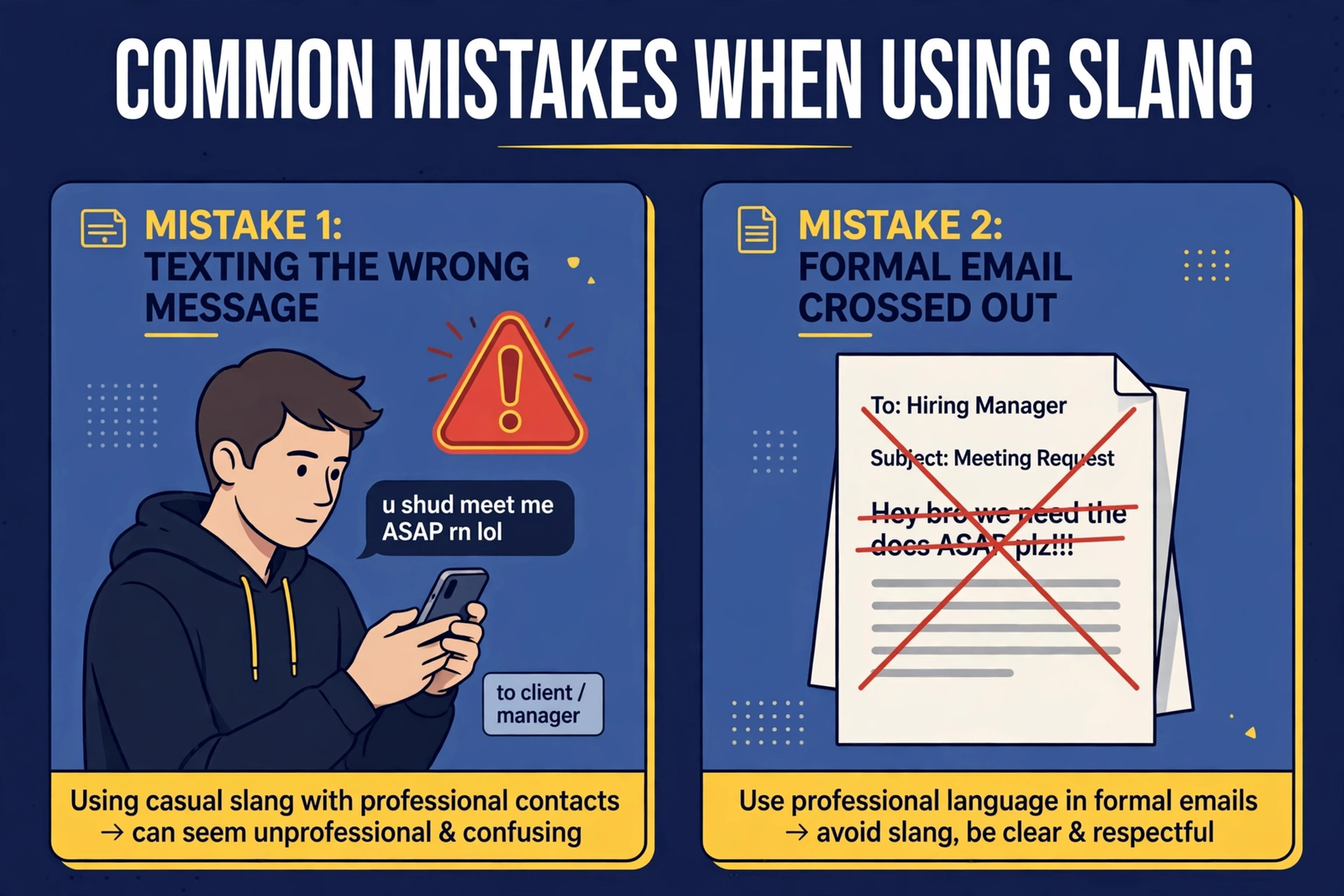
MIA is casual slang, so it does not belong in formal writing or serious workplace communication. If you need to describe someone’s absence politely, try one of these instead:
- Unavailable: “Mark is unavailable this week” — neutral, professional, and safe for any email.
- Unreachable: “We have been unable to reach the client since Tuesday” — clear without sounding accusatory.
- Out of contact: “She has been out of contact for a few days” — formal and factual.
- Not responded yet: “I have not heard back from them yet” — gentle, and it leaves room for a simple follow-up.
- Taking a break: “He is taking a short break from social media” — warm and understanding when someone steps away on purpose.
- Away: “She is away at the moment” — the simplest option, and it works in almost any situation.
Even in friendly work chats, match your words to the relationship. “You’ve been MIA” is fine with a close colleague you joke with daily; with a new client or a senior manager, “I haven’t heard back yet” says the same thing without the slang.
Common Mistakes
MIA is easy to use, but people still get it wrong in a few predictable ways. Avoid these and the word will always land the way you want it to.
- Using it for a serious disappearance. If someone is genuinely missing or in danger, “MIA” is not the word. It is a joke about being unreachable, not a term for a real emergency. In serious situations, say plainly that you cannot reach the person and are worried.
- Confusing MIA with ghosting. Going MIA for a weekend is not ghosting. Ghosting means deliberately ending contact, usually for good. Calling a busy friend a “ghoster” overstates the situation and can turn a light joke into an argument.
- Using it in formal messages. “You’ve been MIA” in a job application follow-up or a formal complaint reads as careless. Save it for friends, casual chats, and lighthearted work messages.
- Assuming the worst. Someone going MIA does not automatically mean they are ignoring you. Phones die, people get sick, work gets busy, and some people simply need a break from their screens. Check in kindly before assuming bad intent.
- Writing it as “Mia” in slang contexts. In the middle of a sentence about a missing friend, “Mia” with a lowercase “ia” looks like the name. Keep the slang in capitals — MIA — so nobody has to guess whether you mean a person or an absence.
Quick Tips
- Keep it light. MIA works best as a joke or a gentle nudge. Pair it with a friendly follow-up — “you good?” or “missed you in the chat” — so the other person knows you are checking in, not accusing them.
- Add a timeframe when it helps. “You’ve been MIA for three days” is clearer and funnier than a bare “you’re MIA.” The timeframe shows you actually noticed, and it gives your friend something specific to answer.
- Use it about yourself too. “Sorry, I went MIA — my phone died at the concert” is a perfect apology. Owning your own absence with a little humor defuses any annoyance before it starts.
- Know the gaming callout. In League of Legends and similar games, type “mia” plus the lane (“mia mid”) the moment an enemy disappears. Your teammates need that warning fast, and three letters are faster than a sentence.
- Match the platform. MIA fits texts, Discord, TikTok comments, Instagram DMs, and casual group chats. On LinkedIn or in a formal email, switch to “unavailable” or “I haven’t heard back.”
- Check before you tease. If a friend has been quiet for an unusually long time, a kind “hey, everything okay?” beats a joking “bro went MIA lol.” Humor is great — kindness comes first.


FAQ
What does MIA mean in slang?
In slang, MIA stands for “Missing In Action.” It describes someone who has disappeared from a conversation, stopped replying, skipped a plan, or gone quiet on social media. It is a playful way of saying someone is absent without explanation.
What does MIA mean in texting?
In texting, MIA means someone has stopped responding or has been inactive in the chat for a noticeable amount of time. For example, “You’ve been MIA all week” means “you haven’t replied to anyone’s messages all week.”
What does MIA mean in gaming?
In gaming, MIA is a warning that an enemy player has left their lane and could be moving toward your team — for example, “mia mid” in League of Legends. It also describes a teammate who disconnected or left mid-match, as in “our healer went MIA and we lost.”
Is MIA the same as ghosting?
No. MIA describes a temporary absence — hours to a few weeks — with no assumption about intent. Ghosting means deliberately cutting off all contact, usually permanently, with no intention of returning. Going MIA for a weekend is not ghosting.
What does it mean when someone says “I went MIA”?
It means they disappeared from a conversation, a group chat, or social media for a while, usually on purpose or because life got busy. People often say it as a light apology: “Sorry I went MIA, work was crazy this week.”
Is MIA rude to say?
Usually not. Between friends, “you’ve been MIA” is a friendly joke. It can feel rude if the person was dealing with something serious, or if it is used in a formal setting.
What is the full form of MIA?
The full form of MIA is “Missing In Action.” It began as a military classification for soldiers whose whereabouts were unknown after combat. The noun was first used in 1944, according to Merriam-Webster, and the figurative everyday use came much later.
Can MIA describe things, not just people?
Yes. People jokingly call anything that disappears “MIA” — motivation, Wi-Fi, a sleep schedule, or a favorite snack. For example, “My motivation has been MIA since Monday” is a common funny use. The word works whenever something expected is suddenly gone.
Conclusion
MIA is one of the most useful three-letter words in modern slang. It started as a serious military classification — Missing In Action, first recorded in 1944 — and grew into a playful, everyday way to describe anyone who has quietly vanished from a chat, a game, or a plan. It is short, funny, and says exactly what it needs to say without turning a small absence into a big deal.
The key to using it well is remembering what it is not. It is not ghosting, which is deliberate and usually permanent. It is not AFK, which is a break of minutes, not days. MIA is the lighthearted middle ground: a joke, a nudge, and a check-in rolled into one. Use it with friends, use it in games, use it about your own disappearing motivation — and when someone calls you MIA, take it as a sign that people noticed you were gone, and that they want you back.
Want to keep building your slang vocabulary? Our guides to Australian slang and Italian slang cover more of the words you will actually hear in texts, on TikTok, and in real conversations — and once you know them, you will never be the one going MIA in the group chat again.
