Quick definition: In texting and social media slang, ion usually means “I don’t.” It is a casual, phonetic spelling of “I don’t” that sounds like the phrase when spoken quickly — as in “ion know” (“I don’t know”). Written in all capital letters, ION can mean something completely different: “In Other News.”
Ion Slang Meaning & Definition
If you have ever stared at a text that said “ion know” and wondered what on earth the sender meant, you are not alone. Ion slang is one of those small internet words that confuses everyone the first time they see it — and then feels obvious forever after.
So, what does ion mean in text? In almost every casual conversation, ion means “I don’t.” It is not an acronym and it is not short for a longer phrase. It is simply how “I don’t” sounds when people say it fast in everyday speech, written down exactly the way it sounds. Say “I don’t know” quickly five times and you will hear it: the sounds blur together into something very close to “ion know.”
That is the whole trick behind ion slang. It is a phonetic spelling — a word written the way it is pronounced in relaxed, informal speech, rather than the way a dictionary spells it. English texting slang is full of these: “gonna” for “going to,” “wanna” for “want to,” and “ion” for “I don’t.”
But there is a twist, and it is the reason this guide exists. The same three letters can carry a second meaning. When someone writes ION in all caps, especially at the start of a sentence, it often stands for “In Other News” — a quick way to change the subject, similar to saying “by the way” or “on another note.” The capitalisation is usually the clue: lowercase ion is almost always “I don’t,” while uppercase ION is often “In Other News.” Context does the rest of the work.
This article explains both meanings of ion slang in full: where the word came from, why it exploded on TikTok and Twitter, how to use it correctly, the mistakes that make you look out of touch, and polite alternatives for professional settings. By the end, you will read “ion” as naturally as any other word in a text message.

Introduction
Slang moves fast. A word that did not exist in your vocabulary last year can be all over your group chat today, and “ion” is a perfect example. It shows up in TikTok comments, Instagram captions, Snapchat messages, Discord servers, and Twitter replies — usually in sentences like “ion even care anymore” or “ion think that’s true.”
For people who grew up hearing it, ion is invisible. For everyone else, it looks like a typo, a chemistry term, or a name. (And yes, in science class, an ion is an atom with an electric charge — but nobody in a group chat is talking about chemistry.) The texting meaning has nothing to do with science. It is pure spoken language, typed out.
Understanding ion slang matters for a simple reason: it is everywhere in Gen Z and millennial texting, and misreading it changes the meaning of a whole sentence. “Ion like him” does not mean someone likes him — it means the exact opposite. “Ion know” is not a confession of ignorance about the word “ion”; it is the sender saying they do not know something. Once you know the code, hundreds of confusing comments suddenly make sense.
In this guide, we will break down the ion meaning in text, trace its roots in African American Vernacular English (AAVE), compare it with similar slang terms like idt and fn, and show you exactly when — and when not — to use it yourself.
Origin
Every slang word has a birthplace, and ion’s is African American Vernacular English, usually shortened to AAVE. AAVE is a dialect of English with its own consistent grammar, rhythm, and pronunciation patterns, and it has shaped a huge share of modern American slang — from words that started in Black communities and spread through music, comedy, and social media to the mainstream.
In spoken AAVE, “I don’t” naturally contracts when people talk quickly. Say the phrase at normal speed: “I don’t know.” Now say it the way you would to a close friend, fast and relaxed. The “I” and “don’t” blur into one smooth sound — “ion.” It is the same process that turned “going to” into “gonna” in general American speech. The spelling simply caught up with the sound.
Dictionary.com notes that the “ion” spelling for “I don’t” appeared in internet writing as early as the 2000s. That timing matters. The 2000s were the era of MySpace, early Twitter, and texting on numeric keypads, when every character cost effort and short, sound-based spellings spread quickly. “Ion” was short, it was expressive, and it carried a specific voice — the sound of someone talking casually, not writing formally.
From there, the word followed the classic path of modern slang:
- Community use: Spoken in AAVE-speaking communities and written in early internet forums and chatrooms.
- Music and pop culture: Hip-hop lyrics, viral tweets, and memes carried the spelling to wider audiences.
- Platform amplification: Twitter, and later TikTok and Instagram, exposed the term to millions of people through captions, replies, and comment sections.
- Mainstream adoption: By the early 2020s, “ion” had become standard Gen Z texting vocabulary, used by people far beyond its original communities — sometimes without knowing where it came from.
Meanwhile, the second meaning was developing on a separate track. ION as “In Other News” grew out of forum and chat culture, where people needed a quick way to pivot to a new topic. It works exactly like “BTW” (by the way): a short signal that says “subject change coming.” Because it is an acronym, it is usually written in capital letters, which is what separates it from lowercase “ion” in most messages.
Popularity
Ion slang is popular for the same reason most texting slang is popular: it is fast, it sounds natural, and it signals that the conversation is casual and friendly. Typing “ion” instead of “I don’t” saves a few characters, but more importantly, it changes the tone. “I don’t know” can sound stiff or formal in a chat. “Ion know” sounds like a real person talking.
The word’s popularity is visible across every platform where young people write quickly:
- TikTok: “Ion” appears constantly in video captions, on-screen text, and comment sections — often in reactions like “ion even know what this means” or “ion care anymore.” TikTok’s short, casual format is the perfect environment for phonetic slang.
- Twitter / X: Tweets like “Ion trust people easily” or “Ion know why I keep doing this” regularly go viral, because the spelling itself carries attitude and relatability.
- Instagram: Captions and DMs use ion for the same reason — it sounds like spoken conversation rather than a written statement.
- Snapchat: Quick, disappearing chats reward the shortest possible phrasing, and “ion” is about as short as “I don’t” gets.
- Discord and group chats: In gaming and friend groups, ion is part of the everyday vocabulary, used without a second thought.
Search interest in the term has stayed strong because new people keep encountering it for the first time. Every year, another wave of users sees “ion” in a comment, does not recognise it, and searches for the meaning. That steady stream of first encounters is exactly why guides like this one stay useful — the word is established, but it is never quite finished spreading.
How It Is Used
Using ion correctly is mostly about one rule: it replaces “I don’t” before a verb. If you can swap “I don’t” into the sentence and it still makes sense, “ion” works. If you cannot, it probably does not.
Here is the basic pattern:
- ion + verb: “ion know,” “ion care,” “ion like,” “ion want,” “ion think,” “ion trust,” “ion feel like it.”
- ion + even + verb: “ion even know,” “ion even care,” “ion even want to talk about it.” The “even” adds emphasis, like saying “I really don’t.”
- ion + contraction: “ion wanna go,” “ion gotta do that,” “ion need it.” The double contraction sounds very casual, which is the point.
The uppercase version follows a different pattern. ION as “In Other News” almost always opens a sentence or a new thought: “ION, did y’all see the game last night?” or “ION my exam got postponed.” It is a topic pivot, not a denial. If the word comes before a verb (“ion know”), it is “I don’t.” If it comes before a whole new subject (“ION, guess what happened”), it is “In Other News.”
Ion is also flexible about tone. Depending on the sentence around it, it can express:
- Uncertainty: “Ion know what to do about this.”
- Disagreement: “Ion think that’s right.”
- Indifference: “Ion care what they say.”
- Refusal: “Ion wanna go out tonight.”
- Frustration: “Ion even know why I bother.”
- Humour: “Ion know who needs to hear this but…”
One thing ion is not: formal. It belongs in texts, comments, captions, and chats with friends. It does not belong in a work email, a school essay, or a message to someone you need to impress professionally — unless you are deliberately being funny and you are sure the joke will land.
Examples
Examples are the fastest way to learn a slang word, because they show the word doing its job in real sentences. Below are examples in three tones — friendly, professional, and funny — so you can see how “ion” shifts with context while keeping the same core meaning.
Friendly Examples
In friendly chats, ion is relaxed, warm, and completely normal. These are the kinds of messages you would send to a best friend or a sibling:
- “Ion know what to watch tonight, you pick.” → I don’t know what to watch tonight, you pick.
- “Ion feel like cooking, let’s just order something.” → I don’t feel like cooking, let’s just order something.
- “Ion think she’s coming, she hasn’t replied.” → I don’t think she’s coming, she hasn’t replied.
- “Ion care, honestly, either place is fine with me.” → I don’t care, honestly, either place is fine with me.
- “Ion wanna be late again, let’s leave early.” → I don’t want to be late again, let’s leave early.
Notice how natural these sound. In a friendly text, “ion know” feels warmer and less stiff than “I don’t know.” That is the appeal: it sounds like talking, not writing.
Professional Examples
Here is the honest truth: there are almost no professional examples of “ion,” because it is not a professional word. In a work email or a message to a client, you would write “I don’t” or “I’m not sure.” Using ion with a boss or a teacher risks sounding careless, even if your meaning is perfectly clear.
The closest thing to a “professional” use is a deliberately casual workplace chat — for example, a relaxed Slack message between close teammates: “ion think the meeting is still on, let me check.” Even then, the safer move is the full phrase. A good rule is simple: if the message could be screenshotted and shown to your manager, write “I don’t.”
That said, understanding ion is professionally useful in one specific way: reading it. If a customer, a younger colleague, or a social media commenter writes “ion,” you now know exactly what they mean — and you can reply in clear, standard English without missing the point.
Funny Examples
On TikTok and Twitter, ion is often part of the joke. The humour usually comes from dramatic exaggeration — pairing a casual “ion” with a wildly over-the-top statement:
- “Ion know who needs to hear this, but the group project is due tomorrow.”
- “Ion even like coffee, I just like holding the cup for the aesthetic.”
- “Ion trust anyone who says ‘just one more episode’ at 2 a.m.”
- “Ion know why I keep doing this to myself 💀”
- “Ion wanna adult today. Can I get a refund on being a grown-up?”
The “ion know who needs to hear this” format is a meme in its own right: a fake announcement to the whole internet, delivered in the most casual spelling possible. The contrast between the grand setup and the tiny slang word is what makes it funny.

Comparison with Similar Terms
Ion is not the only short way to say “I don’t” online, and it is easy to mix it up with other slang that looks or sounds similar. The table below compares ion with the terms people confuse it with most often.
| Term | Meaning | How It Is Different from Ion | Example |
|---|---|---|---|
| ion | “I don’t” | The baseline — a phonetic spelling of the full phrase. | “Ion know.” |
| ION | “In Other News” | Same letters, different job — a topic change, not a denial. | “ION, guess what happened.” |
| idk | “I don’t know” | An acronym for one specific phrase; ion works before any verb. | “Idk what to do.” |
| idc | “I don’t care” | An acronym for one specific phrase; ion + care means the same thing. | “Idc what they think.” |
| ion even | “I don’t even” | An emphasised version of ion — stronger feeling, same meaning. | “Ion even care.” |
| dunno | “Don’t know” | Another phonetic spelling, but it only replaces “don’t know.” | “Dunno what happened.” |
| nah | “No” | A casual “no,” not a replacement for “I don’t.” | “Nah, I’m good.” |
The most useful comparison is with idk. Both are everywhere in texting, but they are not interchangeable. “Idk” only ever means “I don’t know” — it is a fixed acronym. “Ion” is flexible: it can mean “I don’t know,” but also “I don’t care,” “I don’t want,” “I don’t think,” and any other “I don’t + verb” combination. If you only know “idk,” learning “ion” gives you the whole family of “I don’t” sentences in three letters.
It is also worth comparing ion with other phonetic slang on the site. If you have ever wondered about iktr or csl meaning in text, you will recognise the same pattern: internet slang often starts as spoken language written down the way it sounds, and only later gets a dictionary-style definition. Ion is one of the cleanest examples of that process.

Alternate Meanings
Most slang words have one main meaning and a few side meanings. Ion is unusual because its two meanings are equally well known — and because capitalisation is usually the only thing telling them apart.
1. Ion = “I don’t” (lowercase, most common)
This is the meaning you will see 90% of the time. It comes from AAVE, it is a phonetic spelling, and it appears before a verb: “ion know,” “ion care,” “ion want.” If the sentence is a denial, a refusal, or an expression of uncertainty, this is the meaning.
2. ION = “In Other News” (uppercase, topic change)
This is an acronym, and it works like “BTW.” It introduces a new or unrelated topic: “ION, did y’all see the game last night?” or “ION my exam got postponed.” The uppercase letters are the giveaway — and the fact that it starts a new thought rather than finishing one.
3. Ion = the science term (not slang)
In chemistry and physics, an ion is an atom or molecule with an electric charge. This has nothing to do with the slang meaning, but it is the reason the word looks familiar to everyone. If someone writes “ion” in a science discussion, they mean the chemistry term. In a text or a TikTok comment, they almost certainly do not.
| Form | Meaning | Clue | Example |
|---|---|---|---|
| ion (lowercase) | “I don’t” | Comes before a verb | “Ion feel like cooking tonight.” |
| ION (all caps) | “In other news” | Starts a new topic | “ION, did y’all see the game?” |
| ion (science) | Charged atom | Science context | “A sodium ion has a positive charge.” |
When you are unsure which meaning applies, read the sentence out loud and try both. If “I don’t” fits grammatically, that is the answer. If the sentence sounds like a subject change, it is “In Other News.” In practice, the lowercase “I don’t” reading wins almost every time.
Professional or Polite Alternatives
Ion is perfect for friends and completely wrong for formal writing. When the setting changes, swap it for one of these alternatives — they all mean the same thing, but they fit the room you are in.
| Instead of | Say this (casual) | Say this (formal) |
|---|---|---|
| “Ion know.” | “I’m not sure.” | “I don’t have that information yet.” |
| “Ion care.” | “Either works for me.” | “I’m happy with either option.” |
| “Ion think so.” | “I’m not so sure about that.” | “I have some reservations about that.” |
| “Ion wanna go.” | “I’d rather stay in tonight.” | “I won’t be able to attend.” |
| “Ion feel like it.” | “I’m not really in the mood.” | “I’m afraid I’ll have to pass this time.” |
The key skill is not memorising these swaps — it is code-switching, the ability to change register depending on who you are talking to. People who are fluent in slang and fluent in formal English can move between the two without thinking. “Ion know” with a friend, “I’m not sure” with a client: same meaning, different room.
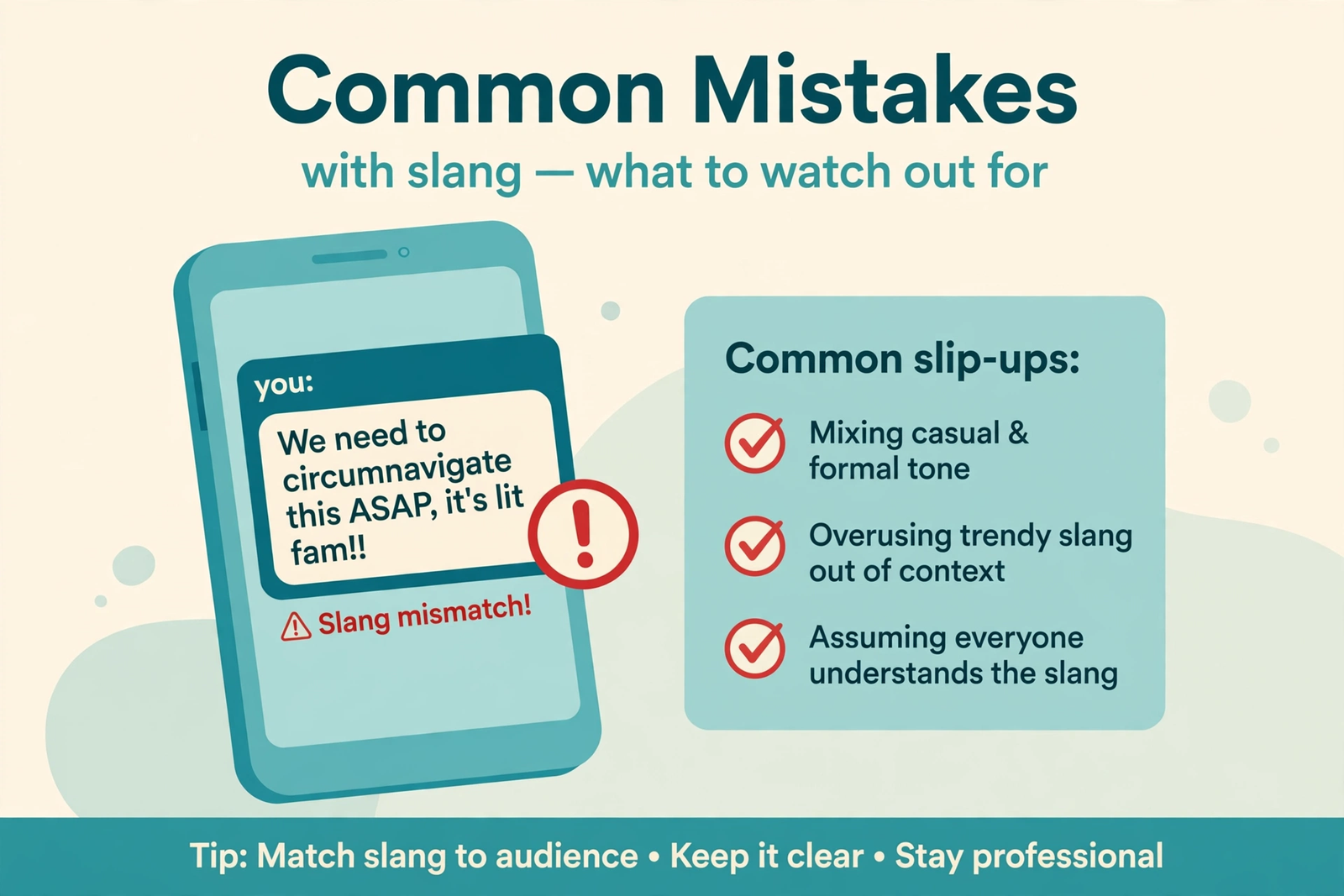
Common Mistakes
Ion is a simple word, but people still get it wrong — usually in ways that change the meaning of their message or make them look like they are trying too hard. Here are the mistakes to avoid.
1. Using it in formal messages. The number one mistake. “Ion” in a work email, a job application, or a message to a teacher reads as careless. Save it for friends and casual chats.
2. Using it when “I don’t” would not fit. “Ion” only replaces “I don’t.” It does not replace “I can’t” (“ion go” does not work — say “I can’t go”), and it does not replace “I won’t” on its own. Test the sentence with “I don’t” first; if the test fails, ion fails too.
3. Confusing the two meanings. Replying “okay, what news?” to someone who wrote “ion care” means you read an “In Other News” that was never there. Capitalisation and context are your guides: lowercase before a verb is almost always “I don’t.”
4. Overusing it. Ion is seasoning, not the whole meal. A message full of slang — “ion know, ion care, ion wanna” — is harder to read than a message with one casual phrase. Use it where it sounds natural, and write the rest of the sentence normally.
5. Reading it as a typo. This is the reader’s mistake, not the writer’s — but it is the most common one of all. “Ion” is not a misspelling of “iron,” and it is not a name. If you see it in a chat, assume the slang meaning first and only look for another explanation if the sentence does not make sense.
6. Correcting someone who uses it. If a friend texts “ion know,” they know exactly what they are doing. Correcting their spelling in a casual chat comes across as rude, not helpful. Slang is a choice, not an error.
Quick Tips
Want to use ion slang confidently? These quick tips cover everything that matters:
- The one-second test: Before you type “ion,” say the sentence with “I don’t” in your head. If it works, ion works.
- Watch the caps: Lowercase “ion” means “I don’t.” All caps “ION” usually means “In Other News.” When you write it, match the case to the meaning you want.
- Keep it casual: Ion belongs in texts, DMs, comments, and chats with friends. Keep it out of emails, essays, and anything professional.
- Pair it with a verb: “Ion know,” “ion care,” “ion want” — the verb after “ion” is what carries the meaning. Without a verb, the word floats.
- Add “even” for emphasis: “Ion even care” is stronger than “ion care.” Use it when you really mean it.
- Don’t force it: If “I don’t” sounds more natural in the sentence, use “I don’t.” Slang works best when it sounds effortless, not performed.
- When reading, trust context: If a sentence with “ion” seems confusing, replace it with “I don’t” and read it again. It will almost always click.
- Remember the origin: Ion comes from AAVE and Black American speech. Using it respectfully means using it naturally — not mocking the accent or overdoing the spelling for effect.

FAQ
What does ion mean in text?
In texting, ion usually means “I don’t.” It is a casual, phonetic spelling of “I don’t” that comes from African American Vernacular English — for example, “ion know” means “I don’t know.” Written in all capital letters, ION can also mean “In Other News.”
What does ion mean on TikTok?
On TikTok, ion means the same thing it means everywhere else: “I don’t.” You will see it in captions, comments, and on-screen text, usually in phrases like “ion even know what this means” or “ion care anymore.” The platform does not change the definition — the sentence around it does.
Is ion short for “I don’t” or “in other news”?
Both — and the capitalisation usually tells you which one. Lowercase “ion” is the phonetic spelling of “I don’t.” Uppercase “ION” is the acronym for “In Other News.” When in doubt, try “I don’t” first: it is the far more common meaning.
Where did ion slang come from?
Ion slang comes from African American Vernacular English (AAVE). In spoken AAVE, “I don’t” contracts naturally when spoken quickly, and the spelling “ion” captures that sound in writing. It spread through early internet forums, hip-hop, Twitter, and later TikTok into mainstream Gen Z texting.
Is it rude to say “ion”?
No — “ion” itself is not rude. It is informal, not offensive. What matters is the sentence around it: “ion care” can sound dismissive depending on tone, just like “I don’t care” can. The word is casual; the attitude comes from context.
Can I use ion in a professional setting?
You should not. Ion is casual slang for texts and chats with friends. In work emails, school assignments, or messages to clients, write “I don’t” or “I’m not sure” instead. Understanding the word is useful everywhere; using it is only appropriate in informal settings.
What is the difference between ion and idk?
“Idk” is an acronym that only means “I don’t know.” “Ion” is more flexible: it can mean “I don’t know,” “I don’t care,” “I don’t want,” “I don’t think,” and any other “I don’t + verb” combination. Think of idk as one fixed phrase and ion as the whole family.
How do you respond when someone says “ion know”?
Respond the same way you would to “I don’t know.” If they are unsure, give them the information or an opinion: “That’s okay, I’ll figure it out” or “No worries, take your time.” If they are being dismissive, you can ask a follow-up question or simply move on. There is no special reply — just answer the meaning, not the spelling.

Conclusion
Ion slang is a small word with a simple job: it means “I don’t,” written the way it sounds when people talk fast. It grew out of African American Vernacular English, spread through forums, music, and social media, and is now a normal part of Gen Z texting on TikTok, Instagram, Snapchat, and Twitter. Its only real rival meaning is uppercase ION — “In Other News” — a topic-change signal that capitalisation and context usually make easy to spot.
The practical takeaway is straightforward. When you read “ion” before a verb, translate it to “I don’t” and the sentence will make sense. When you write it, keep it casual, keep it before a verb, and keep it out of formal messages. And if you enjoy decoding internet slang, the same sound-it-out logic explains plenty of other terms — from fn meaning in text to idt — because slang, at its best, is just spoken language finding its way onto the screen.
So the next time a comment says “ion know,” you will know exactly what it means — and you will know that the person who wrote it probably doesn’t know either.

3 thoughts on “Ion Slang Meaning: What Does Ion Mean in Texting and on TikTok?”