What Does ICL Mean In Text Messages?
If you’ve been scrolling through a group chat, TikTok comments, or Snapchat and hit a wall of confusion at the letters “ICL,” you’re not alone. The ICL meaning in text messages is simple once you know it: ICL stands for “I Can’t Lie.” It’s used right before someone says something honest, blunt, or emotionally real — a verbal nudge that says “what I’m about to say is the truth, whether you like it or not.”
That’s the short answer. But if you actually want to use it correctly, understand when it means something else, and avoid embarrassing yourself in a group chat, you need more than a one-line definition. That’s what this guide covers.
Where ICL Comes From
The ICL meaning in text messages didn’t appear out of nowhere. It grew out of the same texting culture that gave us “NGL” (not gonna lie) and “TBH” (to be honest) — all phrases built around the idea of prefacing a statement with a claim of honesty. As typing speed became the priority in DMs, comments, and captions, “I can’t lie” got shortened to three letters, and it stuck.
It picked up real traction on Twitter and Snapchat first, where character limits and quick replies rewarded short slang. From there it spread to TikTok captions and comment sections, where Gen Z users leaned into it as a way to sound both honest and casual at the same time. It’s now common enough that most people under 30 in the U.S. recognize it instantly, while people outside that age range often see it for the first time and have to ask what it means — which is usually how they end up here.
Why People Use ICL Instead of Just Saying “Honestly”
Texting slang exists for two reasons: speed and tone. Typing “ICL” is faster than typing “honestly” or “to be honest,” but it’s also doing something “honestly” doesn’t do as well — it signals casualness. Saying “honestly” in a text can sometimes read as formal or serious. Saying “ICL” reads as relaxed, a little playful, and distinctly modern.
That’s a big part of why the ICL meaning in text messages stuck around instead of fading out like other short-lived slang. It fills a specific gap: honest, but not stiff.
ICL Meaning In Text Messages: Where It Appears In A Sentence
One thing most guides skip is where ICL actually shows up in a message, because it’s not locked to the front of a sentence. Here’s how it typically breaks down:
At the start of a sentence (most common): “ICL, I didn’t even like that movie.”
In the middle of a sentence (for emphasis): “I really, icl, thought you weren’t coming.”
At the end of a sentence (softer, almost like an afterthought confession): “That outfit looked great on you, icl.”
All three are correct. The meaning doesn’t change based on placement — only the emphasis does. Front-loaded ICL feels more like a warning (“brace yourself, here comes the truth”). End-placed ICL feels more like a quiet admission.
ICL vs. Other Honesty Slang: A Side-By-Side Comparison
This is the part most articles about the ICL meaning in text messages skip entirely, and it’s exactly what causes confusion. ICL isn’t the only “honesty prefix” floating around texts. Here’s how it stacks up against the others:
| Term | Full Meaning | Tone | Best Used For |
|---|---|---|---|
| ICL | I Can’t Lie | Casual, slightly emphatic | Confessions, blunt opinions, compliments |
| NGL | Not Gonna Lie | Casual, neutral | Everyday honest statements |
| TBH | To Be Honest | Semi-casual | Slightly more thoughtful or serious opinions |
| Deadass | (no expansion — means “seriously”) | Very casual, intense | Emphasizing you’re 100% serious |
| Fr fr | For real, for real | Very casual | Agreeing strongly or confirming truth |
The practical difference: NGL and TBH are close cousins and often interchangeable. ICL carries a touch more emotional weight — it’s frequently used right before something a little more personal, funny, or awkward gets admitted. Deadass and “fr fr” aren’t really about honesty prefacing — they’re about intensity and agreement.
Does ICL Ever Mean Something Other Than “I Can’t Lie”?
Yes, and this is where a lot of confusion comes from. While the dominant ICL meaning in text messages is “I Can’t Lie,” a few alternate readings exist:
- “I Care Less” — a much rarer usage, sometimes seen when someone wants to express indifference rather than honesty. Context makes this obvious fast: “ICL what you think” reads completely differently from “ICL, I think you’re right.”
- “In Christian Love” — occasionally used in faith-based messaging or email sign-offs, almost never in casual texting between friends.
- “I Chuckled Lightly” — a niche, far less common usage found mostly in older internet slang dictionaries, rarely seen in real conversations today.
For 95%+ of real-world texting, if you see “ICL” from a friend, classmate, or in a comment section, it means “I Can’t Lie.” The alternate meanings exist, but they’re the exception, not the rule.
How To Tell Which Meaning Applies
Since the ICL meaning in text messages can technically shift, here’s a fast way to check which one you’re dealing with:
- Look at what follows it. If a personal opinion, confession, or emotional statement comes right after, it’s “I Can’t Lie.”
- Check the platform. TikTok, Snapchat, and Instagram comments almost always mean “I Can’t Lie.” A formal email or church newsletter is more likely to mean “In Christian Love.”
- Read the tone of the whole message. Indifferent, dismissive phrasing points toward “I Care Less.” Genuine, expressive phrasing points toward “I Can’t Lie.”
In nearly every day-to-day texting scenario, you can skip steps 2 and 3 entirely — the honesty meaning is the safe default.
Real Text Message Examples
Seeing the ICL meaning in text messages in action makes it click faster than any definition can. Here are examples across different emotional tones:
Sincere/complimentary: “ICL, you looked really good today.”
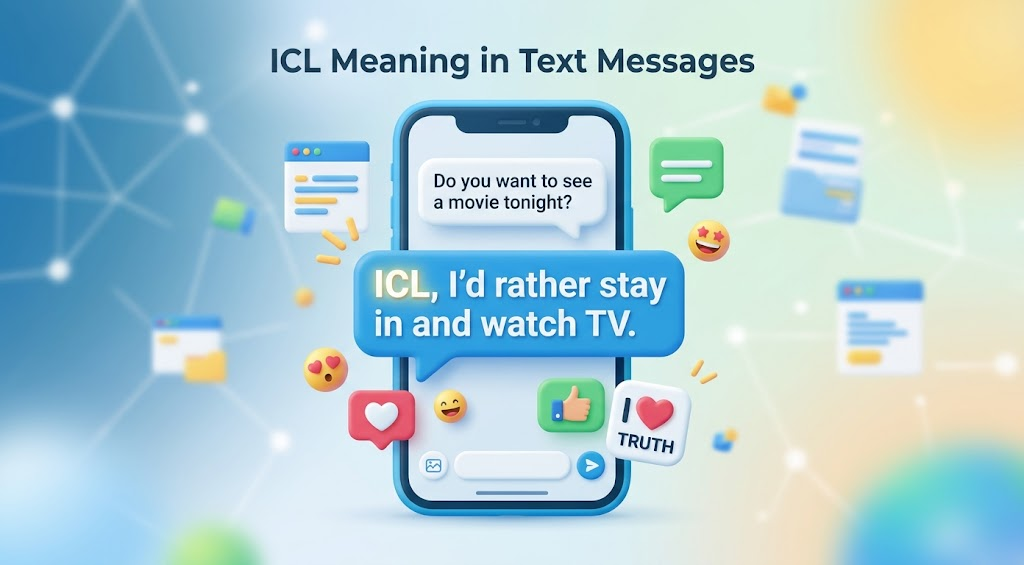
Confession/admission: “ICL, I forgot we had plans tonight.”
Funny/relatable: “ICL, I checked the fridge four times hoping food would just appear.”
Slightly sarcastic: “ICL, that was the worst movie I’ve seen all year 😂”
Emotional/vulnerable: “ICL, I really miss how things used to be.”
Notice the pattern: ICL rarely stands alone. It’s always a setup for the real statement that follows.
How To Respond When Someone Texts You “ICL”
This is a subtopic almost nobody covers, but it matters — knowing the ICL meaning in text messages is only half the equation if you don’t know how to reply naturally.
- If it’s a compliment: a simple “omg thank you 😭” or “stoppp” works fine.
- If it’s a confession: acknowledge it lightly — “lol it’s fine” or “wait really?” depending on what they admitted.
- If it’s an opinion you disagree with: you can push back casually — “nahh icl I actually loved it.”
- If it feels emotional or vulnerable: match the tone — don’t respond with a joke if they just opened up about something real.
The key is mirroring the emotional weight of their message. ICL signals sincerity, so a dismissive or joking reply to a heartfelt “ICL” can land the wrong way.
Where You’ll See ICL Most Often
The ICL meaning in text messages isn’t limited to just texting — it spreads across nearly every platform where casual, fast typing happens:
- Text messages / iMessage — the most direct use case, usually one-on-one or in group chats
- Snapchat — common in captions, streak replies, and private chats
- TikTok — frequent in comment sections and video captions
- Instagram — shows up in DMs and comment replies
- Twitter/X — used in quick reactionary posts and replies
While the wording stays the same everywhere, icl meaning understanding tone shifts slightly by platform. A TikTok comment using ICL tends to be more exaggerated or joke-driven, while a text between friends tends to be more sincere.
When Not To Use ICL
Knowing the ICL meaning in text messages also means knowing when it doesn’t belong. Avoid it in:
- Professional emails
- Job applications or interviews
- Formal written reports
- Customer service messages
- Any communication where you’re expected to sound polished
In those settings, swap it for the full phrase: “honestly” or “to be honest.” ICL is internet slang, and while it’s widely understood among younger users, using it in a formal context can come across as unprofessional.
Quick Reference Table
| Question | Answer |
|---|---|
| What does ICL mean in text messages? | “I Can’t Lie” |
| Is it formal or informal? | Strictly informal |
| Where did it originate? | Twitter and Snapchat, later spreading to TikTok |
| Who uses it most? | Primarily Gen Z and younger millennials |
| Common alternate meaning | “I Care Less” (rare) |
| Similar slang | NGL, TBH, deadass, fr fr |
| Good for professional writing? | No |
Frequently Asked Questions
Is ICL rude?
No. ICL is generally used to soften or introduce an honest statement, not to insult anyone. The words that follow it determine whether the message feels blunt.
What is the difference between ICL and NGL?
They’re very close in meaning, but ICL tends to carry slightly more emotional emphasis, while NGL is used for more everyday, low-stakes honesty.
Can ICL mean “I Care Less”?
Occasionally, yes, though this usage is far less common. Context — especially the tone of the sentence — makes it clear which meaning is intended.
Is ICL only used by teenagers?
It’s most popular among Gen Z and younger millennials, but it’s understood widely enough that people in their 30s and beyond use and recognize it too.
Should I use ICL in a work email?
No. It’s internet slang and not appropriate for professional communication. Use “honestly” or “to be honest” instead.
Does ICL mean the same thing on every app?
Yes, the meaning stays consistent across Snapchat, TikTok, Instagram, and texting — only the tone tends to shift depending on the platform.
Final Thoughts
At its core, the ICL meaning in text messages comes down to three words: “I Can’t Lie.” It’s a small piece of slang, but it carries a specific job — signaling honesty in a way that feels casual instead of formal. Whether you see it in a compliment, a confession, or a joke, the letters are doing the same work every time: telling you that what comes next is the truth.
Once you understand the pattern — where it’s placed, what tone it carries, and how to respond to it — you’ll never have to pause and wonder what someone meant by it again.
