
Quick Definition: In slang, head is one of the most flexible words in English. Its best-known slang meaning is oral sex — as in “give head” or “get head” — but head slang also covers the “-head” suffix for fans and addicts (pothead, gearhead, sneakerhead), thinking and the mind (“use your head”), a veteran or respected person (“old head”), a bathroom (“hit the head”), a leader (“head honcho”), and even a per-person count (“ten dollars a head”). The meaning always depends on context, so this guide breaks down all seven uses with real examples.
Head Slang Meaning & Definition
Head slang means the informal, non-literal ways people use the word “head” in everyday speech, texts, music, and social media. Unlike the dictionary definition — the top part of your body — slang turns “head” into a verb, a suffix, and a stand-in for a person, a place, or an act. That is why a single sentence like “he’s a real head” can mean three different things depending on who says it and where.
The word has been slang for a very long time. Sailors were calling the ship’s toilet “the head” in the 1700s. Jazz musicians and comedians were using “head” for oral sex by the 1930s. Drug culture gave us “pothead” in the 1950s, hip-hop gave us “old head” in the 1980s and 1990s, and sneaker culture gave us “sneakerhead” in the 2000s. Today, head slang shows up everywhere from song lyrics and group chats to TikTok comments and gaming lobbies.
| Slang Meaning | What It Means | Quick Example |
|---|---|---|
| Oral sex | To give or receive oral sex | “He asked for head.” |
| -head suffix | A big fan, enthusiast, or addict | “She’s a total sneakerhead.” |
| Mind / thinking | Your brain, thoughts, or judgment | “Use your head!” |
| A person / veteran | Someone experienced and respected | “Ask the old head.” |
| Bathroom | A toilet, from navy slang | “I need to hit the head.” |
| Leader | The person in charge | “She’s the head honcho.” |
| Per person | One person, as a count | “It’s $20 a head.” |
Most of the time, you can tell which meaning is in play from the sentence around it. “Give head” is always the adult meaning. “Pothead” is always the suffix. “Use your head” is always about thinking. The confusion only starts when the word stands alone — and that is exactly what the rest of this guide clears up.
Introduction
Imagine scrolling through comments and reading “bro is such a head.” Is that a compliment, an insult, or something you should not repeat at work? The honest answer is: it could be any of the three. Few English words carry as many slang jobs as “head,” and almost none of them are obvious from the literal meaning.
That is what makes head slang worth a full guide. The word sits at the crossroads of several slang traditions at once. It belongs to old navy talk, jazz-era street slang, drug culture, hip-hop, sneaker culture, and internet texting — and it picked up a new job in every one of those worlds. When you see it in a song lyric, it usually means one thing; when you see it in a text from your boss, it means something completely different.
This guide covers every major slang meaning of head, where each one came from, and how to use it without embarrassing yourself. You will find real examples for friendly, professional, and funny situations, a comparison with similar slang words like noggin and dome, the mistakes people make most often, and answers to the eight questions people search for most about head slang. You will also learn the one meaning you should never use in polite company — and the polite alternatives to use instead.
One quick note before we start: because “head” appears in the acronym SMH, short for “shaking my head,” you will meet this word in texts far more often than you realise. Once you know the seven meanings below, you will never have to guess again.

Origin
The slang story of “head” starts with the body. The Old English word “heafod” meant the top of the body, and from there it naturally spread to mean the top of anything — the head of a line, the head of a table, the head of a department. That “top or front” idea is the seed of almost every slang meaning that followed.
The oldest slang use is the bathroom. On old sailing ships, the toilet was a plank with holes at the very front — the head — of the vessel, so sailors called it “the head.” The term stuck in the US Navy and then spread into everyday American speech: “hit the head” still means “go to the bathroom” today, centuries later.
The adult meaning arrived much later. According to Green’s Dictionary of Slang, “head” as a term for oral sex appears in American slang from around the 1930s, in phrases like “head play” and “head job,” and it became widely known through comedy, music, and film in the decades that followed. The phrase “give head” is now the standard slang expression, understood across the English-speaking world.
The “-head” suffix took off in the 1950s with drug culture. “Pothead” (a regular marijuana user) was one of the first, followed by “crackhead,” “meth head,” and later by harmless fan words: “gearhead” for car lovers, “metalhead” for heavy-metal fans, “deadhead” for Grateful Dead followers, and “sneakerhead” for shoe collectors. The same suffix can praise a passion or warn about an addiction — the word in front of it decides which.
Hip-hop added another layer in the 1980s and 1990s. In rap and street culture, a “head” is a person — and an “old head” is a respected veteran who has been around long enough to give advice. You will hear it in lyrics, interviews, and neighbourhood talk: the old head is the one younger people listen to.
Popularity
Head slang stays popular for a simple reason: it is short, flexible, and everywhere. Music keeps the adult meaning in circulation — rap and R&B lyrics use “head” constantly, and listeners learn the meaning from context long before anyone explains it. Comedy keeps it alive too, from stand-up routines to sitcom jokes built on the double meaning of an innocent-looking word.
Sneaker culture gave the word a second wind in the 2000s. “Sneakerhead” went from a niche label to a mainstream identity, with YouTube channels, resale apps, and whole communities built around it. The same pattern repeated with “gearhead,” “gym head,” and “coffeehead” — every hobby now has its own “-head” tribe, and the suffix is a quick way to claim membership in one.
Texting gave “head” its most invisible job. Millions of people type SMH — “shaking my head” — every day without thinking about the word inside it. The acronym turned a physical gesture into a reaction, and it made “head” part of the basic vocabulary of the internet. Related reactions like SMDH (“shaking my damn head”) work the same way.
Gaming and streaming added more uses. “Get your head in the game” is standard coach talk in esports and sports alike, and “head game” describes a player’s mental skill — their focus, their ability to read opponents, and their confidence under pressure. In that world, your head is your biggest weapon.
How It Is Used
Here are the seven slang meanings of “head,” each with its own context and tone. Learn to spot the clue words around it, and you will always know which one is meant.
1. Oral Sex (“Give Head” / “Get Head”)
This is the most famous slang meaning of “head,” and the one you must handle carefully. “Give head” means to perform oral sex, and “get head” means to receive it. The phrases are blunt, adult, and common in music, comedy, and private conversation — but they are not appropriate at work, at school, or around children. If you hear “head” used with “give” or “get,” this is almost always the meaning.
2. The “-Head” Suffix: Fan, Enthusiast, or Addict
Stick “-head” on the end of a noun and you get a person defined by that thing. A “sneakerhead” collects shoes. A “gearhead” loves cars. A “metalhead” lives for heavy metal. A “pothead” uses marijuana regularly. The tone depends on the base word: hobby words sound affectionate, drug words sound like a warning. New versions appear all the time — “gym head,” “coffeehead,” “bookhead” — because the pattern is so easy to copy.
3. Mind, Thinking, and Judgment (“Use Your Head”)
“Use your head” means “think before you act.” It is the everyday version of the mind meaning, and it shows up in advice, scolding, and encouragement alike. Related phrases include “get your head in the game” (focus), “head game” (mental skill or, in dating slang, the ability to keep someone interested), “lose your head” (panic), and “keep your head” (stay calm). In all of these, “head” is your brain.
4. A Person, Especially a Veteran (“Old Head”)
In hip-hop and street culture, a “head” can simply mean a person, and an “old head” is an older, experienced person whose advice carries weight. “The old heads warned us about that block” means the neighbourhood veterans gave a warning. The younger version, “young head,” exists too but is much rarer. This use is respectful — calling someone an old head is closer to a compliment than an insult.
5. Bathroom (“Hit the Head”)
“Hit the head” is the old navy phrase for going to the bathroom, and it is still used in the military, on boats, and in casual American speech. “I need to hit the head before we leave” is a perfectly polite sentence — the slang history is invisible to most listeners. You will also hear “head” alone for a toilet in military and sailing contexts.
6. Leader or Person in Charge (“Head Honcho”)
“Head honcho” means the boss, the person running the show. It comes from the old “head of the department” idea, with “honcho” (from Japanese “hancho,” a squad leader) added for flavour. “Ask the head honcho” means go to the person who actually decides. The plain “head” works the same way in phrases like “head of the crew” or “head of the family.”
7. One Person, as a Count (“A Head”)
In pricing and counting, “a head” means “per person.” A restaurant charging “$25 a head” charges $25 per guest. A party host saying “we need chairs for 40 heads” needs 40 seats. This is old, practical slang — the head stands in for the whole person, the way “hands” once stood in for workers on a farm or a ship.
Examples
The same word changes completely with the sentence around it. These examples show head slang in friendly, professional, and funny contexts — and which meaning each one uses.
Friendly Examples
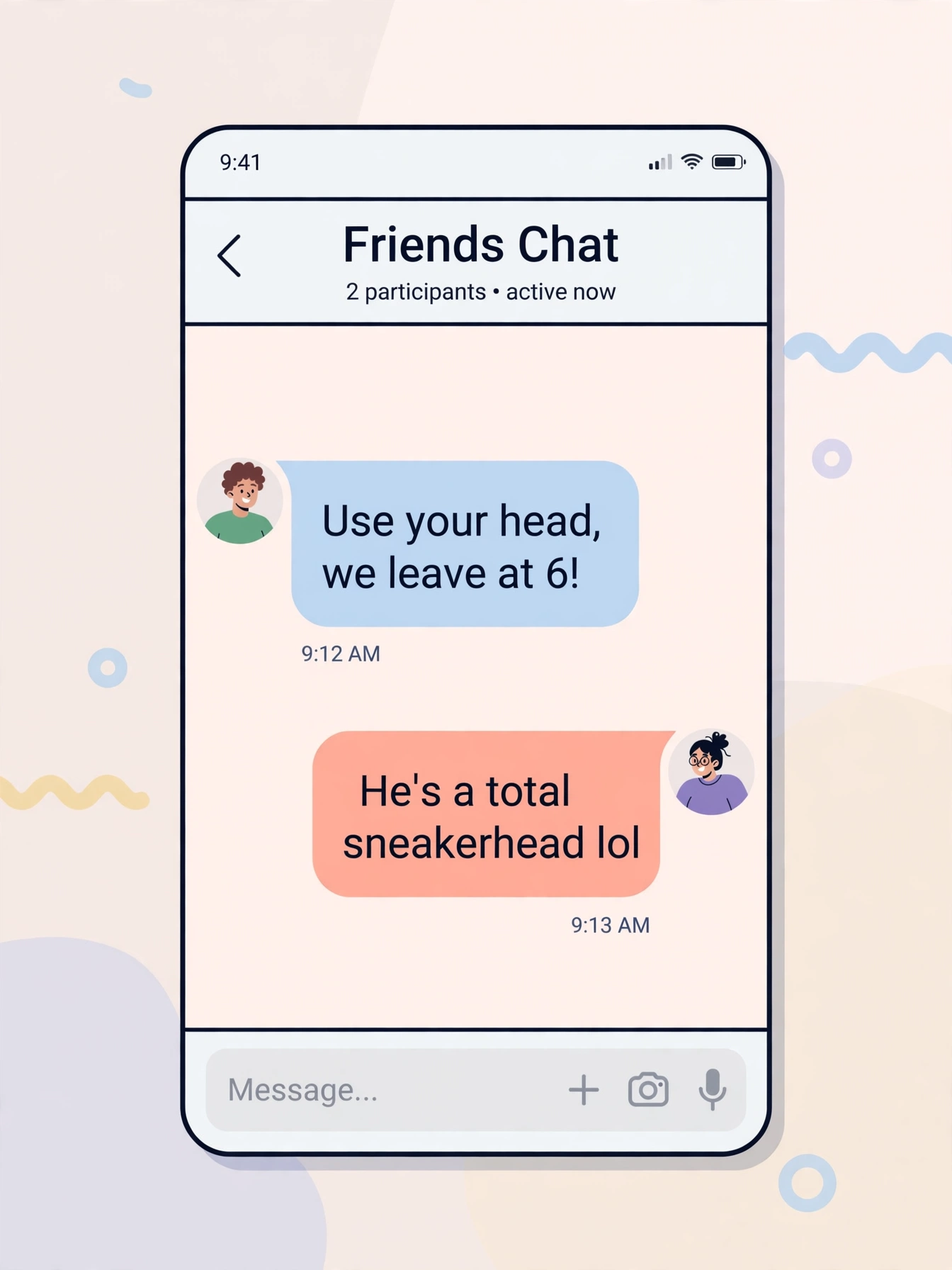
- “He’s a total sneakerhead — his closet is just Jordans.” (Meaning: enthusiastic fan.)
- “Use your head, man — just text her back.” (Meaning: think it through.)
- “Ask the old head on our street, he knows everyone.” (Meaning: respected veteran.)
- “I’m starving, but first I need to hit the head.” (Meaning: bathroom.)
- “Don’t lose your head over one bad grade.” (Meaning: don’t panic.)
- “We split the bill — $15 a head, easy.” (Meaning: per person.)
Professional Examples
- “She’s the head honcho on this project, so run it by her first.” (Meaning: the leader.)
- “Our head of sales wants the report by Friday.” (Meaning: the person in charge.)
- “Keep your head in the meeting — this decision matters.” (Meaning: stay focused.)
- “The new hire is a real gearhead, perfect for the auto team.” (Meaning: car enthusiast.)
- “The venue charges $40 a head for the dinner.” (Meaning: per person.)
Funny Examples
- “My head game is terrible — I forgot my own birthday.” (Meaning: my thinking skills.)
- “He’s such a coffeehead he owns six French presses.” (Meaning: coffee obsessive.)
- “Bro said ‘use your head’ and I did — I used it to take a nap.” (Meaning: thinking, jokingly.)
- “SMH, my head is empty and my playlist is full.” (Meaning: shaking my head.)
- “I’m not a pothead, I’m a snackhead — I just eat everything.” (Meaning: playful fan of snacks.)
Notice how the professional examples never use the adult meaning. That is the rule: meanings 2 through 7 are safe almost everywhere, but meaning 1 belongs only in private, adult conversation.
Comparison with Similar Terms
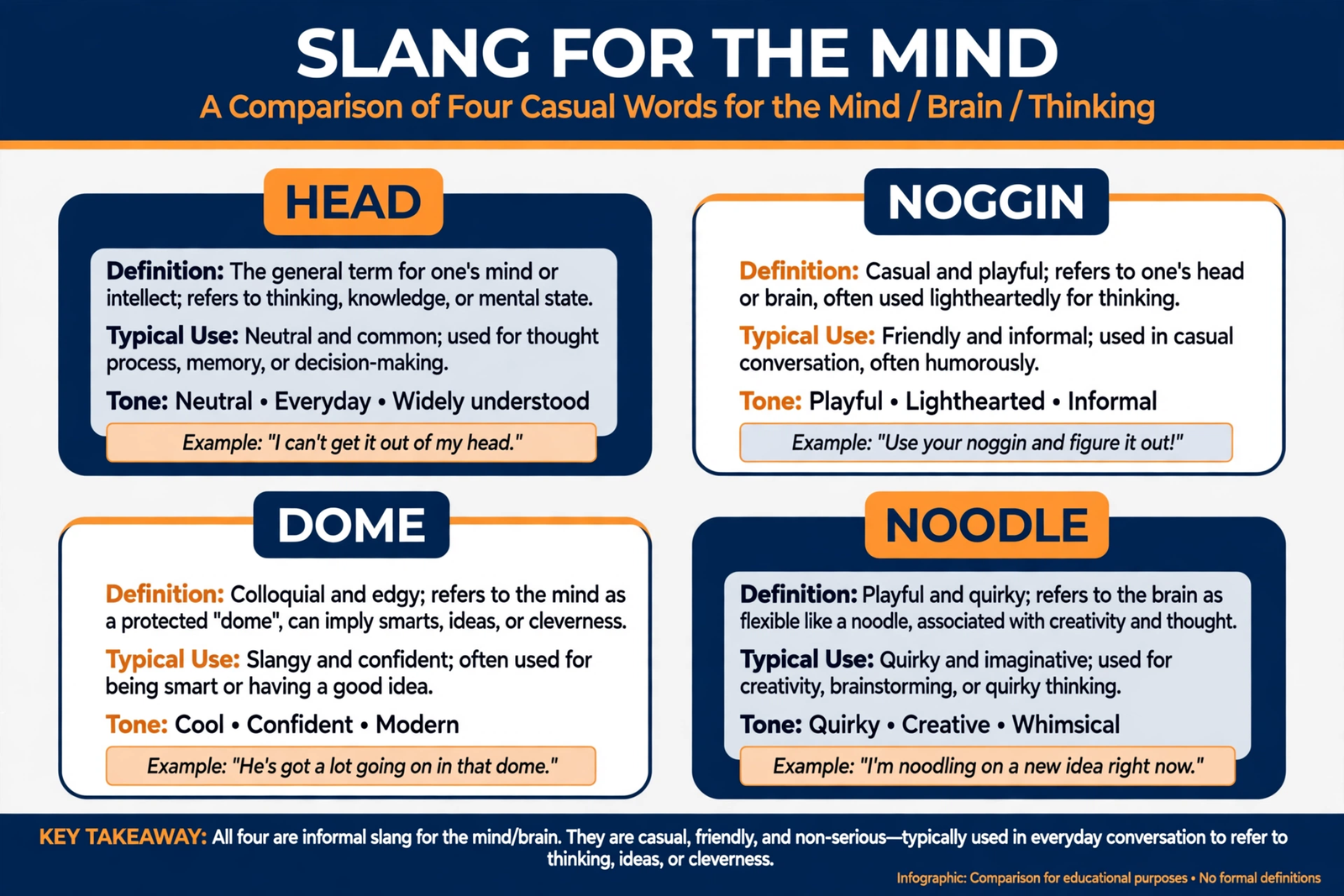
“Head” is not the only slang word for the mind or the brain. Here is how it stacks up against the other common ones, so you pick the right word for the moment.
| Term | What It Means | Tone | Example |
|---|---|---|---|
| Head | Mind, person, or (adult) oral sex | Varies — check context | “Use your head.” |
| Noggin | Your head or brain, playfully | Light, affectionate | “Use your noggin!” |
| Dome | Your head, often in hip-hop or sports | Cool, urban | “Get it through your dome.” |
| Bean | Your head or brain, old-fashioned | Playful, dated | “Use your bean.” |
| Noodle | Your brain, in thinking phrases | Friendly, casual | “Use your noodle.” |
| Brain | Literal mind or intelligence | Neutral | “He’s got a big brain.” |
| Mind | Thoughts and attention | Neutral, formal | “Keep it in mind.” |
| Skull | Your head, edgy or dramatic | Tough, joking | “Get it through your skull.” |
The key difference is range. “Noggin,” “dome,” “bean,” and “noodle” only ever mean your head or brain — they are safe, one-job words. “Head” does seven jobs, including the adult one, so it carries more risk and more power. If you want a playful word for thinking with zero chance of misunderstanding, “noggin” or “noodle” is the safer pick. If you want the hip-hop flavour, “dome” fits better. “Head” is the word you choose when you want the full street-culture sound.
There is also a family of “-head” words worth comparing with each other. “Sneakerhead,” “gearhead,” and “metalhead” are compliments inside their communities — they mean passion. “Pothead” and “crackhead” describe drug use, and “crackhead” in particular is an insult, not a joke. Same suffix, very different weight: the word before “-head” decides whether you are praising someone’s hobby or describing an addiction.
Alternate Meanings
Beyond the seven slang meanings, “head” has a long list of standard and secondary meanings. Knowing them helps you tell slang from ordinary speech — and stops you reading a double meaning into an innocent sentence.
| Meaning | Example | Slang or Standard? |
|---|---|---|
| Top part of the body | “She hurt her head.” | Standard |
| Leader of a group | “Head of the department.” | Standard |
| Front or top of something | “Head of the line.” | Standard |
| Toilet (navy origin) | “Hit the head.” | Slang |
| Coin toss, “heads” | “Heads or tails?” | Standard |
| A headache | “I’ve got a bad head today.” | Informal (British) |
| To move toward | “Let’s head home.” | Standard verb |
| A head of lettuce, beer foam | “A head of cabbage.” | Standard |
| Oral sex | “Give head.” | Slang (adult) |
| Enthusiast / addict suffix | “Sneakerhead.” | Slang |
The most common mix-up is the verb “head.” When someone says “let’s head home,” they are using the ordinary verb meaning “to go toward” — there is no slang hiding in it. The same goes for “head of the class” or “head of the table.” Slang only kicks in when “head” stands for a person, a fan, a bathroom, or the adult meaning — and the sentence around it will always give you the clue.
Professional or Polite Alternatives
Because the adult meaning of “head” is so well known, it pays to have polite substitutes ready — especially at work, at school, or in mixed company. Use these instead and nobody will misunderstand you.
| Instead of This | Say This | When to Use It |
|---|---|---|
| “Give head” / “get head” | “Oral sex” (clinical) or avoid the topic | Any formal or mixed setting |
| “He’s a pothead” | “He uses marijuana regularly” | Work, school, healthcare |
| “Old head” | “Veteran” or “experienced colleague” | Professional settings |
| “Hit the head” | “Use the restroom” | Formal or polite company |
| “Head honcho” | “The person in charge” / “team lead” | Business emails and meetings |
| “Use your head” | “Think it through” | When advising politely |
| “$20 a head” | “$20 per person” | Formal pricing and invitations |
A good rule of thumb: if the sentence would sound strange in a job interview, swap the slang for the polite version. “Head honcho” is the exception — it is playful enough for most workplaces, but “team lead” is still safer in writing. And the adult meaning has no polite slang substitute at all: in any public setting, simply do not say it.
Common Mistakes
People get head slang wrong in a few predictable ways. Avoid these and you will sound natural every time.
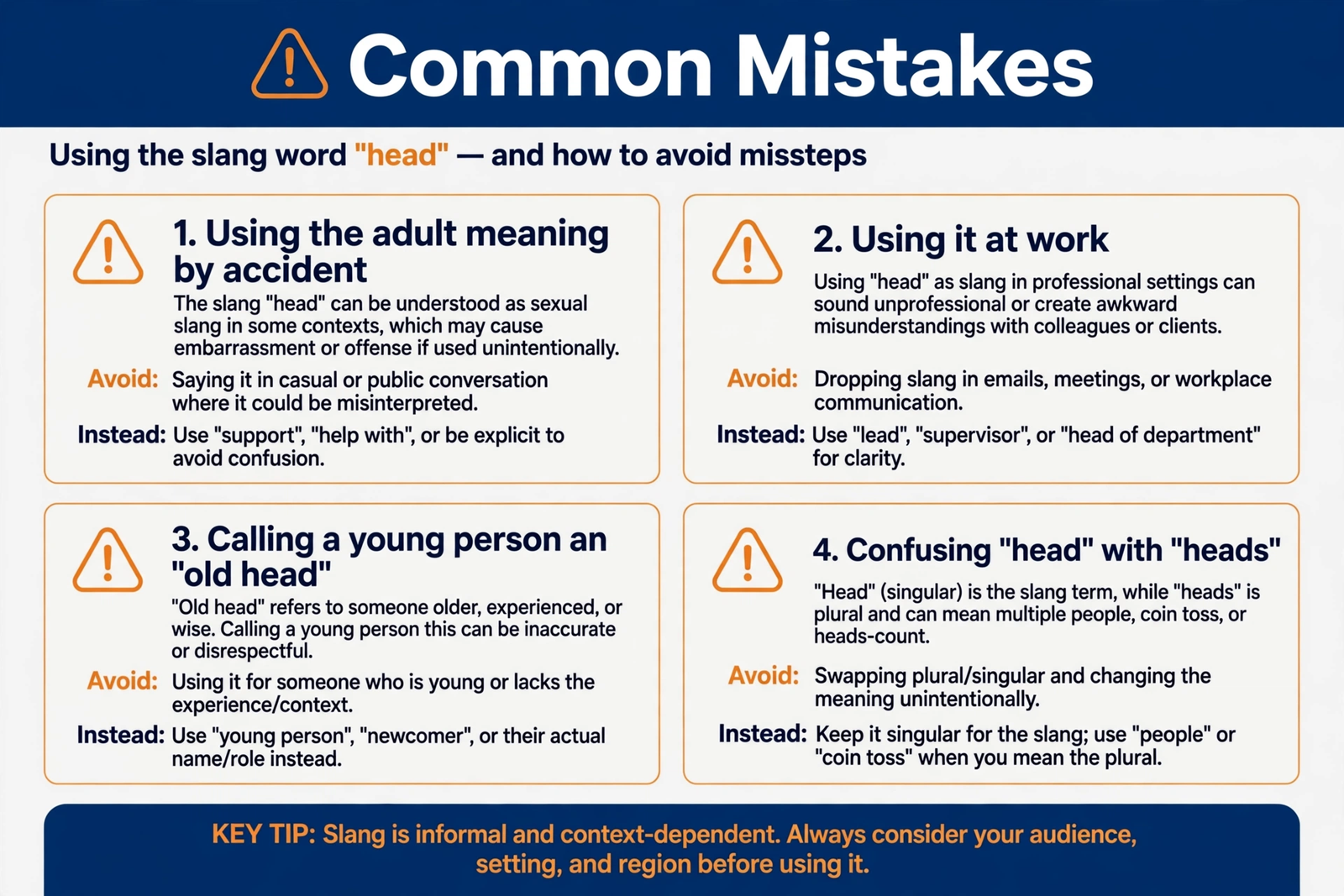
- Using the adult meaning by accident. Saying “I need head” when you mean “I need to think” is a classic disaster. Always add the missing words: “I need to use my head” is safe; “I need head” is not.
- Dropping “head” into professional settings. “Head game” might mean mental skill in sports, but in dating slang it means something else entirely. At work, say “focus” or “strategy” instead.
- Assuming every “-head” is an insult. “Sneakerhead” and “gearhead” are badges of honour. Only the drug words — “pothead,” “crackhead,” “meth head” — carry a negative charge, and “crackhead” is outright offensive.
- Calling a young person an “old head.” The phrase specifically means an older veteran. Using it for a teenager sounds wrong to anyone who knows the culture.
- Confusing “head” with “heads.” “Heads” can mean the coin-toss side, a count of people (“we need 30 heads”), or, in drug slang, a high. “Head” alone almost never means any of those.
- Reading slang into innocent sentences. “Head of the class” and “let’s head home” are standard English. Not every “head” is slang — context decides.
- Using “hit the head” in formal writing. It is fine in speech, but in an email or a report, “restroom” is the better choice.
Quick Tips
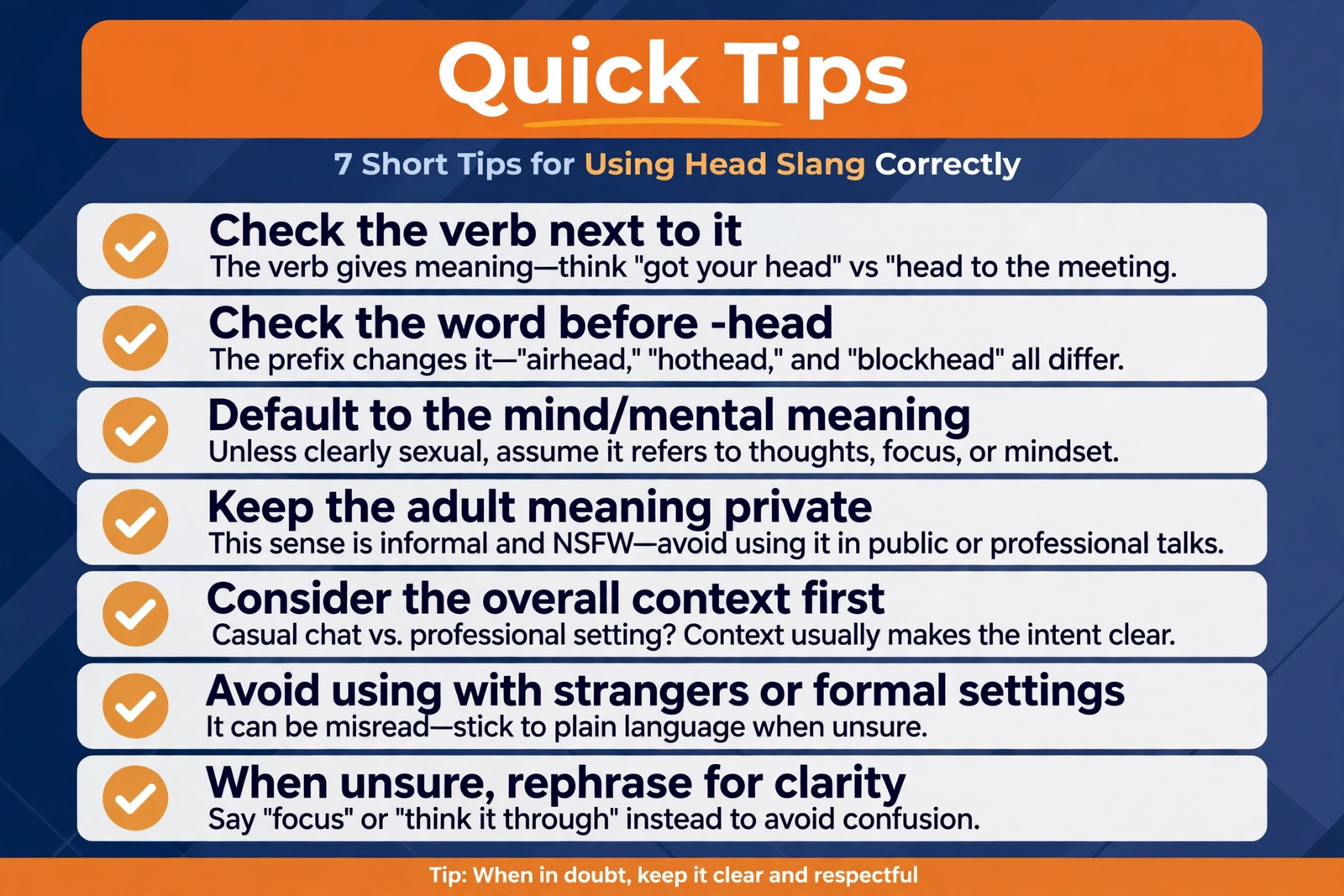
Seven fast rules for using head slang correctly, wherever you hear it.
- Check the verb next to it. “Give” or “get” plus “head” means the adult sense. “Use” plus “head” means thinking. “Hit” plus “head” means the bathroom.
- Check the word before “-head.” A hobby word means a fan; a drug word means a user. That one word sets the whole tone.
- Default to the mind meaning. If the sentence is about thinking, deciding, or focusing, “head” means your brain — that is the safest guess.
- Keep the adult meaning private. Only use “give head” or “get head” in adult, private conversation. Never at work, school, or in public posts.
- Use “old head” with respect. It is a compliment for an experienced person, not a joke about age. Say it like you mean the respect.
- Prefer “noggin” or “noodle” for jokes. When you want a funny word for thinking, those two carry no double meaning at all.
- When in doubt, ask what they meant. “Head” has seven slang jobs — even native speakers pause sometimes. A quick “wait, what do you mean by that?” saves everyone.
FAQ
What does head mean in slang?
In slang, head has several meanings: most famously oral sex (“give head”), the “-head” suffix for fans and addicts (sneakerhead, pothead), the mind (“use your head”), a respected veteran (“old head”), a bathroom (“hit the head”), a leader (“head honcho”), and a per-person count (“$20 a head”). Context decides which one is meant.
What does “give head” mean?
“Give head” is slang for performing oral sex. It is adult language, widely understood in music, comedy, and private conversation, and it is not appropriate in professional, school, or family settings.
What does “pothead” mean?
A “pothead” is slang for someone who uses marijuana regularly. It comes from the “-head” suffix, which turns a noun into a person defined by it — the same pattern gives us “gearhead” for car lovers and “sneakerhead” for shoe collectors.
What does “old head” mean?
In hip-hop and street culture, an “old head” is an older, experienced person whose advice is respected. It is a compliment, not an insult — the old head is the veteran everyone listens to.
What does “hit the head” mean?
“Hit the head” means to go to the bathroom. It comes from old navy slang: on sailing ships the toilet sat at the front, or “head,” of the vessel. It is still common in military and casual American speech.
What does “use your head” mean?
“Use your head” means “think before you act” or “use your judgment.” It is the mind meaning of head slang, and it shows up in advice, coaching, and everyday scolding alike.
Is head slang offensive?
It depends on the meaning. The “-head” fan words, the mind phrases, “old head,” and “hit the head” are harmless. The adult meaning (“give head” / “get head”) is vulgar and offensive in polite company, and drug words like “crackhead” are insults. Use the meaning that fits the room.
What does “head” mean in texting and on TikTok?
In texts, “head” usually appears inside SMH, short for “shaking my head,” which expresses disbelief or disappointment. On TikTok you will also see “-head” fan labels (sneakerhead, gym head) and “head game” for mental skill. The adult meaning appears in lyrics and jokes, so read the sentence around it before reacting.
Conclusion
Head slang is a perfect example of how one small word can do a dozen jobs. From the navy bathroom to the hip-hop veteran, from the sneaker collector to the thinking phrase “use your head,” the word has collected meanings in every corner of English — and its most famous meaning, the adult one, is the reason you should always check the context before you repeat it.
The practical takeaway is simple. In friendly conversation, the “-head” suffix and the mind phrases are your safest tools: calling someone a sneakerhead or telling a friend to use their head will never get you in trouble. In professional settings, swap the slang for plain language — “team lead” instead of “head honcho,” “restroom” instead of “hit the head.” And keep the adult meaning exactly where it belongs: in private, adult conversation only.
Once you know the seven meanings, you will spot them everywhere — in song lyrics, in group chats, in SMH reactions, and in the fan cultures around rizz, no cap, and brain rot. Slang moves fast, but “head” has been moving for three hundred years — and it is not slowing down. Now you know exactly what it means, whichever version you meet next.
