
Quick definition: Golf slang is the informal language golfers use on the course — fun nicknames for shots, scores, and situations, from “birdie” and “mulligan” to “fried egg” and “snowman.” Learning golf slang helps beginners follow conversations, understand the game faster, and sound like they belong on the first tee.
Golf Slang Meaning & Definition
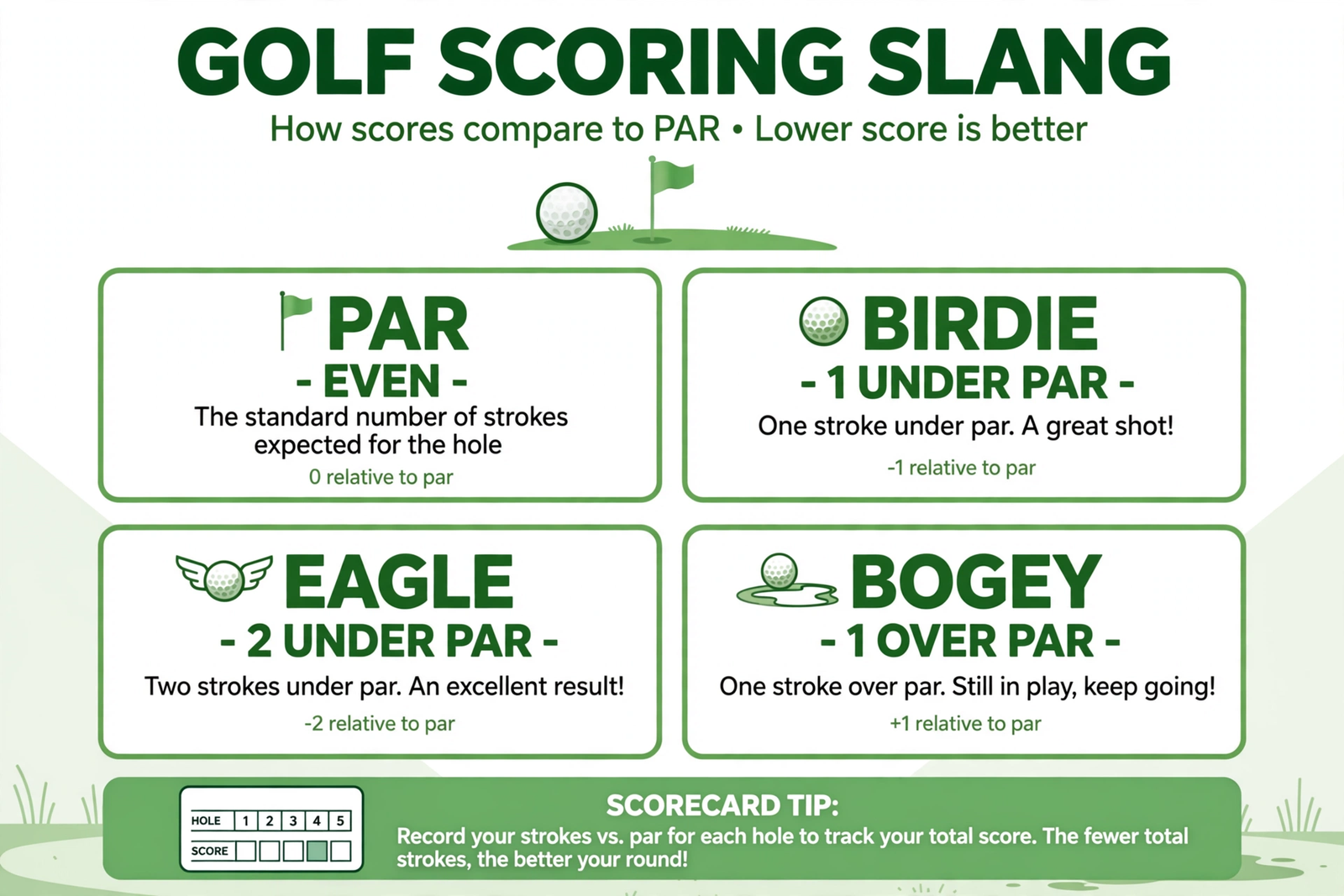
Golf slang means the casual, colorful vocabulary that golfers use to describe shots, scores, clubs, course features, and the ups and downs of a round. Some of it is official scoring language — a birdie is one under par, a bogey is one over par — and some of it is pure clubhouse humor, like calling a score of 8 a “snowman” because the number looks like a snowman’s body.
Unlike the formal Rules of Golf, golf slang is not written down anywhere official. It grows out of locker rooms, caddie yards, pro tours, and weekend foursomes, and it changes with every generation of players. A term like “mulligan” (a free do-over) has been around for a century, while newer phrases spread through golf TikTok and YouTube within weeks. If you are new to the game, golf slang can feel like a second language — but once you know the 50 or so terms in this guide, you will understand almost everything you hear on the course.
This guide covers the most common golf slang terms, what each one means, where it came from, and how to use it without embarrassing yourself. Whether you are watching the Masters on TV, playing your first round, or just trying to understand what your golf-obsessed friend keeps saying, you are in the right place.
Introduction
Picture this: you are standing on the first tee of your first real round of golf. Your playing partner turns to you and says, “Nice drive, but you are going to need a Texas wedge from there — and whatever you do, don’t chili-dip it.” You nod, smile, and quietly panic. What is a Texas wedge? What does chili-dip mean? And why is everyone laughing?
Every sport has its own language, but golf slang is something special. It is part history, part humor, and part secret code. Some terms are hundreds of years old and come from Scotland, where the game was born. Others were invented by tour pros, TV commentators, or weekend hackers trying to make a bad shot sound funny. Slang does more than describe the game — it is how golfers bond, tease each other, and turn frustration into laughter.
The good news is that golf slang is easy to learn once someone explains it plainly. You do not need to memorize a dictionary. You just need the core scoring terms (birdie, bogey, eagle, par), the most common shot descriptions (shank, chunk, slice, hook), and a handful of funny expressions (snowman, fried egg, breakfast ball) that come up in almost every casual round. This article gives you all of that, with real examples you can actually use.
Origin
Golf slang began in Scotland in the 15th and 16th centuries, when the game itself was taking shape on the linksland of the east coast. Many of the oldest terms come from Scots words and everyday life. “Fore” — the famous warning shout — is a shortened form of “before” or “afore,” called out to warn people standing ahead of the ball. “Bogey” comes from a popular song called “The Bogey Man” from the early 1890s, and it originally meant the score a good recreational golfer should make on a hole before the modern idea of par took over.
“Birdie” has one of the best origin stories in golf slang. In 1903 at the Atlantic City Country Club, an American golfer hit a remarkable shot and someone called it “a bird of a shot.” A playing partner joked that he should double the money if he finished the hole one under par — and the name stuck. Because an eagle is a bigger bird than a birdie, a score of two under par became an “eagle,” and the extremely rare three-under-par score became an “albatross,” after the huge seabird.
American golf culture added its own layer in the 20th century. “Mulligan” — the friendly do-over — is believed to be named after a golfer named Mulligan in the 1920s, though several clubs claim the honor. “Gimme” is simply a shortened “give me,” for a putt so short your opponents concede it. Caddies, who spend all day watching shots good and bad, invented some of the funniest terms: a ball half-buried in a bunker became a “fried egg” because the top of the ball looks like a yolk, and a wild shot bouncing left then right then left again became “army golf” — left, right, left, right, like marching.
Today, golf slang keeps evolving. TV commentators coin phrases that spread overnight, tour players bring their own locker-room language to the broadcast, and social media gives every funny new term a global audience in days. The slang you hear on a Texas muni course in 2026 is a mix of 500-year-old Scottish words and jokes invented last month — and that is exactly what makes it fun.
Popularity
Golf slang has never been more popular. Golf is booming with younger players: driving ranges, Topgolf venues, and golf content on TikTok and YouTube have brought millions of new fans into the game since 2020. Those new players hear the slang, look it up, and repeat it — which is why searches for terms like “what does birdie mean” and “golf slang” keep climbing every year.
TV coverage plays a huge role. When commentators say a player “drained a 30-footer” or “found the cabbage,” casual viewers pick up the language. The Masters, the Ryder Cup, and viral clips of pros like Scottie Scheffler and Rory McIlroy turn golf expressions into mainstream phrases. Even people who never play golf know what a “hole-in-one” is — and many know a “mulligan” as a second chance in everyday life.
Slang is also popular because golf is a social game. A round lasts four hours, and most of that time is walking, waiting, and talking. The jokes, nicknames, and funny terms are the entertainment between shots. Like Australian slang, golf slang is a shared language that marks you as part of the group — knowing it is the fastest way to feel welcome on the course.
How It Is Used
Golf slang is used in three main situations: describing shots, keeping score, and joking around with your group. On the course, it is almost always casual and spoken. You will hear it between shots, on the green, and in the clubhouse afterward — rarely in formal writing, and never in the official rulebook.
Here is how it works in practice:
- Scoring: “I made a birdie on 7 and a bogey on 8.” Every golfer tracks the round in these words rather than numbers.
- Shot descriptions: “I chunked my approach” or “That drive was a banana ball” tells your group exactly what happened in two words.
- Warnings: “Fore!” is shouted the moment a ball heads toward people. It is the one piece of slang that is also a safety rule.
- Agreements: “That’s a gimme” or “Take a mulligan” are informal deals between playing partners in casual rounds.
- Teasing: “Nice snowman on the 12th” is how friends joke about an 8 — golf slang turns bad shots into punchlines.
The key rule of using golf slang is context. In a friendly weekend game, almost anything goes. In a tournament or a serious match, stick to the standard terms and skip the do-overs — mulligans and gimmes are not part of the official rules. And like any slang, the tone matters: calling your own shot a “shank” is self-deprecating and funny; calling someone else’s shot a shank right after they hit it is just rude.
Examples
The best way to learn golf slang is to see it in real sentences. Here are examples grouped by tone, so you know what sounds friendly, what fits a work outing, and what is just for laughs with close friends.
Friendly Examples
- “I finally got my first birdie today — I was so nervous over the putt!”
- “That was a great drive! You absolutely striped it down the middle.”
- “Don’t worry about the last hole, take a mulligan and let’s keep playing.”
- “We are all square going into the back nine — this match is going to be fun.”
- “My ball is in the fried egg lie. This bunker shot is going to be ugly.”
Professional Examples
- “The course is playing tough today; the greens are fast and the rough is thick.”
- “He finished the round at two under par with three birdies and one bogey.”
- “She hit her approach shot to within three feet and tapped in for par.”
- “The 18th is a dogleg left with water guarding the green — accuracy matters more than distance here.”
- “In match play, we were dormie with two holes to go, so the worst we could do was halve the match.”
Funny Examples
- “I was playing army golf all day — left, right, left, right. I never found a single fairway.”
- “He hit a banana ball so big it nearly landed on the next hole.”
- “I made a snowman on the par 3. An 8. On a par 3. Please don’t tell anyone.”
- “That putt had a serious case of the yips — my hands were shaking like a leaf.”
- “I took a breakfast ball off the first tee and still managed to find the trees.”
- “My caddie said I should use the Texas wedge — that’s a putter from 40 yards, and honestly, he was right.”

Comparison with Similar Terms
Golf slang is full of terms that sound alike but mean very different things. This table clears up the most common mix-ups, so you never confuse an eagle with an albatross again.
| Term | What It Means | How It Differs |
|---|---|---|
| Birdie | One stroke under par on a hole | The most common under-par score; a great result for most golfers |
| Eagle | Two strokes under par on a hole | Rarer than a birdie; usually a hole-out on a par 5 or a hole-in-one on a par 4 |
| Albatross | Three strokes under par on a hole | Extremely rare — rarer than a hole-in-one; also called a double eagle |
| Ace | A hole-in-one | Scoring a hole in one stroke, not a score relative to par |
| Bogey | One stroke over par on a hole | The opposite of a birdie; a double bogey is two over par |
| Mulligan | A free do-over shot in casual play | Informal only — never allowed in official competition |
| Breakfast ball | A mulligan taken on the first tee | A specific kind of mulligan, only used on the first hole |
| Gimme | A very short putt conceded by opponents | A putt you do not have to hit, not a do-over of a bad shot |
| Shank | A shot hit off the hosel, flying sideways | The most feared miss in golf; very different from a slice or hook |
| Slice / Hook | A shot curving sharply right (slice) or left (hook) for a right-handed golfer | Curves in the air off the clubface; a shank is a contact error, not a curve |
| Fried egg | A ball half-buried in a sand bunker | A lie in the sand, not a shot — the ball looks like a yolk in a pan |
| Snowman | A score of 8 on a hole | A score, not a shot; the number 8 looks like a snowman’s body |
| Yips | Nervous twitches that ruin short putts | A mental and physical problem, not a type of shot |
| Texas wedge | Using a putter from well off the green | A club choice (putter instead of wedge), named after Texas courses where it works well |

Alternate Meanings
Most golf slang terms have one clear meaning on the course, but a few have crossed over into everyday English with a different sense — and one term in particular means something else entirely outside golf.
- Mulligan: In golf, a do-over shot. In everyday speech, a “mulligan” means any second chance — “I blew the presentation, but my boss gave me a mulligan.” The golf meaning came first.
- Gimme: On the course, a conceded short putt. Off the course, a “gimme” is anything easy or free — “That exam question was a gimme.”
- Birdie / Eagle: In golf, scores under par. In other sports, they are just birds. But golfers use them so often that many non-golfers now know the golf meaning first.
- Fore: The warning shout in golf comes from the Scottish “afore.” Outside golf, “fore” is mostly used in the phrase “fore and aft” on boats, meaning the front and back.
- Sandbagging: In golf slang, a “sandbagger” is a player who deliberately keeps their handicap high to get strokes in a match — essentially, hiding how good they are. In business, a “sandbagger” is someone who sets low expectations on purpose. Both meanings share the idea of pretending to be weaker than you are.
- Yips: Golfers use it for putting nerves, but the word is now used for sudden losses of fine motor control in other sports too, especially baseball throwing.
- Caddie: In golf, the person who carries the bag and advises on shots. The word has no other common meaning, though it is sometimes confused with “caddy,” the small container for tea.
Context is everything. If someone says “nice birdie” at a golf club, they mean a great hole. If they say it while birdwatching, they mean something else entirely.
Professional or Polite Alternatives
Golf slang is casual by nature, and most of it is fine in friendly games. But in formal settings — a business round with clients, a club tournament, or a conversation with a golf professional — you may want cleaner language. Here is how to say the same thing more professionally:
| Golf Slang | Polite / Professional Alternative |
|---|---|
| “I shanked it” | “I caught that one off the hosel” |
| “Take a mulligan” | “Let’s replay that one” (casual rounds only) |
| “That’s a gimme” | “That’s good — pick it up” |
| “I made a snowman” | “I had an 8 on that hole” |
| “He’s a sandbagger” | “His handicap may not reflect his current form” |
| “I chunked it” | “I hit that one heavy / fat” |
| “That was a banana ball” | “That one sliced quite a bit to the right” |
| “I’ve got the yips” | “I’m struggling with my short putting today” |
The polite versions are also the versions a rules official or a coach would use. Slang is for fun; precise language is for scoring, coaching, and business golf. Knowing both is part of being a well-rounded golfer — much like knowing when to use Gen Alpha slang with friends and plain English at work.
Common Mistakes
New golfers make the same mistakes with golf slang over and over. Avoid these and you will sound like you have been playing for years.
- Calling every under-par score a birdie: A birdie is one under par. Two under is an eagle, three under is an albatross. Getting them mixed up is the fastest way to look like a beginner.
- Using “mulligan” in a real competition: Mulligans are for casual rounds with friends only. Taking one in a tournament or a handicap round is against the rules and can get you disqualified.
- Shouting “fore” too late — or not at all: “Fore” must be shouted the instant a ball heads toward people, not after it lands. It is a safety warning, not a joke.
- Calling a slice a shank: A slice curves in the air; a shank is hit off the hosel and flies almost sideways. Golfers treat the shank as a serious (and funny) problem, so do not use the word lightly.
- Assuming a gimme: Never pick up your ball and call it a gimme unless your playing partners agree. In match play, only your opponent can concede a putt.
- Using slang you do not understand: Saying “nice Texas wedge” when someone used a sand wedge makes no sense — the Texas wedge specifically means putting from off the green.
- Overusing slang to impress people: Dropping five slang terms per sentence sounds forced. Use the words naturally, the way experienced golfers do, and people will respect it more.
- Forgetting the slang is regional: Some terms are British (“cabbage” for thick rough), some are American (“breakfast ball”). A term that is common in one country may draw blank stares in another.

Quick Tips
Want to learn golf slang fast and actually remember it? These tips will get you fluent in a few rounds.
- Learn the scoring terms first: Par, birdie, bogey, eagle, and albatross cover 90% of what you will hear about scores. Master those five before anything else.
- Watch golf on TV with the sound on: Commentators explain slang in context. One round of the Masters will teach you more terms than any list.
- Play with experienced golfers: Ask what a word means the first time you hear it. Golfers love explaining the game, and nobody expects a beginner to know everything.
- Keep a small note on your phone: Jot down new terms after each round and look them up later. After five or six rounds, you will have the full vocabulary.
- Use the terms out loud: Saying “I made a bogey” instead of “I got a five” is how the words become natural. Use them in conversation, not just in your head.
- Learn the funny ones — they stick: “Snowman,” “fried egg,” and “banana ball” are easy to remember because the images are vivid. Start with those.
- Know the etiquette, not just the words: When to shout “fore,” when a gimme is acceptable, and when a mulligan is fine are just as important as the definitions.
- Read a golf glossary before your first round: Ten minutes with a list like this one will save you a lot of confused nodding on the first tee.

FAQ
What does golf slang mean?
Golf slang means the informal words and phrases golfers use to describe shots, scores, and situations on the course — terms like birdie, bogey, mulligan, shank, and snowman. It is casual language that is not part of the official rules, but every golfer uses it.
What is a birdie in golf slang?
A birdie is a score of one stroke under par on a hole — for example, finishing a par-4 hole in 3 strokes. The term dates back to 1903, when an American golfer called a great shot “a bird of a shot,” and the name stuck.
What does mulligan mean in golf?
A mulligan is a free do-over of a bad shot, agreed among friends in a casual round. It is not allowed under the official Rules of Golf, so you can only use it in friendly games, never in tournaments or handicap rounds.
What is a snowman in golf?
A snowman is a score of 8 on a hole. The name comes from the shape of the number 8, which looks like a snowman’s body. It is one of the most common funny golf slang terms, usually said with a laugh after a very bad hole.
What does “fore” mean in golf?
“Fore” is a warning shout that means a golf ball is heading toward people. It comes from the Scottish word “afore,” meaning “before” or “ahead.” Every golfer is expected to shout it immediately when a shot goes toward other players.
What is a fried egg in golf?
A fried egg is a ball half-buried in a sand bunker, with only the top half visible — it looks like the yolk of a fried egg. It is a very difficult lie, because the club has to dig the ball out of the sand instead of hitting it cleanly.
What is the difference between a birdie and an eagle?
A birdie is one stroke under par on a hole, while an eagle is two strokes under par. For example, on a par-5 hole, a 4 is a birdie and a 3 is an eagle. An eagle is much rarer than a birdie, and an albatross (three under par) is rarer still.
How can beginners learn golf slang quickly?
Learn the five scoring terms first (par, birdie, bogey, eagle, albatross), watch golf on TV with the commentary on, and play with experienced golfers who explain terms as they come up. Keeping a note of new words after each round will make you fluent within a few weeks.
Conclusion
Golf slang is one of the most enjoyable parts of the game. It turns a four-hour walk into a running conversation full of jokes, history, and shared language — from the 500-year-old Scottish roots of “fore” and “bogey” to the modern clubhouse humor of “snowman,” “fried egg,” and “breakfast ball.” Knowing the terms does not just help you understand what people are saying; it makes you part of the group from your very first round.
Start with the essentials: the scoring words (birdie, bogey, eagle, par), the shot descriptions (slice, hook, shank, chunk), and the friendly agreements (mulligan, gimme). Then add the funny ones as you hear them. Watch a tournament, play a casual round, and do not be afraid to ask what a word means — every golfer remembers being a beginner, and most love explaining the game. Like other sports language covered in our D1 meaning slang guide, golf slang is a living language that keeps growing, so there is always a new term to learn.
The next time someone on the first tee offers you a breakfast ball, you will know exactly what they mean — and you will know whether to take it. Now get out there, enjoy the round, and remember: even the pros hit a snowman sometimes. For a deeper look at how golf slang is explained by the experts, see this essential golf slang guide, and for more everyday slang explained the same way, check out our bougie slang guide.
