
Camp Meaning Slang & Definition
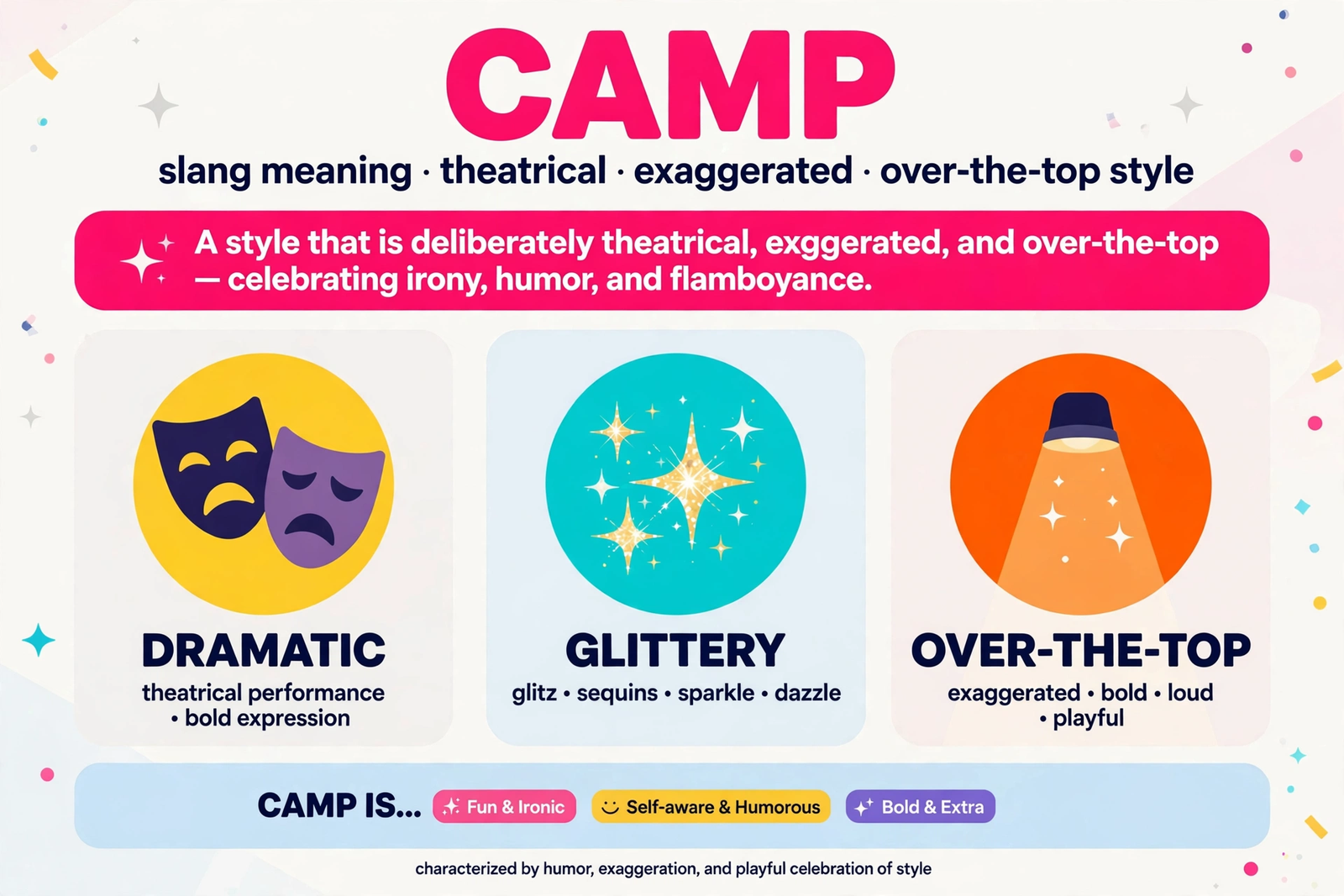
Quick definition: In current slang, camp meaning slang refers to something deliberately exaggerated, theatrical, and over-the-top — so dramatic, flamboyant, or cheesy that it becomes fun, stylish, or iconic on purpose. When people call a movie, an outfit, a performance, or a meme “so camp,” they mean it is extra in the best way: big gestures, bold fashion, dramatic flair, and a wink that says, “yes, I know this is a lot — and that is exactly the point.” Camp is not an accident. It is exaggeration as an art form.
That is the meaning most people are searching for today. But “camp” has other lives too: it can mean a summer camp, a tent pitched in the woods, or a video-game player who hides in one spot waiting for opponents. This guide covers the slang meaning first — because that is what almost every search means in 2026 — then the alternate meanings, so you never mix them up.
Introduction
If you have spent any time on TikTok lately, you have probably seen a comment like “this is so camp 😭” under a video of a celebrity in a giant feathered gown, a drag performance, or a movie scene so dramatic it loops back around to being brilliant. Nobody is talking about tents or summer camp. On TikTok, in group chats, and in pop-culture conversations, “camp” has become one of the internet’s favorite compliments — a single word that says a look, a performance, or a moment is gloriously, intentionally too much.
Camp is everywhere once you learn to spot it. The Met Gala’s most talked-about outfits are camp. A horror movie with a villain who delivers every line like it is Shakespeare is camp. Your friend who walks into the party in a sequined cape and sunglasses at midnight is camp. The word describes a very specific kind of fun: the joy of something that refuses to be subtle. And because the internet loves anything bold, shareable, and a little bit extra, camp slang has exploded far beyond the communities where it started.
In this guide, you will learn exactly what camp means in slang, where the word came from, how it is used on TikTok and in texts, and how to use it yourself without sounding confused. We will cover real examples, compare camp with similar words like “extra” and “cheesy,” explain the alternate meanings, and answer the most-searched questions about it. By the end, you will know camp when you see it — and you will probably start seeing it everywhere.
Origin
The slang meaning of “camp” did not start on TikTok. It started in queer culture, and it is much older than most people realize. The word was already in use in gay subcultures in the early 20th century, where “camp” described an exaggerated, theatrical style of behavior — men who spoke, dressed, and performed in deliberately flamboyant ways. It was both a private code and a public performance: a way to celebrate identity, mock seriousness, and turn being “too much” into something joyful.
The word went mainstream in 1964, when writer Susan Sontag published her famous essay “Notes on Camp.” Sontag described camp as a sensibility — a love of the unnatural, the artificial, and the exaggerated. Her examples included old Hollywood movies, opera, and anything that took itself so seriously it became funny. The essay gave camp an intellectual frame, and suddenly the word was being discussed in universities and newspapers, not just in drag clubs and theater circles.
From there, camp moved through pop culture in waves. The 1970s and 1980s brought glam rock, disco, and stars like David Bowie and Madonna, who built entire careers on camp style. The 1990s and 2000s brought cult films like “Showgirls” and “Mommie Dearest,” which audiences loved precisely because they were over-the-top. Then drag culture went mainstream: “RuPaul’s Drag Race,” which premiered in 2009, turned camp into weekly television. The queens’ catchphrases, costumes, and performances taught a whole generation of viewers what camp looked like — and gave them the vocabulary to name it.
The biggest single moment came in 2019, when the Met Gala chose “Camp: Notes on Fashion” as its theme. Celebrities arrived in chandeliers, feathered capes, and outfits that took six people to carry up the stairs. The event was covered everywhere, and overnight “camp” went from a niche cultural word to a mainstream search term. Since then, TikTok has done the rest: every awards show, every viral outfit, every dramatic movie scene gets the same comment — “this is so camp.” The word now belongs to everyone, but its roots in queer culture are still the heart of what it means.
Popularity
Camp slang is popular for a simple reason: the internet runs on exaggeration. Social media rewards the boldest outfit, the most dramatic reaction, and the funniest over-the-top moment. Camp is the word that describes all of that in one syllable, and it fits perfectly into a comment, a caption, or a text.
On TikTok, “camp” shows up in a few predictable places. Fashion TikTok uses it constantly: outfit-of-the-day videos, red-carpet reactions, and thrift hauls where someone finds a ridiculous vintage jacket and declares it “camp.” Movie TikTok uses it for films that are so dramatic they become iconic — horror movies with screaming villains, musicals with huge dance numbers, and soap operas where every scene feels like a season finale. Music TikTok uses it for pop stars whose performances are pure theater: glitter, costume changes, and choreography that would fill a stadium.
The word is also popular because it is a compliment with a personality. Calling something “good” is boring. Calling it “camp” says it is good in a specific way: bold, theatrical, fun, and a little bit ridiculous on purpose. It signals that you get the joke, that you understand the culture, and that you appreciate the effort. That is why it spreads so fast in comments — it is short, it is positive, and it makes the person who wrote it look like they know what they are talking about.
Search interest in camp slang has grown steadily since the 2019 Met Gala, with spikes every awards season, every time a major pop star drops a theatrical music video, and every time a campy movie or show goes viral. Gen Z uses it the most, but millennials and even older viewers who grew up with drag culture and cult films use it too. It is one of those rare slang words that crossed from a specific community into everyday language without losing its meaning — and that is exactly why it keeps trending.
How It Is Used
Camp is mostly used as an adjective, and it usually comes with a little excitement. Someone says “that outfit is so camp,” “the whole movie is camp,” or simply “this is camp” under a video. The word “so” shows up a lot — “so camp” is the standard way to say something is extremely camp. You will also see “campy,” which means the same thing in a slightly softer way: “a campy horror movie” is a movie that is fun because it is exaggerated, while “camp” can be the stronger, cooler version of the same idea.
The tone is almost always positive or admiring. When people call something camp, they are celebrating it. A camp performance is a great performance. A camp outfit is a great outfit. The word can also be used neutrally, just to describe a style: “the show has a camp aesthetic” simply means it looks theatrical and over-the-top. It is rarely an insult — but context matters, and we will cover the one situation where it can sting in the common-mistakes section below.
In texts and chats, camp usually appears as a quick reaction. A friend sends a photo of a celebrity in a giant hat and you reply “so camp 😭” or “iconic, so camp.” In comments, it works the same way: a one-word or two-word reaction that says everything. On TikTok, creators use it in captions too: “POV: your outfit is camp and you know it.” The word is flexible enough for a caption, a comment, a tweet, or a text — which is part of why it spread so far.
Here is a quick cheat sheet for how camp is used in everyday conversation:
- As a compliment: “That performance was so camp, I loved every second of it.”
- As a description: “The movie is campy on purpose — the director knows exactly what he is doing.”
- As a reaction: “This outfit is camp. Full stop.”
- As a vibe check: “Is it camp? Yes. Is it iconic? Also yes.”
- As a noun (rare): “The whole film is pure camp.” — here camp is the style itself, not just a description.
Notice that camp describes the style, not the person. You can call an outfit camp, a movie camp, or a performance camp. Calling a person “camp” is different — it traditionally described a flamboyant way of behaving, and it can feel like a label rather than a compliment. Stick to describing things, looks, and performances, and you will use the word the way most people do today.
Examples
The fastest way to understand camp is to see it in action. Here are real-world examples of how people use the word in friendly chats, professional settings, and funny situations — with the tone and context for each one.
Friendly Examples
In friendly conversations, camp is a fun, enthusiastic compliment. It is the kind of word you drop when your friend sends you a photo or a video that is gloriously dramatic:
- Text: “Okay the feathered jacket?? So camp, I am obsessed 😭”
- Text: “Your Halloween costume is camp in the best way. You understood the assignment.”
- Group chat: “Did anyone see the new music video? The choreography, the glitter, the drama — pure camp.”
- Comment: “This look is so camp. She ate and left no crumbs.”
- Text: “The whole party was camp. Someone brought a fog machine to a house party.”
In these examples, camp means the same thing every time: bold, theatrical, extra — and the person saying it loves it. The emoji and the excitement are part of the package. Nobody says “so camp” in a bored voice. The word carries energy, and the examples above show how it works as a reaction, a compliment, and a shared joke between friends.
Professional Examples
Camp also shows up in professional and media contexts, especially in fashion, film, and entertainment writing. Here, it is used as a real critical term, not just slang:
- Film review: “The director leans into camp, turning a low-budget horror script into a cult classic.”
- Fashion article: “This season’s runway was unapologetically camp — oversized bows, neon feathers, and drama at every turn.”
- Entertainment news: “The pop star’s new era is pure camp: glitter, costume changes, and a stage show built for arenas.”
- Work chat: “The client wants the launch event to feel fun and theatrical — a little camp, not corporate.”
- Podcast: “We love a campy movie night. The worse the acting, the better the experience.”
Notice that in professional settings, camp is a style label. A film critic who calls a movie camp is not insulting it — they are telling you it is intentionally exaggerated, and that the exaggeration is the point. A fashion editor who calls a collection camp is saying it is bold, theatrical, and fun to look at. The word works in a review, a pitch meeting, or a podcast because everyone in the room understands what it means.
Funny Examples
Camp is at its funniest when the exaggeration is accidental — or when someone leans into it so hard that it becomes a joke:
- Text: “Bro showed up to brunch in a cape. A CAPE. That is camp behaviour.”
- Comment: “This soap opera is so camp. The villain just fainted for the third time in one episode.”
- Group chat: “My grandma’s Christmas decorations are camp. There are 400 lights and a singing reindeer.”
- TikTok caption: “Me entering the function like it is the Met Gala. Camp is a lifestyle.”
- Text: “The movie was camp from minute one. The hero’s entrance had wind machines. Indoors.”
The humor in these examples comes from the gap between normal life and camp life. A cape at brunch, a fog machine at a house party, wind machines indoors — all of it is too much, and all of it is funny precisely because it is too much. That is the heart of camp slang: the joke and the compliment are the same thing.
Example Table: Camp in Different Contexts
| Context | Example Sentence | What “Camp” Means Here |
|---|---|---|
| Fashion | “That gown is so camp.” | Theatrical, oversized, dramatic — a look that refuses to be subtle |
| Movies | “The film is campy and I love it.” | Over-the-top acting and drama that makes it entertaining |
| Music | “Her new era is pure camp.” | Big performances, glitter, costume changes, pure theater |
| Everyday life | “This party is camp.” | Exaggerated, extra, dramatic in a fun way |
| Comments | “So camp 😭” | A quick compliment for anything bold and theatrical |
Comparison with Similar Terms
Camp is close to several other slang words, but it is not the same as any of them. The differences matter, because using the wrong word can change the compliment completely. Here is how camp compares with the terms people mix it up with most often.
| Term | What It Means | How It Differs from Camp | Example |
|---|---|---|---|
| Camp | Deliberately exaggerated, theatrical, flamboyant | — | “That performance was so camp.” |
| Extra | Over-the-top, dramatic, doing the most | Extra is about effort and attitude; camp is about theatrical style and aesthetic | “She is so extra for bringing a fog machine.” |
| Cheesy | Tacky, low-quality, trying too hard | Cheesy is usually negative; camp is usually a compliment | “That movie is cheesy, but I love it.” |
| Kitsch | Tacky art or objects that are fun because they are tacky | Kitsch is about objects and taste; camp is about performance and style | “The plastic flamingos are pure kitsch.” |
| Dramatic | Full of emotion, intense, theatrical | Dramatic is general; camp is dramatic on purpose, with a wink | “He is being so dramatic right now.” |
| Iconic | Legendary, unforgettable, instantly recognizable | Iconic is about status; camp is about style — something can be both | “That look is iconic.” |
| Slay | To look amazing, to perform perfectly | Slay is about success; camp is about the theatrical way it is done | “She slayed that performance.” |
The most useful distinction is camp versus cheesy. Something cheesy fails because it tried to be serious and missed. Something camp succeeds because it knows exactly what it is doing. A bad action movie with wooden acting is cheesy. A movie where the villain delivers every line like it is Shakespeare — on purpose — is camp. The same goes for camp versus extra: extra describes a person doing too much, while camp describes a style that is theatrical by design. And if you want more slang decoded the same way, our bms meaning slang guide breaks down another TikTok favorite, and the corn slang guide explains one of the internet’s strangest code words.

Alternate Meanings
Camp is one of those words with completely different meanings depending on where you hear it. If you only know the slang, the other uses can be confusing — so here they are, side by side.
- Summer camp: The oldest and most common meaning. A place where children spend days or weeks in summer, doing outdoor activities, crafts, and sports. “She is going to summer camp in July” has nothing to do with slang.
- Camping / to camp: Staying outdoors in a tent, or sleeping outside. “We camped by the lake” means you slept in a tent, not that you were theatrical.
- Camping in video games: In shooters like Call of Duty or Fortnite, “camping” means staying in one hidden spot and waiting for opponents to walk past. Gamers often complain about campers, and it is an insult in that world — the opposite of the slang compliment.
- Camp as a verb (old slang): In early queer slang, “to camp” meant to behave in an exaggerated, flamboyant way. This is where the modern adjective comes from.
- Camp (military): A military base or temporary settlement, as in “boot camp” or “refugee camp.” Completely unrelated to the slang.
- Camp (adjective, British): In British English, “camp” has long been used to describe someone or something as effeminate or flamboyant, often in a teasing way. This is close to the slang meaning, but it is about a person, not a style — and it can feel like a label, so use it carefully.
How do you tell which meaning someone intends? Context does the work. On TikTok, under a fashion video, or in a movie review, camp means theatrical and exaggerated. In a conversation about a holiday, a tent, or a video game, it means something else entirely. If someone says “that outfit is camp,” they are complimenting the look. If someone says “we camped in the mountains,” they slept in a tent. The slang meaning almost always shows up with words like “so,” “pure,” “iconic,” or an emoji — those are your clues.
Professional or Polite Alternatives
Camp is casual slang, so it does not fit every situation. In a formal email, a work presentation, or a conversation with someone who does not know the slang, these alternatives say the same thing in a more professional way:
- Theatrical — “The production had a wonderfully theatrical style.” (Best all-round alternative.)
- Flamboyant — “The designer’s flamboyant collection stole the show.” (For fashion and performance.)
- Over-the-top — “The launch event was deliberately over-the-top and guests loved it.” (Clear and neutral.)
- Bold and dramatic — “The campaign’s bold, dramatic visuals stood out immediately.” (Safe for work.)
- Extravagant — “An extravagant stage design with lights, glitter, and costume changes.” (Formal and positive.)
- Playfully exaggerated — “The ad uses a playfully exaggerated style that audiences remember.” (Great for marketing.)
- Show-stopping — “Her show-stopping entrance set the tone for the night.” (For performances and events.)
Use “theatrical” or “over-the-top” when you want to be safe, and save “camp” for friends, social media, and pop-culture conversations where the slang lands. If you are writing a review or a pitch, “camp” is fine in entertainment and fashion — critics use it all the time — but in a corporate report, “bold and dramatic” is the better choice.
Common Mistakes
Camp is an easy word to use, but there are a few mistakes that show up again and again. Avoid these and you will sound like you know exactly what you are talking about:
- Calling everything camp: Not everything bold is camp. A great outfit is not automatically camp — it has to be theatrical, exaggerated, or deliberately over-the-top. Calling a plain black dress camp makes the word meaningless.
- Using it as an insult: Camp is almost always a compliment. If you say “that movie is camp” in a scornful tone, people will be confused — or think you are mocking something they love. If you did not like it, say so directly instead.
- Confusing camp with cheesy: Cheesy means it tried and failed. Camp means it is exaggerated on purpose and proud of it. A campy movie knows it is campy. A cheesy movie does not.
- Calling a person camp: The modern slang describes things, looks, and performances. Calling a person “camp” can feel like a label about their personality or sexuality, especially given the word’s history. Describe the outfit, the performance, or the moment — not the person.
- Using it for the gaming or camping meanings: “He is camping in the game” has nothing to do with the slang. Mixing the meanings up in a gaming chat will confuse everyone.
- Forgetting the “on purpose” part: Camp only works when the exaggeration is intentional. An accident is not camp. A deliberate choice to be extra is camp. That intention is the whole point of the word.
- Overusing it: Camp is a strong word. If every outfit, movie, and meme is “so camp,” the word loses its punch. Save it for the moments that really earn it — the feathered gown, the dramatic entrance, the performance that goes all in.

Quick Tips
Want to use camp slang like someone who has been saying it for years? These quick tips will get you there:
- Pair it with “so”: “So camp” is the natural form. It sounds right in a comment, a caption, or a text.
- Use it for things, not people: Outfits, movies, performances, parties, and looks are camp. People are not.
- Look for the wink: If something is exaggerated on purpose — if it knows it is too much — it is probably camp.
- Add an emoji: 😭, ✨, or 💅 next to “so camp” is the standard internet punctuation for it.
- Use it as a compliment: Camp is praise. Say it when you love the drama, not when you are mocking it.
- Learn from drag culture: Watch a few episodes of a drag competition or a campy cult film and you will understand the word faster than any definition can teach you.
- Know when to switch words: In a formal setting, say “theatrical” or “over-the-top” instead. Camp is for casual and creative conversations.
- Do not force it: If you are not sure something is camp, it probably is not. The real thing is obvious the moment you see it.

FAQ
What does camp mean in slang?
In slang, camp means deliberately exaggerated, theatrical, and over-the-top — a style that is flamboyant, dramatic, and fun on purpose. A camp outfit, movie, or performance is bold and extra, and the exaggeration is the whole point.
Is camp a compliment?
Yes, almost always. Calling something camp is a compliment — it means the thing is bold, theatrical, and entertaining. It is a way of saying “this is gloriously too much and I love it.”
What does “so camp” mean on TikTok?
On TikTok, “so camp” is a comment or caption praising something theatrical and exaggerated — a dramatic outfit, a flamboyant performance, or an over-the-top movie scene. It is one of the most common positive reactions on fashion and pop-culture videos.
Where did camp slang come from?
Camp slang comes from queer culture, where it described an exaggerated, theatrical style of behavior and performance. Susan Sontag’s 1964 essay “Notes on Camp” brought it to a wider audience, and drag culture, the 2019 Met Gala, and TikTok made it mainstream.
What is the difference between camp and cheesy?
Cheesy means something tried to be serious and failed — it is usually negative. Camp means something is exaggerated on purpose and proud of it — it is usually a compliment. A campy movie knows it is campy; a cheesy movie does not.
What does camp mean in gaming?
In gaming, “camping” means something completely different: staying hidden in one spot and waiting for opponents to walk past. It is usually an insult in games, and it has nothing to do with the slang meaning of camp as theatrical and exaggerated.
Can a movie be camp?
Yes — movies are one of the most common things people call camp. A camp movie is one with over-the-top acting, dramatic scenes, and a style that is exaggerated on purpose, like many cult horror films, musicals, and soap-opera-style dramas.
Is camp the same as extra?
Not quite. Extra describes a person or an attitude — someone doing the most. Camp describes a theatrical style or aesthetic — something that is deliberately exaggerated. A person can be extra, and their outfit can be camp, and both can be true at the same time.
Conclusion
Camp slang is one of the internet’s best words because it names something we all recognize but rarely had a name for: the joy of being deliberately, gloriously too much. In camp meaning slang, a camp outfit, movie, or performance is not trying to be subtle — it is theatrical, flamboyant, and exaggerated on purpose, and that is exactly what makes it fun. From its roots in queer culture and Susan Sontag’s famous essay to the Met Gala and TikTok, camp has traveled a long way — and it has kept its meaning the whole time.
The trick is remembering the “on purpose” part. Camp is not an accident, and it is not a failure. It is a choice: big gestures, bold fashion, dramatic flair, and a wink that says the exaggeration is the point. Use it for the looks and performances that earn it, save it for the moments that are truly extra, and do not confuse it with cheesy — cheesy misses the mark, camp hits it on purpose. And if you want to keep decoding the slang your feed throws at you, check out the glizzy meaning guide and the tysm meaning guide next — the internet invents a new word every week, and we are keeping up with all of them. For the cultural history behind the word, the Wikipedia entry on camp as a style is a great place to start.
