
Quick definition: Canada slang is the informal vocabulary Canadians use in everyday conversation — words like eh, toque, loonie, double-double and Timmies that sound perfectly normal in Toronto or Vancouver but can leave visitors from the United States completely confused. It is a friendly mix of British roots, American influence, French-Canadian heritage and homegrown northern inventions.
Introduction
Picture this: you land in Toronto, order a coffee, and the person ahead of you asks for a “double-double from Timmies,” pays with a “loonie,” and ends every sentence with “eh?” If you nodded along while understanding almost nothing, welcome to the wonderful world of canada slang. Canadians speak English, but they speak it with their own twist — a warm, polite, slightly quirky vocabulary shaped by long winters, hockey culture, Tim Hortons runs and a bilingual country that stretches from the Atlantic to the Pacific.
Canada slang is more than a funny accent or a punchline in a comedy sketch. It is a living part of Canadian identity. The words Canadians use tell you where they are from, what generation they belong to and even what they had for breakfast. A toque keeps your head warm in Winnipeg in January, a two-four is what you bring to a cottage weekend, and saying “give ‘er” is the most Canadian way possible to tell someone to go all out.
In this guide, we break down canada slang the easy way. You will learn the 25 most common Canadian slang words with clear meanings, real examples, origins and regional notes, so you can understand Canadians — and sound a little more Canadian yourself. Whether you are moving to Canada, visiting friends in Vancouver, chatting with a Canadian online or just curious about what “eh” really means, this guide has you covered. And if you enjoy decoding modern slang, you will also like our guide to goated meaning slang, another term that took over group chats everywhere.
canada slang Meaning & Definition
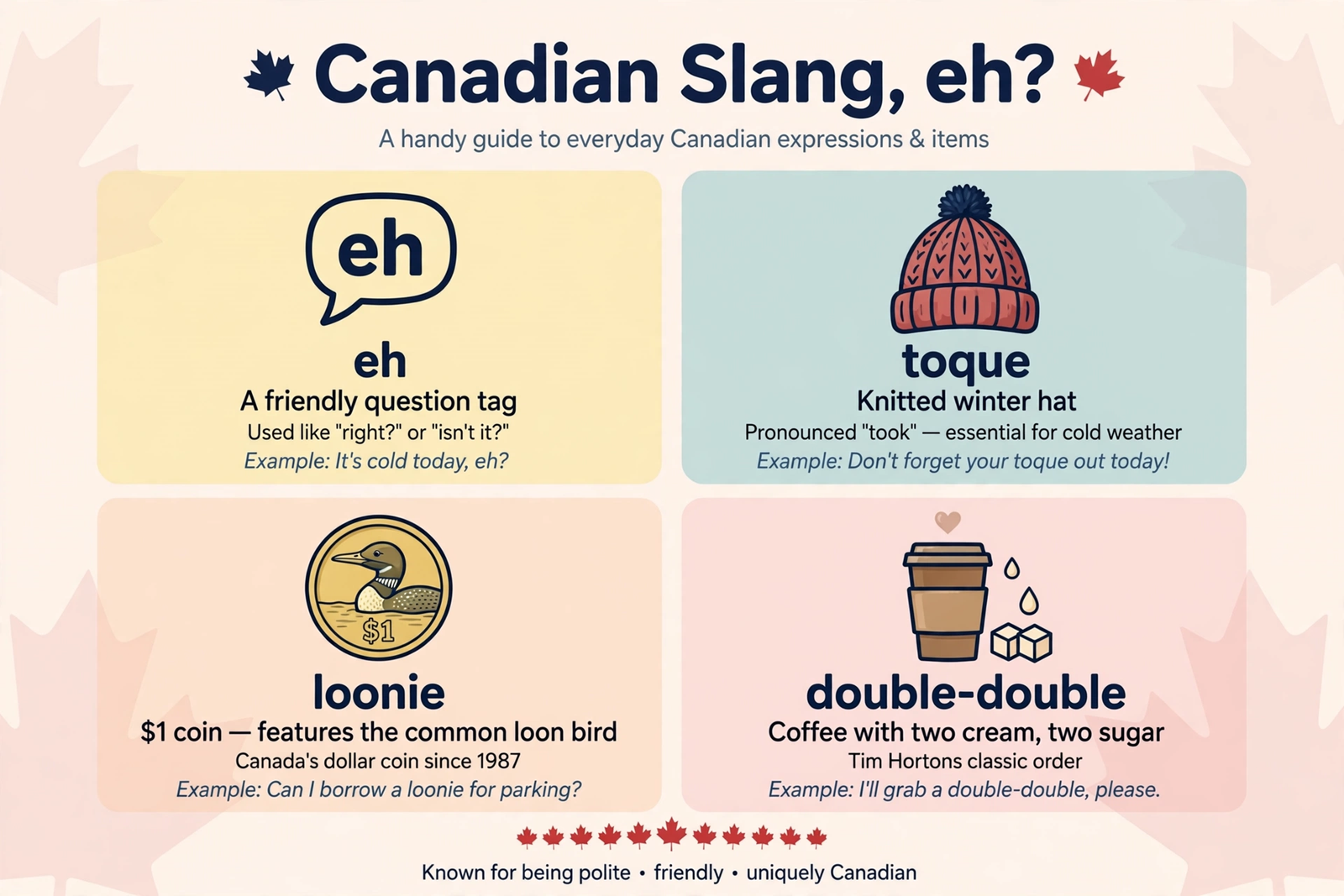
Canada slang refers to the informal words, phrases and expressions that are unique to Canadian English (and, in Quebec, to Canadian French). Some of these words are everyday vocabulary in Canada — a washroom instead of a restroom, hydro instead of electricity — while others are true slang, like hoser or keener, used mostly in casual conversation.
What makes canada slang special is its blend. Canada sits between Britain and the United States, and its language reflects that. Canadians spell words like colour and centre the British way, watch American television, and add French words like toque (from the French tuque) and poutine. The result is a vocabulary that feels familiar to Americans and Brits, yet is unmistakably Canadian.
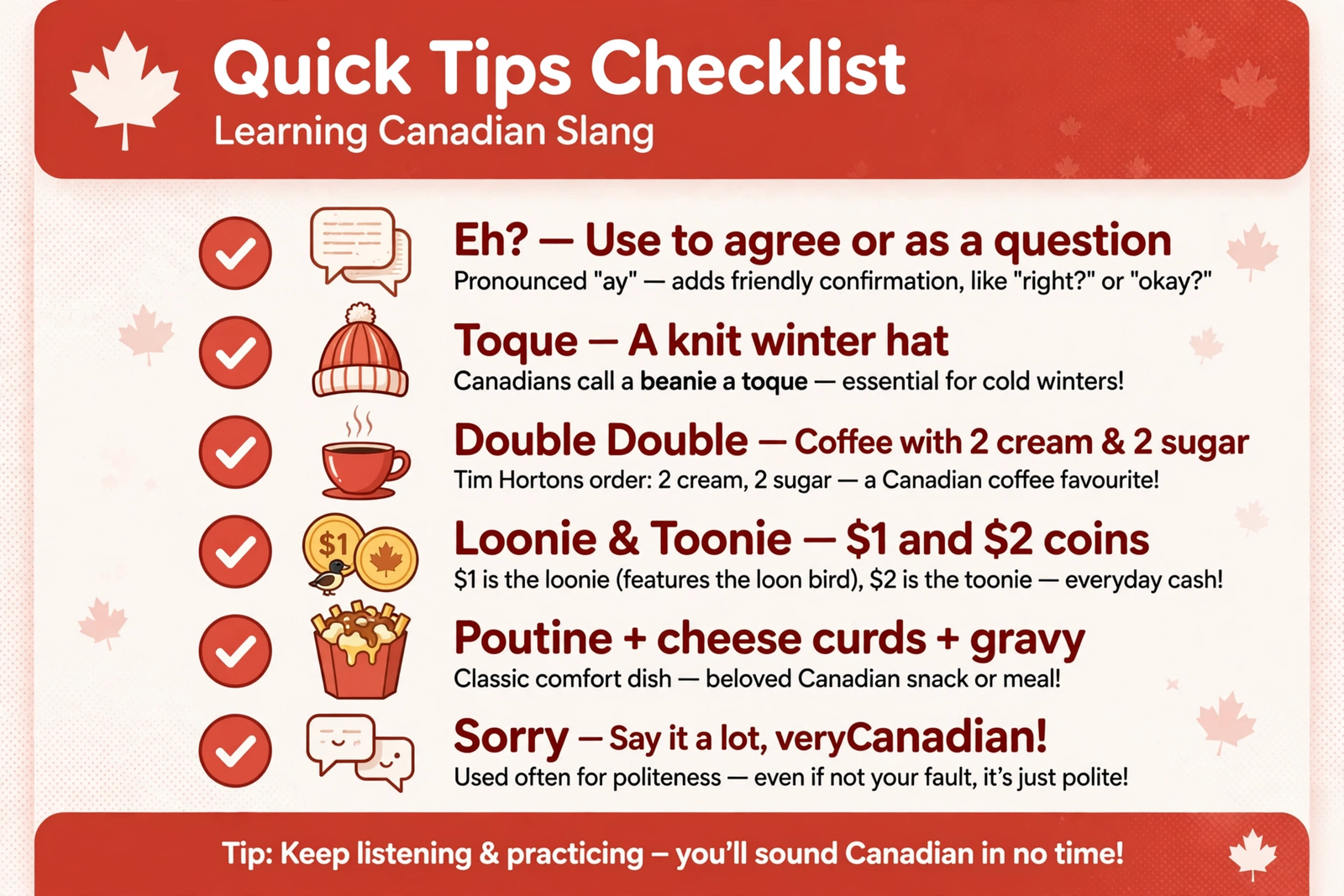
Here is a quick snapshot of the most iconic canada slang words before we dive deeper:
| Canadian Slang Word | Meaning | Where You Will Hear It |
|---|---|---|
| Eh | A tag that means “right?”, “you know?” or “huh?” | Everywhere in Canada |
| Toque | A knitted winter hat (a beanie) | Everywhere, especially in winter |
| Loonie / Toonie | The $1 and $2 Canadian coins | Shops, parking meters, everywhere |
| Double-double | Coffee with two creams and two sugars | Tim Hortons, any coffee shop |
| Timmies | Tim Hortons, Canada’s famous coffee chain | Everyday conversation |
| Washroom | Bathroom / restroom | Restaurants, offices, schools |
| Give ‘er | Go all out, give it maximum effort | Sports, work, casual talk |
| Two-four | A case of 24 beers | Parties, cottage weekends |
| Hoser | A friendly insult for a goofy or unsophisticated person | Playful teasing among friends |
| Keener | An eager overachiever, a teacher’s pet | Schools, universities, offices |
Canadians do not use all of these words every day, and usage changes a lot by region and age. A teenager in Toronto might say “the 6ix” for their city, while a grandparent in Nova Scotia might still call the couch a “chesterfield.” That regional flavour is part of what makes canada slang so much fun to learn.
Origin
Canada slang did not appear overnight. It grew over centuries from the people who settled the country: British and French colonists, Indigenous peoples, waves of immigrants, and later, American neighbours just across the border. Each group left words behind, and Canadians kept the ones that fit life in the north.
Eh is the most famous example. Linguists believe it evolved from the British “aye” or “hey,” but Canadians turned it into something of their own — an “invariant tag” used to check understanding, invite agreement or soften a statement. It is so deeply Canadian that it became a national stereotype, even though how often people say it depends heavily on region, age and context.
Toque comes straight from French. The word tuque dates back to 15th-century France, where it described a brimless hat worn by sailors and chefs. French-Canadian settlers brought it to Canada, and it stuck — because in a country where winter can last six months, you need a good word for a warm hat. If you call it a “beanie” at a Canadian hockey rink, expect some friendly teasing.
The loonie has a very modern origin. When Canada replaced the one-dollar bill with a gold-coloured coin in 1987, the coin featured a common loon, a water bird iconic to the Canadian wilderness. Canadians immediately nicknamed it the “loonie,” and the name stuck so well that the Royal Canadian Mint trademarked it. When the two-dollar coin arrived in 1996, it rhymed its way into existence as the “toonie.”
The double-double owes its fame entirely to Tim Hortons. The coffee chain made “two creams, two sugars” the default order for millions of Canadians, and the term became so culturally significant that it was officially added to the Canadian Oxford Dictionary in 2004. For a deeper look at how Canadian vocabulary is documented, the Berlitz guide to Canadian slang and key words is a useful authoritative reference.
Other words come from everyday Canadian life. A two-four is simply a case of 24 beers, named for the number on the box. A mickey is a 375 ml flask-sized bottle of liquor, named after the small “Mickey” bottles that were once common. Chesterfield, the old Canadian word for a sofa, arrived with British settlers and lingered for generations before “couch” took over. And hydro — the Canadian word for electricity — comes from the country’s early reliance on hydroelectric power, especially in Ontario and Quebec, where power bills literally say “hydro” on them.
Popularity
Canada slang is more popular than ever, and the internet is a big reason why. TikTok creators, YouTubers and Instagram accounts dedicated to “things only Canadians understand” regularly go viral, introducing words like eh, toque and double-double to audiences far beyond Canada’s borders. American viewers love the charm of it, and Canadians abroad love using it as a badge of identity.
Television helped too. The comedy duo Bob and Doug McKenzie turned hoser and eh into international jokes in the 1980s, and shows like Letterkenny and Schitt’s Creek brought small-town Ontario speech to global audiences. Suddenly, phrases that once marked you as a rural Canadian became cool, quotable and shareable.
Immigration and travel keep the vocabulary fresh. Newcomers to Canada pick up canada slang quickly because it is practical — you cannot live in Canada without learning what a washroom is or how to order at Timmies. At the same time, regional slang keeps evolving: Toronto gave the world “the 6ix,” Vancouver has its own laid-back surf-and-snow vocabulary, and the Maritimes hold on to colourful expressions like “right some good” (meaning “really great”).
Search interest in canada slang spikes every year around winter, the start of the school year and major hockey events, when people look up words they heard in a game broadcast or a viral video. It is also a favourite topic for language learners, travellers and new immigrants preparing for life in Canada — proof that slang is not just entertainment, it is a real tool for fitting in.
How It Is Used
Canada slang shows up in almost every part of daily life, but it follows a few unwritten rules. First, it is casual. You will hear eh, Timmies and give ‘er in conversation with friends, family and coworkers, but rarely in a formal business email or a legal document. Second, it is warm. Canadian slang is rarely aggressive — even the insults, like hoser, are usually said with a grin between friends.
Here is how the most common canada slang words work in real life:
- Eh as a question tag: “Cold out there, eh?” — the speaker is inviting you to agree. It works like “right?” or “isn’t it?”
- Eh as a check-in: “I grabbed us a double-double, eh?” — here it means “okay?” or “got it?”
- Eh as surprise: “You won the game, eh?!” — pure amazement, said with a laugh.
- Toque as a necessity: “Grab your toque, it’s minus twenty out there.” Nobody says “beanie” when the wind chill hits.
- Loonie and toonie as money: “Parking is two bucks — do you have a toonie?” Canadians talk about coins by name, not just by value.
- Double-double as an order: “One double-double and a Boston cream, please.” Short, clear, and every Tim Hortons employee understands it instantly.
- Give ‘er as encouragement: “It’s the last lap — give ‘er!” This is the Canadian way of saying “go for it, full speed.”
- Two-four as a plan: “Pick up a two-four on your way to the cottage.” Everyone knows exactly what to buy.
- Washroom as politeness: “Where’s the washroom?” Canadians almost never say “bathroom” in a restaurant or office.
- Keener as a label: “She finished the assignment a week early — total keener.” Said with affection, or a little eye-roll, depending on who is talking.
Context matters a lot. Saying “eh” once in a conversation sounds natural. Ending every single sentence with it sounds like a parody. Using hoser with a close friend is funny; using it with a stranger or a boss is not. The golden rule of canada slang is the same as any slang: learn the meaning first, then copy how locals actually use it, not how movies exaggerate it.
Examples
The best way to learn canada slang is to see it in real sentences. Here are examples grouped by tone, so you can hear how the same words change their feel depending on the situation.
Friendly Examples
- “Nice game last night, eh? The Leafs finally gave ‘er in the third period!”
- “I’m heading to Timmies — want a double-double or a regular?”
- “Don’t forget your toque, it’s freezing out there and the wind is brutal.”
- “We drove 300 clicks to the cottage and it was worth every minute, eh?”
- “Grab a two-four and some chips — we’re having a fire tonight at the lake.”
- “Sorry, do you have a loonie for the parking meter? I’m all out of change.”
- “That poutine was right some good, I’m still thinking about it.”
Professional Examples
- “Could you send me the hydro bill? I want to check this month’s usage.”
- “The meeting room is down the hall, and the washroom is just past the kitchen.”
- “He’s a real keener — he had the report ready two days before the deadline.”
- “We’ll need to pencil in the project kickoff for the first week of January.”
- “The client is based in the 6ix, so let’s schedule the call in Eastern Time.”
- “Please e-transfer the deposit and I’ll send the confirmation right away.”
Funny Examples (if applicable)
- “Take off, hoser! You call that a slapshot?” — classic playful teasing at a hockey game.
- “He showed up to a snowstorm in running shoes. No toque, no mitts, nothing. Beauty, eh?”
- “I asked for a regular coffee in the States and they looked at me like I ordered in another language.”
- “My American friend thought a ‘mickey’ was a cartoon mouse. It was not a cartoon mouse.”
- “You know you’re Canadian when you say ‘sorry’ to a chair you bumped into.”
- “It’s so cold that the toque is wearing a toque.”
Notice how friendly and funny examples lean on eh, hoser and give ‘er, while professional examples use practical words like washroom, hydro and e-transfer — words that are not really slang at all, just the normal Canadian term. That split is important: part of canada slang is colourful expression, and part of it is simply how Canadians name ordinary things.
Comparison with Similar Terms
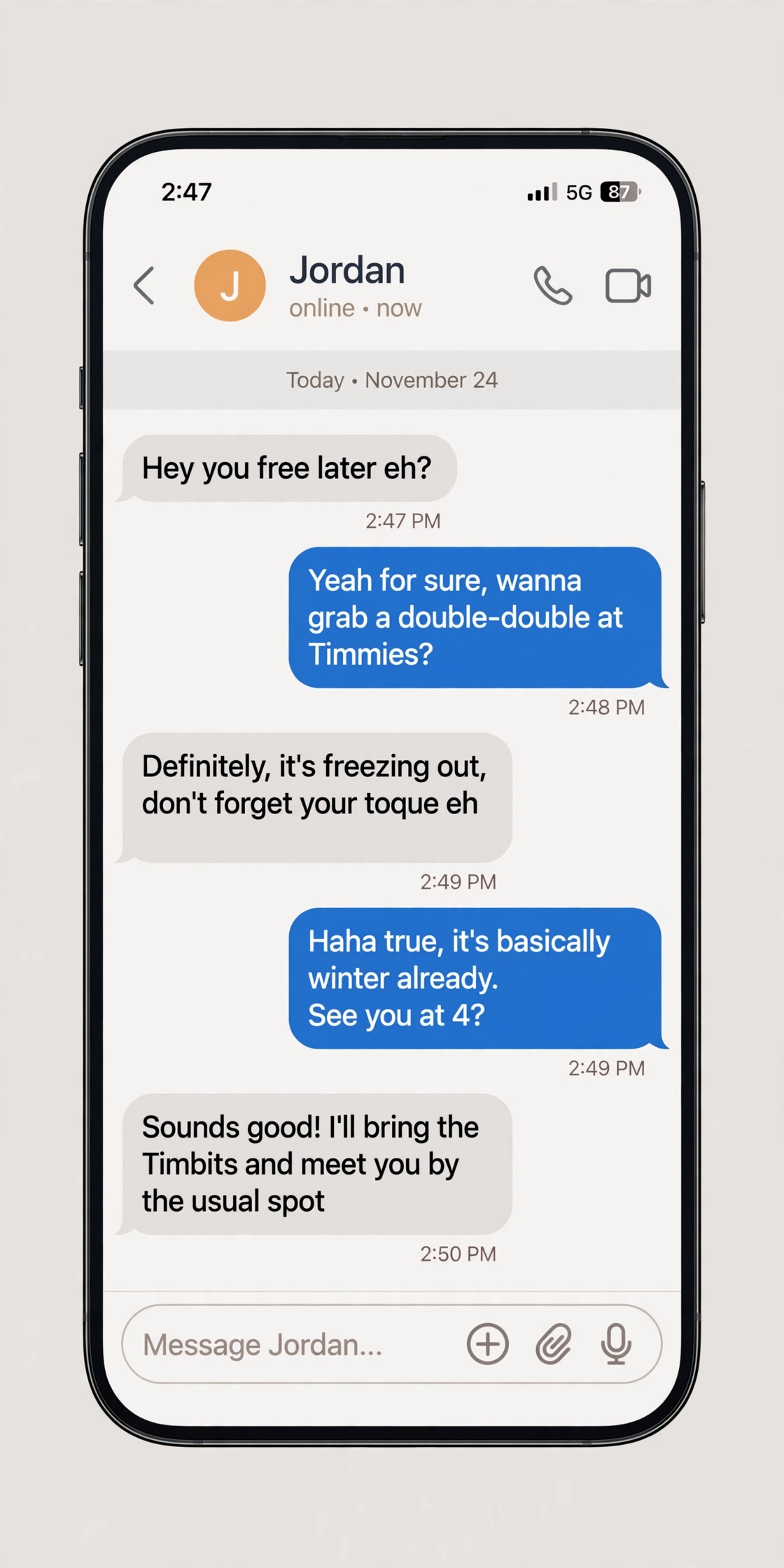
Canada slang sits in the middle of the English-speaking world, borrowing from Britain, the United States and France, then adding its own inventions. The table below shows how the same everyday thing gets a different name in Canada, the United States and the United Kingdom — and why confusing them can lead to a funny misunderstanding.
| Thing | Canada Slang / Canadian Term | United States | United Kingdom |
|---|---|---|---|
| Knitted winter hat | Toque | Beanie | Bobble hat |
| Bathroom in public | Washroom | Restroom | Loo / WC |
| Coffee, 2 creams 2 sugars | Double-double | Regular coffee | White coffee, 2 sugars |
| $1 coin | Loonie | (No $1 coin in common use) | £1 coin |
| Sofa | Chesterfield (older term) | Couch | Settee |
| Mac and cheese | KD (Kraft Dinner) | Mac and cheese | Macaroni cheese |
| Electricity bill | Hydro bill | Electric bill | Electricity bill |
| 24 beers | Two-four | Case (24-pack) | Crate of 24 |
| Agreement tag | Eh? | Right? / Huh? | Innit? / Yeah? |
| University first year | Frosh | Freshman | Fresher |
Canada slang also has close cousins inside Canada itself. Quebec French slang is a whole world of its own — tabarnak, dépanneur (corner store) and tuque all come from French-Canadian life. Meanwhile, Newfoundland English has expressions like “stay where you’re to” (stay where you are) that even other Canadians find charmingly confusing. If you want to explore more modern slang that crosses borders, our guide to period meaning slang shows how one small word became a whole attitude online.
The biggest difference between canada slang and American slang is tone. American slang often aims to sound cool, tough or cutting-edge. Canadian slang aims to sound friendly, practical and a little self-deprecating. Nobody is trying to impress you with a toque — they are just trying to stay warm. That warmth is exactly why people love it.
Alternate Meanings
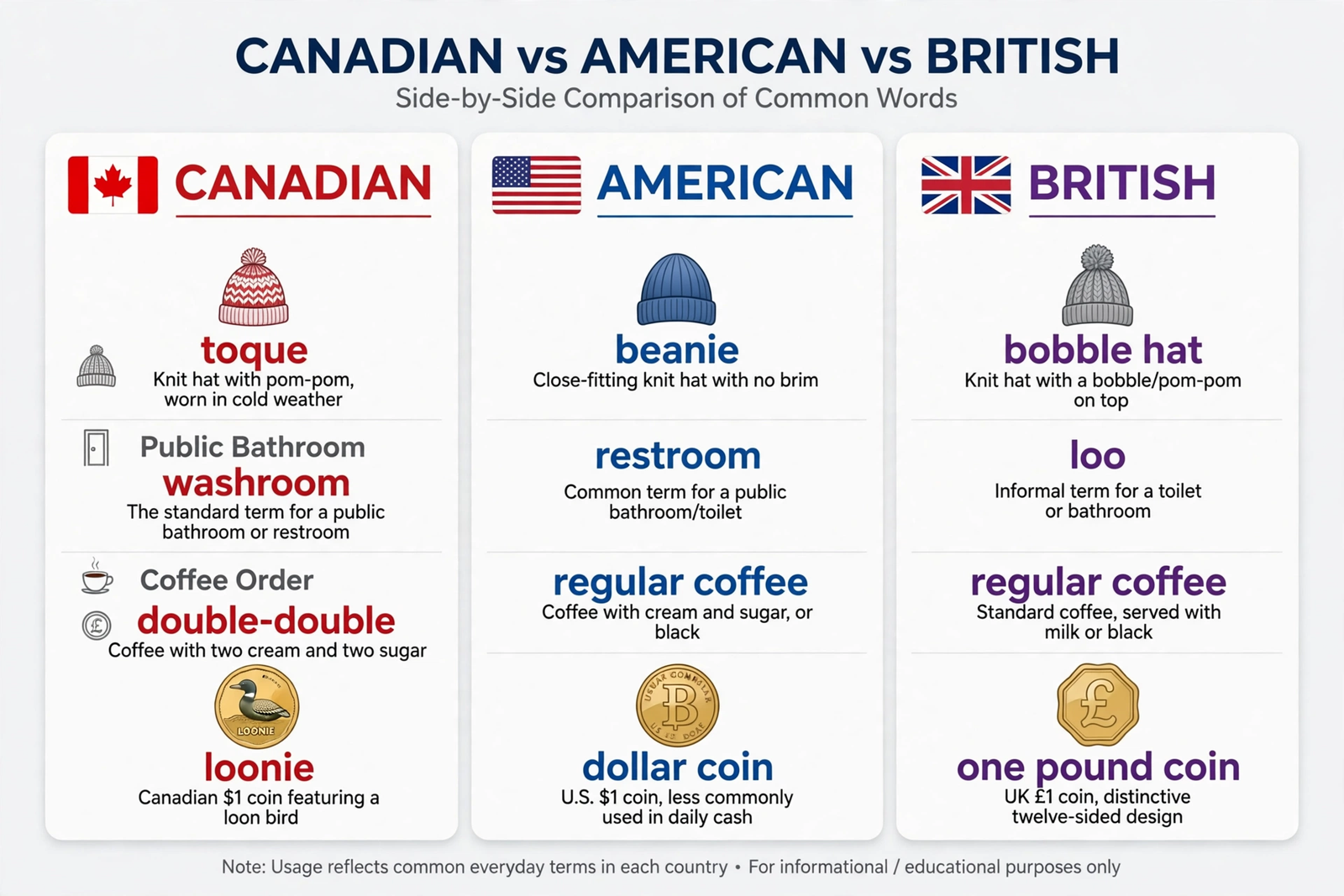
Like all slang, canada slang words can mean different things depending on context. Here are the most common alternate meanings to watch out for:
- Eh: Usually a question tag (“Nice day, eh?”), but it can also express surprise (“Eh?! You did what?”), disagreement (“Eh, I don’t think so”) or simply fill a pause while someone thinks. The tone of voice tells you which one it is.
- Beauty: In Canada, calling something a “beauty” often means it is excellent or impressive, not that it is pretty. “That goal was a beauty!” means it was a great goal. It can also describe a person who is a good sport: “He drove me home in the snow — what a beauty.”
- Keener: In school it means an eager overachiever, but at work it can be a compliment for someone who is proactive — or a gentle tease for someone who tries a little too hard.
- Give ‘er: Normally means to put in maximum effort, but it can also mean to speed up (“Give ‘er on the highway”) or to start something with energy (“Give ‘er, boys, the game’s on!”).
- Toque: Always a winter hat in Canada, but in French cooking a toque is a chef’s tall white hat — a completely different item that shares the same French root.
- Clicks: Short for kilometres (“It’s about 50 clicks from here”), never for mouse clicks in this context.
- Mickey: A small 375 ml bottle of liquor — but never confuse it with Mickey Mouse, or with a “two-six” (750 ml) and a “forty” (1.14 L), the other classic Canadian bottle sizes.
- Runners: In Canada these are athletic shoes or sneakers, not people who run. “Put on your runners” means put on your trainers.
- Pencil in: To schedule something tentatively — used everywhere in Canada, and a good example of a phrase that sounds formal but is really casual office talk.
The lesson here is simple: never translate a canada slang word literally. Always check the situation, the speaker’s tone and the region. A word that means one thing in downtown Toronto might mean something slightly different in rural Alberta or St. John’s, Newfoundland.
Professional or Polite Alternatives
Canada slang is wonderful in casual conversation, but some situations call for plainer language. Here are polite, professional alternatives for the most common canada slang words:
| Canada Slang | Professional / Polite Alternative | When to Switch |
|---|---|---|
| Eh? | “Does that make sense?” / “Right?” | Formal meetings, presentations, emails |
| Timmies | “Tim Hortons” / “the coffee shop” | Client meetings, written communication |
| Double-double | “Coffee with two creams and two sugars” | Ordering outside Canada |
| Hoser | Don’t use — just describe the behaviour | Any professional setting |
| Give ‘er | “Let’s give it our best effort” | Work emails, speeches |
| Keener | “Highly motivated colleague” | Performance reviews, HR contexts |
| Two-four | “A case of 24 beers” | Formal invitations, work events |
| Washroom | “Restroom” (US) / keep “washroom” in Canada | Actually fine everywhere in Canada |
| Beauty | “Excellent” / “outstanding” | Written reports, formal praise |
| Loonie / Toonie | “One-dollar coin” / “two-dollar coin” | Banking, official documents |
Here is the good news: many canada slang words are already polite. Washroom, hydro and e-transfer are standard Canadian English, not rude slang, so you can use them anywhere in Canada without a second thought. The ones to soften are the playful ones — hoser, give ‘er and heavy use of eh — which are best saved for friends, family and relaxed coworkers. When in doubt, mirror the people around you: if your Canadian colleagues say “eh” in a meeting, you can too. If they don’t, keep it for the coffee break.
Common Mistakes
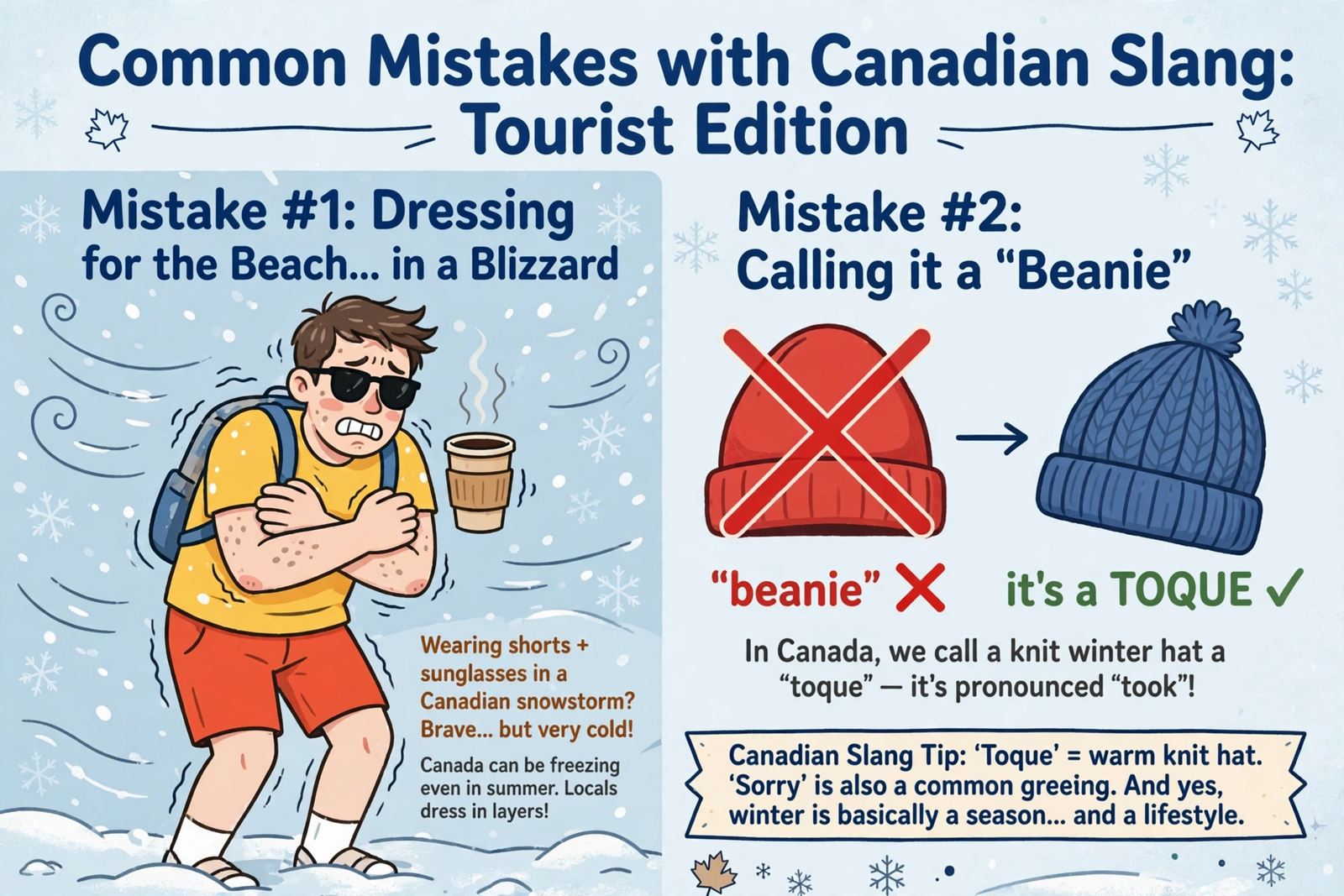
Learning canada slang is fun, but a few mistakes trip up almost every newcomer. Avoid these and you will sound natural instead of like a parody:
- Ending every sentence with “eh.” Real Canadians use eh occasionally, not constantly. One or two per conversation is natural; every sentence sounds like a comedy sketch. Listen first, then copy the rhythm.
- Calling a toque a “beanie” in winter. Everyone will understand you, but you will instantly mark yourself as a visitor. In Canada, it is a toque — full stop.
- Asking for a “bathroom” in a restaurant. Canadians say washroom. “Bathroom” works, but it sounds American, and in some places it can cause a confused pause.
- Ordering a “regular coffee” and expecting two creams and two sugars. In the United States, “regular” often means exactly that. In Canada, say “double-double” if that is what you want, or specify “one cream, one sugar” clearly.
- Using “hoser” with strangers. It is a friendly insult between friends, not a greeting. With someone you just met, it can come across as rude.
- Assuming all Canadian slang is the same everywhere. Toronto slang, Quebec slang, prairie slang and Newfoundland slang are genuinely different. “The 6ix” means nothing in Halifax, and a “chesterfield” will get blank stares from most people under 30.
- Overusing “sorry.” Canadians do say sorry a lot — but the famous politeness is real, not a joke to copy mechanically. A sincere “sorry” when you bump into someone is perfect; apologising for existing is not.
- Pronouncing “toque” like “toke.” It rhymes with “uke” — say “tuke.” Getting it right is a small detail that makes a big difference.
- Confusing a “mickey” with a cartoon. At a liquor store, a mickey is a small bottle. Context is everything.
- Forgetting the French side. Canada is officially bilingual, and Quebec has its own rich slang. Words like dépanneur (corner store) and tuque are part of everyday life in Montreal — ignoring them misses half the country’s flavour.
Quick Tips
- Start with five words: Learn eh, toque, loonie, double-double and washroom first. These five cover most daily situations.
- Listen before you speak: Spend a day noticing which words locals actually use, then copy those — not the ones from movies.
- Use slang in low-stakes chats: Coffee runs, hallway hellos and group chats are perfect practice. Save formal meetings for plain language.
- Learn the food words: Poutine, KD, Timbits and double-double will come up constantly, and they make great conversation starters.
- Ask when you are unsure: Canadians love explaining their slang. “What does that mean?” is always welcome — and usually gets a funny story in return.
- Watch Canadian shows: Letterkenny, Schitt’s Creek and Kim’s Convenience are entertaining crash courses in how Canadians actually talk.
- Learn regional words before you travel: Going to Toronto? Learn “the 6ix.” Going to Newfoundland? Learn “b’y.” A little local vocabulary goes a long way.
- Keep it light: Canada slang is friendly by nature. If a word feels aggressive or rude, you are probably using it wrong — check the context.
FAQ
What does canada slang mean?
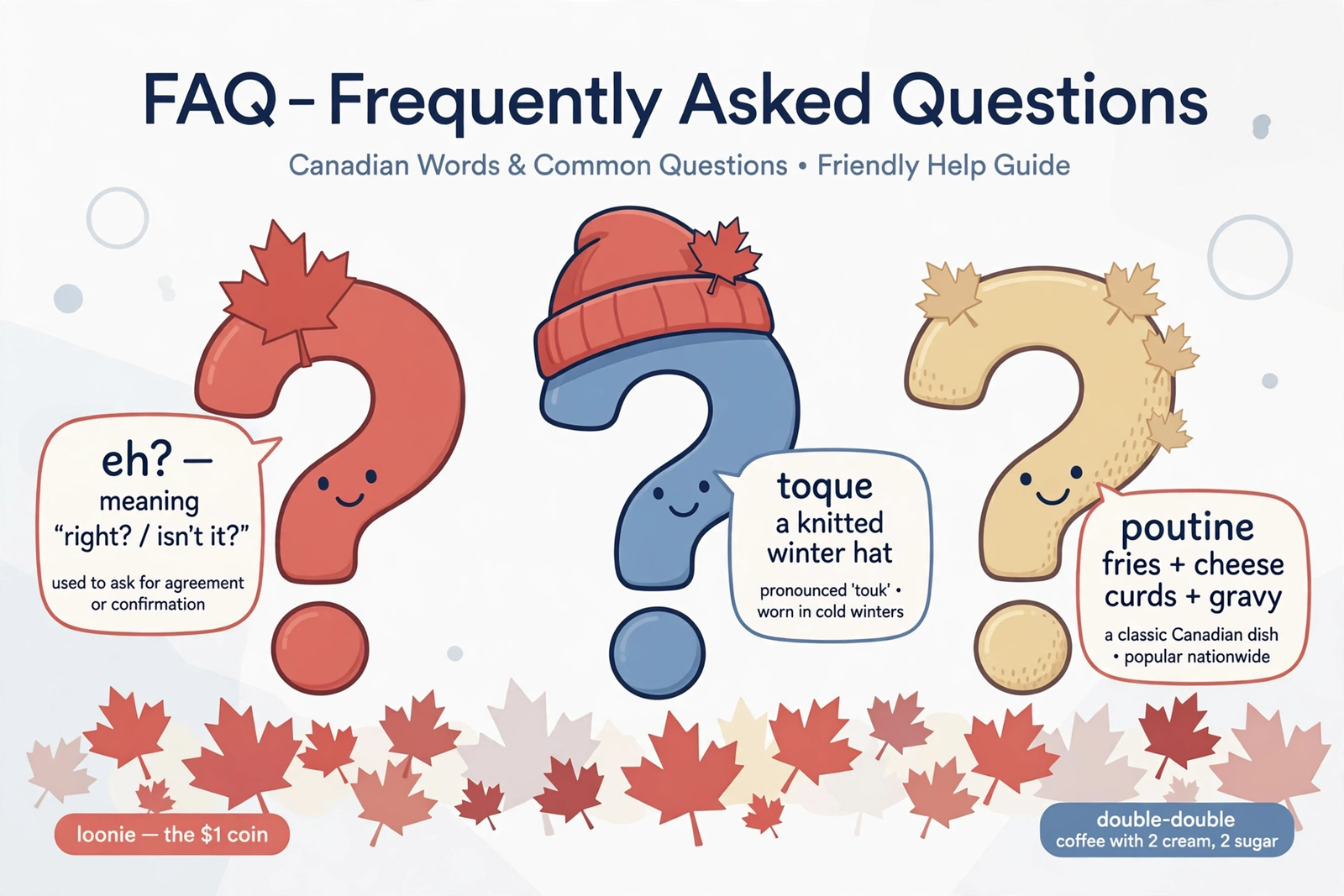
Canada slang means the informal words and expressions unique to Canadian English, such as eh (a tag for agreement), toque (a winter hat), loonie (the $1 coin), double-double (coffee with two creams and two sugars) and Timmies (Tim Hortons). It blends British, American and French-Canadian influences into a friendly, practical vocabulary.
What does “eh” mean in Canada?
“Eh” is a versatile Canadian tag used to invite agreement (“Cold out there, eh?”), check understanding (“We’re meeting at six, eh?”), express surprise (“Eh?! Really?”) or soften a statement. It works like “right?”, “you know?” or “huh?” in American English, and how often people say it depends on region and age.
What is a toque in Canada?
A toque (pronounced “tuke”) is a knitted winter hat, what Americans call a beanie. The word comes from the French tuque, dating back to 15th-century France. In Canada, it is an essential winter item — nobody survives a Winnipeg January without one.
What is a double-double?
A double-double is a coffee with two creams and two sugars, the classic order at Tim Hortons. It became so popular that the term was added to the Canadian Oxford Dictionary in 2004. If you order one anywhere in Canada, every coffee shop will know exactly what you mean.
What is a loonie and a toonie?
A loonie is the Canadian one-dollar coin, named after the common loon pictured on it since 1987. A toonie is the two-dollar coin, introduced in 1996 and named to rhyme with “loonie.” Canadians use both names in everyday conversation, for example: “Do you have a toonie for parking?”
Do all Canadians say “eh”?
No — not all Canadians say “eh,” and how often it is used varies a lot by region, age and context. It is more common in Ontario, the Prairies and Atlantic Canada, and less common among younger urban Canadians. It is a real part of Canadian speech, but the stereotype that every sentence ends with “eh” is exaggerated.
What is Timmies in Canada?
Timmies is the affectionate nickname for Tim Hortons, Canada’s most famous coffee and donut chain, founded by hockey player Tim Horton. Saying “I’m going to Timmies” is as normal in Canada as saying “I’m going to Starbucks” is in the United States. A “Timmies run” usually means coffee, Timbits (donut holes) and a double-double.
What is the difference between Canadian slang and American slang?
Canadian slang is generally friendlier and more practical than American slang, shaped by British spelling, French influence and northern life. Americans say “beanie,” “restroom” and “regular coffee”; Canadians say “toque,” “washroom” and “double-double.” American slang often aims to sound cool or cutting-edge, while canada slang aims to sound warm, polite and a little self-deprecating.
Conclusion
Canada slang is one of the warmest, friendliest vocabularies in the English-speaking world. From a simple eh at the end of a sentence to a double-double at Timmies, a toque in a snowstorm and a loonie in your pocket, these words are more than funny expressions — they are a window into how Canadians live, laugh and look after each other. Learning them is not just about sounding local; it is about understanding a culture that values politeness, humour and practicality in equal measure.
Start small: master eh, toque, loonie, double-double and washroom, then add regional favourites like “the 6ix” or “give ‘er” as you go. Listen to how real Canadians use these words, practise them in low-stakes conversations, and do not be afraid to ask what something means — Canadians genuinely love explaining their slang. And when you are ready for more modern internet slang, check out our guide to bae meaning slang and our breakdown of ope meaning slang — two more terms that prove how much a single small word can say.
So grab your toque, order a double-double, and give ‘er — you are ready to talk like a Canadian, eh?
