
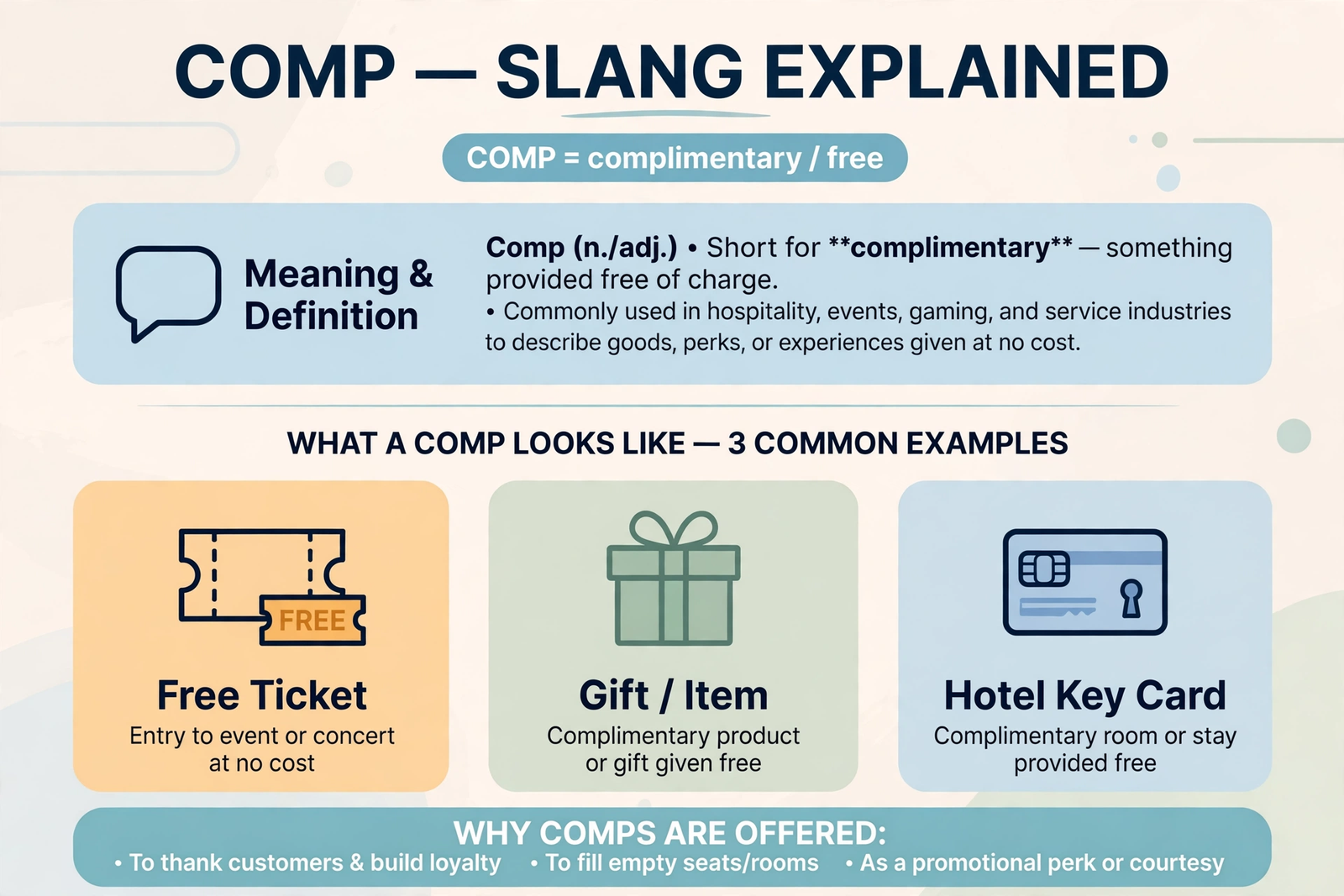
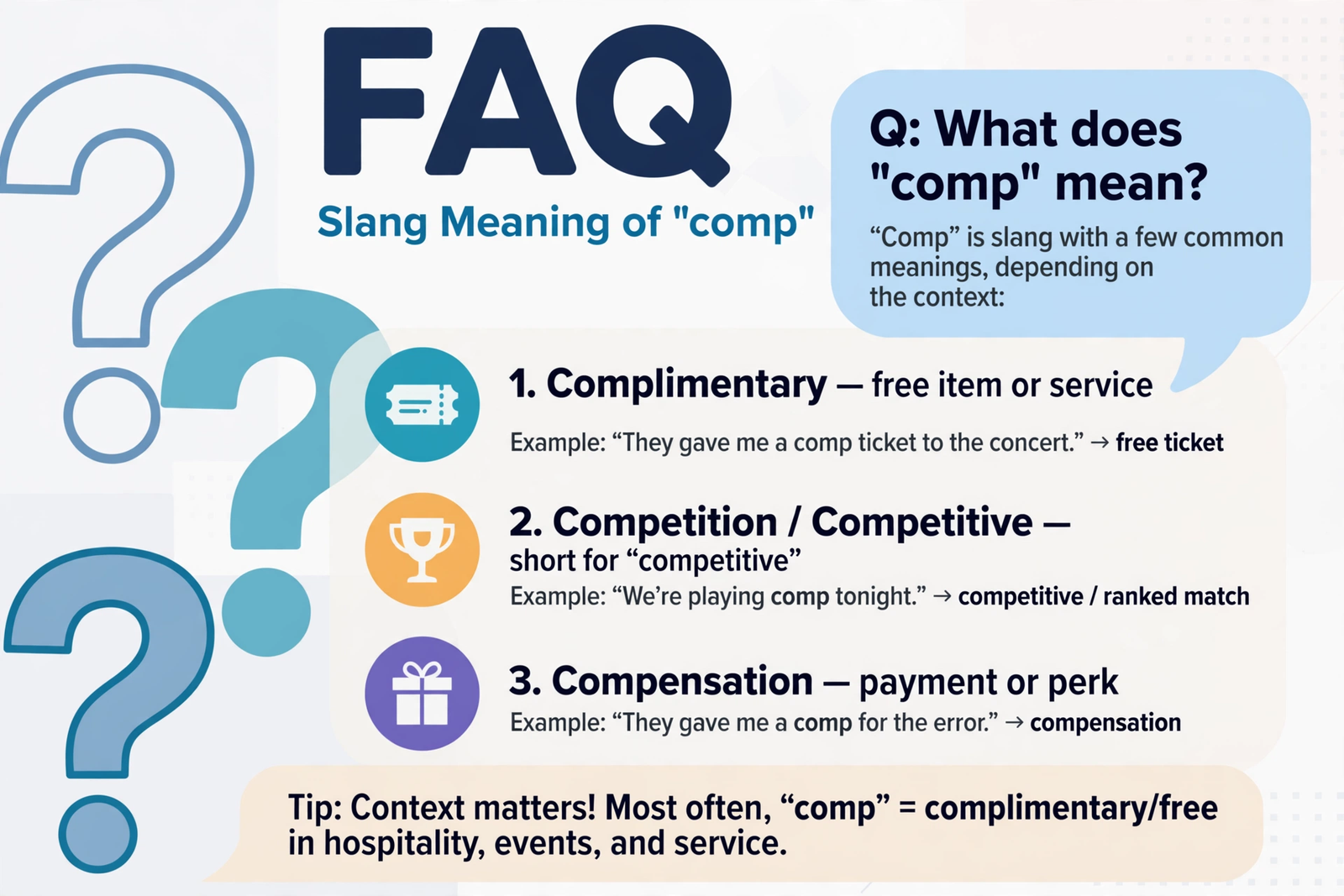
Quick definition: In slang, comp most often means something given free of charge — short for complimentary. A “comp ticket” is a free ticket, a “comped meal” is a meal the restaurant covers, and a “comp room” is a free hotel stay. But the word wears several hats: in gaming it means a team composition, in jobs it means compensation, and in real estate it means comparable homes. The meaning always depends on context, and this guide breaks down all of them.
comp meaning slang & Definition
The comp meaning slang question pops up everywhere — in group chats, on TikTok, in gaming lobbies, and at restaurant tables. At its core, comp is a clipped word, a shortened form of a longer word. Which longer word it stands for is the whole puzzle.
The most common meaning, and the one most people are looking for, is complimentary: something free. If a hotel “comps your room,” you do not pay for it. If a casino host offers you “comps,” you are getting free food, drinks, or show tickets as a valued guest. In this sense, comp is both a noun (“We got a comp for the show”) and a verb (“The manager comped our dessert”).
But stop there and you will miss half the story. The same four letters also stand for competition, composition, compensation, and comparable — and each of those lives in its own world. A gamer talking about “our comp” means the lineup of characters on their team, not a freebie. An employee asking about “comp” means pay and benefits. A realtor talking about “comps” means recently sold houses used to price a listing.
So what does comp mean in slang? It means free stuff most of the time — but the smart reader checks the room before assuming. This article covers every meaning, where each one came from, and how to use the word without embarrassing yourself.
Introduction
You have probably seen it already without noticing. A friend texts, “The hotel comped our whole stay!” A streamer says, “This comp is broken.” A coworker mentions “comp season” with a sigh. Same word, three totally different conversations — and that is exactly why people keep searching for the comp meaning slang explanation.
Slang loves short words. The internet doubly so. “Comp” compresses a mouthful — complimentary, competition, compensation, composition — into a single punchy syllable that fits in a fast-moving chat. That efficiency is why it spread from casino floors and hotel front desks into gaming chats, group texts, and TikTok comments. If you have ever wondered whether someone was offering you something free or talking about a video game strategy, this guide will clear it up in a few minutes.
By the end, you will know the seven main meanings of comp, the origin of each one, real examples of how people use it in texts and speech, and the mistakes to avoid. You will also find a comparison table, polite alternatives for formal situations, and answers to the eight questions people ask most about this word.
Origin of Comp
To understand the comp meaning slang, you have to start with the word it was clipped from — and the surprising fact is that there is more than one parent word.
The complimentary connection
The oldest and most widespread root is complimentary, meaning “given free as a courtesy.” The practice itself is ancient: innkeepers and tavern owners have always given a free drink or a free night to smooth over a problem or reward a loyal guest. The phrase “on the house” is the older, folksier version of the same idea.
The word “comp” as shorthand grew up in 20th-century American hospitality — hotels, casinos, restaurants, and theaters. Front-desk staff, pit bosses, and managers needed a fast word for a free room, a free meal, or a free ticket, and “comp” fit. A casino “comp” became an entire system: the more you played, the more free perks you earned. From there, the verb form appeared — “to comp someone a room” — and the word jumped from industry jargon into everyday speech. Wiktionary lists comp as a clipping of complimentary, with senses ranging from a free ticket to a team composition in video games.
The gaming connection
The second origin story starts in online gaming. In competitive games like League of Legends, Overwatch, and Valorant, “comp” is short for composition — the mix of characters, roles, and abilities on a team. A good comp wins games; a bad comp loses them. Players started discussing comps constantly — “What comp are we running?” — and the term became one of the most-used words in gaming chat.
The same gaming world also uses comp for competition itself: “comp play” means ranked, competitive matches as opposed to casual ones. So a single gaming sentence like “our comp is bad for comp” can mean “our team lineup is bad for competitive play” — confusing to outsiders, perfectly clear to players.
The workplace and real estate connections
Two more roots grew up independently. In workplaces, “comp” is clipped from compensation — pay, bonuses, and benefits. “Workers’ comp” is the well-known short form for workers’ compensation, the insurance that covers employees injured on the job. In real estate, “comps” are short for comparables, the recently sold homes an appraiser uses to set a price. And in music, jazz players have “comped” — short for accompanying — behind soloists for a century.
Four different parent words, one tiny slang word. That is the whole reason the comp meaning slang question never has a one-line answer.
Why Comp Became So Popular
Short words win on the internet. “Comp” is four letters, one syllable, and it works as a noun and a verb. In a fast chat or a tense game, nobody wants to type “complimentary” or “team composition.” The abbreviation saves time, and time is the currency of online conversation.
The word also spread because it crossed communities. It started in casinos and hotels, then moved into restaurants, then into gaming, then into TikTok and Instagram comments. Each community added a meaning, and social media carried all of them everywhere at once. A word that means “free stuff” is also fun to say — it sounds like a perk, a win, a little victory. People like sharing wins, so they like the word.
There is also a social reason. Saying “the hotel comped us” is a humble brag: it tells the story of a free upgrade without sounding like you are showing off. Saying “that comp was unfair” in a game is a complaint that sounds analytical rather than whiny. The word lets people talk about money, status, and fairness without naming any of those things directly. That is classic slang behavior, and it is why comp has stuck around while other trendy words faded.
How Comp Is Used in Everyday Conversations
Context decides the meaning. Here is how to read the word in the places you will actually meet it.
- In restaurants and hotels: “Comp” means free. “They comped our appetizer because the food was late.” If you hear it here, someone is getting something for nothing.
- In casinos and entertainment: “Comps” are the freebies a venue gives regulars — rooms, meals, show tickets. High rollers get the biggest comps.
- In gaming: “Comp” means the team lineup or competitive play. “What comp should we run on this map?” is a strategy question, not a freebie question.
- At work: “Comp” means pay and benefits. “How is the comp for that role?” is a salary question. “Comp season” is the time of year when raises and bonuses are decided.
- In real estate: “Comps” are comparable home sales. “We need better comps to justify that price” is a pricing conversation.
- In texting and social media: “Comp” usually means free or complimentary. “I got comp tickets to the concert!” is a happy announcement.
- In school or exams: “Comps” can mean comprehensive exams — the big qualifying tests graduate students take.
The trick is simple: look at who is talking and where. A gamer means composition or competition. A hotel guest means free. A coworker means pay. Once you know the room, the word is easy.
Examples of Comp in Real Life
Nothing teaches slang like real sentences. Here are examples of the comp meaning slang in action, grouped by tone so you can see how the same word shifts its feel.
Friendly Examples
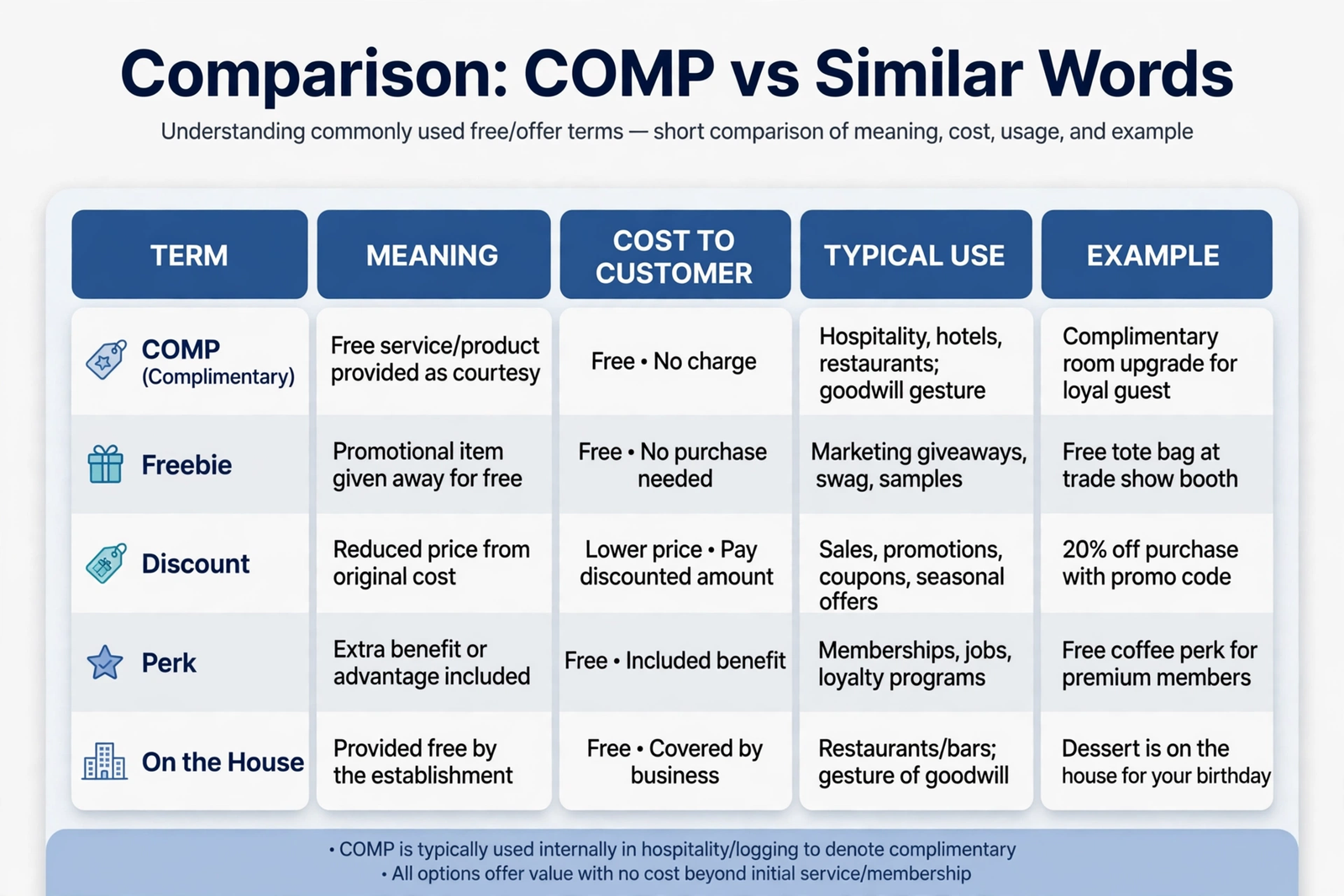
- “Dude, the restaurant comped our whole dessert because it was my birthday!”
- “I got comp tickets to the game — want to come with me?”
- “The hotel comped our parking, so the trip was basically free.”
- “My cousin works at the theater and gets us comps for every show.”
- “They messed up our order, so they comped the drinks. Honestly, best mistake ever.”
Professional Examples
- “What is the total comp package for this position?”
- “We comped the client’s dinner as a gesture of goodwill.”
- “The realtor pulled comps from three nearby streets to price the house.”
- “Comp discussions happen during the annual review cycle.”
- “The venue offered media comps for the opening night performance.”
Funny Examples
- “My wallet is empty, but my comp game is strong — free food everywhere.”
- “I went in for one coffee and walked out with a comp muffin. I am basically a VIP now.”
- “Our team comp was five snipers and zero healers. We lost in four minutes.”
- “He asked for a comp ticket to his own party. The confidence, honestly.”
- “The casino comped me a buffet after I lost twenty bucks. Fair trade, I guess.”
Notice how the friendly examples are almost all about free things, the professional ones are about pay or pricing, and the gaming ones are about team lineups. Same word, different worlds — and the examples make the difference obvious.
Comparison with Similar Terms
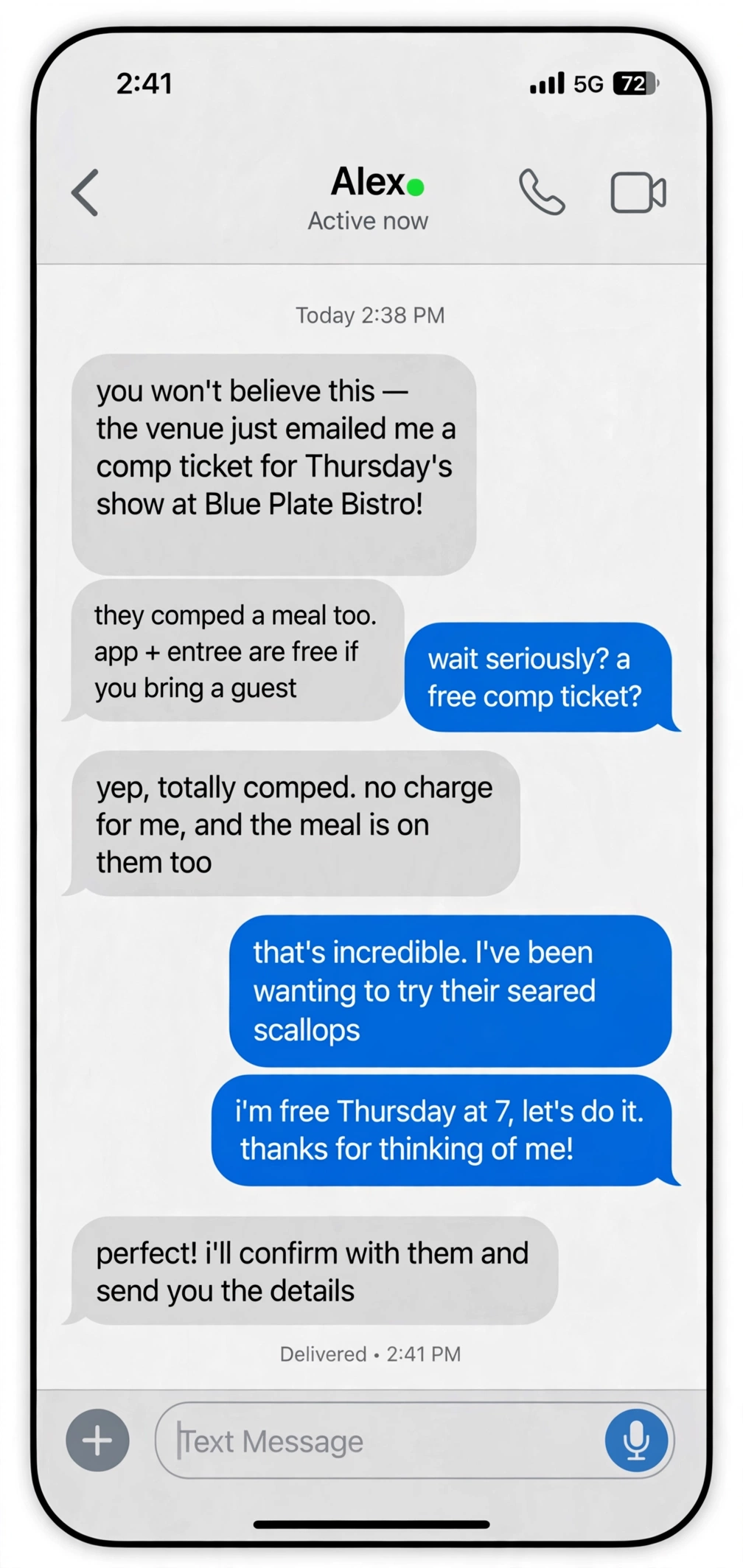
Comp sits in a crowded neighborhood of words about free stuff, pay, and competition. This table sorts them out.
| Term | What It Means | How It Differs from Comp |
|---|---|---|
| Comp | Free item or service; team lineup; pay; comparable sale | The umbrella word — context decides the meaning |
| Freebie | Something given away free, usually promotional | Casual and playful; comp sounds more like a system or a perk |
| On the house | Free, courtesy of the establishment | Older idiom, almost only used for food and drinks |
| Perk | An extra benefit, often part of a job | A perk is a benefit of a role; a comp is usually a one-time freebie |
| Discount | A reduced price | You still pay something; a comp means you pay nothing |
| Compensation | Pay, or payment for loss or injury | The full formal word comp is clipped from in work contexts |
| Meta | The most effective tactics in a game | Gaming slang like comp, but meta describes strategy, comp describes the lineup |
| Comped vs. complimentary | Same meaning, different register | “Complimentary” is formal; “comped” is casual and conversational |
The most useful distinction is comp versus discount: a discount lowers the price, while a comp erases it. If your meal was comped, you paid zero. If it was discounted, you paid less. People mix these up constantly, and the difference matters — especially if you are the one paying.
Alternate Meanings of Comp
If you only remember the “free” meaning, the other uses of comp will confuse you. Here is the full map of alternate meanings, so nothing catches you off guard.
- Complimentary (free): The main slang meaning. Free tickets, rooms, meals, and upgrades given as a courtesy or an apology.
- Team composition (gaming): The mix of characters or roles on a team. “Our comp has no tank” means the lineup is missing a defensive player.
- Competition (gaming): Ranked or competitive play. “Comp mode” is the serious, ranked version of a game.
- Compensation (work): Salary, bonuses, and benefits. “Strong comp” in a job post means good pay.
- Workers’ comp: Short for workers’ compensation — insurance and payments for employees hurt on the job.
- Comparables (real estate): Recently sold similar homes used to value a property. Realtors say “comps” constantly.
- Comprehensive exam (education): The big qualifying exam graduate students must pass. “I am studying for comps” means exam prep, not freebies.
- Accompanying (music): In jazz, “comping” means playing chords behind a soloist. A pianist comps while the saxophone solos.
- Comp card (modeling): A model’s composite card with photos and stats, handed to clients and agencies.
- Computer (dated slang): In older casual use, “comp” was sometimes short for computer, though this use has mostly faded.
Seven of these are live in everyday conversation today: free, gaming lineup, competition, pay, workers’ comp, real estate comps, and comprehensive exams. If someone says “comp” and none of those fit, ask what they mean — even native speakers pause on this word sometimes.
Professional or Polite Alternatives
Slang is great with friends, but “comp” can sound too casual — or too unclear — in formal settings. Here are polished alternatives for each meaning.
- Instead of “comp” (free item): say “complimentary,” “courtesy of the house,” or “provided at no charge.” Example: “Your dessert is complimentary this evening.”
- Instead of “comped” (verb): say “covered the cost of” or “waived the charge for.” Example: “We waived the charge for your room.”
- Instead of “comp” (pay): say “compensation package,” “salary and benefits,” or “total rewards.” Example: “Could you share the compensation package for this role?”
- Instead of “comps” (real estate): say “comparable sales” or “recent comparable transactions.” Example: “We based the valuation on comparable sales in the area.”
- Instead of “comp” (gaming): in a mixed audience, say “team lineup” or “team composition.” Example: “Our team composition needs a healer.”
- Instead of “comps” (exams): say “comprehensive examinations” or “qualifying exams.”
The rule of thumb: with friends, “comp” is perfect. In an email to a client, a job interview, or a formal document, use the full word. It costs you two seconds and removes all ambiguity — and if you want more examples of how slang shifts between casual and formal settings, the guide to fn meaning in text shows the same pattern with another chat abbreviation.
Common Mistakes When Using Comp
Because comp has so many meanings, it is easy to use it wrong. These are the mistakes people make most.
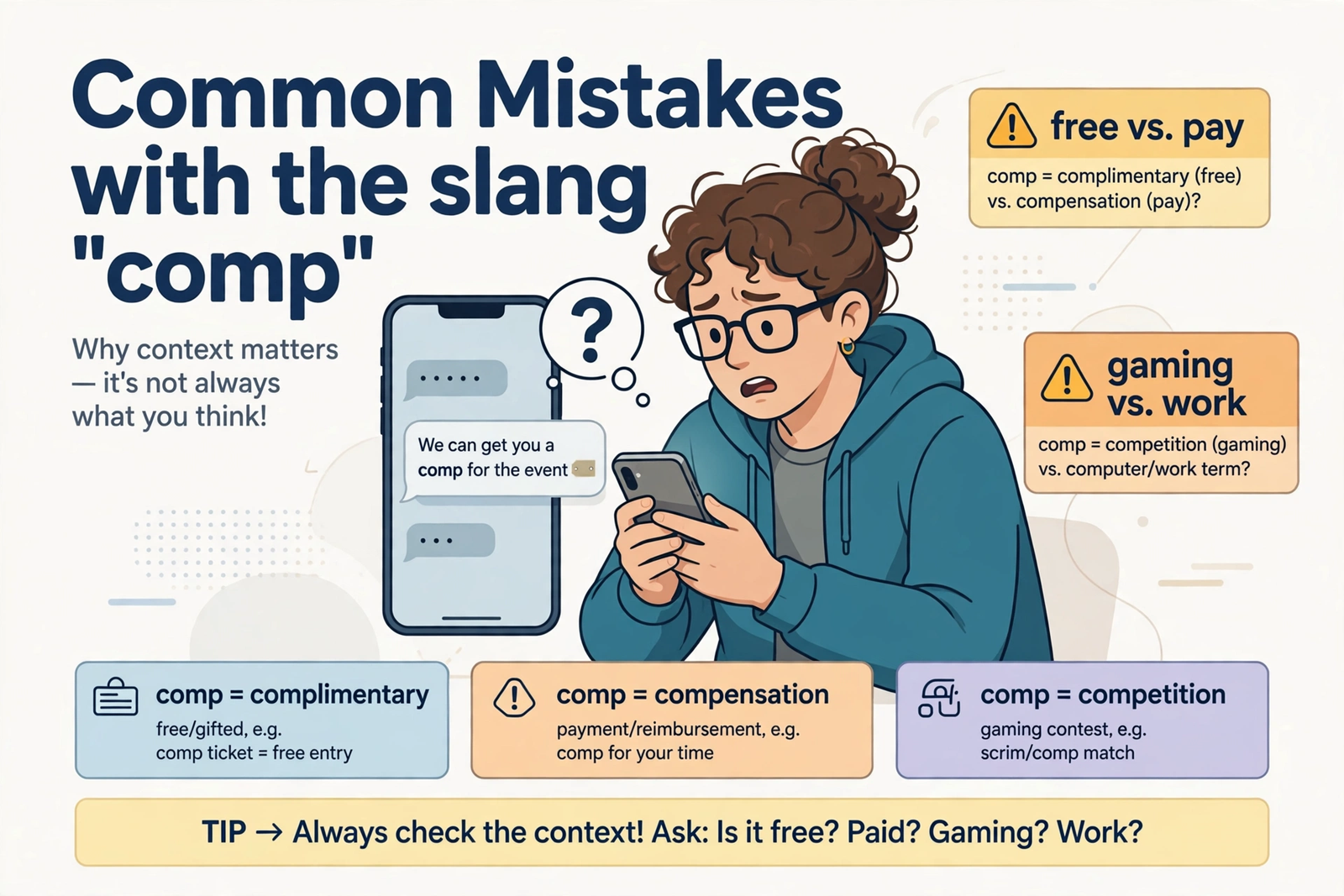
- Assuming it always means free: The biggest mistake. Telling your boss “the comp is bad” when you mean the team lineup will start a very confusing conversation about your salary.
- Demanding a comp: Asking a restaurant to comp your meal because you feel like it is rude. Comps are offered, not demanded — they usually follow a real mistake or loyal patronage.
- Confusing comp with discount: A comp means free. If you still paid something, it was a discount, not a comp.
- Using it in formal writing: “Comp” in a contract, a resume, or a formal email looks sloppy. Use “complimentary” or “compensation” instead.
- Mixing up the gaming meanings: “Comp” as a lineup and “comp” as competitive play are different things. “Our comp is bad for comp” only makes sense if your audience knows both meanings.
- Spelling it “komp”: It is always spelled c-o-m-p. The “k” version is a typo, not a style choice.
- Calling everything a comp: A free sample at a store is a sample. A gift from a friend is a gift. Reserve “comp” for hospitality, gaming, work, or real estate contexts where it actually belongs.
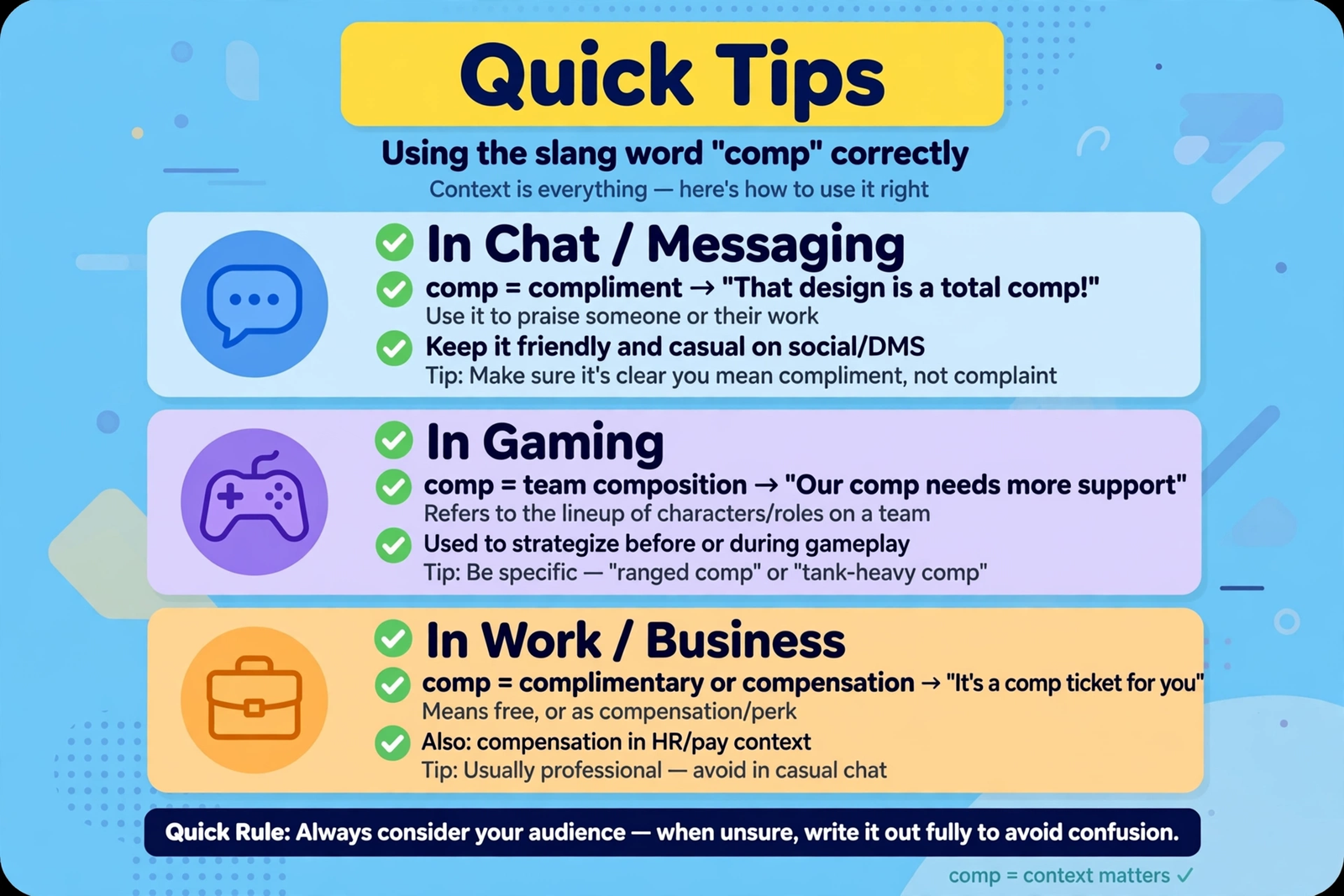
Quick Tips for Using Comp Correctly
Want to sound natural instead of confused? These quick tips will keep you on track.
- Match the room: Free stuff at a hotel or restaurant, lineup in a game, pay at work, prices in real estate. The setting picks the meaning.
- Use it as a verb or a noun: Both work. “They comped us” (verb) and “We got a comp” (noun) are equally correct.
- Do not force it: If “free” or “complimentary” is clearer, use that instead. Slang should help, not confuse.
- Listen before you use it: If everyone around you means “team lineup” by comp, do not jump in talking about free hotel rooms.
- Keep it casual: Comp is informal by nature. In formal situations, switch to the full word — complimentary, compensation, or comparable sales.
- Pair it with context: “Comp tickets” is clearer than “comps” alone. A word or two of context removes all doubt.
- Remember it is a perk, not a right: Nobody owes you a comp. When you get one, a thank-you goes a long way.
FAQ
What does comp mean in slang?
In slang, comp most often means something given free of charge — short for complimentary. A comp ticket is a free ticket, and a comped meal is a meal the restaurant pays for. In gaming it can also mean team composition, and at work it can mean compensation.
What does “comped” mean?
“Comped” is the past tense of the verb “to comp.” It means something was provided free of charge. If your hotel room was comped, you did not have to pay for it — usually as a courtesy, a reward, or an apology for a problem.
What is a comp in gaming?
In gaming, a comp is a team composition — the combination of characters, roles, and abilities your team uses. It can also mean competitive play, as in “comp mode” for ranked matches. A good comp balances attack, defense, and support roles.
What does comp mean at work?
At work, comp is short for compensation — the full package of salary, bonuses, and benefits for a job. “What is the comp?” is a normal way to ask about pay, and “comp season” is when companies decide raises and bonuses.
What are comps in real estate?
In real estate, comps are comparable homes — recently sold properties similar to the one being priced. Agents and appraisers use comps to decide a fair listing price or home value.
Is comp short for complimentary or competition?
Both — and that is why it confuses people. In hotels, restaurants, and casinos, comp is short for complimentary (free). In gaming, it is short for composition or competition. The context tells you which parent word is in play.
How do you use comp in a sentence?
As a noun: “We got a comp for the show.” As a verb: “The manager comped our dessert.” In gaming: “What comp are we running?” At work: “How is the comp for that role?” Each use is natural once the context is clear.
Is it rude to ask for a comp?
Usually, yes. Comps are offered by a business as a courtesy or to fix a mistake — they are not something customers demand. If something genuinely went wrong, you can politely mention the problem and let the staff decide. Demanding a freebie outright comes across as entitled and rarely works.
Conclusion
The comp meaning slang question has no single answer because comp is really several words sharing one short form. Most of the time it means something free — a complimentary ticket, meal, or room. In gaming it means your team composition or competitive play. At work it means compensation, and in real estate it means comparable sales. The context always tells you which one is in play, so listen to the room before you decide.
The smartest way to use comp is to keep it casual and clear. With friends, it is a fun, punchy word for a freebie or a gaming lineup. In formal settings, switch to the full word — complimentary, compensation, or comparable sales — and nobody will misunderstand you. And remember the golden rule: a comp is a gift, not a right, so enjoy it when it comes and never demand it.
If this guide cleared things up, you will probably enjoy the same treatment of other confusing slang — the breakdown of mid definition slang explains another word that changes meaning with context, and the guide to smut meaning slang covers a term that is just as easy to misunderstand. Now that you know what comp means, you will start noticing it everywhere — in texts, in games, at work, and at your next dinner out.
