
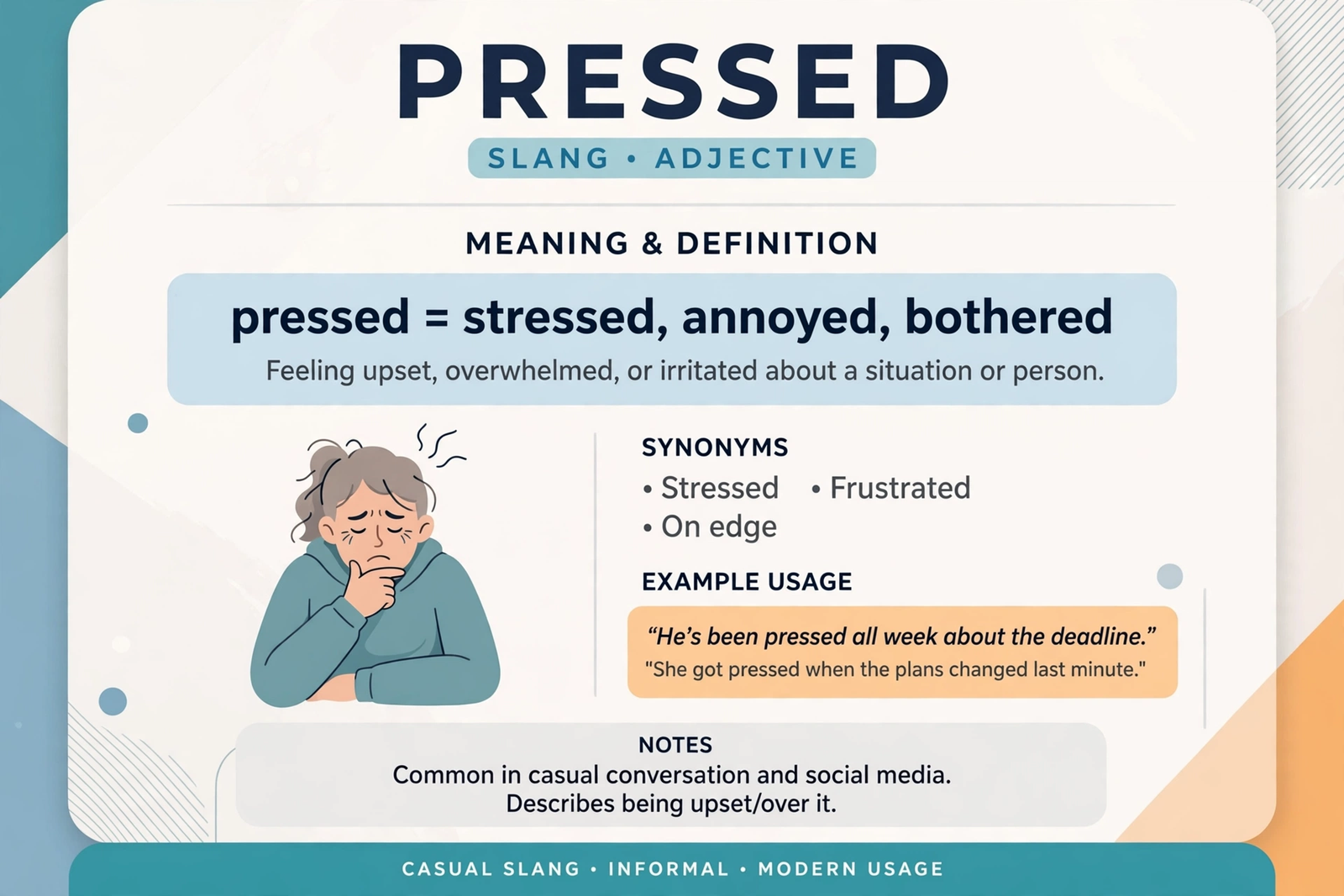
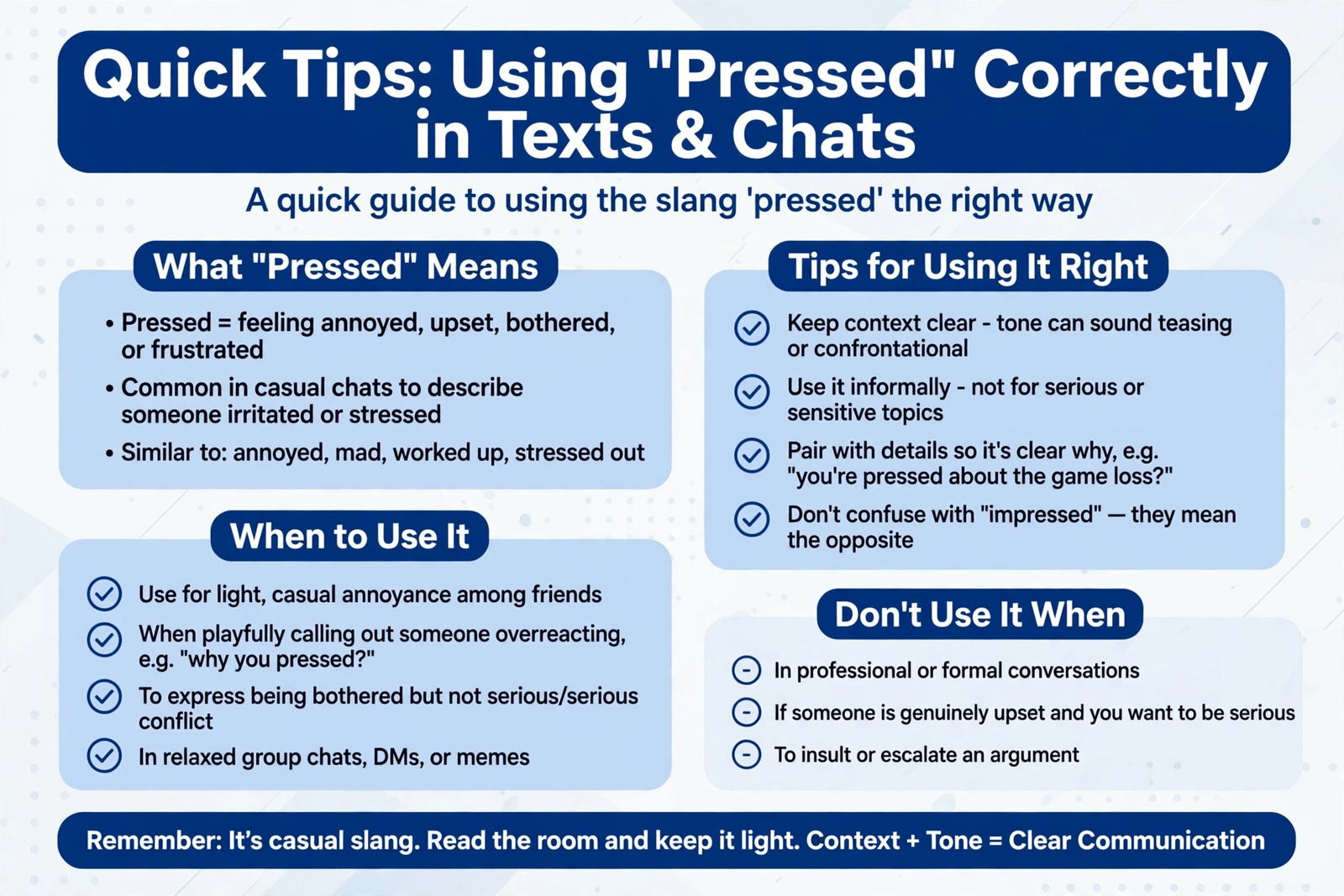
Quick definition: In slang, pressed means stressed, annoyed, bothered, or upset — usually because someone or something got under your skin. If a friend texts “I’m so pressed right now,” they are not talking about an iron or a juice machine. They mean they are irritated, under pressure, or low-key upset about something that just happened.
pressed meaning slang & Definition
The pressed meaning slang is simple once you hear it in context: to be pressed is to be bothered. It describes that tight, irritated feeling you get when someone embarrasses you, cancels plans at the last minute, talks behind your back, or just will not stop pushing your buttons. It sits somewhere between “annoyed” and “stressed” — stronger than a shrug, softer than full-blown anger.
Here is the easiest way to remember it: if something is pressing on you — a deadline, a rude comment, a person who keeps testing you — you feel pressed. The word paints a picture of pressure, and that is exactly what it describes. You will see it most often in casual texts, group chats, TikTok comments, and Twitter/X replies, almost always in the first person: “I’m pressed,” “she’s so pressed,” or “why are you pressed?”
It is worth noting that “pressed” is flexible. It can describe a quick flash of irritation (“Ugh, I’m pressed — he left me on read again”) or a longer mood (“I’ve been pressed all week about this exam”). The tone depends on the sentence around it, which is why examples matter so much with this word. Like slay and other slang that flipped an ordinary word into something new, “pressed” took a plain English word and gave it a whole second life online.
Introduction
You have probably seen it in a comment section: someone loses an argument, and the replies flood in with “you’re pressed.” Or a friend vents in the group chat about their boss, their ex, or a delayed delivery, and someone answers, “don’t be pressed, it’s not that deep.” If you paused and wondered what exactly that means, you are not alone — “pressed” is one of those slang words that sounds obvious until you try to explain it.
The reason it confuses people is that “pressed” already has a normal meaning in English. Clothes get pressed. Grapes get pressed into juice. People get pressed for time. But in slang, the word moved into emotional territory, and it did it so smoothly that most people under 30 use it without thinking twice.
In this guide, we break down the pressed meaning slang in full: where it came from, how it is used in texts and on TikTok, what it looks like in real conversations, how it compares with similar slang like “salty” and “stressed,” the mistakes people make with it, and the polite alternatives you can use at work or school. By the end, you will not only understand the word — you will know exactly when to use it and when to skip it.
Origin
Like a lot of modern slang, “pressed” does not have one single birthday. Its roots trace back to African American Vernacular English (AAVE), where “pressed” has been used for years to describe someone who is bothered, stressed, or overly concerned about something — often in the phrase “pressed over” someone or something. In that early usage, being pressed usually meant you were too invested: you cared too much, you were in your feelings, or you were letting something get to you.
The phrase “why you so pressed?” — meaning “why are you so bothered?” — circulated in hip-hop lyrics, comedy sketches, and everyday conversation long before TikTok existed. Rappers and comedians used it as a quick way to call out someone who was taking things too seriously. The line worked because it was short, a little teasing, and hard to argue with: if you were not pressed, you would not be reacting.
Social media did the rest. As short-form video and comment culture exploded in the late 2010s and early 2020s, “pressed” moved from spoken slang into written slang. It spread through Twitter roasts, Instagram captions, TikTok comments, and group chats, and each platform added its own shade of meaning. On TikTok, “pressed” often shows up in storytimes and reaction videos; on Twitter/X, it is a standard reply when someone is clearly upset about a post. By 2026, the word is firmly part of everyday internet English, understood far beyond the communities that created it.
Popularity
“Pressed” is popular because it is useful. English has plenty of words for being upset — angry, mad, annoyed, stressed, bothered — but “pressed” covers a specific middle ground that none of those words quite reach. It is casual enough for a text, strong enough to sting a little, and vague enough to use when you do not want to explain exactly how you feel.
A few things keep it in heavy rotation:
- It fits comment culture. “You’re pressed” is a two-word reply that ends an argument. It tells the other person their reaction says more than their words do.
- It works as a joke and a jab. Friends tease each other with it (“you’re so pressed right now, relax”), and rivals use it to dismiss each other. Same word, different edge.
- It is short and textable. In a fast-moving group chat, “I’m pressed” says everything in two words.
- It pairs well with other slang. You will see it next to words like “salty,” “mad,” “in your feelings,” and “not that deep,” which keeps it inside the slang ecosystem people already speak.
- It travels across platforms. The same usage appears on TikTok, Instagram, Twitter/X, Snapchat, and Discord, so once you learn it, you can use it everywhere.
Search interest in the phrase has stayed steady rather than spiking and fading like a one-week meme. That is a sign the word has settled into the language instead of burning out. It is not a trend; it is vocabulary now.
How It Is Used
The most common pattern is simple: a form of “to be” + “pressed.” “I am pressed.” “He is so pressed.” “Why are you pressed?” The word almost always describes a person and their emotional state, not a thing or a situation — although you will hear people say “this situation has me pressed,” which keeps the person at the center of it.
Here are the main ways people use it:
- To describe yourself: “I’m pressed about my grade.” “I’ve been pressed all day.” This is honest venting — you are telling people something is bothering you.
- To describe someone else: “She’s pressed because her team lost.” This is observation, sometimes sympathetic and sometimes mocking.
- To dismiss someone: “You’re pressed over nothing.” “Why are you so pressed?” This is the confrontational use — it says the other person’s reaction is too big for the situation.
- With “pressed about” or “pressed over”: “He’s pressed over his ex.” “Don’t get pressed about a game.” The preposition names the cause.
- As a joke between friends: “Okay, I’m a little pressed, I admit it.” Said with a laughing emoji, it becomes self-aware instead of serious.
One thing to notice: “pressed” is almost never used in formal writing, work emails, or serious conversations. It belongs to casual speech. Using it with your boss or in an essay would sound out of place, which is why the polite alternatives section below matters.
Examples
Seeing “pressed” in real sentences is the fastest way to learn it. The meaning shifts a little with tone, so pay attention to who is speaking and how they feel.
Friendly Examples
Between friends, “pressed” is usually light — a way to vent or tease without starting a fight.
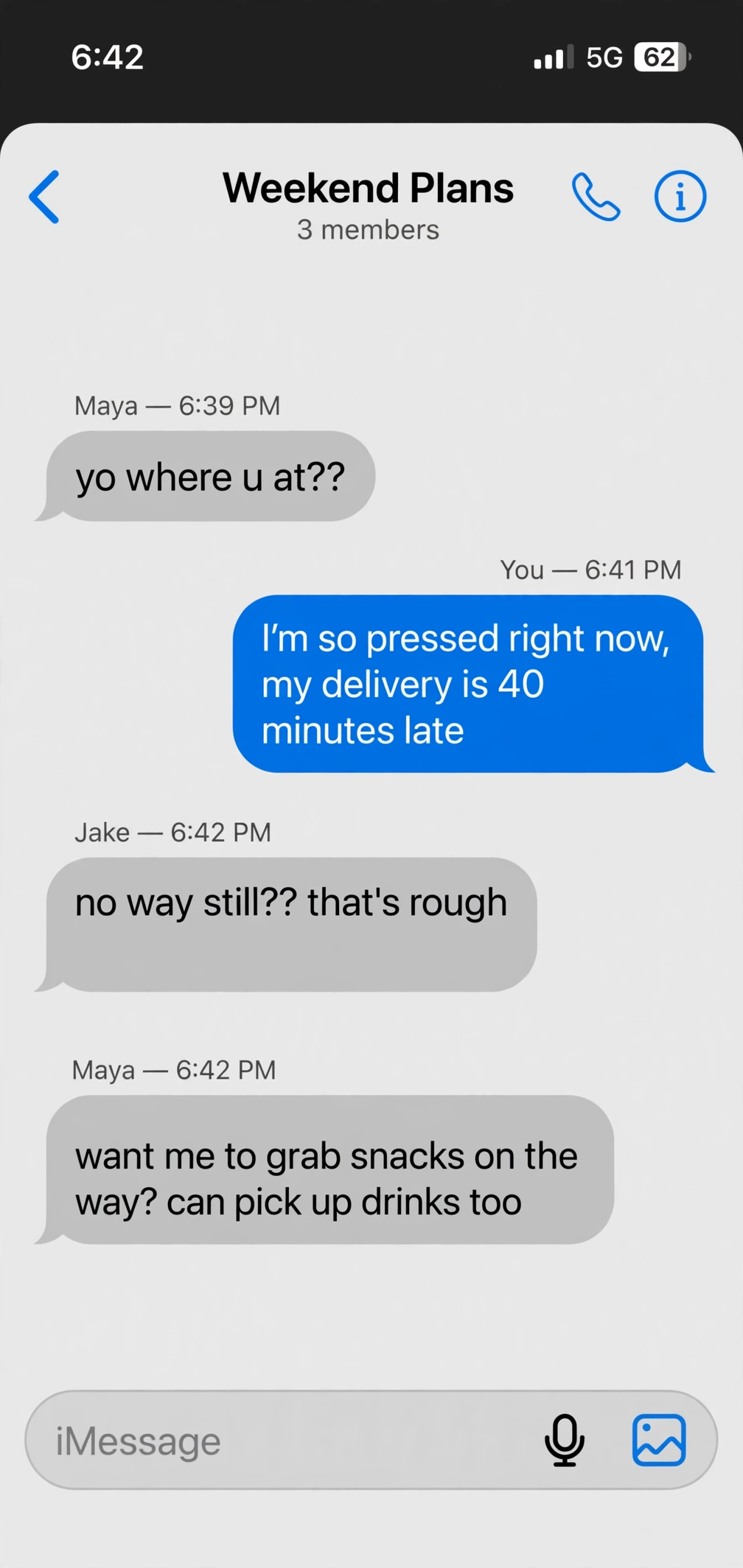
- “I’m so pressed — my food delivery is 40 minutes late and I’m starving.”
- “Don’t be pressed, we’ll get tickets next time. It’s not the end of the world.”
- “She’s pressed because her favorite show got canceled. Give her a day.”
- “I’m a little pressed that they changed the group project topic without telling me.”
- “Bro is pressed over a video game. Someone tell him to touch grass.”
In these examples, nobody is truly furious. “Pressed” just names the irritation so friends can laugh about it or offer sympathy.
Professional Examples
In a professional setting, people rarely say “pressed” out loud — but they do use it in casual workplace chats and messages with coworkers they trust. When they do, it usually describes stress or pressure rather than anger.
- “I’m pretty pressed about the deadline moving up. We only have two days left.”
- “The whole team is pressed after that client call. Let’s take a breather before the next meeting.”
- “Don’t get pressed — we’ll sort the schedule out in the morning.”
- “She’s been pressed all week with back-to-back shifts.”
Notice how these examples lean toward the “stressed” side of the meaning. In a work context, “pressed” is closer to “under pressure” than to “offended.” If you want to sound polished, though, the alternatives in the section below are safer choices.
Funny Examples
Humor is where “pressed” really shines. The word is funny precisely because it sounds calm while describing someone who is not calm at all.
- “He lost one round of the game and now he’s pressed for the rest of the night.”
- “My cat knocked my phone off the table and I’m pressed like she did it on purpose.”
- “You’re pressed because the Wi-Fi went down for five minutes? Relax.”
- “She saw her ex’s new post and got pressed in 0.2 seconds.”
- “I’m pressed that autocorrect changed my whole message and I didn’t notice.”
The joke works because the reaction is bigger than the trigger. That mismatch — small cause, big feeling — is the heart of the word.
Comparison with Similar Terms
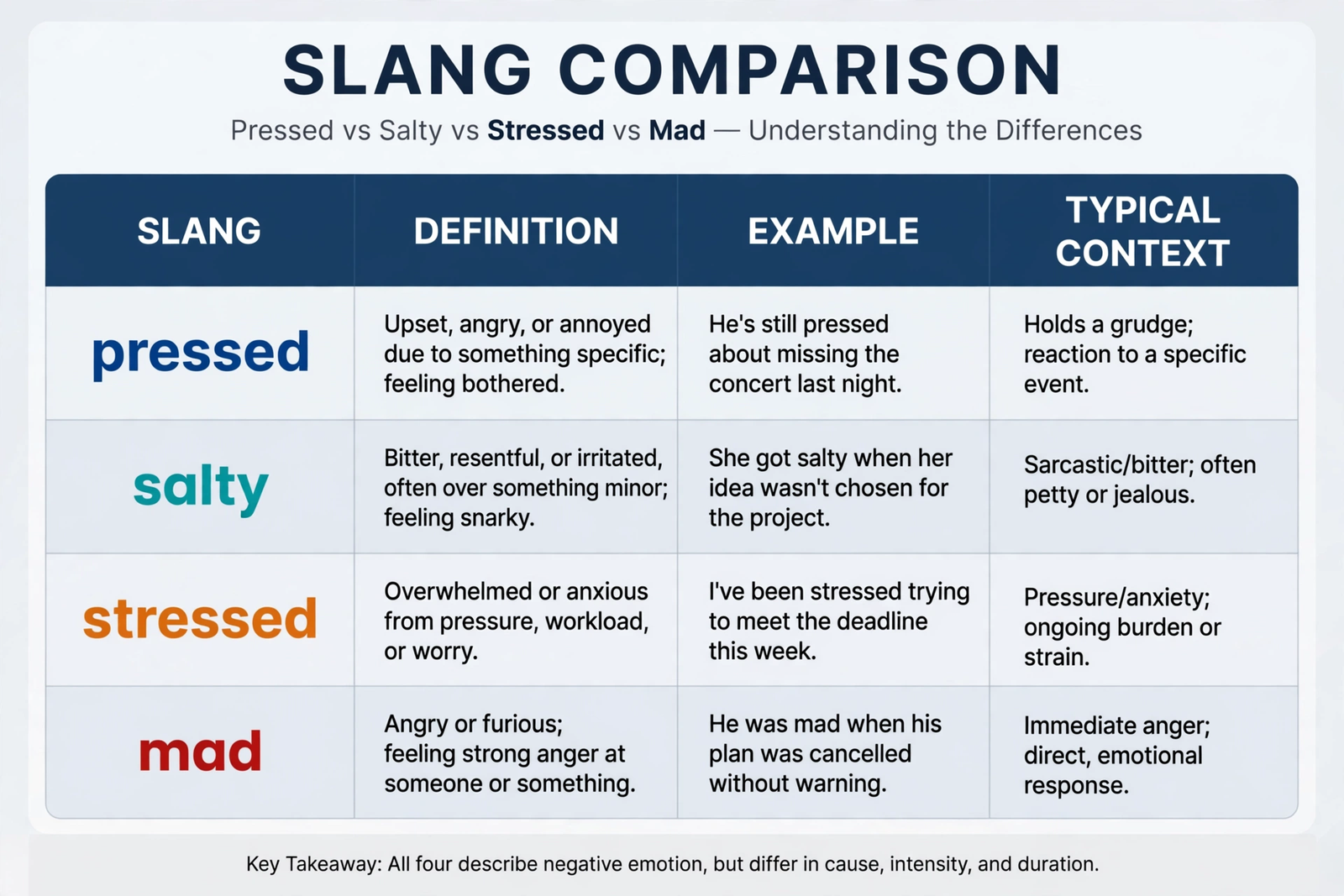
“Pressed” has plenty of neighbors in slang, and they are easy to mix up. The table below shows how it differs from the words people confuse it with most.
| Term | Core Meaning | How It Differs from “Pressed” | Example |
|---|---|---|---|
| Pressed | Stressed, bothered, or irritated | — | “I’m so pressed about this traffic.” |
| Salty | Bitter or resentful, usually after losing | Salty is about bitterness after a loss; pressed is broader irritation | “He’s salty because he lost the bet.” |
| Stressed | Under mental or emotional pressure | Stressed is neutral and formal; pressed is casual slang for the same feeling | “I’m stressed about the exam.” |
| Mad | Angry | Mad is stronger and more direct; pressed is milder and more playful | “She’s mad at her brother.” |
| Bothered | Mildly annoyed or disturbed | Bothered is plain English; pressed adds slang flavor and a hint of drama | “I’m bothered by that noise.” |
| Triggered | Upset by something that hits a nerve | Triggered implies a specific sensitive topic; pressed can be about anything | “That comment triggered her.” |
| In your feelings | Emotionally affected, often about love or rejection | Usually about relationships; pressed covers work, games, traffic, anything | “He’s in his feelings over the breakup.” |
The closest cousin is “salty.” Both describe someone reacting strongly to something small. The difference is that “salty” usually follows a loss or a defeat — a game, an argument, a competition — while “pressed” can follow anything: a late delivery, a rude comment, a bad grade. If you want a quick rule: salty is about losing, pressed is about being bothered.
It is also worth comparing “pressed” with another word that flipped from ordinary to slang: “sick.” In slang, sick means something is cool or impressive, which is the opposite of its normal meaning. “Pressed” works the same way — an ordinary word that picked up a new emotional meaning online. And like flex, which moved from “showing off muscles” to “showing off anything,” pressed shows how slang rebuilds everyday words into emotional shorthand.
Alternate Meanings
Because “pressed” is an ordinary English word first, it has several meanings outside slang. Knowing them helps you avoid confusion when the context changes.
- Ironed or smoothed: “a freshly pressed shirt” means the shirt was ironed. This is the oldest meaning and still the most common in formal English.
- Squeezed or crushed: “cold-pressed juice” is made by squeezing fruit without heat. “Pressed flowers” are flowers flattened and dried between pages.
- Pressed for time: “I’m pressed for time” means you are in a hurry. This one is close to the slang meaning, because both involve pressure — but here the pressure is about the clock, not your feelings.
- Pressed into service: something forced into use, like “he was pressed into helping.” Again, the idea of pressure is there, but the meaning is about being forced, not being annoyed.
- Pressed someone: to push someone for an answer — “the reporter pressed her for details.” This is about persistence, not emotion.
- In medicine and technology: “pressed” can describe something physically pushed or compressed, from a button to a tablet of medicine.
Context tells you which meaning is in play. If someone says “my shirt is pressed,” they are talking about laundry. If someone says “I’m pressed,” they are talking about feelings. The slang meaning almost always appears with a person as the subject and an emotional cause nearby.
Professional or Polite Alternatives
Slang is fun, but it does not belong everywhere. If you are writing a work email, talking to a teacher, or speaking to someone you do not know well, these alternatives say the same thing without the slang.
| Instead of | Say | When to Use It |
|---|---|---|
| “I’m pressed about this.” | “I’m a bit stressed about this.” | Work, school, formal chats |
| “Don’t be pressed.” | “Try not to worry about it.” | Calming someone down politely |
| “She’s so pressed.” | “She’s quite upset about it.” | Describing someone to others |
| “Why are you pressed?” | “Why does this bother you so much?” | Asking gently instead of teasing |
| “This has me pressed.” | “This situation is really frustrating.” | Explaining your feelings clearly |
| “I’m pressed all week.” | “I’ve been under a lot of pressure this week.” | Talking to a manager or teacher |
The polite versions are longer, but that is the trade-off: formal language is precise, slang is fast. Use slang with friends, and switch to the formal versions when the setting calls for it. Nobody will ever fault you for saying “I’m a little stressed” in a meeting.
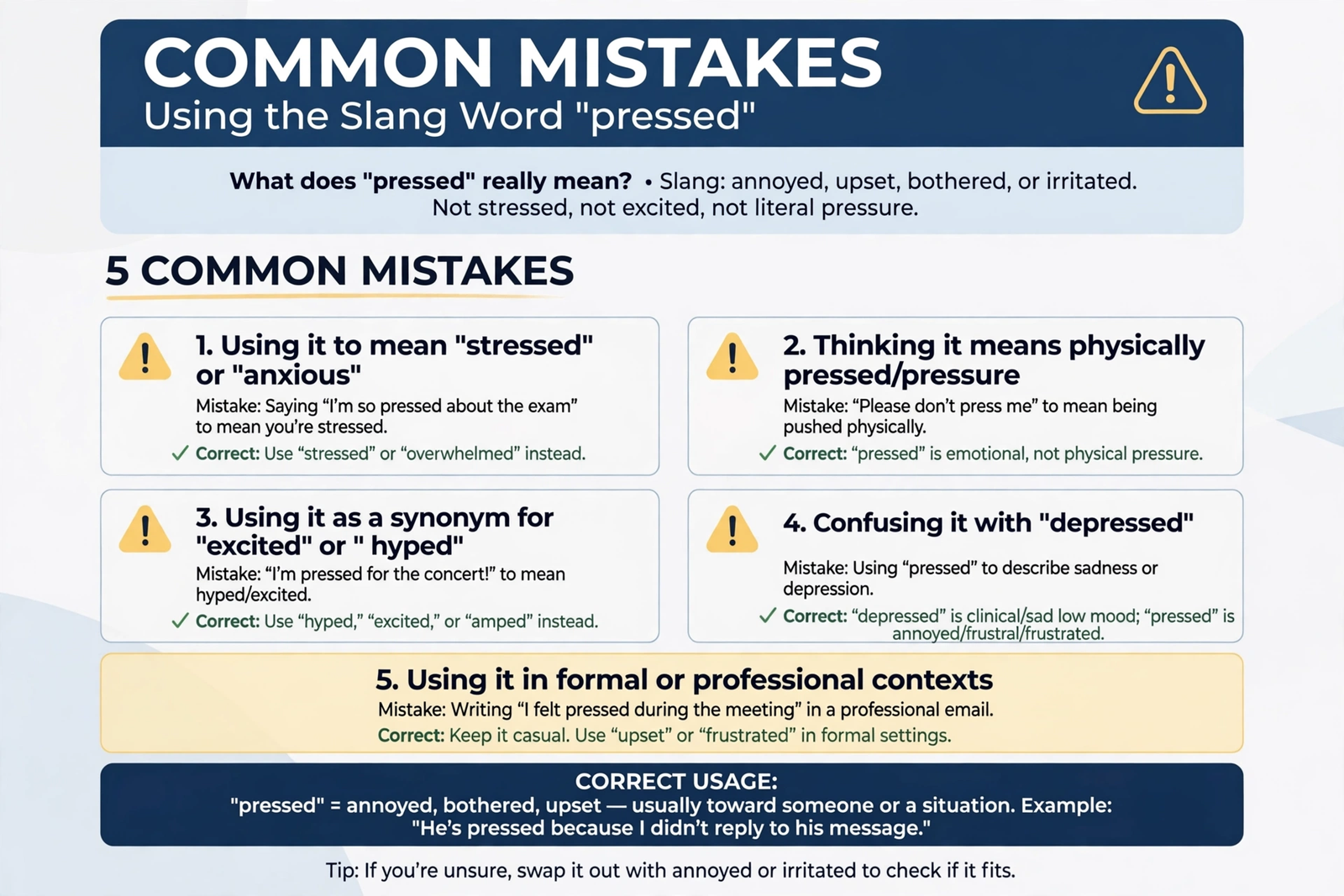
Common Mistakes
Even people who use “pressed” every day sometimes get it wrong. Here are the mistakes to avoid.
- Using it for physical pressure. “The elevator is pressed” makes no sense. “Pressed” in slang is always about feelings, not objects.
- Confusing it with “depressed.” The two words sound similar, but they mean very different things. “Pressed” is temporary irritation; “depressed” is a serious mental health condition. Never use one as a casual substitute for the other.
- Using it in formal settings. Dropping “I’m pressed” in a job interview or a business email will confuse people or make you sound unprofessional. Save it for casual conversation.
- Overusing it to dismiss people. Telling someone “you’re pressed” every time they disagree shuts down conversation instead of winning an argument. Used too often, it stops being funny and starts being rude.
- Forgetting the cause. “I’m pressed” works best when the listener knows why. Without context — “I’m pressed” out of nowhere — people will just ask “about what?” Add the reason when it matters.
- Mixing it up with “impressed.” “I’m pressed” and “I’m impressed” are opposites in slang. One means bothered; the other means amazed. Autocorrect has caused this mix-up more than once.
- Assuming it always means angry. Sometimes “pressed” just means mildly annoyed or stressed. Reading it as full anger can escalate a conversation that was never heated.
Quick Tips
Want to use “pressed” naturally? Keep these tips in mind.
- Match the mood. Use it when the feeling is real but not serious — irritation, stress, or playful frustration. If someone is genuinely furious or upset, a gentler word fits better.
- Add the reason. “I’m pressed about the delay” lands better than “I’m pressed.” The cause makes the sentence useful.
- Use it with friends first. The teasing version (“you’re so pressed”) only works when the other person knows you are joking. With strangers, it can sound like an insult.
- Pair it with tone markers. In text, an emoji or “lol” softens it: “I’m pressed 😭” reads as funny venting, while “I’m pressed.” on its own can read as genuinely upset.
- Do not force it. If “stressed” or “annoyed” comes more naturally, use that. Slang sounds best when it is not trying too hard.
- Watch the reply. If you tell someone “you’re pressed” and they get more upset, the word did its job a little too well. Apologize and move on.
- Remember it is versatile. “Pressed” works for traffic, games, gossip, deadlines, and dating drama. That range is exactly why it stuck around.
FAQ
What does “pressed” mean in slang?
In slang, “pressed” means stressed, annoyed, bothered, or upset. If someone says “I’m so pressed,” they mean something or someone is getting on their nerves or putting them under pressure. It is a casual way to describe irritation without saying you are angry.
Is “pressed” the same as “mad”?
Not exactly. “Mad” means angry, and it is usually stronger and more direct. “Pressed” is milder — closer to annoyed or stressed — and it often carries a playful or teasing tone. You can be pressed without being mad, and you can be mad without describing yourself as pressed.
What does “why are you so pressed?” mean?
It means “why are you so bothered by this?” It is usually said when someone thinks the other person’s reaction is too big for the situation. It can be teasing between friends or dismissive in an argument, depending on the tone.
Where did “pressed” slang come from?
The slang use of “pressed” comes from African American Vernacular English (AAVE), where it described someone who was bothered or overly concerned about something. It spread through hip-hop, comedy, and everyday conversation, then exploded on social media platforms like Twitter and TikTok in the late 2010s and early 2020s.
Can “pressed” mean stressed?
Yes. Stress is one of the main meanings. When people say “I’m pressed about the deadline” or “work has me pressed,” they mean they feel under pressure. In casual conversation, “pressed” and “stressed” are often interchangeable, though “pressed” is more informal.
Is it rude to call someone “pressed”?
It depends on the context. Between friends, it is usually a joke. In an argument with a stranger, it can feel dismissive, because it suggests their feelings do not matter. If you are not sure how it will land, it is safer to say “you seem upset” instead.
What is the difference between “pressed” and “salty”?
“Salty” describes bitterness or resentment, usually after losing something — a game, an argument, or a competition. “Pressed” is broader: it covers any kind of irritation or stress, from a late delivery to a rude comment. Salty is about losing; pressed is about being bothered.
How do you use “pressed” in a sentence?
Use it with a form of “to be”: “I’m pressed,” “she’s so pressed,” or “don’t get pressed.” Add the cause with “about” or “over”: “He’s pressed over his ex.” Keep it casual — it belongs in texts, chats, and social media, not in formal writing.
Conclusion
The pressed meaning slang is one of those small words that does a big job. In two syllables, it captures the whole feeling of being bothered, stressed, or irritated — the tight, annoyed mood that “angry” overstates and “fine” understates. It grew out of AAVE, spread through hip-hop and social media, and earned its place in everyday internet English because it is short, flexible, and honest about how people actually feel.
Now you know how to use it: describe yourself when you are venting (“I’m pressed about this delay”), tease a friend gently (“you’re so pressed, relax”), or name the pressure at work (“the deadline has me pressed”). Just remember the limits — keep it casual, add the reason when it matters, and do not use it to shut people down. And if you want to keep building your slang vocabulary, check out what ASF means in text next — it is another everyday word with a very different slang life.
For the standard English definition of the word, the Merriam-Webster entry for “pressed” is a useful reference. The next time someone texts you “I’m so pressed,” you will know exactly what they mean — and exactly what to say back.
