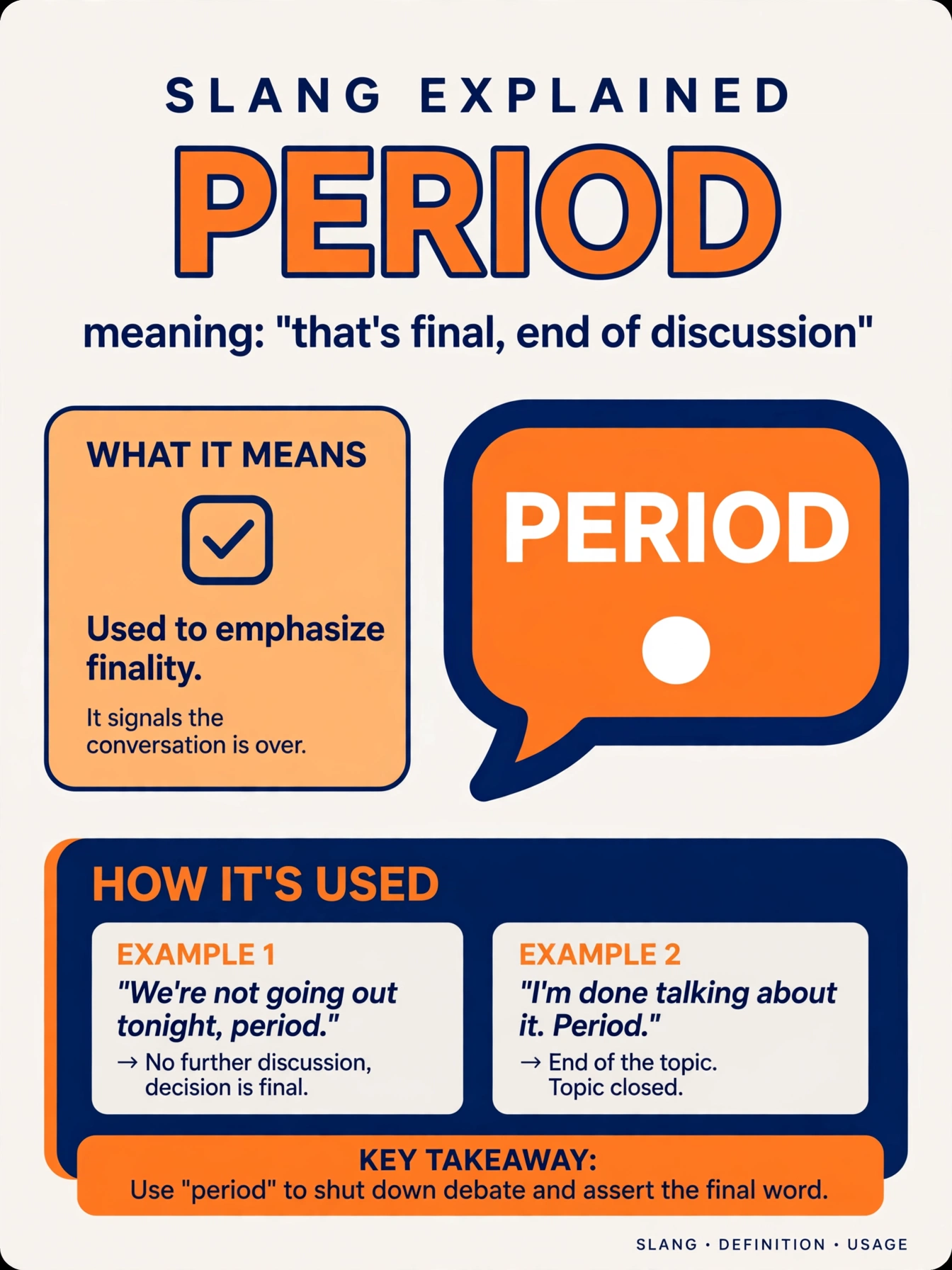
Quick definition: In slang, “period” means “that’s final” or “end of discussion.” When someone says “period” at the end of a statement, they are saying their point is not up for debate — the conversation on that topic is over. It works like a spoken full stop, and it is one of the most confident ways to end a sentence in modern texting, TikTok comments, and everyday speech.
Period Meaning Slang & Definition
The period meaning slang is simple but powerful: it turns an ordinary sentence into a final statement. Saying “period” after a claim is the speaker’s way of telling the listener that nothing more needs to be said. It carries confidence, attitude, and a touch of drama — and that is exactly why it became so popular online.
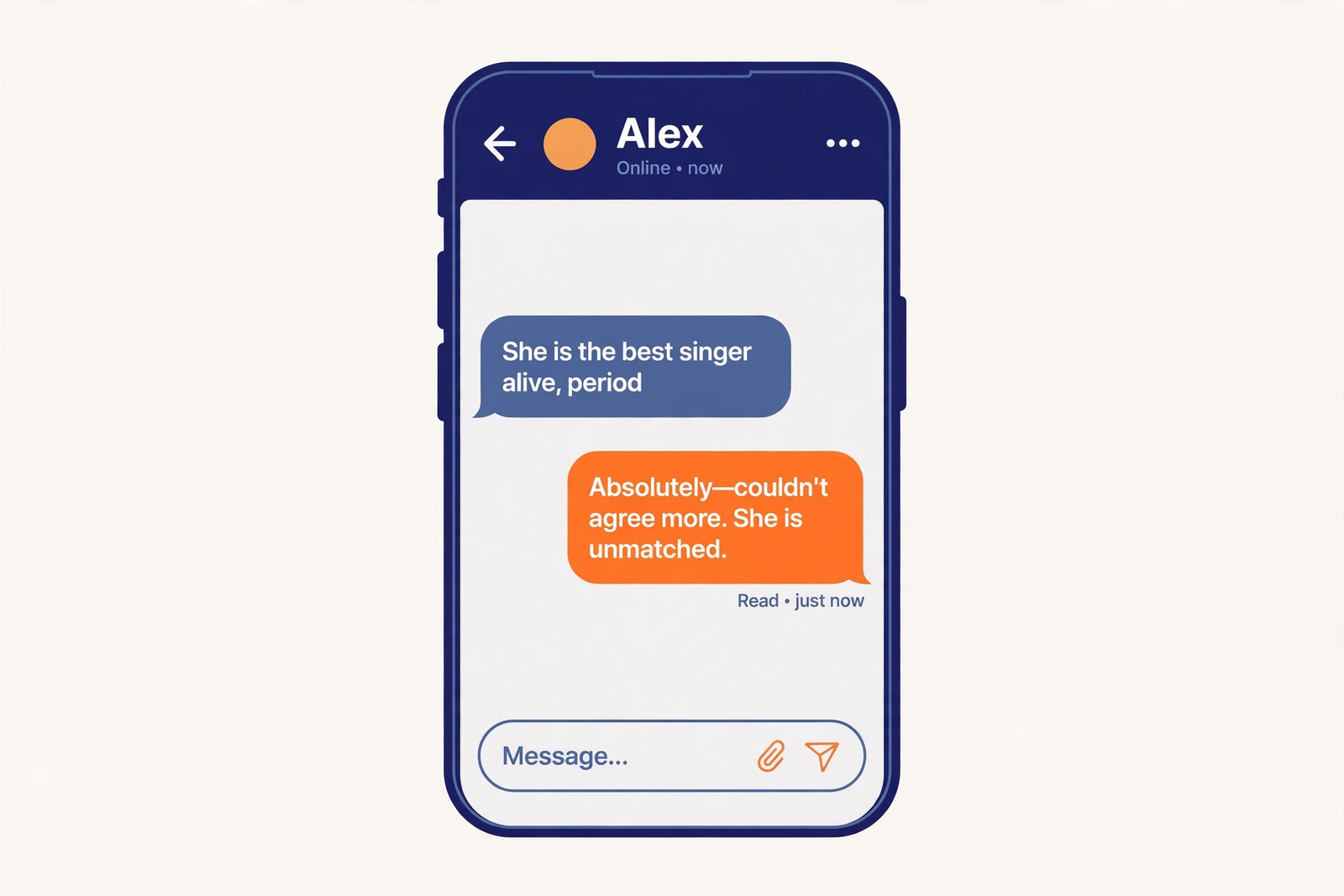
For example, if someone writes, “She is the best singer alive, period,” they are not inviting an argument. They are closing the door on the debate before it even starts. The word does the same job as a full stop at the end of a written sentence: it marks the end. In slang, though, it also adds emotion. It says, “I said what I said, and I stand by it.”
The dictionary definition of “period” is a punctuation mark that ends a sentence, and the slang meaning grows directly out of that idea. Just as a written period stops a sentence, a spoken “period” stops a discussion. The slang version simply takes the grammar rule and turns it into an attitude.
People use “period” in texts, captions, tweets, TikTok comments, and real-life conversations. It is short, punchy, and instantly understood by anyone who spends time online. It is also flexible: it can sound playful, sassy, supportive, or dead serious depending on the tone and context around it.
Introduction
Scroll through TikTok or X (Twitter) for five minutes and you will almost certainly see someone end a sentence with “period.” It shows up in comments under celebrity posts, in group chats between friends, and in captions where someone is stating an opinion they refuse to back down from. It is one of those small slang words that does a lot of heavy lifting.
The rise of “period” as slang is tied to how people talk online. Social media rewards short, bold, confident statements. Nobody wants to write a long paragraph explaining why they are right when one word can do the job. “Period” lets a person plant a flag and walk away. It is confident without being long-winded, and it signals that the speaker is not looking for a reply — or at least not a disagreement.
This article explains everything you need to know about the period meaning slang: where it came from, how it is used, what it means in different situations, and how it compares to similar slang terms like “periodt,” “slay,” and “facts.” You will also find real examples, common mistakes to avoid, and quick tips so you can use it naturally — without sounding forced.
If you enjoy learning how internet slang works, you may also like our guide to slay slang, another confident expression that took over TikTok and texting at the same time.
Origin
The slang use of “period” has its roots in Black American English and ballroom culture, where it was used to add finality and emphasis to a statement. In those communities, ending a sentence with “period” was a way of saying “that is the truth, and there is nothing more to discuss.” The phrase carried attitude and confidence, and it was often delivered with a snap, a look, or a gesture that made the meaning unmistakable.
From there, the word spread into mainstream pop culture through music, reality television, and social media. Artists, influencers, and TV personalities used it in interviews and songs, and their audiences picked it up. By the late 2010s, “period” had moved from niche slang into everyday internet language.
TikTok gave it a second wave of popularity. Creators used “period” in captions, comments, and voiceovers to agree with a hot take or to shut down a critic. The platform’s short-form format was perfect for it: a one-word punchline that needed no explanation. Each time a viral video used it, millions of new viewers learned what it meant.
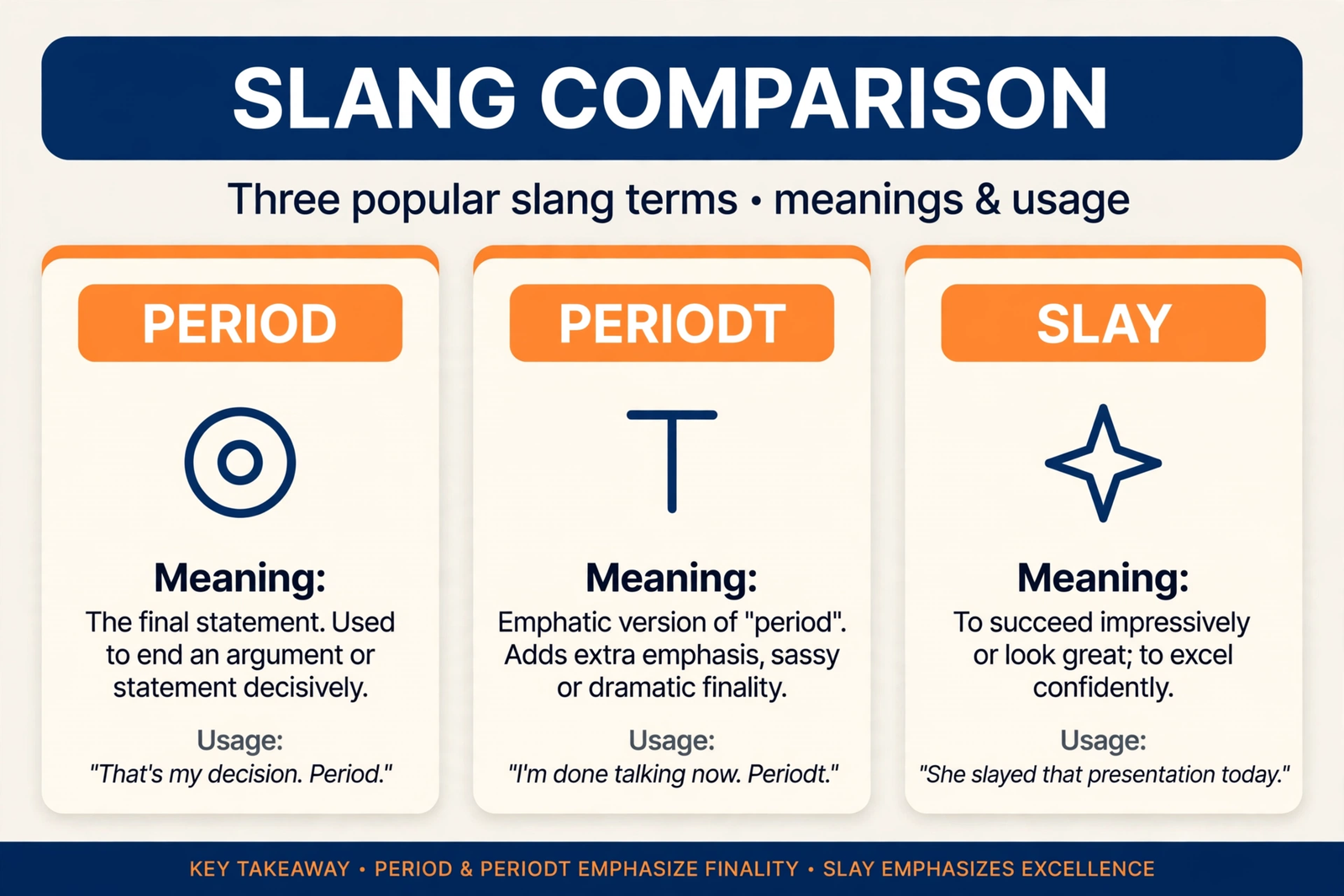
It is also worth noting that “period” is closely related to “periodt,” a popular variant with a harder “t” sound at the end. “Periodt” is essentially the same idea with extra emphasis — a louder, sassier version of the same word. Many people use the two interchangeably, though “periodt” usually feels more playful or dramatic.
Popularity
Today, “period” is one of the most widely recognized slang terms in English. It is used by teenagers, young adults, celebrities, and brands. It appears in memes, song lyrics, reaction videos, and even marketing campaigns that want to sound current and confident.
Several things explain its staying power. First, it is extremely easy to use — one word, no learning curve. Second, it works in almost any conversation where someone wants to sound sure of themselves. Third, it is versatile: it can express agreement, confidence, sass, or finality, and the listener almost always understands which one is meant.
On TikTok, the hashtag and sound trends built around “period” have collected millions of views. On X, people drop it at the end of opinion posts to signal they are not interested in a debate. In group chats, it is the quickest way to end a friendly argument with style. Unlike many slang words that fade within months, “period” has lasted for years because it fills a real gap in how people express certainty.
Its popularity also crosses borders. English speakers in the United States, the United Kingdom, Canada, Australia, and beyond all use it, and non-native speakers pick it up quickly because the concept is so simple. If you understand what a full stop does in a sentence, you already understand the slang.
How It Is Used
“Period” is almost always used at the end of a sentence or as a standalone reply. Here are the most common ways people use it:
- To end a debate: “Pineapple belongs on pizza, period.” The speaker is saying the argument is over.
- To agree strongly: Someone posts a hot take, and a commenter replies, “Period.” That single word means “I agree completely.”
- To show confidence: “I am going to pass this exam, period.” The word adds determination to the statement.
- To support someone: “She deserved that award, period.” Here it works like applause in word form.
- To shut down negativity: “I don’t care what they think, period.” The speaker refuses to let criticism in.
It can also be combined with other slang for extra effect. “Periodt,” “period, no cap,” and “period, that’s it” are all stronger versions. Some people pair it with emojis — a raised hand, a crown, or a sparkle — to underline the attitude.
Tone matters a lot. In a friendly chat, “period” feels fun and sassy. In a heated argument, it can feel dismissive, because it signals that the speaker is done listening. Used at the right moment, it is confident and cool; used at the wrong moment, it can come across as rude. The trick is knowing your audience.
It is also used in captions and comments where space is short. A creator might caption a photo “Confidence looks good on me, period,” and the word does the work of an entire closing paragraph. That is why it is so popular with influencers and brands: it says a lot with very little.
Examples
The best way to understand the period meaning slang is to see it in action. Here are real-world style examples grouped by tone, so you can see how the same word changes with context.
Friendly Examples
- “You looked amazing last night, period.”
- “Best pizza in town is the one on Main Street, period.”
- “We are going to the beach this weekend, period. No excuses!”
- “That movie was a masterpiece, period.”
- “You are the funniest person in this group chat, period.”
In friendly conversations, “period” adds warmth and enthusiasm. It is a way of hyping up a friend or making a fun opinion sound official. Nobody takes it seriously as a fight — it is just a playful way to say “I am sure about this.”
Professional Examples
- “Our team delivered the project on time, period.”
- “Quality comes first in everything we do, period.”
- “The deadline is Friday, period. Let’s make it happen.”
- “We do not cut corners on safety, period.”
In professional settings, “period” should be used carefully. It can sound confident and decisive in a team pep talk, but it can also sound blunt in a formal email or meeting. A softer version — “The deadline is Friday, and that is final” — usually works better at work. Save the slang version for casual team chats where everyone already speaks that way.
Funny Examples
- “Sleep is the best hobby, period.”
- “My dog runs this house, period.”
- “Coffee first, then everything else, period.”
- “I am not sharing my fries, period.”
- “Naps should be a human right, period.”
Humor is where “period” shines brightest. Pairing a silly opinion with a dramatic full stop makes the joke land harder. The contrast between the playful claim and the dead-serious delivery is exactly what makes people laugh — and it is why so many memes use this exact formula.
Comparison with Similar Terms
“Period” is part of a family of confident slang words. Each one has its own flavor, and choosing the right one depends on what you want to say. Here is how “period” compares to its closest cousins.
| Term | Core Meaning | Best Used When | Tone |
|---|---|---|---|
| Period | That’s final; end of discussion | Closing a statement with confidence | Confident, sassy, final |
| Periodt | Same as period, but stronger | Adding extra drama or emphasis | Extra sassy, playful, loud |
| Slay | To do something amazingly well | Praising someone’s look or performance | Enthusiastic, admiring |
| Facts | That is true; I agree | Agreeing with someone’s statement | Supportive, casual |
| Chile | Expressing disbelief or shade | Reacting to gossip or drama | Playful, gossipy |
| No cap | I’m not lying; for real | Stressing that you are honest | Sincere, emphatic |
The key difference is focus. “Period” closes a conversation, “periodt” closes it louder, “slay” praises, “facts” agrees, “chile” reacts to drama, and “no cap” swears honesty. They often appear together — “She ate that, periodt, no cap” — but each one adds its own layer of meaning.
If you want to compare more confident slang, check out our breakdown of chile meaning slang, which covers another expressive word that lives in the same world of TikTok and group-chat reactions. You can also read our guide to tea meaning slang to see how gossip and shade slang works alongside “period.”
Alternate Meanings
Like many English words, “period” has several meanings outside of slang, and context is everything. Here are the main ones you should know so you never mix them up:
- Punctuation: The dot at the end of a sentence. This is the original meaning, and the slang version is built on it.
- A length of time: A period can mean a stretch of time, such as “a period of three weeks” or “the Victorian period” in history.
- A school class: In American schools, a “period” is a single class session, like “third period math.”
- Menstruation: “Period” is also a common word for a menstrual cycle, as in “my period started today.” This is a completely separate meaning, and it is usually obvious from context which one is meant.
- A sports segment: In ice hockey, a game is divided into periods.
When someone writes “period” on its own at the end of a sentence online, the slang meaning is almost always the intended one. But in a sentence like “I missed my period,” the meaning is clearly different. Tone, topic, and surrounding words will tell you which “period” you are looking at.
Professional or Polite Alternatives
“Period” is casual slang, so it does not belong in every situation. If you want the same confident finality in a formal or professional setting, try one of these alternatives:
- “That is final.”
- “There is no further discussion on this.”
- “I stand by my decision.”
- “That settles it.”
- “The matter is closed.”
- “I am confident in this choice.”
- “Let’s move forward with this.”
These phrases carry the same certainty without the slang. They work in emails, meetings, presentations, and any setting where a casual tone might hurt your message. Save “period” for friends, social media, and casual conversations where everyone is on the same wavelength.
Common Mistakes
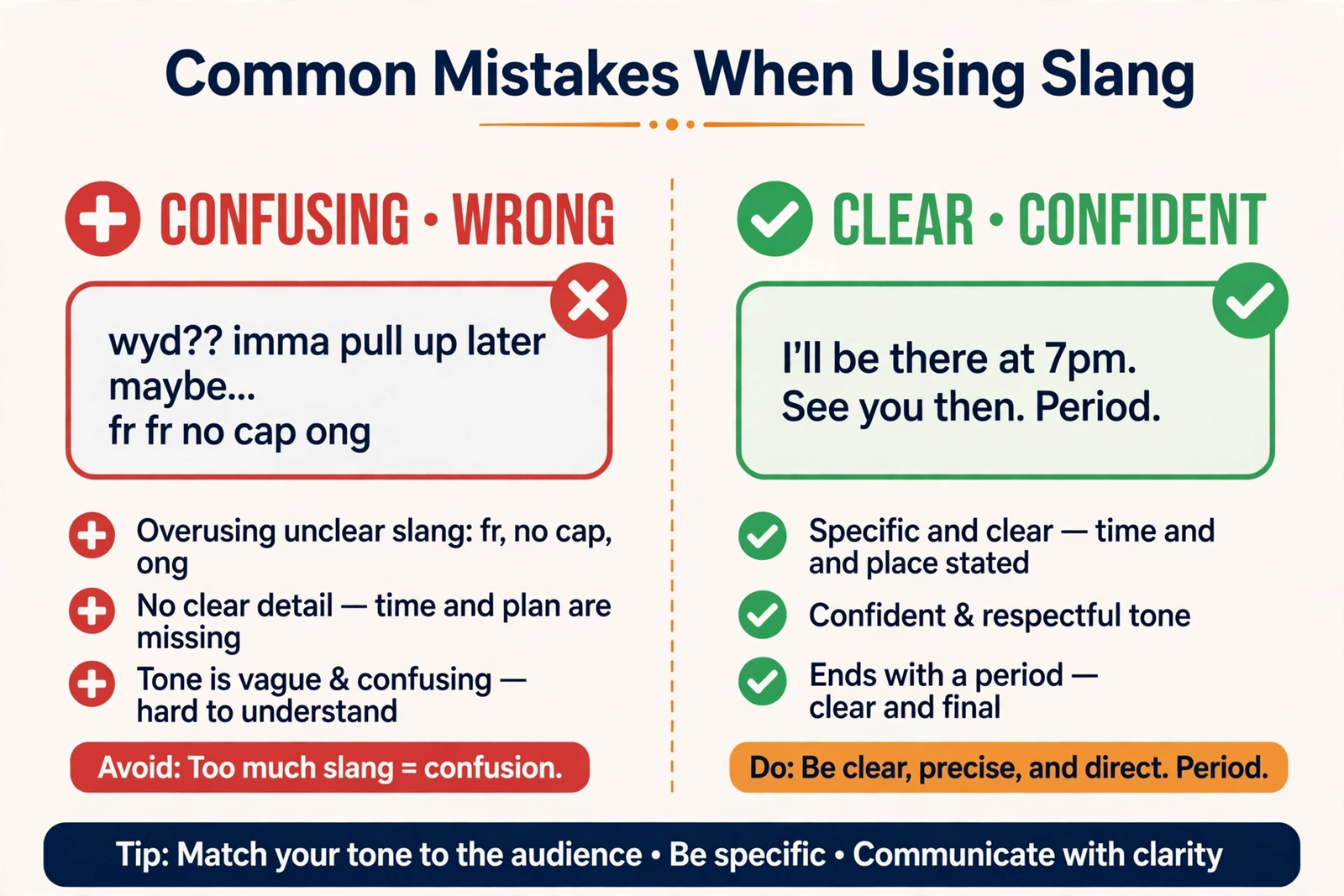
“Period” is easy to use, but a few mistakes can make it sound awkward or rude. Here are the most common ones to avoid:
- Using it in formal writing: Ending a work email with “period” can look unprofessional. Keep it out of reports, applications, and formal messages.
- Overusing it: If every sentence ends with “period,” the word loses its punch. Save it for the moments that really deserve emphasis.
- Using it to shut people down rudely: In a real disagreement, “period” can feel dismissive. If someone is sharing a genuine concern, listening is better than closing the conversation.
- Confusing it with “periodt”: The two are related, but “periodt” is the louder, more playful version. Using “periodt” in a serious moment can undercut your point.
- Using it mid-sentence: “Period” belongs at the end of a statement. Putting it in the middle — “I period think so” — makes no sense and confuses the listener.
- Mixing up the menstrual meaning: Be aware of context. A sentence about health and a sentence about an argument use the same word very differently.
The golden rule is simple: use “period” when you are confident, the setting is casual, and you genuinely mean “end of discussion.” If any of those three things is missing, choose a softer way to say it.
Quick Tips
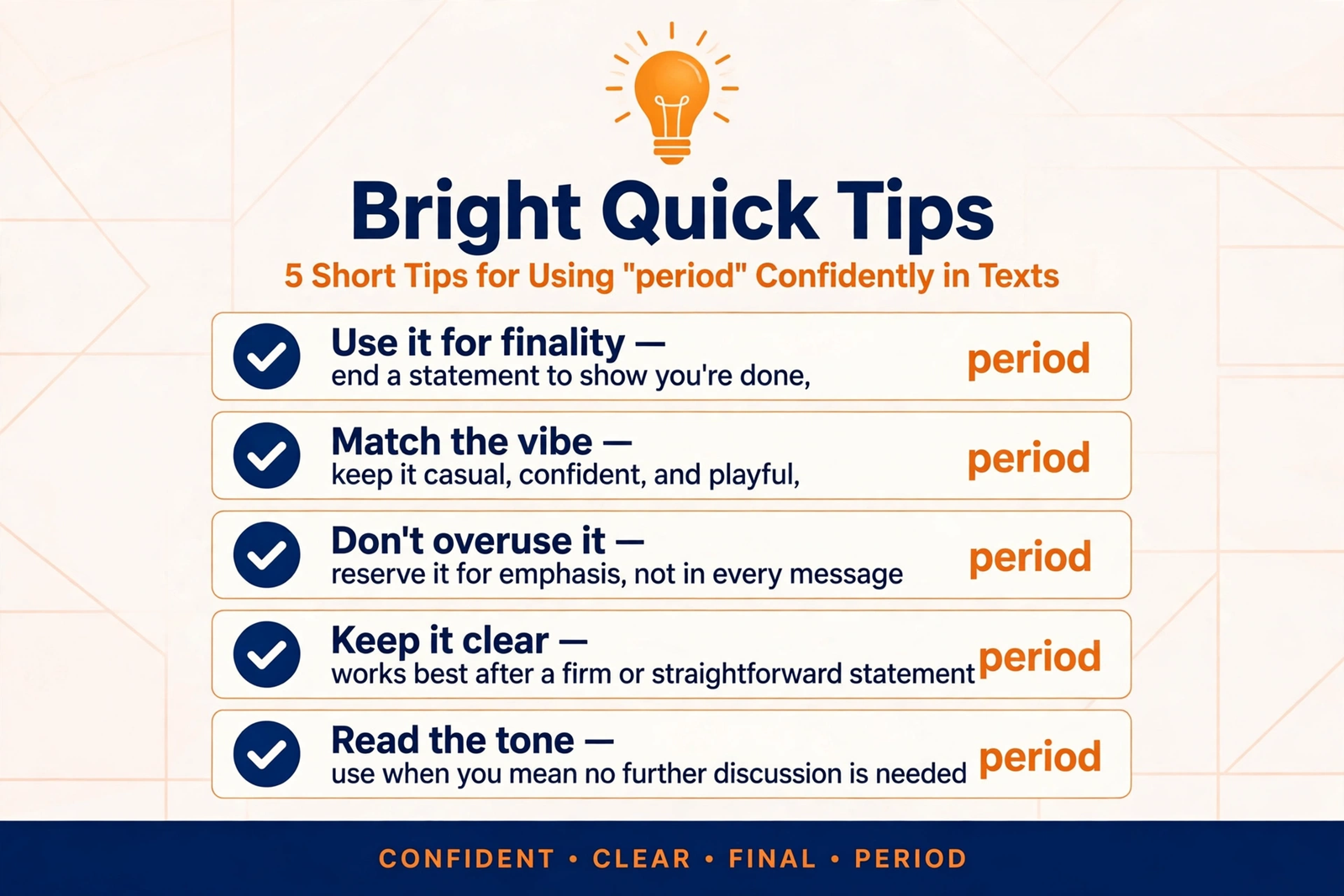
Want to use “period” like a native speaker? Keep these quick tips in mind:
- Place it last: “Period” always goes at the very end of your sentence. That is where it gets its power.
- Match the moment: Use it when you are sure, not when you are guessing. Confidence is the whole point.
- Pair it with a strong statement: A weak claim plus “period” still sounds weak. The statement itself should be worth closing.
- Use it sparingly: Once per conversation is plenty. Overuse turns a power move into a habit.
- Read the room: With close friends, it is fun. With a boss or a stranger, it can feel abrupt. Adjust to your audience.
- Combine it naturally: “Period, no cap” or “periodt” add flavor, but only when the vibe is playful.
- Let the emoji help: A crown, sparkle, or raised-hand emoji can add the tone that plain text cannot.
- Don’t force it: If “period” does not fit the sentence, leave it out. Natural slang never sounds rehearsed.
FAQ
What does “period” mean in slang?
In slang, “period” means “that’s final” or “end of discussion.” It is placed at the end of a statement to show confidence and to signal that the speaker’s point is not up for debate. It works like a spoken full stop.
What does “period” mean in texting?
In texting, “period” adds finality to a message. For example, “Best show ever, period” means the sender believes it completely and is not looking for an argument. It can also be sent alone as a reply that means “I agree” or “exactly.”
What is the difference between “period” and “periodt”?
“Period” and “periodt” mean the same thing, but “periodt” is a stronger, sassier version with a harder “t” sound at the end. “Periodt” usually feels more dramatic and playful, while “period” can sound more serious or neutral. Many people use them interchangeably.
Where did “period” slang come from?
The slang use of “period” comes from Black American English and ballroom culture, where it was used to add finality and emphasis to a statement. It spread into mainstream culture through music, reality TV, and social media, especially TikTok, where it became a widely used expression of confidence.
Is “period” rude?
“Period” is not rude on its own, but it can feel dismissive in a serious conversation because it signals that the speaker is done listening. With friends and in playful contexts, it is fun and confident. In formal settings or heated arguments, it can come across as abrupt, so it is best used carefully.
Can you use “period” at work?
You can use it in casual team chats where everyone speaks informally, but it is better to avoid it in formal emails, reports, and meetings. Professional alternatives like “That is final” or “I stand by my decision” carry the same confidence without the slang.
What does “period” mean on TikTok?
On TikTok, “period” is used in captions, comments, and voiceovers to agree with a statement or to shut down a debate. A comment that just says “Period.” usually means “I completely agree.” Creators also use it in captions to make a confident claim, such as “Confidence looks good on me, period.”
Is “period” the same as “facts”?
Not quite. “Facts” means “that is true” and is used to agree with someone else’s statement. “Period” means “that’s final” and is used to close your own statement with confidence. They are similar in spirit — both show strong agreement — but “period” adds finality, while “facts” adds agreement.
Conclusion
The period meaning slang is one of the simplest and most useful expressions in modern internet language. One small word turns an ordinary sentence into a final statement: “that’s it, end of discussion.” It grew out of Black American English and ballroom culture, spread through music and television, and found its perfect home on TikTok and in group chats, where short, confident statements win the day.
Use it at the end of a strong claim, use it sparingly, and match it to the moment. With friends, it is fun, sassy, and full of personality. In a professional setting, swap it for “that is final” or “I stand by my decision.” And if you ever want to turn the volume up, “periodt” is waiting with extra attitude.
Once you start noticing “period” online, you will see it everywhere — in comments, captions, memes, and everyday conversation. Now you know exactly what it means, where it came from, and how to use it without sounding forced. If you are curious about other expressive slang words, explore more guides like our look at Filipino slang and keep building your internet vocabulary one word at a time.
