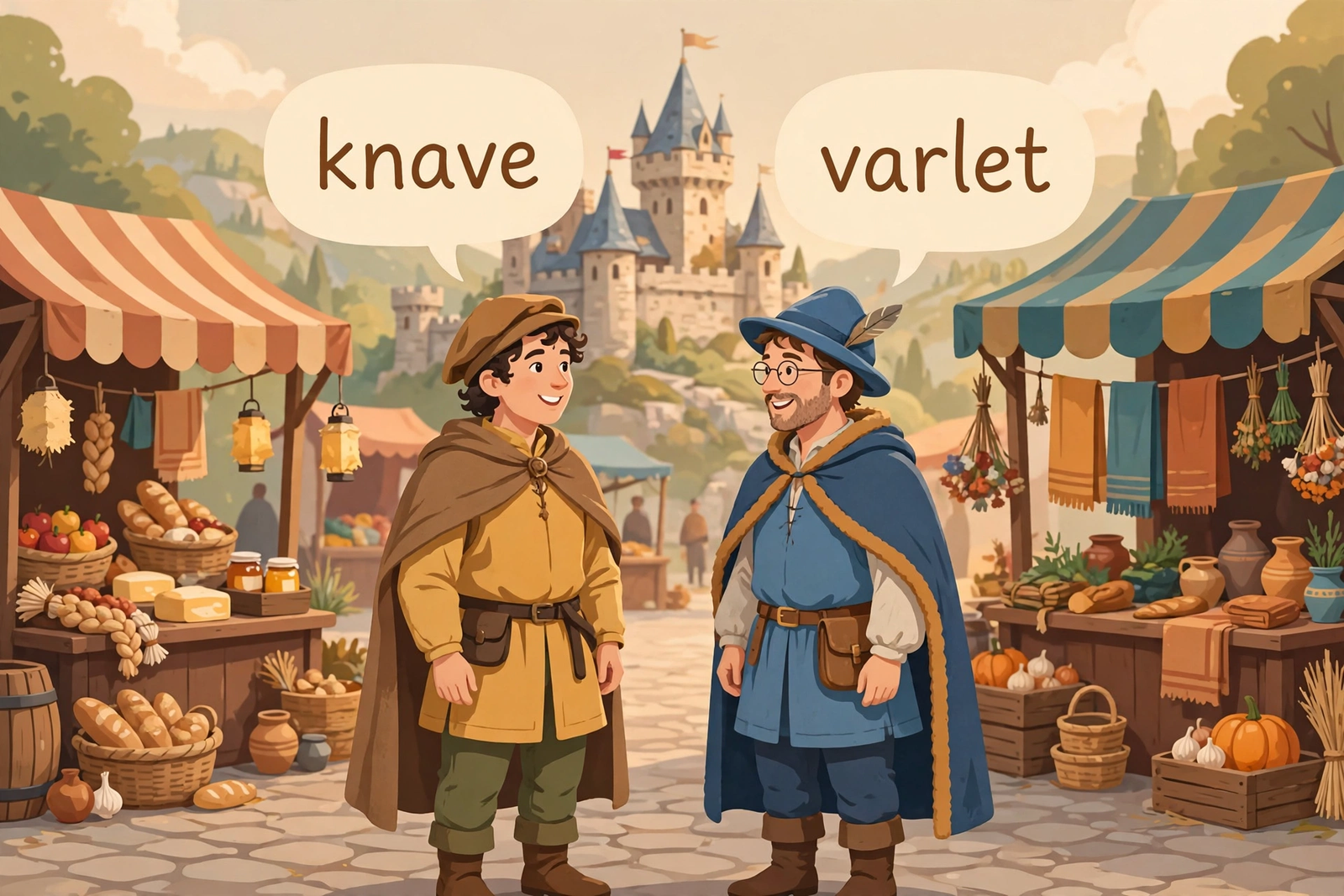
Quick definition: Medieval slang is the informal, colorful vocabulary ordinary people used in the Middle Ages — roughly 500 to 1500 AD — to talk about friends, fools, thieves, money, drinking, fighting, and romance. Words like knave, wench, varlet, and churl were the medieval equivalent of today’s texting slang: short, punchy, and packed with attitude.
Medieval Slang Meaning & Definition
When people search for the medieval slang meaning, they usually want one of two things: a list of actual words medieval people used in everyday speech, or an explanation of what a specific old word meant back then. The short answer is that medieval slang was the casual, street-level language of the Middle Ages — the words peasants, traders, soldiers, and tavern crowds used when they were not speaking formally or writing in Latin.
Unlike the polished language of court documents and church records, medieval slang was shaped by local dialects, social class, trade, religion, and the mix of languages spoken at the time: Old English, Norman French, Latin, and Norse all left fingerprints on it. A word could be a compliment in one village and an insult in the next, and meanings shifted fast — just like slang does today.
Some of these words survived into modern English. Knave still lives on in a deck of cards (the jack was once called the knave), wench shows up in pirate movies and Renaissance fairs, and scoundrel is still a perfectly good insult. Others, like gadling and losel, faded away entirely. This guide covers the 15 most useful and entertaining medieval slang words, what they really meant, how people used them, and where you will still hear them today.
Introduction
Picture a crowded market square in the year 1350. A merchant is shouting about his goods, a group of soldiers is laughing over mugs of ale, and a pickpocket is quietly working the crowd. None of them are speaking the formal English you find in history books. They are using slang — quick, vivid words that get the point across and make everyone around them laugh, wince, or back off.
That is the world medieval slang comes from. It was the language of the tavern, the battlefield, the marketplace, and the street, not the language of the monastery or the royal court. And just like modern slang, it was full of insults, nicknames, jokes about money, and words for people you could not trust.
Today, medieval slang is having a surprising second life. Fantasy novels, video games, Renaissance fairs, and TikTok creators all borrow these words to make a scene feel old, dramatic, or funny. If you have ever called someone a knave as a joke, or heard a pirate-movie character shout about a scoundrel, you have already used medieval slang without knowing it. This article gives you the full story: the definitions, the origins, real examples, and the mistakes to avoid when you use these words yourself.

Origin
Medieval slang grew out of Middle English, the language spoken in England roughly between 1150 and 1500. After the Norman Conquest of 1066, French became the language of the ruling class while ordinary people kept speaking English — and the two languages collided. French words for law, food, and fashion mixed with Old English words for farming, fighting, and everyday life. The result was a rich, messy vocabulary where a single idea could have three different words, one formal and two rude.
Most medieval slang was never written down in dictionaries. It lived in speech: in Chaucer’s Canterbury Tales, in mystery plays performed in town squares, in court records where witnesses repeated exactly what someone had shouted during a fight, and in the margins of manuscripts where bored scribes scribbled jokes. Scholars today reconstruct it from those fragments, plus works like Jonathon Green’s Dictionary of Slang, which traces slang words back through the centuries.
The word “medieval” itself comes from the Latin medium aevum, meaning “middle age” — the period between the ancient world and the Renaissance. You can see the full etymology on Etymonline’s entry for medieval. The slang of the period, though, was anything but middle-of-the-road: it was direct, earthy, and often deliberately shocking, because in a world without mass media, a sharp insult was entertainment.
Popularity
Medieval slang never really died — it just changed jobs. In the Middle Ages it was everyday speech. Today it survives in four places: literature, games, festivals, and the internet.
Fantasy is the biggest reason these words are still alive. Authors from J.R.R. Tolkien onward borrowed medieval vocabulary to build believable worlds, and modern writers of historical fiction and fantasy do the same. When a character in a novel calls someone a varlet or a churl, the reader instantly knows the setting is old, rough, and hierarchical.
Video games are the second engine. Role-playing games set in medieval-style worlds — from tabletop Dungeons & Dragons to massive online games — are full of knaves, wenches, and scoundrels. Gamers pick the words up and carry them into chats and forums, where they sit comfortably next to modern gaming slang. If you enjoy decoding gaming terms, our guide to NPC meaning slang shows how the same thing happens with modern game words.
Renaissance fairs and medieval reenactment events keep the words spoken out loud. Actors and fairgoers use them as part of the costume, the same way they wear tunics and drink from goblets. And on TikTok and YouTube, creators use medieval slang for comedy: calling a rude commenter a knave is funnier than calling them a jerk, because the old word lands as both an insult and a joke.
How It Is Used
Medieval slang works in three main ways today: as a historical reference, as a joke, and as flavor in creative writing. Understanding which one you are doing matters, because the same word can sound charming in a novel and rude in a text message.
As a historical reference, the words describe real medieval life. A historian might explain that a varlet was a low-ranking servant or attendant, or that pelf was a contemptuous word for money. In this use, accuracy matters more than style.
As a joke, medieval slang is a softer, funnier way to insult someone. Calling a friend a lubber when they trip over their own feet is playful; calling a stranger a scoundrel in an argument is still an insult, but the old-fashioned word takes some of the sting out — and usually gets a laugh. The same trick works with modern slang: our guide to larping meaning slang shows how an old word became a brand-new TikTok callout.
As flavor in creative writing, medieval slang sets the scene fast. A single word like wench or churl tells the reader the story is set in the past without a paragraph of description. Writers use it sparingly, though — too much old slang makes dialogue hard to read, which is why the best historical fiction mixes a few period words into otherwise modern sentences.
Examples
Here is how the most common medieval slang words actually sounded in use — and how you can use them today without sounding like you swallowed a history textbook.
Friendly Examples
- “Come on, you old gadling, the ale is getting warm.” — A teasing greeting between friends, where gadling (a young or inexperienced person) works like calling a friend “kid” or “rookie.”
- “My wench of a sister stole my horse again.” — In medieval times, wench could simply mean a young woman, and this kind of affectionate complaint was common between siblings.
- “Do not be such a lubber — help me carry this barrel.” — A friendly nudge. Lubber meant clumsy or awkward, and friends used it the way we say “butterfingers” today.
- “You look like a proper knight today, not a knave at all.” — A compliment that only works because the listener knows a knave was the opposite of a knight: dishonest and low.
Professional Examples
- “The steward warned the household against a varlet who had been stealing from the kitchens.” — A formal report where varlet names a low-ranking servant or rogue.
- “The merchant refused to deal with the churl after the insult at the market.” — Here churl describes a rude, low-status man in a business context.
- “The chronicler described the tax collector as a lover of pelf, not of the people.” — Pelf (money, viewed with contempt) was a favorite word of writers criticizing greed.
- “The play’s villain was written as a scoundrel, and the audience hissed every time he entered.” — A theater example showing how scoundrel marked a character as untrustworthy.
Funny Examples
- “Thou art a knave, a lubber, and a coney all at once — and somehow still my best friend.” — Stacking three insults (knave: dishonest man; lubber: clumsy fool; coney: gullible simpleton) turns the insult into a joke.
- “He called me a varlet, so I called him a ribaud. The whole tavern cheered.” — A medieval insult contest, which was genuinely a form of entertainment.
- “She is no doxy, she is my wife — and she heard you say it.” — A joke that only works because doxy meant a mistress or lover outside marriage.
- “The only pelf I have is the coin I found behind the tavern.” — Self-deprecating humor about being broke, using the old contemptuous word for money.
Comparison with Similar Terms
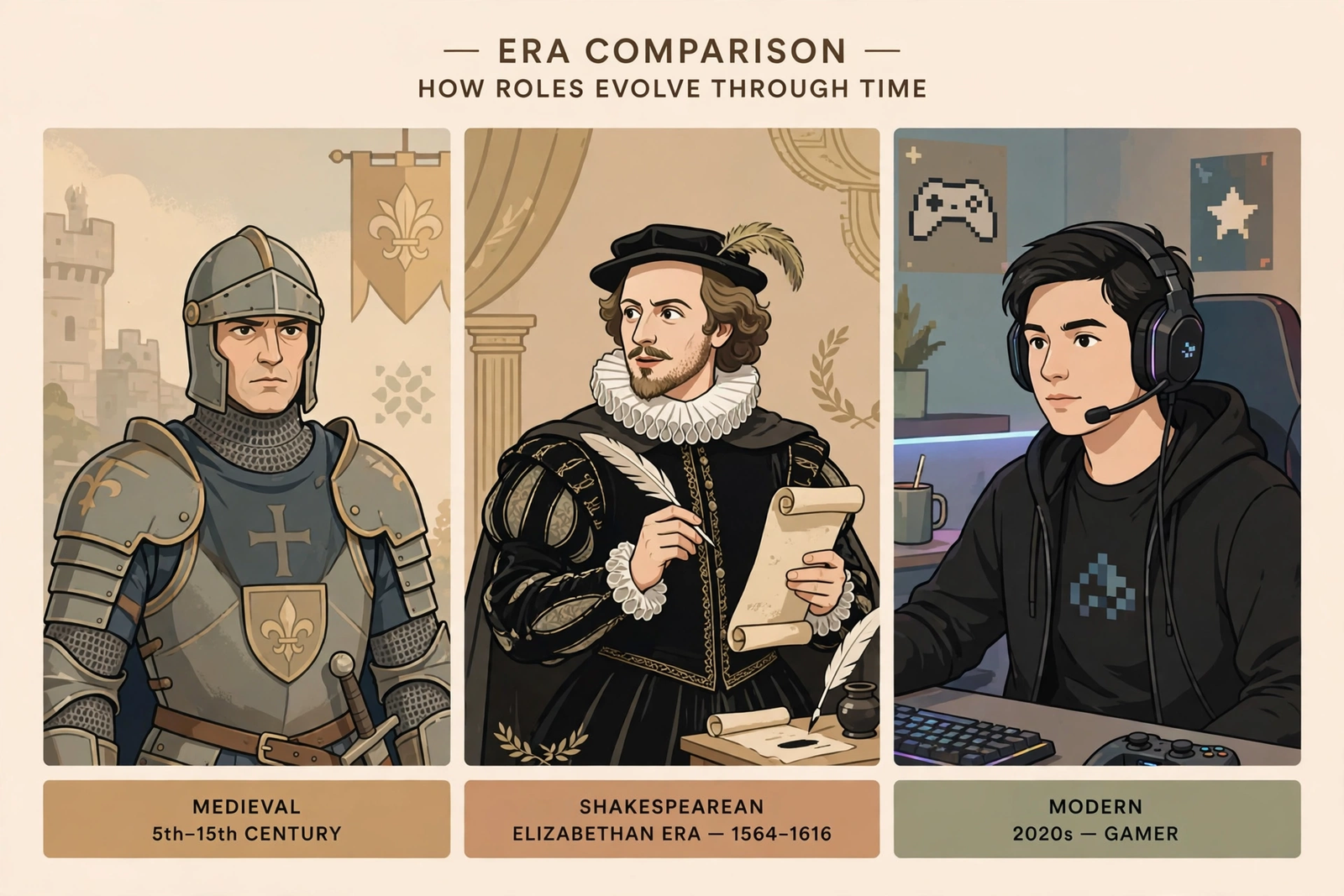
Medieval slang is often confused with three related things: Old English, Shakespearean language, and modern fantasy slang. They overlap, but they are not the same. This table makes the differences clear.
| Term / Concept | What It Is | Time Period | Example Words | Used Today For |
|---|---|---|---|---|
| Medieval slang | Informal, street-level words of the Middle Ages | 500–1500 AD | knave, wench, varlet, churl | Historical flavor, jokes, fantasy |
| Old English | The formal early language of England | 450–1150 AD | þegn (thane), eorl (earl) | Academic study, Beowulf |
| Shakespearean slang | Elizabethan insults and wordplay | 1500s–1600s | coxcomb, knave (still), milksop | Theater, witty insults |
| Modern fantasy slang | Invented words for games and novels | 1900s–today | choom, preem, gonk | Gaming, sci-fi, pop culture |
| Modern internet slang | Texting and TikTok abbreviations | 2000s–today | slay, NPC, larping | Chats, memes, social media |
The most useful comparison is between medieval slang and modern internet slang. Both do the same job: they mark who belongs to a group, they insult people quickly, and they make boring things sound fun. The difference is speed. A medieval word like scoundrel took centuries to spread across England. A modern word like slay can spread around the world in a week — as our guide to slay slang shows. Medieval slang also tended to be about class and honor, while modern slang is more often about attitude and identity.
Within medieval slang itself, the words split into clear groups. Insults for dishonest men (knave, varlet, scoundrel, ribaud) were the most common, because trust mattered in a world without police or contracts. Words for women (wench, doxy, harlot) carried heavy social judgment, which is why they sound harsh today. Words for money (pelf) and for fools (lubber, coney, gadling) rounded out the set — the same topics, honestly, that slang covers in every era.
Alternate Meanings
Many medieval slang words changed meaning over time, and some of them meant something completely different from what people assume today. Knowing the alternate meanings keeps you from using a word the wrong way.
Knave is the best example. In early medieval use, a knave was simply a boy or a young male servant — a neutral job description. Over time it picked up the meaning of a dishonest or untrustworthy man, and that is the sense that survived. In a deck of cards, the knave (now called the jack) kept the older, neutral sense.
Wench also shifted. It started as a general word for a young woman or a female servant. Later it became derogatory, especially when used by strangers, and in modern pirate movies it is often used as a flirtatious or teasing word — a meaning medieval speakers would not have recognized.
Harlot originally meant a disreputable person of either sex — a vagabond, a rogue, a low fellow. Only later did it narrow to mean a sexually immoral woman or a sex worker. Using it today with its modern meaning is fine, but in a historical novel set in 1300, a male character could be called a harlot too.
Coney literally meant a rabbit. As slang, it meant a gullible person or a simpleton — someone as easily caught as a rabbit. The same animal logic gave us the phrase “to coney-catch,” meaning to trick or swindle someone.
Churl began as a word for a peasant or commoner — a social rank, not an insult. It only became a word for a rude, unpleasant man when the upper classes started using a person’s low birth as an insult. That shift from class label to character judgment happened to many medieval words, and it tells you a lot about how the society worked.
Swive was the blunt medieval verb for having sex, the equivalent of the modern four-letter word. It appears in Chaucer and in court records, and it is a good reminder that medieval people swore just as much as we do — they just swore in Middle English.
Professional or Polite Alternatives
Most medieval slang words are insults, so you need polite alternatives when you are writing formally, talking to strangers, or working with kids. Here are the swaps that keep the meaning without the sting.
- Instead of knave: say “dishonest person” or “untrustworthy man.” In a story, “rogue” keeps the flavor with less bite.
- Instead of scoundrel: say “a person of bad character” or “someone I would not trust.” Scoundrel is mild enough for most settings, but the formal version is safer at work.
- Instead of churl: say “rude person” or “ill-mannered man.” The word churl insults both manners and birth, which is why it lands harder than it looks.
- Instead of wench: say “young woman” or just use the person’s name. Wench is the riskiest word on this list today — what was once neutral is now often heard as demeaning.
- Instead of harlot or doxy: avoid both in modern speech entirely. There is no polite version of these words; describe the situation plainly instead.
- Instead of lubber: say “clumsy” or “awkward.” Lubber is gentle enough for jokes between friends, but “clumsy” is clearer for everyone else.
- Instead of pelf: say “money” or “wealth.” Pelf adds contempt, so use it only when you actually want to sound disapproving — in a story about a greedy villain, for example.
A good rule: if you would not say the modern equivalent to someone’s face, do not dress it up in medieval clothing and say it anyway. The old word does not make the insult polite — it just makes it sound like a costume.
Common Mistakes
People make the same five mistakes with medieval slang over and over. Avoid them and you will sound knowledgeable instead of like a Renaissance fair tourist.
Mistake 1: Using “thou” and “thee” with medieval slang words from the wrong century. “Thou” is Early Modern English — Shakespeare’s era, not the Middle Ages. A medieval speaker would not say “thou knave” the way a Shakespeare character would. If you want authentic medieval flavor, use the slang word in a normal modern sentence instead of adding fake old grammar.
Mistake 2: Calling everything “medieval” when it is actually Victorian or Elizabethan. Words like coxcomb and milksop are 16th century, not medieval. Check the date before you label a word medieval, or your historically-minded readers will correct you in the comments.
Mistake 3: Using wench as a friendly word for a woman. This is the most common error, and the most likely to offend. In modern use, wench reads as demeaning no matter how playfully you mean it. Keep it in historical fiction and out of real conversations.
Mistake 4: Mixing medieval slang with modern slang in the same sentence. “That knave is so sus” is funny exactly once, and then it is just confusing. Pick one era per sentence and commit to it.
Mistake 5: Assuming every old word was slang. Many medieval words were formal, technical, or religious terms — cuisses (thigh armor), greaves (shin armor), and hauberk (a mail shirt) are vocabulary, not slang. Slang is the informal, joking, insulting layer of a language, not just anything old.

Quick Tips
- Start with three words: Learn knave, varlet, and scoundrel first. They cover most insult situations and everyone recognizes them.
- Use slang as seasoning, not the main dish: One medieval word per paragraph is plenty in creative writing. More than that and readers slow down to decode instead of enjoying the story.
- Check the century: Before calling a word medieval, confirm it was in use before 1500. Green’s Dictionary of Slang timelines are the gold standard for this.
- Read Chaucer for the real thing: The Canterbury Tales — especially the Miller’s Tale — is full of authentic medieval slang in context, and it is far funnier than any list.
- Use it for games and parties: Medieval slang shines at Renaissance fairs, Dungeons & Dragons nights, and costume parties, where everyone is already playing a role.
- Keep the insults friendly: With friends, lubber and gadling are safe and funny. Save knave and scoundrel for characters in a story, not people you actually know.
- Pair it with real history: A slang word lands harder when you know the world behind it. Knowing that pelf was a contemptuous word for money tells you how medieval people felt about greed.

FAQ
What is medieval slang?
Medieval slang is the informal, everyday vocabulary people used during the Middle Ages (roughly 500–1500 AD) — words like knave, wench, varlet, and churl for friends, fools, rogues, and money. It was the casual language of markets, taverns, and battlefields, as opposed to the formal language of courts and churches.
What does knave mean in medieval slang?
In medieval slang, a knave was a dishonest or untrustworthy man. The word started out neutrally, meaning a boy or a young male servant, and only later picked up its negative sense. The knave in a deck of cards — now called the jack — preserves the older meaning.
What is a wench in medieval times?
In medieval times, a wench was a young woman or a female servant. Over time the word became derogatory, and today it is usually heard as demeaning, so it is best kept in historical fiction rather than modern conversation.
What does varlet mean?
A varlet was a low-ranking servant or attendant, and by extension a rogue or rascal. The word comes from Old French and was used both as a job title and as an insult for someone untrustworthy.
Did medieval people really swear?
Yes. Medieval people swore constantly, and court records are full of the insults people shouted during fights. Words like swive and the ancestors of modern four-letter words appear in Chaucer and in legal documents — proof that swearing is one of the oldest human habits.
What is the difference between medieval slang and Shakespearean slang?
Medieval slang comes from the Middle Ages (before 1500) and words like knave, churl, and varlet. Shakespearean slang comes from the Elizabethan era (late 1500s–early 1600s) and includes words like coxcomb and milksop. Shakespeare borrowed some medieval words, but his famous insults are mostly from his own century.
Is medieval slang still used today?
Yes, mostly in fantasy novels, video games, Renaissance fairs, and online comedy. Words like knave, scoundrel, and wench survive because they instantly signal an old, dramatic setting — and because calling someone a knave is funnier than calling them a jerk. For a modern comparison, see how gaming words evolve in our guide to cyberpunk slang.
How can I use medieval slang without sounding silly?
Use one word at a time, in a normal modern sentence, and only where the setting fits — a story, a game, a fair, or a joke between friends. Avoid fake old grammar like “thou” and “prithee,” skip the word wench in real conversation, and never mix medieval and modern slang in the same sentence.
Conclusion
Medieval slang is a window into how ordinary people actually talked a thousand years ago — not the formal language of kings and monks, but the quick, funny, insulting words of the marketplace and the tavern. Fifteen words cover most of it: knave, wench, varlet, churl, scoundrel, harlot, lubber, gadling, coney, doxy, ribaud, pelf, swive, cullion, and losel. Learn those, and you can read Chaucer with a smile, write better fantasy dialogue, and win any medieval insult contest at a Renaissance fair.
The bigger lesson is that slang never really changes — only the words do. Medieval people used slang to mark their friends, mock their enemies, and talk about money, just like we do with words like slay and NPC today. The words are old, but the instinct behind them is completely modern.
So the next time someone cuts you off in traffic, skip the modern insult and try a medieval one: the driver is a knave, a lubber, and a scoundrel all at once. It will not fix the traffic — but you will feel like you just stepped out of a Chaucer story, and that is worth something. Want to keep decoding the words around you? Start with our guides to slay slang, NPC meaning slang, and larping meaning slang — the same human habit, in three very different centuries.
