Quick definition: The surfer slang meaning is simple — it is the informal vocabulary surfers use to talk about waves, boards, wipeouts, and the feeling of riding the ocean. Words like stoked, gnarly, kook, and shaka are not random beach talk; they are a shared language that grew out of Hawaii and California surf culture and now shows up in texts, TikTok captions, and everyday conversation far from the ocean.
Surfer Slang Meaning & Definition
Surfer slang is the casual, expressive language of the surfing community. It covers everything a surfer needs to describe quickly in the water: the size and shape of a wave, the quality of a ride, the skill (or lack of it) of the person next to them, and the pure joy of a good session. The surfer slang meaning goes beyond a dictionary definition — it carries the laid-back, sun-soaked attitude of surf culture itself.
Unlike formal sports terminology, surf slang is playful and emotional. A wave is never just “large” — it is gnarly, heavy, or a bomb. A surfer is never just “happy” — they are stoked, frothing, or amped. This language developed because surfers needed short, punchy words they could shout over crashing waves, and because the culture values fun over formality.
Today, surfer slang has escaped the beach. You will hear gnarly in a skate park, see stoked in a group chat about a job offer, and spot shaka emojis in Instagram comments. Understanding the surfer slang meaning helps you decode all of it — whether you surf or have never touched a board.
Introduction
Picture this: you are scrolling through TikTok when someone captions a beach video “absolutely frothing, that set was gnarly, bro.” Your friend texts “I’m so stoked for Saturday” after booking surf lessons. A coworker calls a difficult project “a total wipeout.” None of these people are professional surfers — but all of them are speaking surfer slang.
Surf lingo is one of the most borrowed vocabularies in English. It started on Hawaiian beaches in the 1940s and 1950s, exploded through California surf movies and surf rock in the 1960s, and then rode a second wave through skateboarding, snowboarding, and social media. The result is a language that feels sunny, relaxed, and a little rebellious — which is exactly why people love using it.
This guide explains the surfer slang meaning in plain English, traces where the words came from, and breaks down 50+ of the most common surf terms with real examples. You will learn which words to use, which ones to avoid, and how to sound like you belong in the lineup — even if your closest wave is a hundred miles away. If you enjoy decoding internet slang, our guide to drip slang meaning covers another corner of modern slang the same way.
Origin
Surf slang was born in Hawaii, where modern surfing itself began. Ancient Hawaiians called the sport he’e nalu (wave sliding), and when surfing spread to the California coast in the early 1900s, a new beach culture grew around it. Duke Kahanamoku, the Hawaiian Olympic swimmer who popularized surfing in California and Australia in the 1910s and 1920s, helped carry the first surf words from the islands to the mainland.
The real explosion came in the 1950s and 1960s. Post-war California developed a full surf subculture: surf clubs, beach parties, surfboard shapers, and a new kind of teenager who lived at the beach. The 1959 film Gidget and the surf-rock sound of The Beach Boys and Dick Dale pushed words like gnarly, stoked, and hang ten into mainstream America. Surfers needed quick words for conditions and maneuvers, and the slang stuck because it sounded fun.
Two things shaped the vocabulary. First, practicality: in the lineup, you have seconds to warn someone about a wave, so words had to be short and loud. Second, identity: slang marked you as part of the tribe. Knowing the difference between a kook and a grom told other surfers you belonged. That insider feeling is a big reason the words survived for eighty years.
Popularity
Surfer slang has never been more popular. The 1960s made it cool, the 1980s and 1990s kept it alive through skateboarding and movies like Point Break and Fast Times at Ridgemont High (Spicoli’s “gnarly” is still quoted today), and social media gave it a third life. On TikTok and Instagram, surf clips routinely go viral, and their captions are packed with slang — frothing, pitted, shacked — which teaches millions of non-surfers the vocabulary.
The words also crossed into other sports. Skateboarders, snowboarders, and even gamers borrowed stoked, rad, gnarly, and shred wholesale. Brands noticed too: surf terms now sell everything from energy drinks to swimwear. A word like stoked is so mainstream that it appears in job postings and wedding speeches, far from any beach.
Search interest follows the same pattern. People look up surfer slang before beach holidays, before their first surf lesson, and after hearing a term in a song or a show. The language is a gateway: learn ten words and a whole culture suddenly makes sense. That is why a clear, complete guide beats a bare glossary — and why this one gives you meanings, origins, and examples together.
How It Is Used
Surfers use slang in three main places: in the water, in texts and chats, and in captions and comments. In the water, it is fast and functional — “Set coming!” or “Drop in on that one!” On land, it is relaxed and social — “That session was epic, I’m still frothing.” Online, it is shorthand for a whole lifestyle, often paired with wave and shaka emojis.
The table below covers the 30 most important surfer slang terms. Learn these and you will understand about 90% of what surfers say.
| Term | Meaning | Example |
|---|---|---|
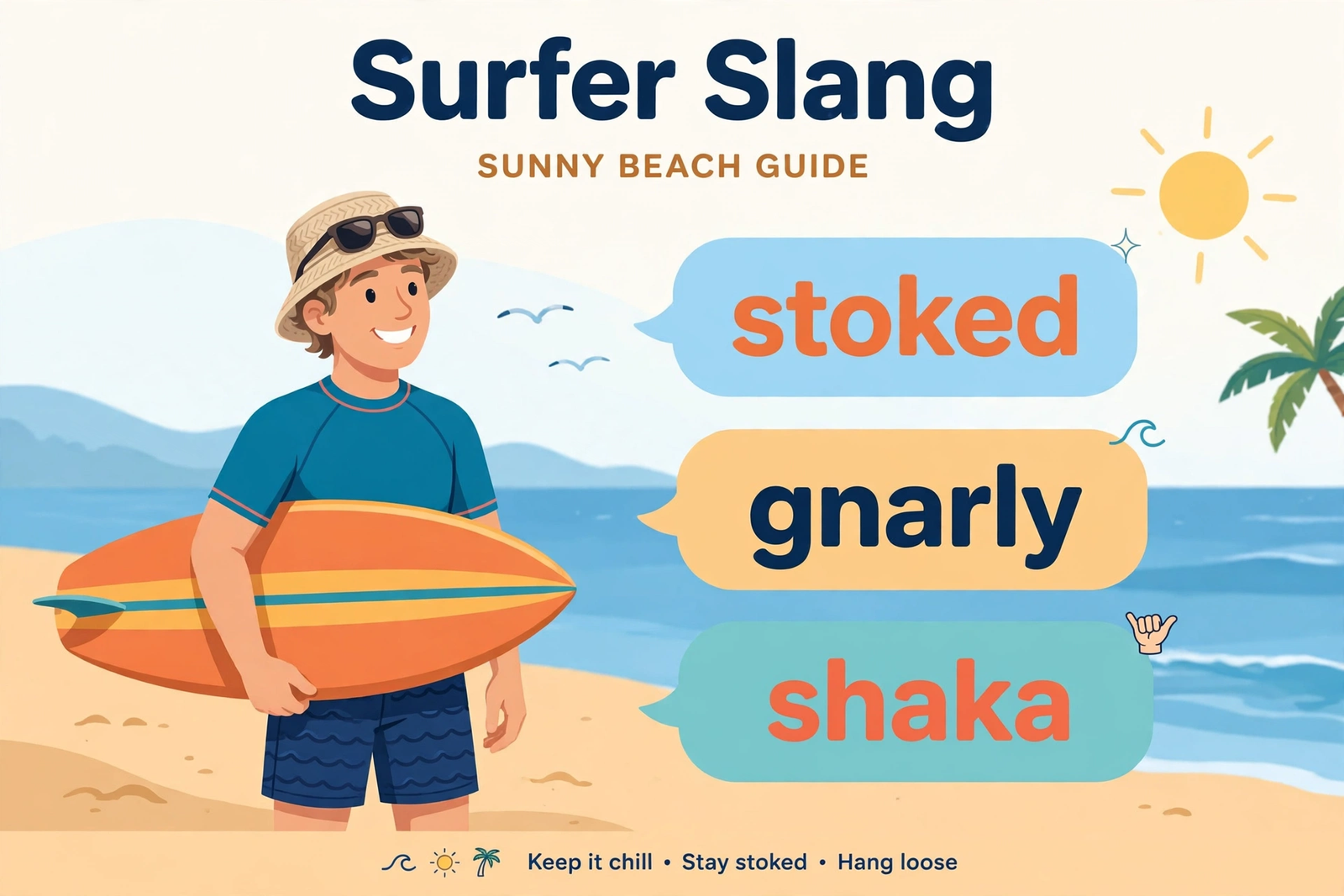
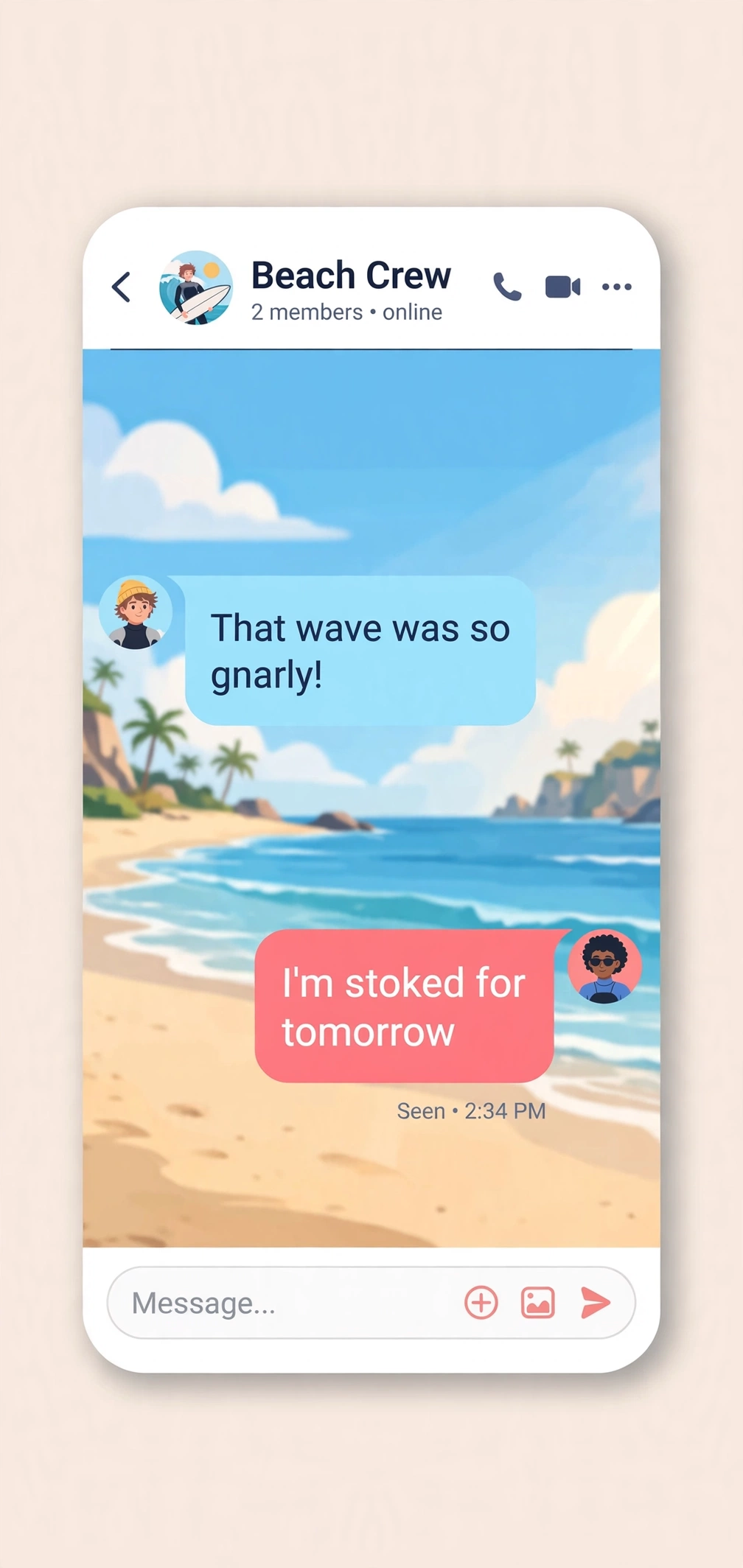
| Stoked | Extremely excited or happy | “I’m so stoked for tomorrow’s swell.” |
| Gnarly | Amazing, intense, or difficult | “That wave was gnarly — double overhead!” |
| Kook | An inexperienced or clueless surfer who breaks etiquette | “That kook dropped in on everyone.” |
| Grom / Grommet | A young surfer, usually a kid or teen | “The groms were ripping today.” |
| Shaka | The hang-loose hand gesture; also means “all good” | “He threw a shaka as he paddled in.” |
| Froth / Frothing | Being wildly excited about surfing | “I’m frothing — the forecast looks perfect.” |
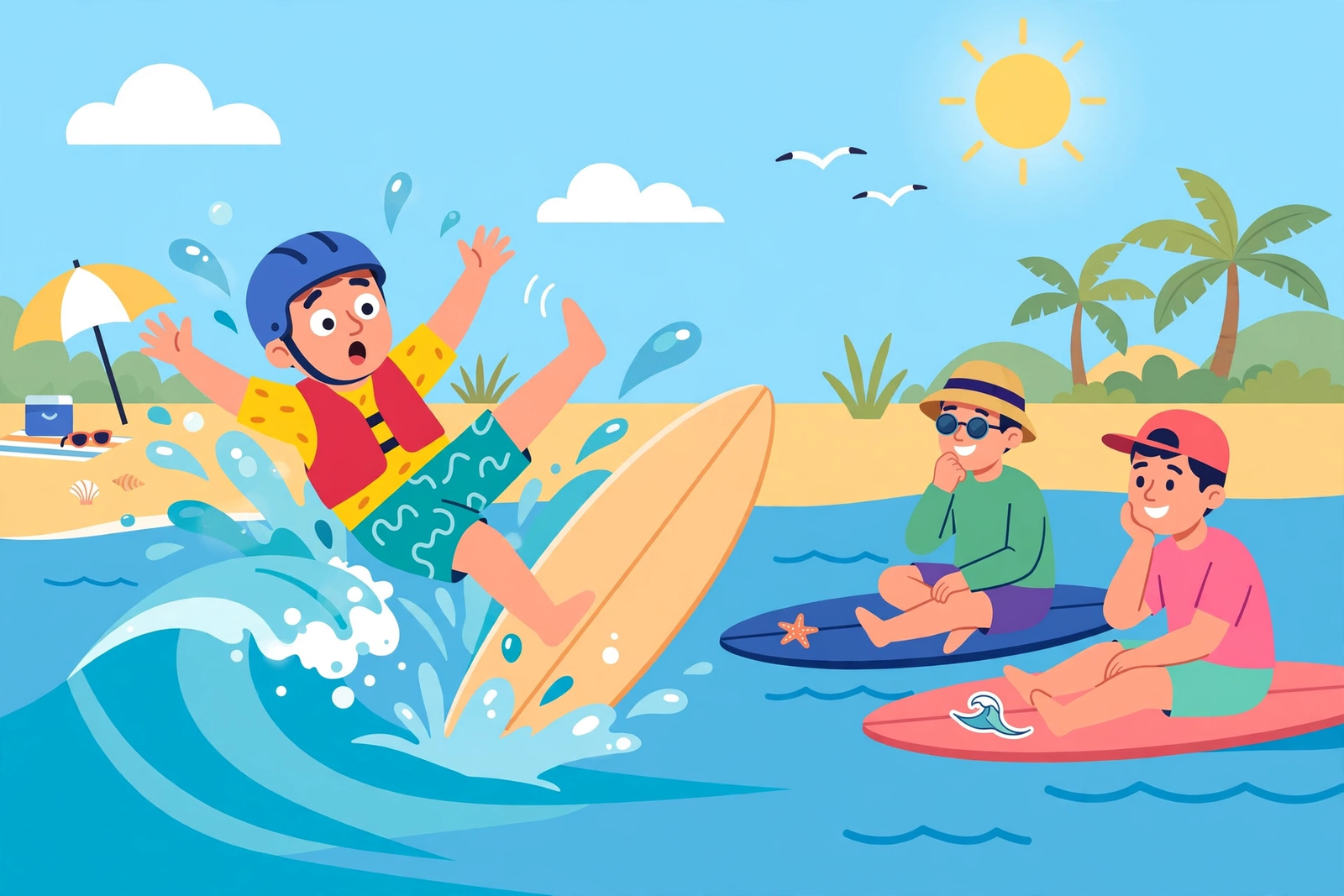
| Wipeout | Falling off your board | “Took a heavy wipeout on that set wave.” |
| Barrel / Tube | The hollow part of a curling wave | “He got barreled — best wave of the day.” |
| Shred / Rip | To surf very well and aggressively | “She absolutely shredded that wave.” |
| Hang ten | Riding with all ten toes over the nose of the board | “He hung ten all the way to the beach.” |
| Drop in | Taking a wave someone else already has | “Don’t drop in — that’s bad etiquette.” |
| Snake | Paddling around someone to steal their wave | “He snaked me for the last set wave.” |
| Lineup | Where surfers wait for waves | “The lineup was packed this morning.” |
| Set | A group of larger waves arriving together | “Wait for the set — the next one looks better.” |
| Dawn patrol | An early-morning surf session before sunrise | “Dawn patrol at 5:30, don’t be late.” |
| Break | A spot where waves break well for surfing | “That point break is world-class.” |
| Offshore | Wind blowing from land to sea, cleaning up the waves | “Offshore winds — it’s going to be glassy.” |
| Glassy | Smooth, clean wave conditions with no wind chop | “Glassy morning, perfect for longboarding.” |
| Choppy | Rough, messy wave conditions | “Too choppy today, not worth paddling out.” |
| Swell | The waves rolling in from the open ocean | “Big swell hitting the coast this weekend.” |
| Caught inside | Stuck between the shore and the breaking waves | “I got caught inside for ten minutes.” |
| Ding | Damage to a surfboard, like a dent or crack | “Got a ding on my board — needs a repair.” |
| Rad | Excellent or awesome | “That air was so rad!” |
| Brah / Bro | A surfer friend or buddy | “Thanks, brah — that was a sick wave.” |
| Betty | A female surfer | “The betties were charging today.” |
| Hodad | A poser who hangs at the beach but never surfs | “He’s a total hodad — all gear, no surfing.” |
| Barney | A beginner who looks lost or clumsy in the water | “Don’t be a barney — watch the lineup first.” |
| Pitted | Riding deep inside the barrel of a wave | “She got so pitted on that last one.” |
| Aggro | Aggressive surfing or attitude | “That local is super aggro about his spot.” |
| Foamie | A soft foam surfboard, great for beginners | “Start on a foamie — it forgives mistakes.” |
Beyond the core 30, there are dozens more: amped (excited before a session), ankle slapper (a tiny wave), backdoor (entering a barrel from behind the peak), bomb (a huge wave), bottom turn (the first turn at the base of a wave), closeout (a wave that breaks all at once), cutback (turning back toward the breaking part of the wave), duck dive (pushing the board under an oncoming wave), goofy foot (surfing with the right foot forward), heavy (powerful or dangerous), inside (the area closer to shore), kick out (exiting a wave safely), log (a longboard), party wave (a wave shared by several surfers), peeling (a wave breaking cleanly along its length), pop up (jumping to your feet on the board), reef break (waves breaking over a reef), section (a part of a wave), shorebreak (waves breaking right on the sand), takeoff (catching a wave and standing up), tube ride (riding inside the barrel), and whitewash (the foamy broken part of a wave near shore). That is more than 50 terms — enough to follow any surf conversation.
Examples
Surfer slang changes flavor with the situation. The same word can sound friendly, professional, or funny depending on how you use it. Here are real examples in each tone.
Friendly Examples
- “Dude, that was the best session ever — I’m still so stoked!”
- “Morning, brah! The swell looks epic today, you coming out?”
- “You got barreled on your third wave? That’s insane, congrats!”
- “No worries, take your time — the waves aren’t going anywhere. 🤙”
- “Shaka, my friend! See you at dawn patrol tomorrow.”
- “I’m frothing for the weekend. The forecast is looking glassy.”
Professional Examples
- “Our surf school starts every beginner on a foamie so they can learn the pop-up safely before moving to a hardboard.”
- “Today’s conditions are choppy with a moderate swell, so we will practice in the whitewash before heading to the lineup.”
- “As a coach, I teach students to read a set, pick their wave early, and never drop in on another surfer.”
- “The contest judges scored the barrel ride highest because the surfer stayed pitted through the full section.”
- “For this article, we asked three local surf instructors what kook means — and all three said the same thing: it is about etiquette, not skill.”
Funny Examples
- “I tried to hang ten and ended up doing a spectacular wipeout in front of everyone. The whole beach cheered.”
- “He showed up in a wetsuit, sunglasses, and a GoPro, then got owned by an ankle slapper. Classic hodad.”
- “My first wave lasted about two seconds. My wipeout lasted considerably longer.”
- “I told my boss I was ‘caught inside’ this morning. She thinks I meant traffic. I meant the ocean.”
- “Surfing is easy, they said. Then I met the shorebreak.”
Comparison with Similar Terms
Surfer slang overlaps with other slang worlds, but it is not the same thing. The comparison below shows how it differs from the closest cousins — and how a few famous terms differ from each other.
| Surfer slang | Similar language | Key difference |
|---|---|---|
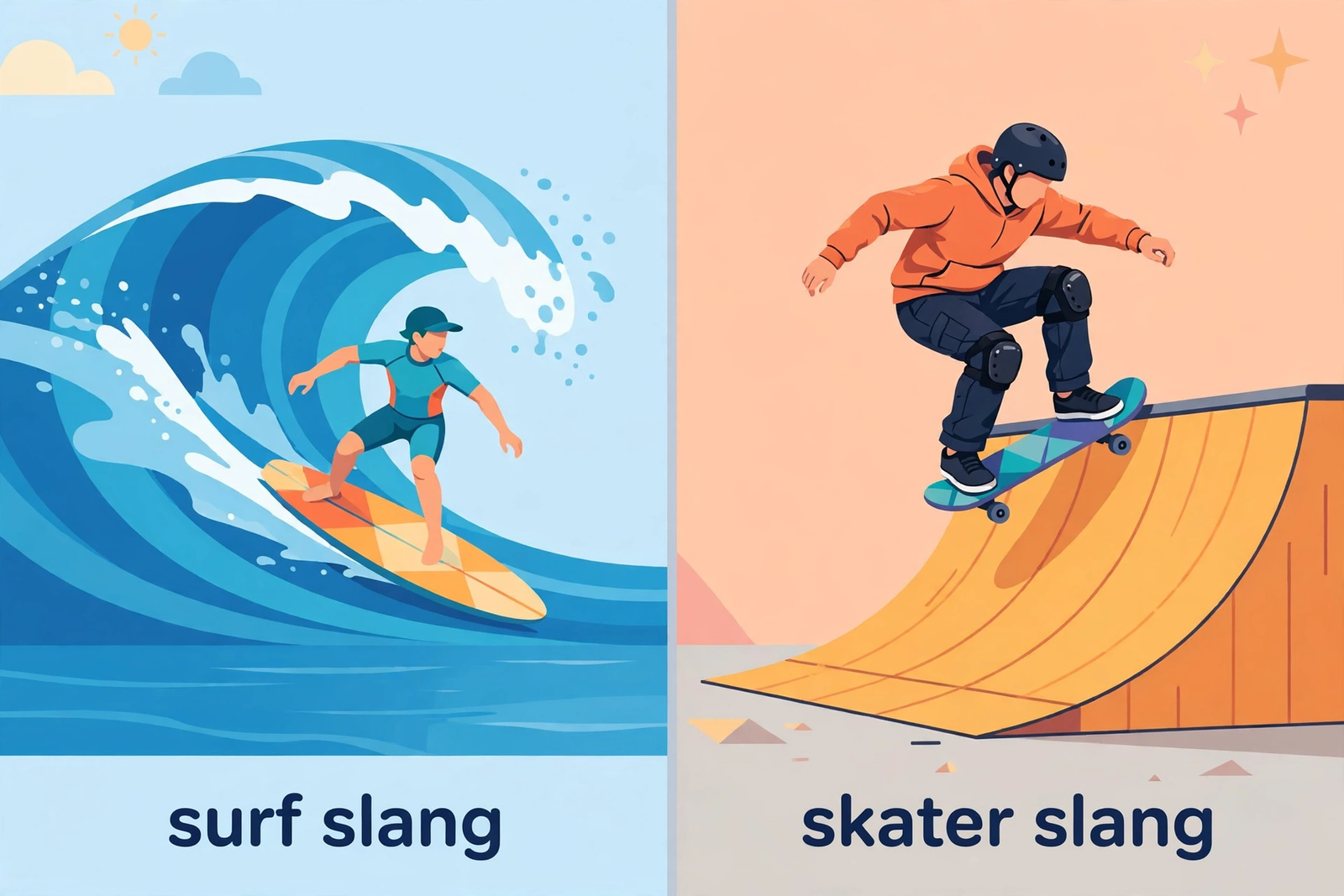
| Surfer slang | Skater slang | Skater slang shares words like stoked and gnarly, but surf terms describe waves, wind, and the ocean — skaters talk about tricks, spots, and concrete. |
| Surfer slang | Snowboarder slang | Snow slang borrows heavily from surf (shred, pow vs swell), but it describes snow, mountains, and cold — not tides and barrels. |
| Surfer slang | Beach slang | Beach slang is general vacation talk (sun, sand, cocktails). Surfer slang is technical — it describes wave mechanics and lineup rules. |
| Surfer slang | General internet slang | Internet slang changes every month and lives in text. Surf slang is eighty years old and lives in the water first, online second. |
| Stoked | Hyped | Stoked is warm, grateful excitement (often after a good session). Hyped is loud, anticipatory energy — closer to amped. |
| Gnarly | Awesome | Gnarly can mean amazing or intense and scary (“gnarly wipeout”). Awesome only means great. |
| Kook | Newbie | A newbie is just new. A kook is clueless about etiquette — a beginner who learns the rules stops being a kook fast. |
| Shaka | Thumbs up | A thumbs up means “good.” A shaka means “all good, take it easy, hang loose” — it carries the whole surf attitude. |
| Wipeout | Fail | A wipeout is a specific surf fall, often fun and expected. A fail is a general internet term for any mistake. |
Alternate Meanings
Most surfer slang has one clear meaning in the lineup, but a few terms wear different hats outside it. Gnarly is the best example: surfers use it for a great wave (“gnarly barrel”) and for a bad situation (“gnarly sunburn”), and doctors even use it for twisted tree roots. Context decides which one you hear.
Barrel is another double-duty word — in surfing it is the tube of a wave, but in everyday English it is a large container. Shred means surfing brilliantly, but guitarists also “shred” a solo, and offices “shred” documents. Surf itself has a famous alternate meaning: “surfing the internet” borrowed the wave-riding metaphor in the 1990s and is now the everyday meaning for most people.
Then there is the phrase “surfer slang” itself. Some people use it loosely to mean any beachy, laid-back way of talking — “dude,” “bro,” “chill” — even when no surfing is involved. Strictly, the surfer slang meaning is tied to the sport: the words describe waves, boards, and the lineup. The casual “dude” and “bro” are part of it, but they are the garnish, not the main dish.
Professional or Polite Alternatives
Surf slang is perfect at the beach and in casual chats, but it can sound out of place at work, in school, or in a formal email. Use these plain alternatives when the audience is not a surf crowd.
| Surfer slang | What it means | Polite or professional alternative |
|---|---|---|
| Stoked | Very excited | Thrilled / really looking forward to it |
| Gnarly | Intense or amazing | Impressive / challenging |
| Kook | Clueless beginner | Beginner / someone still learning |
| Wipeout | A bad fall | A fall / an accident |
| Frothing | Extremely excited | Really enthusiastic |
| Brah / Bro | Friend | Friend / mate / colleague |
| Shred | Perform brilliantly | Perform excellently |
| Dawn patrol | Early-morning session | Early-morning activity |
| Aggro | Aggressive | Confrontational / intense |
| Hodad | Poser | Someone who talks more than they do |
A good rule: if you would not say it to a client or a teacher, swap it. “I’m really looking forward to the project” lands better in a meeting than “I’m so stoked, brah.” Save the slang for the beach, your friends, and your captions.
Common Mistakes
Surf slang is easy to get wrong, and locals notice. These are the mistakes beginners make most often.
- Calling every beginner a kook. A kook is not a beginner — it is someone who ignores etiquette. Calling a polite learner a kook is rude and marks you as the rude one.
- Dropping in on someone’s wave. Taking a wave another surfer already caught is the biggest lineup sin. Watch who has priority before you paddle.
- Overusing “brah” and “dude.” One “brah” is friendly. Ten in one sentence sounds like a parody. Locals can tell instantly.
- Using “gnarly” for everything. Gnarly means intense or extreme. Calling a sandwich “gnarly” is technically fine, but calling a calm day “gnarly” makes no sense.
- Forcing the shaka everywhere. The shaka is a real gesture with real meaning. Throwing it in a board meeting or a job interview does not make you look relaxed — it makes you look lost.
- Mixing up “barrel” and “tube.” They mean the same thing, so this one is forgivable — but saying “I got tubed in a barrel” is redundant. Pick one.
- Claiming a wave you did not earn. Bragging about a “sick barrel” when you actually took a whitewash ride will get you laughed out of the lineup. Surf culture respects honesty.
- Using slang you do not understand. If you are not sure what snaking or burning means, do not use it. Misusing an etiquette word is worse than not knowing it.
Quick Tips
- Learn the top 10 first: stoked, gnarly, kook, grom, shaka, froth, wipeout, barrel, shred, and drop in. They cover most conversations.
- Listen before you speak: spend a session watching the lineup and listening to how locals talk. You will pick up the rhythm fast.
- Use slang in texts and captions: “stoked,” “gnarly,” and “frothing” are safe and widely understood, even by non-surfers.
- Never drop in: the single most important rule. When in doubt, let the other surfer have the wave.
- Match the tone: friendly with friends, plain with strangers and at work. Slang is a seasoning, not the whole meal.
- Watch surf movies and clips: classic films and modern YouTube surf vlogs are the fastest way to hear the words in context.
- Learn the etiquette, not just the words: knowing what a kook is matters less than not being one.
- Have fun with it: surf slang exists because surfing is fun. Use it lightly, laugh at your own wipeouts, and enjoy the language.
FAQ
1. What does surfer slang mean?
Surfer slang is the informal vocabulary surfers use to describe waves, boards, maneuvers, and feelings about surfing. It includes words like stoked (excited), gnarly (intense or amazing), kook (a clueless surfer), and shaka (the hang-loose gesture). It grew out of Hawaiian and Californian surf culture in the 1940s–1960s and is now used worldwide in texts, captions, and everyday speech.
2. What does “stoked” mean in surfer slang?
Stoked means extremely excited or happy, especially about surfing. A surfer is “stoked” after catching a great wave, and the word is now used far beyond the beach — people say they are stoked about a new job, a trip, or a weekend plan. It comes from the idea of stoking a fire: the excitement keeps burning.
3. What does “gnarly” mean?
Gnarly means intense, extreme, or amazing — and the context decides which. A “gnarly wave” is a big, powerful, impressive one. A “gnarly wipeout” is a rough, painful fall. A “gnarly sunset” is simply beautiful. It is one of the most flexible words in surfer slang, which is why it spread so far into mainstream English.
4. What is a “kook” in surfing?
A kook is a surfer who breaks lineup etiquette — dropping in on others, snaking waves, or paddling into danger without awareness. It is not just a beginner: a polite beginner who respects the rules is not a kook, while an experienced surfer who hogs waves can be one. The word is teasing, not a compliment, so use it carefully.
5. What does “shaka” mean?
The shaka is the “hang loose” hand gesture — thumb and pinky finger extended, middle fingers folded down. It means “all good,” “take it easy,” or “aloha.” Surfers flash it to greet friends, say thanks, or celebrate a good wave. It started in Hawaii and is now recognized worldwide, often paired with the 🤙 emoji.
6. Is surfer slang the same as beach slang?
No. Beach slang is general holiday talk — sun, sand, cocktails, and relaxation. Surfer slang is specific to the sport: it describes wave shapes (barrel, closeout), board moves (hang ten, cutback), and lineup rules (drop in, snake). The two overlap on words like chill and dude, but surf slang is far more technical.
7. How do you say “cool” in surfer slang?
Surfers say rad, gnarly, sick, or epic instead of “cool.” A great wave is “sick,” a great move is “rad,” and a great day is “epic.” For a person, stoked works too: “He’s so stoked” means he is in a great mood. Pick the word that fits the moment — they are not all interchangeable.
8. Can I use surfer slang if I don’t surf?
Yes — millions of people do. Words like stoked, gnarly, rad, and wipeout are mainstream English now and sound natural in casual conversation. Just use them lightly, avoid etiquette words like kook unless you know what they mean, and skip the slang entirely in formal or professional settings.
Conclusion
The surfer slang meaning is more than a list of funny words — it is the language of a culture built on waves, patience, and pure stoke. From gnarly barrels to frothing groms, these terms have traveled from Hawaiian beaches to group chats around the world, and they are still evolving. Learn the top 30, respect the lineup rules, and you will never feel lost when surf talk starts flying.
The key takeaways are simple: stoked means excited, gnarly means intense or amazing, a kook breaks etiquette (not just a beginner), and the shaka means all good. Use the words naturally, do not force them, and remember that in surfing — as in slang — watching and listening first always beats talking first.
Want to keep decoding the slang in your chats? Start with drip slang meaning, then check FN meaning in text, PMO meaning in text, and CFS meaning in text — four more guides that break down the abbreviations filling your messages every day. And for the history behind the sport itself, Britannica’s overview of surfing traces how wave riding grew from ancient Hawaii into a global culture. Now go catch some knowledge — and maybe a wave too. 🤙

1 thought on “Surfer Slang Meaning: 50+ Surf Terms Explained With Real Examples”