
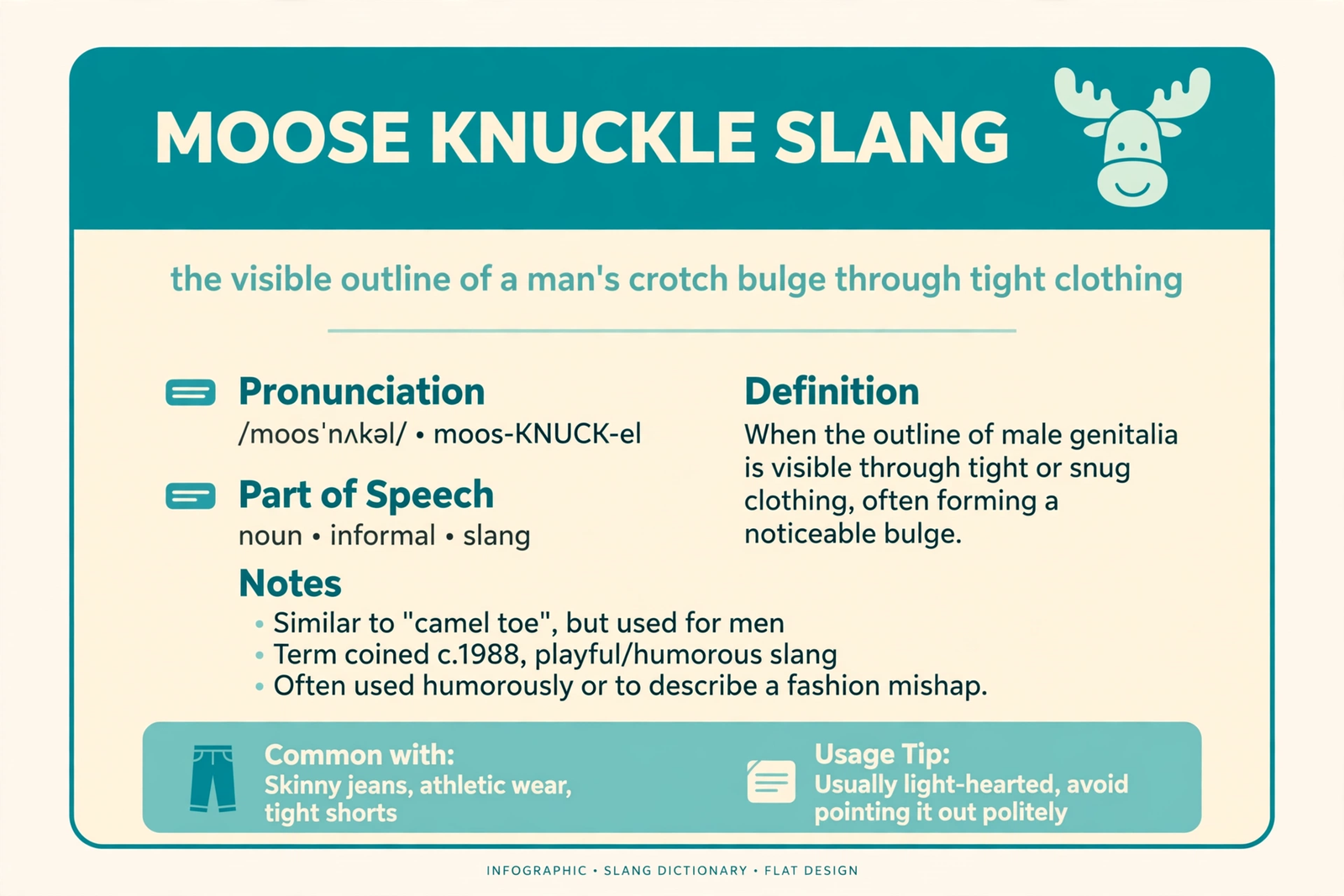
Quick definition: Moose knuckle slang means the visible outline of a man’s genitals through tight clothing, like gym shorts, leggings, or swim trunks. It is the male version of “camel toe,” and people almost always use it as a joke, a tease, or a fashion warning.
Moose Knuckle Slang Meaning & Definition
Moose knuckle slang describes what happens when a man’s pants, shorts, or underwear fit so tightly in the front that the shape of his anatomy shows clearly through the fabric. The name comes from the way the bulge resembles the large, cloven hoof of a moose — wide, rounded, and impossible to miss.
The term is almost always informal and humorous. Nobody uses “moose knuckle” in a formal report or a polite conversation. It lives in locker rooms, group chats, memes, and comedy routines, where it works as a quick, visual punchline. When someone says, “Bro, you’ve got a serious moose knuckle going on,” they are not giving a compliment about his outfit. They are telling him his clothes are too tight, and everyone can see it.
Here is the simplest way to remember it:
- What it is: the outline of male genitalia visible through tight clothing.
- When it happens: with tight gym shorts, leggings, cycling shorts, swimwear, or pants that are a size too small.
- How it sounds: funny, teasing, and a little crude — never formal or polite.
- Female equivalent: camel toe, which describes the same effect on women’s clothing.
Unlike most slang terms that describe an attitude or a feeling, moose knuckle describes a very specific visual situation. That is exactly why it sticks in people’s minds. You hear it once, you picture it instantly, and you never forget what it means. It belongs to the same family of blunt, body-based slang as sus and other terms that spread through group chats and social media, but it is far more visual than any of them.
Introduction
Some slang words need a whole paragraph of explanation. Moose knuckle is not one of them. The moment someone says it, the image forms in your head, and you either laugh or wince. It is one of the most vivid terms in modern English slang, and it has survived for decades without ever becoming polite, mainstream, or safe for work.
The reason it keeps coming up is simple: tight clothing is everywhere. Gym culture, athleisure fashion, cycling, running, and swimming all put men in stretchy, form-fitting outfits. The tighter the fabric, the higher the chance of a moose knuckle. Add smartphones, social media, and meme culture to the mix, and one badly chosen pair of shorts can become a joke seen by thousands of people in a single afternoon.
This article covers everything you need to know about moose knuckle slang: the exact meaning, where the term came from, why it became popular, how people actually use it in real conversations, and how to avoid becoming the example everyone laughs about. You will also find a comparison with similar terms, polite alternatives for professional settings, common mistakes people make when using the term, and answers to the most searched questions about it.
Origin
The term “moose knuckle” has been around much longer than most people think. According to Partridge’s New Dictionary of Slang and Unconventional English, the phrase dates back to at least 1988, around the same time “camel toe” entered the cultural vocabulary. Green’s Dictionary of Slang traces similar usage to the same era, which suggests both terms grew up together as a matched pair — one for men, one for women.
The name itself is a visual joke. A moose’s hoof is cloven, meaning it splits into two rounded parts, and a moose’s knuckle — the joint above the hoof — is thick, knobby, and prominent. When tight fabric presses against the male anatomy, the resulting shape reminded early users of the term of that same knobby, split outline. It is crude, it is visual, and it is instantly understandable, which is why the name stuck when dozens of other slang candidates faded away.
Early uses of the term spread through locker rooms, sports teams, and comedy clubs. It was the kind of word athletes used to roast a teammate whose shorts were too tight, and the kind of word comedians used when they wanted a guaranteed laugh from a crowd. For years it stayed mostly in spoken language. Online dictionaries eventually caught up: Urban Dictionary entries for moose knuckle date back to 2003, and reference sites like Dictionary.com now document the term with a full history of its meaning and origin.
The term also picked up a second life in pop culture. Moose Knuckles is a Canadian outerwear brand, which has nothing to do with the slang meaning but keeps the phrase in front of shoppers every winter. Meanwhile, memes, TikTok videos, and gym humor accounts keep the slang version circulating among younger audiences who may never have heard it in a locker room at all.
Popularity
Moose knuckle is not a term that trends every week, but it never really goes away either. Its popularity follows a steady pattern: it spikes whenever tight men’s fashion is in the news, whenever a celebrity gets caught in ill-fitting shorts, or whenever a viral gym video makes the rounds on TikTok and Instagram.
Several things keep the term alive:
- Gym and athleisure culture: leggings, compression shorts, and fitted training gear are more popular than ever, and they create exactly the conditions for a moose knuckle.
- Social media and memes: a single photo of a celebrity in tight shorts can generate thousands of jokes, comments, and shares within hours.
- Comedy: stand-up comedians and sketch shows use the term because it reliably gets a laugh from almost any adult audience.
- Group chats: friends use it to tease each other, which is how most slang spreads among teenagers and young adults.
The term also benefits from being paired with “camel toe” in almost every discussion. Articles, videos, and social posts that explain one term almost always mention the other, so each term keeps the other visible in search results and everyday conversation. Together they form a matched set that people learn as a pair, much like they learn other opposites in slang.
Search interest in the phrase stays steady year-round, with small spikes during summer, when swimwear and shorts are everywhere, and during major sporting events, when athletes in tight uniforms are on television for hours at a time. It is not the kind of slang that explodes and disappears. It is the kind that quietly stays in the language for decades.
How It Is Used
Moose knuckle is used in three main ways: as a teasing observation, as a fashion warning, and as a joke or punchline. The tone depends entirely on who is speaking and who is listening.
1. As a teasing observation. This is the most common use. A friend notices the outline through someone’s shorts and points it out, usually with laughter. The goal is to embarrass the person lightly, the way friends roast each other about a bad haircut or an ugly shirt. Example: “Dude, those leggings are giving you a full moose knuckle.”
2. As a fashion warning. Sometimes the term is used helpfully, to save someone from embarrassment. A friend, partner, or teammate quietly tells the person before they walk into a public place. Example: “Hey, before you go on stage, you might want to change — you’ve got a bit of a moose knuckle situation.”
3. As a joke or punchline. Comedians, meme creators, and social media users drop the term into a joke because the image it creates is funny on its own. It works as a punchline because the audience instantly understands it without any setup. Example: “His gym shorts were so tight, the moose knuckle had its own zip code.”
The term is almost always used about someone else, not about yourself, and it is rarely a compliment. Even when people say it with a laugh, the underlying message is that something looks wrong or awkward. The one exception is when someone uses it proudly or ironically, usually as a joke about their own confidence — but that is rare, and it only works among close friends who understand the humor.
It is also worth knowing where not to use it. Moose knuckle is not appropriate at work, in school, in front of children, or in any formal or professional conversation. It refers directly to a person’s body, so using it about a stranger or a colleague can come across as harassment rather than humor. Save it for close friends, comedy, and casual online spaces.
Examples
Seeing the term in real sentences is the fastest way to understand how it works. The examples below show the friendly, professional, and funny sides of moose knuckle slang, along with the tone of each one.
| Example | Tone | Context |
|---|---|---|
| “Bro, your shorts are way too tight — total moose knuckle.” | Teasing / friendly | A friend warning another friend at the gym |
| “I can’t unsee the moose knuckle in that photo.” | Humorous | Reacting to a celebrity photo online |
| “He walked into the meeting like the moose knuckle was part of the outfit.” | Funny / exaggerated | A joke between coworkers after work |
| “Those cycling shorts are giving him a serious moose knuckle.” | Observational | Watching a cycling race on TV |
| “Change before we leave, you’ve got a moose knuckle situation.” | Helpful warning | A partner saving someone embarrassment |
| “His moose knuckle was so obvious, even the camera noticed.” | Comedic | A meme caption on social media |
Friendly Examples
Among friends, moose knuckle is a classic roast — sharp enough to be funny, but not so harsh that it ends a friendship. It usually comes with laughter and a suggestion to change clothes.
- “Dude, those new gym shorts are not your friends. Full moose knuckle.”
- “I love you, man, but you cannot wear those leggings to the party.”
- “We need to talk about your shorts. The moose knuckle is doing all the talking right now.”
- “Bro, size up. Nobody needs to see all that at brunch.”
Friendly uses work because everyone in the group understands it is a joke. The person being teased usually laughs, changes, and moves on. The key is that the teasing stays light. If the same joke is repeated over and over, it stops being funny and starts feeling like bullying, so good friends know when to drop it.
Professional Examples
In professional settings, people avoid the term itself and talk around it instead. A manager, stylist, or costume designer would never say “moose knuckle” in a meeting. They use polite, indirect language to solve the same problem.
- “Those trousers are a little snug in the front — let’s try the next size up.”
- “The fit isn’t quite right for camera. Can we adjust the wardrobe?”
- “For the photoshoot, we’ll need a looser cut on the shorts.”
- “The outfit reads a bit tight on screen. Let’s swap it before we go live.”
If you ever need to raise the issue at work, this indirect approach is the right one. It fixes the problem without embarrassing anyone, and it keeps the conversation professional. The slang term stays in the group chat, not in the office.
Funny Examples (if applicable)
Comedy is where moose knuckle truly shines. The term is funny because it is specific, visual, and slightly shocking, which makes it perfect for jokes, memes, and stand-up routines.
- “His shorts were so tight, his moose knuckle filed its own taxes.”
- “The moose knuckle walked in five minutes before he did.”
- “I’ve seen less definition in a bodybuilding competition.”
- “That moose knuckle has more screen time than the main character.”
- “Bro’s gym fit came with a free nature documentary.”
These jokes work because they exaggerate a real, relatable situation. Almost everyone has either seen a moose knuckle or worried about having one, so the humor lands instantly. Like other blunt slang terms such as no cap, the comedy comes from saying out loud what everyone is already thinking.

Comparison with Similar Terms
Moose knuckle is often confused with a few related terms, but each one means something different. The table below shows how it compares with the closest slang words and phrases.
| Term | Meaning | Used For | Tone |
|---|---|---|---|
| Moose knuckle | Visible outline of male genitalia through tight clothing | Men | Humorous, teasing |
| Camel toe | Visible outline of female genitalia through tight clothing | Women | Humorous, teasing |
| Bulge | A general, neutral word for a visible shape under clothing | Anyone | Neutral, descriptive |
| Man toe | A less common nickname for the same thing as moose knuckle | Men | Humorous, informal |
| Crotch bulge | A plain, literal description of the same effect | Men | Neutral to crude |
| Wardrobe malfunction | Any accidental clothing failure, not just tightness | Anyone | Polite, media-friendly |
The most important distinction is between moose knuckle and camel toe. They describe the same kind of effect, but for different genders. Moose knuckle is the male version, camel toe is the female version, and mixing them up is the most common mistake people make with these terms.
“Bulge” is the safe, neutral alternative. If you need to describe the situation without slang and without crudeness, “bulge” is the word to use. “Wardrobe malfunction” is the polite, media-friendly option — it covers any clothing problem, from a torn seam to a visible outline, and it never sounds crude. Reporters and stylists prefer it for exactly that reason.
“Man toe” is worth knowing because it appears in some online discussions, but it is far less common than moose knuckle and sounds more awkward. If you want people to understand you instantly, stick with moose knuckle.

Alternate Meanings
Moose knuckle has a few alternate meanings, but the slang definition is by far the most common one. Here are the others you might run into:
- Moose Knuckles (the brand): a Canadian luxury outerwear company that makes winter jackets and parkas. When someone says “Moose Knuckles jacket,” they are talking about the brand, not the slang term. The plural form and the word “jacket” or “parka” nearby are the clues.
- The animal reference: in hunting and wildlife contexts, a moose’s knuckle is literally the joint of the animal’s leg. This use is rare in everyday conversation and almost never comes up outside of butchery or anatomy discussions.
- Plural confusion: some people say “moose knuckles” when they mean the slang term, but the singular “moose knuckle” is the standard form. The plural is mostly used for the brand name.
There is also an important disagreement in some online dictionaries. A few crowdsourced entries describe moose knuckle as the female equivalent instead of the male one, which is the opposite of the standard meaning. That confusion comes from people mixing it up with camel toe. The widely accepted definition — the one used by Dictionary.com, Green’s Dictionary of Slang, and most reference sites — is the male version. When in doubt, trust the male definition, because that is the one most people understand.
Context usually makes the meaning clear. If the conversation is about fashion, gym clothes, or a funny photo, it is the slang term. If it is about winter jackets, it is the brand. If it is about wildlife, it is the animal. In almost every case you will encounter online, it is the slang term.
Professional or Polite Alternatives
Because moose knuckle is crude by nature, you need polite alternatives for any situation where the slang would be inappropriate. Here are the best options, from most formal to most casual:
| Instead of “moose knuckle,” say… | Best for |
|---|---|
| “The fit is a bit tight in the front.” | Work, school, customer service |
| “Those shorts are a little snug.” | Polite conversation with anyone |
| “Wardrobe malfunction” | Media, public statements, formal writing |
| “The outfit isn’t quite right for camera.” | Photoshoots, TV, presentations |
| “You might want a looser fit.” | Helpful advice to a friend or family member |
| “Visible bulge” | Neutral description when you must be direct |
The general rule is simple: if you would not say it in front of your boss, your teacher, or your grandmother, do not say “moose knuckle.” Use one of the alternatives above instead. They communicate the same message — the clothes are too tight — without the crude image or the joke that comes with the slang term.
This matters because the term describes someone’s body. Even when it is meant as a joke, it can feel like a personal comment about a person’s anatomy. Polite alternatives keep the focus on the clothing, not the body, which is why they work in every setting where the slang does not.
Common Mistakes
People make a few predictable mistakes with moose knuckle slang. Avoiding them keeps you from sounding confused or accidentally rude.
1. Mixing it up with camel toe. This is the number one mistake. Moose knuckle is the male version, camel toe is the female version. Using one for the other gender confuses everyone and makes it clear you do not know the term.
2. Using it in professional settings. The term is crude. Saying it at work, in a classroom, or in a formal email can damage your reputation and make people uncomfortable. Use a polite alternative instead.
3. Saying it about a stranger. Joking about a stranger’s body is not friendly teasing — it is harassment. The term only works among friends who understand the humor. About a stranger, it is rude and can genuinely upset the person.
4. Repeating it too many times. One joke about a moose knuckle is funny. The fifth joke about the same person’s shorts is bullying. Know when the joke has landed and move on.
5. Thinking it is always an insult. Sometimes the term is used as a warning to help someone, not to mock them. Context and tone decide whether it is friendly or mean. A quiet, private warning is helpful. A loud joke in front of a crowd is humiliating.
6. Using the plural when you mean the slang. “Moose Knuckles” with an “s” usually means the jacket brand. For the slang term, use the singular “moose knuckle.” Getting this wrong can confuse your reader, especially in writing.
7. Assuming everyone knows what it means. Older people, non-native English speakers, and people outside North American slang culture may not know the term. If someone looks confused, explain it plainly instead of repeating it louder.

Quick Tips
Whether you want to use the term correctly or avoid the fashion problem it describes, these quick tips cover both sides.
Tips for using the term:
- Use it only with close friends and in casual settings — never at work or school.
- Keep the tone light. One joke is enough; do not turn it into a running gag.
- If you are warning someone, do it privately. A quiet word saves embarrassment; a public joke creates it.
- Never use it about a stranger. That crosses the line from humor into harassment.
- In writing, use the singular form “moose knuckle” for the slang meaning.
Tips for avoiding a moose knuckle:
- Choose the right size. Shorts, leggings, and swim trunks that are too small are the main cause. If the fabric pulls tight across the front, go up a size.
- Pick thicker fabrics. Thin, stretchy material shows everything. Heavier fabrics and lined shorts hide far more.
- Wear supportive underwear. Well-fitted briefs or compression underwear keep things in place and reduce the visible outline.
- Check before you leave. A quick look in the mirror — sitting and standing — catches problems before anyone else does.
- Avoid light colors in thin fabric. White or pale grey leggings and shorts are the worst offenders. Darker colors and patterns are much more forgiving.
- Try a longer cut. Longer shorts and a shirt that covers the waistband area reduce the chance of an obvious outline.

FAQ
What does moose knuckle slang mean?
Moose knuckle slang means the visible outline of a man’s genitals through tight clothing, such as gym shorts, leggings, or swim trunks. It is the male equivalent of camel toe, and it is used as a humorous or teasing term.
Is moose knuckle the same as camel toe?
No. They describe a similar effect but for different genders. Camel toe refers to the visible outline of a woman’s anatomy through tight clothing, while moose knuckle refers to the male version. Mixing them up is the most common mistake people make with these terms.
Where did the term moose knuckle come from?
The term dates back to at least 1988, according to slang dictionaries, and it comes from the visual resemblance between the outline created by tight clothing and the cloven hoof and knobby knuckle of a moose. It spread through locker rooms, sports teams, and comedy before reaching the internet.
Is it rude to say moose knuckle?
It depends on the context. Among close friends, it is usually a lighthearted joke. At work, at school, in front of strangers, or about someone you do not know well, it can feel rude or even harassing because it comments on a person’s body. In polite settings, use an alternative like “the fit is a bit tight.”
Why is it called a moose knuckle?
It is called a moose knuckle because the shape created by tight fabric resembles the large, rounded, cloven hoof and knuckle joint of a moose. The name is a visual joke, and that vivid image is exactly why the term has survived for decades.
How do you avoid a moose knuckle?
Wear the right size, choose thicker or lined fabrics, wear supportive underwear, and check your outfit in a mirror before leaving the house. Darker colors and longer cuts also help, while thin, light-colored leggings and shorts make the problem worse.
Is moose knuckle a compliment?
Almost never. It is usually a tease or a fashion warning, meaning the clothes are too tight and the outline is too visible. In rare cases among close friends it is used ironically as a joke about confidence, but you should not assume it is a compliment.
What is the polite way to say moose knuckle?
The polite alternatives are “the fit is a bit tight in the front,” “those shorts are a little snug,” or “wardrobe malfunction.” These phrases communicate the same message about the clothing without the crude slang or the focus on the person’s body.
Conclusion
Moose knuckle slang is one of the most visual terms in modern English — a funny, blunt phrase for the outline of a man’s anatomy showing through tight clothing. It has been around since at least 1988, it is the male counterpart to camel toe, and it survives because tight gym wear, athleisure, and social media keep creating new examples every single day.
The key takeaways are simple. First, know exactly what it means: a visible outline caused by clothing that is too tight, not a body type or a fashion choice. Second, use it only where it belongs — among close friends, in comedy, and in casual conversation — and never at work, at school, or about a stranger. Third, if you are on the receiving end, the fix is easy: a better size, thicker fabric, supportive underwear, and a quick mirror check before you leave the house.
Slang like this works because it says in two words what would take a whole sentence to explain politely. That is also why it needs care. Used well, it is a quick laugh between friends. Used badly, it embarrasses someone for no reason. Now that you know the meaning, the origin, and the rules, you can use it correctly — and if you ever spot one in the wild, you will know exactly what to call it and exactly how to handle it.
Want to keep building your slang vocabulary? Check out our guides to slay meaning slang and BFE meaning next — both break down popular terms the same clear, no-nonsense way.
