
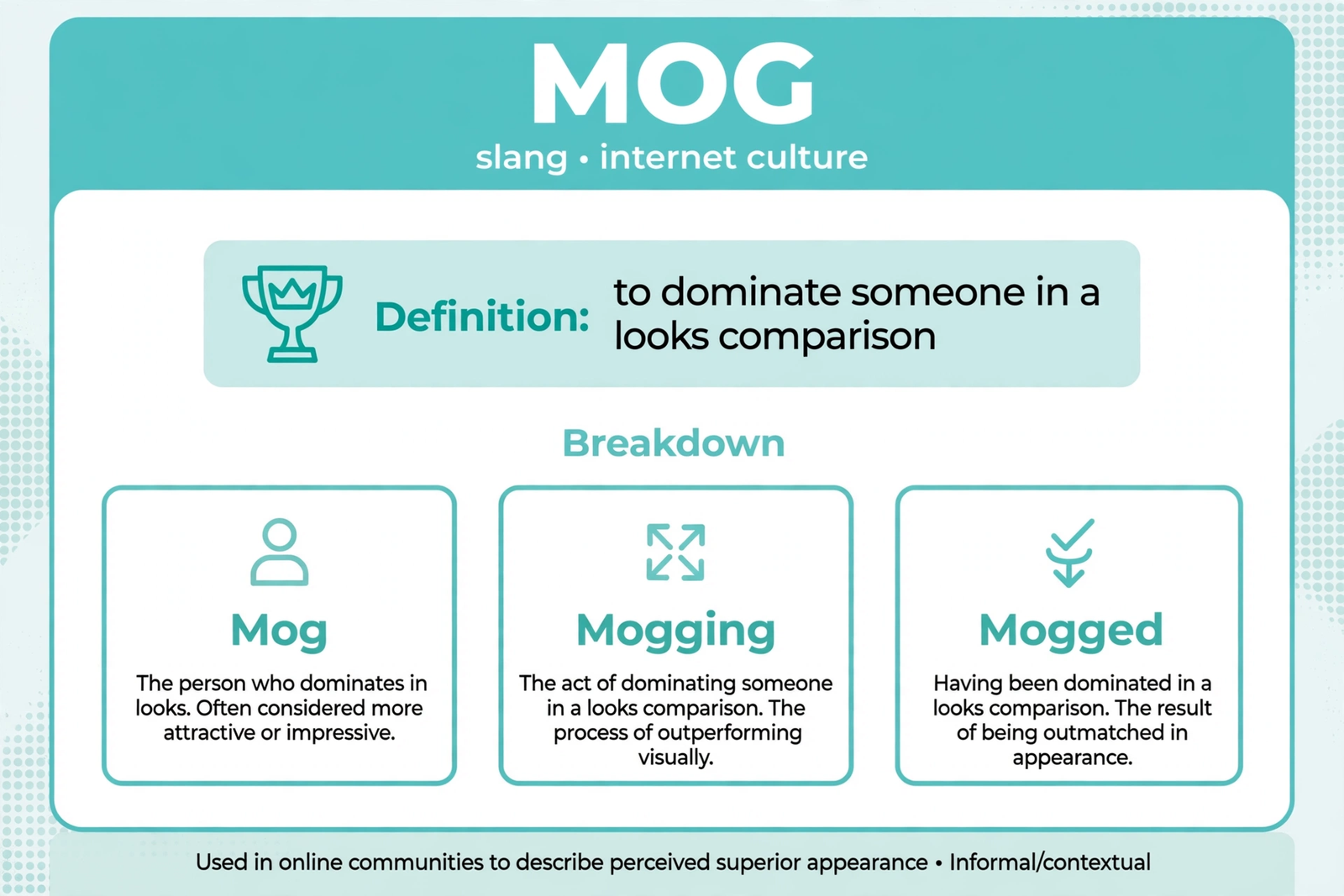
Quick Definition: In slang, mog means to dominate, outclass, or completely overshadow someone — usually in looks, height, or style. If someone says “he mogs you,” they mean that person looks so much better than you in comparison that there is no contest. Mog meaning slang comes from looksmaxxing and TikTok culture, where side-by-side photo comparisons turned “getting mogged” into one of the internet’s favorite ways to rank attractiveness.
Mog Meaning Slang Meaning & Definition
Mog is a slang verb that means to overpower someone in a comparison, especially a visual one. The most common form you will see online is mogging — the act of dominating someone else in looks — and mogged, the past tense, which describes the person who lost the comparison.
Here is the simplest way to understand it: imagine two people standing in the same photo. One has a sharper jawline, better height, and stronger style. The internet looks at that photo and says the first person “mogs” the second. The comparison can be about almost anything visible — jawline, height, hair, shoulders, or overall presence — but the core idea never changes: one person clearly wins, and the other one does not stand a chance.
| Form | Meaning | Example |
|---|---|---|
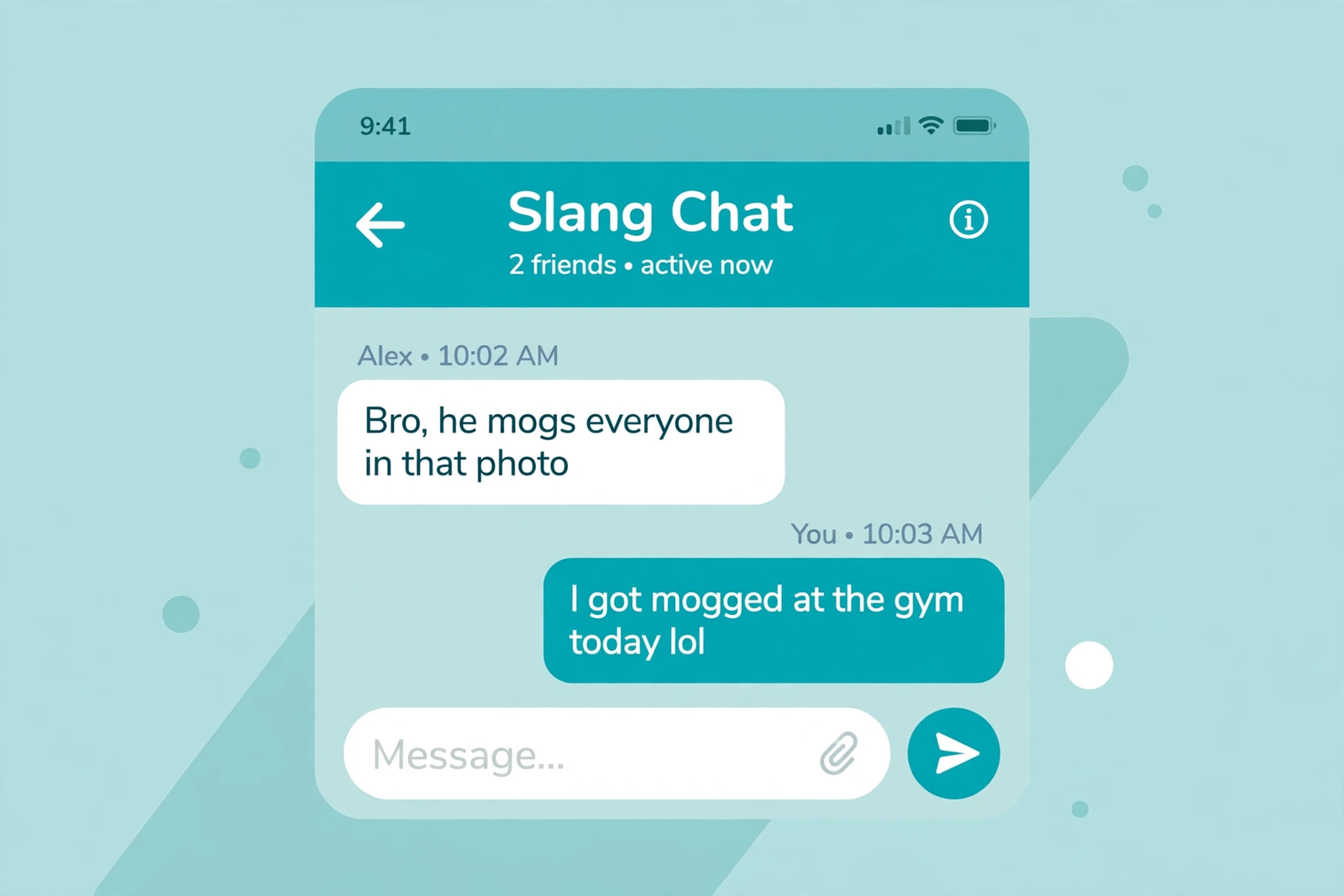
| Mog | To dominate someone in a comparison | “He mogs everyone in that photo.” |
| Mogging | The act of dominating someone | “The mogging in this video is unreal.” |
| Mogged | Having been dominated in a comparison | “I got mogged at the gym today.” |
| Mogger | A person who constantly mogs others | “He is a certified mogger.” |
| Height mog | Dominating someone because of height | “He got height mogged at the party.” |
| Jaw mog | Dominating someone with a stronger jawline | “That jawline mogs the whole room.” |
Unlike many slang words that stay vague, mog is brutally specific. It always describes a one-sided comparison. Nobody says “we mogged each other.” One person mogs, the other gets mogged, and everyone watching knows exactly who won. That is why the word spread so fast: it packs an entire verdict — a winner, a loser, and a crowd reaction — into three letters.
Introduction
You scroll TikTok and see a video of two guys standing next to each other. The comments are full of one word: “mogged.” You check a group chat and your friend texts, “Bro, I just got mogged by a 6’5 guy at the gym.” You have no idea what anyone is talking about — but everyone else seems to find it hilarious.
Welcome to mog, one of the most competitive slang words on the internet. It grew out of the looksmaxxing community, exploded across TikTok and Instagram, and is now part of everyday Gen Z and Gen Alpha vocabulary. It is funny, it is harsh, and it is surprisingly useful once you understand the rules behind it.
In this guide, we will break down exactly what mog means, where it came from, how people actually use it in texts and on TikTok, and how it compares to similar slang like looksmaxxing, chopped, and aura. By the end, you will not only understand every “mogged” comment you see — you will know exactly when to use the word yourself and when to stay far away from it.
Origin
The story of mog starts in two different corners of the internet that eventually collided.
The AMOG theory (2000s): The most widely cited origin traces mog back to AMOG, short for “Alpha Male Of the Group,” a term from the pickup-artist forums of the 2000s. To “AMOG” someone meant to out-alpha them in a social situation — to be the more dominant, more impressive man in the room. Over time, forum users shortened AMOG to “mog,” and the meaning shifted from social dominance to visual dominance: outshining someone in looks rather than in conversation.
The looksmaxxing explosion (2020s): The word found its real home in the looksmaxxing community — online spaces obsessed with maximizing physical attractiveness through jawline exercises, hairstyles, skincare, and posture. On forums like Looksmax.org, users posted photos of themselves next to celebrities or other users and asked, “Do I mog him?” The verdict was always a brutal yes or no. Around 2022 and 2023, TikTok creators picked the word up, and “mog battles” — side-by-side photo comparisons set to dramatic music — became a viral video format.
Why it stuck: Mog survived because it fills a gap in the language. Before mog, there was no single casual word for “that person looks dramatically better than the person next to them.” Slang like “outshine” sounds formal, and “destroyed” sounds violent. Mog is short, punchy, and funny — perfect for comment sections where the verdict has to land in one word.
Popularity
Mog went from niche forum slang to mainstream internet vocabulary in roughly two years. A few forces drove that rise:
- TikTok mog battles: Creators post split-screen comparisons of celebrities, athletes, or random people, and viewers vote on who mogs whom. These videos routinely get millions of views because the verdict is instant and the debate in the comments is endless.
- Gym and fitness culture: Height mogs and frame mogs are daily conversation in gym communities, where physical comparison is already the norm. “I got mogged at the gym” became a self-deprecating joke for anyone who stood next to someone taller or more built.
- Gaming and streaming: Streamers use mog for skill as well as looks — “he mogs you in aim” — which carried the word into gaming chats and Discord servers.
- Gen Alpha adoption: Younger users picked mog up from TikTok and started using it at school, in group chats, and in Roblox and Fortnite lobbies, pushing it far beyond its looksmaxxing roots.
Today, mog is one of those rare slang words that works across platforms. It shows up on TikTok, Instagram Reels, X (Twitter), Reddit, Discord, and in real-life conversations among teens and young adults. It is not quite as universal as “slay” or “no cap” yet, but it is well on its way — and the fact that people keep asking “what does mog mean” is proof that it is still spreading.
How It Is Used
Mog is flexible, but it follows a few clear patterns. Here is how people actually use it:
- As a verb: “He mogs you.” / “She mogs the entire cast.” This is the most common form — one person dominating another in a comparison.
- As a past-tense roast: “You got mogged.” Usually said jokingly after a photo or video where someone clearly lost the looks comparison.
- With a specific feature: “Height mog,” “jaw mog,” “hair mog,” “style mog,” “frame mog.” Adding the feature tells everyone exactly how the mogging happened.
- As a noun for the act: “The mogging in that video is crazy.” Here, mogging describes the whole event, not one person.
- Self-deprecatingly: “I walked in and immediately got mogged by everyone.” People use it on themselves to joke about feeling outclassed.
- For skill, not just looks: “He mogs you in every game.” The meaning stretches from appearance to any competition where one person is clearly better.
The tone matters more than the grammar. Mog is almost always playful or competitive, even when it sounds harsh. Friends mog each other as a joke; strangers in comment sections mog celebrities they will never meet. It only turns mean when it is aimed at someone’s real insecurity in a serious context — and that is exactly the line you should not cross.
Examples
Real examples show how mog works better than any definition. Here are the main situations you will see it in:
Friendly Examples
- “Bro, your new haircut mogs your old one. Keep it.”
- “We took a group photo and Jake mogged all of us. Unfair.”
- “Your fit today mogs mine, I am not even mad.”
- “He walked into the gym and mogged the whole room without trying.”
Professional Examples
- “Our competitor’s new ad campaign mogs ours — we need to step up.” (used casually at work among younger colleagues)
- “That portfolio mogs mine. I need to rebuild everything.”
- “Her presentation mogged every other talk at the conference.”
Funny Examples
- “My cat mogs your dog. Look at that face.”
- “The baby in that video mogs every model on the runway 😂”
- “I got height mogged by a 12-year-old today. I need to sit down.”
- “POV: You get mogged by your own reflection.”
Notice the pattern: in every example, there is a clear winner and a clear loser, and the comparison is visual or competitive. If you can picture two things side by side and one obviously wins, mog fits.
Comparison with Similar Terms
Mog gets confused with several other slang words, but each one means something different. This table clears it up:
| Term | Meaning | How It Differs from Mog |
|---|---|---|
| Mog | Dominate someone in a comparison | The baseline: a one-sided visual or skill comparison |
| Slay | To look amazing or perform perfectly | Slay praises one person; mog needs a loser too |
| Ate | Did something flawlessly | Ate is about performance; mog is about beating someone else |
| Chopped | Unattractive or looking bad | Chopped describes one person; mog describes the gap between two |
| Cooked | Finished, done for, embarrassed | Cooked is about failure; mogged is about losing a comparison |
| Aura | A person’s vibe or presence | Aura is a quality you have; mog is something you do to someone |
| Ratio | Getting more likes than a post you replied to | Ratio is a numbers game on social media; mog is a visual verdict |
| Looksmaxxing | Trying to maximize your attractiveness | Looksmaxxing is the effort; mogging is the result |
The closest cousins are slay and ate, because all three celebrate looking good. The difference is competition: you can slay alone in your bedroom mirror, but you can only mog someone else. That competitive edge is the whole point of the word — and the reason it thrives in comment sections where people love picking winners. If you want the full picture of the culture mog came from, our guide to looksmaxxing meaning explains the community that made the word famous, and the mewing meaning guide covers the jawline trend that shows up in half of all mog battles.

Alternate Meanings
Like most slang, mog has a few other meanings depending on where you see it:
- Mog as a name: Mog is a popular cat name — most famously Mog the cat from Judith Kerr’s beloved children’s books. If someone says “Mog is sleeping on my bed,” they probably mean the cat, not a dominance battle.
- Moggy: In British slang, a “moggy” (or “mog”) is a cat, especially a non-pedigree one. “That moggy is huge” has nothing to do with looksmaxxing.
- MOG as an acronym: In gaming and tech, MOG has been used for “Multiplayer Online Game” and similar phrases, and a few brands and products use the name. Context makes the meaning obvious.
- Mog in music: Some people use “mog” as a shortened nickname or handle online, with no slang meaning at all.
Here is the rule: if the conversation is about looks, TikTok, or comparisons, mog means dominate. In any other context — cats, gaming acronyms, names — it is probably something else entirely. The slang meaning is by far the most common one online today, which is why this guide focuses on it.
Professional or Polite Alternatives
Mog is fun in group chats and comment sections, but it does not belong everywhere. In formal or professional settings, use one of these instead:
| Instead of Mog | Say This | When to Use It |
|---|---|---|
| “He mogs everyone” | “He really stands out” | Complimenting someone politely |
| “She got mogged” | “She was outshined” | Describing a comparison gently |
| “That campaign mogs ours” | “That campaign outperforms ours” | Work or business discussions |
| “He mogs you in every game” | “He outperforms you consistently” | Talking about skill |
| “Your fit mogs mine” | “Your outfit is on another level” | Complimenting a friend’s style |
The point is simple: mog is a competitive, slightly savage word. In professional emails, job interviews, or conversations with people who do not follow internet slang, plain language always works better. Save mog for the group chat, where everyone understands the joke.
Common Mistakes
People get mog wrong in a few predictable ways. Avoid these and you will always sound natural:
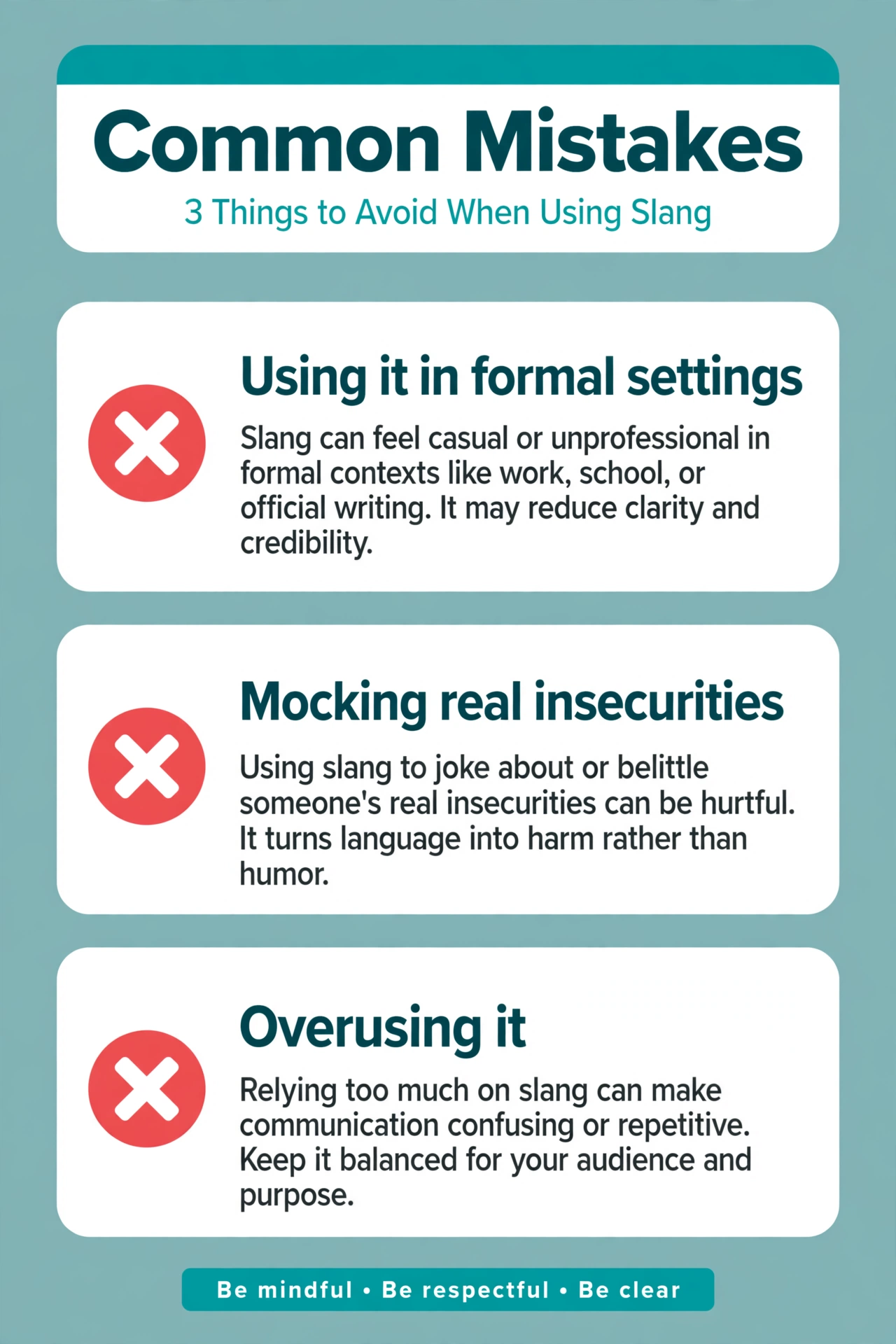
- Using it in formal settings: Telling your boss someone “mogged” the team in a meeting will get you confused stares. Keep it casual.
- Mogging someone about an insecurity: Joking that a friend got “mogged” is fine when everyone is laughing. Using it to mock someone’s real insecurity — their height, their weight, their face — is just bullying with slang on top.
- Thinking it only means looks: Mog started with looks, but people now use it for style, height, skill, and even wealth. Limiting it to faces misses half the usage.
- Confusing mog with moggy: If a British person talks about their “mog,” they may mean their cat. Do not congratulate the cat on dominating anyone.
- Overusing it: Like any slang, mog gets annoying fast if every sentence has it. Use it when there is a real comparison to make, not as a filler word.
- Calling yourself a mogger seriously: “I mog everyone” only works as a joke. Said seriously, it sounds arrogant — and the comments will let you know.
- Using it without a comparison: “This pizza mogs” makes no sense unless you are comparing it to another pizza. Mog always needs a loser, even an implied one.
Quick Tips
Want to use mog like a native? Follow these tips:
- Read the room first: Mog works best in casual chats, TikTok comments, and gaming lobbies. Skip it in class presentations and work emails.
- Pair it with a feature: “Height mog” and “jaw mog” sound sharper and funnier than a plain “mog” — and they tell the reader exactly what happened.
- Use it on yourself first: Self-deprecating mog jokes (“I got mogged by a toddler”) land better than mogging other people, and they make you sound confident rather than mean.
- Keep it visual: Mog hits hardest when people can see the comparison — a photo, a video, or two people standing together. In pure text, add context so the joke lands.
- Know when to stop: If someone is clearly upset by a “mogged” joke, drop it. The word is meant to be funny, not hurtful.
- Learn the family: Mog, mogging, mogged, and mogger all work the same way. Master one and you have all four. For a related concept, see our aura points meaning guide — aura and mog are the two words that run TikTok’s entire ranking culture.


FAQ
1. What does mog mean in slang?
In slang, mog means to dominate or outclass someone in a comparison, usually about looks, height, or style. If someone “mogs” you, they look noticeably better than you in that comparison. It comes from looksmaxxing and TikTok culture.
2. What does mogged mean?
Mogged is the past tense of mog. It means you lost a comparison — someone looked better, taller, or more stylish than you in a photo, video, or real-life moment. “I got mogged at the gym” is a common self-deprecating joke.
3. Where did mog come from?
Mog most likely comes from AMOG (“Alpha Male Of the Group”), a term from 2000s pickup-artist forums, shortened to “mog” and adopted by the looksmaxxing community in the early 2020s. TikTok then spread it to mainstream Gen Z and Gen Alpha audiences.
4. What is mogging on TikTok?
On TikTok, mogging usually means posting side-by-side “mog battle” videos where viewers judge who looks better. Creators also use the word in comments, captions, and edits — often with dramatic music — to declare a winner in a looks comparison.
5. Is mogging an insult?
It depends on the context. Between friends and in comment sections, it is usually a playful roast. But aimed at someone’s real insecurity in a serious moment, it can feel like an insult. The intent and the relationship matter more than the word itself.
6. What does “height mog” mean?
Height mog means dominating someone specifically because you are taller than them. It is one of the most common forms of mogging, along with “jaw mog” (stronger jawline) and “frame mog” (broader shoulders and build).
7. Can anyone mog, or is it only for guys?
Anyone can mog. The word started in male-dominated looksmaxxing spaces, but today people use it for women, men, celebrities, athletes, and even pets — anyone who clearly outshines someone else in a comparison.
8. How do I reply when someone says I got mogged?
Laugh it off or flip it into a joke: “Fair, he mogs everyone 😂” or “Let me hit the gym and run it back.” Getting defensive makes it worse; owning the joke makes it disappear. If the comment was genuinely mean, you do not owe it a reply at all.
Conclusion
Mog meaning slang is simple once you see it in action: to dominate a comparison so clearly that everyone notices. It started as forum shorthand, grew up in the looksmaxxing community, and became a TikTok staple — and now it is one of the internet’s favorite ways to crown a winner in any visual showdown.
The key takeaways are easy to remember. Mog always needs a comparison — a winner and a loser. It works for looks, height, style, and even skill. It is playful between friends, funny in comment sections, and best avoided in formal settings or aimed at real insecurities. And if you ever get mogged yourself, the best response is the same one the internet uses: laugh, hit the gym, and run it back.
Now you know what every “mogged” comment means, how to use the word naturally, and when to leave it alone. For more slang that rules the same comment sections, check out our guides on looksmaxxing, chopped, and aura points — together, they explain half the vocabulary on your For You page. And if you want the community’s own definition, Urban Dictionary’s entry for mogging is where most people first looked it up.

1 thought on “Mog Meaning Slang: What Does Mog Mean & How to Use It (2026)”