
Millenial Slang Meaning & Definition
Millenial slang is the informal language, abbreviations, and catchphrases popularized by millennials — people born roughly between 1981 and 1996 — during the rise of the internet, texting, and social media. It includes words like lit, bae, YOLO, on fleek, adulting, and throwing shade, most of which spread through AIM chats, Tumblr, Twitter, Vine, and early Instagram before becoming part of everyday English.
In short: if a word feels like it came straight out of a 2014 Tumblr post, a BuzzFeed listicle, or a group chat from the Obama era, it is probably millenial slang. Some of these terms have faded, some have gone fully mainstream, and a few are now so normal that people forget they were ever slang at all.
| Term | Quick meaning |
|---|---|
| Millenial slang | Informal words and phrases made popular by the millennial generation online |
| Peak era | Roughly 2008–2016, the Tumblr–Twitter–Vine years |
| Where you see it | Texts, memes, social media captions, casual workplaces, pop culture |
| Still used today? | Yes — many terms went mainstream; others survive as nostalgia or irony |
Introduction
Every generation invents its own way of talking, but millennials were the first to do it in public, in real time, and in writing. Before them, slang travelled by word of mouth — through school hallways, music, and television. Millennials had something new: the group chat, the timeline, and the meme. A joke made on Tumblr on Monday could be in everyone’s Twitter bio by Friday.
That is why millenial slang feels so familiar even to people who never used it seriously. Words like lit, slay, bae, and basic escaped the internet and landed in advertising, TV scripts, and even news headlines. Some of it now sounds dated — saying “YOLO” unironically in 2026 will get you a look — but much of it quietly became standard English. You probably said something was “awkward” or called a situation “a hot mess” this week without realizing both were once peak millennial slang.
This guide breaks down what millenial slang really is, where it came from, the 40+ words you are most likely to hear, how they compare to Gen Alpha slang, and the mistakes to avoid when you use them. Whether you are a millennial feeling nostalgic, a Gen Z kid decoding your older cousin’s texts, or a marketer trying not to sound like a cringe brand account, you will find the answer here.

Origin
Millenial slang did not appear out of nowhere. It grew out of three overlapping forces: the technology millennials grew up with, the economic moment they came of age in, and the platforms that rewarded short, funny, shareable language.
1. The texting era. Early mobile phones charged per message and limited texts to 160 characters, so shortening words was practical before it was cool. LOL, OMG, BRB, and TTYL were survival tools first and slang second. As phones got smarter, the abbreviations stayed — and multiplied.
2. The social media explosion. Between 2008 and 2016, Facebook, Twitter, Tumblr, Instagram, and Vine gave millions of young adults a public stage. Tumblr, in particular, was a slang factory: its reblog culture let a phrase jump from one niche blog to millions of dashboards overnight. Words like on fleek (from a 2014 Vine by Peaches Monroee) and bae (popularized through memes and music) went from a single post to national vocabulary in weeks.
3. The recession generation. Millennials entered adulthood during the 2008 financial crisis, and their slang reflects it. Adulting — doing boring grown-up tasks like paying bills or doing laundry — turned the struggle into a joke. I can’t even captured a specific kind of overwhelmed exhaustion. The humour was self-deprecating because the circumstances often were.
Music, reality TV, and Black Twitter also shaped the vocabulary enormously. Many of the most famous millennial terms — throwing shade, slay, on fleek, yas, woke — originated in Black culture and LGBTQ+ ballroom culture before crossing into the mainstream, a history worth knowing before you use them.
Popularity
Millenial slang peaked in the mid-2010s, when “YOLO” was named one of the defining words of the decade and brands were falling over themselves to sound relatable. BuzzFeed built an empire on listicles written in the voice of the internet. Every major brand’s Twitter account tried to be funny, and the ones that succeeded borrowed heavily from millennial vocabulary.
The slang spread so far that dictionaries started catching up. Merriam-Webster added many of these terms over the years, and you can still check the formal definition of millennial to see how the generation itself is defined. What started as internet jokes became documented English.
So why did it fade? Two reasons. First, generations move on: Gen Z arrived with its own vocabulary (no cap, rizz, slay in a new sense), and using your older sibling’s slang is the fastest way to sound old online. Second, overuse killed the cool factor. Once a phrase appeared in a bank advertisement, it was finished as slang. That is the life cycle of every slang word: born in a subculture, adopted by the mainstream, killed by a marketing department.
But here is the twist — in 2026, millenial slang is having a nostalgia comeback. TikTok creators in their late twenties and early thirties post “millennial core” videos, ranking old terms and reliving the Tumblr era. Using lit or adulting today is often deliberate: a wink to people who were there. The slang is no longer cutting-edge, but it is a shared cultural memory — and that makes it worth understanding.
How It Is Used
Millenial slang shows up in four main places, and the rules are slightly different in each one:
- Texting and group chats: Short, punchy, and expressive. “This party is lit 🔥” or “I can’t even right now.” Abbreviations save time and add tone.
- Social media captions: Hashtags and captions were the natural home of terms like #blessed, #goals, and throwback Thursday. Captions still use them ironically today.
- Memes and pop culture: Many terms survive mainly as meme formats. Nobody says “YOLO” seriously anymore, but everyone recognizes it as a joke about reckless decisions.
- Casual workplaces: Millennials brought their language to work, which is why “Let’s circle back” sits next to “That meeting was a hot mess” in the same office. Keep it light here — slang in a client email is still a risk.
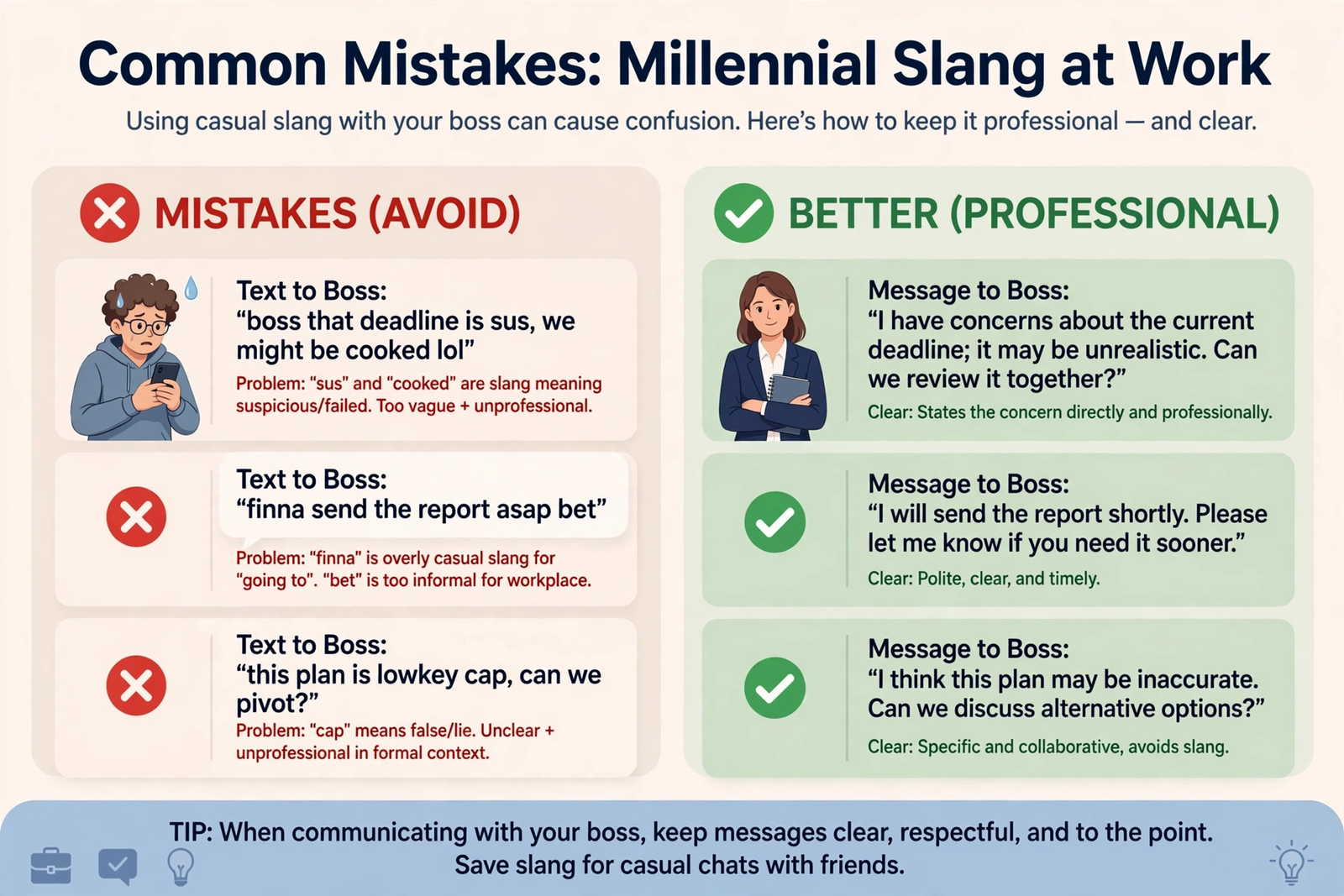
The golden rule: millenial slang works best when it is casual, self-aware, and matched to your audience. With friends your own age, it lands naturally. With Gen Z colleagues, it can sound dated. With your boss, pick the mildest terms — awesome, epic fail, game-changer — and leave turnt and thirsty at home.
Examples
Here are the 40+ millenial slang words you are most likely to encounter, with plain-English meanings and a real example for each.
| Slang word | Meaning | Example |
|---|---|---|
| Lit | Amazing, exciting, fun | “That concert was lit!” |
| Bae | Baby / significant other | “Movie night with bae tonight.” |
| YOLO | You only live once | “Book the flight. YOLO.” |
| On fleek | Perfectly done, flawless | “Her eyebrows are on fleek.” |
| Slay | To do something brilliantly | “She slayed that presentation.” |
| Adulting | Doing grown-up responsibilities | “Paid my rent and did laundry. Adulting is hard.” |
| Basic | Mainstream, unoriginal, clichéd | “Pumpkin spice lattes are so basic.” |
| Throwing shade | Subtly insulting someone | “She was throwing shade at her ex all night.” |
| I can’t even | Too overwhelmed to react | “I can’t even with this plot twist.” |
| Turnt | Excited, drunk, or hyped up | “We got turnt at the party.” |
| Thirsty | Desperate for attention or approval | “He keeps liking all her photos. So thirsty.” |
| Ghosting | Suddenly cutting off contact | “He ghosted me after two dates.” |
| FOMO | Fear of missing out | “I have FOMO about the concert.” |
| GOAT | Greatest of all time | “Serena Williams is the GOAT.” |
| Squad | Close group of friends | “Squad goals right there.” |
| Ship | To support a romantic pairing | “I totally ship them.” |
| Feels | Strong emotions | “That movie gave me all the feels.” |
| Awkward | Socially uncomfortable | “That silence was so awkward.” |
| Hot mess | A chaotic disaster (often funny) | “My hair this morning is a hot mess.” |
| Epic fail | A spectacular failure | “Dropped my phone in the pool. Epic fail.” |
| Low-key | Quietly, secretly, or mildly | “I low-key love that song.” |
| High-key | Openly, obviously, intensely | “I high-key need a vacation.” |
| Salty | Bitter or annoyed | “He’s still salty about losing.” |
| Shade / No shade | An insult / “no offence intended” | “No shade, but that outfit is a choice.” |
| Woke | Socially aware | “Stay woke about what’s happening.” |
| Yas / Yass | An enthusiastic yes | “Yas! That dress is everything.” |
| Extra | Over-the-top, dramatic | “She is so extra with the decorations.” |
| Netflix and chill | Watching Netflix (with implied romance) | “Wanna Netflix and chill tonight?” |
| Troll | Someone who provokes people online | “Ignore him, he’s just a troll.” |
| Stan | An obsessive fan | “I stan that band so hard.” |
| Receipts | Proof or evidence | “I have the receipts — here are the screenshots.” |
| Spill the tea | Share the gossip | “Spill the tea about the party.” |
| Shook | Shocked or surprised | “I am shook by that ending.” |
| Dead / I’m dead | Laughing extremely hard | “That meme has me dead.” |
| Flex | To show off | “He’s flexing his new car again.” |
| Vibe / Vibes | The feeling or atmosphere | “This café has such good vibes.” |
| On point | Exactly right, perfect | “Her outfit is on point today.” |
| Side-eye | A look of suspicion or judgement | “I gave him the side-eye.” |
| Game-changer | Something that changes everything | “This app is a total game-changer.” |
| Snack | Someone attractive | “He is a whole snack.” |
Friendly Examples
With friends, millenial slang is warm, funny, and exaggerated. “OMG, your new place is everything! We are so proud of you. Squad dinner this weekend? I am low-key already planning the menu.” Notice how the slang does the emotional work — everything means “perfect,” low-key softens the enthusiasm, and squad turns a group of friends into a team.
Another classic: “Bae surprised me with tickets and I literally can’t even. Best night ever, no cap — wait, that’s Gen Z. I mean, for real, it was lit.” Even the self-correction is part of the joke, and that is exactly how friends use this slang today: half sincere, half nostalgic.
Professional Examples
At work, only the mildest millennial terms survive, and they usually lose their edge. “That campaign was a game-changer for the team” sounds natural in a meeting. “Let’s circle back after lunch — I want to get this deck on point before the client sees it” is perfectly professional. Even slay has crept into workplace praise: “You slayed that pitch” is now a normal compliment in creative industries.
What does not belong at work: thirsty, turnt, Netflix and chill, and anything about bae. The test is simple — if you would not want it quoted in a company-wide email, keep it in the group chat.
Funny Examples
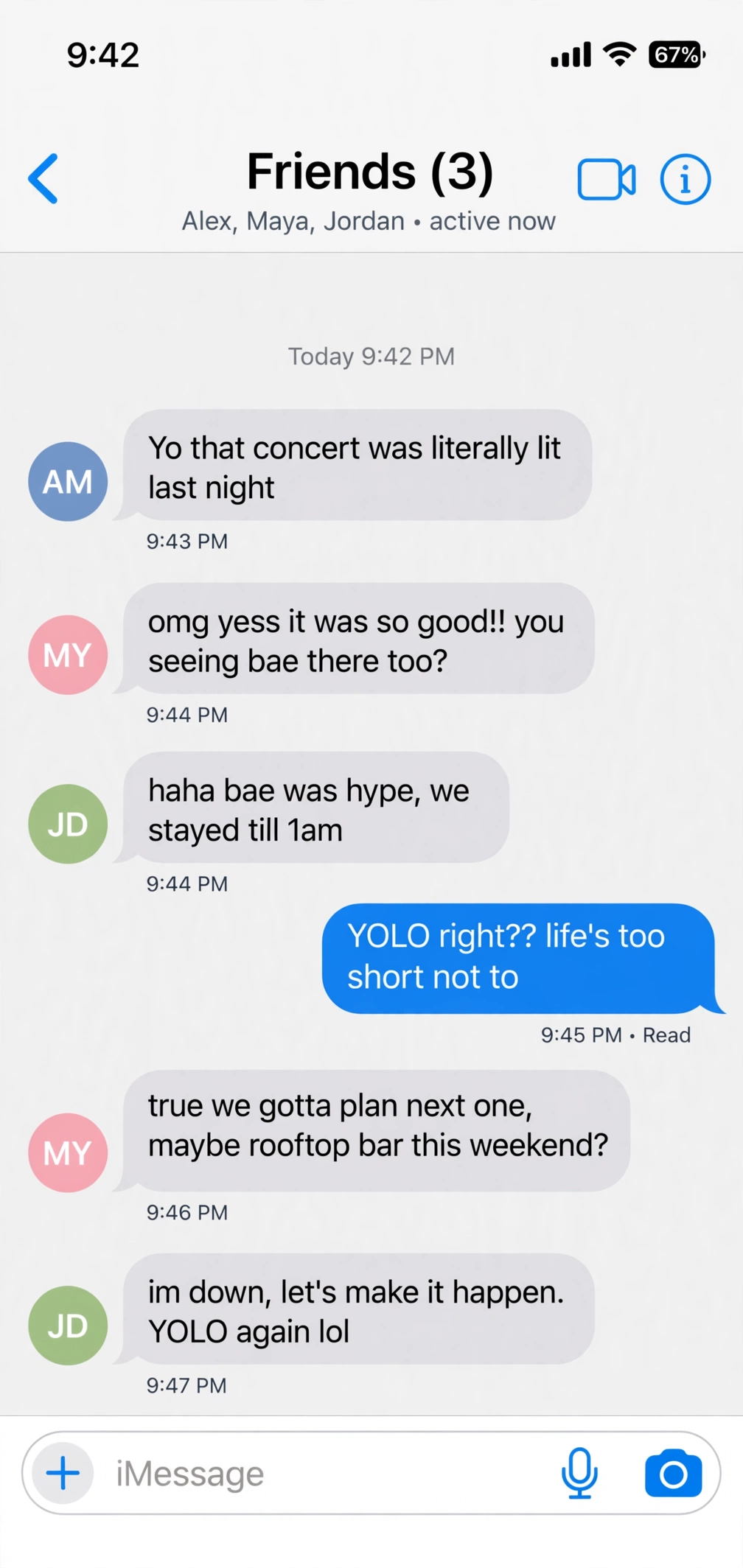
The funniest millennial slang is the kind that has aged badly on purpose. “Adulting is hard. I just Googled ‘how to boil an egg’ at age 32.” Or: “Me: I am going to save money this month. Also me, buying a third scented candle: YOLO.” The joke works because everyone recognizes the contradiction — a generation that invented hustle culture also invented the meme about being too tired to do laundry.
And then there is the classic overreaction: “My Wi-Fi went down for two minutes and I was like, I literally can’t even. This is the worst day of my life.” The drama is the point. Millenial slang was never about being accurate; it was about being entertaining.
Comparison with Similar Terms
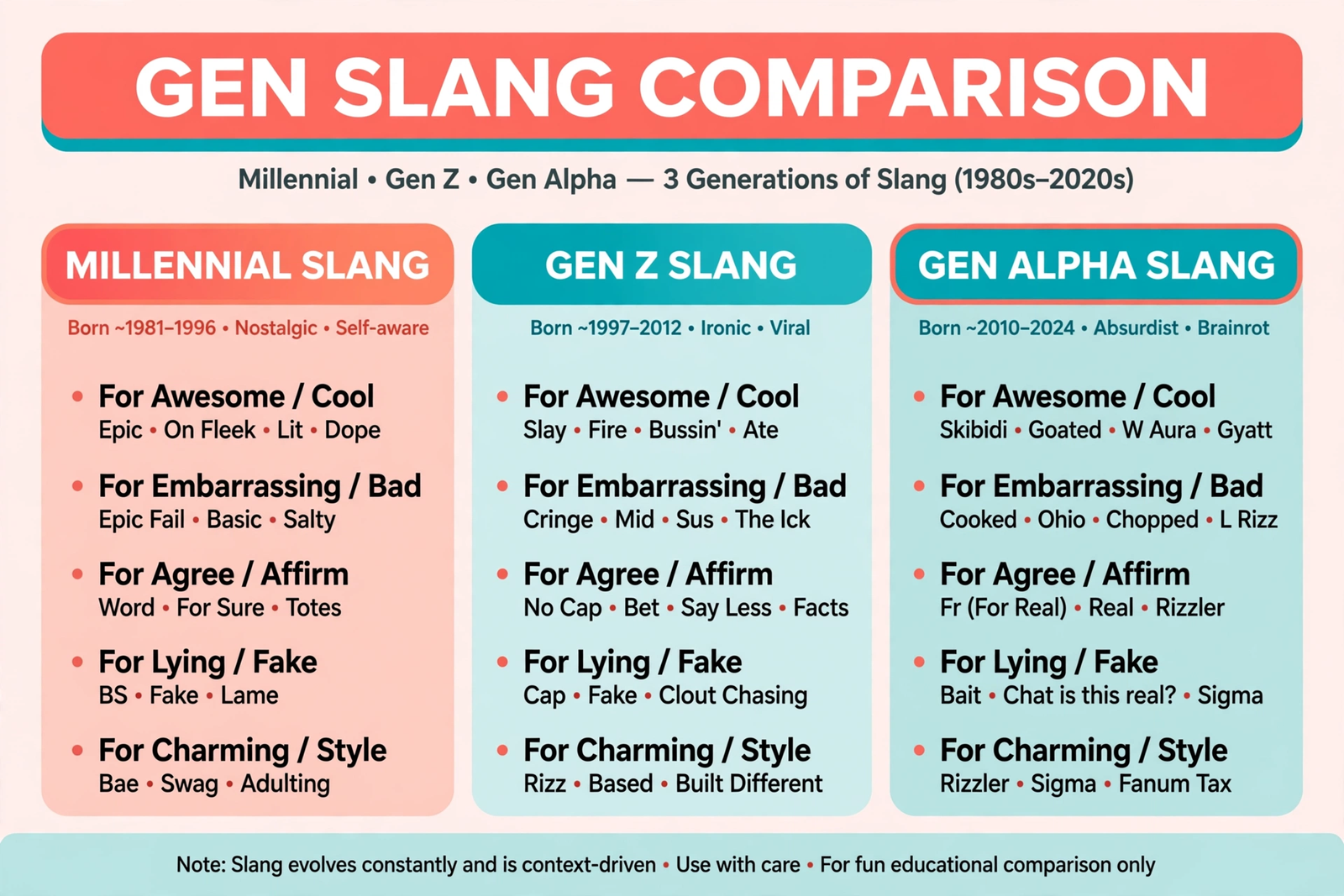
Millenial slang is often confused with the slang of neighbouring generations, but each one has its own flavour. Millennials were ironic and self-deprecating; Gen Z is blunt and absurdist; Gen Alpha is deeply online and gaming-flavoured; boomers had their own classic slang long before the internet existed.
| Feature | Millenial slang | Gen Z slang | Gen Alpha slang |
|---|---|---|---|
| Peak years | 2008–2016 | 2018–now | 2022–now |
| Home platform | Tumblr, Twitter, Vine | TikTok, Discord | TikTok, YouTube, Roblox |
| Signature words | Lit, bae, YOLO, on fleek | No cap, rizz, slay, bet | Skibidi, sigma, Ohio, gyat |
| Tone | Ironic, self-deprecating | Blunt, deadpan, absurdist | Chaotic, meme-driven |
| Emoji style | 😂🔥💯 | 💀😭 (ironic crying) | 🗿🍷 |
| Status in 2026 | Nostalgic, mainstream | Current, evolving fast | Brand new, confusing to adults |
If you want to see how the youngest generation talks, our Gen Alpha slang guide covers 25+ terms with examples. And for a fun contrast, Australian slang shows how the same English language can sound completely different on another continent — “arvo,” “brekkie,” and “no worries” instead of “lit” and “bae.”
Alternate Meanings
Many millenial slang words have more than one meaning, and context is everything. Lit can mean exciting (“the party was lit”), drunk (“he got lit last night”), or literally illuminated (“the room was lit by candles”). Bae is usually a partner, but in Danish it means “poop” — a fun fact that has ruined more than one international text exchange. Slay can mean to perform brilliantly or, in its original sense, to kill — context makes the difference obvious, but the double meaning is why your grandmother raised an eyebrow.
Thirsty is another tricky one: it can mean desperate for attention, but it can also just mean you need water. “I am so thirsty” after a run is not slang at all. Similarly, basic started as an insult for unoriginal taste, but many people now use it affectionately — “I am basic and proud of it” is a whole personality on Instagram.
And a quick spelling note: the keyword for this guide is millenial slang, but the standard spelling of the generation is millennial with two Ns. Both spellings appear in searches, which is why you will see both online. When in doubt, use “millennial” in formal writing.
Professional or Polite Alternatives
Slang is great with friends, but there are times when plain English works better. Here is a quick translation table for formal settings:
| Millenial slang | Professional alternative |
|---|---|
| Lit | Excellent / very enjoyable |
| Slay | Performed exceptionally well |
| I can’t even | I am overwhelmed / surprised |
| Adulting | Managing responsibilities |
| Throwing shade | Being critical / making a pointed remark |
| Ghosting | Ending communication without notice |
| Hot mess | Disorganized / chaotic situation |
| Epic fail | A significant mistake |
| Low-key | Somewhat / quietly |
| Extra | Excessive / over the top |
None of this means you should never use slang at work — a well-placed “game-changer” or “on point” is fine in most modern offices. The trick is knowing which words have crossed into standard English and which ones still belong to the group chat.
Common Mistakes
Using millenial slang wrong is worse than not using it at all. Here are the mistakes people make most often:
- Using dead slang seriously. Saying “YOLO” or “on fleek” with a straight face in 2026 sounds like a time capsule. These words only work now as deliberate jokes.
- Forcing it at work. A manager saying “Let’s get turnt on this Q3 report, squad!” is not relatable — it is a meeting everyone remembers for the wrong reasons.
- Mixing generations badly. “No cap, that party was lit, fam” mashes Gen Z and millennial slang together. Pick one era per sentence.
- Getting the meaning wrong. Bae is a partner, not a best friend. Thirsty is about attention, not actual thirst. Shade is subtle — if it is obvious, it is not shade, it is just an insult.
- Using slang you do not understand. Several famous millennial terms come from Black and LGBTQ+ culture. Using them without knowing their history can come across as careless. When in doubt, look it up first.
- Overdoing it. One slang word per sentence is flavour; five is a parody. “OMG, that lit party was so extra, I can’t even, for real though” is exhausting to read.
- Using it with the wrong audience. Your Gen Z niece will laugh if you say “YOLO” — and not with you. Match the slang to the people you are talking to.
Quick Tips
- Start with the survivors. Words like lit, vibes, ghosting, FOMO, and GOAT are now standard English — safe almost anywhere casual.
- Use slang for tone, not information. Slang adds feeling; plain words carry facts. Lead with the fact, season with the slang.
- Watch the room. In a group chat of thirty-somethings, go wild. In a client meeting, keep it to one mild term at most.
- Embrace the nostalgia. In 2026, millenial slang works best as a shared joke — “adulting is hard” lands because everyone in the room has felt it.
- Learn the origin. Knowing that on fleek came from Vine and slay came from ballroom culture makes you use them more respectfully — and more accurately.
- Do not chase trends. If you missed a slang wave, let it go. Forcing new slang is how “How do you do, fellow kids?” happens in real life.
- Keep it natural. The best slang use is the kind nobody notices. If you have to think hard about whether a word fits, it probably does not.

FAQ
What does millenial slang mean?
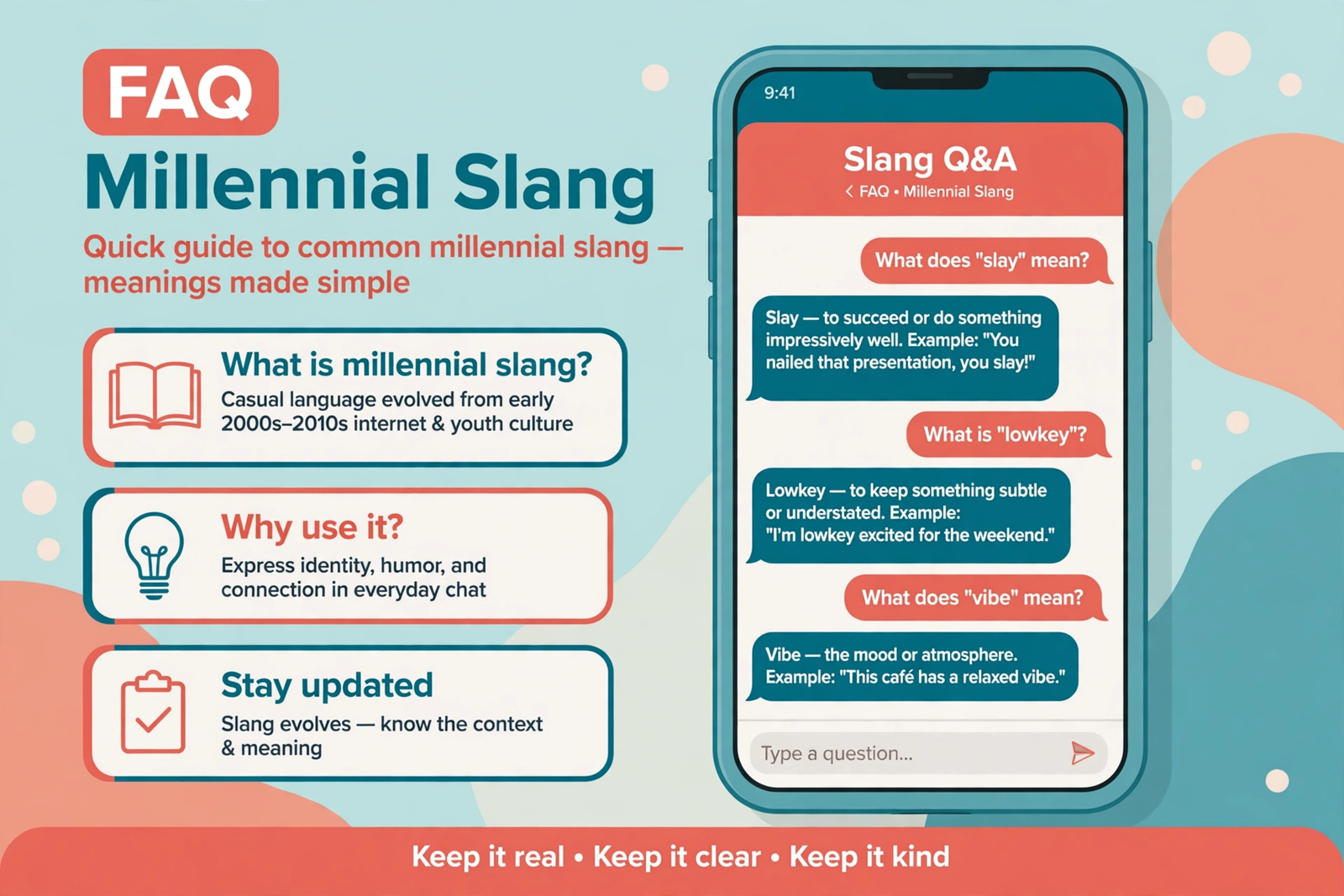
Millenial slang is the informal vocabulary popularized by millennials (born roughly 1981–1996) during the rise of texting and social media. It includes words like lit, bae, YOLO, on fleek, adulting, and throwing shade, and it peaked between about 2008 and 2016.
What are some examples of millenial slang?
Popular examples include lit (amazing), bae (partner), YOLO (you only live once), on fleek (perfect), slay (perform brilliantly), adulting (doing grown-up tasks), ghosting (cutting off contact), FOMO (fear of missing out), and GOAT (greatest of all time). Our table above lists 40+ terms with meanings and examples.
Is millenial slang still used in 2026?
Yes, but differently. Many terms like lit, vibes, ghosting, and FOMO became standard English and are still used daily. Others like YOLO and on fleek are mostly used ironically or nostalgically now. Gen Z has its own slang, but millennial terms remain widely understood.
What is the difference between millennial slang and Gen Z slang?
Millennial slang (lit, bae, YOLO) is ironic and self-deprecating and grew up on Tumblr and Twitter. Gen Z slang (no cap, rizz, bet) is blunter and grew up on TikTok. Millennials use 😂 while Gen Z often uses 💀 ironically. The generations overlap, but the flavour is different.
What does “I can’t even” mean?
“I can’t even” means you are too overwhelmed — by excitement, shock, or frustration — to finish the sentence. It is short for “I can’t even deal with this right now.” Example: “Did you see the finale? I can’t even.”
Where did “on fleek” come from?
“On fleek” (meaning flawless or perfect) went viral in 2014 from a Vine video by Peaches Monroee, who used it to describe her eyebrows. It spread across Twitter and Tumblr within weeks and became one of the defining millennial phrases of the decade.
What does “adulting” mean?
Adulting means doing the boring responsibilities of grown-up life — paying bills, doing laundry, cooking dinner, going to the dentist. Millennials turned it into a joke about how hard ordinary life can feel: “I did my taxes today. Adulting level: expert.”
Is it okay to use millenial slang at work?
Mild terms like game-changer, on point, and slay are fine in most casual workplaces. Stronger slang like turnt, thirsty, or bae should stay out of professional settings. When in doubt, use plain English in emails and save the slang for the team group chat.
Conclusion
Millenial slang is more than a list of funny words — it is a record of the first generation to grow up online. From the texting shortcuts of the early 2000s to the Tumblr and Vine explosions of the 2010s, millennials turned the internet into a shared language, and much of that language never left. Words like lit, ghosting, FOMO, and GOAT are now so normal that we forget they were ever slang at all.
The key takeaways are simple. First, know the classics — the 40+ terms in this guide cover almost everything you will hear. Second, know the context: casual with friends, careful at work, and ironic when the word has aged out. Third, respect the origins: a lot of this vocabulary came from Black culture and LGBTQ+ communities, and using it well means knowing where it came from. And if you want to keep exploring how slang evolves, check out our bougie slang guide for a term that went from niche to mainstream in record time.
So the next time someone says a party was lit, a friend is being extra, or adulting is hard, you will know exactly what they mean — and you will know whether to laugh, agree, or gently tell them it is 2026 and YOLO is officially a joke now.
