Quick Definition: DTF meaning slang is short for “down to f***” — a blunt, direct way of saying someone is open to a casual sexual encounter with no relationship strings attached. On dating apps, in DMs, and in group chats, “DTF” signals willingness to hook up rather than date seriously. The term exploded into mainstream culture through MTV’s “Jersey Shore” in 2009, but it has been part of American slang since the early 2000s. Because it is so direct, context matters enormously: the same three letters can be a serious proposition, a flirty joke, or — in a few sanitized corners of the internet — a playful stand-in for “down to feast” or “down to fun.”
DTF Meaning Slang Meaning & Definition
DTF meaning slang refers to the acronym DTF, which stands for “down to f***.” It is used to say, without any beating around the bush, that a person is willing to have casual sex. The phrase is direct by design. Unlike softer dating slang that leaves room for interpretation, DTF removes all ambiguity: the person is interested in a physical encounter, not in a date, not in a relationship, and not in a long getting-to-know-you phase.
The slang meaning of DTF is built from two very common pieces of English. “Down to” is casual slang for being willing or up for something — as in “I’m down to grab pizza” — and the final letter stands for the explicit verb. Put together, the acronym becomes a compact, three-letter signal that fits perfectly in a text message, a dating-app bio, or a TikTok comment. That compactness is a big part of why it spread: it says in three characters what would otherwise take a whole awkward sentence.
On dating apps like Tinder, Bumble, and Hinge, DTF usually appears in bios and opening messages, where it works as a filter. Someone who writes “DTF” in their profile is telling potential matches exactly what they are looking for before either person invests time in small talk. In private chats between people who already know each other, it can be a question (“u dtf?”), a statement (“I’m dtf tonight”), or a joke between friends who would never actually mean it literally.
It is important to understand that DTF describes willingness, not a promise and never an obligation. Saying it, hearing it, or seeing it in a bio does not create consent, and consent can be withdrawn at any time. The word is a conversation starter about intentions — the actual encounter, if any, still depends on clear, enthusiastic agreement from everyone involved. That distinction matters, and it is one reason the term carries so much social weight: it is casual in tone but serious in what it proposes.
Introduction
You have almost certainly seen the letters DTF somewhere by now — in a dating-app bio, a meme, a song lyric, or a friend’s text that made you do a double take. Maybe you already know what it means and just want to be sure. Maybe someone sent it to you and you need to know how to respond. Or maybe you are a parent, teacher, or curious reader who keeps hearing it and wants a straight answer without the awkwardness.
This guide gives you that straight answer. We will break down exactly what DTF means in slang, trace where it came from, show how it is actually used on dating apps and in texting, compare it with similar terms like NSA and FWB, and cover the mistakes people make with it — including the places where it should never appear. By the end, you will know not only the definition but the tone, the timing, and the etiquette that surround these three little letters.
Origin
The phrase behind DTF is older than the acronym itself. The expression “down to f***” circulated in American slang for years before anyone shortened it. Rapper Big Pun used the phrase “down to f***” in his 1998 song “Still Not a Player,” and the general construction — “down to” plus a verb — was already standard casual English by then. Green’s Dictionary of Slang dates the acronym DTF itself to around 2002, the same year the first Urban Dictionary entry for it appeared.
For most of the 2000s, DTF lived mainly in texting and online chat, where short acronyms thrive. Then came the moment that pushed it into the mainstream: MTV’s reality show “Jersey Shore,” which premiered in 2009. Cast members — most famously Pauly D and The Situation — used the term freely on camera to describe their approach to the nightlife scene, and millions of viewers heard it week after week. A word that had been niche internet slang suddenly became something your coworker might say at a bar.
The 2010s cemented it further. Dating apps turned DTF into a practical tool rather than just a joke: when your entire profile is a photo and a sentence, three letters that state your intentions clearly are efficient. At the same time, movies, music, and memes kept the term in circulation, and by the mid-2010s it had become one of the most recognized acronyms in dating slang. Google Trends data shows interest in “DTF meaning” peaking between 2010 and 2013, right in the Jersey Shore era, but the term never faded the way many reality-TV catchphrases do — because dating apps gave it a permanent job to do.
Popularity
DTF is one of the most widely recognized slang acronyms in English, and its popularity has proven remarkably durable. Unlike slang that burns out in a year, DTF has survived for more than two decades, moving from early-2000s chatrooms to Jersey Shore to Tinder bios to TikTok comments without losing its core meaning. That staying power is unusual, and it comes down to usefulness: as long as people use dating apps and texting to arrange casual encounters, they need a short way to say what they want.
On dating apps, DTF remains a standard part of the vocabulary. It appears in bios, in opening lines, and in the unspoken sorting process every app user performs — swiping left or right partly on the basis of what the other person seems to want. On TikTok and Instagram, the term shows up in memes, story replies, and comments, often with a joking or exaggerated tone. On Reddit, threads about dating etiquette regularly debate whether putting DTF in a bio is honest or off-putting, which itself keeps the term in circulation.
Interestingly, Gen Z has also started sanitizing DTF for joke purposes. On TikTok, creators use “DTF” to mean “down to feast” before a meal, “down to fun” for a night out, or “down to frolic” as a deliberately wholesome rewrite. These joke versions work precisely because everyone knows the original meaning — the humour comes from the contrast. The term has even entered the vocabulary of people who would never use it seriously, as a punchline or a piece of internet literacy. Knowing what DTF means has become part of understanding modern dating culture, whether or not you ever use the word yourself.
How It Is Used
DTF is used in a few distinct ways, and the meaning shifts with the setting. On dating apps, it is usually a statement of intent. A bio that says “just looking for something casual, DTF” is telling matches upfront that the person is not looking for a relationship. An opening message like “hey, u dtf?” is a direct proposition — blunt, and deliberately so, because the sender wants an equally direct answer.
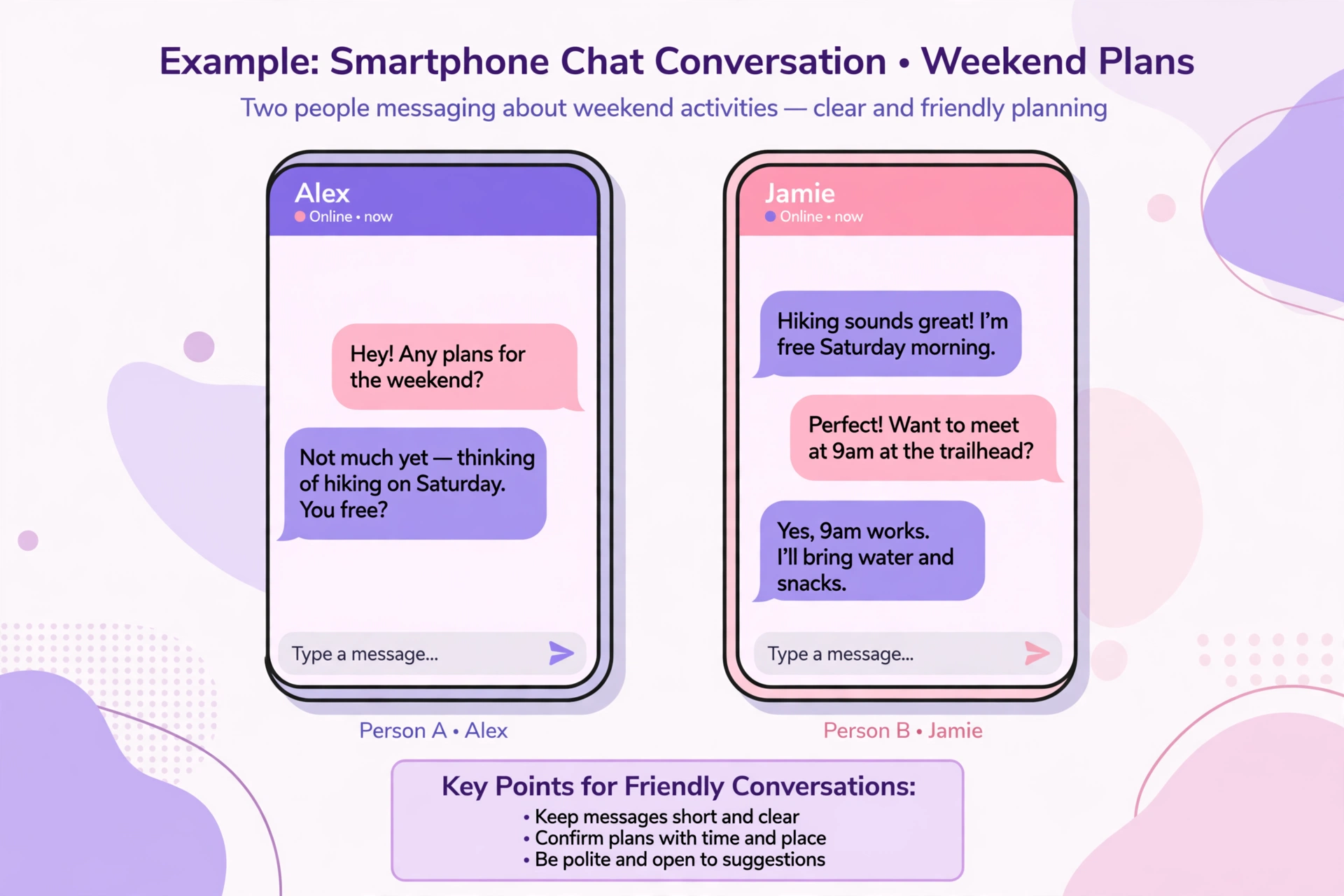
In private texting between people who are already flirting, DTF works as a check-in. One person floats it, the other person confirms, declines, or laughs it off, and the conversation moves forward with everyone on the same page. In this setting it is often softened with humour or emojis: “dtf? 😏” reads very differently from a bare, formal “Are you DTF?” The tone of the surrounding conversation does most of the work.
Among close friends, DTF is frequently a joke rather than a proposition. Someone might say “I’m so DTF right now” about a plate of food, or text “dtf??” when a friend suggests a spontaneous road trip. In these cases the sexual meaning is understood and deliberately played with — the joke is that everyone knows what it really means, and the absurd context makes it funny. The same letters in a message to a stranger would land completely differently, which is why the relationship between the people matters so much.
There are also clear places where DTF does not belong. It is not workplace language, not school language, and not something to say to someone you barely know outside a dating or flirting context. Dropping it into a professional chat, a family group, or a conversation with a stranger is likely to be read as crude or inappropriate — and, in a work setting, it can be a genuine problem. The term’s bluntness is its point, but bluntness without the right context is just rudeness.
Examples
Seeing DTF in real sentences makes its tone much clearer than a dictionary definition can. The examples below show how it appears in friendly, professional-adjacent, and funny contexts — and how the same three letters change meaning depending on who is talking and where.
Friendly Examples
Between close friends, DTF is usually a joke or an exaggeration rather than a real proposition. The friendship provides the safety net that makes the explicit meaning funny instead of awkward.
- “The new taco place just opened and I’m so DTF right now.” — Here the friend is jokingly borrowing the acronym to say they are extremely eager to eat tacos. The humour works because everyone in the group knows the real meaning and knows it does not apply to tacos.
- “Road trip this weekend? I’m DTF if you drive.” — A playful yes to a plan. The friend means “I’m down,” with the acronym adding a layer of joke energy. Nobody in this conversation is proposing anything romantic.
- “She said she’s DTF and honestly I respect the honesty.” — A friend reporting what someone wrote on a dating app. The tone is matter-of-fact: the person stated their intentions clearly, and the friend appreciates the lack of games.
- “Are you DTF for karaoke tonight or are you staying in?” — Another joke usage, where DTF just means “are you up for it?” The sexual meaning is present as a wink, but the actual question is about karaoke.
Professional Examples
Here is the honest truth: there is almost no professional context where DTF belongs. It is explicit dating slang, and using it at work, in a classroom, or in any formal setting will be read as inappropriate. The closest thing to a “professional” example is knowing when not to use it — and what to say instead when the topic comes up in a legitimate setting, such as a writer, researcher, or educator discussing slang itself.
- A journalist writing about dating culture might write: “The acronym DTF, short for ‘down to f***,’ appears frequently in dating-app bios as a signal of interest in casual encounters.” That is a professional use — describing the term, not using it toward a person.
- A parent who finds the term in a teenager’s messages might say: “I saw the term DTF in your chat. It means someone is asking about casual sex. Let’s talk about what that means and why context matters.” Calm, factual, and educational.
- In a workplace, the correct move is simple: do not use it. If a colleague uses it toward you, that is worth flagging to HR, because it is sexual language in a professional setting. There is no professional sentence in which DTF is the right word choice.
Funny Examples (if applicable)
DTF is a favourite of internet humour precisely because its meaning is so widely known. The joke is almost always the gap between the explicit original and an innocent substitute.
- “Mood: DTF — down to feast. This pizza isn’t going to eat itself.” — A classic TikTok-style caption. The punchline is the reveal: you expected one meaning and got pizza.
- “Me: I’m DTF. Also me: falls asleep on the couch at 9pm.” — Self-deprecating humour about the gap between the bold claim and the reality of being tired.
- “My grandma asked what DTF means and I told her ‘down to fish.’ She now tells everyone at church she’s DTF on weekends.” — A running joke format online, built on the innocent cover meanings people invent for the acronym.
- “DTF? More like DTF — down to fold laundry and go to bed.” — The domestic, unglamorous rewrite that works because it is the exact opposite of the original energy.
These joke versions — down to feast, down to fun, down to frolic, down to fish — have become so common that some people encounter the sanitized version before they learn the real one. But make no mistake: the original meaning is the one almost everyone understands first, and the jokes only land because of it.
Comparison with Similar Terms
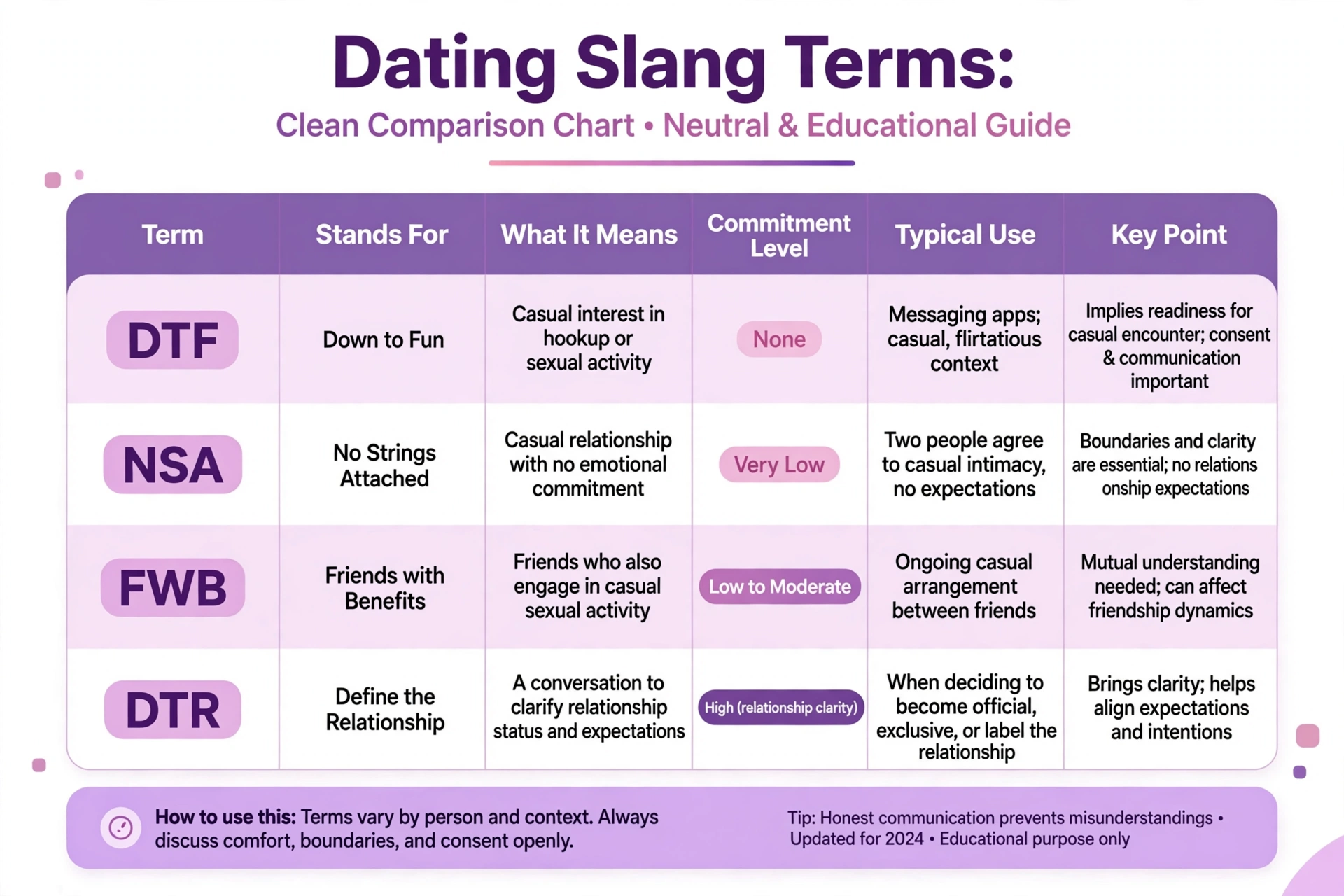
DTF sits inside a whole family of dating and hookup slang, and the terms around it are easy to confuse. The table below shows how DTF compares with its closest neighbours, so you can tell exactly what each one signals.
| Term | Full Form / Meaning | What It Signals | How It Differs from DTF |
|---|---|---|---|
| DTF | Down to f*** | Open to a casual sexual encounter | The baseline: direct and explicit about intent |
| NSA | No strings attached | Casual encounters with no commitment | Focuses on the lack of commitment rather than the act itself; often used for ongoing arrangements |
| FWB | Friends with benefits | Friends who also hook up | Implies an existing friendship first; DTF implies no prior relationship is needed |
| ONS | One-night stand | A single casual encounter | Describes the event; DTF describes the willingness before it happens |
| DTR | Define the relationship | “We need to talk about what we are” | The opposite energy: DTR is about clarity and commitment, DTF is about avoiding both |
| Hook up | To meet for casual sex | General term for a casual encounter | Broader and softer than DTF; can also mean just meeting up or kissing |
| Netflix and chill | Watching Netflix as a pretext for sex | An invitation framed as a casual hangout | Indirect and coded; DTF is the direct version of the same invitation |
The key distinction is directness. NSA and FWB describe the shape of an arrangement; ONS describes an event; DTR is about defining things. DTF is the most blunt of the group — it states willingness in three letters and leaves nothing to interpret. That is why it works so well in dating-app bios, where space is short and clarity is valuable, and why it can feel too forward in a conversation that has not established that level of comfort yet.
There is also a tonal difference. “Hook up” and “Netflix and chill” soften the proposition with vagueness or humour. DTF does the opposite: it owns the proposition outright. People who use it are usually signalling that they prefer honesty over politeness in this particular context — which some people find refreshing and others find off-putting. Neither reaction is wrong; the term simply sorts people by preference, which is exactly what dating slang is for.
Alternate Meanings
Outside dating and texting slang, DTF has several completely unrelated meanings. If you see it in a professional or technical context, it almost certainly means one of these instead.
- Direct-to-Film (printing): In the apparel and textile industry, DTF printing is a method where designs are printed onto a special film and then heat-transferred onto fabric. If you see “DTF printer” or “DTF transfer” in a shopping listing, this is the meaning — it has nothing to do with dating.
- Drug Task Force (law enforcement): In police and news contexts, DTF can stand for a drug task force, a multi-agency unit focused on drug enforcement. A headline like “DTF seizes shipment” is about law enforcement, not slang.
- Down to fight (gaming): In gaming lobbies and competitive chats, some players use DTF to mean “down to fight,” as in ready for a match or a confrontation. This usage is niche and usually clear from context.
- Down to feast / fun / frolic (joke meanings): The sanitized, humorous rewrites used on TikTok and in memes. These are deliberate jokes that depend on everyone knowing the original meaning.
- Desktop publishing / file formats: In older computing contexts, DTF has appeared as a file extension or technical abbreviation, though this usage is rare today.
Context is the only reliable way to tell which DTF you are looking at. On a dating app, in a DM, or in a TikTok comment, the slang meaning is almost always the right one. In a printing shop, a police report, or a gaming lobby, it is one of the alternatives. When in doubt, the setting around the letters tells you everything.
Professional or Polite Alternatives
Because DTF is explicit, there are many situations where a softer phrasing says the same thing without the crudeness. If you want to express interest in something casual without using the acronym, these alternatives work in dating-app bios and conversations.
- “Looking for something casual” — The most common polite equivalent. It signals the same intent as DTF without the explicit language, and it is widely understood on every dating app.
- “Open to meeting up and seeing where it goes” — Softer still, and it leaves room for either a casual connection or something more. Good when you are not sure what you want yet.
- “Not looking for anything serious right now” — States the boundary (no relationship) without stating the proposition. Many people prefer this because it is honest but not blunt.
- “Here for fun, no strings” — Close to NSA in meaning. Casual, clear, and much less likely to be flagged or misread.
- “Open to a casual connection” — A neutral, adult phrasing that works in a bio and in conversation. It says what DTF says, minus the shock value.
- “Just seeing what’s out there” — The vaguest option. It hints at casual intent without committing to it, which suits people who want to keep their options open.
Which one you choose depends on your audience. On an app where explicit language is normal, DTF itself is fine. On an app with stricter norms, or when messaging someone you have just matched with, the softer versions land better and are less likely to get your message ignored or reported. The goal is the same in every case — clear communication about what you want — and clarity does not require crudeness.
Common Mistakes
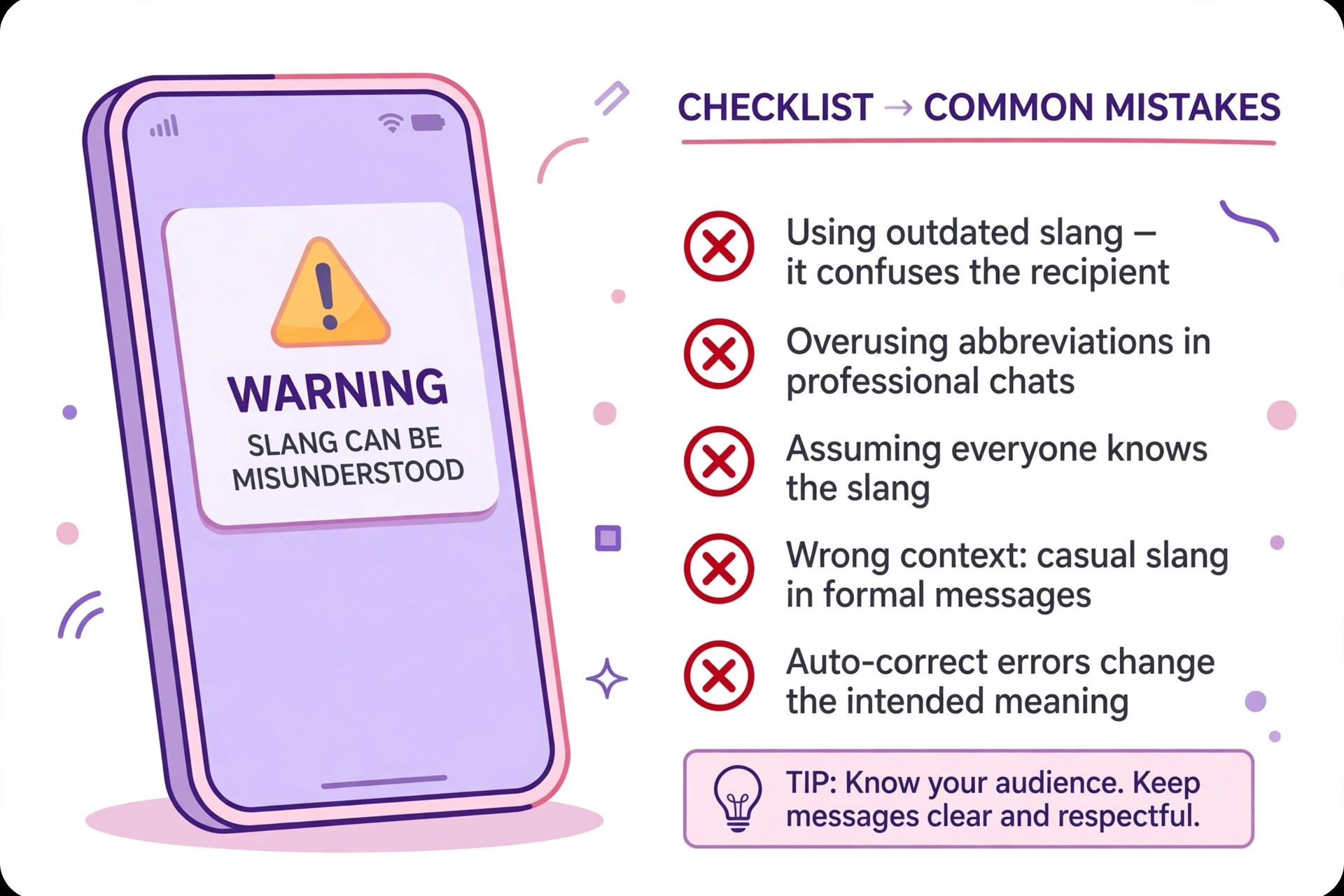
DTF is short and simple, which makes it easy to use badly. These are the mistakes people make most often — and how to avoid them.
- Using it with the wrong person. Sending “u dtf?” to a stranger, a coworker, or someone you have only just matched with is likely to come across as crude or disrespectful. The term assumes a level of comfort that may not exist yet. Wait until the conversation has established a flirty or dating context before using it.
- Using it in the wrong place. DTF does not belong in work chats, family groups, school messages, or public comments where the audience is mixed. Even as a joke, it reads as sexual language, and in professional settings it can be a real problem. Keep it in dating and close-friend contexts.
- Assuming it means yes to everything. Someone saying they are DTF means they are open to the idea — not that they have agreed to anything specific, with anyone, at any time. Treating the acronym as consent is a serious mistake. Consent is specific, enthusiastic, and ongoing, and it can be withdrawn at any point.
- Assuming it is only a joke. The reverse mistake is just as common: assuming someone who says DTF is joking when they are serious. If a person uses it in a dating context, take the literal meaning seriously. If you are unsure whether they mean it, ask — do not guess.
- Putting it in a bio without thinking. A DTF in your dating profile will attract some people and repel others, which is the point — but it can also get your profile flagged on apps with stricter content rules, and it sets an expectation you may not want with every single match. Think about what you actually want before advertising it.
- Using it to pressure someone. Repeating it, or using it after someone has said no or changed the subject, turns a casual proposition into pressure. One clear “no” ends the topic. Persistence after a no is not flirting.
- Forgetting the joke versions are jokes. Telling your grandmother you are “DTF — down to fish” is funny online because the audience knows the real meaning. In real life, with people who do not know the slang, the joke can fall flat or cause genuine confusion. Know your audience before you deploy the punchline.
Quick Tips
- Read the room first. DTF works when both people are already in a dating or flirting frame of mind. If the conversation is still at “hello,” it is too early.
- Be direct, but be kind. The term is blunt by nature, but bluntness does not require rudeness. A simple “I’m DTF if you are, no pressure either way” communicates the same thing with far more respect.
- Accept any answer gracefully. A “no,” a laugh, or a change of subject are all valid responses. Thank the person for their honesty and move on.
- Use the polite alternatives when in doubt. “Looking for something casual” says the same thing and is far less likely to offend a new match. Save the acronym for when the vibe is clearly established.
- Never use it at work or school. This is a hard rule, not a guideline. Explicit dating slang has no place in professional or educational settings.
- Remember consent is separate. DTF opens a conversation about intentions. It does not replace a real, clear conversation about consent, boundaries, and protection.
- Know the joke versions, but know they are jokes. “Down to feast” is funny on TikTok because everyone knows what it is covering for. Do not use a joke version and expect people to think you mean the innocent one.
- Check the platform’s rules. Some dating apps and social platforms flag explicit language in bios. A softer phrasing keeps your profile visible and your account safe.
FAQ
What does DTF mean in slang?
DTF stands for “down to f***” and means someone is open to a casual sexual encounter with no relationship strings attached. It is most commonly used on dating apps, in DMs, and in texting between adults who are flirting or arranging a hookup.
Is DTF rude?
It depends on context. Between consenting adults in a dating or flirting conversation, it is usually seen as direct rather than rude. Sent to a stranger, a coworker, or someone who has not shown interest, it can feel crude or disrespectful. The setting and the relationship matter more than the letters themselves.
Where did DTF come from?
The phrase “down to f***” appeared in American slang in the late 1990s — Big Pun used it in his 1998 song “Still Not a Player” — and the acronym DTF was first recorded around 2002. It exploded into mainstream culture through MTV’s “Jersey Shore,” which premiered in 2009, and dating apps kept it in everyday use after that.
What does DTF mean on Tinder?
On Tinder, DTF in a bio or message means the person is looking for a casual hookup rather than a serious relationship. It is used as a filter: people who want something casual swipe right, and people looking for a relationship know to move on.
What is the difference between DTF and NSA?
DTF describes willingness — being open to a casual encounter right now. NSA (no strings attached) describes the terms of an arrangement — casual encounters with no commitment, which may happen more than once. DTF is about intent in the moment; NSA is about the rules of an ongoing setup.
Can DTF mean something innocent?
Usually, no. The dominant meaning is explicit. However, people joke with sanitized versions like “down to feast,” “down to fun,” or “down to frolic,” especially on TikTok. Outside dating contexts, DTF can also mean direct-to-film printing or drug task force — but in a text or dating app, the slang meaning is almost always the right one.
How do you respond if someone says they are DTF?
Answer honestly and clearly. If you are interested, say so and talk about boundaries. If you are not, a simple “I’m not looking for that, but thanks for being upfront” is respectful and clear. If you are unsure, ask what they mean — it is always better to clarify than to guess.
Should I put DTF in my dating bio?
Only if you genuinely want casual encounters and you are comfortable with the attention it brings. It will attract people looking for the same thing and put off people looking for a relationship — which is the point of a filter. If you want the same result with softer language, try “looking for something casual” instead.
Conclusion
DTF meaning slang is simple on the surface — “down to f***,” an open signal of interest in a casual encounter — but the three letters carry a surprising amount of social weight. They have travelled from late-90s hip-hop lyrics and early-2000s chatrooms through Jersey Shore and into the bios of every major dating app, surviving for more than twenty years because they do a job no other acronym does quite as directly: they state an intention in three characters and leave no room for misunderstanding.
That directness is both the term’s strength and its risk. Used in the right context, between adults who are already flirting or dating, DTF is honest, efficient, and even refreshing — nobody’s time gets wasted on mixed signals. Used in the wrong context, it is crude, inappropriate, and potentially harmful. The difference is never the letters themselves; it is the relationship, the setting, and the respect shown to the other person.
If you take one thing from this guide, let it be this: slang is a tool for clear communication, and DTF is at its best when it makes intentions clearer, not when it is used to pressure, shock, or shortcut a real conversation. Say what you mean, respect what the other person says, and remember that consent is a conversation, not an acronym. And if you want to keep building your slang vocabulary, our guide to sharking meaning slang covers another word that jumped from niche slang to mainstream in record time, while our guide to glizzy meaning explains a term with a very different journey through internet culture. For the abbreviations you will see in the very same chats, TYSM meaning and FN meaning in text are worth a read too. For an authoritative take on the term itself, Family Education’s Gen Z slang guide to DTF is a useful reference.
