
Slang for Vagina Meaning & Definition
Quick definition: “Slang for vagina” refers to the hundreds of informal, playful, euphemistic, or vulgar words people use instead of the clinical term “vagina” — from tame favorites like kitty, hoo-ha, and lady bits to blunt ones like pussy and snatch. Which term someone picks depends on tone, audience, and context: a joke between friends, a song lyric, a medical chat, or a comedy sketch all call for very different words.
English has more slang for the vagina than for almost any other body part. Researchers have documented well over 1,000 synonyms, and new ones appear every year on TikTok, in memes, and in group chats. Some are centuries old — “altar of Venus” dates to 1584 — while others, like “vajayjay,” were popularized by a single TV moment. This guide breaks down the most common slang for vagina, explains what each term really means, where it came from, and when (and when not) to use it.
Introduction
Why does one body part need so many names? The short answer is taboo. For centuries, polite society avoided saying “vagina” out loud, so people invented softer, funnier, or sneakier words instead. Comedy, music, and the internet then turned that habit into a sport: every generation adds its own slang for vagina, from Victorian poets writing about “nature’s treasury” to Gen Z texting “coochie” in a group chat.
If you have ever read a lyric, a meme, or a text and wondered what a word actually meant, this article is for you. You will learn the most widely used slang for vagina in the United States and the UK, how the terms differ in tone — cute, clinical, crude, or comic — and the mistakes that make people sound awkward or offensive. And because slang for vagina overlaps with the wider world of internet language, it helps to know how other body and identity slang works too — our guide to DSL slang covers another term that lives in exactly the same gray zone between joke and taboo.
Origin
Slang for vagina is as old as English itself. The most taboo word of all, “cunt,” was recorded as early as 1250, and by the 1500s writers were already inventing poetic stand-ins: “belle-chose” (1386), “altar of Venus” (1584), “Netherlands” (1591), “phoenix nest” (1618), and “nature’s treasury” (1635). Lexicographer Jonathon Green’s Green’s Dictionary of Slang traces hundreds of these terms across 600 years, showing that every era invents its own euphemisms and then replaces them when they start to sound too direct.
The modern wave began in the 20th century. “Pussy” took on its genital sense by 1879 (possibly earlier), “beaver” appeared in the 1920s, and “snatch” and “twat” spread through comedy and music in the 1960s and 70s. Television gave us “vajayjay” — popularized by Oprah Winfrey’s show in 2007 as a family-friendly stand-in — and “coochie” rode hip-hop and TikTok into mainstream slang in the 2010s and 2020s. Each new term follows the same pattern: a word that starts as a joke or a whisper becomes common, then feels too blunt, and a softer replacement takes its place.
One important language note: most slang for vagina actually refers to the vulva (the external genitalia), not the vagina (the internal canal). Everyday speech rarely makes the distinction, but knowing it helps you understand why doctors and textbooks prefer the clinical terms — and why slang almost always describes what is visible or joked about, not the anatomy textbook definition. For the clinical side, Merriam-Webster’s definition of vagina is the authoritative reference.
Popularity
Slang for vagina is everywhere in 2026: song lyrics, stand-up comedy, TikTok captions, Reddit threads, and group chats. “Pussy” remains the most widely recognized term in American English, while “fanny” dominates in British English — with a famous twist: in the US, “fanny” means buttocks, so the same word is innocent in London and confusing in Los Angeles. “Coochie” and “cooch” surged with TikTok and hip-hop, “vajayjay” is the go-to polite joke word, and “kitty” and “hoo-ha” stay popular as cute, non-threatening options.
Search interest follows the same pattern as other slang: people look up a term after hearing it in a song, a meme, or a show, then want to know whether it is rude, funny, or safe to repeat. That is why slang guides rank so well — a single lyric can send thousands of people searching for one word on the same day. Regional slang adds another layer: Australian and British lists of slang for vagina include words Americans rarely hear, like “minge,” “clunge,” and “map of Tassie,” which is why our roundup of Australian slang is a useful companion read if you enjoy regional word lists.
How It Is Used
Slang for vagina shows up in four main contexts, and the right term depends entirely on which one you are in:
- Playful and affectionate: “kitty,” “hoo-ha,” “lady garden,” “flower,” “cookie” — soft words used in jokes, with partners, or when talking around children.
- Casual and conversational: “coochie,” “cooch,” “vajayjay,” “hoo-hoo,” “down there” — everyday informal words that sound natural in a group chat or a comedy bit.
- Crude and explicit: “pussy,” “snatch,” “twat,” “cunt” — blunt words common in music, porn-adjacent humor, and insults. These are the ones most likely to offend.
- Medical or educational: “vagina,” “vulva,” “genitals,” “private parts” — the safe choices for doctors, teachers, and parents.
Tone is everything. The same word can be a term of endearment between partners, a punchline in a comedy routine, or a serious insult depending on who says it and to whom. As a rule, the cuter the word, the safer the setting; the blunter the word, the more private the setting needs to be. If you are unsure, the clinical word or a soft euphemism like “down there” is always the safer choice.
Examples
Here is how slang for vagina actually sounds in real conversations, grouped by tone. Notice how the word choice changes the whole feeling of the sentence.
Friendly Examples
- “She calls it her kitty — it’s just her cute little nickname for it.”
- “My grandma always said hoo-ha instead of the real word. It still makes me laugh.”
- “Okay, TMI, but my lady garden needs a trim before summer.”
- “The doctor asked if I had any pain down there, which honestly felt way less awkward than the medical term.”
Professional Examples
- “In the clinic we say vagina or vulva — slang terms cause confusion in medical records.”
- “The health class used the correct anatomical terms, but the students kept giggling at vajayjay.”
- “For the article, we used private parts because the audience includes teenagers and parents.”
- “The comedian’s whole bit was about how many words exist for it — coochie, hoo-ha, lady bits — and the crowd lost it.”
Funny Examples
- “He called it a bearded clam and I have never recovered. Who says that?”
- “My friend calls hers the cha-cha. I don’t know why. I don’t want to know why.”
- “The meme said ‘protect your pink taco at all costs’ and honestly, fair enough.”
- “Somebody in the group chat just wrote punani unironically. It’s 2026, sir.”

Comparison with Similar Terms
Not all slang for vagina means the same thing, and the differences matter. This table groups the most common terms by tone, region, and typical use, so you can pick the right one — or recognize the wrong one — at a glance.
| Term | Tone | Region / Origin | Typical Use |
|---|---|---|---|
| Pussy | Crude to casual | US, worldwide | Most common; also used as an insult |
| Coochie / Cooch | Casual, playful | US, hip-hop / TikTok | Group chats, lyrics, jokes |
| Vajayjay | Polite joke | US, TV (2007) | Talk shows, comedy, euphemism |
| Kitty | Cute, soft | US, worldwide | Playful, affectionate, pet names |
| Hoo-ha / Hoo-hoo | Cute, childlike | US | Family-friendly euphemism |
| Fanny | Casual (UK) / confusing (US) | UK, Australia, NZ | Means genitals in UK; buttocks in US |
| Minge / Clunge | Crude | UK | British slang, often insulting |
| Snatch | Vulgar | US, UK | Old-school slang, now mostly crude |
| Beaver | Comic, dated | US (1920s) | Retro jokes, puns |
| Yoni | Respectful, spiritual | Sanskrit origin | Wellness, yoga, sacred language |
| Lady bits / Lady garden | Polite, comic | UK, US | Comedy, polite conversation |
| Down there / Privates | Neutral euphemism | Worldwide | Medical chats, with kids, polite talk |
The pattern is clear: animal words (kitty, beaver, fox hole), food words (pink taco, cookie, honeypot), and flower words (flower, rosebud, lady garden) dominate the cute end, while short blunt words (pussy, snatch, twat) dominate the crude end. Knowing which family a word belongs to tells you almost everything about how it will land.
Alternate Meanings
Many words in the slang for vagina family have completely different meanings in other contexts, which is where most confusion comes from:
- Fanny: In the UK it means vagina; in the US it means buttocks. A “fanny pack” is innocent in America and a joke in Britain.
- Pussy: Also means a cat, or — as an insult — a coward. “Don’t be such a pussy” has nothing to do with anatomy.
- Beaver: Also the animal, and a dated term for a beard. Context decides everything.
- Box: Also a container, a TV, or a boxing ring. “Box” as slang for vagina is almost always clear from context, but it is rarely the first meaning a listener thinks of.
- Cookie: Also a biscuit or a browser file. As slang it is usually playful rather than explicit.
- Snatch: Also means to grab quickly (“he snatched the bag”), and it is the title of a Guy Ritchie film — three meanings, one word.
- Twat: In British English it doubles as a general insult meaning “idiot,” which is how most people under 30 actually encounter it.
This is why context is the real dictionary for slang for vagina. A word that is crude in one sentence can be innocent in the next, and the only reliable way to tell is to look at who is talking, where, and about what.
Professional or Polite Alternatives
When you need to talk about the topic without sounding crude, these are the safe choices:
- Vagina / Vulva: The correct anatomical terms. Use them with doctors, in school, and in writing that needs to be accurate.
- Private parts / Privates: The standard polite euphemism for mixed company, children, and formal settings.
- Down there / Downstairs: Casual, vague, and almost impossible to take offense at.
- Intimate area: The phrase used in health products, ads, and medical leaflets.
- Yoni: A respectful Sanskrit word used in wellness and yoga contexts; it carries a positive, sacred tone.
- Lady bits: Light and comic, but polite enough for a TV panel show.
In professional writing, the rule is simple: use the clinical term first, then a euphemism only if the tone allows it. In comedy or casual chat, the cute words (kitty, hoo-ha, vajayjay) are the safest way to be funny without being offensive. If you want more examples of how slang shifts between polite and crude, the zesty slang guide shows the same tone ladder working for a completely different word.
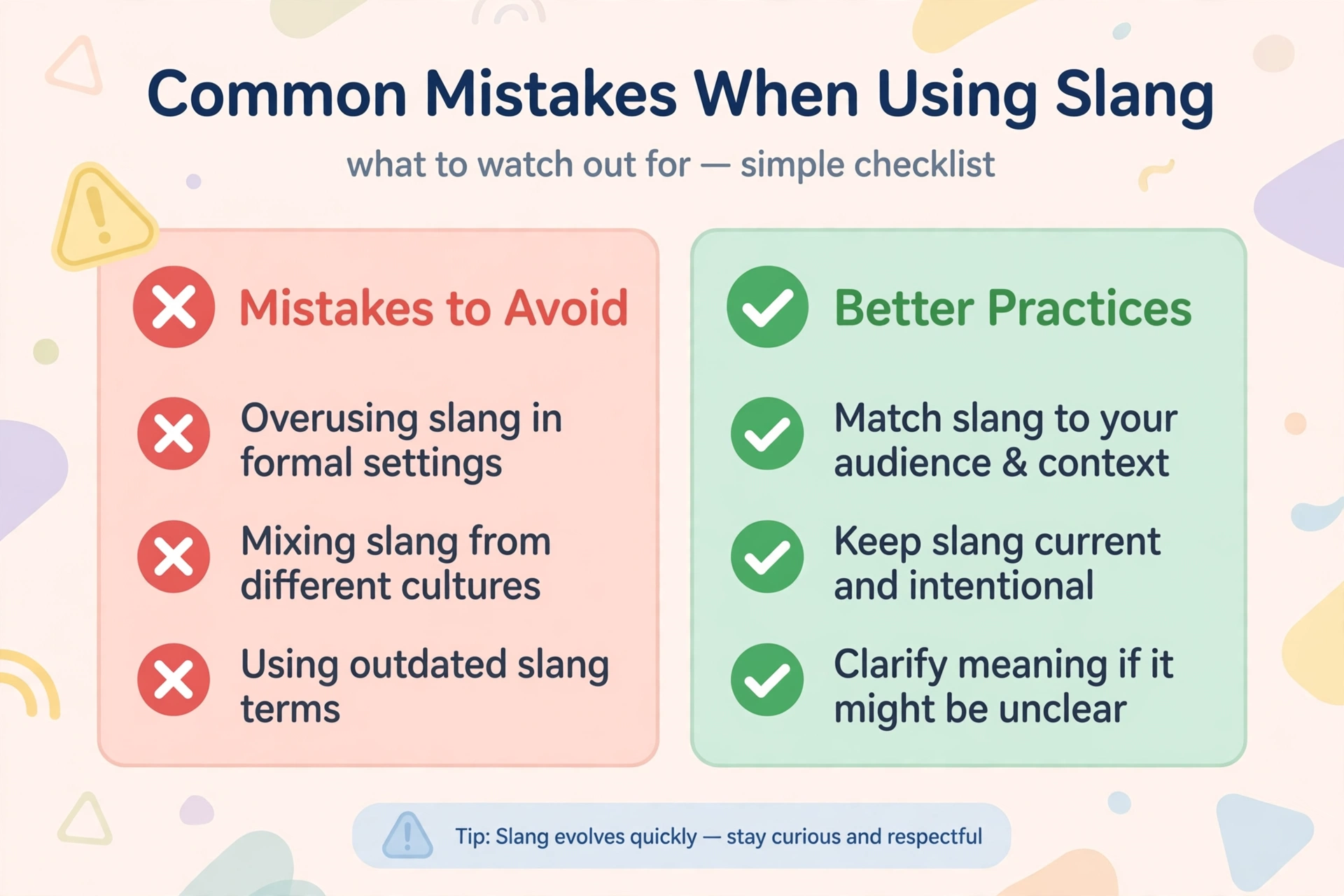
Common Mistakes
These are the errors people make most often with slang for vagina — and how to avoid them:
- Using a crude term in a polite setting: Saying “pussy” or “snatch” at work, at school, or in front of children is the fastest way to make a room uncomfortable. Match the word to the room.
- Confusing vagina and vulva: Most slang refers to the vulva (the outside), not the vagina (the inside). In a medical conversation, mixing them up causes real confusion.
- Using “fanny” across the Atlantic: An American saying “fanny” means buttocks; a Brit hears something far more explicit. If your audience is international, skip it.
- Repeating a lyric without knowing the meaning: Plenty of songs use slang for vagina as a punchline. Singing along is fine — quoting the lyric in a work meeting is not.
- Assuming every term is an insult: “Pussy” can be an insult, but “kitty” or “coochie” almost never is. The word’s history matters as much as the word itself.
- Using the most taboo word as a joke: The c-word is widely considered the most offensive word in English. Even as a joke, it lands badly in most American settings.
- Overusing slang in health conversations: With a doctor, slang wastes time. Say the clinical word, describe the symptom, and save the jokes for later.
Quick Tips
- Match the room: Cute words for friends, clinical words for doctors, neutral words for mixed company.
- When in doubt, go soft: “Down there,” “private parts,” or “lady bits” are never the wrong choice.
- Learn the regional twist: Before using “fanny,” “minge,” or “clunge” abroad, check what they mean there.
- Read the lyric first: If a song lyric uses slang for vagina, learn what it means before you quote it or post it.
- Keep it respectful: Slang about someone else’s body is only funny when everyone in the conversation is comfortable.
- Use the right word for health: Symptoms, doctors, and pharmacists need the clinical term — slang slows the conversation down.
- Remember the context rule: The same word can be a joke, a compliment, or an insult. The sentence around it decides.

FAQ
1. What is the most common slang for vagina?
“Pussy” is the most widely recognized slang for vagina in American English, followed by “coochie,” “vajayjay,” and “kitty.” In British English, “fanny” is the most common, with “minge” and “clunge” close behind.
2. What does “coochie” mean?
“Coochie” (or “cooch”) is casual American slang for vagina, popularized by hip-hop and TikTok. It is playful and informal — much softer than “pussy” — and is common in lyrics, memes, and group chats.
3. What does “vajayjay” mean?
“Vajayjay” is a polite, joking euphemism for vagina, popularized on Oprah Winfrey’s show in 2007. It is the go-to word when someone wants to refer to the topic without saying the clinical term or anything crude.
4. Is “pussy” rude or offensive?
It depends on context. As slang for vagina it is crude but extremely common in music and casual speech. As an insult (“don’t be a pussy”) it is derogatory. It is not appropriate at work, at school, or in formal settings.
5. What is British slang for vagina?
The most common British slang for vagina includes “fanny,” “minge,” “clunge,” “quim,” and “lady garden.” Note that “fanny” means buttocks in American English, so it causes confusion across the Atlantic.
6. What is a polite way to say vagina?
The safest polite options are the clinical terms “vagina” or “vulva,” or euphemisms like “private parts,” “down there,” and “intimate area.” For a light, comic tone, “lady bits” also works.
7. What does “kitty” mean as slang?
“Kitty” is cute, playful slang for vagina, drawing on the long tradition of cat words for the body (the same family as “pussy”). It is one of the softest and least offensive terms, often used affectionately or in jokes.
8. Why are there so many slang words for vagina?
Taboo is the main reason: for centuries, polite society avoided the clinical word, so people invented euphemisms — and each euphemism eventually felt too direct, so a new one replaced it. Researchers have documented over 1,000 synonyms, from 14th-century poetry (“belle-chose”) to TikTok-era terms like “coochie.”

Conclusion
Slang for vagina is a whole language of its own: more than a thousand words, from the poetic (“altar of Venus”) to the playful (“kitty,” “hoo-ha,” “vajayjay”) to the blunt (“pussy,” “snatch”). The key takeaway is simple — tone and context choose the word, not the other way around. Cute words suit jokes and friends, casual words suit group chats and lyrics, clinical words suit doctors and classrooms, and crude words belong only in private settings where everyone is comfortable.
Now you can recognize the most common slang for vagina, understand where each term came from, and avoid the classic mistakes — especially the transatlantic “fanny” trap. Use the soft words when you want to be funny, the clinical words when you want to be clear, and when you are ever unsure, “down there” will never let you down. Language keeps moving, and new slang for vagina will keep appearing — but the rule for using it well will stay the same: know your audience, match the room, and keep it respectful.
