Quick Definition: SYBAU slang means “shut your b*tch a*s up” — a blunt, aggressive internet acronym used to tell someone to stop talking. It started in African American Vernacular English (AAVE), was first documented on Urban Dictionary in 2003, and exploded on TikTok in late 2024 and early 2025, where it became one of the most recognisable dismissals in comment sections, group chats, and meme captions.
SYBAU Slang Meaning & Definition
SYBAU is an acronym, and every letter stands for one word in the phrase it shortens:
- S — Shut
- Y — Your
- B — B*tch
- A — A*s
- U — Up
Put together, SYBAU slang translates to “shut your b*tch a*s up.” It is a harsher, more insulting cousin of a plain “shut up.” The extra words are not decoration — they are the whole point. They add attitude, contempt, and a deliberate sting that a simple “be quiet” never carries.
That said, the literal meaning is only half the story. Online, SYBAU works more like a reaction than a sentence. People drop it under a bad take, a cringe video, or a comment they think is nonsense, the same way someone might reply with a single emoji. The message is not really “please stop speaking.” It is “what you just said is so wrong or so annoying that it does not deserve a real reply.” Understanding that social meaning is what separates people who use SYBAU naturally from people who just sound rude.
SYBAU is also a classic example of algospeak — slang built to dodge content filters. Typing the full insult on TikTok or Instagram can get a comment hidden or a video flagged, so users compress the phrase into five letters that everyone in the know recognises instantly. The letters hide the profanity while keeping the punch, which is exactly why the acronym spread so fast.
Introduction
Open TikTok, scroll to any controversial video, and read the comments. Sooner or later you will see it: a single word, five letters, no explanation. “SYBAU.” Sometimes it stands alone. Sometimes it comes with a broken heart emoji (💔) or a wilted rose (🥀). And if you have never seen it before, it looks like a typo — or a random jumble of letters someone mashed out by accident.
It is neither. SYBAU is one of the defining slang terms of the TikTok era, a word that travelled from Black online communities and early internet forums into the feeds of millions of teenagers and young adults. It belongs to the same wave of compressed, punchy acronyms as TS PMO and ICL, and it is often used right alongside them — “TS PMO ICL SYBAU” is practically a sentence in itself in some corners of TikTok. If you have spent any time around Gen Alpha slang, you have almost certainly seen it, even if you did not know what it meant.
This guide explains SYBAU slang properly: what it stands for, where it came from, why it went viral, how people actually use it in texts and comments, and — just as importantly — when you should never use it. You will find real examples in friendly, funny, and dismissive tones, a comparison with similar terms like STFU and SYFM, the fake “wholesome” meaning people use to trick newcomers, polite alternatives for work and school, and the mistakes that make people sound awkward when they try it.
Origin
Most people assume SYBAU is a brand-new Gen Z invention. It is not. The term is more than two decades old — older than TikTok, older than Instagram, and older than most of the people currently using it.
The earliest known use of the acronym comes from Urban Dictionary, where user gh0ti a.k.a. markie defined it on November 19, 2003. The definition has not really changed since: “shut your b*tch a*s up.” The full phrase itself is older still. It comes from African American Vernacular English (AAVE), where phrases built around “b*tch a*s” have long been used for emphasis in casual and confrontational speech. Like so much internet slang, SYBAU travelled from Black online communities into the wider internet — often without the credit its origins deserve.
For most of the 2000s and 2010s, SYBAU stayed niche, appearing in gaming chats, Discord servers, and meme captions. That changed in the 2020s. Around 2021 and 2022, TikTok creators started dropping it in comment sections and reaction videos, and by late 2024 it was everywhere. Know Your Meme records that SYBAU became increasingly popularised on TikTok in late 2024 and early 2025, frequently appearing alongside other compressed slang like TS and PMO.
Then came the meme that sealed it. In mid-2025, the SYBAU Picture — also called the SYBAU Guy — became a viral reaction image on TikTok. It shows rapper Lazer Dim 700 holding up his hands, captioned with “SYBAU 💔,” and it spread through comment sections as the perfect visual version of the word: part dismissal, part joke, part melodrama. TikToker @awoppoepaeol.2 posted one of the earliest viral versions on March 28, 2025, and the image became a staple of JuggTok meme circles, usually paired with the broken heart and dead rose emojis. By that point SYBAU had completed the full journey — from a 2003 forum definition to a 2025 TikTok reaction image recognised by millions.
Popularity
Why did a 20-year-old insult suddenly become one of the most recognisable slang terms of 2025 and 2026? Four forces pushed it over the edge.
First, TikTok’s comment culture. TikTok comments reward short, punchy reactions. A five-letter acronym that delivers a whole insult in one breath is perfectly built for that environment. SYBAU does not need a sentence around it — it is the sentence. And because TikTok’s algorithm pushes the same phrases to users everywhere at once, a term can go from niche to universal in weeks.
Second, algospeak. Social media platforms flag and hide comments that contain obvious profanity. Acronyms like SYBAU let users say something rude without triggering the filter. The letters are a code: everyone in the group understands them, while the moderation system sees nothing to flag.
Third, the meme economy. The SYBAU Guy picture gave the word a face. Reaction images travel further than text alone, and once the Lazer Dim 700 image started circulating, people who had never typed SYBAU in their lives started recognising it. The broken heart and wilted rose emojis that usually travel with it added another layer — a deliberately dramatic sadness that turns an insult into a joke.
Fourth, the Gen Alpha slang wave. SYBAU arrived alongside a whole cluster of terms — sigma, skibidi, Ohio, glazing, gyatt — that made internet slang feel like a shared language with its own grammar. Young users did not just adopt one word; they adopted the whole set, and SYBAU became one of its most-used dismissals. Parents, teachers, and older siblings started searching for its meaning in huge numbers, which is exactly why guides like this one exist.
By 2026, SYBAU slang had gone fully mainstream: it appears in slang explainers, parenting blogs, and news articles. It is no longer just a TikTok word. It is part of the internet’s everyday vocabulary — and, like every slang term that goes mainstream, it is already starting to feel a little less cool to the people who used it first.
How It Is Used
SYBAU is used in very specific ways, and context decides everything. The same five letters can be a joke, a roast, or a genuine insult depending on who says them, who receives them, and what came before.
- In TikTok comments: This is SYBAU’s home turf. It usually appears under unpopular opinions, bad takes, or cringe videos — often alone, sometimes with 💔 or 🥀. “SYBAU 💔” under a controversial opinion is the comment-section equivalent of a buzzer.
- In texts and group chats: Friends use it as a fast, funny shutdown when someone is talking nonsense, overreacting, or repeating themselves. In a group chat it often lands as banter, not a fight.
- In gaming: Gamers drop SYBAU in voice and text chat during heated moments — after a bad play, a trash talk, or a teammate’s wild claim. It is the digital version of waving someone off mid-argument.
- With other slang: SYBAU rarely travels alone. It shows up stacked with terms like TS PMO ICL, SYFM, and SMYW, forming little slang sentences that read like code to outsiders.
- With emojis: The broken heart (💔) and wilted rose (🥀) are SYBAU’s signature companions. They add a fake-dramatic, sarcastic sadness — “you broke my heart, now shut up” — that signals the user is joking, or at least half-joking.
- As a reaction image: The SYBAU Guy picture does the same job as the word, but visually. Posting the image is often softer than typing the acronym, because the meme framing makes the insult feel playful.
The golden rule of SYBAU slang is simple: it is a dismissal, not a conversation. Real users drop it and move on. If someone replies to SYBAU with a long paragraph defending themselves, they have already lost the exchange — the whole point of the word is that the conversation is over.
Examples
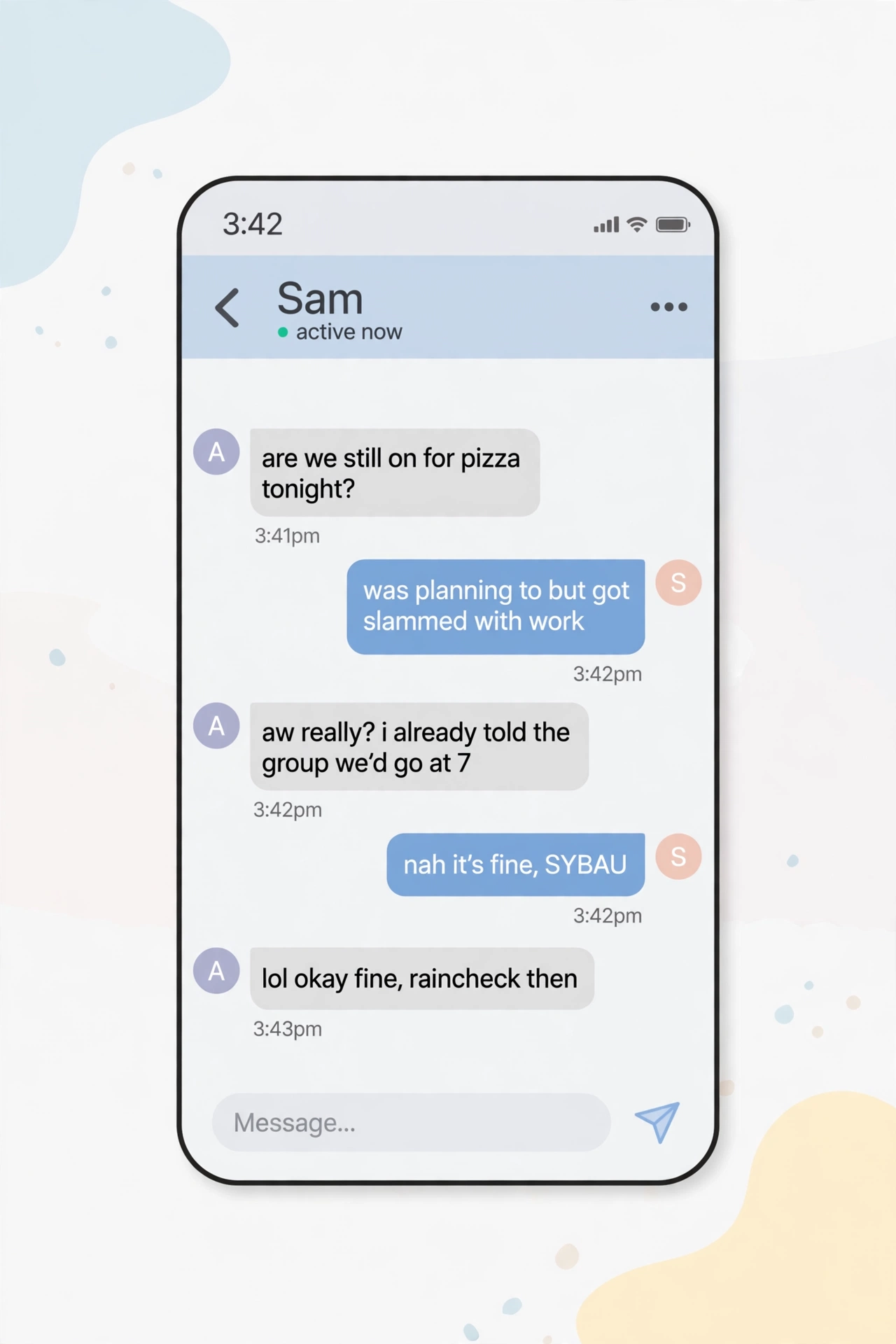
SYBAU changes meaning with tone, so the best way to understand it is to see it in action. Here are real-world style examples across the tones people actually use.
Friendly
Among close friends, SYBAU is often pure banter — a playful “shut up, you are being ridiculous” with no real anger behind it. The friendship is the safety net: everyone knows nobody actually wants anyone to stop talking.
- Friend 1: “Bro I could totally beat you in a race right now, I’m literally built different.”
Friend 2: “SYBAU 😂 you tripped over your own shoes yesterday.” - Friend 1: “I think pineapple on pizza is elite and I’ll die on this hill.”
Friend 2: “SYBAU nobody asked for this take 💀”
Notice the pattern: friendly SYBAU almost always comes with laughing emojis, a joke, or a teasing follow-up. The emoji does the work of saying “I am joking.” Without it, even a friendly SYBAU can land wrong.
Professional
Here is the honest truth: there is no professional version of SYBAU. It is a vulgar insult, and using it at work, in school, or with a teacher is a fast way to damage your reputation. If you are tempted to say it in a professional setting, what you actually need is a polite replacement — and those are covered in the alternatives section below.
- Do not say: “SYBAU, your idea won’t work.”
Say instead: “I see it differently — let’s look at the numbers before we decide.” - Do not say: “SYBAU, we already discussed this.”
Say instead: “I think we covered this earlier — happy to recap the decision.”
If a colleague or classmate drops SYBAU on you in a semi-formal setting, the best response is usually no response at all — or a calm “Let’s keep this respectful.” Engaging with the insult gives it more power than it deserves.
Funny
Funny SYBAU is where the word does its best work. It is exaggerated, theatrical, and often aimed at something absurd rather than at a person.
- “My alarm clock this morning: SYBAU 💔🥀” — posted under a meme about oversleeping.
- “Me trying to explain my dream to my friends and they just hit me with SYBAU 😭” — self-deprecating, and everyone in the comments relates.
- “SYBAU” as the entire reply to a 10-paragraph rant in a comment section — the brevity is the joke.
The humour comes from the mismatch: a dramatic, aggressive phrase used against something harmless. That is also why the SYBAU Guy meme works so well — a rapper throwing up hand signs next to a broken heart emoji is funny precisely because it is over the top.
Negative / Dismissive
Used seriously, SYBAU is genuinely rude. This is the tone that gets people in trouble, and it is the tone most guides skip over because it is uncomfortable. But it is the most common real-world use of the word outside friend groups.
- “SYBAU, your opinion is trash and nobody cares.” — a blunt shutdown in an argument.
- “SYBAU nobody asked.” — the classic comment-section dismissal, often the entire reply.
When SYBAU is used like this, it is not banter. It is a signal that the speaker has stopped listening. If someone says it to you in this tone, the smartest move is to walk away from the exchange — replying with your own insult just keeps a pointless argument alive.
| Tone | What it sounds like | Safe to use? |
|---|---|---|
| Friendly / joking | “SYBAU 😂 you are so unserious right now” | Yes — with close friends only |
| Funny / meme | “SYBAU 💔🥀” under a silly video | Yes — in casual online spaces |
| Dismissive / angry | “SYBAU nobody asked” | Risky — it will offend people |
| Professional / school | Any use of SYBAU | No — use a polite alternative |
Comparison with Similar Terms
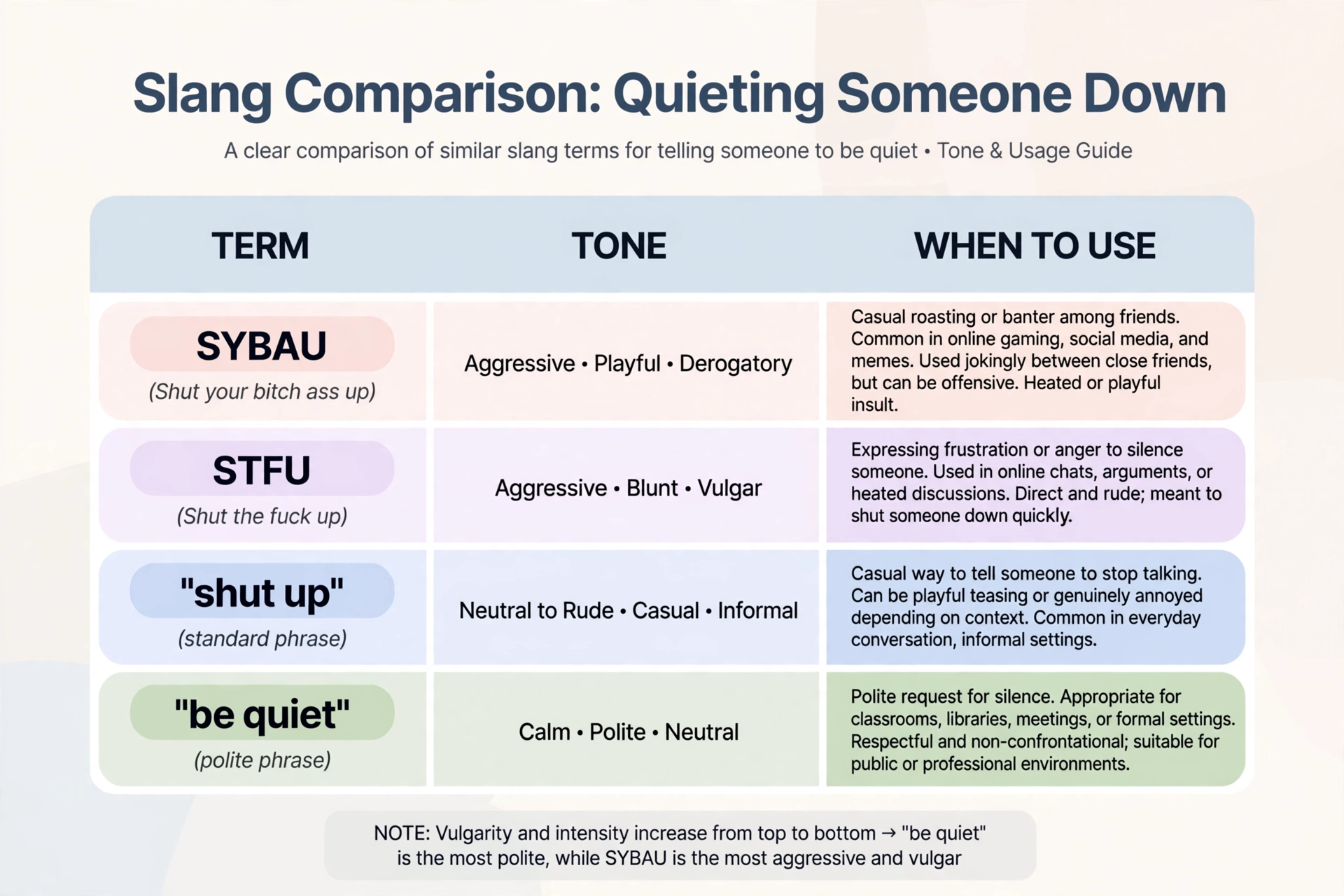
SYBAU is not the only way the internet says “shut up.” It sits in a crowded family of dismissals, and each one has a slightly different flavour. Knowing the differences is what keeps you from using the wrong one in the wrong moment.
| Term | Full form | Meaning | Tone | When to use it |
|---|---|---|---|---|
| SYBAU | Shut your b*tch a*s up | A blunt, insulting “stop talking” | Rude to joking | TikTok comments, friend banter, memes |
| STFU | Shut the f*** up | A direct, aggressive “be quiet” | Angry, harsh | Arguments, gaming — rarely playful |
| SYFM | Shut your f***ing mouth | A direct insult aimed at someone’s mouth | Aggressive, confrontational | Heated arguments; almost never joking |
| Shut up | — | The plain version: stop talking | Neutral to rude | Everyday speech, mild annoyance |
| Be quiet | — | A polite request for silence | Polite, neutral | Classrooms, work, family |
| Nobody asked | — | Your opinion was not wanted | Dismissive, sarcastic | Comment sections, roasts |
| SMYW | Shut your mouth, weirdo | A teasing dismissal | Playful, mocking | Friend groups, meme replies |
The closest comparison is STFU. Both are acronyms, both are rude, and both mean “stop talking.” The difference is flavour: STFU is older, blunter, and almost always angry, while SYBAU is newer, more meme-coded, and often used jokingly. SYBAU also carries the AAVE roots and the TikTok meme culture that STFU never had. Think of STFU as the shout and SYBAU as the eye-roll with a punchline.
SYBAU also overlaps with the wider world of sigma and crash out culture — the same TikTok ecosystem where attitude, irony, and exaggerated reactions are the default language. Like those terms, SYBAU works best when everyone in the conversation already knows the code. Used with strangers who do not know the slang, it just reads as a random insult.
Alternate Meanings
SYBAU has one real meaning — “shut your b*tch a*s up” — but the internet has invented several fake ones, and that is where most people get confused. Here are the alternate meanings you will actually encounter, and which ones are real.
The fake wholesome meaning. The most famous fake definition is “so you’re beautiful and unique.” In February 2025, TikToker @onmybehalf posted a video that purposely misdefined SYBAU this way, and it gained over 1.6 million views in three days. The joke is the trick itself: someone asks what SYBAU means, a friend gives them the sweet version, and they walk around repeating a compliment that is actually an insult. It is funny — until someone uses it on a teacher or a parent thinking they are being nice. Do not be that person.
“Stay young, beautiful, and unique.” A longer version of the same joke. It sounds like a motivational poster, and it is just as fake. It exists only to fool newcomers, and it works because SYBAU’s letters could plausibly stand for almost anything.
“Shut your boring a*s up.” This one shows up on some smaller slang blogs, and it is a sanitised remix rather than the real definition. “Boring” replaces the original word to soften the phrase, and some writers genuinely believe it is correct. It is not — the documented definition, from Urban Dictionary in 2003 to Know Your Meme today, uses the other word. Treat “boring” as a misunderstanding, not an alternate meaning.
Typos and misspellings. You will also see “SYBU,” “SYGAU,” and “SYABU” floating around. These are usually typos or auto-correct victims, not separate terms. If you see “SYBU” in a comment, the writer almost certainly meant SYBAU and dropped a letter. Similarly, “SYB” is sometimes used as an even shorter form of the same insult.
The bottom line: if a definition of SYBAU sounds wholesome, it is a joke. The real meaning is rude, and every “nice” version is either a prank or a mistake. That is worth knowing before you repeat one of them in front of the wrong person.
Professional or Polite Alternatives
SYBAU has no place in professional, academic, or family settings. But the feeling behind it — “please stop talking, this is not helpful” — comes up everywhere. Here are polite ways to say the same thing without the insult.
- “I hear you — let’s move on to the next point.” Perfect for meetings. It acknowledges the person, then redirects the conversation.
- “I think we’ve covered this — can we focus on the solution?” Works when someone is repeating themselves or going in circles.
- “Let’s take this offline.” The classic workplace way of ending a discussion without embarrassing anyone.
- “I respectfully disagree.” Short, calm, and impossible to argue with. It ends the point without attacking the person.
- “Could we pause here?” Gentle, neutral, and works in almost any situation, from classrooms to family dinners.
For texts with friends, you can also soften SYBAU itself instead of replacing it. “Okay okay, I get it 😂” or “Alright, chill, I heard you” delivers the same “stop” energy without the insult. And in comment sections, the simplest polite alternative is silence — not every bad take needs a reply, and a scroll-past is often the most powerful response of all.
Common Mistakes
SYBAU is easy to use badly. These are the mistakes people make most often — and how to avoid them.
1. Using it with strangers or authority figures. SYBAU is an in-group word. Dropping it on a teacher, a boss, a parent, or a stranger in a comment section is not funny, it is offensive. The joke only works when the other person knows you are joking. If they do not know you, they will take it literally — because literally, it is an insult.
2. Believing the fake wholesome meaning. “So you’re beautiful and unique” is a prank, not a definition. People have genuinely embarrassed themselves by using it as a compliment. If someone tells you SYBAU means something sweet, check a reliable source before repeating it.
3. Using it in a serious argument. SYBAU ends conversations; it does not win them. If you actually want someone to listen, insulting them is the worst possible strategy. Save it for jokes and memes, and use real words when something actually matters.
4. Overusing it. Like every slang term, SYBAU gets less funny the more you say it. One well-timed SYBAU in a group chat is hilarious. Ten in a row makes you the person who only knows one word. Real slang users mix it into normal sentences — they do not replace every sentence with it.
5. Typing it in full. Writing out “shut your b*tch a*s up” in a comment defeats the entire purpose of the acronym. The letters exist to dodge filters and keep the insult compact. If you type the full phrase, you will probably get flagged, hidden, or reported — and you will look like you do not understand how the slang works.
6. Using it without the tone markers. In friendly banter, the laughing emoji or the 💔 is doing half the communication. A bare “SYBAU” with no emoji and no context reads as angry, even if you meant it as a joke. When in doubt, add the emoji — or do not send it at all.
7. Thinking it is harmless because it is short. Five letters do not make an insult gentle. SYBAU contains two swear words in its full form, and many platforms and schools treat it as profanity. Do not use it where swearing would get you in trouble, because that is exactly what it is.
Quick Tips
Want to use SYBAU slang without sounding awkward or getting in trouble? Keep these tips in mind.
- Know your audience. Only use SYBAU with people who know the slang and know you are joking. Close friends and casual group chats are safe. Everyone else is a risk.
- Let the emoji do the talking. A 😂, 💀, 💔, or 🥀 after SYBAU signals playfulness. Without one, the same message can read as genuinely hostile.
- One is enough. SYBAU works because it is short and surprising. Repeating it in every message kills the effect and makes you sound like a broken record.
- Pair it with a joke, not an argument. The best SYBAU moments are reactions to something silly — a bad take, a wild claim, a funny fail. In a real argument, it just makes things worse.
- Never use it at work or school. This is not a suggestion, it is a rule. Teachers, managers, and HR departments will not find it funny.
- Learn the meme, not just the word. The SYBAU Guy picture and the 💔🥀 emoji combo are part of the language. Using the image instead of the text is often the softer, funnier option.
- If someone says it to you, do not panic. In most cases it is a joke or a meme reply, not a real attack. A laughing emoji back, or simply ignoring it, is usually the best response.
- When in doubt, do not send it. If you are unsure whether the other person will take it as a joke, they probably will not. A plain “lol no way” gets the same laugh with zero risk.
FAQ
What does SYBAU mean in slang?
SYBAU slang means “shut your b*tch a*s up.” It is a blunt internet acronym used to tell someone to stop talking, usually in a rude, dismissive, or joking way. It is most common on TikTok, in group chats, and in gaming, and its tone depends entirely on context — among friends it is often banter, while from a stranger it is an insult.
What does SYBAU mean on TikTok?
On TikTok, SYBAU is a comment-section dismissal. Users post it — often with the 💔 or 🥀 emoji, or as the SYBAU Guy reaction image of rapper Lazer Dim 700 — under videos or opinions they disagree with. It became popular on the platform in late 2024 and early 2025 and is often used alongside other slang like TS PMO ICL.
Is SYBAU rude or offensive?
Yes, SYBAU is rude by definition — its full form contains two swear words. Among close friends it is usually meant as a joke, but from a stranger, at school, or at work, it is genuinely offensive. Because the acronym hides the profanity, people sometimes forget how harsh the full phrase is. Treat it like any other swear word: fine with friends who expect it, unacceptable everywhere else.
Where did SYBAU come from?
SYBAU comes from African American Vernacular English (AAVE), and the acronym was first documented on Urban Dictionary on November 19, 2003. It stayed niche in forums and gaming chats for years before exploding on TikTok in late 2024 and early 2025, helped by the viral SYBAU Guy meme in mid-2025.
Does SYBAU mean “so you’re beautiful and unique”?
No. “So you’re beautiful and unique” is a fake definition from a joke TikTok video by @onmybehalf in February 2025, which gained over 1.6 million views in three days. The prank works by tricking newcomers into repeating a compliment that is actually an insult. The real meaning is “shut your b*tch a*s up.”
What does SYBAU 💔 mean?
SYBAU 💔 — sometimes with a wilted rose 🥀 — is the meme version of the term. The broken heart adds fake, theatrical sadness, turning the insult into a joke: “you broke my heart, now shut up.” It comes from the SYBAU Guy reaction image featuring rapper Lazer Dim 700, which became a viral TikTok meme in mid-2025. The emojis signal that the user is being dramatic or sarcastic, not genuinely angry.
What is the difference between SYBAU and STFU?
Both mean “stop talking,” but STFU (“shut the f*** up”) is older, blunter, and almost always angry, while SYBAU is newer, more meme-coded, and often used jokingly among friends. SYBAU also carries TikTok meme culture — the reaction image, the 💔🥀 emojis, and its use alongside terms like TS PMO — that STFU never had. In short, STFU is the shout and SYBAU is the eye-roll with a punchline.
Can I use SYBAU at school or work?
No. SYBAU is a vulgar insult, and using it at school or work can get you in serious trouble. If you need to tell someone to stop talking in a professional setting, say “I think we’ve covered this” or “let’s move on” instead. Save SYBAU for casual chats with close friends who understand the joke.

Conclusion
SYBAU slang is a small word with a long history. It started as a phrase in African American Vernacular English, became an acronym on Urban Dictionary in 2003, and spent two decades in gaming chats and forums before TikTok turned it into one of the most recognisable dismissals on the internet. Today it is a comment-section staple, a meme, a reaction image, and — for parents and teachers — one of the most-searched slang terms of the year.
What makes SYBAU interesting is not just what it means, but how it works. Five letters carry a whole attitude: the joke, the dismissal, the eye-roll, and the “I am done with this conversation” all at once. It is algospeak, meme culture, and in-group language wrapped into one tiny package, and it sits comfortably next to the rest of the Gen Alpha slang wave that defines how young people talk online in 2026.
But the word is also a reminder that slang has rules. Use it with friends who get the joke, and it is hilarious. Use it with strangers, teachers, or colleagues, and it is just an insult. Know the difference, know the fake meanings, and know when to leave it in the group chat where it belongs.
Now that you know what SYBAU slang really means, you will never be confused by those five letters again — and you will know exactly when to laugh, when to ignore it, and when to keep scrolling. If you found this guide useful, explore more slang explained on Means Today, including our guides to TS PMO and glazing slang, and you will be fluent in the comments section in no time.
For a broader look at how internet slang evolves, see the Gen Z slang overview on Wikipedia, which traces how terms like SYBAU travel from niche communities into everyday language.
