Quick definition: In slang, aura is the cool, confident energy or presence a person gives off — the vibe people feel the moment they walk into a room. When Gen Z says someone “has aura,” they mean that person seems effortlessly cool, calm, or impressive. Do something smooth and you gain aura; do something embarrassing and you lose it, which is where the joke of imaginary “aura points” comes from.
Aura Meaning Slang Meaning & Definition
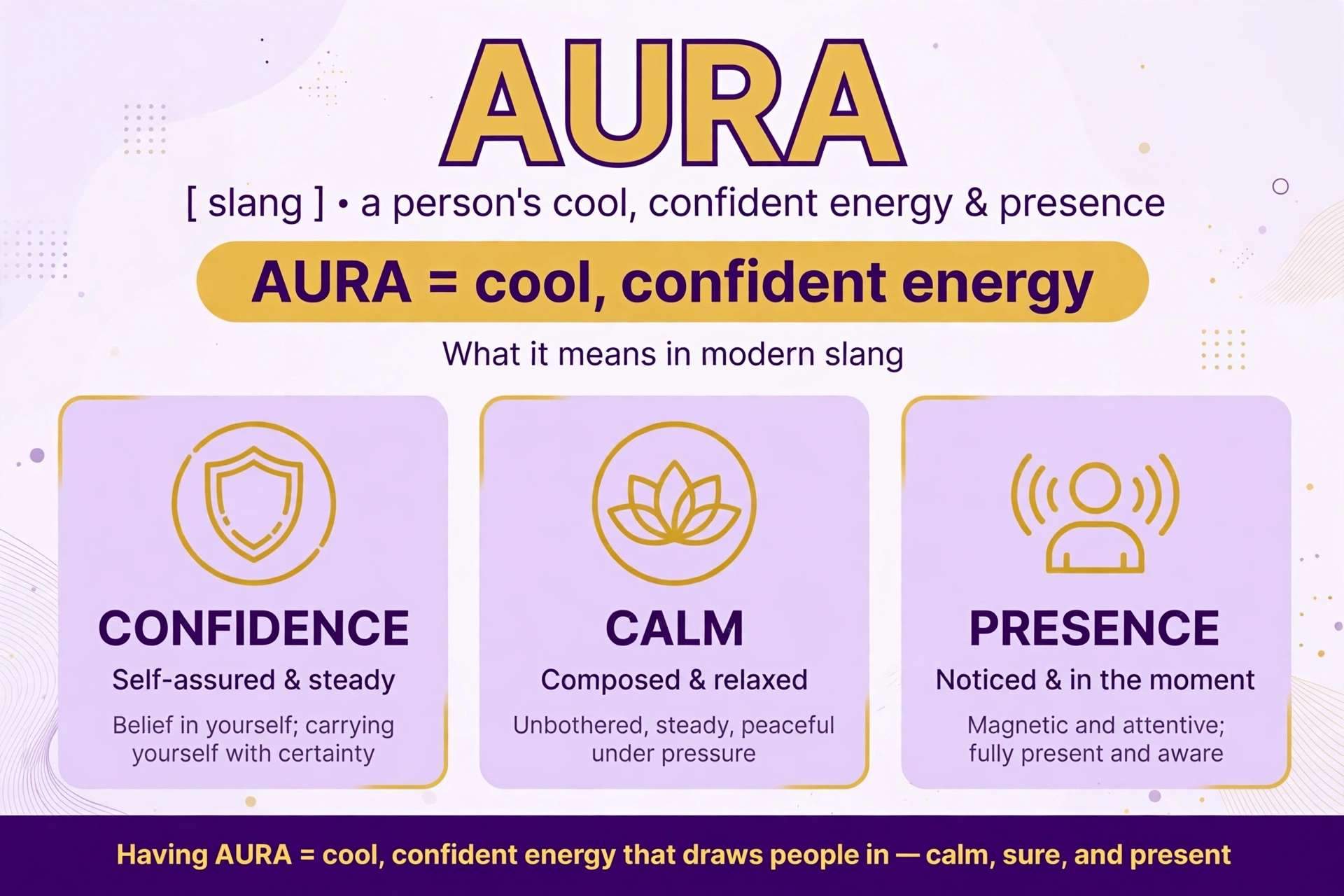
When someone searches for the aura meaning slang, they are almost always asking about the same thing: that unexplainable quality that makes one person magnetic and another forgettable. In today’s slang, aura is a noun that describes your overall presence — your confidence, your calm, your style, and the feeling you leave behind after you walk away. It is bigger than “vibe” and cooler than “charisma,” because it carries a hint of mystery with it.
Here is the simplest way to remember it:
- Aura (noun): Your presence, coolness, or energy. “He walked in and the whole room felt his aura.”
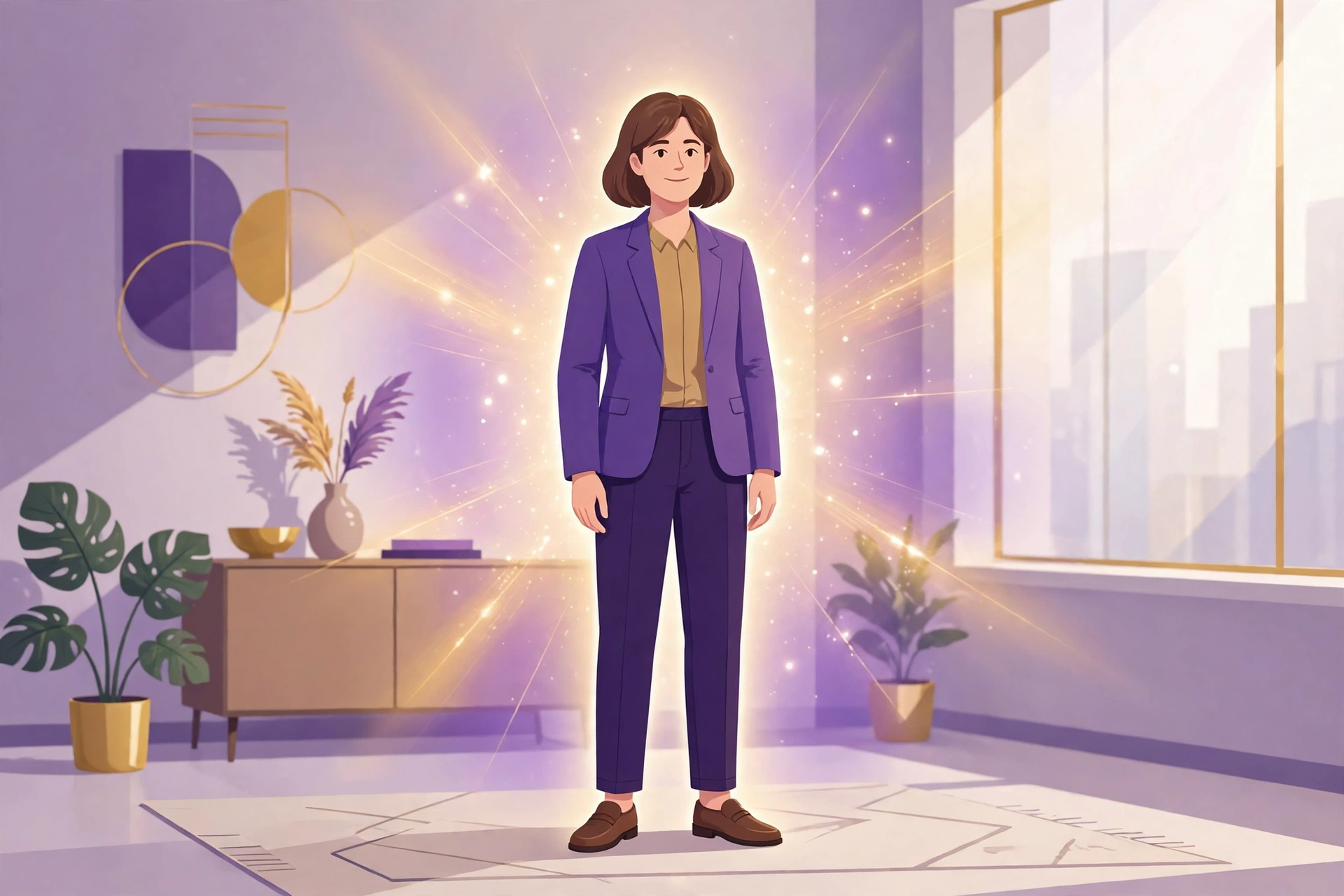
- Has aura: A compliment. Someone seems confident, impressive, or untouchable. “She has serious aura.”
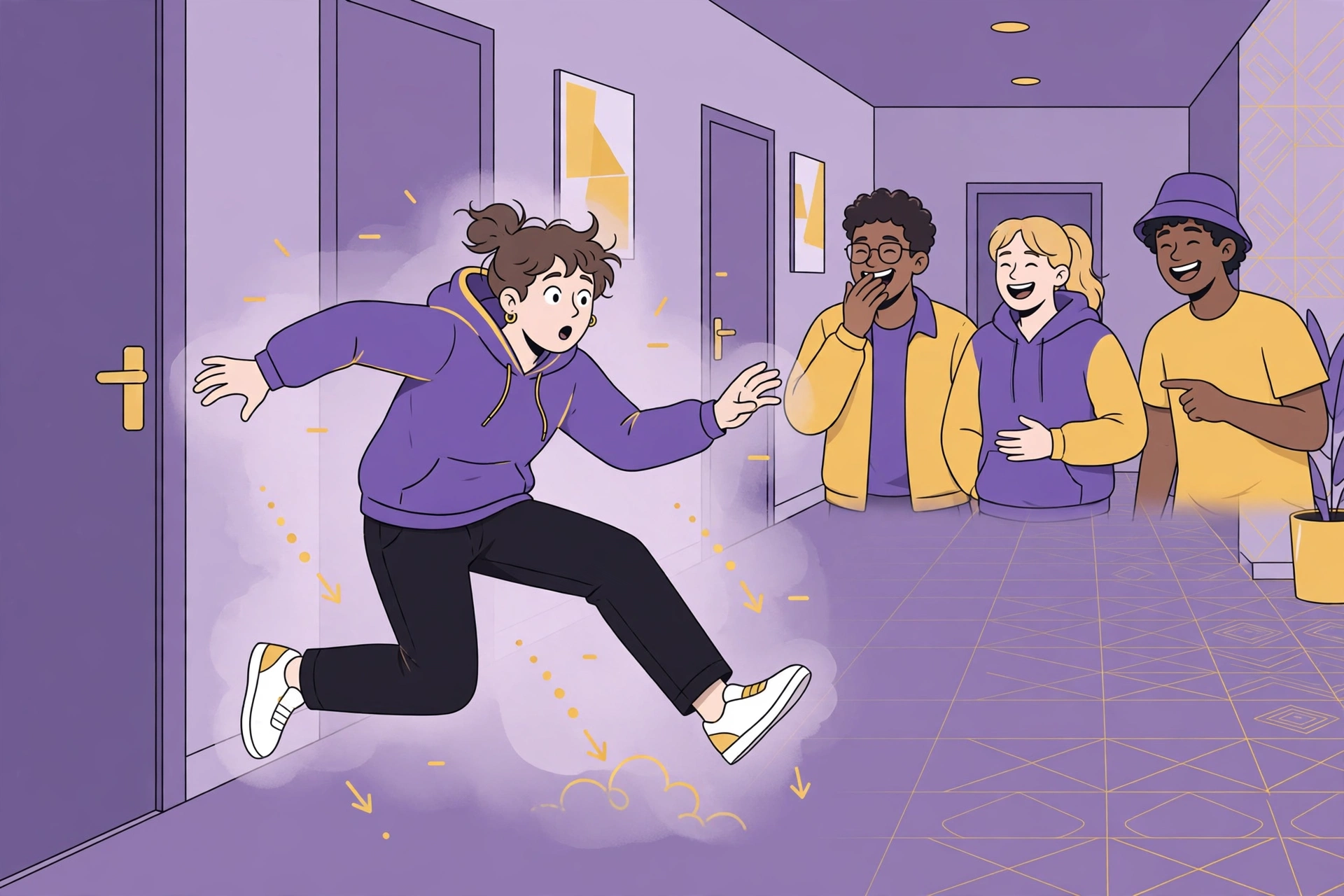
- No aura / lost aura: The opposite — someone seems awkward, forgettable, or embarrassing. “He lost all his aura when he tripped.”
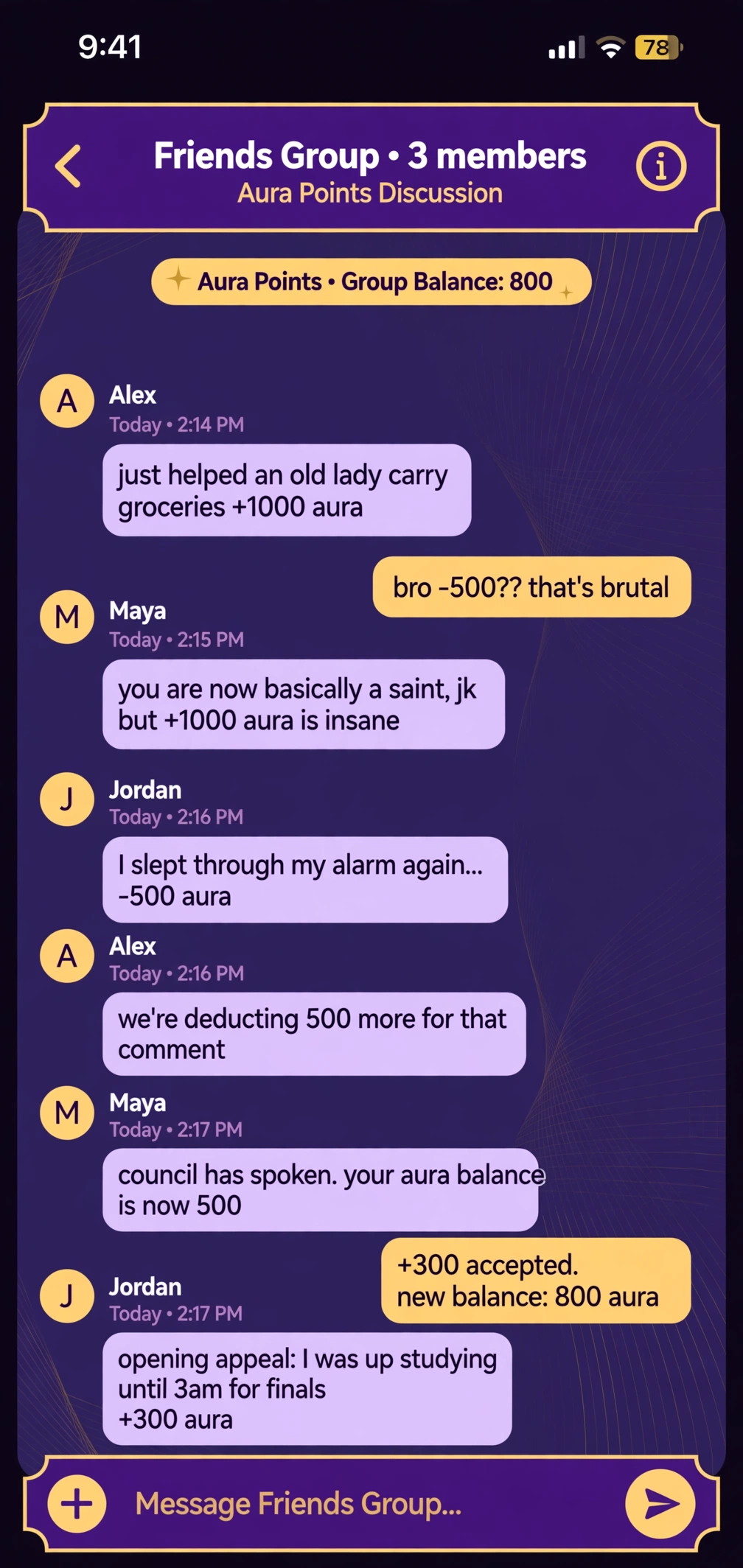
- Aura points: An imaginary score. Smooth moves earn points, cringeworthy moments lose them. “Plus 1,000 aura for that catch.”
- Aura farming: Trying, often too obviously, to look cool or mysterious on purpose.
| Quick facts | Details |
|---|---|
| Word | Aura |
| Slang meaning | Cool, confident energy or presence |
| Used as | Noun (“he has aura”) and points (“+1,000 aura”) |
| Related terms | Aura points, aura farming, aura debt, negative aura, aura maxxing |
| Where you will see it | TikTok, Instagram Reels, X, YouTube Shorts, Discord, group chats, school hallways |
| Popular with | Gen Z and Gen Alpha |
| Older meanings | Spiritual energy field; the visual disturbance before a migraine |
The word itself is not new at all. For more than a century, “aura” has described an invisible field of energy that supposedly surrounds a person. What changed is the tone: in 2024, Gen Z took that old spiritual idea, stripped out the mysticism, and turned it into a joke about social coolness — a score you can win and lose in front of everyone. If you want the full breakdown of the points game specifically, our aura points meaning guide covers the scoring jokes in detail.
Introduction
Picture this: a basketball player sinks a three-pointer at the buzzer, turns around, and walks back down the court without even looking at the basket. The crowd erupts. The comments section does not say “great shot” — it says “his aura is insane.” Now picture the opposite: the same player celebrates too early, trips over his own feet, and face-plants in front of the bench. The comments say “-1,000 aura.” Same player, same game, two completely different scores — and everyone understands the joke instantly.
That is the power of the aura meaning slang. It is one of those rare internet words that crossed from TikTok comments into everyday speech in less than a year. Teenagers use it in school hallways, athletes hear it from fans, and even brands have started borrowing it in ads. Unlike most slang that fades in a season, aura has stuck around because it describes something real: the way some people simply command a room without trying, while others try hard and still fall flat.
In this guide, you will learn exactly what aura means in slang, where the trend came from, how aura points work, what aura farming is, how aura compares to words like rizz and vibe, the mistakes that make you sound like you are trying too hard, and the polite alternatives you can use when slang is not appropriate. By the end, you will understand every “plus aura” and “minus aura” joke in your feed — and you will know whether you have aura yourself. If you enjoy decoding the newest internet words, our CSL meaning in text guide is a good next stop, because slang moves fast and yesterday’s viral word is already old news.
Origin
The word “aura” comes from the Latin word for “breeze” or “air,” and it entered English in the 19th century through spiritualism and theosophy. In that older world, an aura was a coloured field of energy said to surround every living body — something psychics claimed to read like a picture of a person’s emotional or spiritual state. A migraine aura, a completely different medical meaning, is the shimmering light or blind spot some people see before a headache. Both senses are still in use today, which is why context matters so much when you hear the word.
The slang meaning grew out of anime and movie fan communities, where people praised characters for their powerful “aura” — think of a villain walking slowly toward the camera while the music drops, or a hero standing calmly as chaos explodes behind them. From there, the word moved to sports fandom on X (formerly Twitter) around 2022 and 2023, where fans used it to describe athletes with an untouchable presence, like Liverpool defender Virgil van Dijk. The word was already a compliment; what TikTok added was the score.
The tipping point came in May 2024, when TikToker @aidan2funny posted one of the first “aura points” memes, a clip that racked up roughly three million plays. The format was simple and endlessly repeatable: show someone doing something smooth, award them “+1,000 aura”; show someone doing something embarrassing, take away “-1,000 aura.” The numbers were always exaggerated and always a joke — nobody was keeping a real tally — but the format spread across TikTok, Instagram, and X within weeks. By mid-2024, “how many aura points did I lose?” had become a standard punchline, and “aura farming” — deliberately acting cool to collect those imaginary points — was named one of Oxford’s shortlisted words for 2025 Word of the Year. Wikipedia’s article on aura farming traces how the phrase was popularised in 2024, largely through anime characters and celebrities whose calm, dramatic entrances became the template for the trend.
What makes this origin story interesting is the loop it closes. The slang sense is, in a way, the original meaning coming back in modern clothes: a 19th-century word for “the impression a person makes” became a 21st-century word for exactly the same thing — only now the impression is scored, memed, and announced in the comments.
Popularity
Aura is no longer a niche TikTok word. By 2026 it has become one of the most durable pieces of Gen Z slang, appearing in TikTok captions, Instagram comments, YouTube Shorts, sports broadcasts, gaming chats, and school conversations. Oxford International English lists it among the essential TikTok slang words for 2026, and slang glossaries from major publishers now define it alongside “rizz” and “vibe” as core vocabulary for anyone trying to understand internet culture.
Several things keep it popular. First, it is flexible: it works as a compliment (“she has aura”), a joke (“-500 aura”), a verb-adjacent concept (“stop aura farming”), and a whole points system. Second, it is visual. Short video is the perfect home for aura, because a calm walk, a smooth catch, or a confident stare can be shared and scored in seconds. Third, it is democratic — anyone can gain or lose aura in a single moment, which makes it perfect for reaction content, sports clips, and fail videos alike.
The word also travels well across platforms and age groups. Parents hear it from their kids, teachers hear it in classrooms, and even people who never open TikTok meet it in sports commentary or memes shared on Facebook. Its staying power is unusual for internet slang: most viral words burn out in months, but aura has survived for two full years because it names something people genuinely talk about — presence — and it does so with a scoring joke that never gets old.
How It Is Used
The aura meaning slang changes slightly with context, so here is how each version actually works in real life.
As a compliment (“has aura”): This is the most common use. When someone says “he has aura” or “her aura is unreal,” they mean that person seems confident, cool, and magnetic without trying. It is high praise, and it is usually sincere. “Did you see how she handled that interview? She has aura.”
As a score (“aura points”): This is the joking version. People award or deduct imaginary points for anything — catching a falling phone (+100 aura), waving at someone who was not waving at you (-1,000 aura), or walking into a glass door (-10,000 aura). The numbers are always round and always exaggerated, which is the whole point. Nobody tracks the total; the announcement is the joke.
As a warning (“aura is off”): When someone’s aura is “off,” something about their energy feels strange, uncomfortable, or wrong. It is a softer, vaguer version of saying “something is wrong with him today.” “His aura was off in that interview — he seemed nervous and defensive.”
As a call-out (“aura farming”): This describes someone who is clearly trying to look cool — walking slowly, staring into the distance, posing for a photo they pretend is candid. It is almost always teasing. “Bro is aura farming in the hallway again.”
As a superlative (“main character aura”): Someone with “main character aura” carries themselves like the star of a movie — noticeable, interesting, and impossible to ignore. It is a compliment with a playful edge, because it implies the person knows they are the main character.
Tone matters more than grammar here. “Aura” is casual, playful, and young. It suits friends, group chats, comments, and captions. It does not suit a job interview, a formal email, or a conversation with your grandmother — not because it is rude, but because it will sound like you are speaking a different language, and in formal settings that reads as unserious.
Examples
The fastest way to understand aura is to see it in real sentences. Notice how the same word shifts between a compliment, a joke, and a call-out depending on the situation.
Friendly Examples
- “You caught your phone before it hit the floor. Plus 100 aura points.”
- “He walked into the party late like nothing happened. That is aura.”
- “Her aura is so calm — she never panics, even when everything goes wrong.”
- “Bro, your aura in that photo is insane. You look like a movie character.”
- “She gave the best answer in class without even trying. Main character aura.”
Professional Examples
- “The new manager has real aura — the whole team listens when she speaks.”
- “He lost a bit of aura in that meeting when he read straight from the slides.”
- “A good speaker’s aura does half the work before they even open their mouth.”
- “She handled the client complaint so calmly. That is the kind of aura you cannot fake.”
Funny Examples
- “I waved back at a stranger who was waving at someone behind me. Minus 1,000 aura.”
- “He tripped over absolutely nothing in the hallway. Negative aura. He owes aura now.”
- “My dad just said ‘aura farming’ at dinner. Plus 5,000 aura for him, honestly.”
- “I tried to look mysterious in my profile photo and ended up looking confused. Aura debt.”
- “He walked into the glass door and then pretended it was on purpose. That is minus 10,000 aura and everybody saw it.”
Comparison with Similar Terms
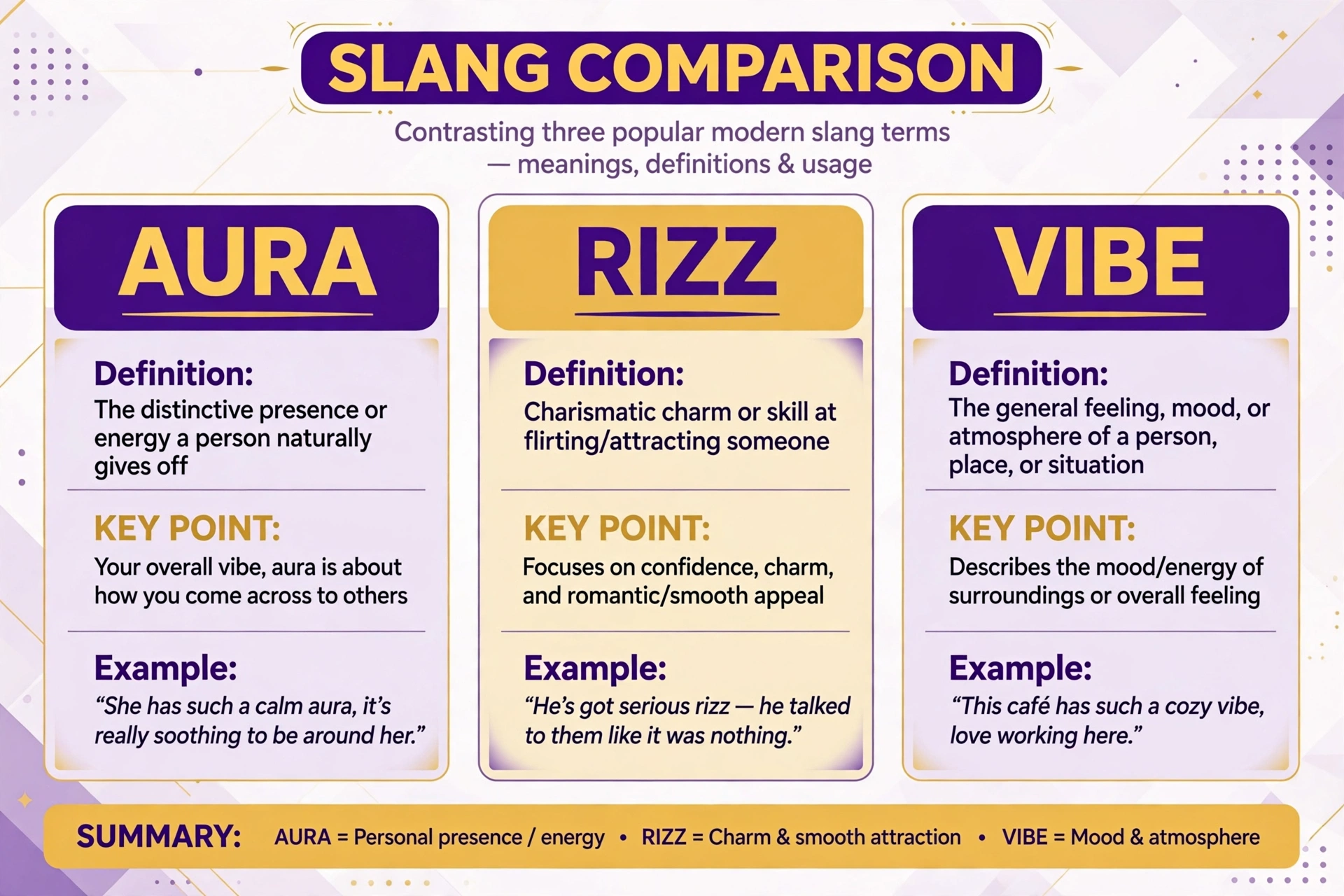
Aura gets confused with several nearby words, and the differences matter. Here is how it stacks up against the terms people mix it with most often.
| Term | What it means | How it differs from aura |
|---|---|---|
| Aura | Coolness, presence, or charisma, often scored in points | The base term — general presence anyone can have |
| Rizz | Romantic charm; skill at flirting | Rizz is about attraction and flirting; aura has no romantic angle |
| Vibe | A feeling or atmosphere | Vibe describes a mood or place; aura describes a person’s presence |
| Charisma | Personal charm that wins people over | Charisma is the formal, serious version; aura is the playful, scored version |
| Main character energy | Acting like the star of your own story | Main character energy is one flavour of aura, usually louder and more dramatic |
| Swag | Confident style, especially in fashion | Swag is mostly about how you look; aura is about how you carry yourself |
| Aura farming | Deliberately trying to look cool or mysterious | This is the effort behind aura — and people tease you for it |
The key distinction is that aura is about presence, not performance. Rizz needs a target — someone to charm. Vibe needs a setting — a room, a song, a moment. Aura needs only the person. That is why “he has aura” works as a complete sentence, and why losing aura is so funny: it is the one compliment that can be taken away by a single clumsy moment.
Alternate Meanings
Because the word “aura” is so old, it carries several meanings that have nothing to do with slang. Knowing them keeps you from misunderstanding a conversation — or a doctor.
Spiritual aura: The original sense. In spiritual and New Age traditions, an aura is a coloured field of energy said to surround a person, read as a picture of their emotional or physical state. If a medium, healer, or meditation teacher talks about your aura, they mean this — not your TikTok presence.
Migraine aura: A medical term. Some people see shimmering lights, zig-zag lines, or a blind spot in their vision before a migraine headache begins. Doctors call this a migraine aura, and it is a neurological symptom, not a personality trait.
Aura in gaming and anime: In games and anime, a character’s aura is often shown as a visible glow or energy field around them when they power up. This is where the slang meaning partly comes from — fans described powerful characters as having a strong “aura,” and the word jumped from fiction into real life.
Aura as atmosphere: In older literary English, “aura” can simply mean the atmosphere or feeling around a place, similar to “ambience.” “The old house had a strange aura.” This sense overlaps with the slang meaning, which is probably why the slang version felt so natural when it arrived.
Context is your best friend here. If the conversation is about TikTok, sports, or a group chat, “aura” almost certainly means the slang sense. If it is about meditation, energy healing, or a headache, it almost certainly does not.
Professional or Polite Alternatives
Slang is fun, but it does not belong everywhere. Here are polished ways to say the same thing in formal, professional, or mixed-age settings:
- Instead of “he has aura”: “He has a commanding presence” or “She carries herself with real confidence.”
- Instead of “she lost aura”: “That moment hurt her credibility a little” or “It was an awkward moment for him.”
- Instead of “aura farming”: “He is trying a bit too hard to impress people” or “She is very conscious of her image.”
- Instead of “main character aura”: “She has a natural star quality” or “He really stands out in a room.”
- Instead of “his aura is off”: “Something seemed off about him today” or “Her energy felt different in that meeting.”
The trick is to keep the compliment and drop the scoring language. In a performance review, “commanding presence” lands; “+1,000 aura” does not. Save the points for the group chat, where the joke belongs.
Common Mistakes
Aura is easy to use and easy to misuse. These are the mistakes that give people away instantly.
1. Saying it about yourself. Aura is something other people grant you. Saying “I have so much aura” is the fastest way to lose it — the moment you claim it, you are aura farming, and everyone can see it. Let other people say it about you.
2. Using it in formal settings. Telling your boss “great aura in that presentation” might get a laugh, or it might get a confused stare. In professional settings, use “presence” or “confidence” instead. Slang has a time and a place, and a client meeting is rarely either.
3. Confusing aura with aura points. Aura is the quality; aura points are the joke about it. “He has a lot of aura points” sounds odd to native users — the natural phrasing is “he has aura” or “plus 1,000 aura for that.” Keep the points for the scoring joke, not for the quality itself.
4. Taking the score seriously. There is no real tally, no leaderboard, and no official rulebook. If someone says “-1,000 aura,” they are joking. Arguing about your score, demanding points back, or keeping count misses the joke entirely — and ironically costs you aura.
5. Forcing it into every sentence. Like any slang, aura gets tired fast when it is overused. Dropping it into every comment or caption makes you sound like you learned the word yesterday. Use it when it fits, and let it land.
6. Using it for the spiritual or medical meaning by accident. If a friend mentions their “migraine aura” and you reply “+1,000 aura,” you have misunderstood badly. Check the context before you joke — some auras are not funny.
Quick Tips
- Let aura find you. Calm confidence, good posture, and not overreacting to small moments build more aura than any pose or catchphrase ever will.
- Stay calm under pressure. The single biggest aura-builder is handling an awkward or stressful moment without panicking. People remember composure.
- Use it as a compliment, not a weapon. “She has aura” makes someone’s day. Using aura points to mock someone repeatedly just makes you look unkind.
- Keep the numbers absurd. The joke works because the numbers are ridiculous — plus 1,000, minus 10,000. Small, realistic numbers are not funny.
- Know when to drop it. In formal writing, work emails, or conversations with older relatives, switch to “presence,” “confidence,” or “charisma.”
- Do not announce your own aura farming. The moment you say “I am aura farming right now,” the joke is over — and so is the aura.
- Watch the masters. The best way to learn the rhythm of aura jokes is to watch sports clips and anime edits on TikTok, where the format was born.
- Pair it with the right words. Aura sits naturally next to “vibe,” “rizz,” and “main character energy” — if you want to keep up with the whole family of terms, our FN meaning in text guide and our IDT meaning in text guide cover more of the slang you will meet in the same feeds.
FAQ
1. What does aura mean in slang?
In slang, aura means a person’s coolness, confidence, or presence — the energy people feel when that person walks into a room. Someone with aura seems effortlessly cool, calm, or impressive, and the word is usually a compliment.
2. What are aura points?
Aura points are an imaginary score people joke about on TikTok and in group chats. You gain points for smooth, impressive moments (“+1,000 aura for that catch”) and lose them for embarrassing ones (“-1,000 aura for tripping”). Nobody keeps a real tally — the announcement is the joke.
3. What does aura farming mean?
Aura farming means deliberately trying to look cool, confident, or mysterious — walking slowly, staring into the distance, or posing for a photo you pretend is candid — in order to build up your aura. It is usually said teasingly, because trying too hard is the opposite of effortless cool.
4. What does it mean when someone says “he has aura”?
It means the person seems confident, magnetic, and impressive without trying. It is high praise in Gen Z slang, similar to saying someone has a commanding presence or star quality.
5. What does “negative aura” or “minus aura” mean?
It means someone just did something embarrassing or uncool, so they jokingly lost aura points. “Minus 1,000 aura” after walking into a glass door is the classic example — the bigger and rounder the number, the funnier the joke.
6. Is aura the same as rizz?
No. Rizz is about romantic charm and skill at flirting, while aura is about general presence and coolness with no romantic angle. Someone can have aura without having rizz, and vice versa — although the most magnetic people often have both.
7. Where did aura slang come from?
The slang grew out of anime and movie fan communities, spread through sports fandom on X around 2022 and 2023, and exploded on TikTok in May 2024 when “aura points” memes went viral. The word itself comes from the Latin for “breeze” and has described a person’s energy field since the 19th century.
8. Can you lose aura?
In the joke, yes — one clumsy or embarrassing moment can cost you a thousand imaginary points. In real life, aura is just how people perceive you, and a single awkward moment rarely changes that for long. Confidence, calm, and humour rebuild it faster than any points system ever could.
Conclusion
The aura meaning slang turns out to be beautifully simple: it is the cool, confident energy a person gives off, scored as a joke and felt as a compliment. It started as a spiritual word, travelled through anime edits and sports clips, and became one of the defining slang terms of 2026 — a word that lets an entire generation talk about presence, confidence, and social coolness in a single syllable.
The key takeaways are easy to remember. Aura is presence, not performance. You gain it by staying calm, confident, and natural, and you lose it by trying too hard or claiming it for yourself. Aura points are always a joke — the numbers are absurd on purpose — and aura farming is what happens when the effort starts showing. Use it with friends, in comments, and in captions, and switch to “presence” or “confidence” when the setting turns formal.
Now you can read every “plus aura” and “minus aura” joke in your feed without missing a beat — and you know exactly what to do the next time someone says you have aura: accept the compliment, stay calm, and do not trip on the way out. Keep exploring the slang that fills your timeline, from CSL meaning in text to the newest guides on this site, and you will never be lost in a comment section again.

2 thoughts on “Aura Meaning Slang: What “Aura” Really Means in 2026”