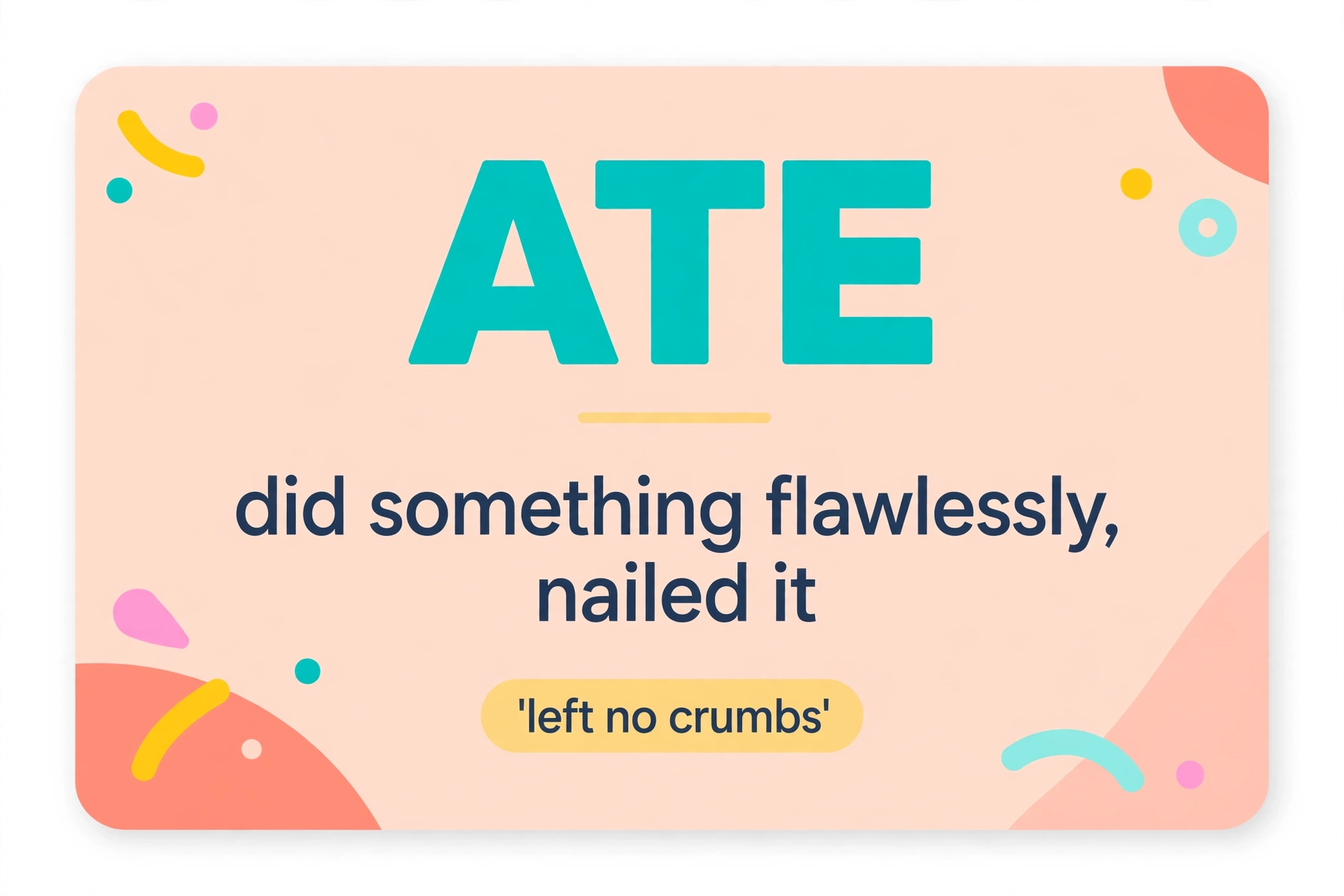
Quick definition: In slang, ate means someone did something exceptionally well — they nailed it, owned it, or performed flawlessly. When a comment says “she ate,” it means she delivered a look, a performance, or a comeback so good there is nothing left to say. It comes from the phrase “ate that up” or “ate and left no crumbs,” and it is almost always a compliment.
Ate Slang Meaning & Definition
The ate slang meaning is simple once you hear it in context: it is praise for a flawless performance. When someone posts a photo, a dance video, a runway walk, or a witty reply and the comments flood in with “ATE,” “she ate,” or “you ate that up,” they are saying the person absolutely nailed it. There was no mistake, no weak moment, nothing left to improve — they consumed the moment completely.
The word comes from the longer expression “ate that up,” which itself grew out of “ate and left no crumbs.” The image is vivid: just as someone who eats a meal and leaves no crumbs has finished it completely, a person who “ate” a performance has delivered it so fully that there is nothing left for anyone else. No crumbs means no flaws, no leftovers, no room for criticism. It is the highest compliment a comment section can pay.
Unlike the standard English word “ate,” the past tense of “eat,” the slang version has nothing to do with food. Context makes the difference. “I ate lunch” is a meal. “She ate that look” is a fashion verdict. The slang meaning lives almost entirely on social media — TikTok, Instagram, X (Twitter), and group chats — where short, punchy praise travels fastest.
It is also worth knowing that “ate” can stand alone as a complete sentence. A single-word comment — “Ate.” — under a photo is a full review. Adding fire emojis (“Ate 🔥🔥”) or the phrase “left no crumbs” turns the praise up even further. On the other hand, “ate” is sometimes used with a playful edge, as in “okay, ate!” — a way of saying “fair enough, you really did that.”
Introduction
You have probably seen it a hundred times without noticing: a single word sitting alone in a TikTok comment section, under an Instagram outfit photo, or at the end of a text from a friend. “Ate.” No emoji, no explanation, no follow-up. Just ate. And if you did not grow up with the slang, that one word can feel like a riddle — did someone eat something? Is it a typo? A compliment? An insult?
It is, almost always, a compliment — and a strong one. In the slang of TikTok, Instagram, ballroom culture, and group texts, “ate” has become one of the fastest ways to say “you absolutely killed that.” It is short, it is punchy, and it carries more weight than a simple “nice” or “great.” This guide breaks down the full ate slang meaning, where it came from, how people actually use it in 2026, and the mistakes to avoid so you never use it in the wrong moment.
Origin
The story of “ate” as praise starts in Black LGBTQ+ ballroom culture, where language has always been vivid, competitive, and celebratory. In ballroom, performers walk categories — fashion, dance, realness — and the audience judges them in real time. To “eat” a category meant to dominate it so completely that nobody else stood a chance. The phrase “ate that up” described a performance devoured whole, with nothing left over for the competition.
From ballroom, the expression traveled into drag culture and reality television. Shows like RuPaul’s Drag Race carried phrases such as “she ate” and “ate and left no crumbs” to a mainstream audience, and the queens’ catchphrases did the rest. By the late 2010s, the phrase was all over stan Twitter, where fans used it to celebrate their favorite pop stars’ outfits, music videos, and red-carpet looks.
What changed everything was TikTok. On a platform where a comment has about one second to land, a single punchy word beats a sentence. “Ate” became the perfect reaction word: faster than “that was an incredible performance,” cooler than “amazing,” and flexible enough to fit a fit check, a dance challenge, a makeup transformation, or a comeback. By 2022 and 2023, “ate” and “left no crumbs” were everywhere — in captions, in comments, and in everyday speech among Gen Z and younger Millennials.
The phrase also picked up variations along the way. “Ate that up” is the classic full form. “Ate and left no crumbs” is the emphatic version. “Ate, no crumbs” is the shorthand. “Devoured” is a close cousin that means almost the same thing. Each version says the same thing at a different volume: this person did not just do well — they did it perfectly.
Popularity
Ate is not a niche word anymore. It shows up across every platform where young people talk, and it has stayed active while dozens of other slang terms have burned out. A few reasons explain why it stuck:
- It is short. One syllable, three letters, no thinking required. It fits comments, captions, and fast-moving group chats.
- It is visual. The eating metaphor paints an instant picture: total, complete, nothing left. People understand it the first time they hear it.
- It sounds confident. Compared with “good job” or “well done,” ate carries swagger. It suggests the performance was not just good — it was undeniable.
- Pop culture keeps feeding it. Drag shows, music videos, fashion content, and celebrity moments all invite a one-word verdict — and “ate” became the default.
The word is most common among Gen Z (roughly ages 12 to 27) and younger Millennials, and it is strongest on TikTok, Instagram, X, and Snapchat, plus in texting. It also appears in fandom spaces, beauty and fashion communities, dance and music circles, and drag and ballroom fan spaces. You will hear it less in formal or professional settings, which is part of the point: ate is a casual word, and using it casually is what makes it work.
Search interest in the term has stayed steady through 2025 and into 2026, and the questions people ask about it tell the story: “ate slang meaning TikTok,” “what does ate mean from a girl,” “ate vs slayed,” and “did she eat or did she ate.” People are not confused about whether the word exists — they are confused about intent and grammar, and that is what the rest of this guide clears up.
How It Is Used
Ate works as a verb, a reaction, and a standalone sentence. The grammar is loose on purpose. Here are the patterns you will actually see:
- As a one-word reaction: “Ate.” / “ATE 🔥” / “Ate, no crumbs.” This is the most common form — a complete verdict in a single word.
- With a subject: “She ate.” / “He ate that.” / “They ate.” This names who delivered the performance.
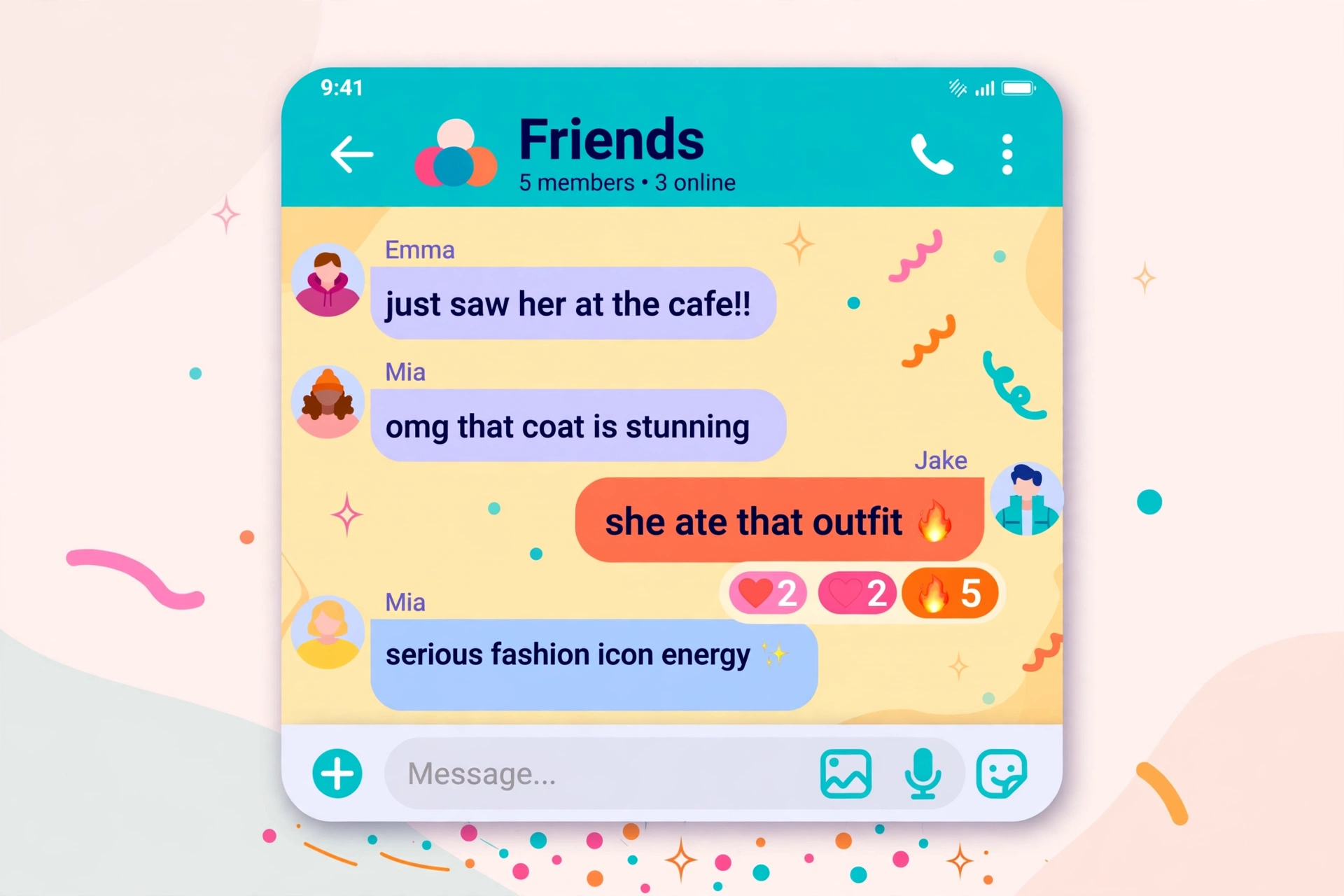
- With an object: “She ate that look.” / “You ate that performance up.” / “She ate the runway.” This names what was nailed.
- As a question or challenge: “Did she eat or did she eat?” (Meaning: was that amazing or was that amazing?) / “Tell me she didn’t eat.” (Meaning: admit it was great.)
- About a comeback or reply: “You ate him up with that reply.” This praises a witty or devastating response.
The word also pairs naturally with fire emojis, “no crumbs,” “period,” and “and that’s on that” — all of them ways of saying “I mean this sincerely, and there is no debate.” A comment that reads “ATE, LEFT NO CRUMBS 🔥🔥” is about as strong a compliment as a comment section gives. On the other hand, “ate” on its own, with no emoji and no context, usually still reads as positive. The default meaning online is praise; it takes a very specific context to make it anything else.
| Form | What it usually means | Example |
|---|---|---|
| “Ate.” | That was flawless, full stop. | Comment under a dance video: “Ate.” |
| “She ate.” | She nailed it completely. | “Did you see Beyoncé’s outfit? She ate.” |
| “Ate and left no crumbs.” | Perfect — nothing to criticize. | “That transition? Ate and left no crumbs.” |
| “You ate that up.” | You owned that moment. | “You ate that presentation up, honestly.” |
| “Did she eat?” | Was that amazing? (Yes.) | “Did she eat or did she eat?” |
Examples
Friendly Examples
- “Okay bestie, you ATE that outfit. Where did you even get that jacket?”
- “She posted the fit check and the whole group chat just said ‘ate’ — nothing else needed.”
- “Your makeup today? Ate and left no crumbs. Tutorial when?”
- “He ate that dance challenge up, I watched it three times.”
Professional Examples
“Ate” is casual slang, so in professional settings it usually stays in informal moments — a creative team’s group chat after a great presentation, or a colleague’s message after a successful pitch. For example: “You ate that presentation up — the client loved it.” In a formal email or a client meeting, the professional alternatives below work better.
- “You absolutely ate that pitch — the client was impressed from the first slide.”
- “She ate the keynote. Standing ovation, no notes.”
Funny Examples
- “My cat knocked over the vase and then sat there like she ate. Zero crumbs of remorse.”
- “He tried to roast me and I ate him up with one reply. He hasn’t texted back since.”
- “Tell me she didn’t eat — the Halloween costume won the whole party.”
Comparison with Similar Terms
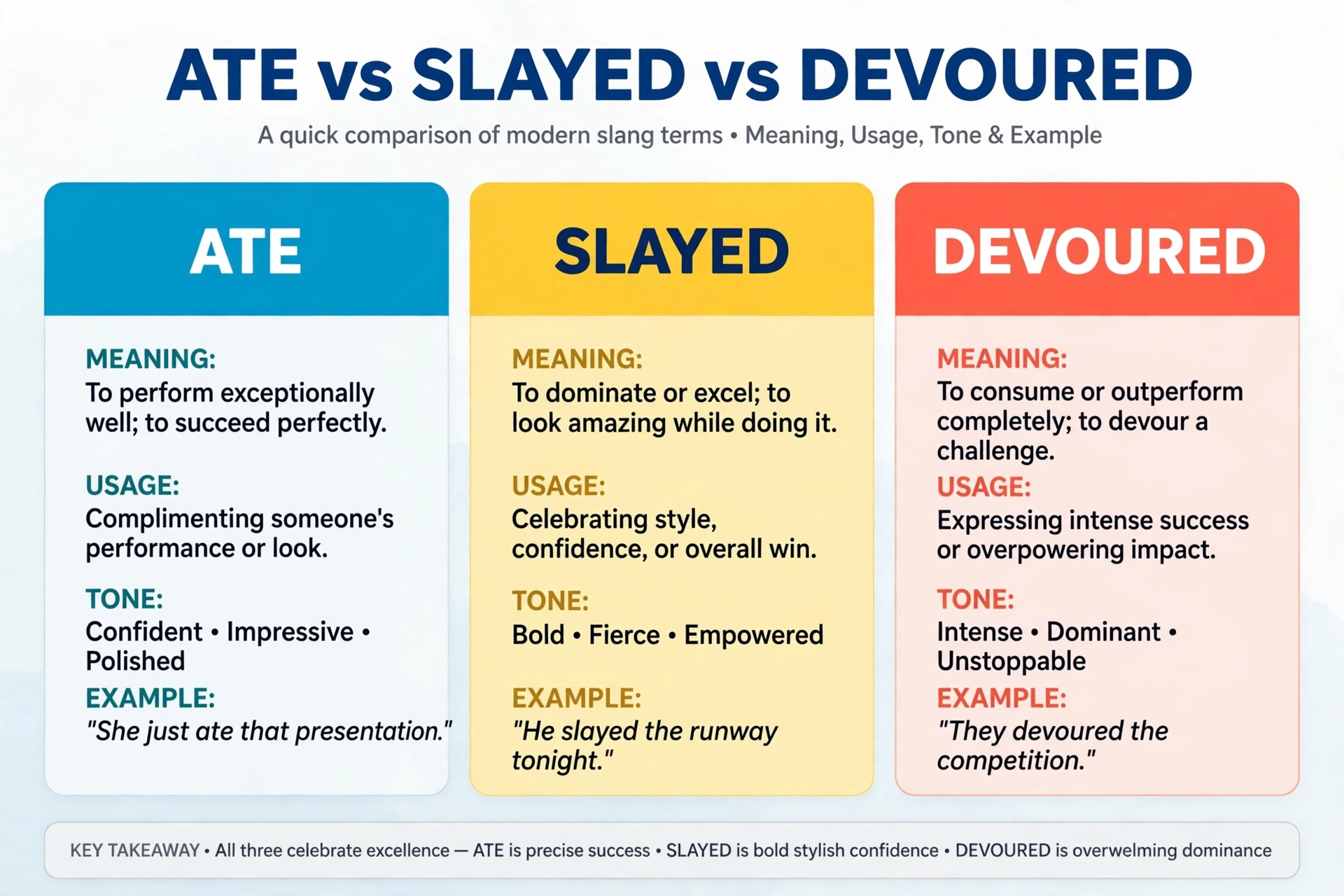
“Ate” belongs to a family of slang words that all praise a great performance, but each one has its own flavor. Knowing the difference keeps you from sounding like you are reading off a list.
| Term | Meaning | How it differs from “ate” |
|---|---|---|
| Ate | Did something flawlessly; nailed it. | The baseline — total, complete domination of a moment. |
| Slayed | Did something brilliantly; killed it. | Older and broader; “slayed” can describe an outfit, a performance, or a whole day. “Ate” feels more current and more specific to a single moment. |
| Devoured | Completely owned a look or performance. | Almost a synonym for “ate,” often used in the same sentences (“she devoured, no crumbs”). Slightly more dramatic. |
| Killed it | Performed excellently. | Mainstream and older; works in more settings, including work. Less internet-specific than “ate.” |
| Snapped | Did something impressively, often a photo or look. | Usually about visuals — “she snapped on this photoshoot.” “Ate” covers performances, replies, and looks alike. |
| Tuff | Cool, impressive, hard-hitting. | “Tuff” describes the thing itself (that jacket is tuff). “Ate” describes the person’s performance (she ate that look). Related praise, different grammar — see the full tuff slang meaning guide. |
| GOAT | Greatest of all time. | A bigger claim — GOAT is about all-time status, while “ate” is about one moment. Read the GOAT meaning in slang guide for the full breakdown. |
They overlap, but they are not interchangeable. “Slayed” is the classic, “ate” is the current favorite, and “devoured” is the dramatic upgrade. The safest move is to match the word to the moment: a red-carpet look gets “ate,” a career milestone gets “killed it,” and an all-time great gets GOAT.
Alternate Meanings
Outside slang, “ate” is simply the past tense of “eat” — and that ordinary meaning never goes away. “I ate breakfast” is a meal, not a compliment. The slang meaning only activates in the right context: a performance, a look, a reply, or a moment being judged.
There are a few other niche uses worth knowing:
- “Ate” as in consumed by something: In older slang, “ate up” could mean obsessed with something (“he’s all ate up with that car”), but this usage is rare today.
- “Ate” in gaming: In gaming chats, “ate” sometimes means a player dominated a match or a round — “bro ate in that lobby.” Same praise, different arena.
- “Ate” as a typo: Occasionally “ate” is just a misspelling of “at” or “eight” in fast typing — context and emojis usually make it obvious which one it is.
- “Ate” vs “eat”: The present tense “eat” is sometimes used the same way in slang — “she eats every time” means she never misses. “Ate” is the past tense form, used after the moment has happened.
The rule of thumb: if the sentence is about a person doing something impressive, it is slang praise. If it is about a meal, it is dinner.
Professional or Polite Alternatives
“Ate” is casual slang, and it does not belong in formal writing, work emails, or professional settings. When the moment calls for polish, these alternatives carry the same energy without the slang:
- “You nailed it.” — The closest professional equivalent. Works in almost any setting.
- “Flawless performance.” — Perfect for a presentation, pitch, or speech.
- “Outstanding work.” — Safe for emails, reviews, and formal praise.
- “You absolutely owned that.” — Casual but professional enough for most workplaces.
- “Impeccable.” — For a look, a design, or a delivered result.
- “Brilliant.” — Short, warm, and universally appropriate.
A good test: if you would not say it to your boss’s boss, use one of the alternatives. Save “ate” for friends, social media, and casual conversations where slang is welcome — that is where it lands best.
Common Mistakes
“Ate” is easy to use, but a few mistakes make people sound like they are trying too hard — or using the word in the wrong place entirely:
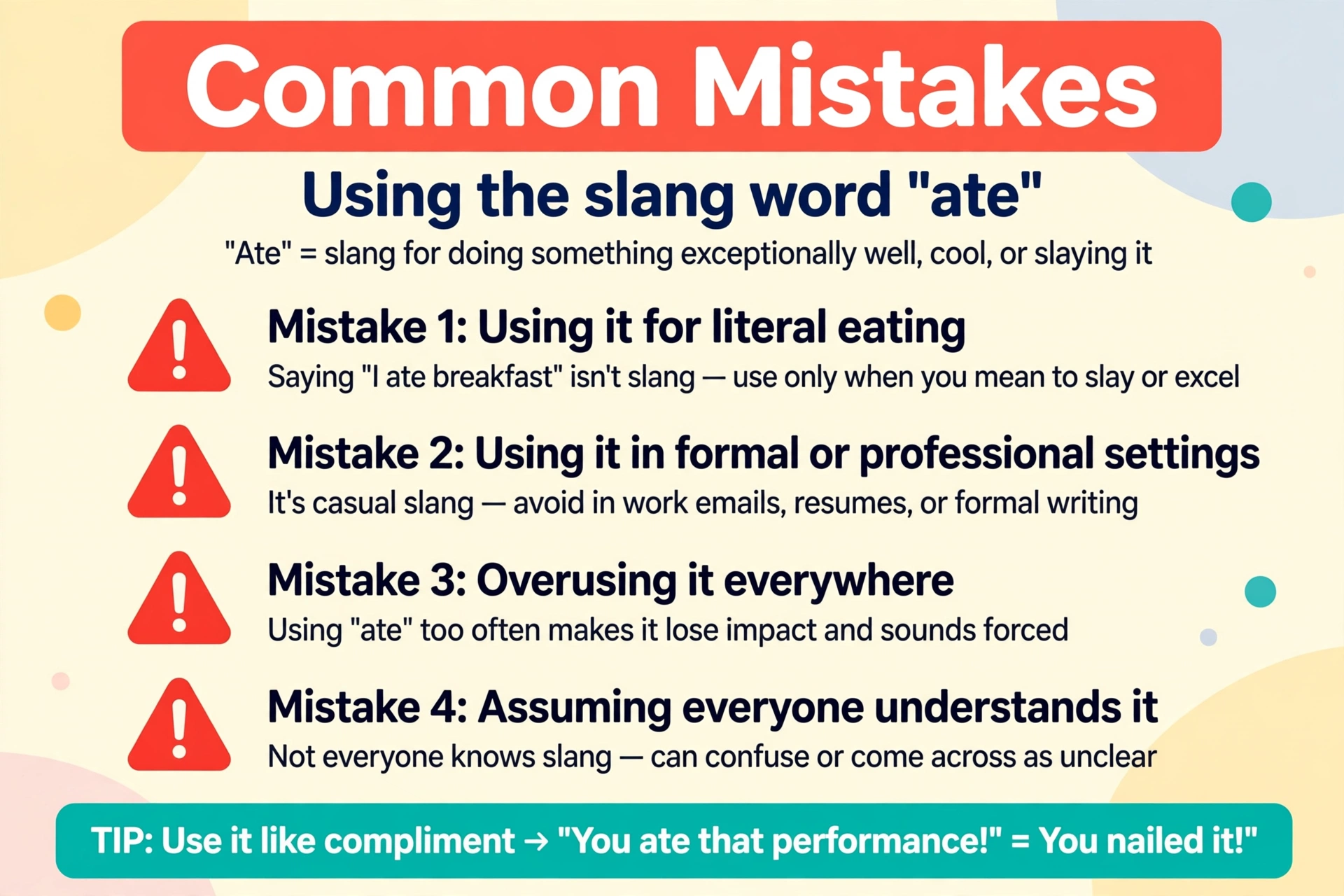
- Using it for ordinary things. “Ate” is for standout moments, not everyday tasks. Saying “she ate that email” about a routine message sounds strange. Save it for performances, looks, and moments that actually impressed you.
- Using it about food by accident. “I ate” in a comment under a food photo means you ate the food — not that the food was amazing. If you mean the dish looked incredible, say “that looks amazing” instead.
- Overusing it. If everything “ate,” nothing did. The word works because it signals something exceptional. Use it sparingly and it keeps its power.
- Getting the grammar wrong. “She ate” is correct. “She eated” is not a word, and “she eat” only works as the present-tense slang (“she eats every time”). For a finished moment, “ate” is the form.
- Using it in formal settings. Dropping “ate” in a work email, a school essay, or a job interview will confuse people — or make you sound unprofessional. Keep it casual.
- Forgetting the crumbs. “Ate and left no crumbs” only makes sense when the performance was genuinely flawless. Using it for something mediocre reads as sarcasm, which is fine if that is the joke — but be sure the joke lands.
Quick Tips
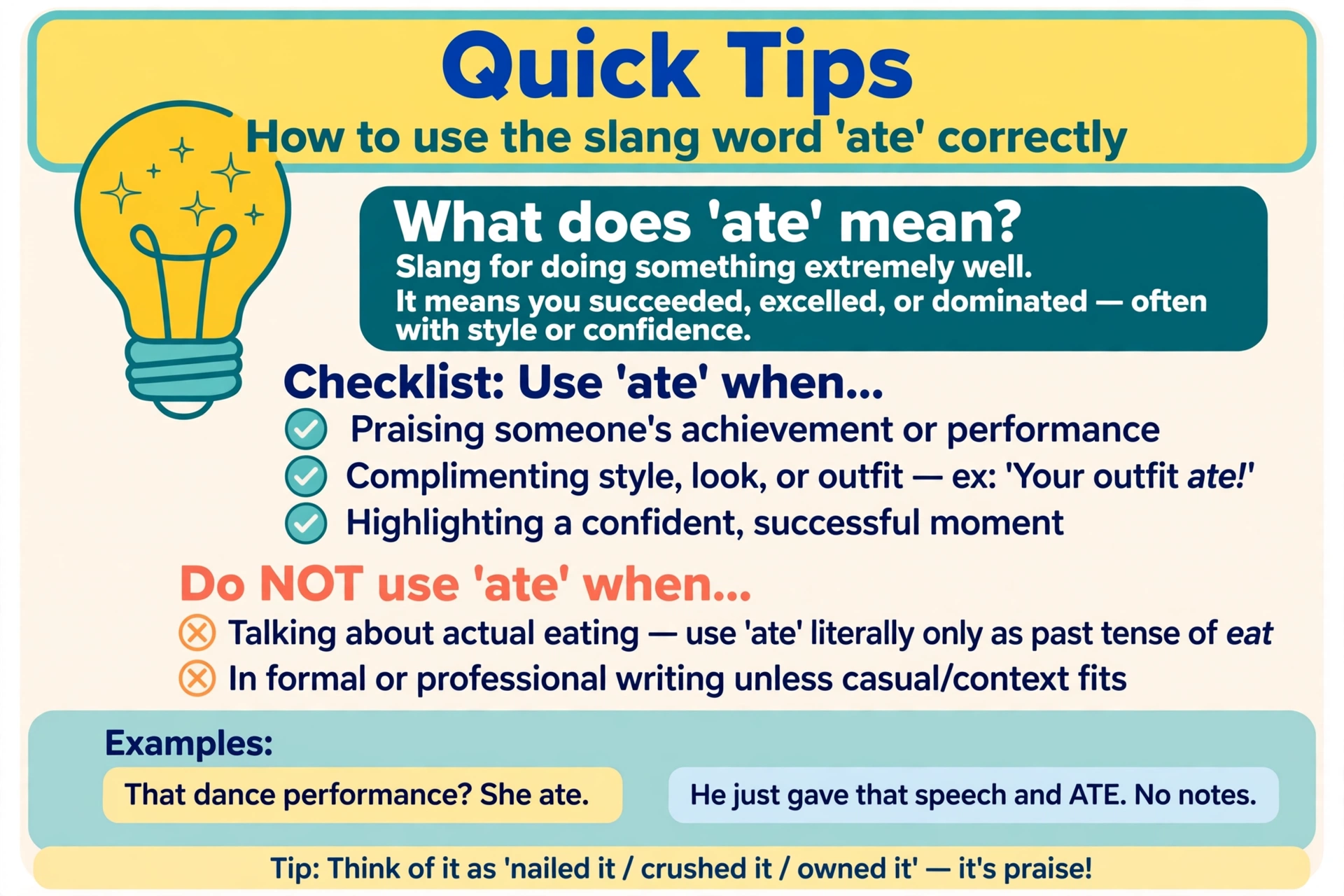
- Let the moment earn it. Use “ate” when something genuinely impressed you — a look, a performance, a comeback. The word is a verdict, not a greeting.
- One word is enough. A single “Ate.” in a comment section says everything. You do not need a paragraph to back it up.
- Add “no crumbs” for emphasis. “Ate and left no crumbs” turns a compliment into a standing ovation. Use it for the truly flawless moments.
- Match the energy. A fire emoji or two fits naturally with “ate.” A formal sentence does not.
- Know your audience. With friends and online, “ate” lands instantly. With older relatives or at work, pick a professional alternative.
- Pair it with specifics. “She ate that transition” is stronger than just “ate,” because it names what was impressive.
- Do not force it. If you are not sure the moment deserves it, a simple “that was great” is always safe.
FAQ
1. What does “ate” mean in slang?
In slang, “ate” means someone did something flawlessly — they nailed it, owned it, or performed perfectly. It comes from “ate that up” and “ate and left no crumbs,” and it is almost always a compliment for a look, a performance, or a comeback.
2. What does “she ate” mean on TikTok?
On TikTok, “she ate” means a woman delivered something flawlessly — a dance, an outfit, a transition, or a video. It is the comment section’s way of saying “that was perfect, no notes.” The phrase is praise, and the fire emojis that usually follow it confirm the tone.
3. What does “ate and left no crumbs” mean?
“Ate and left no crumbs” is the emphatic version of “ate.” It means someone performed so completely and flawlessly that there was nothing left to criticize — just as eating a meal and leaving no crumbs means finishing it entirely. It is the highest compliment in the “ate” family.
4. Is “ate” a compliment or an insult?
“Ate” is a compliment in almost every case. It means someone nailed it. The only exception is sarcasm — if someone says “oh, you really ate with that one” about something clearly bad, they are joking. Tone, emojis, and context make it obvious which one it is.
5. What is the difference between “ate” and “slayed”?
They mean almost the same thing, but “slayed” is older and broader — it can describe an outfit, a performance, or a whole day. “Ate” is more current and more specific to a single moment, and it carries the “left no crumbs” idea of total completeness. Younger users on TikTok tend to say “ate”; “slayed” is the classic version.
6. What does “did she eat or did she eat” mean?
It is a playful rhetorical question meaning “was that amazing or was that amazing?” Both options are the same — the question is a joke that says the performance was so good there is no other way to describe it. The expected answer is always yes.
7. Where did “ate” slang come from?
“Ate” as praise started in Black LGBTQ+ ballroom culture, where “eating” a category meant dominating it completely. It traveled through drag culture and reality TV, then exploded on TikTok and stan Twitter in the early 2020s, where it became a standard one-word compliment for flawless looks and performances.
8. Can I use “ate” in formal situations?
No, not really. “Ate” is casual slang. In formal writing, work emails, or professional settings, use “nailed it,” “flawless,” or “outstanding” instead. Save “ate” for friends, social media, and casual conversations where slang is welcome.
Conclusion
The ate slang meaning is refreshingly simple: it is a short, confident way to say someone did something flawlessly. Born in ballroom culture, carried by drag and pop culture, and launched into everyday language by TikTok, “ate” has become one of the most useful words in modern slang — a complete compliment in three letters, with “left no crumbs” as the standing ovation.
The one thing to remember is that the word is a verdict, and verdicts only work when they are earned. Use it for the moments that genuinely impress you — the outfit, the performance, the comeback — and it will always land. Overuse it, and it turns into background noise. And if you are ever unsure whether a moment deserves it, remember the test the comment section already uses: did they leave any crumbs? If the answer is no, then yes — they ate. For a broader look at how praise slang works online, the FRFR meaning in text guide covers another phrase that lives in the same comment sections, and the aura points meaning guide explains how social media scores the same kind of standout moments.
For the standard English definition behind the slang, see Merriam-Webster’s entry for “ate” — the past tense of “eat,” which the slang meaning plays on.
